Taiwan Security Monitor

Taiwan Affairs Office: Zheng Liwenโ€™s (Cheng Li-wun’s) delegation visit to the mainland accords with mainstream public opinion in Taiwan

At the April 8 Taiwan Affairs Office press conference, a reporter asked: regarding Cheng Li-wun leading a delegation to visit the mainland, a YouTube poll reportedly showed that 60 percent of netizens believe the visit will have a positive impact on this yearโ€™s KMT county and city magistrate elections and will boost the partyโ€™s standing. What is your comment on this?

TAO spokesperson Zhu Fenglian responded that Chair Cheng Li-wun’s visit to the mainland with a Chinese Kuomintang delegation, and the dialogue and exchanges carried out on the common political foundation of adhering to the โ€œ1992 Consensusโ€ and opposing โ€œTaiwan independence,โ€ are in line with the mainstream public opinion in Taiwan, which wants peace, development, exchange, and cooperation. She said the visit is of important significance for promoting the peaceful development of cross-Strait relations and safeguarding the interests and well-being of Taiwan compatriots, and that it will receive the affirmation and support of the people of Taiwan.

Taiwan Affairs Office: The Lai Ching-te authoritiesโ€™ attempt to undermine cross-Strait economic ties will not succeed

At the April 8 Taiwan Affairs Office press conference, a reporter asked: Lai Ching-te recently said that the United States has become Taiwanโ€™s largest destination for outbound investment and largest export market, that Taiwanโ€™s investment in the mainland has fallen to 3.7 percent, and that Taiwan will continue deepening cooperation with the United States to safeguard global supply chain security. What is your comment on this?

TAO spokesperson Zhu Fenglian responded that the Lai administration, for the selfish political interests of one party, has continuously tried to curry favor with the United States and push for the โ€œdecoupling and breaking of linksโ€ in cross-Strait economic relations, harming the interests and well-being of industries and people in Taiwan. She said that Laiโ€™s claim about โ€œdeepening cooperation with the U.S. and safeguarding global supply chain securityโ€ is, in essence, โ€œrelying on the U.S. to sell out Taiwan,โ€ and further exposes what she described as his deliberate and unscrupulous effort to โ€œseek independence by relying on external forces.โ€

Zhu added that, according to statistics from the General Administration of Customs, total cross-Strait trade maintained steady growth in the first two months of this year, reaching US$52.54 billion. Of that, mainland exports to Taiwan rose 28.1 percent, while mainland imports from Taiwan rose 19 percent. She said this fully demonstrates that the two sidesโ€™ economies cannot be decoupled and their industrial links cannot be severed, and that deepening cross-Strait integrated development is in line with the common interests of people on both sides and with market logic. She concluded that the Lai administrationโ€™s attempt to undermine cross-Strait economic ties is unpopular and will not succeed.

Taiwan Affairs Office: The DPP authoritiesโ€™ servile obsequiousness will not win them any pity

At the April 8 Taiwan Affairs Office press conference, a reporter asked: the United States will impose a high 100% tariff on imported pharmaceuticals. Although the DPP authorities claim they have secured preferential treatment, Taiwan is not mentioned on the list of tariff exemptions released by the United States. What is your comment on this?

TAO spokesperson Zhu Fenglian responded that the United States always follows โ€œAmerica Firstโ€ and cares only about โ€œAmerican interests.โ€ She said that more and more facts are leading people in Taiwan to realize that the United Statesโ€™ coercive and predatory behavior does not operate on reason, and that the DPP authoritiesโ€™ servile obsequiousness will not win them any pity. She added that the DPP authoritiesโ€™ so-called โ€œpreferential treatmentโ€ is in fact U.S. bullying and exploitation of Taiwan, and represents the DPP authorities currying favor and pledging loyalty at the expense of Taiwanโ€™s economy, concealing what she described as the DPPโ€™s malicious intent to โ€œseek independence by relying on the United States.โ€

Taiwan Affairs Office: The 15th Five-Year Plan period will open up broader space for cross-Strait industrial cooperation

At the April 8 Taiwan Affairs Office press conference, a reporter asked: a mainland motorcycle brand, โ€œZhangxue Motorcycles,โ€ won a championship in the World Superbike Championship, sparking heated discussion among netizens in Taiwan. Many commented that the quality of mainland manufacturing has already reached a world-class level, boosting the confidence of Chinese people on both sides of the Strait, and that cross-Strait industrial cooperation should be deepened to further expand and strengthen national manufacturing brands. What is your comment on this?

TAO spokesperson Zhu Fenglian responded that people can see that in fields such as robotics, drones, new energy vehicles, and motorcycles, more and more outstanding mainland brands and products are going global, drawing worldwide attention, winning broad recognition, and becoming consumersโ€™ preferred choice. Relying on a complete industrial system and a deep industrial foundation, mainland manufacturing continues to set new records. During the 15th Five-Year Plan period, she said, the mainland will continue focusing on high-quality development and on building a modern industrial system with advanced manufacturing as its backbone. She added that the mainland is fertile ground for innovators and entrepreneurs and will open up broader space for cross-Strait industrial cooperation. She said they warmly welcome Taiwan compatriots and Taiwan businesses to put down roots and develop on the mainland, deepen cross-Strait exchanges, cooperation, and integrated development, and jointly strengthen the Chinese national economy.

Taiwan Affairs Office: We welcome more Taiwan compatriots to travel to and from the mainland via the โ€œMini Three Linksโ€ routes

At the April 8 Taiwan Affairs Office press conference, a reporter asked: according to reports, during the Qingming Festival period, the โ€œMini Three Linksโ€ passenger routes saw a peak in Taiwan compatriots returning home to pay respects to their ancestors. Could the spokesperson provide some details?

TAO spokesperson Zhu Fenglian responded that the โ€œMini Three Linksโ€ passenger routes are one of the most important and convenient channels for exchanges between the two sides of the Strait, especially between Fujian and Taiwan. During the Qingming holiday, these routes saw a passenger traffic peak. Relevant port authorities strengthened traveler service and support, improved organizational coordination and dispatching, and opened โ€œgreen channelsโ€ to ensure priority passage for โ€œMini Three Linksโ€ passenger vessels. At the Xiamen-Kinmen โ€œMini Three Linksโ€ port, the border inspection โ€œfamily reunionโ€ channel and the dedicated โ€œlarge luggageโ€ convenience channel were kept open at all times; at the Fuzhou-Matsu โ€œMini Three Linksโ€ port, six additional round-trip sailings were added to meet passenger demand; and at the Quanzhou-Kinmen โ€œMini Three Linksโ€ port, authorities worked with the Fujian-Taiwan Kinship Museum to hold an on-site event titled โ€œTracing Roots During Qingming, Same Origins Across the Strait,โ€ as well as a Fujian-Taiwan ancestral roots culture exhibition, to strengthen emotional resonance between compatriots on both sides of the Strait. According to statistics, from April 1 to 6, the โ€œMini Three Linksโ€ routes transported a total of 34,100 passengers, up 9.49 percent year-on-year.

Zhu added that compatriots on both sides of the Strait are one family, and that they welcome more people from Taiwan to travel to the mainland via the โ€œMini Three Linksโ€ routes to trace their roots and pay respects to their ancestors, visit relatives and friends, and engage in exchanges and cooperation.

Taiwan Affairs Office: The DPP authorities are โ€œkneeling to the U.S. and selling out Taiwan,โ€ sacrificing the future of Taiwanโ€™s agriculture

At the April 8 Taiwan Affairs Office press conference, a reporter asked: recently, Taiwanโ€™s agricultural authorities said that Taiwanโ€™s commitment not to impose Special Safeguard (SSG) tariffs on U.S. agricultural products is expected to have only a limited impact on local industries. This has triggered widespread concern in Taiwanโ€™s agricultural sector that an influx of U.S. farm products would seriously affect related local industries such as chicken, pork, and beef, and there are also worries that lax inspection and quarantine controls could lead to crop pests and diseases. What is your comment?

TAO spokesperson Zhu Fenglian responded that, in the face of U.S. economic bullying, the DPP authorities have responded only with compromise, retreat, and ingratiation, allowing the United States to take whatever it wants and turning Taiwan into a dumping ground for U.S. agricultural products. She said this would inevitably deal a serious blow to Taiwanโ€™s agricultural market, affect the income of Taiwanโ€™s farmers and fishers, and naturally provoke concern among Taiwanโ€™s agricultural sector and consumers. She added that the DPP authoritiesโ€™ โ€œkneeling to the U.S. and selling out Taiwanโ€ has no bottom line, harms the interests of the people of Taiwan, and sacrifices the future of Taiwanโ€™s agriculture.

Weekly Security Review: 4/6/26

Author: Jaime Ocon


Welcome to the Weekly Security Review, where we highlight key military, security, and political developments around Taiwan in one straightforward summary!

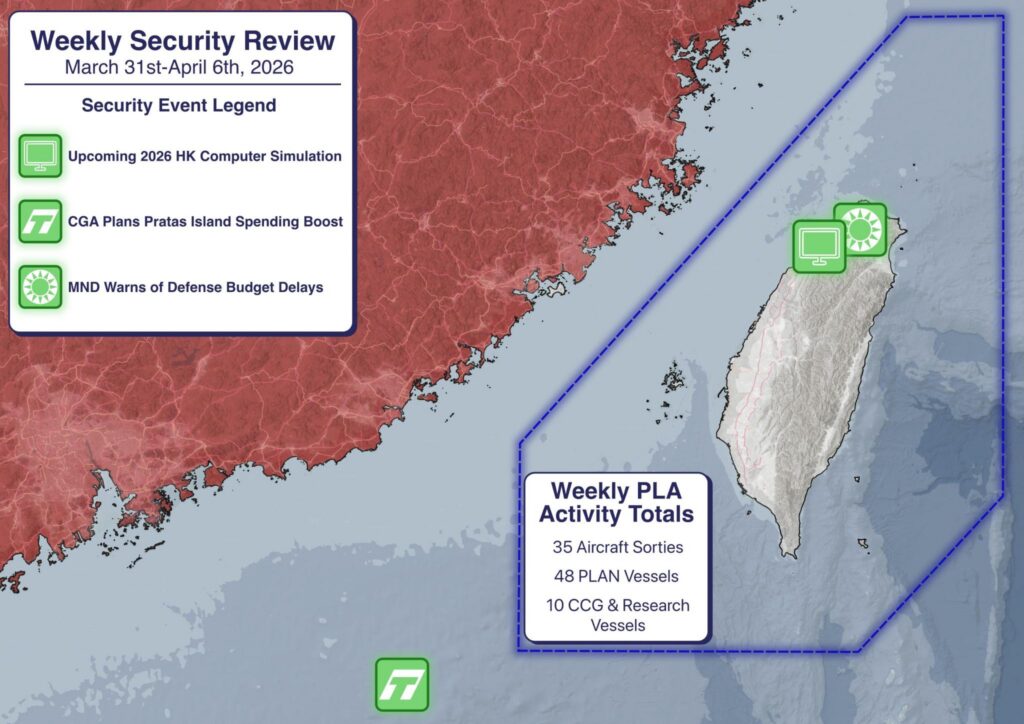
This week, Taiwanโ€™s military gets ready to start annual military wargames, the Coast Guard plans to spend big and reinforce Pratas Island, and the MND issues a warning over the possible effects of a budget delay.

Han Kuang Computer-Simulated Military Drills Starting Soon

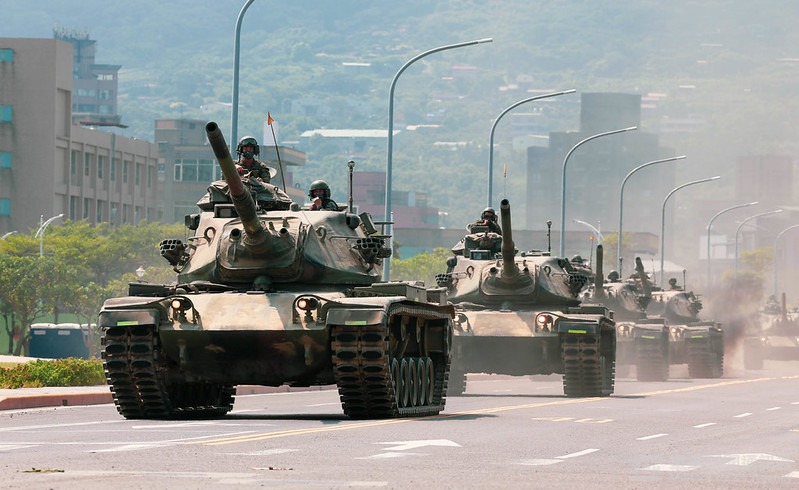
Taiwanโ€™s Ministry of National Defense (MND) has released more information on the upcoming 2026 Han Kuang exercise, with computer-assisted war games running from April 11 to 24. Military officials at a press conference say the simulations will focus on operational strategy, early warning and detection of enemy forces, rapid-response drills, and testing decision-making skills under pressure. The MND also added that this yearโ€™s drills will take lessons from recent conflicts in Iran, Venezuela, and Ukraine, as well as focus on drone and counter-drone operations. Officials say they emphasized these points to demonstrate that the military is adapting its training to the realities of the modern battlefield. 

Taiwanโ€™s annual Han Kuang exercises are the countryโ€™s largest military drill and simulate how the military would respond to a full-scale invasion from China. The exercises began in the 1980s and have since come a long way, doubling in duration from five to ten days, and now featuring tens of thousands of conscripts. They are usually divided into two sections: a computer simulation and a live fire component. The drills had been criticized for decades for being too scripted and unrealistic, and since 2022, the MND has made significant improvements to try to fix that. Another major change is the addition of a โ€œmini Han Kuangโ€ that the military is calling a warm-up exercise ahead of the main exercises. This “Joint Defense Exercise” will take place sometime in July, and the live-fire component of Han Kuang will take place in early to mid-August. 

This year, the MND says Han Kuang will no longer just be a rehearsal for an invasion scenario, but also test whether Taiwan can sustain command and control during a conflict. Major benchmarks will include how well the MND can coordinate across different government agencies and how it will keep key systems functioning under gray-zone pressure and wartime conditions. Already, the military is prioritizing dispersed command posts, backup communications, and cross-regional force deployment, alongside logistics coordination across the island.

Coast Guard Plans $2B in Upgrades to Pratas Island Defenses Against Gray-Zone Pressure

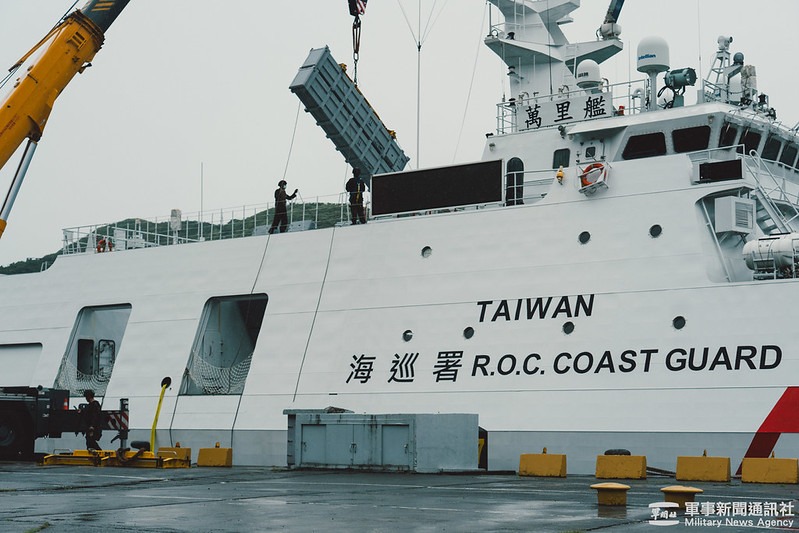
Taiwanโ€™s Coast Guard Administration (CGA) says it will strengthen its defenses on Pratas Island due to increasing gray-zone pressure from China, according to Ocean Affairs Council head Kuan Bi-ling. As a whole, Kuan says the CGA plans to invest roughly US$1.88 billion to reinforce the coast guard, including improving port infrastructure, procuring more patrol vessels, and increasing capacity to conduct law enforcement operations. Kuan added that Beijing has been increasing the number of government vessels in operation, specifically around Dongsha, since last year, and warned that seizing these islands would carry โ€œconsiderable strategic significanceโ€ for China. She stressed that Chinese maritime pressure was already a โ€œwar without gunpowderโ€.

Speaking at the Taiwan Foreign Correspondents Club, Kuan highlighted how lightly defended Pratas remains and pointed to a Chinese reconnaissance drone flying over it in January as another example of provocative activity by the Peopleโ€™s Liberation Army (PLA). The big concern is that daily Chinese pressure around Dongsha and other outlying islands like Kinmen, Matsu, and Penghu is stretching Taiwanโ€™s resources. While the Coast Guard and the military say it provides an opportunity for Taiwan to test its resolve, more needs to be done to accelerate the transition from peacetime to wartime readiness. 

Taiwanโ€™s MND Warns Legislature of Harmful Effects of Budget Delay

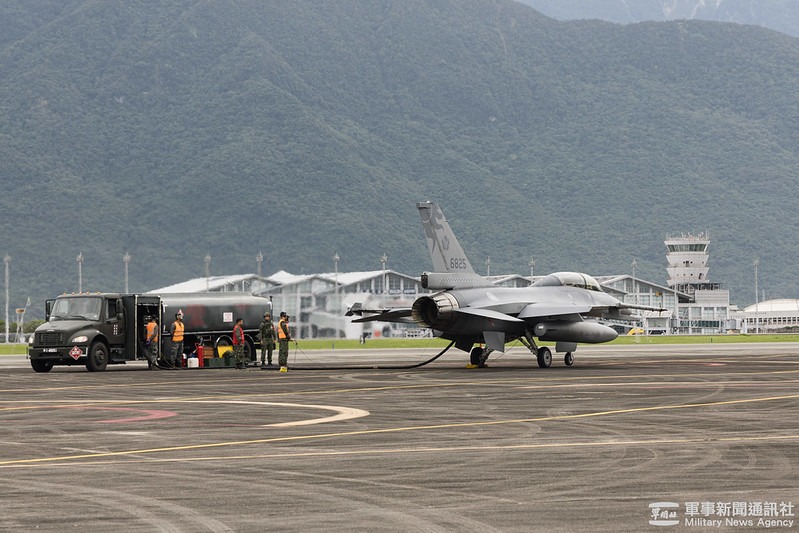
Taiwanโ€™s MND has warned that any delays in approving this yearโ€™s defense budget could threaten roughly NT$78 billion (US$2.44 billion) in weapons procurement, maintenance, and training. Officials say that delays could affect roughly 21 percent of the annual budget and its original timetable. This includes procurement programs such as HIMARS, Javelin missiles, and follow-on training for F-16s.

These warnings from the MND come at a difficult time for Taiwan, as its Legislature is currently embroiled in a debate over how much to spend on its defense. The ruling Democratic Progressive Party (DPP) has submitted a separate NT$1.25 trillion (US$40 billion) special defense budget, while opposition Kuomintang (KMT) and Taiwan Peopleโ€™s Party (TPP) have submitted proposals of roughly NT$380 billion (US$12 billion) and NT$400 billion (US$13 billion), respectively. Opposition lawmakers continue to criticize the Lai administrationโ€™s budget for a lack of specificity with some budget items, and are pushing the government to justify how they intend to spend appropriated funds. 

Defense officials have increasingly become frustrated with the deadlock, which is approaching almost six months. The MND argues that any delay will produce irreversible effects because procurement timelines, training pipelines, and maintenance schedules all depend on predictable funding. 

Strait Snapshot, March 2026 Update

Author: Ethan Connell & Jonathan Walberg


Key Findings

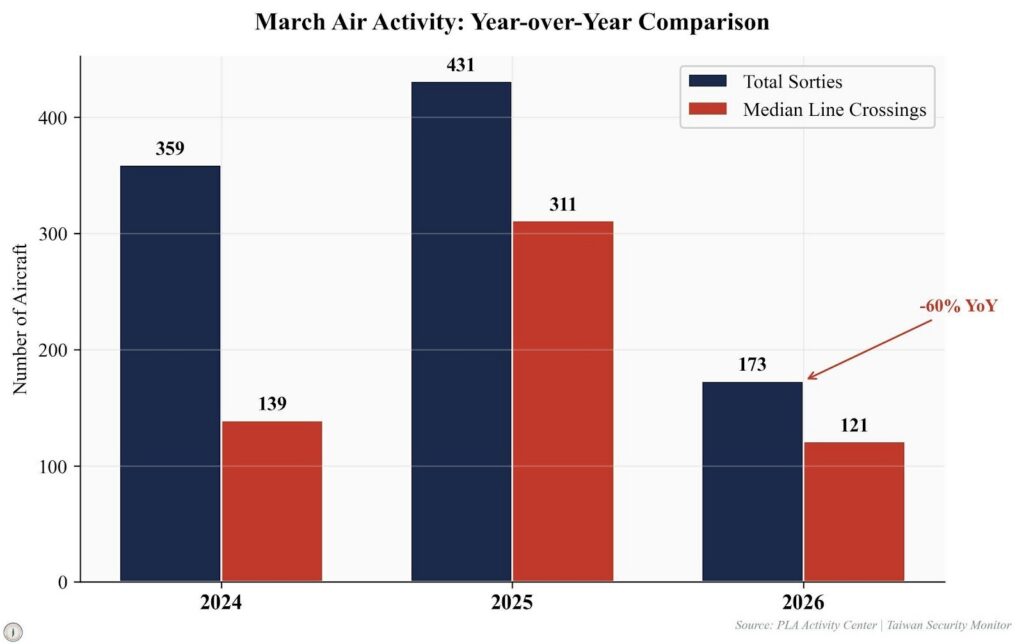
  • In March 2026, Taiwan’s Ministry of National Defense recorded 173 PLA aerial sorties around the island, representing a 60 percent year-over-year decline and extending the downward trend observed since the December 2025 Justice Mission exercises.
  • Between late February and mid-March, air operations declined to near-zero levels for thirteen days. This lull coincided with China’s annual Two Sessions legislative period of the National Peopleโ€™s Congress and followed the dismissal of two senior Central Military Commission vice-chairmen in January. This pattern aligns with previously documented instances of institutional caution during politically sensitive periods.
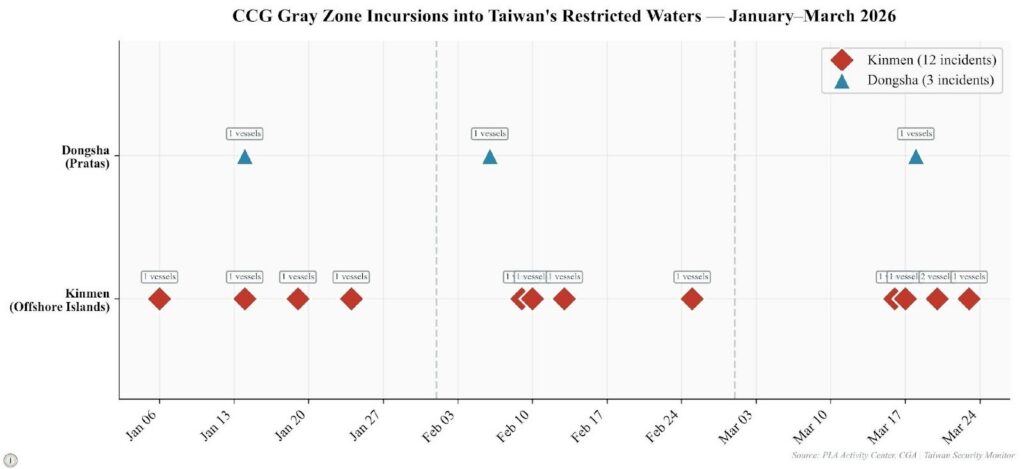
  • Taiwanese Coast Guard Administration data shows 15 documented CCG incursions into Taiwan’s restricted waters from January through March, concentrated around Kinmen (12 incidents) and Dongsha Island (three incidents), with dwell times in the Dongsha incursions exceeding 24 hours.
  • In March, PLAN vessel detections around Taiwan averaged approximately seven per day, consistent with the five-to-nine vessel baseline observed throughout 2025. The continued naval presence during a period of reduced air activity suggests that the air and maritime domains are governed by distinct operational logics.

The March Lull

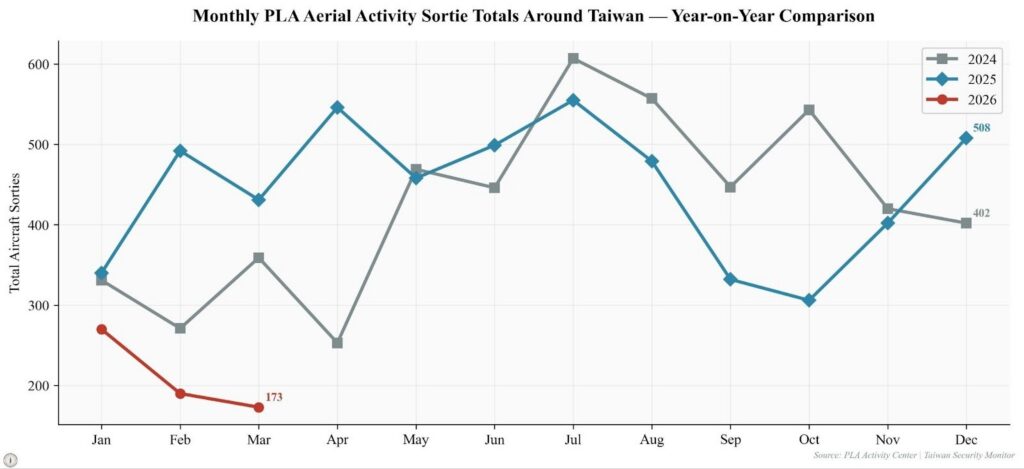
March 2026 marked a significant deviation from the Peopleโ€™s Liberation Army (PLA) air activity patterns observed around Taiwan during the previous twelve months. The 173 detected aircraft sorties, including 121 that entered Taiwan’s Air Defense Identification Zone, constitute a 60 percent reduction from March 2025, when 431 sorties were recorded. This figure also continues the sequential decline observed in the first three months of 2026: January recorded 270 sorties, February recorded 190, and March recorded 173.

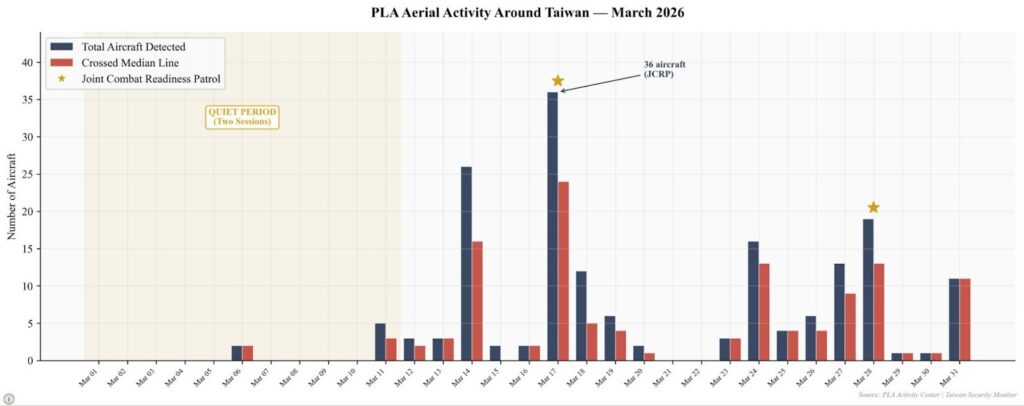
A notable feature of the month was the lull in PLA air activity in early March, during which Taiwan detected only limited aircraft activity around the island. Rather than pointing to a single discrete cause, this slowdown is better understood as the product of overlapping factors. The strongest explanation remains the PRCโ€™s domestic calendar: the annual โ€œTwo Sessions,โ€ combined with the tail end of the Spring Festival period, has historically aligned with a lower operational tempo around Taiwan. Other theories, including the idea that leadership turmoil within the PLA or fuel pressures linked to Middle East instability drove the reduction, are harder to sustain. As TSM noted in The Monitor, those explanations fit the available evidence less well, especially given continued Chinese activity in the East and South China Seas during the same period.

Figure 1. Daily PLA activity around Taiwan, March 2026. The shaded region marks the quiet period.

Air operations resumed in the second half of March. On March 17, Taiwan’s Ministry of National Defense (MND) reported a joint combat readiness patrol (JCRP) involving thirty-six aircraft, marking the month’s single-day peak. This was followed by a second JCRP on March 28 with nineteen aircraft and a third on April 1. The resumption of large-scale exercises after a period of relative quiet aligns with patterns observed in previous years. The PLA appears to adjust its daily sortie rate in response to political calendars and internal dynamics while maintaining the capacity for periodic high-intensity demonstrations.

Monthly Trajectory: A Sustained Decline

March’s figures are a continuation of a three-month decline. From January through March 2026, monthly sortie totals fell from 270 to 190 to 173, respectively. This trajectory comes on the heels of the elevated activity of late 2025, when the PLA’s Justice Mission-2025 exercise on December 29 saw the use of 130 aircraft in a single day, the largest single-day operation around Taiwan since comprehensive daily reporting began.

Figure 2. Monthly PLA sortie totals, 2024โ€“2026. The Januaryโ€“March 2026 trend shows consecutive declines.

However, the frequency of Joint Combat Readiness Patrols (JCRPs), which represent the highest-intensity format of PLA air operations around Taiwan, has remained broadly stable. March 2026 included three JCRPs, matching the number in March 2025 and exceeding the two recorded in March 2024. This continuity indicates that the reduction in routine sortie volume has not been accompanied by a corresponding decrease in the PLA’s willingness or ability to conduct large-scale, multi-domain demonstrations on short notice.

At Sea: Persistent Naval Presence

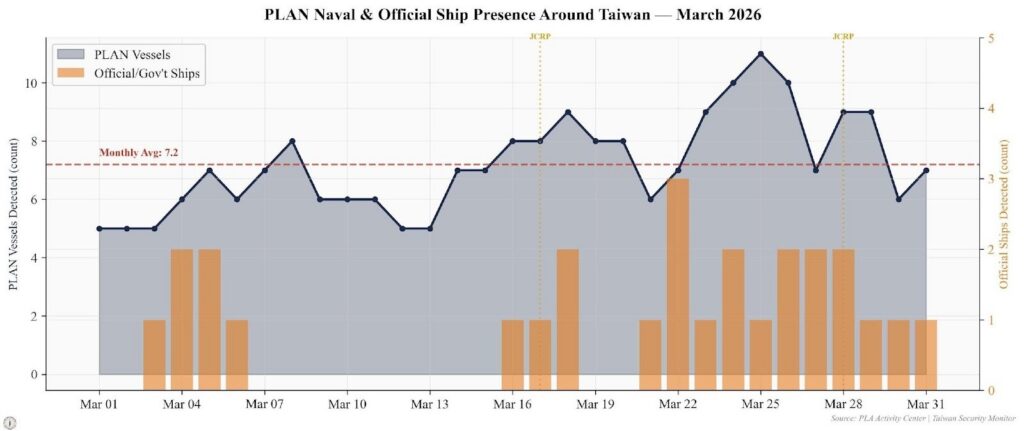
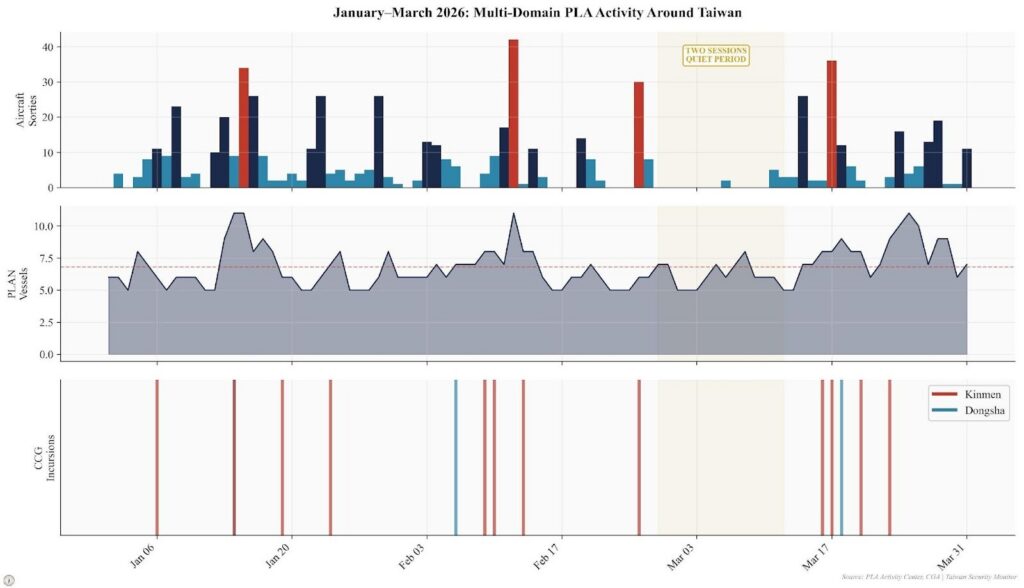
PLAN vessel detections in the waters around Taiwan averaged 7.2 per day in March, with a peak of eleven on a single day. These figures are consistent with the range of 5-9 vessels that have characterized PLAN presence throughout 2025. The stability of the naval posture during a month of minimal air activity highlights a structural difference in how the PLA manages its air and maritime components around Taiwan. Air sorties appear responsive to political calendars and institutional dynamics, whereas naval presence serves as a persistent baseline feature of cross-strait military activity.

Figure 3. PLAN vessel and official ship detections around Taiwan, March 2026.

This divergence between air and naval activity patterns holds analytical significance for assessments of cross-strait tension. Analysts who focus solely on sortie counts may interpret the March figures as evidence of de-escalation, however the unchanged naval footprint demonstrates that the PLA’s overall posture in the Taiwan Strait has not meaningfully decreased.

Coast Guard Gray Zone Operations

China Coast Guard (CCG) activity in Taiwan’s restricted waters represents a third, often underreported, dimension of cross-strait pressure. From January through March 2026, the CCG conducted at least 15 documented incursions: 12 around Kinmen and three near Dongsha Island (Pratas). The Kinmen operations have developed into a recognizable pattern, typically involving two to four CCG cutters entering restricted waters for two to three hours before withdrawing. This approach appears intended to establish a regular CCG presence in waters considered under the jurisdiction of Taiwan’s Coast Guard Administration.

Figure 4. CCG incursions into Taiwan’s restricted waters, Januaryโ€“March 2026, by location and vessel count.

The Kinmen incursions have involved a recurring set of CCG cutters (specifically, hull numbers 14529, 14603, 14605, and 14609), indicating a dedicated patrol rotation rather than ad hoc deployments. The Dongsha operations differ qualitatively, involving larger vessels from the 3101 and 3102 classes and featuring extended dwell times, with the March 18th incursion east of Dongsha lasting over twenty-five consecutive hours. The increasing dwell times at Dongsha merit particular attention, as they challenge the Coast Guard Administration’s capacity to maintain a sustained presence at Taiwan’s most remote holding.

The Full Picture: Multi-Domain Overview

Figure 5. Januaryโ€“March 2026 multi-domain PLA activity: air sorties, naval presence, and CCG incursions.

An examination of all three domains simultaneously reveals that the first three months of 2026 present a more complex situation than any single metric suggests. Air activity has been volatile and responsive to political events, while naval presence has remained steady and largely unaffected by fluctuations in the air domain. Coast Guard incursions have persisted and, in the Dongsha cases, have increased in duration. Analysts and policymakers should avoid interpreting a reduction in one domain as an overall reduction in pressure. The multi-domain posture, considered in its entirety, does not indicate meaningful de-escalation.

Figure 6. March air activity year-over-year: total sorties and median line crossings, 2024โ€“2026.

Methodology & Sources

Air and naval detection data are drawn from daily press releases issued by Taiwan’s Ministry of National Defense and compiled in the PLA Activity Center database maintained by Taiwan Security Monitor. Coast Guard incident data are compiled from Coast Guard Administration press releases, verified against contemporaneous media reporting, and compiled in the China Coast Guard Incident Tracker Database. “Median line” refers to the informal centerline of the Taiwan Strait historically observed by both sides. “JCRP” denotes Joint Combat Readiness Patrols as designated by Taiwan’s MND. All analysis and commentary are by Taiwan Security Monitor.

ยฉ 2026 Taiwan Security Monitor. All rights reserved.

Weekly Arms Update: 4/1/26

Author: Joe Oโ€™Connor, Shikhar Chaturvedi, Danielle Kremer, and Wyeth Lindberg


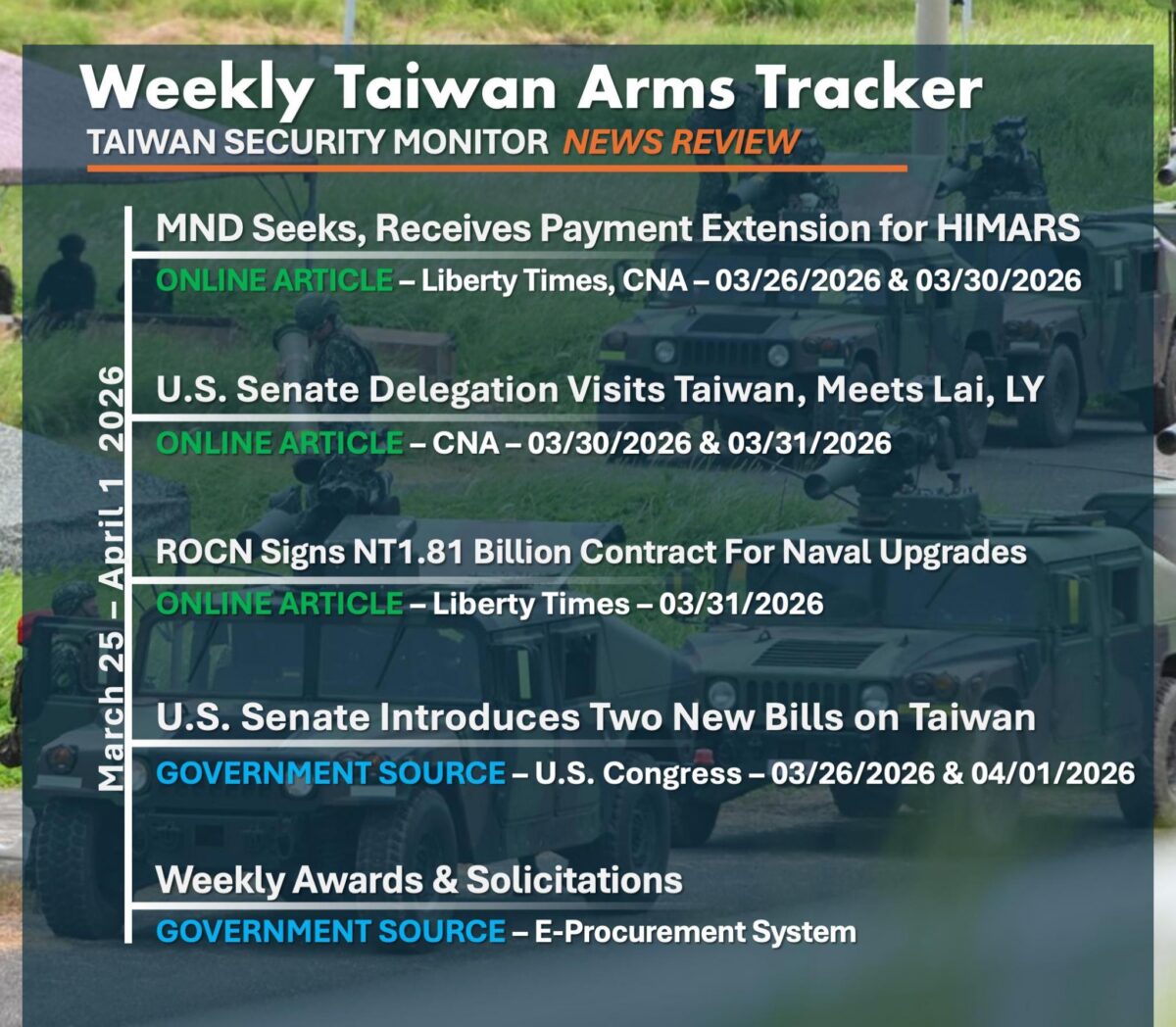
This week: the MND received a payment extension for the sale of HIMARS, a U.S. congressional delegation visited Taiwan to support ongoing budget negotiations, the ROCN signed a major upgrade contract with a French firm, and two Taiwan-related defense bills were introduced in the U.S. Senate, alongside weekly awards and solicitations.

MND Seeks, Receives Payment Extension for HIMARS

Taiwanโ€™s Ministry of National Defense said this week that the United States has agreed to defer the first payment deadline for 82 HIMARS launchers, giving Taipei temporary relief as the Legislative Yuan continues to debate the Lai administrationโ€™s NT$1.25 trillion special defense budget. According to Defense Minister Wellington Koo and MND officials, the HIMARS payment can now be pushed to around May, when Washington expects to complete contract negotiations with the supplier (Lockheed Martin), rather than the original March 30 deadline. Taiwan had already secured legislative authorization on March 13 to sign Letters of Offer and Acceptance for four U.S. arms sales packages worth roughly US$9 billion, but still lacked appropriated funds for the required down payments.

The HIMARS case nevertheless underscores how legislative delays are now affecting backlog management. Liberty Times reported on March 26 that MND officials had warned missing the HIMARS payment window could force Taiwan to wait until the end of the year for another contracting opportunity, and CNA now reports that MND is still trying to secure similar payment extensions for three additional systems: TOW missiles, Javelins, and M109A7 self-propelled howitzers. Together, the four initial payments total about US$79 million. For now, Taiwan has avoided a near-term disruption on HIMARS, but the episode shows how domestic budget gridlock can still complicate contracting timelines and add friction to efforts of moving delayed U.S. arms cases through the pipeline.

U.S. Senate Delegation Visits Taiwan, Meets Lai, LY

On Monday and Tuesday, a delegation of four U.S. Senators, led by Ranking Member of the Senate Foreign Relations Committee Jeanne Shaheen (D-NH), visited Taiwan on one leg of a trip around the Indo-Pacific. Shaheen, accompanied by Sens. Thom Tillis (R-NC), John Curtis (R-UT), and Jacky Rosen (D-NV), met with President Lai Ching-te and Minister of Foreign Affairs Lin Chia-lung, reaffirming support for Taiwanโ€™s defense and relations with the U.S. Before arriving, Sen. Curtis told the Financial Times that the visitโ€™s timing was linked to efforts in Taiwanโ€™s Legislative Yuan to pass a special defense budget, which has largely stalled in negotiations.

On Monday, the delegation also visited the National Chung-Shan Institute of Science and Technology (NCSIST), Taiwanโ€™s state-owned indigenous defense manufacturer, and viewed results of live-fire testing of the Mighty Hornet IV, a new attack drone jointly produced by NCSIST and US company Kratos that is a variant of the MQM-178 Firejet target drone.

On Tuesday, the delegation met with a bipartisan group of DPP and KMT Legislative Yuan members in a closed-door evening session. Per legislators Niu Hsu-ting (KMT) and Chen Kuan-ting (DPP), the delegations discussed ongoing arms procurement between the United States and Taiwan, as well as the current legislative process for the special defense budgets and how to build consensus among all parties. After this, the delegation departed Taipei, enroute to Japan.

ROCN Signs NT$1.81 Billion Contract for Naval Upgrades

On Tuesday, the Republic of China Navy (ROCN) signed a deal with Defense Conseil International (DCI) worth NT$1.81 billion (US$56.73 million) for technical support services as it begins upgrading its fleet of six Kang Ding-class frigates. DCI is Franceโ€™s state-owned operator for the exporting of military assistance to international partners, under the Ministry for the Armed Forces. Since the Kang Ding-class frigates are export models of Franceโ€™s own La Fayette-class frigates, their structural designs and parameters are protected by French patents.

Modifications include the installation of BAE Systemsโ€™ Type 997 Artisan radar and Safran S.A.โ€™s PASEO NS electro-optical fire control system, as well as installation of the indigenously produced Hua Yang vertical launch system (VLS), equipped with 32 TC-2N (Tien Chien II or Sky Sword II) air-to-air missiles, to replace older U.S. naval Sea Chaparral surface-to-air missiles. With the first upgraded ship being completed in February of this year, the contract will run for 5 years and 6 months and is expected to be completed by the end of 2031. This contract will ensure effective integration of Taiwanโ€™s domestically developed weapons with foreign-built platforms, avoiding any impact on shipsโ€™ operational or stealth performance.

U.S. Senate Introduces Two New Bills on Taiwan

On Thursday, Senators Michael Bennet (D-CO) and Pete Ricketts (R-NE) introduced the First Island Chain Deterrence Act, a measure requiring the U.S. Government Accountability Office (GAO) to issue a report to Congress on the status of major arms sales and if there are any delays affecting Japan, Taiwan, and the Philippines. The same report would assess the impacts of such delays, their effects on readiness in the region, and would be due within 18 months of the bill becoming law.

Today, Senators Jeff Merkley (D-OR), Ted Cruz (R-TX), Andy Kim (D-NJ), and John Curtis (R-UT), introduced the Blue Skies for Taiwan Act, which aims to support Taiwanโ€™s indigenous drone production industry. The measure specifically would establish a โ€œBlue UAS Working Group,โ€ which would assess Taiwanese industry and begin adding Taiwanese systems to the DODโ€™s secure โ€œBlue UASโ€ program, ensuring capabilities and components are โ€œPRC-independent.โ€ The bill, if passed, also directs the Pentagon and State Department to begin expedited certification processes for Taiwanese drone manufacturers.  

Weekly Awards/Solicitations

On Thursday, the Naval Command made a repeat solicitation of bids for transport trucks, worth NT$1.35 billion (US$42.13 million).

On Friday, the Military Medical Bureau solicited bids for the construction of the Radiation Oncology and Nuclear Medicine Center, worth NT$216.39 million (US$6.77 million).

On Tuesday, the Naval Command awarded Defense Conseil International a NT$1.81 billion (US$56.73 million) contract for naval technical support services. DCI is Franceโ€™s Ministry for the Armed Forces operator for the exporting of military assistance to international partners. The contract is to be fulfilled throughout the southern region of Taiwan.

On Wednesday, the Information and Communications Command made a repeat solicitation of bids for the licensing of cloud information services, worth NT$36.03 billion (US$1.13 billion).

Also on Wednesday, the Armaments Bureauโ€™s Production and Manufacturing Center, made a repeat solicitation of bids for night-vision detection equipment, worth NT$38.89 million (US$1.22 million).

CTC 2.0 Visualization


Author: TSM Staff


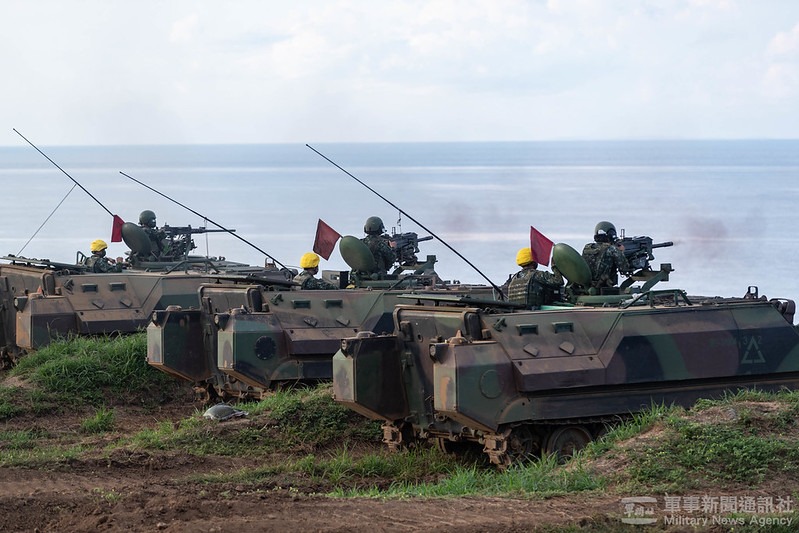
Taiwanโ€™s Army recently completed the inaugural โ€œCTC 2.0โ€ rotation, a new-style Combat Training Center exercise that expanded combat readiness evaluations from 5 days and 4 nights to 10 days and 9 nights of continuous, unscripted operations. Involving the 542nd, 584th, and 586th Combined Arms Brigades, the drills were designed to stress endurance, logistics, command decision-making, and combined arms coordination under more realistic battlefield conditions.

Below is our visualization of the Combat Training Center exercise’s locations: