Author: Jaime Ocon
Welcome to the Weekly Security Review, where we highlight key military, security, and political developments around Taiwan in one straightforward summary!
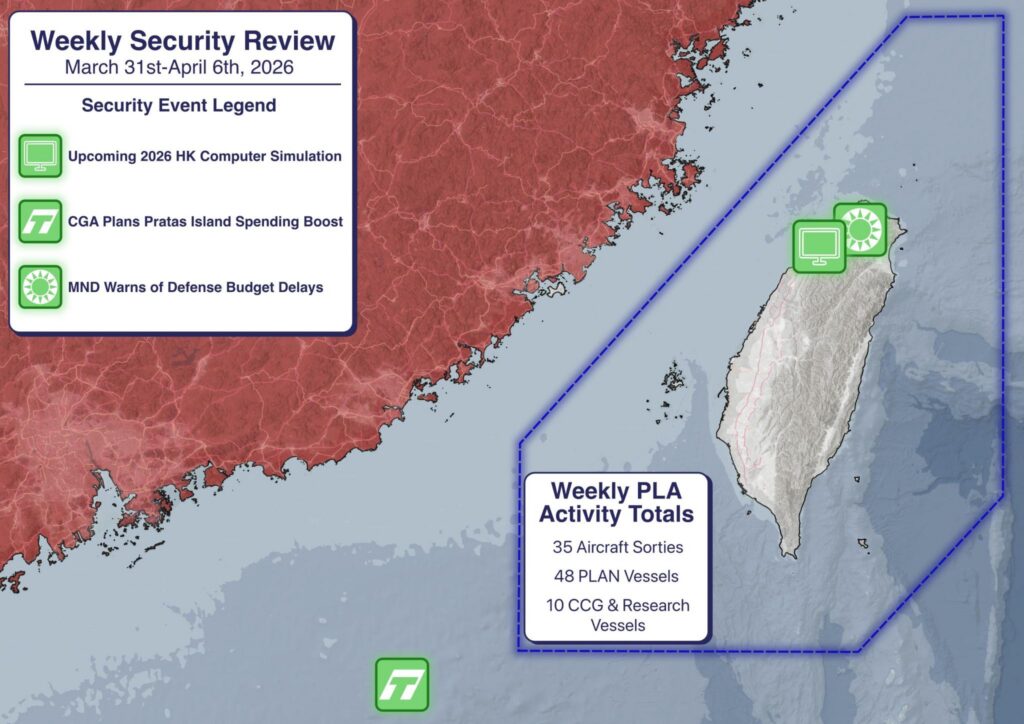
This week, Taiwan’s military gets ready to start annual military wargames, the Coast Guard plans to spend big and reinforce Pratas Island, and the MND issues a warning over the possible effects of a budget delay.
Han Kuang Computer-Simulated Military Drills Starting Soon
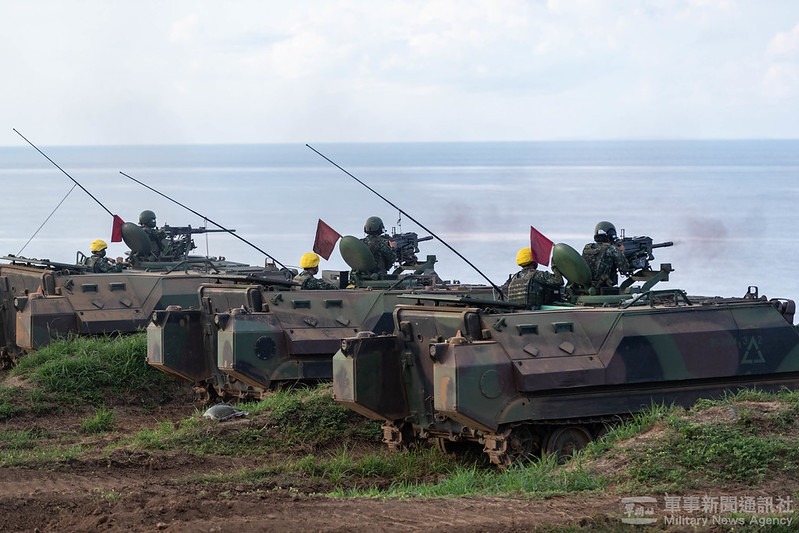
Taiwan’s Ministry of National Defense (MND) has released more information on the upcoming 2026 Han Kuang exercise, with computer-assisted war games running from April 11 to 24. Military officials at a press conference say the simulations will focus on operational strategy, early warning and detection of enemy forces, rapid-response drills, and testing decision-making skills under pressure. The MND also added that this year’s drills will take lessons from recent conflicts in Iran, Venezuela, and Ukraine, as well as focus on drone and counter-drone operations. Officials say they emphasized these points to demonstrate that the military is adapting its training to the realities of the modern battlefield.
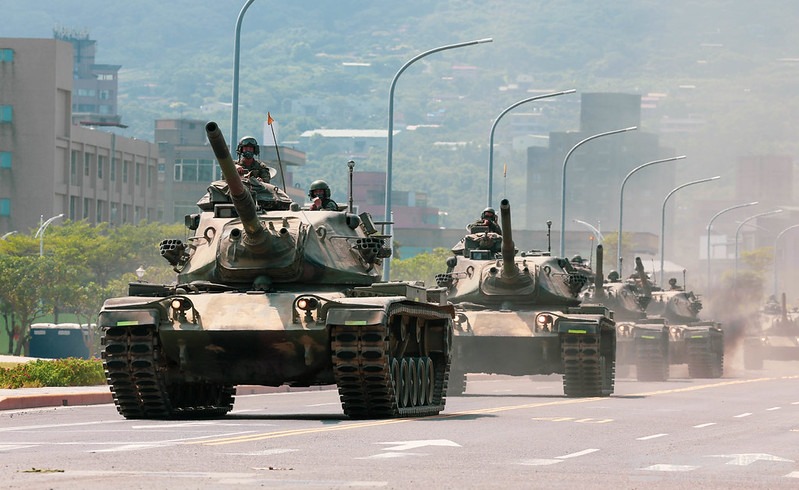
Taiwan’s annual Han Kuang exercises are the country’s largest military drill and simulate how the military would respond to a full-scale invasion from China. The exercises began in the 1980s and have since come a long way, doubling in duration from five to ten days, and now featuring tens of thousands of conscripts. They are usually divided into two sections: a computer simulation and a live fire component. The drills had been criticized for decades for being too scripted and unrealistic, and since 2022, the MND has made significant improvements to try to fix that. Another major change is the addition of a “mini Han Kuang” that the military is calling a warm-up exercise ahead of the main exercises. This “Joint Defense Exercise” will take place sometime in July, and the live-fire component of Han Kuang will take place in early to mid-August.
This year, the MND says Han Kuang will no longer just be a rehearsal for an invasion scenario, but also test whether Taiwan can sustain command and control during a conflict. Major benchmarks will include how well the MND can coordinate across different government agencies and how it will keep key systems functioning under gray-zone pressure and wartime conditions. Already, the military is prioritizing dispersed command posts, backup communications, and cross-regional force deployment, alongside logistics coordination across the island.
Coast Guard Plans $2B in Upgrades to Pratas Island Defenses Against Gray-Zone Pressure
Taiwan’s Coast Guard Administration (CGA) says it will strengthen its defenses on Pratas Island due to increasing gray-zone pressure from China, according to Ocean Affairs Council head Kuan Bi-ling. As a whole, Kuan says the CGA plans to invest roughly US$1.88 billion to reinforce the coast guard, including improving port infrastructure, procuring more patrol vessels, and increasing capacity to conduct law enforcement operations. Kuan added that Beijing has been increasing the number of government vessels in operation, specifically around Dongsha, since last year, and warned that seizing these islands would carry “considerable strategic significance” for China. She stressed that Chinese maritime pressure was already a “war without gunpowder”.
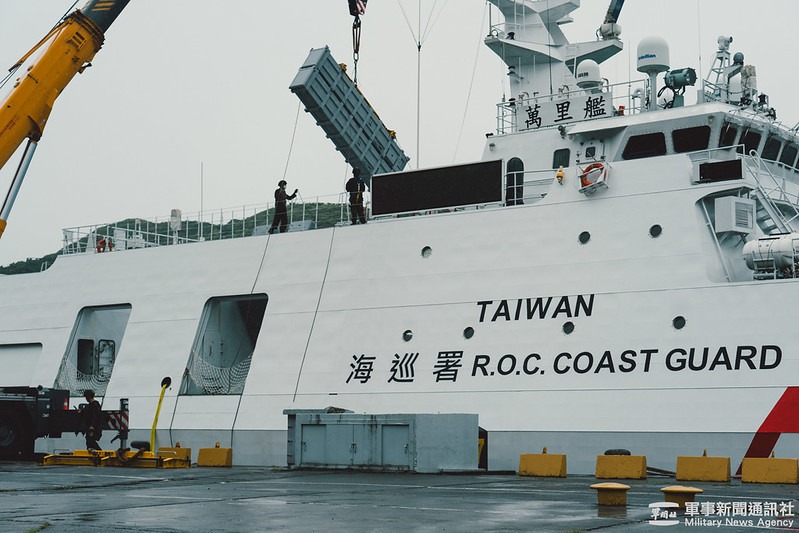
Speaking at the Taiwan Foreign Correspondents Club, Kuan highlighted how lightly defended Pratas remains and pointed to a Chinese reconnaissance drone flying over it in January as another example of provocative activity by the People’s Liberation Army (PLA). The big concern is that daily Chinese pressure around Dongsha and other outlying islands like Kinmen, Matsu, and Penghu is stretching Taiwan’s resources. While the Coast Guard and the military say it provides an opportunity for Taiwan to test its resolve, more needs to be done to accelerate the transition from peacetime to wartime readiness.
Taiwan’s MND Warns Legislature of Harmful Effects of Budget Delay
Taiwan’s MND has warned that any delays in approving this year’s defense budget could threaten roughly NT$78 billion (US$2.44 billion) in weapons procurement, maintenance, and training. Officials say that delays could affect roughly 21 percent of the annual budget and its original timetable. This includes procurement programs such as HIMARS, Javelin missiles, and follow-on training for F-16s.
These warnings from the MND come at a difficult time for Taiwan, as its Legislature is currently embroiled in a debate over how much to spend on its defense. The ruling Democratic Progressive Party (DPP) has submitted a separate NT$1.25 trillion (US$40 billion) special defense budget, while opposition Kuomintang (KMT) and Taiwan People’s Party (TPP) have submitted proposals of roughly NT$380 billion (US$12 billion) and NT$400 billion (US$13 billion), respectively. Opposition lawmakers continue to criticize the Lai administration’s budget for a lack of specificity with some budget items, and are pushing the government to justify how they intend to spend appropriated funds.
Defense officials have increasingly become frustrated with the deadlock, which is approaching almost six months. The MND argues that any delay will produce irreversible effects because procurement timelines, training pipelines, and maintenance schedules all depend on predictable funding.