Taiwan Security Monitor

Weekly Arms Update: 3/11/26

Authors: Joe Oโ€™Connor & Shikhar Chaturvedi


This week: the Kuomintang releases its budget proposal, leading to a flurry of statements about special budgets; the MND confirms Abrams tanks are en route to Taiwan; Minister Koo confirms an LOA for HIMARS was received; and the ministry releases budget details on NCSIST domestic production, alongside weekly bids and solicitations.

KMT Releases Proposal + Special Budget Updates

On Thursday, 5 March, the opposition Kuomintang (KMT) party released its special defense budget proposal, after weeks of internal debate as to the amount. The proposal allocates NT$380 billion (US$11.93 billion) specifically to fund the eight U.S. arms sale cases announced in December and would require additional special budget requests for future procurement to be submitted to the Legislative Yuan. Additional reporting on Friday revealed that the request was NT$30 billion (US$940 million) higher than party leadership had planned for; with the KMT also mandating that Letters of Offer and Acceptance, which outline payment and delivery schedules, be issued and signed before funds are appropriated.

Immediately after, the Lai administration began issuing statements opposing the proposal and clarifying their own. The same day, 5 March, the MND issued a statement clarifying that three sales from December (the Taiwan Tactical Network, AH-1W SuperCobra spare parts, and Harpoon missile refurbishment) were not included in the special budget and would be in annual defense budgets. The next day, 6 March, Minister of National Defense Wellington Koo spoke to the press, stating that the KMTโ€™s requirement that all sales be completed by December 2028 is unreasonable and impossible. On Saturday, 7 March, the MND issued a second statement, specifically discussing the KMT requirement of having LOAs before funding is approved, stating that cases follow a formal acquisition timeline and that public disclosure of budget items only occurs after U.S. congressional notification.

On Sunday, 8 March, President Lai visited Jieyun Temple in Banqiao District, New Taipei, giving a speech where he compared his special defense budget to installing a security system against a โ€œbad neighbor.โ€ Lai also argued for the reasonableness of his budget, comparing it to yearly defense spending by Japan and South Korea, both of which are more than his planned NT$1.25 trillion (US$40 billion) in spending over eight years. Also on Sunday, when asked by CNA if the U.S. would support the KMTโ€™s proposal, an unnamed State Department official stated that they โ€œencourage all parties in Taiwanโ€™s legislature to work through political differences and quickly pass a special defense budget,โ€ not taking a partisan side on the issue.

Today, the Legislative Yuan held elections for committee โ€œconvening members,โ€ legislators who serve as co-chairs and who control the agenda and legislative review, electing DPP legislator Chen Kuan-ting and KMT legislator Ma Wen-jun to the Foreign Affairs and National Defense Committee, which is tasked with review of the three special budget proposals. Chen, on Monday, met with former U.S. INDOPACOM commander Admiral John Aquilino, discussing Indo-Pacific security, domestic defense production, and advocating for the Lai administrationโ€™s budget to pass quickly.

Abrams Tanks “At Sea,โ€ Expected by End of March

An MND official told CNA on Tuesday that the final batch of 28 M1A2T Abrams tanks is โ€œat sea,โ€ en route to Taiwan, with delivery expected before the end of March. The first batch of 38 tanks arrived in December 2024 and was commissioned into the Armyโ€™s 584th Combined Arms Brigade in October. A second batch of 42 tanks, which arrived in July 2025, is still undergoing training and is expected to be commissioned by mid-year. This marks the last out of 108 total tanks that Taiwan began procuring in July 2019.

LOAs for HIMARS Received + MQ-9B Clarification

On Tuesday, Minister of National Defense Wellington Koo told the press that the MND had received a fourth Letter of Offer and Acceptance (LOA) from the U.S., for the sale of 82 High Mobility Artillery Rocket Systems (HIMARS) and associated munitions, worth NT$127.2 billion (US$4.05 billion), initially being notified in December.  This LOA, which has a deadline of 26 March to be signed, joins three prior LOAs, for Paladin self-propelled howitzers, Javelin anti-armor missiles, and TOW-2B anti-armor missiles, that have not been signed by the MND owing to ongoing special budget negotiations and are in danger of expiry. On Thursday, 5 March, however, it was reported that the Taiwan Peopleโ€™s Party (TPP), the KMTโ€™s fellow opposition party in the LY, will allow the three previous LOAs, which expire on March 15, to be signed if they are reported immediately to the LY. As of the time of writing, however, we are not aware of those three LOAs having been signed.

While speaking to the press on Tuesday, Minister Koo also clarified ongoing rumors about delays in the delivery of four MQ-9B SeaGuardian maritime surveillance drones to Taiwan, stating that the ongoing conflict in the Middle East has no effect on delivery timelines to Taiwan and that the MND continues to interface with U.S. partners if that were to change.

MND Releases NCSIST Production Budget Request

Taiwanโ€™s Ministry of National Defense has begun releasing additional budget details tied to the National Chung-Shan Institute of Science and Technology (NCSIST), offering a clearer picture of how Taipei intends to scale domestic weapons production under the proposed NT$1.25 trillion โ€œDefense Resilience and Asymmetric Capabilitiesโ€ special budget. Per Central News Agency reporting, the MND explained that NT$80.9 billion (US$2.55 billion) of the package will fund NCSIST mass production programs, including NT$36.1 billion (US$1.14 billion) for the Strong Bow missile system, NT$16.8 billion (US$529 million) for the Rui Yuan II surveillance drone program, and NT$28 billion (US$881.7 million) for production of โ€œsmall suicide unmanned surface vessels.โ€

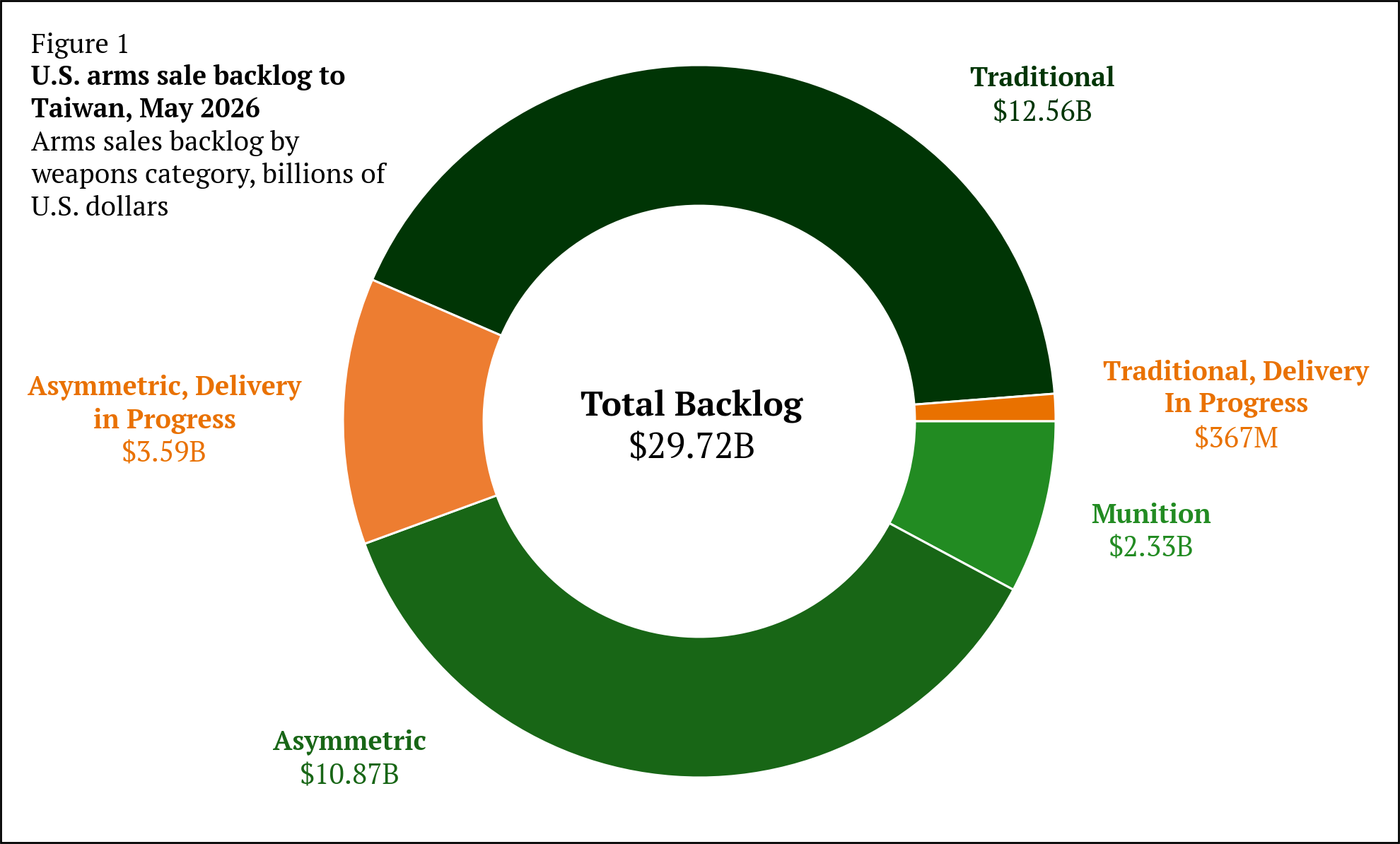
The newly released figures reinforce a trend visible across Taiwan Security Monitorโ€™s backlog and acquisition analysis: Taiwan is increasingly pairing U.S. arms purchases with expanded domestic production capacity anchored by NCSIST. Previous special budgets (such as the Sea and Air Combat Power Improvement Plan) already used this model to accelerate missile and unmanned platform production while strengthening Taiwanโ€™s industrial supply chain. Taiwan Security Monitorโ€™s December 2025 update on the Arms Sales Backlog showed a growing shift in U.S. arms packages toward asymmetric capabilities that are cheaper and faster to produce. The new NCSIST allocations suggest Taiwan is now extending that logic domestically, using local production to scale asymmetric systems while relying on Foreign Military Sales (FMS) programs for higher-end platforms.

Weekly Awards/Solicitations

On Thursday, the Armaments Bureauโ€™s 209th Factory awarded an NT$480 million (US$15.09 million) contract to the Armaments Bureau’s 202nd Factory for base section maintenance of 40-mm remote-controlled turret systems, which feature on Clouded Leopard infantry fighting vehicles. The contract will be fulfilled in Jiji Township, Nantou County.

On Monday, the Naval Specialty Training Center, Naval Education and Training Command, awarded an NT$180 million (US$5.66 million) contract to NCSIST for the repair of โ€œSea Chain IVโ€ training simulators. We estimate this may be some sort of tactical data link. The contract will be fulfilled in the southern region of Taiwan.

On Wednesday, the 192nd Fleet, Naval Command, the ROCNโ€™s minesweeping force, awarded an NT$51.21 million (US$1.61 million) contract to NCSIST for comprehensive mine inspection and maintenance of various mines, including maintenance of MK 6 mine projectiles. The contract will be fulfilled in the southern region of Taiwan.

All Quiet in the Taiwan Strait? Explaining the Recent Drop in PLA Aircraft Activity Around Taiwan

Authors: Noah Reed, Jonathan Walberg, Ethan Connell, & Joe Oโ€™Connor


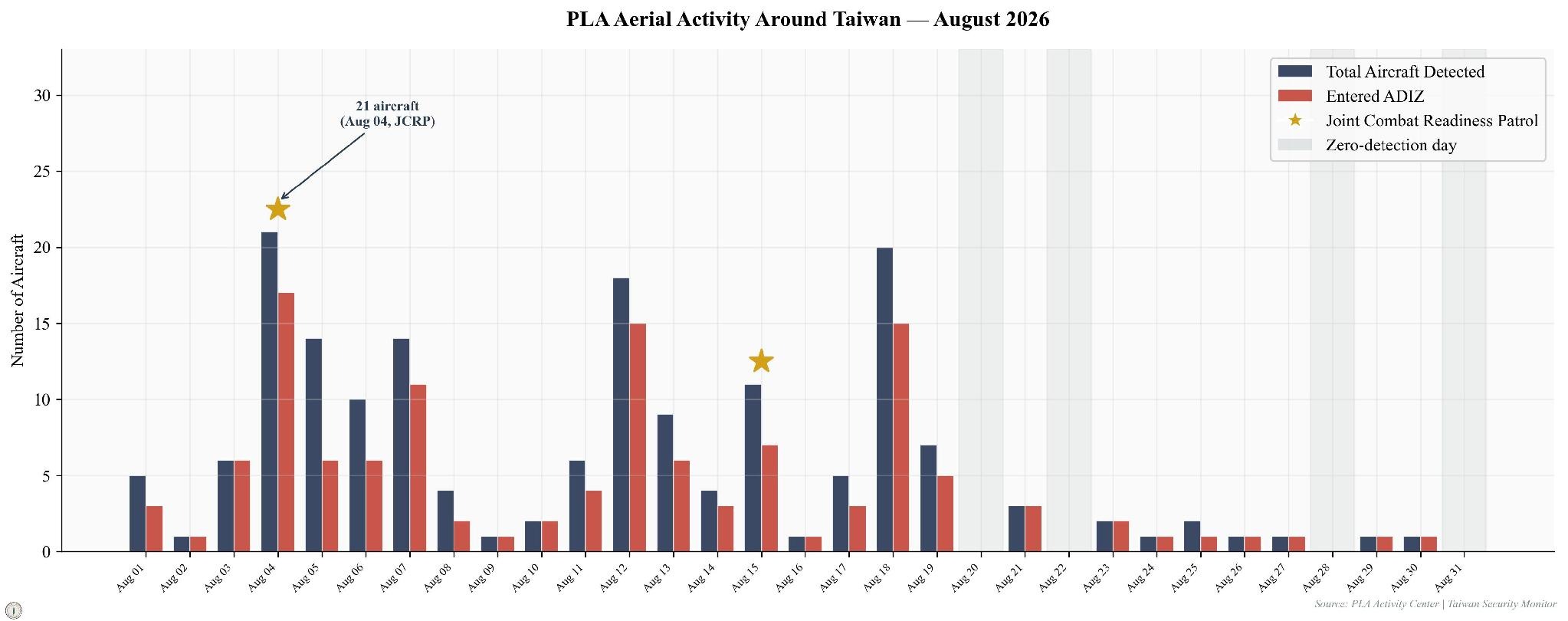
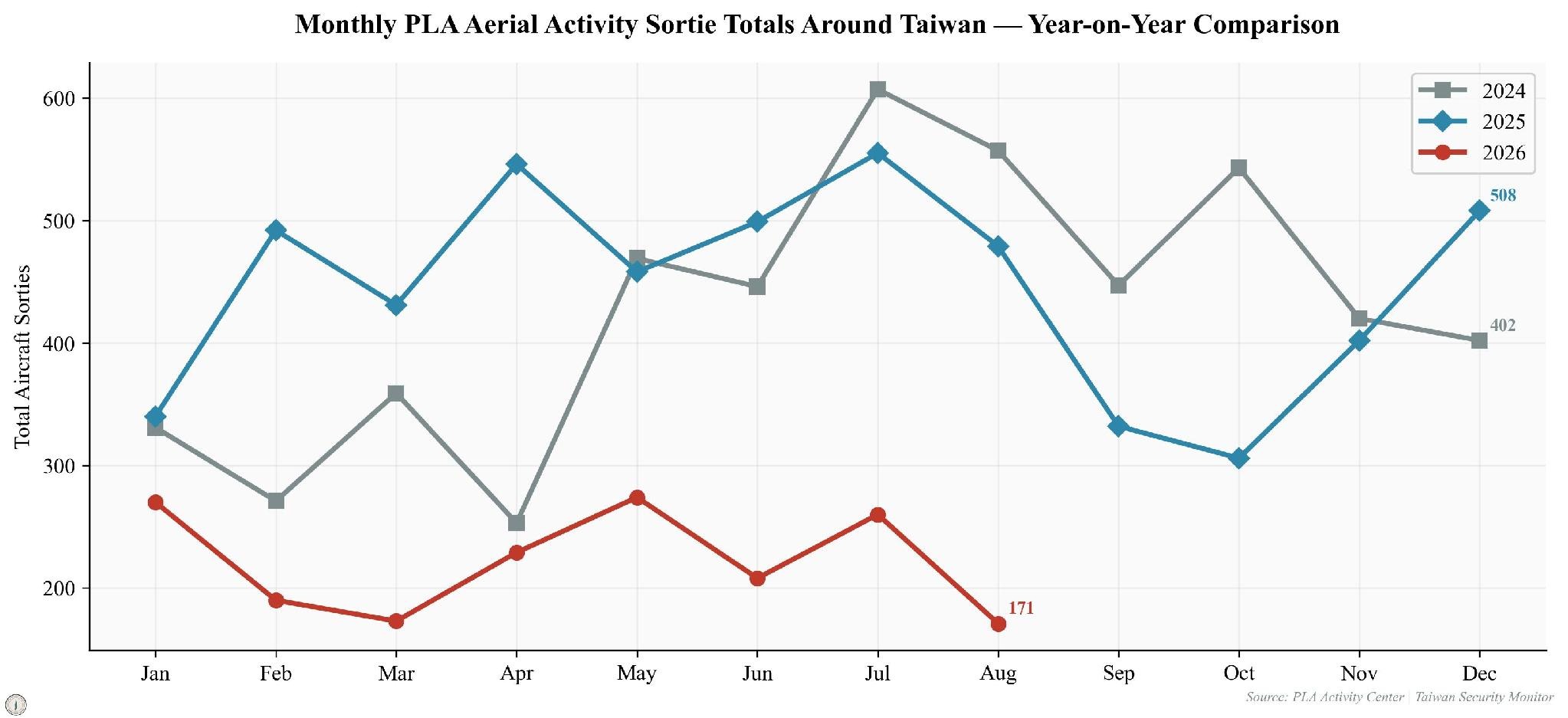
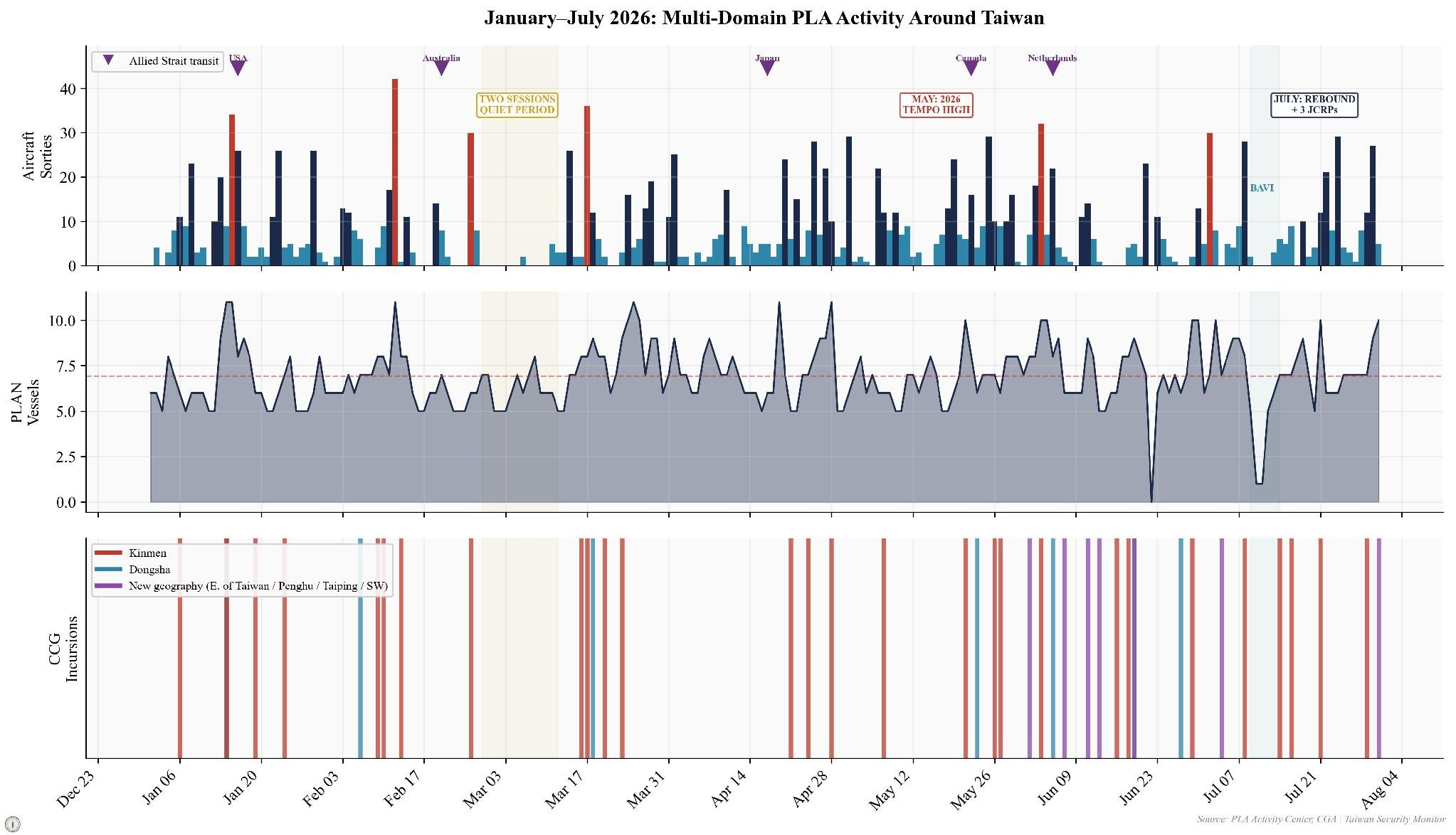
From February 27th to March 5th, Taiwanโ€™s Ministry of National Defense (MND) reported no Peopleโ€™s Liberation Army aircraft operating in the airspace near Taiwanโ€™s Air Defense Identification Zone (ADIZ), an unusually long pause in activity that drew significant attention among regional observers. No supply flights, no repositioning of aircraft, and not even any training exercises.  While long pauses in ADIZ violations have occurred in the past, it has become extremely rare in recent years for Taiwanโ€™s military to detect no aircraft operating in the nearby airspace outside the ADIZ for a prolonged period. The reason for this is quite simple: ADIZ violations are almost always directed at Taiwan, while activity outside Taiwanโ€™s ADIZ could involve routine training flights or transits between coastal airbases. Thus, it is more common for the PRC to halt incursions into Taiwanโ€™s ADIZ than to reduce aviation activity in the Eastern Theater Command writ large over a long period of time.

This pause naturally sparked speculation, however many popular theories are as of yet unsupported by observable patterns and regional events. Observers have forwarded several possible explanations, to include the ongoing operations in Iran, the upcoming summit between President Trump and Xi, an inability to operate routinely following a series of major officer purges, and domestic politics in Taiwan. Below, we parse through the most prominent suggested theories and examine if they hold up to historical trends and further scrutiny. As our central argument suggests, it remains too early to make definitive judgments given the available data. Instead, we focus on understanding the factors behind several of the leading explanations for this break from pattern.

I: Domestic Explanations and Leadership Struggles

Two domestic events in the PRC could reasonably explain the dive in PLA activity in February. First, this week marked the beginning of the โ€œTwo Sessions,โ€ an annual meeting of the PRCโ€™s National Peopleโ€™s Congress (NPC).[i] Historically, this event coincided with lower ADIZ violations, with a notable exception of 2025.[ii] The heightened level of activity seen during 2025โ€™s NPC meeting relative to prior years could be explained by the higher cross-Strait tension at the time, with the PLA holding its Strait Thunder-2025Aย joint exercise around Taiwan less than a month later.

Second, the end of the Spring Festival and the beginning of the Lantern Festival in the PRC could play some part in the lower activity. The Spring Festival has empirically propelled lower reported ADIZ numbers from late January into February over the last couple of years.[iii] Still, it is difficult to discern if the holidays alone drive these trends, or if it is merely one element of a broader rationale.

Finally, it is worth addressing the rumors that the PLA is simply incapable of conducting aerial activity around Taiwan due to recent turmoil in its leadership. This appears to be a less convincing explanation. After all, PLAN activity around Taiwan remains somewhat consistent, and the PLA and China Coast Guard (CCG) remain active in the Senkaku Islands and the South China Sea. Moreover, it is not clear why the removal of senior leadership would cause the PLA to be incapable of flying aircraft around Taiwan, as such activity has become routine, even mundane, for several years. It also cannot explain why several waves of aerial activity occurred around Taiwan in February after the leadership investigations took place.

Overall, the National Peopleโ€™s Congress, as well as Spring/Lantern festivals, have historically contributed to lower numbers of ADIZ and airspace violations. However, it is rare for these events to coincide with total stoppages in incursions.

II: Trumpโ€“Xi Meeting and the โ€œBest Behaviorโ€ Hypothesis

Another explanation is that the pause reflects a temporary โ€œbest behaviorโ€ or truce period ahead of a pending meeting between Donald Trump and Xi Jinping later this spring.[iv] Under this interpretation, Beijing may be attempting to avoid incidents or tensions that could complicate or even cancel the meeting.[v] This suggests that China would reduce visible military pressure around Taiwan to create a more stable atmosphere prior to the meeting.

While plausible, the explanation doesnโ€™t fit the observed pattern of activity.

First, the lull extended beyond just a halt in ADIZ incursions, but rather to all aircraft activity in the area, where regular flights and movements occur with training flights and movements between coastal bases. If the goal were to signal intent to Washington regarding Taiwan, Beijing could easily continue routine training flights in these areas while avoiding breaching Taiwanโ€™s ADIZ. A complete halt of flights in the area goes beyond just signaling that Beijing doesnโ€™t want to โ€˜rock the boat.โ€™ It also assumes that Washington views the ADIZ as the principal outlet of PRC signaling over Taiwan, something that cannot necessarily be accepted at face value.

Second, the logic of a pre-summit truce, while plausible, would require a much longer pause in operations. This would become more plausible if the lull had continued. Further, it would commit the PLA to maintaining a break for a period following the summit, as a resumption of regular patrols would risk creating the impression that the summit had failed. In practice, maintaining the appearance of diplomatic restraint would likely require months of reduced activity, which is unlikely given the PLAโ€™s ongoing pressure campaign that has seen few pauses since 2022.

 Finally, the broader geopolitical context makes the argument less convincing. Some analysts frame ADIZ incursions as a signaling mechanism directed at Washington, meaning that temporarily halting them could itself be a signal, a tacit gesture of restraint ahead of a summit. But even under this logic, the timing is difficult to reconcile with current events. The United States is presently engaged in an escalating conflict with Iran involving large-scale strikes and the possibility of wider regional escalation.[vi] In that environment, it is not obvious why Beijing would view the suspension of routine PLA sorties near Taiwan as a necessary diplomatic signal. If Beijing is prepared to pursue high-level diplomacy with Washington while the United States is conducting major military operations elsewhere, it is difficult to see why the symbolic value of turning off routine Taiwan-related flights would suddenly become decisive.

Put simply, a snapshot of the rest of the world makes the idea that Beijing is shelving routine Taiwan-related air activity purely to preserve summit optics less convincing.

III: Signaling to Taiwan

Yet another explanation being advanced is that Beijing is signaling its lack of concern over Taiwanโ€™s ongoing special defense budget debate. However, the timeline of PLA activity does not support this interpretation. The debate has been ongoing for months, yet PLA air activity remained elevated throughout that period.[vii] For example, Taiwanโ€™s Ministry of National Defense reported 19 PLA aircraft operating around Taiwan on January 29, just days after the Taiwan Peopleโ€™s Party unveiled its alternative special budget proposal. Activity continued shortly afterward, with 32 PLA aircraft detected on February 12, two days after Lai publicly urged the Legislative Yuan to pass the proposal during a press conference. Similarly, 22 PLA aircraft were detected on February 26, the day after Taiwanโ€™s legislature agreed to send multiple budget proposals to committee review. These patterns suggest that PLA air activity has continued regardless of developments in Taiwanโ€™s defense budget debate.

The PRC is likely to react to developments in Taiwanโ€™s special defense budget proposals as they move through the Legislative Yuan. Beijing has repeatedly framed major Taiwanese defense initiatives as provocations, often responding with diplomatic pressure or military signaling. The PLAโ€™s most recent exercise, Justice-Mission 2025A, reflects this pattern.[viii] Much of the iconography and messaging released before and during the exercise framed the drills in punitive terms, portraying them as a warning to Taipei. In that sense, the exercise reinforced the perception that advances in Taiwanโ€™s defense budgeting process can trigger demonstrative military responses from Beijing.

Others advance this as rewarding Lai for his statements during a Spring Festival event where he referred to โ€œMainland Chinaโ€ instead of just โ€œChina,โ€ a term that the PRC prefers.[ix] This reference, while not necessarily insignificant in meaning, is unlikely to prompt Beijing to depart three years of policy and โ€œrewardโ€ the Lai administration by giving them time to breathe over a difference in terminology.

IV: Middle East and Fuel Hypothesis, Regional activity

One external explanation for the Eastern Theater Commandโ€™s pause in flight activity is that Beijing is temporarily conserving aviation fuel amid uncertainty about the ongoing conflict in the Middle East and potential supply disruptions. Sustained air operations require significant fuel resources, and the PLA may reduce nonessential sorties if leadership anticipates a prolonged price increase or broader market volatility.

However, the fuel-constraint explanation presents two significant challenges:

First, China has invested decades in developing strategic petroleum stockpiles to mitigate supply shocks. Public estimates indicate that Beijing maintains hundreds of millions of barrels in state strategic reserves, supplemented by commercial storage.[x] Recent planning documents and reports further suggest that China continues to expand these undisclosed strategic holdings, rather than signaling scarcity.[xi] Therefore, if the PLA were experiencing immediate operational constraints due to fuel availability, it would indicate a far more acute, system-wide stress than current stockpiling trends imply.

Second, if fuel conservation were the primary factor, a broader reduction in activity would be expected across all PLA operating areas, rather than a distinct, localized pause in aircraft activity detected around Taiwan. Chinese military activity in other regions, however, appeared to remain consistent with typical patterns.

For example, in the South China Sea, the PLAโ€™s Southern Theater Command publicly released footage of naval and air units conducting a readiness patrol around Scarborough Shoal on February 28.[xii] The patrol involved coordinated use of early warning aircraft, anti-submarine aircraft, fighters, and bombers, accompanied by messaging that forces remain โ€œon high alertโ€ and prepared to take countermeasures. A subsequent Weibo post by the Southern Theater Command highlighted a PLAAF unit undergoing โ€œrigorous combat training,โ€ with a follow-on Global Times report stating that these patrols and exercises have continued โ€œsince Februaryโ€ and are explicitly linked to responses to external โ€œjoint patrolโ€ activity.[xiii] This reinforces that PRC operational signaling in the south has not paused during this period.

Japanese public reporting over the past week indicates continued and routine activity around the Senkaku Islands. In its March 1, 2026, update, Japanโ€™s Ministry of Foreign Affairs notes that Chinese government vessels, mainly from the China Coast Guard, have continued to enter Japanโ€™s contiguous zone near the Senkakus almost daily.[xiv] On February 28th, Japanโ€™s Joint Staff reported that two Peopleโ€™s Liberation Army (PLA) Y-9 intelligence, surveillance, and reconnaissance (ISR) aircraft flew from the East China Sea, passed between Okinawa and Miyako, and continued into the Pacific as far as the Amami island chain, then reversed course and returned, prompting Japan Air Self-Defense Force (JASDF) scrambles.[xv] Overall, Japanโ€™s official statements and recent Joint Staff reports indicate that PRC operations in the East China Sea remain active, even as aviation patterns near Taiwan fluctuate.

V. Preparing for an Invasion or Major Exercise

A more dramatic explanation is that the pause reflects preparations for a major PLA exercise. Others have posited that it could possibly be the โ€˜calmโ€™ before an invasion or move on one of Taiwanโ€™s outlying islands. Under this interpretation, the halt in routine aviation activity signifies an operational pause while forces reposition, conduct planning, or prepare for a larger coordinated operation.

It is true that large exercises or operations are sometimes preceded by short-term changes in routine activity, particularly if units are redeploying, conducting maintenance, or consolidating forces in preparation for a larger event.

However, there was little evidence during the pause to support the idea that it reflected imminent large-scale operations. Even a preparation for a theater-level exercise would likely generate additional changes and disruptions in observable patterns, including major changes in naval deployments, unusual airbase activity, logistical movements, and more. Many of these indicators are regularly detected through open-source monitoring and satellite imagery. At present, there are no clear signs of these types of preparatory activities occurring on a scale that would suggest a major operation is imminent.

More broadly, if the PLA were preparing a large exercise around Taiwan, it is not obvious why routine aviation activity across the Eastern Theater Command would need to halt. Training flights and patrols would normally continue alongside preparations unless airspace was being cleared for a specific operation, something that would likely be accompanied by other visible signals.

For these reasons, while the possibility of future exercises should never be discounted given the PLAโ€™s recent pattern of demonstrations around Taiwan, the current pause alone is not strong evidence that a major operation is imminent.

Taken together, the available evidence suggests that the brief pause in PLA aviation activity around Taiwan was unlikely to be driven by any single factor. Domestic political events in China, including the NPC โ€œTwo Sessionsโ€ and the seasonal slowdown associated with the Spring Festival period, likely contributed to a temporary reduction in operational tempo. At the same time, explanations centered on diplomatic signaling, energy constraints, or preparations for major military operations remain less consistent with observed patterns of activity both around Taiwan and in other regions.

The resumption of PLA flights shortly after this lull reinforces a broader pattern that has characterized Chinese military pressure around Taiwan in recent years: cyclical activity. Periods of heightened sorties are often followed by short pauses before returning to baseline levels. Rather than indicating a change in Beijingโ€™s strategy, the episode likely reflects the routine variability inherent in sustained military operations.

The more important analytical question is not why the PLA paused for several days, but how Beijing calibrates these cycles of pressure. Short interruptions in activity can create the perception of sudden shifts in intent, even when the underlying strategy remains unchanged.


[i] https://asiasociety.org/policy-institute/what-watch-chinas-two-sessions-2026

[ii] PLA Tracker: https://docs.google.com/spreadsheets/d/1qbfYF0VgDBJoFZN5elpZwNTiKZ4nvCUcs5a7oYwm52g/edit?gid=905433190#gid=905433190

[iii] https://chinadrew.substack.com/p/the-pla-has-stopped-flying-aircraft?triedRedirect=true&_src_ref=t.co

[iv] https://www.reuters.com/business/aerospace-defense/chinese-military-flights-around-taiwan-fall-trump-xi-meeting-may-be-factor-2026-03-05/

[v] https://www.taipeitimes.com/News/taiwan/archives/2026/03/05/2003853320

[vi] https://www.war.gov/Spotlights/Operation-Epic-Fury/

[vii] PLA Tracker: https://docs.google.com/spreadsheets/d/1qbfYF0VgDBJoFZN5elpZwNTiKZ4nvCUcs5a7oYwm52g/edit?gid=905433190#gid=905433190

[viii] https://tsm.schar.gmu.edu/justice-mission-2025-the-narrative-battle-inside-chinas-latest-taiwan-exercise/

[ix] https://chinadrew.substack.com/p/the-pla-has-stopped-flying-aircraft?triedRedirect=true&_src_ref=t.co

[x] https://www.eia.gov/international/analysis/country/chn

[xi] https://www.reuters.com/business/energy/china-targets-steady-oil-output-more-gas-stockpiling-five-year-plan-2026-03-05

[xii] https://www.globaltimes.cn/page/202603/1355963.shtml

[xiii] https://weibo.com/7468777622?tabtype=album&uid=7468777622&index=0; https://www.globaltimes.cn/page/202603/1356043.shtml; https://www.globaltimes.cn/page/202603/1355963.shtml

[xiv] https://www.mofa.go.jp/files/100857530.pdf; https://www.mofa.go.jp/region/page23e_000021.html

[xv] https://www.mod.go.jp/js/pdf/2026/p20260302_01.pdf

Taiwan Affairs Office (TAO): We hope the broad community of Taiwan compatriotsโ€”including Taiwan youthโ€”will pay more attention to the National Two Sessions (NPC & CPPCC meetings).

At the March 4 State Council Taiwan Affairs Office (TAO) press briefing, a reporter asked: The National โ€œTwo Sessionsโ€ (NPC and CPPCC) are about to convene. Weโ€™ve noticed that more and more Taiwan compatriotsโ€”especially Taiwan youthโ€”say they are paying attention. What is your comment?

TAO spokesperson Zhang Han responded: The peopleโ€™s congress system is Chinaโ€™s fundamental political system, and the system of multiparty cooperation and political consultation under the leadership of the Communist Party of China is one of Chinaโ€™s basic political systems. The National Peopleโ€™s Congress and the Chinese Peopleโ€™s Political Consultative Conference are important platforms that centrally reflect and deeply practice whole-process peopleโ€™s democracy. Todayโ€™s opening of the 4th session of the 14th CPPCC National Committee, and tomorrowโ€™s opening of the 4th session of the 14th National Peopleโ€™s Congress, are important meetings convened in the opening year of the โ€œ15th Five-Year Planโ€ period. The agenda includes discussing and reviewing the government work report and the outline of the โ€œ15th Five-Year Plan,โ€ among other items; these meetings will sketch out the countryโ€™s development blueprint for the next five years and reveal the logic and direction of Chinaโ€™s future development.

Zhang added: By paying attention to and understanding the Two Sessions, Taiwan compatriots can better understand the mainlandโ€™s democratic political system and its economic and social development, experience the achievements of whole-process peopleโ€™s democracy and Chinese-style modernization, and learn the countryโ€™s future development directionโ€”thereby grasping opportunities for their own development. We hope Taiwan compatriots, including Taiwan youth, will actively participate in cross-strait exchanges and cooperation and in integrated development, jointly promote the peaceful development of cross-strait relations, and together create a bright future of national rejuvenation and the reunification of the motherland.

Taiwan Affairs Office (TAO): The DPP authorities, by obstructing Taiwan compatriots from receiving evacuation assistance from Chinese embassies and consulates abroad, have lost their conscience and extinguished their humanity.

At the March 4 State Council Taiwan Affairs Office (TAO) press briefing, a reporter asked: Recently, the United States and Israel launched military operations against Iran. Chinaโ€™s Ministry of Foreign Affairs and our relevant embassies and consulates issued notices reminding Chinese citizensโ€”including Taiwan compatriotsโ€”to evacuate as soon as possible, and said Taiwan compatriots who need to leave can register. However, the DPP authorities have falsely claimed that it is โ€œriskyโ€ for Taiwan compatriots to seek evacuation assistance from the mainland. What is your comment?

TAO spokesperson Zhang Han responded: Taiwan compatriots are Chinese citizens; they are our flesh and blood, our close kin. From evacuations from Libya, Yemen, and Sudan, to the outbreak of the Israelโ€“Palestine conflict, and when Taiwan compatriots overseas encountered dangers such as typhoons and earthquakes, we have maintained close contact with Taiwan compatriots on the ground and provided timely assistance. As always, we will take all necessary measures to protect the safety of Chinese citizens, including Taiwan compatriots. If Taiwan compatriots need assistance, they can contact Chinese embassies and consulates locally at any time, or call the 12308 consular protection hotline. No matter where they are or what difficulties they face, the great motherland is the strong backing of Taiwan compatriots.

Zhang added: At this critical moment, when the safety of Taiwan compatriots is at stake, the DPP authorities are still engaging in political manipulationโ€”losing their conscience and extinguishing their humanity. What they fear most is seeing โ€œcompatriots on both sides are one family, and true feelings show in hardship,โ€ and they are doing everything they can to place their political schemes above peopleโ€™s lives and safety. Their cold-bloodedness and selfishness are fully exposed, and they will inevitably face firm opposition from Taiwan compatriots.

Taiwan Affairs Office: The punitive measures targeting โ€˜Taiwan independenceโ€™ diehard separatistsโ€”and their affiliated companies and financial backersโ€”do not involve the vast majority of Taiwan compatriots or Taiwan businesspeople and enterprises.

At the March 4 State Council Taiwan Affairs Office (TAO) press briefing, a reporter asked: After the mainland disclosed that relatives of Liu Shifang hold positions in mainland enterprises and announced it would handle the matter in accordance with laws and regulations, Taiwanโ€™s Mainland Affairs Council (MAC) on the 28th issued its first โ€œ2026 Mainland China Economic Risk Warning.โ€ It reminded Taiwanese businesspeople to carefully assess investment, operations, and work on the mainland to avoid economic losses and personal safety risks, and called on the mainland to โ€œpull back from the brink.โ€ What is your comment?

TAO spokesperson Zhang Han responded: Media reporting has already drawn widespread attention across Taiwan. At present, the key issue is that the DPP authorities must directly answer whether Liu Shifangโ€™s relatives are seeking profits on the mainland, and whether there is โ€œdouble standardsโ€ within the Green campโ€”on the one hand suppressing and participating in the persecution of people involved in cross-strait exchanges, while on the other hand using relatives on the mainland to โ€œmake money from Chinaโ€ (โ€œearning red moneyโ€). Instead of shifting the focus and evading the question, they should address it head-on.

Zhang added: Our punitive measures target only a very small number of โ€œTaiwan independenceโ€ diehard separatists and their affiliated companies and financial backers; they do not involve the vast majority of Taiwan compatriots or Taiwanese businesspeople and enterprises. The DPP authorities are deliberately muddying the waters and fabricating so-called โ€œrisks,โ€ with the aim of intimidating Taiwanโ€™s public, creating a โ€œchilling effect,โ€ and obstructing and undermining cross-strait exchanges and cooperation. Their โ€œpro-independenceโ€ provocations have led to tension and turbulence in the Taiwan Strait; they have repeatedly cracked down on those who participate in cross-strait exchanges and cooperation; and they have a poor record of pushing โ€œdecouplingโ€ and โ€œcutting supply chainsโ€ across the Strait. The side that should โ€œpull back from the brinkโ€ is the DPP authorities themselves.

Taiwan Affairs Office: The DPP authoritiesโ€™ willingness to serve as someone elseโ€™s pawn will only bring them bitter consequences and make them a laughingstock.

At the March 4 State Council Taiwan Affairs Office (TAO) press briefing, a reporter asked: Recently, the U.S. Supreme Court ruled that the โ€œreciprocal tariffsโ€ implemented by President Trump in 2025 are invalid. Some people in Taiwan have analyzed that this ruling completely overturns the legal basis for the Taiwanโ€“U.S. tariff agreement. The Lai Ching-te administration previously made concessions to accommodate the U.S., along with promises of exorbitantly priced purchases and a US$500 billion investment commitment; now, it appears like a blind transfer of benefits with no legal guarantee. What is your comment?

TAO spokesperson Zhang Han responded: The United States is using tariffs as a big stick to apply extreme pressure and to hollow out and scoop up Taiwanโ€™s industriesโ€”this kind of economic bullying is unpopular. The DPP authorities, disregarding the well-being of Taiwanโ€™s people, are kneeling before the U.S. without any bottom line and โ€œselling out Taiwan,โ€ promising massive purchases, substantially opening the market, and cooperating in relocating the islandโ€™s core industries. The result is that they spent a fortune only to end up with a โ€œworthless ballot.โ€ The facts once again prove that, in seeking โ€œindependence by relying on external forces,โ€ the DPP authorities are willing to act as a pawnโ€”and will only suffer the consequences themselves and become a laughingstock.

Taiwan Affairs Office: The DPP authorities should take concrete actions to lift the various bans and restrictions they have imposed on cross-strait exchanges and interactions, including tourism.

At the March 4 State Council Taiwan Affairs Office (TAO) press briefing, a reporter asked: Recently, the UKโ€™s Financial Times published a report titled โ€œLet Chinese mainland tourists return to Taiwan,โ€ saying the mainland has made political statements regarding cross-strait tourism and has begun steps to reopen it without receiving substantive concessions from Taiwan. Taiwan should show greater flexibility and separate tourism from politics. The article has resonated with Taiwanโ€™s tourism industry. What is your comment?

TAO spokesperson Zhang Han responded: We are actively promoting cross-strait tourism exchanges and cooperation, and the goodwill and sincerity we have shown are plain for all to see. Any measures that are conducive to cross-strait exchanges and cooperation and that enhance the interests and well-being of our compatriots, we will actively promote and do our utmost to make happen.

Zhang added: We hope the DPP authorities will follow public opinion, take Taiwan peopleโ€™s well-being seriously, and take practical actions to lift the various bans and restrictions they have imposed on cross-strait exchanges and interactions, including tourism.

Taiwan Affairs Office: The attention to and discussion of the plot of Taiping Nian and the historical context behind it fully reflect that peace is a shared pursuit of compatriots on both sides of the Taiwan Strait.โ€

At the March 4 State Council Taiwan Affairs Office (TAO) press briefing, a reporter asked: Recently, the historical drama Taiping Nian has aired on both sides of the Taiwan Strait and sparked lively discussion. Some commentary believes the show uses a dust-covered chapter of history to awaken peopleโ€™s appreciation for peace and their recognition of the historical trend toward unification. What is your comment?

TAO spokesperson Zhang Han responded: The TV drama Taiping Nian takes the โ€œFive Dynasties and Ten Kingdomsโ€ period as its historical backdrop and explores the grand question of โ€œhow peace is achieved.โ€ It demonstrates the pronounced unifying character of Chinese civilization, and expresses the Chinese nationโ€™s spiritual conviction of opposing division and pursuing unity, as well as a sense of family-and-country responsibility embodied in the idea that โ€œthose who seek what benefits all under heaven must plan for it.โ€

Zhang added: History is the best textbook, and also the best sober-up remedy. The attention to and discussion by audiences on both sides of the Strait of the plot of Taiping Nian and the history behind it fully reflect that peace is a shared pursuit of compatriots on both sides of the Strait. We sincerely hope that all Taiwan compatriots will cherish peace as they cherish their own eyes, pursue unification as they pursue happiness in life, firmly safeguard peace and stability in the Taiwan Strait, and actively participate in advancing the peaceful reunification of the motherland.

Taiwan Affairs Office: We are willing to join hands with Taiwan compatriots to let Chinese culture shine with an even more brilliant radiance.

At the March 4 State Council Taiwan Affairs Office (TAO) press briefing, a reporter asked: During the Lunar New Year period, the Zhejiang Xiaobaihua Yue Opera Theater and a Shanxi โ€œiron flowerโ€ (da tie hua) performance team went to Taiwan to perform and received an enthusiastic welcome and positive reviews from people on the island. Some people in Taiwan said they hope the two sides will always be able to engage in exchanges through art and culture, and absolutely not through the flames of war; the two sides must have peace, so that their cultures can endure for the long term. What is your comment?

TAO spokesperson Zhang Han responded: During the Lunar New Year period, the Zhejiang Xiaobaihua Yue Opera Theater brought two productions, My Grand View Garden and The Garden of Love, to Taiwan, and the Shanxi Gaoping intangible cultural heritage project โ€œiron flowerโ€ also performed in Taiwan. Both were welcomed and praised by audiences on the island, especially young viewers, highlighting the unique charm and strong emotional appeal of Chinaโ€™s outstanding traditional culture. The Taiwanese compatriotsโ€™ love for and identification with Chinese culture once again demonstrates that compatriots on both sides of the Strait share the same roots and origins, and the same language and culture. The calls from relevant figures in Taiwan also voice the shared aspiration of compatriots on both sides for peace, development, exchange, and cooperation.

Zhang added: Chinese culture is the spiritual root and sense of belonging of compatriots on both sides of the Strait. We are willing to work together with Taiwan compatriots to continue advancing cross-strait cultural exchanges and cooperation, jointly safeguard peaceful development across the Strait, and join hands to let Chinese culture shine with an even more brilliant radiance.

Weekly Arms Update: 3/4/26

Authors: Joe Oโ€™Connor, Shikhar Chaturvedi, Danielle Kremer, and Wyeth Lindberg


This week: MND officials provide an update on the delivery of the last batch of Abrams tanks, Taiwan reportedly receives $70 million in royalty payments from F-16V development, both KMT and TPP officials speak about special defense budget proposals, and the military warns of delays to PAC-3 missile production owing to conflict in the Middle East, alongside weekly awards and solicitations.

Abrams Tank Delivery Updates

Taiwanโ€™s M1A2T Abrams program is approaching delivery completion, with reporting confirming that 80 of 108 tanks have already arrived, including 38 delivered in December 2024 and 42 delivered in July 2025, while the final tranche of 28 is projected to be shipped in March, with arrival in April (a timeline that Taiwan Security Monitorโ€™s July 2025 Arms Sale Backlog Update previously assessed as on schedule). Operationally, the Army has paired deliveries with a visible training and validation rhythm. Reporting notes the first tranche completed conversion training and live-fire events before transitioning toward fielded status, and the broader deployment plan aligns the tanks with Sixth Corpsโ€™ northern defense posture, centered on the 584th Brigade with a smaller allocation to the 269th Brigade, reflecting an infrastructure protection logic tied to approaches to key nodes such as Taipei Port. From a procurement perspective, the Abrams case is a useful execution benchmark inside the broader U.S.โ€“Taiwan pipeline. Taiwan Security Monitorโ€™s backlog tracking has flagged Abrams as one of the smoother Foreign Military Sales deliveries, and notes that completion of the final tranche would shift topline backlog optics even as higher friction programs remain constrained by contracting timelines and industrial capacity.

Taiwan Receives Royalty Payments for F-16V Jets

MND officials revealed on Saturday that as of the end of 2025, Taiwan had received approximately US$70 million (NT$2.197 billion) in royalty payments from buyers of F-16V Fighting Falcon fighter jets. A new configuration of the F-16 with advanced AESA radars, avionics, and Auto Ground Collision Avoidance System (Auto GCAS), the Taiwanese government originally worked with the United States and Egypt, who both withdrew, leaving Taiwan as the sole developer and eligible to receive rebate payments from other countries who procure F-16Vs. Per officials, Taiwan is expected to earn hundreds of millions of dollars more from rebate payments in the next five years, as global purchases of the aircraft increase.

Legislative Yuan + Special Defense Budget Updates

On Tuesday, Kuomintang (KMT) legislator Lo Ting-wei confirmed in a radio interview that at a recent dinner attended by KMT lawmakers ahead of Taichung Mayor Lu Shiow-yen’s trip to the US this week, it was mentioned that the United States had apparently demanded the KMTโ€™s special defense budget be approximately NT$900 billion (US$28.6 billion). As we reported last week, the proposed amount of the KMTโ€™s special budget has been highly variable, with Lo confirming this week that it could be between NT$350 billion (US$11.19 billion) and NT$810 billion (US$25.63 billion), not including the USโ€™s suggestion of NT$900 billion. Per other sources, the KMTโ€™s proposal is being personally managed by caucus whip Fu Kun-chi and is still set to be released by the end of this week.

Also on Tuesday, Taiwan Peopleโ€™s Party chairman Huang Kuo-chang held an exclusive interview with The Japan Times, stating that the TPP would agree to pass the Lai administrationโ€™s NT$1.25 trillion (US$40 billion) special budget proposal if the U.S. State Department notified a new, second package of arms sales that would be included under that budget. Huang stated that โ€œwe see no reason to write a blank checkโ€ for the governmentโ€™s budget until more information on specific capability-based spending is released. Per our recent analysis of the Lai administration and TPP budget proposals, the TPPโ€™s focus is specifically on funding sales that have already been approved, including HIMARS, Paladins, and anti-armor missiles. Prior reporting by the Financial Times and New York Times, however, indicate that the Trump administration is delaying approval of a new package of sales until after Xi and Trump meet in April.

On Monday, February 23, an unclassified Department of Defense spending plan was delivered to the U.S. Congress. This spending plan included allocating NT$26.9 billion (US$850 million) as part of a reconciliation bill passed last year. According to the Taipei Times, these funds will be used to replenish US weapons stockpiles, some of which were given to Taiwan. Additionally, this allocation serves to strengthen the alliance between Taiwan and the United States of America in accordance with the Taiwan Enhanced Resilience Act (TERA), passed in 2022. This spending is in addition to approximately US$150 million allocated in the FY26 Department of Defense Appropriations Act, passed in January, backfilling $850 million that was cut by appropriators.

Military Sources Warn of PAC-3 Delays

Military officials stated to Liberty Times today that plans to purchase a battalion worth of Patriot launchers and air defense missiles may be delayed owing to โ€œproduction crowding,โ€ as well as conflicts in Ukraine and the Middle East. Since Taiwanโ€™s Patriot purchase is still in the planning phase, per the officials, it is possible that the United States prioritizes production of missiles to be used in the Middle East or to replenish its own stockpiles before fulfilling Taiwanโ€™s case. To this end, LTN reported that the military would continue monitoring via military exchange channels and also urged that a special budget be passed to avoid disruptions.

Weekly Awards/Solicitations

On Thursday, several bid solicitations were made:

Also on Thursday, the Air Force Command awarded a NT$1.08 billion (US$34.23 million) contract to Air Asia Co. Ltd for the civilian outsourcing of repair and supply services at the Air Force’s Songshan Air Base. Air Asia Co. Ltd, an aircraft maintenance company now owned by Taiwanโ€™s Aerospace Industrial Development Corporation (AIDC), was previously owned and operated covertly by the Central Intelligence Agency. The contract is to be fulfilled at the Songshan Air Base, in the Songshan district of Taipei.

On Monday, the Military Medical Bureau awarded Ningliren Medical Equipment Co., Ltd., a NT$52.75 million (US$1.66 million) contract for interventional angiography X-ray machines. The contract is to be fulfilled in the northern region of Taiwan.

On Wednesday, the Information and Communications Command solicited bids for the integrated construction of field information equipment, translation and voice systems, worth NT$558.18 million (US$17.65 million).