Taiwan Security Monitor

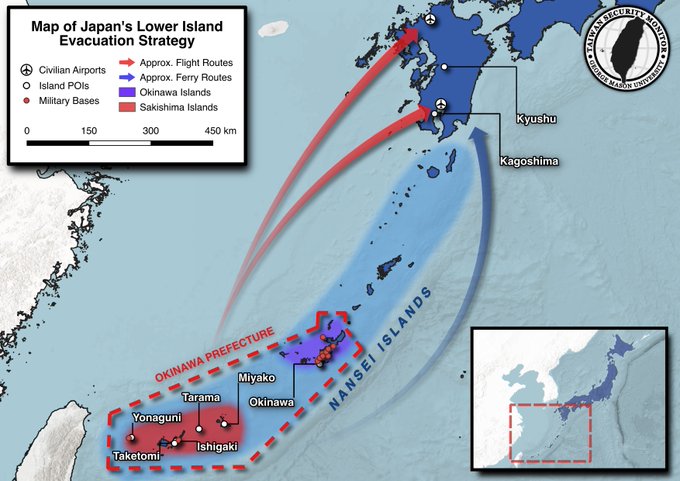
Visualization: Japan’s Lower Island Evacuation Strategy

Author: Ian Struble, Chris Dayton

Research: Olivianna Watkins, Graham Coughlan


In March, the Japanese government announced plans to evacuate up to 120,000 civilians from the Sakishima Islands, part of Okinawa Prefecture, in the event of a Taiwan contingency.

This map is a visualization of those plans, showing the impacted islands and evacuation routes.
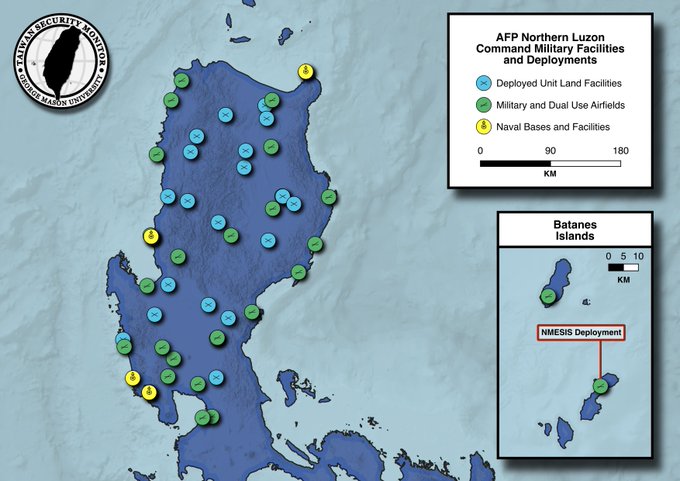
Visualization: AFP Northern Luzon Facilities and Deployments

Author: Chris Dayton, Ian Struble, Ethan Connell


As Balikatan 2025 continues, AFP Chief of Staff Gen. Romeo Brawner recently underscored the “inevitability” of Philippine involvement in a Taiwan conflict, citing 250,000 overseas Filipino workers in Taiwan.

The Northern Luzon Command’s strategic position is pivotal, as joint drills with the US intensify near the Bashi Channel and Luzon Strait.

This map contains all deployed unit land facilities, relevant airfields, and naval bases/facilities.

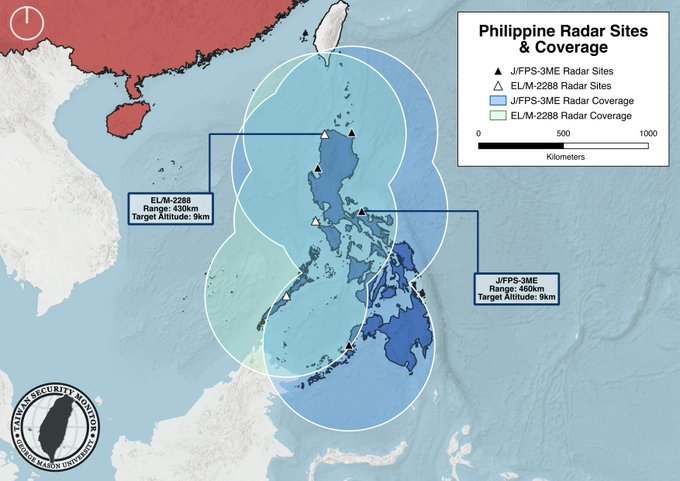
Visualization: Philippine Radar Sites and Coverage

Author: Chris Dayton and Ethan Connell


As part of Balikatan 2025, the Philippine Marine Corps and USMC will be participating in an Integrated Air and Missile Defense event.

This map visualizes the AFP’s air defense infrastructure.

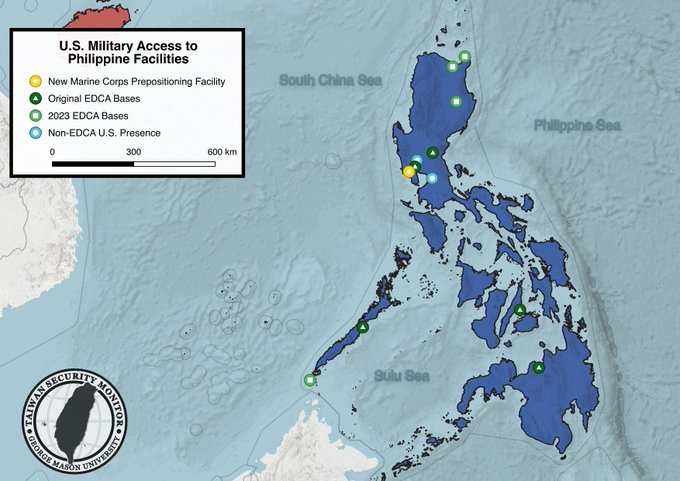
Visualization: U.S. Military Access to Philippine Facilities

Author:ย Chris Dayton and Ethan Connell


Armed Forces of the Philippines Gen. Romeo Brawner Jr. recently gave a speech in which he described the Philippines involvement in a Taiwan contingency as an “inevitability.”

This map visualizes the expanding US military presence in the Philippines.

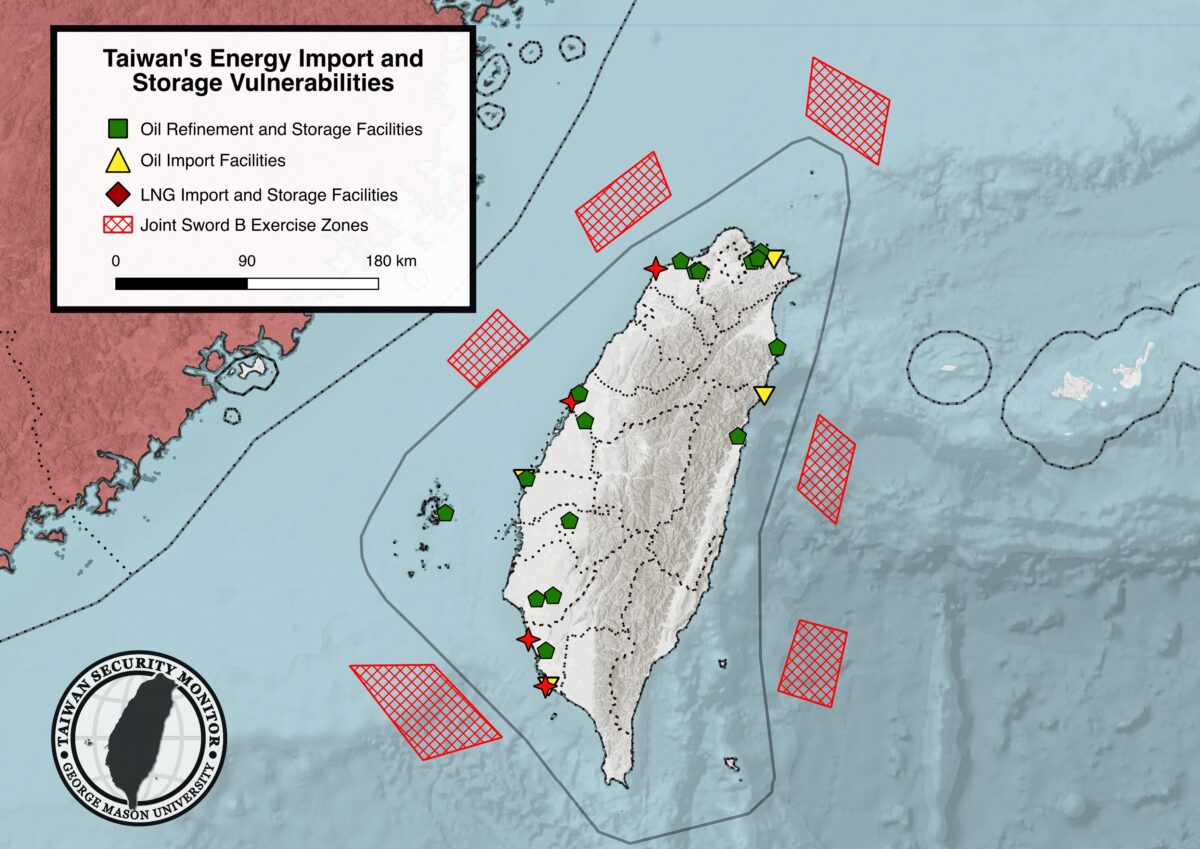
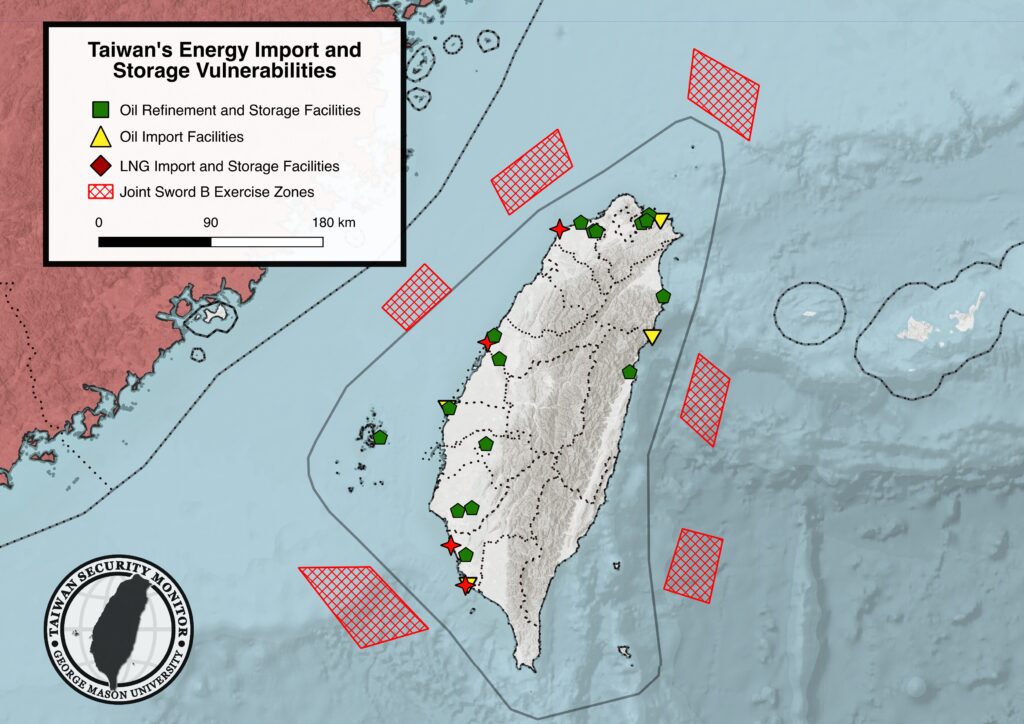
Visualization: Taiwan’s Energy Import and Storage Vulnerabilities

Author: TSM Researchers


This map shows the areas that China operated in for the Joint Sword 2024B Exercise in October 2024, along with Taiwan’s major energy import and storage locations.

Taiwan Arms Sales Backlog, March 2025 Update

New SIPRI Data Sheds Light on Partial Deliveries

By Eric Gomez

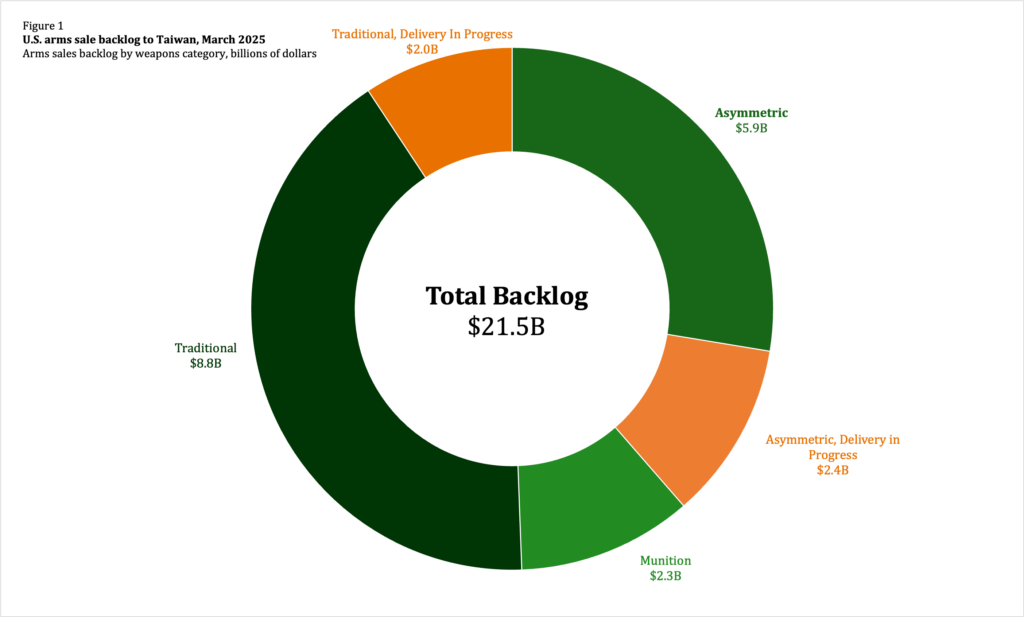
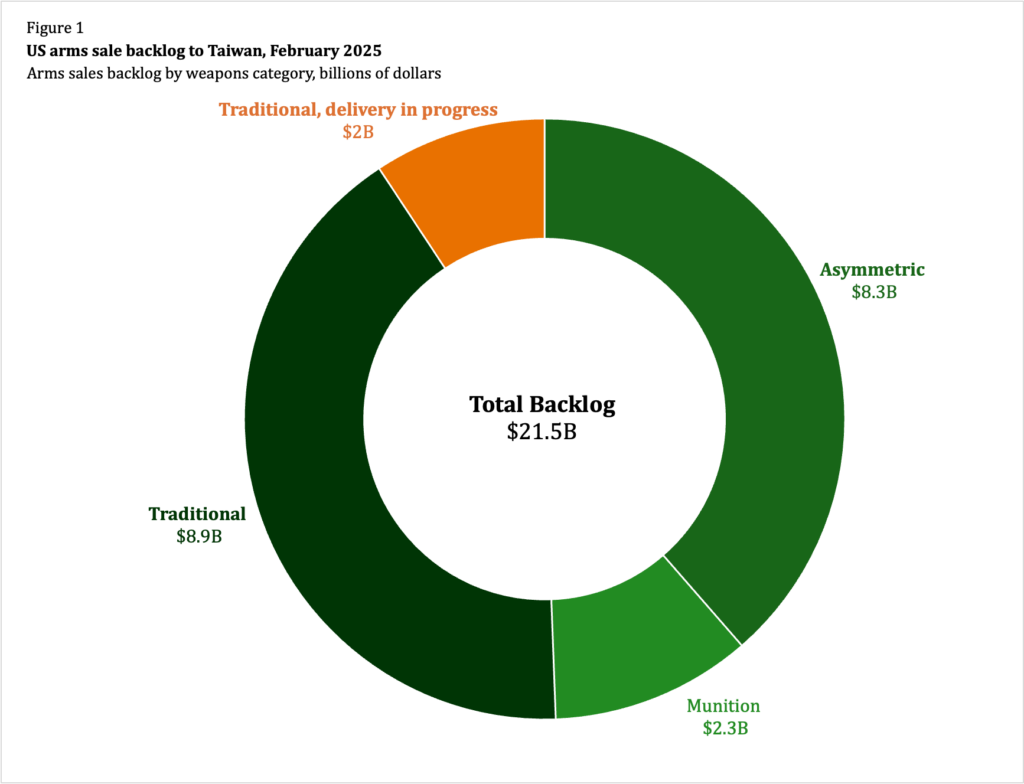
The backlog of US arms sales announced but not delivered to Taiwan did not change in March 2025. As shown in Figure 1, the backlog remains $21.54 billion.

New SIPRI Dataset Reveals a Large Delivery in Progress

SIPRI released its annual update to the Arms Transfer Database in March 2025, which brings the data current as of the end of 2024. Tracking the delivery status of arms sales, to Taiwan or any other country, is a very difficult task. SIPRIโ€™s dataset has been a valuable source of information for the Taiwan arms backlog project since its first publication in November 2023.

However, SIPRIโ€™s data is also imperfect. The 2025 edition of the dataset, for instance, categorizes the sale of 11 HIMARS systems to Taiwan as partially delivered, despite the Ministry of National Defense (MND) confirming full delivery in late 2024. SIPRI is also missing two major Taiwan arms sales from its dataset: a plus-up of 18 additional HIMARS and 100 PAC-3 MSE interceptors for the Patriot air and missile defense system. In SIPRIโ€™s defense, confirming the existence of these two arms sales was not easy. Because both cases were modifications to older arms sales, their notifications were published in the Congressional Record instead of the Defense Security Cooperation Agencyโ€™s website, which is a much more readily accessible source of information.

For the most part, SIPRIโ€™s 2025 update comports with other information I collected in 2024 about the arms sale backlog, but there was one noteworthy development.

According to SIPRIโ€™s dataset, Taiwan has started receiving components of the Harpoon Coastal Defense System or HCDS, a truck-mounted version of the Harpoon anti-ship missile. In October 2020, Congress received notification of a $2.37 billion sale of 100 HCDS launchers, 400 missiles, and 25 radar trucks. The HCDS case is the second-largest arms sale by dollar value in the backlog. In September 2024, Taiwanโ€™s Liberty Times reported that some HCDS equipment had arrived in Taiwan, but I did not feel confident coding HCDS as partially delivered at that time because the Liberty Times reporting was not well detailed.

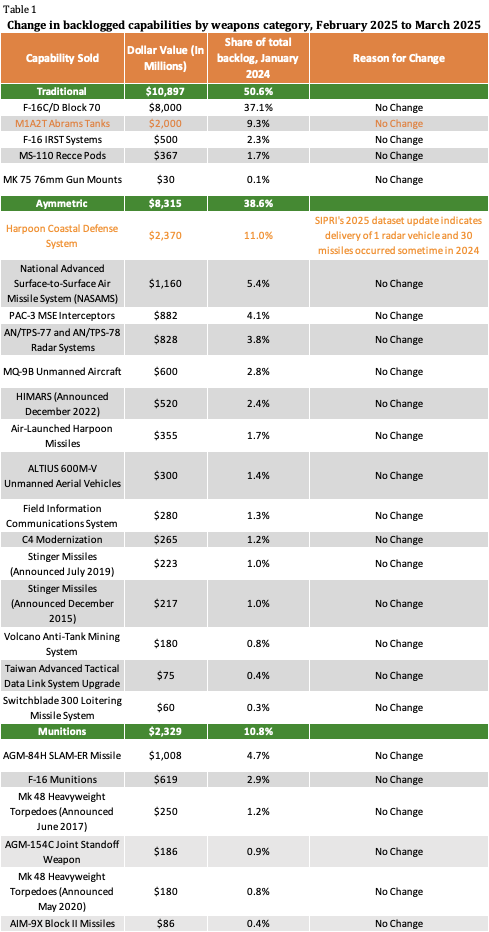
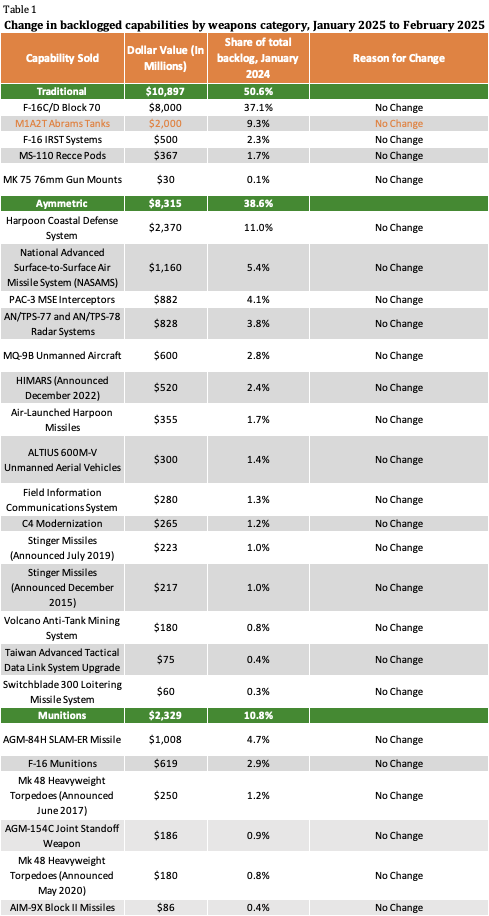
Based on SIPRIโ€™s data, I feel confident in changing the HCDS sale to partially delivered. Like the Abrams tank sale, this partial delivery status is expressed by a different color in the Figure 1 pie chart. As a reminder, the dollar value of the Taiwan arms sale backlog will not be reduced until final delivery of the arms sale occurs because trying to estimate a dollar value for partial delivery would be too difficult and likely inaccurate. Partial delivery of arms sales worth more than $1 billion are displayed visually in Figure 1 and noted with yellow text in Table 1.

First New F-16 Rolls Off Delivery Line

The largest arms sale in the backlog, 66 F-16 Block 70/72s valued at $8 billion, also saw a major development in March 2025, as the first aircraft rolled off the assembly line. Delivery of the first F-16 is approximately two years behind schedule. An October 2024 MND report to the Legislative Yuan cited software problems and other development bottlenecks as the main culprit for delays.

Although the first F-16 has now finished assembly, I have elected to not mark this sale as being partially delivered. The October 2024 MND report and March 2025 reports from Taiwanโ€™s Central News Agency and Taipei Times mention that there will be some gap between the new aircraft being produced and their delivery to Taiwan. This probably is because the aircraft will need to undergo some final flight testing and perhaps pilot training in the United States. Until the first F-16 Block 70/72 lands on Taiwanโ€™s territory, I will not consider this sale to be partially delivered.

The Taiwan Security Monitor will continue keeping tabs on the F-16, HCDS, and all other arms sales in the backlog.

How the Philippines Can Counter Chinaโ€™s South China Sea Aggression

Authors: Jonathan Walberg & Ethan Connell


TSM Associate Directorย Jonathan Walbergย and Research Team Leadย Ethan Connellย write about how the Philippinesโ€™ fragmented maritime response to Chinaโ€™s aggression in the South China Sea undermines its sovereignty while allowing Beijing to control the narrative and test U.S. resolve.

Read the full piece here.

Taiwanโ€™s Biggest Problem in Steeling Itself for War with China is Cultural

Author: Michael Hunzeker


TSM Directorย Dr. Michael Hunzekerย and Yuster Yu argue that Taiwanโ€™s biggest obstacle to preparing for war with China is not military spending or equipment, but a deeply ingrained and outdated military culture that resists reform, innovation, and societal integration.

Read the full piece here.

Taiwan Arms Backlog, February 2025 Update

Early Trump Admin Arms Sales and Rumors of a Big Request from Taiwan

By Eric Gomez

There were no new US arms sales to Taiwan announced or delivered between January and February 2025. The backlog remains $21.54 billion.

Figure 1 shows how the backlog is divided among traditional capabilities, asymmetric capabilities, and munitions. Table 1 contains an itemized list of arms sales in the backlog.

Sources: Defense Security Cooperation Agency: Press Release, US Congressional Record; โ€œMajor Arms Sales,โ€; DCSA Release; DCSA Major Arms Sales; DCSA Press Media TECRO; SIPRI Arms Transfers Database, Stockholm International Peace Research Institute; US Congressional Record; โ€œMajor Arms Sales,โ€ Defense Security Cooperation Agency; โ€œDefense News,โ€ Ministry of National Defense, Republic of China; โ€œLetter from the Ministry of National Defense, Submitting a Written Report on the โ€˜Implementation Status of US Arms Sales to Taiwanโ€™ for the 2024 Budget Resolution,โ€ Ministry of National Defense, June 12, 2024; and โ€œExcerpt from โ€˜Ministry of National Defense 2024 Annual Budget Assessment Reportโ€™,โ€ Ministry of National Defense, October 2023; and โ€œInformation on US Arms Sales to Taiwan,โ€ Ministry of National Defense, October 30, 2024.

Early Trump Arms Sales

February 2025 was a busy month in the world of foreign military sales (FMS) despite none going to Taiwan. The Trump administration notified Congress of nine FMS cases in February. Five of these cases, with a combined value of $10.4 billion, were for Israel.  

In three of the Israel arms sales, the Trump administration bypassed the standard Congressional review period for FMS cases by stating an emergency existed justifying an immediate sale. Normally, Congress would have either 15 or 30 daysโ€”depending on the recipient country, Israelโ€™s period is 15 daysโ€”to issue a joint resolution of disapproval to block the arms sale. The Trump administrationโ€™s invocation of an emergency is legal under the Arms Export Control Act, which governs FMS cases, but drew condemnation from several members of Congress arguing that the administration cut Congress out of politically sensitive sales.

Between inauguration day and the end of February, Middle Eastern countries have been the recipient of eight out of ten FMS cases (Japan and Romania have one sale apiece over the same period). It will be interesting to see if this trend continues. While there appears to be a consensus around reducing US focus on Europe, the administrationโ€™s approach to the rest of the world is not settled. Much of the administrationโ€™s senior foreign policy team has talked about focusing more on China, but recent arms sales and developments in March 2025 suggest more attention on the Middle East at least in the near term.

Rumors of a Large Taiwan Arms Sale

While there has been no official notification of the next US arms sale to Taiwan, the rumor mill was active in February. A Reuters report citing โ€œsources familiar with the situationโ€ said that Taiwanese and American officials were discussing a large arms sale with a price tag between $7 and $10 billion. The full scope of capabilities under discussion was not mentioned, but the Reuters article references HIMARS munitions and coastal defense cruise missiles. Taiwan is already waiting for delivery of these weapons from earlier arms sales, but both are asymmetric capabilities that would be good acquisitions for Taipei.

The last time the press reported on rumors of a Trump administration arms sale to Taiwan was in November 2024, shortly after the election. The Financial Times reported that Taiwan was thinking about making an overture to the incoming administration with a large weapons purchase. Traditional capabilities like F-35 fighter aircraft, E-2D airborne early warning and control aircraft, and retired Ticonderoga-class cruisers featured heavily in the November 2024 rumors, and the dollar figure was much higher at $15 billion.

With the caveat that none of the above information has been confirmed by either the US or Taiwanese governments, the change between the two reports is interesting. Traditional capabilities factored much more heavily in the earlier report, while the more recent report focused on asymmetric capabilities. Both packages would result in a sizable increase in the Taiwan arms sale backlog, but based on recent delivery timelines the February 2025 capabilities should arrive faster than the November 2024 capabilities.

Hopefully, as these negotiations unfold, Taiwan and the United States will keep moving closer to sales of asymmetric capabilities that are easier for Taiwan to afford and more likely to be delivered quickly. The appeal of traditional capabilities like F-35s or large surface warships is understandable, but given Taiwanโ€™s levels of defense spending and longer delivery timelines buying more traditional capabilities would be an imprudent use of time and money.

Conclusion

February 2025 did not see any changes in the US arms sale backlog to Taiwan, but it did provide a peek into important issues that could impact the backlog. The Trump administrationโ€™s early emphasis on the Middle East for new arms sales raises questions about whether the administrationโ€™s actions will reflect its โ€œChina firstโ€ rhetoric. New rumors about a pending US arms sale to Taiwan suggest ongoing tension between Taiwan going all in on asymmetric defense versus securing Trumpโ€™s favor via the purchase of high-priced traditional capabilities.

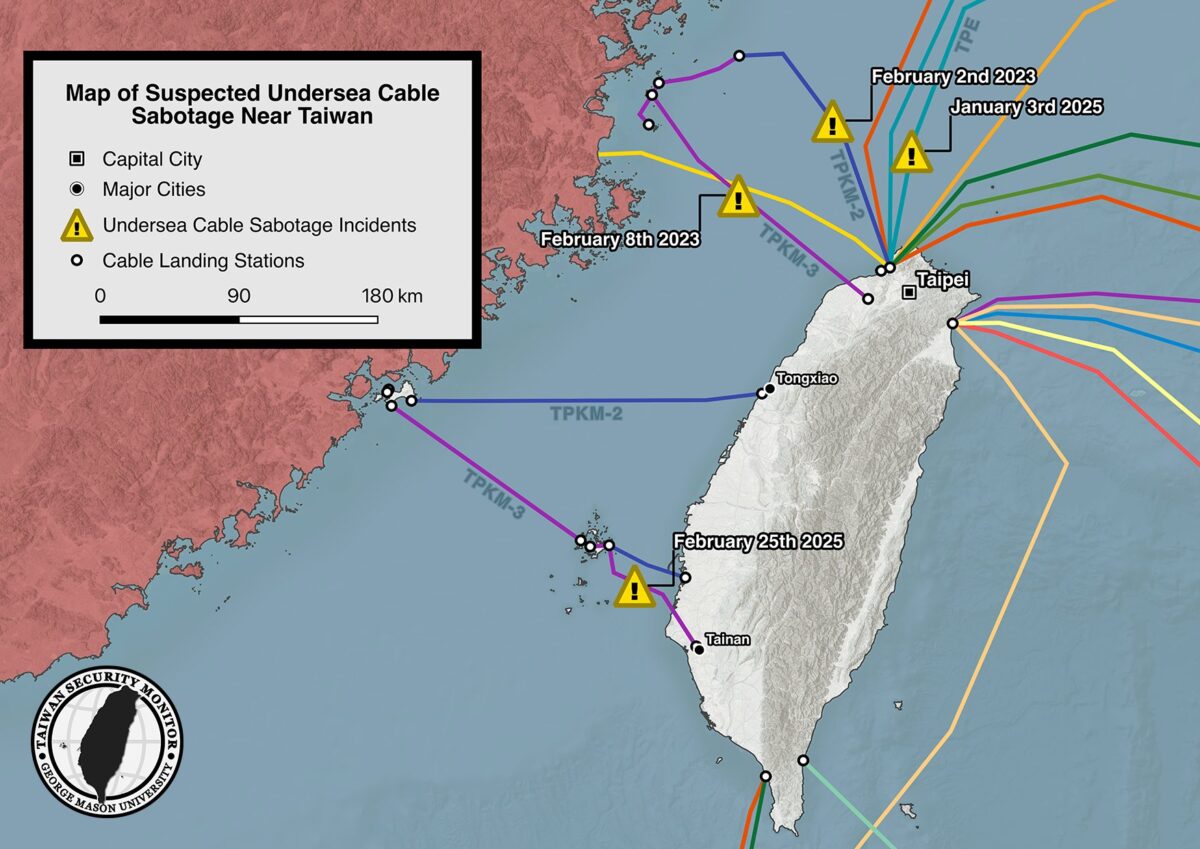
Visualization: Recent Cable Sabotage Incidents around Taiwan

Authors: Ethan Connell and Chris Dayton