Taiwan Security Monitor

Taiwan Affairs Office: More and more Taiwan compatriots recognize that the reunification of the motherland is unstoppable.

At the State Council Taiwan Affairs Office press conference on April 29, a reporter asked: Recently, Taiwanโ€™s โ€œDemocracy Culture and Education Foundationโ€ released its latest public opinion poll on the island, showing that 55.2 percent of respondents believe it is already very difficult for Taiwan to โ€œcontinue maintaining the status quoโ€; 61.6 percent agree that โ€œrather than waiting for the mainland to decide Taiwanโ€™s fate, Taiwan should proactively participate in negotiations and put forward the institutional conditions that would provide the greatest guaranteesโ€; and, if the status quo across the Strait cannot be maintained, 67.4 percent of respondents worry about losing their current way of life and rights. What is your comment?

State Council Taiwan Affairs Office spokesperson Chen Binhua responded by saying: The relevant poll shows that more and more Taiwan compatriots recognize that the historical trend of the motherlandโ€™s eventual and inevitable reunification is rolling forward and cannot be stopped. On the premise of ensuring national sovereignty, security, and development interests, after peaceful reunification, Taiwanโ€™s social system, way of life, and other arrangements will be fully respected, and the private property, religious beliefs, and lawful rights and interests of Taiwan compatriots will be fully protected. Peaceful reunification will create enormous opportunities for Taiwanโ€™s economic and social development, bring tangible benefits to the broad mass of Taiwan compatriots, and make Taiwanโ€™s future even brighter.

We are willing, on the common political foundation of upholding the โ€œ1992 Consensusโ€ and opposing โ€œTaiwan independence,โ€ to carry out broad and in-depth consultations with people from all political parties, sectors, and social strata in Taiwan on cross-Strait relations and the issue of national reunification. Together, we will promote the peaceful development of cross-Strait relations and advance the process of the motherlandโ€™s peaceful reunification. We welcome Taiwan compatriots from all walks of life to actively offer suggestions and proposals on the prospects for achieving the peaceful reunification of the motherland, and to firmly keep Taiwanโ€™s future and destiny in the hands of the Chinese people themselves.

Taiwan Affairs Office: The DPP authorities, in pursuing โ€œindependence,โ€ have become so โ€œanti-Chinaโ€ that they have reached the point of being anti-intellectual.

At the State Council Taiwan Affairs Office press conference on April 29, a reporter asked: Mainland Chinaโ€™s Amap app recently launched a โ€œtraffic light countdownโ€ feature in Taiwan, prompting praise from people on the island who said the navigation countdown is almost โ€œzero-error,โ€ convenient, and efficient. Some people in the DPP claimed there are security concerns, and the DPP authorities also said that, once such concerns are confirmed, they would first require public-sector agencies to stop using it and would advise the public not to use it. What is your comment?

State Council Taiwan Affairs Office spokesperson Chen Binhua responded by saying: The mainland possesses world-leading digital map, navigation, and location-service technologies. Many applications have already been widely used for years on the mainland and in some countries and regions, meeting peopleโ€™s practical needs, making travel more time-saving and convenient, and making life more convenient and richer. This is a concrete example of technological development benefiting humanity. In addition to Amap, the mainland has many other innovative, high-quality products and advanced, cutting-edge technologies. Compatriots on both sides of the Strait are one family, and we are happy to let Taiwan compatriots be among the first to share in them.

In order to pursue โ€œTaiwan independence,โ€ the DPP authorities have taken their โ€œanti-Chinaโ€ stance to the point of being anti-intellectual and anti-technology. Since the DPP came to power, a strange phenomenon of ideological confinement and suppression of speech has emerged in Taiwan society. The most typical examples are that one cannot say โ€œnoโ€ to the United States, and one cannot say anything good about the mainland. Simply because mainland technology and products are useful and popular with people in Taiwan, they try to prevent Taiwan people from using them. This is truly seeing imaginary threats everywhere, absurd and laughable. Such actions do not have popular support and will not succeed.

Taiwan Affairs Office: A first-rate military and strong national defense are the sharp sword for defeating any separatist plot.

At the State Council Taiwan Affairs Office press conference on April 29, a reporter asked: April 23 marked the 77th anniversary of the founding of the Peopleโ€™s Navy. During Navy Day, the Peopleโ€™s Navy held ship open-house events in Qingdao and other locations, attracting Taiwanese media reporters, several Taiwanese political commentators and online influencers, as well as many members of the Taiwanese public. They reportedly praised the achievements of the Peopleโ€™s Navyโ€™s development and said that only with the protection of the Peopleโ€™s Army can the people of Taiwan avoid being bullied by foreign enemies. What is your comment?

State Council Taiwan Affairs Office spokesperson Chen Binhua responded by saying: Since the beginning of the new era, the Peopleโ€™s Navy has strengthened itself through the sea and advanced into the deep blue. This yearโ€™s Navy Day open-house activities displayed the new achievements and new image of the Peopleโ€™s Navyโ€™s development, and demonstrated the Peopleโ€™s Navyโ€™s firm will, strong determination, and powerful capabilities to defend territorial waters, territorial airspace, and national sovereignty. The heartfelt exclamations made by Taiwanese people after their visits expressed the common sentiment of compatriots on both sides of the Strait: only a first-rate military and strong national defense can serve as the most reassuring backing for Chinese sons and daughters at home and abroad, and as the sharp sword for defeating any plot to split China.

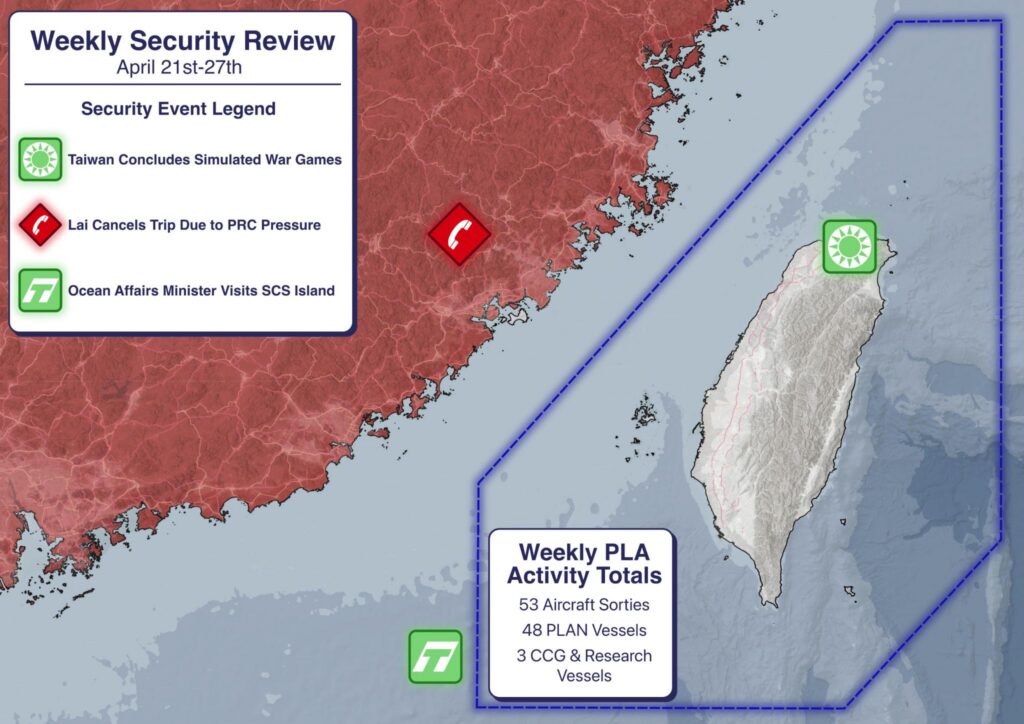
Weekly Security Review: 4/27/26

Authors: Mina Chen, Danielle Kremer, Jaime Oconย 


Welcome to the Weekly Security Review, where we highlight key military, security, and political developments around Taiwan in one straightforward summary!

This week, Taiwan wraps up simulated wargames ahead of live-fire drills, the countryโ€™s ocean minister visits the disputed South China Sea, and President Lai is pressured to cancel his visit to Africa. 

Taiwan Concludes Computer-Simulated Wargames

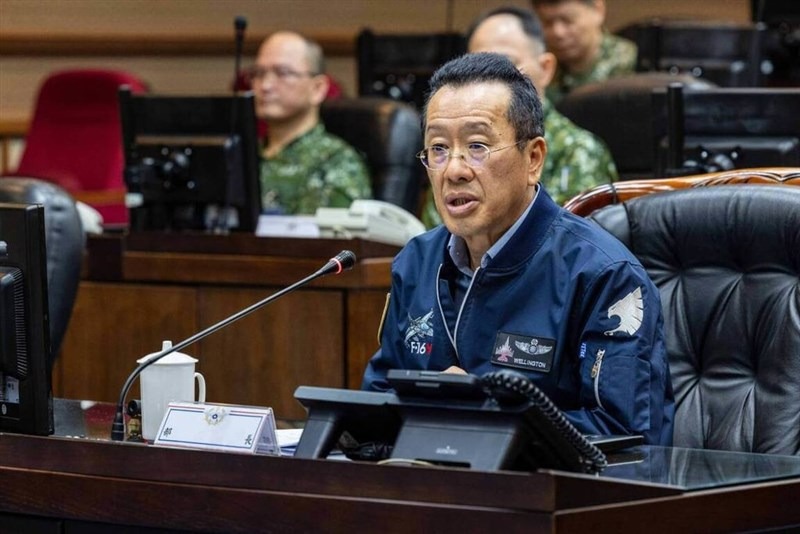
Taiwanโ€™s Ministry of National Defense (MND) concluded the computer-simulated phase of its annual Han Kuang military exercises on April 25. For 14 days, the military used intensive wargaming software to stress-test the decision-making capabilities of the island’s armed forces under simulated combat conditions. Minister of National Defense Wellington Koo made the announcement on social media and described it as a “nonstop” high-intensity tabletop exercise environment. Koo added that the wargames were structured around a scenario that deliberately escalated, beginning with gray-zone harassment tactics and advancing toward full-scale high-intensity military conflict. The minister also said that this yearโ€™s exercise incorporated lessons from recent international conflicts, including multi-domain battlefield dynamics and hybrid threat elements. The inclusion of these lessons reflects Taiwan’s attitude in recognizing that any future conflict in the strait would be fought across conventional, cyber, informational, and electronic domains simultaneously.

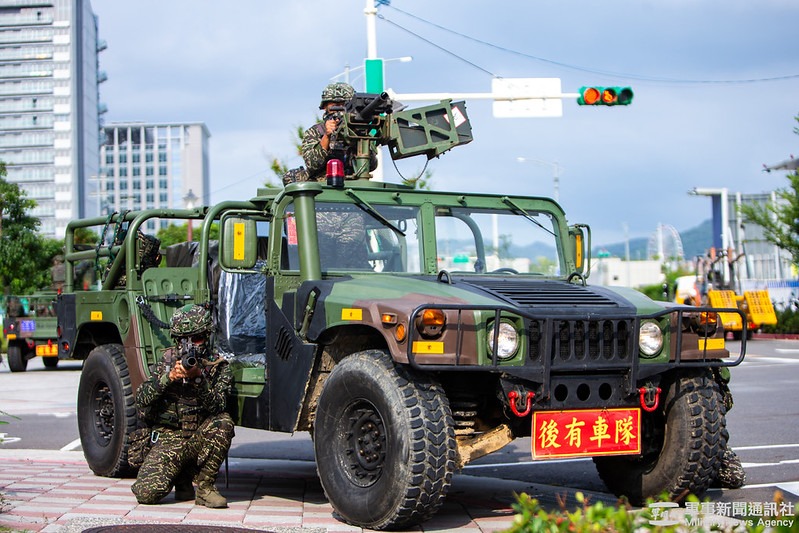
One of the most significant aspects of this year’s Han Kuang exercise is its emphasis on command-and-control resilience amid coordinated enemy strikes. Military sources say that the simulation forced administrative units, armament divisions, and joint operational command centers to disperse to separate locations throughout the exercise. This design choice was intended to check that backup command mechanisms could sustain wartime functions even if the primary infrastructure was degraded or destroyed. 

These simulations are part of the lessons that Minister Koo mentioned, as wars in Ukraine and the Middle East have shown that centralized command nodes pose critical vulnerabilities. Taiwanโ€™s MND says survivable and redundant command architecture is not a secondary consideration but a foundational requirement of credible deterrence. Taiwan hopes that by using live exercise conditions, it can demonstrate its seriousness to other countries regarding an approach to defense. 

The live-fire phase of Han Kuang is scheduled for August, and soldiers, as well as commanders, will be looking to translate the lessons of the tabletop environment into operational reality. 

Taiwanโ€™s Ocean Affairs Minister Visits South China Sea Island

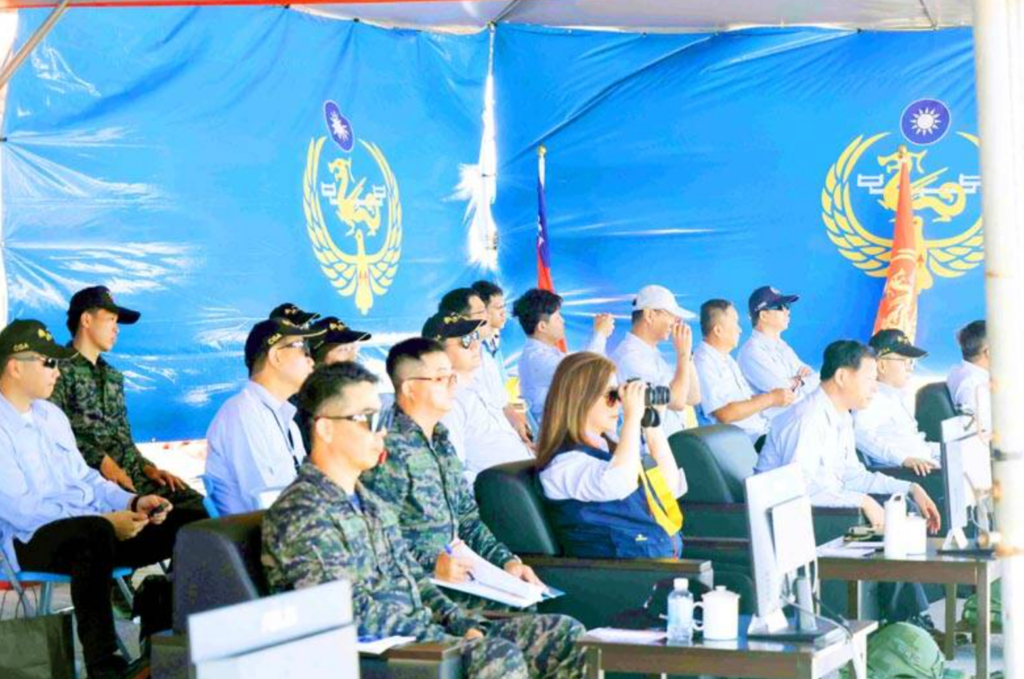
On April 23, the minister of Taiwan’s Ocean Affairs Council (OAC), Kuan Bi-ling, visited Itu Aba, also known as Taiping Island, to observe a maritime rescue drill held by representatives from the OAC’s Coast Guard Administration (CGA), as well as Taiwan’s ministries of transportation, defense, health, and foreign affairs.  Itu Aba lies approximately 1,600 kilometers (860 nautical miles) southwest of Kaohsiung and has historically been claimed by China, Vietnam, and the Philippines. Though many nations lay claim to the island, the Taiwanese government has administered it as part of Cijin District, Kaohsiung. This drill consisted mainly of Coast Guard drills, beginning with special forces practicing armed boarding of suspicious cargo ships and escort to the island’s dock. The drill also simulated interactions with a distressed Vietnamese-registered fishing vessel and a cargo ship, where crewmembers were injured, with some falling overboard. For this part, the Coast Guard dispatched a rescue team and unmanned aerial vehicles, while the Ministry of National Defense (MND) deployed a C-130 transport aircraft to evacuate the injured crew members. During this exercise, they also simulated an oil spill, which the OAC claims was contained using temporary floating barriers (containment booms) used to contain hazardous materials on water by encircling the spill to stop it from spreading.

Itu Aba has a runway capable of handling military supply flights and a recently upgraded wharf that can receive large patrol vessels. The 200 inhabitants of the island are mostly coast guard members who train for both security and rescue work. Its location in the South China Sea makes it a strategic outpost for maritime surveillance and control, as well as a key shipping route for international maritime trade. This is the first time in 7 years that a minister of Taiwan’s OAC has visited the island, showing renewed attention to the strategic importance of South China Sea security.

Taiwan President Cancels Eswatini Visit Due to Chinese Pressure

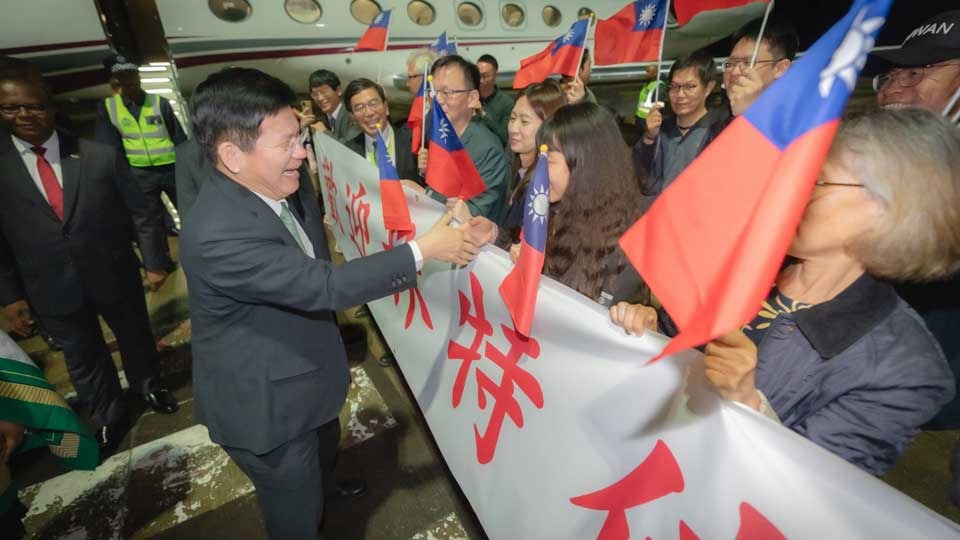
President Lai Ching-te has cancelled a scheduled visit to Eswatini after three African countries withdrew overflight permissions for his aircraft due to pressure from China.

Lai was set to arrive in the kingdom on April 22 for a five-day visit to attend events marking the 40th anniversary of King Mswati III’s accession to the throne and the king’s birthday. The trip was called off after Seychelles, Mauritius, and Madagascar revoked permission for his aircraft to cross their airspace. Pan Meng-an, Secretary-General to the president, attributed the withdrawals to strong pressure from Chinese authorities. China’s Taiwan Affairs Office praised the three nations on April 22, expressing “high appreciation” for their adherence to the “one-China principle.” 

In response, Taiwan dispatched Minister of Foreign Affairs Lin Chia-lung to Eswatini as President Lai’s special envoy. Lin arrived on April 25 and attended the celebration on Taipei’s behalf. During the visit, the minister signed a memorandum of understanding (MOU) with Eswatini’s Minister of Foreign Affairs and International Cooperation Pholile Shakantu on countering disinformation and promoting information integrity. 

The U.S. State Department criticized Beijing’s actions as an abuse of the international civil aviation system and called on China to cease its efforts to intimidate third countries into restricting Taiwan’s freedom of movement. The episode underscores the constant pressure on Taiwan’s already diminished diplomatic standing. Eswatini remains Taiwan’s sole formal ally on the African continent and one of just 12 countries worldwide that still maintain official ties with Taipei.

Weekly Arms Update:ย 4/22/26ย 

Authors: Joe Oโ€™Connor,ย Shikhar Chaturvedi, Danielle Kremer & Wyeth Lindbergย 


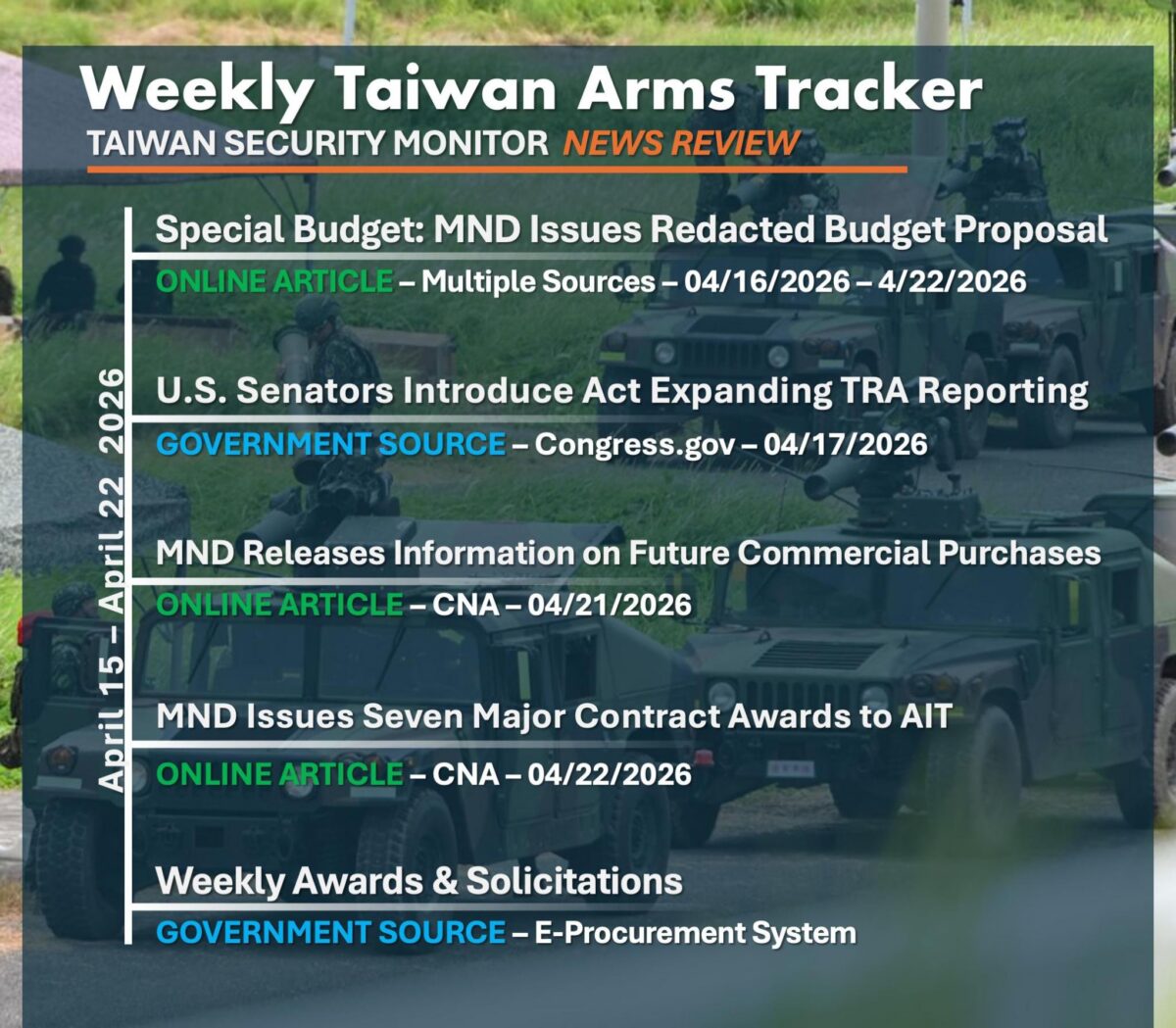
This week: special budget negotiations continued, featuring statements from key stakeholders; two U.S. Senators introduced an act to expand reporting on the Taiwan Relations Act; the MND released statistics on future ammunition purchases; and the MND released seven major contract awards to American contractors; alongside weekly contracts and solicitations. 

Special Budget: MND Issues Redacted Budget Proposal 

Statements from stakeholders involved in or observing special budget negotiations proliferated this week, beginning with a letter from four U.S. Senators, including Senate Foreign Relations Committee Ranking Member Jeanne Shaheen, expressing to Legislative Yuan leaders the need to โ€œapprove a supplementary defense budgetโ€ that addresses ongoing U.S. sales to Taiwan, as well as โ€œspeedier domestic production.โ€ At a military inspection in Kaohsiung on Friday, President Lai also called for passage, reiterating the need for โ€œconstant preparedness.โ€ At a forum in Taipei on the same day, retired U.S. Navy Adm. Mark Montgomery urged the LY to pass a special budget before a Trump-Xi summit in May, warning that not doing so would weaken Taiwanโ€™s relations with the U.S. 

On Sunday, Kuomintang (KMT) media personality, Jaw Shaw-kong, stated that he would support a proposal worth NT$810 billion (US$25.64 billion), tying approximately NT$350 billion of that to existing U.S. arms sales, and holding the remaining NT$460 billion for future U.S. sales. Jaw stated that he came to this number after subtracting budget items for domestic procurement from the Lai administrationโ€™s proposal. 

On Monday, the LYโ€™s Foreign Affairs and National Defense Committee held a closed-door hearing, where Minister of National Defense Wellington Koo laid out a new, partially redacted version of the Lai administrationโ€™s NT$1.25 trillion (US$40 billion) spending proposal. In the hearing, Koo continued to play defense, responding to Jawโ€™s comments by urging the MNDโ€™s need to plan around operational needs.  

On Tuesday, in a Senate Armed Services Committee hearing, U.S. Indo-Pacific Command commander, Admiral Samuel Paparo, stated that progress on the special budget would reflect โ€œhow committedโ€ Taiwan is to its own defense, among other comments. A Reuters report on the hearing also revealed that KMT officials had assured Democratic aides visiting Taiwan in March that a defense proposal would eventually be passed. 

U.S. Senators Introduces Act Expanding TRA Reporting  

A bipartisan group of senators introduced the โ€œTaiwan Relations Reinforcement Actโ€ (S.4294) on April 14, which would require the Department of Defense to submit an annual report assessing the United Statesโ€™ capacity to fully implement the Taiwan Relations Act (TRA). The bill mandates a detailed evaluation of U.S. ability to deter and respond to a range of Taiwan contingency scenarios, including amphibious invasion, blockade, and large-scale missile strikes, while also assessing gray zone coercion across cyber, economic, and information domains. It further requires analysis of U.S. force posture in the Indo-Pacific and the sustainability of operations in a prolonged conflict, alongside the role of allied contributions. Notably, the report must identify capability gaps, estimate future shortfalls over a ten-year horizon, and outline budgetary and force structure changes needed to meet TRA obligations. The legislation also calls for an assessment of U.S. capacity to respond to a Taiwan contingency in the context of managing other global conflicts, underscoring growing congressional concern over resource constraints and multi-theater readiness. 


MND Releases Information on Future Commercial Purchases 

On April 21st, Taiwanโ€™s Ministry of National Defense announced a list of weapons systems it intends to acquire through direct commercial sales (DCS) and domestic manufacturing, many of them being unmanned systems and ammunition. The MND stated that this process would involve working with the National Chung-Shan Institute of Science and Technology (NCSIST) and the Armaments Bureau to achieve the expected results. This would all be part of the US$40 billion (NT$1.25 trillion) special budget plan the DPP and Lai administration proposed in November of 2025. Approximately a quarter of the budget proposal will go to domestic procurement and indigenous production capabilities, with the remaining 76% going to purchases of United States weapons systems.  

MND Issues Seven Major Contract Awards to AIT 

This past week, the Ministry of National Defense awarded 7 major contracts to the American Institute in Taiwan; one Air Force award on Tuesday and six today. 

According to information published yesterday on Taiwanโ€™s government e-procurement website, the Air Force Command awarded the American Institute in Taiwan (AIT) a NT$572.60 million (US$18.19 million) contract for โ€œother support services,” with Liberty Times reporting a performance period of five years. On Wednesday, the Army Command awarded contracts for โ€œMissile combat reserve replenishment,โ€ “Long-range precision strike systems,” and โ€œSelf-propelled artilleryโ€, for various amounts noted below. The Naval Command awarded a contract for “Anti-armor missiles.” The Armaments Bureauโ€™s Production and Manufacturing Center awarded a contract for the โ€œCo-production of large-caliber ammunition.โ€ These awards come as the fate of the special budget, funding from which would likely pay for these tranches, remains undecided as Legislative Yuan leaders debate the scope of approved spending. 

Weekly Awards/Solicitations  

On Thursday, the Naval Command awarded RH Marine a NT$33.32 million (US$1.06 million) contract for 11 items, including oscillators. RH Marine is a Dutch company that designs and integrates advanced electrical and automation systems for both civilian and military naval vessels. The contract is to be fulfilled throughout the southern region of Taiwan. 

On Friday, the Army Command awarded seven companies a NT$1.80 billion (US$57.27 million) contract for frozen meat products. The contract is to be fulfilled nationwide. 

Also on Friday, the Army Logistics Command awarded a NT$339.11 million (US$10.77 million) contract to NCSIST for the outsourced maintenance of the Armyโ€™s “Phase II Mobile Digital Microwave System” for FY2026โ€“2030. The contract is to be fulfilled in the Zhongli District of Taoyuan. 

On Tuesday, the Air Force Command awarded American Institute in Taiwan a NT$572.60 million (US$18.19 million) contract for โ€œother support servicesโ€. 

Also on Tuesday, the Armaments Bureau made a repeat solicitation of bids for the purchase of engineering services for dry dock construction, as part of the Weihai project. The solicitation is valued at NT$6.10 billion (US$193.50 million). 

On Wednesday, several awards were announced: 

  • Theย Army Commandย awardedย the American Institute in Taiwanย aย NT$5.32ย billionย (US$168.98ย million)ย contractย forย โ€œMissile combat reserve replenishmentโ€.ย The contract is to be fulfilled inย Taichung (Houli and Daya Districts), Kaohsiung (Alian District), Pingtung (Wanluanย Township)ย andย Hualien (Hualienย County).ย 
  • Theย Army Commandย awardedย the American Institute in Taiwanย a NT$123.50ย billionย (US$3.92 billion) contractย forย “Long-range precision strike systems”. The contract is to be fulfilled inย Taoyuan (Zhongli District), Taichung (New Community), Tainan (Guanmiaoย District)ย andย Kaohsiung (Qishan District).ย 
  • Theย Army Commandย awardedย the American Institute in Taiwanย aย NT$73.89ย billion (US$2.35ย billion)ย contractย forย “Self-propelled artillery”. The contract is to be fulfilled inย Taoyuan (Zhongliย andย Pingzhenย Districts)ย andย Tainan (Guanmiaoย District).ย 
  • Theย Naval Commandย awardedย the American Institute in Taiwanย aย NT$5.13ย billionย (US$162.75ย million) contractย forย “Anti-armor missiles”. The contract is to be fulfilled inย Taoyuanโ€™sย Guishanย District andย Kaohsiungโ€™sย Linyuanย District.ย 
  • Theย Armaments Bureauโ€™s Production and Manufacturing Centerย awardedย the American Institute in Taiwanย aย NT$910.45 million (US$28.91ย million)ย contractย forย the โ€œCo-production of large-caliber ammunitionโ€.ย The contract is to be fulfilled inย the Zhongshan andย Nagangย Districts of Taipei.ย 
  • Theย General Staffย awardedย the American Institute in Taiwanย a NT$22.88ย million (US$0.73ย million)ย contractย forย โ€œIntegrated air defense servicesโ€.ย Integrated air defense services likelyย refersย to Taiwanโ€™s air and missile defense system,ย the T-Dome.ย The contract is to be fulfilled inย theย Zhongshanย districtย ofย Taipei.ย 

Taiwanโ€™s Mine Warfare Gap: The Distance Between Concept and Capability

Author: Ethan Connell


Naval mines represent one of the few weapon systems capable of imposing disproportionate costs on an amphibious assault force. In a potential Taiwan contingency, mines could delay Peopleโ€™s Liberation Army (PLA) shipping, channel invasion routes into designated kill zones, deny port access, and compel an attacker to allocate valuable time to mine clearance before initiating troop landings. Given that Taiwanโ€™s survival in a cross-Strait conflict relies on gaining time for mobilization and potential external intervention, mines should occupy a central role in defense planning.

The effectiveness of Taiwanโ€™s mine warfare (MIW) and mine countermeasures (MCM) posture depends on several factors: the number of platforms, delivery methods, survivability in combat, mine quality, and the operational geography and threat environment. When evaluated against these criteria, Taiwan presents a mixed picture. While significant investments in offensive minelaying have occurred since 2020, the MCM fleet remains outdated and insufficient for modern threats; minelayers are slow and lightly armed, and there is no confirmed air-delivered mine capability. The gap between doctrinal ambition and practical wartime capability remains substantial. Rather than exhibiting asymmetric innovation, Taiwanโ€™s MIW and MCM posture illustrates the challenges of translating strategic concepts into a survivable, operational force structure.

The Operational Logic of Mining the Strait

Any PLA amphibious assault would require moving large numbers of troops, vehicles, and supplies across 130 to 220 kilometers of open water. That crossing force must load at embarkation ports, transit the strait, and arrive at a limited set of suitable landing areas on Taiwanโ€™s western coastline. Mines can impose costs at each stage.

Taiwan can mine its own coastal waters, port approaches, and landing beaches to slow or funnel an invasion fleet. Mines laid in the strait or near PLA embarkation points could delay loading operations and force PLA commanders to commit mine countermeasures assets before the crossing begins. The Taiwan Straitโ€™s bathymetry favors mining, with average depths of about 60 meters, the Taiwan Banks (averaging 20 meters) at the southern entrance, and the Changyun Ridge extending westward from Taiwan at around 30 meters depth. These conditions make the strait especially suitable for bottom and moored mines while compressing commercial and military traffic into predictable routes. The entire strait sits on Asiaโ€™s continental shelf, within the operational envelope of all modern mine types.[1]

Three categories of capability matter here: Offensive mining targets the adversaryโ€™s waters and transit routes. Defensive mining protects oneโ€™s own ports, littorals, and landing areas. Mine countermeasures, including the detection, classification, and neutralization of enemy mines, protect oneโ€™s own freedom of movement. Taiwan needs all three, and faces different constraints in each.

Effectiveness in each category relies not only on hardware but also on the supporting operational infrastructure. This includes pre-delegation of authority to conduct mining before hostilities commence, dispersed stockpiles at multiple embarkation points, rehearsed loading and deployment procedures, integration with broader coastal defense plans, and hydrographic preparation of minefields. While it is difficult to determine from open sources whether Taiwan has established this architecture, this uncertainty significantly influences assessments of the subsequent force structure.

Taiwanโ€™s Minelaying Capability

Taiwanโ€™s most notable recent investment is the Min Jiang-class fast minelayer, built by Lung Teh Shipbuilding in Yilan County. These 347-ton vessels are the Republic of China Navyโ€™s (ROCN) first purpose-built minelaying platforms. The ROCN commissioned four hulls in January 2022, assigning them to the 192nd Fleetโ€™s Mine Laying Unit at Zuoying Naval Base in Kaohsiung.[2] In March 2025, Taiwanโ€™s Ministry of National Defense (MND) opened a third tender for six additional vessels, budgeted at NT$1.8 billion (US$54.8 million), after two prior tenders failed to attract the minimum number of bids required under procurement law.[3] If that procurement project succeeds, Taiwan will operate 10 dedicated minelayers by around 2027.

Each Min Jiang-class vessel can carry up to 64 Mk-6 mines, 64 Wan Xiang I conical mines, 36 Wan Xiang I cylindrical mines, 40 Wan Xiang II moored mines, or 32 Wan Xiang II bottom mines.[4] The vessels use an automated mine-laying system developed by the National Chung-Shan Institute of Science and Technology (NCSIST), a significant improvement over the manual methods used on the converted landing craft that served as Taiwanโ€™s improvised minelayers before 2022.

The mine inventory spans two families. The Wan Xiang family, developed by NCSIST, includes influence, moored, and bottom variants. NCSIST has also pursued development of self-propelled mines and new shallow- and deep-water influence types, though open-source confirmation of their operational status is limited.[5] Alongside these indigenous systems, Taiwan maintains stockpiles of the U.S.-designed Mk-6 moored contact mine, a design dating to 1917. The ROCN used Mk-6 mines in training exercises as late as 2024.[6]

Reliable estimates of Taiwanโ€™s total mine stockpile are unavailable in open sources. This issue is significant: even with 10 minelayers, each capable of carrying 32 to 64 mines per sortie, the total number of mines that could be deployed in the initial hours of a conflict depends on the depth of the stockpile, distribution across multiple loading points, and the number of sorties each vessel can complete before suffering losses. 10 minelayers, each conducting two sorties, could deploy between 640 and 1,280 mines, which is notable but not decisive given the straitโ€™s width and the number of potential approaches. Whether Taiwanโ€™s inventory can sustain mining operations beyond the initial wave remains uncertain and carries important operational implications.

Available open-source reporting indicates that Taiwan does not possess a confirmed air-delivered mine capability. Reports from approximately 2018 noted Taipeiโ€™s interest in acquiring U.S. Quickstrike mines, which can be deployed by aircraft at range and glide to their targets; however, this acquisition did not occur.[7] Air-delivered mines offer faster and longer-range deployment compared to ship-based methods and eliminate the need for slow surface platforms to enter contested waters. The absence of this capability constitutes a significant operational gap.

Taiwanโ€™s Mine Countermeasures Fleet

Taiwanโ€™s mine countermeasures posture tells a different story than its investment in minelaying. The ROCNโ€™s MCM fleet consists of four Yung Feng-class minehunters built in Germany by Abeking and Rasmussen in 1991, two Yung Jin-class minehunters (ex-U.S. Navy Osprey-class), and a single remaining Yung Yang-class minesweeper, a former U.S. Navy Aggressive-class vessel whose design dates to the 1950s.[8]

PlatformTypeNumberStatus / Notes
Min Jiang-classFast minelayer4 (+ 6 planned)347 tons; commissioned 2022; 14 kt max; 32โ€“64 mines per sortie
Yung Feng-classMinehunter4German-built (Abeking & Rasmussen), 1991; aging sonar and mechanical sweeping
Yung Jin-classMinehunter2Ex-USN Osprey-class; fiberglass hull; limited against modern mine threats
Yung Yang-classMinesweeper1Ex-USN Aggressive-class; 1950s-era design; wooden hull

These platforms are capable of conducting limited coastal mine clearance under permissive conditions. However, none are equipped to address the full spectrum of modern mine threats, such as rocket-rising mines, smart mines with anti-sweep features, or mines with target discrimination algorithms, all of which the PLA is assessed to possess or be developing.[9]

A failed modernization program compounds the problem. In 2014, the MND awarded a NT$35 billion (about US$1.2 billion) contract to a consortium of Ching Fu Shipbuilding, Lockheed Martin, and Italyโ€™s Intermarine to build six new MCM vessels. In 2017, prosecutors raided Ching Fuโ€™s offices. The companyโ€™s chairman was charged with forgery and loan fraud. The contract collapsed.[10] No replacement program has been announced. Taiwanโ€™s MCM fleet has been frozen in time for over a decade, with no confirmed path to modernization.

Operational Constraints and Wartime Viability

Despite Taiwanโ€™s investments, operational constraints significantly limit the potential effectiveness of its mine warfare forces in combat. These constraints differ between minelaying and mine clearance, but both are fundamentally shaped by the disparity between theoretical platform capabilities and their survivability under PLA attack.

The Min Jiang-class maxes out at 14 knots. That speed cannot outrun any modern combatant, anti-ship missile, or armed helicopter. For self-defense, the vessels carry a single T-75 20mm autocannon and two 7.62mm machine guns, with negligible protection against PLA anti-ship cruise missiles. A Beaufort 3 sea-state limitation on the class restricts operations to calm weather, meaning rougher conditions could prevent the vessels from laying mines when needed most or confine them to predictable windows that the PLA could monitor and target. Minelaying also demands that ships follow predetermined tracks at consistent, low speeds, turning them into predictable targets.[11]

PLA intelligence, surveillance, and reconnaissance (ISR) capabilities compound these problems. Chinaโ€™s ISR satellite constellation exceeded 359 systems as of early 2024, triple that of 2018, covering electro-optical, synthetic aperture radar, and signals intelligence. PLA aircraft conducted over 3,600 flights into Taiwanโ€™s air defense identification zone in 2024.[12] Under these conditions, minelayers departing Zuoying would face a high probability of detection and tracking, particularly in the pre-conflict period when PLA surveillance is already at elevated levels. Whether continuous tracking would persist amid the fog and friction of active combat is less certain, but the vulnerability in peacetime and the crisis phase is clear.

This presents a timing problem with no clear answer. Mines work best when laid before hostilities begin or in the first hours of a conflict.[13] Pre-war mining of international waters, however, would be politically provocative and could accelerate escalation. Waiting until conflict starts risks PLA missile strikes suppressing minelayers before they finish their runs. Taiwanโ€™s Overall Defense Concept envisions minelaying during a crisis or mobilization phase, but whether Taiwanese political leadership would authorize mining before the first shots are fired, and whether the operational architecture for rapid, pre-delegated deployment exists, remain open questions.[14]

Mine warfare effectiveness in this context is influenced by more than the number of dedicated platforms. Factors such as air superiority over the strait, missile suppression of embarkation areas, hydrographic knowledge of planned minefields, availability of pre-surveyed mine positions, and external assistance from partners all affect the number of mines deployed and their operational impact. Taiwanโ€™s minelaying capacity should be assessed as part of an integrated coastal defense architecture, recognizing that other components of this system also face significant constraints.

On the minelaying side, even a small number of mines laid in the strait or near PLA embarkation points could impose real costs: PLA commanders would have to commit MCM assets, delaying the crossing timeline and introducing uncertainty into an operation that demands precise coordination. The psychological burden of mines is well-documented: the suspicion of a minefield, even an unconfirmed one, can halt or reroute naval operations for days.

However, Taiwanโ€™s capacity to realize this potential under combat conditions is limited. With four operational minelayers (potentially 10 by 2027), each with a maximum speed of 14 knots and minimal self-defense capabilities, and operating under intense surveillance in the Western Pacific, the likelihood of successfully conducting large-scale mining operations after hostilities commence is low. The absence of air-delivered mines further deprives Taiwan of the most survivable and responsive means of delivery.

The imbalance is even more pronounced regarding mine countermeasures. Mine clearance is inherently slow, hazardous, and resource-intensive. Taiwanโ€™s current MCM fleet is insufficient for the scale of the threat. Should the PLA mine Kaohsiung, which manages over 60 percent of Taiwanโ€™s cargo trade, the islandโ€™s capacity to sustain itself during a blockade or invasion would rely on mine clearance capabilities that are presently inadequate to meet the challenge.[15]

The MCM problem runs in the opposite direction from minelaying. The PLA holds an estimated 50,000 to 100,000 naval mines and can deliver them by submarine, aircraft, surface ship, or, conceivably, civilian vessel.[16] If the PLA mines Taiwanโ€™s port approaches before or during an assault, Taiwanโ€™s aging MCM fleet would be overwhelmed. The PLA can seed Taiwanโ€™s ports with mines far faster than Taiwan can clear them.

The PLAโ€™s Own Mine Clearance Problem

The discussion so far has treated the PLA primarily as a mine-laying actor and an ISR threat. But an amphibious crossing of the Taiwan Strait would also require the PLA to clear mines from its own approach routes: either mines laid defensively by the ROCN in coastal waters and around landing beaches, or mines laid by the PLAN itself to deny port access or deter outside involvement. This is not a trivial requirement to overcome.

The PLA Navy (PLAN) operates a fleet of Type 082 (Wozang-class) and Type 081 (T-43-class) minesweepers, supplemented by newer Type 082-II MCM vessels. Open-source assessments suggest the PLAN has roughly 24โ€“36 dedicated MCM platforms, a modest number relative to the scale of an amphibious operation across a strait that could be mined at multiple points.[17][18] The PLAN has invested in unmanned mine-clearance systems and towed sweeping gear, but whether these assets could clear defended minefields under fire, while Taiwanโ€™s anti-ship missiles, shore-based artillery, and surviving naval units remain in play, is far from certain.

This reciprocal vulnerability is analytically significant. While Taiwanโ€™s mine warfare gap is genuine, the PLA also faces substantial MCM constraints. If Taiwan succeeds in deploying even a moderate number of mines in critical locations before or during the initial phase of conflict, the PLAโ€™s limited MCM capacity could create a bottleneck in the amphibious operation timeline. Thus, the mine warfare balance reflects not only Taiwanโ€™s limitations but also the mutual clearance challenges faced by both sides.

Mine Warfare in the Broader Force Design Debate

Taiwanโ€™s mine warfare posture aligns with the broader argument for asymmetric defense. The ODC, formulated by former Chief of the General Staff Admiral Lee Hsi-min, places mines among the key littoral and beach defense capabilities alongside anti-ship cruise missiles and mobile coastal defense systems.[19] President Lai Ching-te personally inspected a live mine-laying drill during the Han Kuang 41 exercise in July 2025, signaling political commitment.[20]

However, political commitment does not necessarily translate into operational capability. Several critical questions remain unresolved in open-source analysis. Is the mine inventory sufficient in both quantity and sophistication to impose a meaningful delay on a PLA crossing force, or does it serve primarily as a symbolic deterrent? Has Taiwan developed the necessary doctrine, training, and operational infrastructure to employ mines effectively under wartime conditions, including pre-delegation of authority, pre-positioned stocks at dispersed locations, protected embarkation points, and rehearsed rapid-deployment procedures? Furthermore, does the MCM gap represent a strategic vulnerability that cannot be mitigated solely through increased investment in minelaying?

Regarding the final point, available open-source evidence strongly supports this concern. If Taiwan is unable to keep its own ports operational, the denial strategy becomes untenable. A navy capable of mining adversary approaches but unable to clear mines from its own harbors faces a significant strategic asymmetry. While this conclusion is not definitive (classified programs or undisclosed procurement efforts may exist), the publicly observable MCM posture does not inspire confidence.

Taiwan has made modest investments in minelaying capabilities while permitting its mine clearance capacity to decline. Although offensive mining is more cost-effective within a denial strategy and thus defensible in theory, this approach leaves Taiwan vulnerable to a PLA mining campaign with limited options for remediation.

The failed Ching Fu procurement remains a significant setback. The collapse of a billion-dollar program due to fraud, with no replacement in the subsequent nine years, exemplifies the institutional obstacles that can prevent well-designed defense strategies from being implemented.[21]

Implications

Taiwanโ€™s mine warfare posture offers three findings for analysts and policymakers.

First, Taiwanโ€™s leaders have grasped the value of asymmetric, cost-imposing tools and have acted on that understanding in the minelaying domain. The Min Jiang-class program, the Wan Xiang mine family, and the planned expansion to ten vessels represent a deliberate effort to build a capability that did not exist a decade ago. This is a modest but real achievement.

Second, developing a capability that is both survivable and operationally executable is considerably more challenging than simply recognizing its strategic value. Taiwanโ€™s minelayers are slow and lightly armed, operating in an environment characterized by pervasive PLA ISR. The absence of air-delivered mines persists. The issue of when political leaders would authorize mining operations remains unresolved and has not been publicly addressed. Mine warfare effectiveness is determined by multiple factors beyond platforms, including air superiority, pre-positioned stockpiles, hydrographic preparation, and doctrinal readiness, all of which influence whether the capability can be employed effectively at the outset of a conflict.

Third, the gap in mine countermeasures is the most revealing indicator of Taiwanโ€™s procurement challenges. For the United States and other partners, this suggests the need for targeted actions such as capability transfers, technology sharing, and joint planning in the mine warfare domain, which may be as important as platform sales. Unmanned MCM systems, an area where Taiwanโ€™s domestic defense industry has not succeeded, represent a clear opportunity for collaboration. The stalled Quickstrike transfer warrants renewed focus, and joint exercises should rigorously test mine warfare scenarios.

For analysts evaluating Taiwanโ€™s defense preparedness, the mine warfare gap serves as a clear test case. The credibility of any strategy depends on the existence of a deployable force structure to support it. In Taiwanโ€™s situation, the persistent gap between strategic concepts and actual capabilities, between the vision of the Overall Defense Concept and the fleet available to implement it, remains the central challenge.


[1]Taiwan Strait geographic parametersโ€”width, depth, and bathymetric featuresโ€”are drawn from โ€œTaiwan Strait,โ€ Encyclopedia Britannica, and U.S. National Geospatial-Intelligence Agency, Sailing Directions (Enroute), Publication 157.

https://www.britannica.com/place/Taiwan-Strait

https://msi.nga.mil/Publications/SDEnroute

[2] Taiwanโ€™s Ministry of National Defense commissioned the first four Min Jiang-class minelayers on January 14, 2022, assigning them to the 192nd Fleetโ€™s Mine Laying Unit at Zuoying Naval Base. See Mike Yeo, โ€œTaiwan Adds Minelaying to Defenses Against China,โ€ Defense News, January 14, 2022.                                       

https://www.defensenews.com/naval/2022/01/14/taiwan-adds-minelaying-to-defenses-against-china

[3] The March 2025 tender for six additional Min Jiang-class vessels, budgeted at NT$1.8 billion, was the third attempt after two prior tenders failed to attract sufficient bids. See โ€œTaiwan Seeks Contractor for Six Minelayers,โ€ The Defense Post, March 6, 2025.

https://thedefensepost.com/2025/03/06/taiwan-contractor-six-minelayers

[4] Min Jiang-class specifications, including displacement, speed, mine capacity, and armament, are drawn from publicly available technical data. See โ€œTaiwan Seeks Contractor for Six Minelayers,โ€ The Defense Post, March 6, 2025; and Republic of China Ministry of National Defense, ROC National Defense Report, 2023.

https://www.ustaiwandefense.com/taiwan-ministry-of-national-defense-mnd-reports/

[5] Taiwanโ€™s Wan Xiang mine family was developed by the National Chung-Shan Institute of Science and Technology (NCSIST). Open-source reporting on self-propelled mine development appears in the 2023 ROC National Defense Report. Confirmation of operational deployment of advanced variants remains limited.

https://www.ustaiwandefense.com/taiwan-ministry-of-national-defense-mnd-reports/

[6] Taiwan continues to train with the Mk-6 Mod 14 moored contact mine, a design dating to 1917. See Tyler Rogoway, โ€œTaiwan Trains to Use Naval Mines Designed Over a Century Ago Against China,โ€ The War Zone, 2024.

https://www.twz.com/taiwan-trains-to-use-naval-mines-designed-a-century-ago-against-china

[7] Reports of Taiwanโ€™s interest in U.S. Quickstrike air-delivered mines circa 2018, and the failure of that acquisition, appear in Blake Herzinger, โ€œDelay, Disrupt, Degrade: Mine Warfare in Taiwanโ€™s Porcupine Defense,โ€ War on the Rocks.

https://warontherocks.com/delay-disrupt-degrade-mine-warfare-in-taiwans-porcupine-defense

[8] Taiwanโ€™s MCM fleet compositionโ€”four Yung Feng-class (German-built, 1991), two Yung Jin-class (ex-USN Osprey-class), and one remaining Yung Yang-class (ex-USN Aggressive-class)โ€”is documented in International Institute for Strategic Studies, The Military Balance 2025 (London: IISS, 2025); and Janeโ€™s Fighting Ships 2024โ€“2025.

https://www.iiss.org/publications/the-military-balance/2025/the-military-balance-2025

[9] PLA mine types, including the EM-52 rocket-rising mine, EM-53 bottom influence mine, and EM-55 mobile mine, are cataloged in Office of Naval Intelligence, The PLA Navy: New Capabilities and Missions for the 21st Century (2015); and in the Naval War Collegeโ€™s China Maritime Studies Institute publications. PLA MCM platforms are assessed in The Military Balance 2025 by IISS.

https://news.usni.org/2015/04/09/document-office-of-naval-intelligence-2015-assessment-of-chinese-peoples-liberation-army-navy

https://nuke.fas.org/guide/china/plan-2015.pdf

[10] The Ching Fu Shipbuilding scandal, involving an NT$35 billion MCM contract awarded in 2014 that collapsed by 2017 amid fraud charges, is documented in โ€œTaiwan to Build Six New MCM Ships with U.S., Italian Help,โ€ USNI News, November 3, 2014; and subsequent Taipei Times reporting, 2017.

https://news.usni.org/2014/11/03/taiwan-build-six-new-mcm-ships-u-s-italian-help-china-displeased

https://globaltaiwan.org/2017/11/crux-of-ching-fus-case-concerns-china/

https://www.taipeitimes.com/News/taiwan/archives/2019/09/29/200372310

[11] Min Jiang-class specifications, including displacement, speed, mine capacity, and armament, are drawn from publicly available technical data. See โ€œTaiwan Seeks Contractor for Six Minelayers,โ€ The Defense Post, March 6, 2025; and Republic of China Ministry of National Defense, ROC National Defense Report, 2023.

https://www.ustaiwandefense.com/taiwan-ministry-of-national-defense-mnd-reports/

[12] Chinaโ€™s ISR satellite constellation exceeded 359 systems as of January 2024. PLA aircraft conducted 3,615 flights into Taiwanโ€™s ADIZ in 2024. See โ€œAll Quiet in the Taiwan Strait? Explaining the Recent Drop in PLA Aircraft Activity Around Taiwan,โ€ Taiwan Security Monitor, and U.S.-China Economic and Security Review Commission, 2024 Annual Report to Congress.https://tsm.schar.gmu.edu/all-quiet-in-the-taiwan-strait-explaining-the-recent-drop-in-pla-aircraft-activity-around-taiwan

https://www.uscc.gov/annual-report/2024-annual-report-congress

https://www.uscc.gov/sites/default/files/2024-03/J.Michael_Dahm_Testimony.pdf

[13] Joint Chiefs of Staff, Joint Publication 3-15: Barriers, Obstacles, and Mine Warfare for Joint Operations (Washington, DC: Joint Chiefs of Staff, September 6, 2016; validated March 5, 2018), https://www.bits.de/NRANEU/others/jp-doctrine/jp3_15pa%282018%29.pdf

[14] The Overall Defense Concept (ODC), formulated by former Chief of the General Staff Admiral Lee Hsi-min, envisions mines as a key capability for littoral defense. See Lee Hsi-min and Eric Lee, โ€œTaiwanโ€™s Overall Defense Concept, Explained,โ€ The Diplomat, November 3, 2020.

https://thediplomat.com/2020/11/taiwans-overall-defense-concept-explained

[15] Kaohsiung handles over 60 percent of Taiwanโ€™s cargo throughput. About 44 percent of the worldโ€™s container fleet transits the Taiwan Strait each year. See Bureau of Transportation and Communications, Taiwan Statistical Yearbook 2024; and Bloomberg, โ€œTaiwan Strait Shipping Traffic Analysis,โ€ 2024.

https://www.usni.org/magazines/proceedings/2023/november/taiwan-strait-oceans-most-contested-place https://www.statista.com/statistics/1045142/container-throughput-volume-in-kaohsiung-port-taiwan/

[16] Chinaโ€™s naval mine inventory is estimated at 50,000 to 100,000 mines comprising over 30 varieties. See Andrew S. Erickson, Lyle J. Goldstein, and William S. Murray, Chinese Mine Warfare: A PLA Navy โ€œAssassinโ€™s Maceโ€ Capability, China Maritime Studies Institute, U.S. Naval War College, 2009. The estimate has been widely cited in subsequent assessments, including the U.S. Department of Defense, Military and Security Developments Involving the Peopleโ€™s Republic of China, annual reports.

https://digital-commons.usnwc.edu/cmsi-red-books/7

[17] Chinaโ€™s naval mine inventory is estimated at 50,000 to 100,000 mines comprising over 30 varieties. See Andrew S. Erickson, Lyle J. Goldstein, and William S. Murray, Chinese Mine Warfare: A PLA Navy โ€œAssassinโ€™s Maceโ€ Capability, China Maritime Studies Institute, U.S. Naval War College, 2009. The estimate has been widely cited in subsequent assessments, including the U.S. Department of Defense, Military and Security Developments Involving the Peopleโ€™s Republic of China, annual reports.

https://digital-commons.usnwc.edu/cmsi-red-books/7

[18] PLA mine types, including the EM-52 rocket-rising mine, EM-53 bottom influence mine, and EM-55 mobile mine, are cataloged in Office of Naval Intelligence, The PLA Navy: New Capabilities and Missions for the 21st Century (2015); and in the Naval War Collegeโ€™s China Maritime Studies Institute publications. PLA MCM platforms are assessed in The Military Balance 2025 by IISS.

https://news.usni.org/2015/04/09/document-office-of-naval-intelligence-2015-assessment-of-chinese-peoples-liberation-army-navy

https://nuke.fas.org/guide/china/plan-2015.pdf

[19] The Overall Defense Concept (ODC), formulated by former Chief of the General Staff Admiral Lee Hsi-min, envisions mines as a key capability for littoral defense. See Lee Hsi-min and Eric Lee, โ€œTaiwanโ€™s Overall Defense Concept, Explained,โ€ The Diplomat, November 3, 2020.

https://thediplomat.com/2020/11/taiwans-overall-defense-concept-explained

[20] President Lai Ching-te inspected a live mine-laying drill during the Han Kuang 41 exercise in July 2025. See โ€œLai Inspects Mine Drill,โ€ Focus Taiwan, July 14, 2025.

https://focustaiwan.tw/politics/202507140021

[21] The Ching Fu Shipbuilding scandal, involving an NT$35 billion MCM contract awarded in 2014 that collapsed by 2017 amid fraud charges, is documented in โ€œTaiwan to Build Six New MCM Ships with U.S., Italian Help,โ€ USNI News, November 3, 2014; and subsequent Taipei Times reporting, 2017.

https://news.usni.org/2014/11/03/taiwan-build-six-new-mcm-ships-u-s-italian-help-china-displeased

https://globaltaiwan.org/2017/11/crux-of-ching-fus-case-concerns-china/

https://www.taipeitimes.com/News/taiwan/archives/2019/09/29/200372310

Taiwan Affairs Office: The DPP authorities are increasingly standing in opposition to mainstream public opinion on the island.

At the April 22 State Council Taiwan Affairs Office press conference, a reporter asked: Recently, the Taiwan Commercial Association invited representatives from seven major industries on the island, including travel, hotels, and food, to hold a press conference on โ€œIndustry Views on the Mainlandโ€™s Recent Taiwan-Benefiting Policies,โ€ calling on the DPP authorities to prioritize the peopleโ€™s livelihood, not to politicize livelihood and economic issues, and not even to sacrifice the space for survival of grassroots groups. In response, the DPP authorities said that โ€œthe mainlandโ€™s Taiwan-related measures are an attempt to use business to pressure politics,โ€ and demanded that the industry join them in jointly calling on the mainland to begin consultations with them as soon as possible. What is your comment on this?

In response, State Council Taiwan Affairs Office spokesperson Zhang Han said that the views expressed by the Taiwan Commercial Association and the relevant industrial circles fully reflect that the ten policy measures we recently issued to promote cross-Strait exchange and cooperation meet the needs of industrial recovery on the island and are conducive to resolving economic and livelihood pain points.

The DPP authorities disregard public opinion on the island and disregard the interests and well-being of Taiwan compatriots. Faced with the goodwill and sincerity released by the mainland side and the Taiwan-benefiting, people-benefiting policy measures it has introduced, they only know how to blindly smear and attack them, while taking the opportunity to engage in political manipulation, vainly hoping to restore cross-Strait consultation and dialogue without recognizing the โ€œ1992 Consensus.โ€ These habitual tricks cannot deceive anyone, nor can they possibly succeed. They will only cause them to stand more and more in opposition to mainstream public opinion on the island.

Zhang Han said that exchange and integration are what the wishes of compatriots on both sides of the Strait are tied to, and where their well-being lies. The larger trend of compatriots on both sides of the Strait becoming closer, visiting one another, and coming together cannot be stopped by anyone. The DPP authorities should stop political manipulation, conform to the direction of popular sentiment and the broader trend of the times, and change their attitude on promoting cross-Strait exchange and cooperation.

Taiwan Affairs Office: Unification is what Taiwan compatriotsโ€™ interests and well-being are tied to.

At the April 22 State Council Taiwan Affairs Office press conference, a reporter asked: After Kuomintang Chairman Cheng Li-wun returned to Taiwan from his visit to the mainland, Taiwanโ€™s โ€œDemocracy and Education Foundationโ€ released its latest island-wide polling on cross-Strait issues, showing that more than half of respondents agree that Taiwan should proactively face and discuss the issue of cross-Strait unification, and that nearly 70 percent of the public support strengthening cross-Strait contact and interaction in order to maintain peace and stability. What is your comment on this?

In response, State Council Taiwan Affairs Office spokesperson Zhang Han said that the relevant polling shows that Chairman Cheng Li-wunโ€™s leading of the Kuomintang delegation to visit the mainland responded to the mainstream public opinion on the island that wants peace, wants development, wants exchange, and wants cooperation; that it accorded with the broader trend of compatriots on both sides of the Strait becoming closer, visiting one another, and coming together; and that it has important significance for promoting the peaceful development of cross-Strait relations and safeguarding the interests and well-being of Taiwan compatriots.

Zhang Han said that unification is Taiwanโ€™s only future, and is also what the interests and well-being of Taiwan compatriots are tied to; โ€œTaiwan independenceโ€ is a dead end and will only bring grave harm to the Taiwan Strait. He expressed hope that more Taiwan compatriots will follow the broader trend of history, uphold the greater righteousness of the nation, recognize the great benefits of unification, and actively participate in the just cause of advancing the peaceful development of cross-Strait relations and advancing the reunification of the motherland.

Taiwan Affairs Office: The DPP authorities are a โ€œpoisonโ€ that harms Taiwan and brings calamity to the people.

At the April 22 State Council Taiwan Affairs Office press conference, a reporter asked: Regarding Kuomintang Chairman Cheng Li-wen leading a delegation to the mainland for a visit, Taiwan Mainland Affairs Council Minister Chiu Chui-cheng said, โ€œCheng Li-wenโ€™s taking the โ€˜1992 Consensusโ€™ as the precondition for cross-Strait dialogue is helping the mainland endorse the elimination of the โ€˜Republic of China.โ€™ This is poison for annexation, not a cure for peace.โ€ What is your comment on this?

In response, State Council Taiwan Affairs Office spokesperson Zhang Han said that, out of their โ€œTaiwan independenceโ€ nature, the DPP authorities are nakedly peddling the โ€œtwo states theory,โ€ have no willingness to seek peace in the Taiwan Strait, have no ability to properly handle cross-Strait relations, and time and again deliberately sabotage cross-Strait relations and raise tensions in the Taiwan Strait situation. They are the real โ€œpoisonโ€ that harms Taiwan and brings calamity to the people.

Zhang Han said that peace is not difficult, and prospering Taiwan is also not difficult. So long as one adheres to the โ€œ1992 Consensusโ€ and opposes โ€œTaiwan independence,โ€ cross-Strait relations can develop peacefully, the Taiwan Strait can be peaceful and stable, and compatriots on both sides of the Strait can have good lives.

Taiwan Affairs Office: The DPP authoritiesโ€™ smearing of the mainlandโ€™s Taiwan-benefit policies exposes their true โ€œindependenceโ€-seeking face.

At the April 22 State Council Taiwan Affairs Office press conference, a reporter asked: Regarding Kuomintang Chairman Cheng Li-wun leading a delegation to the mainland for a visit, the head of Taiwanโ€™s security authorities said that cross-Strait exchanges should be led by the Taiwan authorities and should not be decided party-to-party; he also said that the mainlandโ€™s introduction of new measures regarding Taiwan may be โ€œelection interferenceโ€ behavior, and that it hopes to influence elections on the island. What is your comment on this?

In response, State Council Taiwan Affairs Office spokesperson Zhang Han said that the DPP authorities stubbornly persist in a separatist โ€œTaiwan independenceโ€ position, causing cross-Strait dialogue and consultation to come to a standstill, while also deliberately smearing, attacking, and suppressing normal exchanges and interactions with the mainland by other political parties, groups, and all sectors of society on the island.

We have introduced ten policy measures to promote cross-Strait exchange and cooperation. All sectors of society on the island and the broad masses of Taiwan compatriots have all praised them, all support them, and all want to benefit from them as soon as possible. Only the DPP authorities have jumped out to attack, smear, and oppose them.

Zhang Han said that this once again fully exposes the true face of the DPP authoritiesโ€™ attempt to seek โ€œTaiwan independence,โ€ as well as their evil nature in sabotaging cross-Strait exchange and cooperation, harming the peopleโ€™s welfare, and acting in direct opposition to the people.