Authors: Mina Chen, Danielle Kremer, Jaime Ocon
Welcome to the Weekly Security Review, where we highlight key military, security, and political developments around Taiwan in one straightforward summary!
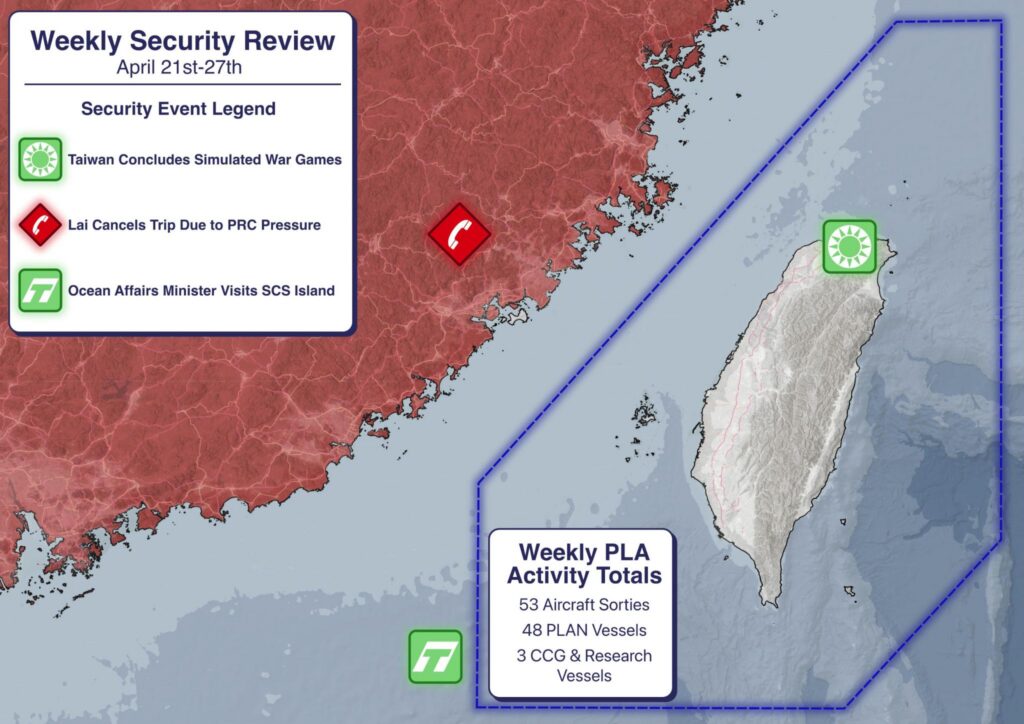
This week, Taiwan wraps up simulated wargames ahead of live-fire drills, the country’s ocean minister visits the disputed South China Sea, and President Lai is pressured to cancel his visit to Africa.
Taiwan Concludes Computer-Simulated Wargames
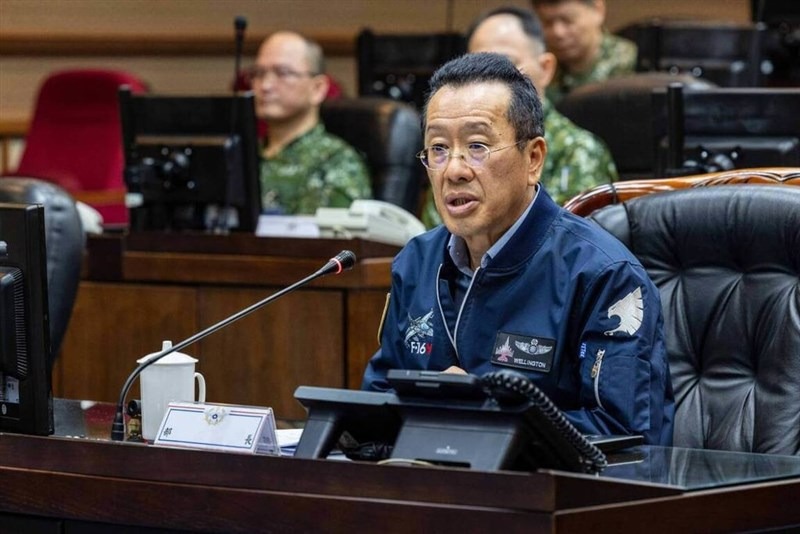
Taiwan’s Ministry of National Defense (MND) concluded the computer-simulated phase of its annual Han Kuang military exercises on April 25. For 14 days, the military used intensive wargaming software to stress-test the decision-making capabilities of the island’s armed forces under simulated combat conditions. Minister of National Defense Wellington Koo made the announcement on social media and described it as a “nonstop” high-intensity tabletop exercise environment. Koo added that the wargames were structured around a scenario that deliberately escalated, beginning with gray-zone harassment tactics and advancing toward full-scale high-intensity military conflict. The minister also said that this year’s exercise incorporated lessons from recent international conflicts, including multi-domain battlefield dynamics and hybrid threat elements. The inclusion of these lessons reflects Taiwan’s attitude in recognizing that any future conflict in the strait would be fought across conventional, cyber, informational, and electronic domains simultaneously.
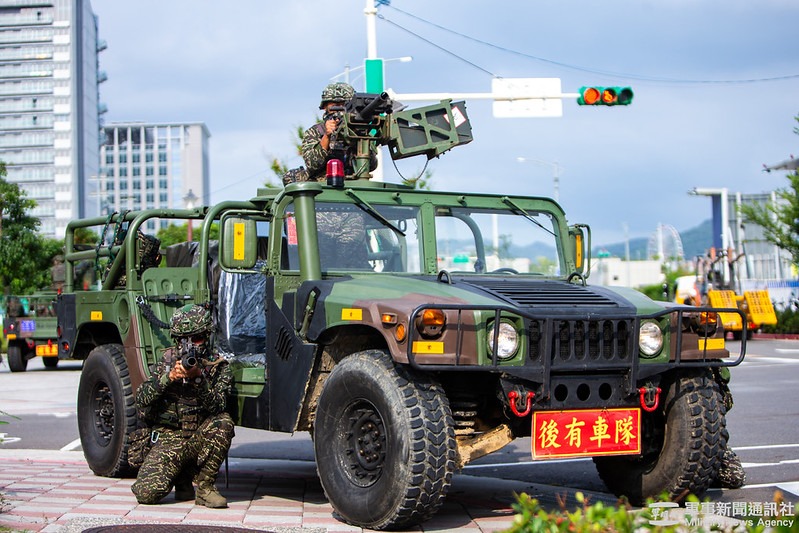
One of the most significant aspects of this year’s Han Kuang exercise is its emphasis on command-and-control resilience amid coordinated enemy strikes. Military sources say that the simulation forced administrative units, armament divisions, and joint operational command centers to disperse to separate locations throughout the exercise. This design choice was intended to check that backup command mechanisms could sustain wartime functions even if the primary infrastructure was degraded or destroyed.
These simulations are part of the lessons that Minister Koo mentioned, as wars in Ukraine and the Middle East have shown that centralized command nodes pose critical vulnerabilities. Taiwan’s MND says survivable and redundant command architecture is not a secondary consideration but a foundational requirement of credible deterrence. Taiwan hopes that by using live exercise conditions, it can demonstrate its seriousness to other countries regarding an approach to defense.
The live-fire phase of Han Kuang is scheduled for August, and soldiers, as well as commanders, will be looking to translate the lessons of the tabletop environment into operational reality.
Taiwan’s Ocean Affairs Minister Visits South China Sea Island
On April 23, the minister of Taiwan’s Ocean Affairs Council (OAC), Kuan Bi-ling, visited Itu Aba, also known as Taiping Island, to observe a maritime rescue drill held by representatives from the OAC’s Coast Guard Administration (CGA), as well as Taiwan’s ministries of transportation, defense, health, and foreign affairs. Itu Aba lies approximately 1,600 kilometers (860 nautical miles) southwest of Kaohsiung and has historically been claimed by China, Vietnam, and the Philippines. Though many nations lay claim to the island, the Taiwanese government has administered it as part of Cijin District, Kaohsiung. This drill consisted mainly of Coast Guard drills, beginning with special forces practicing armed boarding of suspicious cargo ships and escort to the island’s dock. The drill also simulated interactions with a distressed Vietnamese-registered fishing vessel and a cargo ship, where crewmembers were injured, with some falling overboard. For this part, the Coast Guard dispatched a rescue team and unmanned aerial vehicles, while the Ministry of National Defense (MND) deployed a C-130 transport aircraft to evacuate the injured crew members. During this exercise, they also simulated an oil spill, which the OAC claims was contained using temporary floating barriers (containment booms) used to contain hazardous materials on water by encircling the spill to stop it from spreading.
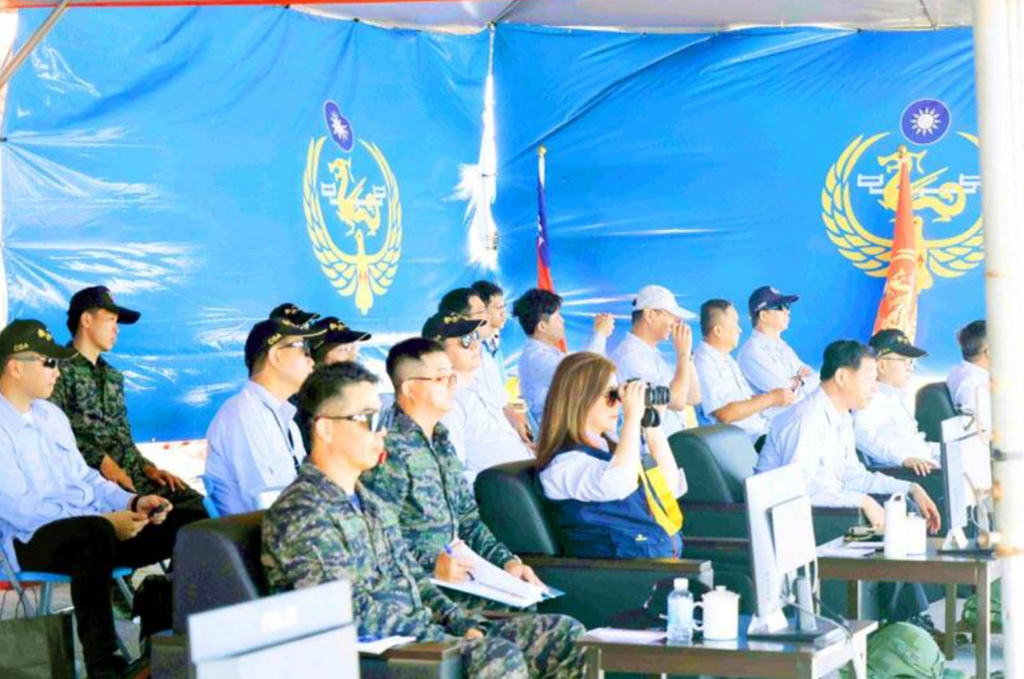
Itu Aba has a runway capable of handling military supply flights and a recently upgraded wharf that can receive large patrol vessels. The 200 inhabitants of the island are mostly coast guard members who train for both security and rescue work. Its location in the South China Sea makes it a strategic outpost for maritime surveillance and control, as well as a key shipping route for international maritime trade. This is the first time in 7 years that a minister of Taiwan’s OAC has visited the island, showing renewed attention to the strategic importance of South China Sea security.
Taiwan President Cancels Eswatini Visit Due to Chinese Pressure
President Lai Ching-te has cancelled a scheduled visit to Eswatini after three African countries withdrew overflight permissions for his aircraft due to pressure from China.
Lai was set to arrive in the kingdom on April 22 for a five-day visit to attend events marking the 40th anniversary of King Mswati III’s accession to the throne and the king’s birthday. The trip was called off after Seychelles, Mauritius, and Madagascar revoked permission for his aircraft to cross their airspace. Pan Meng-an, Secretary-General to the president, attributed the withdrawals to strong pressure from Chinese authorities. China’s Taiwan Affairs Office praised the three nations on April 22, expressing “high appreciation” for their adherence to the “one-China principle.”
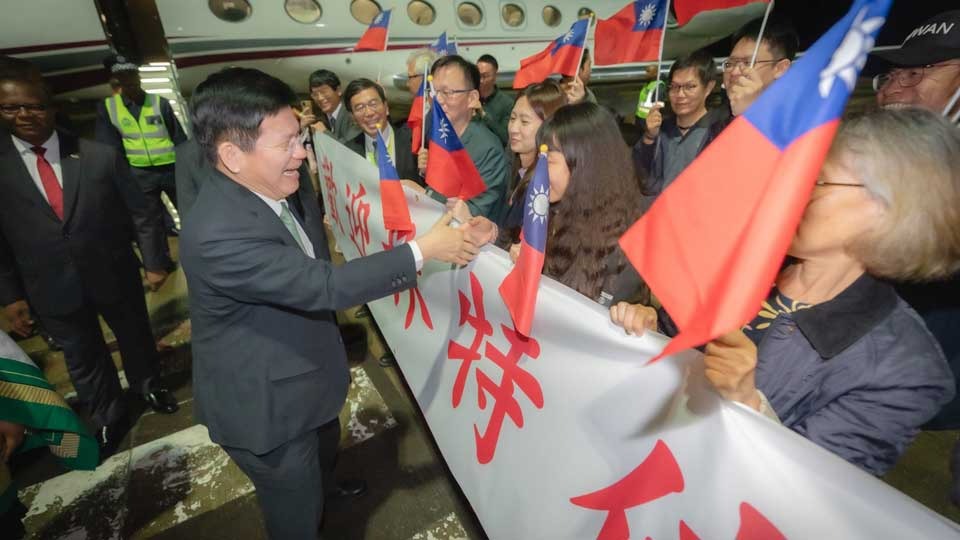
In response, Taiwan dispatched Minister of Foreign Affairs Lin Chia-lung to Eswatini as President Lai’s special envoy. Lin arrived on April 25 and attended the celebration on Taipei’s behalf. During the visit, the minister signed a memorandum of understanding (MOU) with Eswatini’s Minister of Foreign Affairs and International Cooperation Pholile Shakantu on countering disinformation and promoting information integrity.
The U.S. State Department criticized Beijing’s actions as an abuse of the international civil aviation system and called on China to cease its efforts to intimidate third countries into restricting Taiwan’s freedom of movement. The episode underscores the constant pressure on Taiwan’s already diminished diplomatic standing. Eswatini remains Taiwan’s sole formal ally on the African continent and one of just 12 countries worldwide that still maintain official ties with Taipei.