Taiwan Security Monitor

Taiwan Affairs Office: The first local regulation dedicated to promoting common standards across the Taiwan Strait highlights the two key ideas of โ€œconnectivityโ€ (้€š) and โ€œcommonalityโ€ (ๅŒ).

At the December 3 press conference of the State Councilโ€™s Taiwan Affairs Office, a reporter asked: On the 27th, the 19th meeting of the Standing Committee of the 14th Fujian Provincial Peopleโ€™s Congress voted to adopt the Fujian Province Regulations on Promoting Common Standards Across the Taiwan Strait. This is the mainlandโ€™s first legislation in this field and another pioneering Taiwan-related law in Fujian. Could you please introduce the relevant situation?

Spokesperson Zhang Han of the Taiwan Affairs Office replied that the Opinions of the CPC Central Committee and the State Council on Supporting Fujian in Exploring a New Path for Cross-Strait Integrated Development and Building a Demonstration Zone for Cross-Strait Integrated Development clearly state the need to โ€œbuild a service platform for common cross-Strait standards and encourage industry-wide common standards jointly formulated by industrial, academic, research, and business sectors on both sides of the Strait.โ€ In recent years, Fujian has made useful explorations in the area of common cross-Strait standards, continuously deepening this work and formulating a total of 308 common standards across the Strait.

On November 27, the 19th meeting of the Standing Committee of the 14th Fujian Provincial Peopleโ€™s Congress voted to adopt the Fujian Province Regulations on Promoting Common Standards Across the Taiwan Strait. This is the first local regulation to be formulated with the promotion of common cross-Strait standards as its central theme and will enter into force on January 1, 2026. The regulations highlight the two concepts of โ€œconnectivityโ€ (้€š) and โ€œcommonalityโ€ (ๅŒ), promptly codifying Fujianโ€™s mature experience and innovative practices in recent years and elevating them into law. They encourage compatriots on both sides of the Strait to work together and carry out cross-Strait standardization cooperation through jointly selecting topics, drafting, comparison, and use of standards. This is another pioneering piece of Taiwan-related legislation in Fujian Province and is of great significance for building a common cross-Strait market, enhancing the well-being of people on both sides of the Strait, and deepening cross-Strait integrated development.
Taiwan Affairs Office: Urges the Japanese side to deeply reflect on its historical crimes, withdraw its erroneous remarks, and stop interfering in Chinaโ€™s internal affairs.

At the December 3 press conference of the State Councilโ€™s Taiwan Affairs Office, a reporter asked: December 1 marked the 82nd anniversary of the issuance of the Cairo Declaration. However, Japanese Prime Minister Sanae Takaichi has ignored international legal documents including the Cairo Declaration and is attempting to meddle in the situation in the Taiwan Strait, and so far has refused to retract her erroneous remarks on Taiwan. What is your comment?

Spokesperson Zhang Han of the Taiwan Affairs Office replied that this year marks the 80th anniversary of the Chinese peopleโ€™s victory in the War of Resistance Against Japanese Aggression, the 80th anniversary of Taiwanโ€™s restoration, and the 82nd anniversary of the Cairo Declaration. The Cairo Declaration and a series of other international legal instruments are major outcomes of the world anti-fascist war. They clarify, from the perspective of international law, Chinaโ€™s sovereignty over Taiwan and form an important part of the post-war international order. Observing their relevant provisions is an international legal obligation that Japan must assume.

Prime Minister Sanae Takaichiโ€™s erroneous remarks on Taiwan interfere in Chinaโ€™s internal affairs, send a wrong signal to โ€œTaiwan independenceโ€ separatist forces, and undermine peace and stability in the Taiwan Strait. We urge the Japanese side to deeply reflect on its historical crimes, withdraw its erroneous statements, stop interfering in Chinaโ€™s internal affairs, and, through concrete actions, faithfully abide by the one-China principle and its political commitments to China.

Taiwan Affairs Office outlines important points for Taiwan compatriots applying for identity documents on the mainland.

At the December 3 press conference of the State Councilโ€™s Taiwan Affairs Office, a reporter asked: Recently, there has been a lot of online attention on news about Taiwan compatriots applying for identity documents on the mainland. Could the spokesperson please give a detailed overview of the eligibility requirements, procedures, and materials needed for these documents?

Spokesperson Zhang Han of the Taiwan Affairs Office replied that it is the lawful right of Taiwan residents, on a voluntary basis, to apply for mainland identity documents. To prevent ill-intentioned individuals from confusing the public and distorting the issue, and to facilitate Taiwan compatriotsโ€™ applications for relevant mainland documents, I would like to take this opportunity to provide a complete and accurate explanation of the eligibility requirements, procedures, and required materials for Taiwan residents applying for mainland residence permits, settlement permits, and resident ID cards. We have carefully prepared charts to help everyone better understand the situation (charts displayed).

First, the Mainland Residence Permit for Taiwan Residents is a document issued by the relevant mainland authorities specifically to meet the needs of Taiwan compatriots for greater convenience in studying, working, and living on the mainland.

According to the Measures for the Application and Issuance of Residence Permits for Hong Kong, Macao, and Taiwan Residents, Taiwan residents who have lived on the mainland for more than six months and meet one of the conditions of having lawful and stable employment, lawful and stable residence, or continuous study may apply for the permit on a voluntary basis. Applicants simply need to fill out the Hong Kong, Macao, and Taiwan Resident Residence Permit Application Registration Form, present their Taiwan Compatriot Travel Permit to the Mainland, and submit proof of their address, employment, or study on the mainland to the public security police station or household registration service hall designated by the county-level peopleโ€™s government public security organ where they reside.

Second, the Taiwan Resident Settlement Permit is a certificate issued to Taiwan residents who have been approved to settle and be registered as permanent residents on the mainland, for the purpose of registering permanent household registration at the settlement location.

According to the Administrative Measures for Mainland Chinese Citizens Traveling to and from the Taiwan Region and other relevant regulations, Taiwan residents who meet the conditions of joining immediate family members on the mainland, being the spouse of a mainland resident, having investments on the mainland, or being professionals in specialized fields may submit an application for settlement to the entryโ€“exit administration department of the public security organ at or above the county level in the proposed place of residence. When applying, they should submit the Application Form for Taiwan Residents to Settle on the Mainland, their ID photo, valid Taiwan identity card and entryโ€“exit documents, as well as supporting documents corresponding to the grounds for the application. Once approved, the entryโ€“exit administration department of the public security organ will issue a Notice of Approval for Settlement and a Taiwan Resident Settlement Permit. Since January 1, 2024, mainland entryโ€“exit administration authorities have implemented policies encouraging Taiwan residents to settle in Fujian, supporting Taiwan compatriots in realizing the goal of โ€œall who wish to settle can do soโ€ in Fujian.

Third, the Mainland Resident ID Card. Under the relevant provisions of the Resident Identity Card Law of the Peopleโ€™s Republic of China, Taiwan residents who return to the mainland to settle must apply for a resident ID card when registering for permanent household registration. After Taiwan residents go to the public security organ at their place of permanent residence, with their Notice of Approval for Settlement and Taiwan Resident Settlement Permit, to complete permanent household registration procedures, the process for applying for a resident ID card is the same as for mainland residents.

Here, I would also like to stress a few points. First, it is entirely voluntary for Taiwan residents to apply for the above-mentioned documents. Second, we have noticed that some unscrupulous organizations are falsely advertising online that they can handle mainland ID cards on behalf of Taiwan residents and are using this as an opportunity to make a profit. I would like to remind our Taiwan compatriots that, in the process of applying for these documents, apart from the document production fees charged by the official issuing authorities, any paid services offered by non-official organizations or individuals in the name of agency or intermediary services are illegal and in violation of regulations, and you should be on guard against being deceived. Third, the relevant mainland authorities will strictly protect, in accordance with the law, the application materials submitted by Taiwan residents during the acceptance, review, and approval process, and will not disclose applicantsโ€™ personal information or document data. I would also like to remind Taiwan compatriots once again to properly safeguard their documents and personal privacy information to prevent leaks.

Taiwan Affairs Office: Lai Ching-teโ€™s attempt to seek โ€œindependenceโ€ by force will only dig his own grave.

At the December 3 press conference of the State Councilโ€™s Taiwan Affairs Office, a reporter asked: Recently, Lai Ching-te wrote an op-ed in a U.S. media outlet claiming he would allocate NT$1.25 trillion as a special defense budget, which has caused an uproar across various sectors on the island. Public opinion in Taiwan criticizes Lai for โ€œplaying with fire,โ€ arguing that if Taiwan focuses only on preparing for war, other livelihood issues will not be able to move forward and that Taiwan is being treated like an ATM. What is your comment?

Spokesperson Zhang Han of the Taiwan Affairs Office replied that Lai Ching-te, who ingratiates himself with external forces without principle and sells out Taiwan without any bottom line, is racing headlong down the path of seeking โ€œindependenceโ€ through provocations and reckless militarism. He is squandering the hard-earned money of the people, pushing a policy of โ€œeveryone a soldier,โ€ and is willing to turn Taiwan into a battlefield and its people into cannon fodder. Money that could have been used to improve peopleโ€™s livelihoods is instead being wasted on buying weapons and enriching foreign arms dealers, which will only push Taiwan into an even more dangerous situation of looming war.

โ€œโ€˜Taiwan independenceโ€™ means war.โ€ We hope that our compatriots in Taiwan will clearly recognize the extreme danger and harm of Lai Ching-teโ€™s attempt to โ€œprovoke war through Taiwan independence,โ€ firmly oppose โ€œTaiwan independenceโ€ separatism and external interference, and join us in bringing cross-Strait relations back onto the right track of peaceful development, genuinely safeguarding peace and stability in the Taiwan Strait and their own security and well-being. We sternly warn Lai Ching-te and the DPP authorities: do not play with fireโ€”those who play with fire will surely burn themselves. Seeking โ€œindependenceโ€ by force and recklessly taking desperate risks will only dig your own grave!

Taiwan Affairs Office: The opening measures will create more opportunities for people from Taiwanโ€™s legal sector to work and develop on the mainland.

At the December 3 press conference of the State Councilโ€™s Taiwan Affairs Office, a reporter asked: This morning (December 3), the Ministry of Justice issued the Announcement on the Scope of Taiwan-related Civil Cases in which Taiwan Residents Who Have Obtained Mainland Legal Professional Qualifications and Mainland Lawyer Practice Certificates May Act as Agents in Peopleโ€™s Courts on the Mainland. Could the spokesperson brief us on the relevant situation?

Spokesperson Zhang Han of the Taiwan Affairs Office replied that today (December 3), the Ministry of Justice issued Announcement No. 16. Starting from December 3, 2025, for Taiwan residents who have obtained national legal professional qualifications and lawyer practice certificates, the scope of civil cases they may handle as agents on the mainland has been expanded from the original five major categories comprising 237 items to nine major categories comprising 299 items, with 62 new items added in areas such as maritime and admiralty, personality rights, real rights, and competition disputes.

These opening measures will create more opportunities and provide broader space for legal professionals from Taiwan to seek employment and development on the mainland and to participate in the cross-Strait legal services market. We will uphold the concept that people on both sides of the Strait are one family, continuously improve the institutions and policies that promote cross-Strait economic and cultural exchanges and cooperation, and encourage and support more Taiwan compatriots to participate in the mainlandโ€™s economic and social development and share in the opportunities and achievements of Chinese-style modernization.

Taiwan Affairs Office: โ€œโ€˜One country, two systemsโ€™ is a peaceful, democratic, well-intentioned and winโ€“win proposal.โ€

At the December 3 press conference of the State Councilโ€™s Taiwan Affairs Office, a reporter asked: Recently, Lai Ching-te has been loudly asserting that establishing a โ€œone country, two systemsโ€ Taiwan plan is a red line that Taiwanโ€™s society must not cross, and has claimed that on this basis he will impose controls on exchanges and political dialogue between political parties, legal entities, and civic groups on the island and the mainland. What is your comment?

Spokesperson Zhang Han of the Taiwan Affairs Office replied that Lai Ching-te is arbitrarily clamping down on the freedom of Taiwanโ€™s people to take part in cross-Strait exchanges and crudely depriving ordinary people of their right to pursue a better life, fully exposing his nature of โ€œterror politics and green dictatorship.โ€

โ€œโ€˜One country, two systemsโ€™ is a peaceful proposal, a democratic proposal, a well-intentioned proposal, and a winโ€“win proposal. After reunification, with the strong motherland as a backing, the livelihoods and well-being of Taiwan compatriots will be better, their room for development will be greater, they will be safer and enjoy greater dignity, and they will be able to stand taller and more confidently on the international stage. Taiwan will enjoy lasting peace, and the people will live and work in contentment. Taiwan compatriots will, together with compatriots on the mainland, share in the dignity and glory of our great country and embrace a bright future of prosperity and stability.โ€

โ€œThe Taiwan question is at the very core of Chinaโ€™s core interests and concerns the national sentiments of more than 1.4 billion Chinese people; it is a red line that absolutely must not be crossed. If โ€˜Taiwan independenceโ€™ separatist forces dare to breach this red line, we will certainly take resolute action and strike them head-on. We will continue, on the basis of the one-China principle, to conduct broad exchanges of views and in-depth consultations with political parties, groups, and people from all walks of life in Taiwan on cross-Strait relations and national reunification, and jointly promote the peaceful development of cross-Strait relations and advance the great cause of the reunification of the motherland.โ€

Taiwan Affairs Office: Strongly condemns the DPP authorities for suppressing and bullying mainland spouses

At the December 3 press conference of the State Councilโ€™s Taiwan Affairs Office, a reporter asked: Recently, Lai Ching-te openly opposed the KMTโ€™s proposed โ€œlegal amendmentโ€ to safeguard mainland spousesโ€™ โ€œpolitical participation rights,โ€ and the head of Taiwanโ€™s administrative body, Cho Jung-tai, claimed that amending the Nationality Act โ€œinvolves the issue of dual allegiance.โ€ What is your comment?

Spokesperson Zhang Han of the Taiwan Affairs Office replied that mainland spouses are the family members and loved ones of Taiwan compatriots and are builders and contributors to Taiwanโ€™s society. They should be recognized and respected, and their legitimate rights and interests, including the right to participate in politics and public affairs, should be protected. Out of its โ€œTaiwan independenceโ€ nature, the DPP authorities are openly peddling the โ€œtwo-state theory,โ€ arbitrarily stripping mainland spouses of their lawful rights, suppressing and bullying this group, and continually challenging the historical and legal fact that both sides of the Strait belong to one China. We strongly condemn this.

We sternly warn the DPP authorities that any vile actions or tricks that undermine peace and stability in the Taiwan Strait and damage the interests of compatriots on both sides will only bring disastrous consequences upon themselves. As for the โ€œTaiwan independenceโ€ accomplices and henchmen who persecute mainland spouses, we will never let them off lightly; we will, in accordance with the law, hold them accountable and punish them severely without leniency.

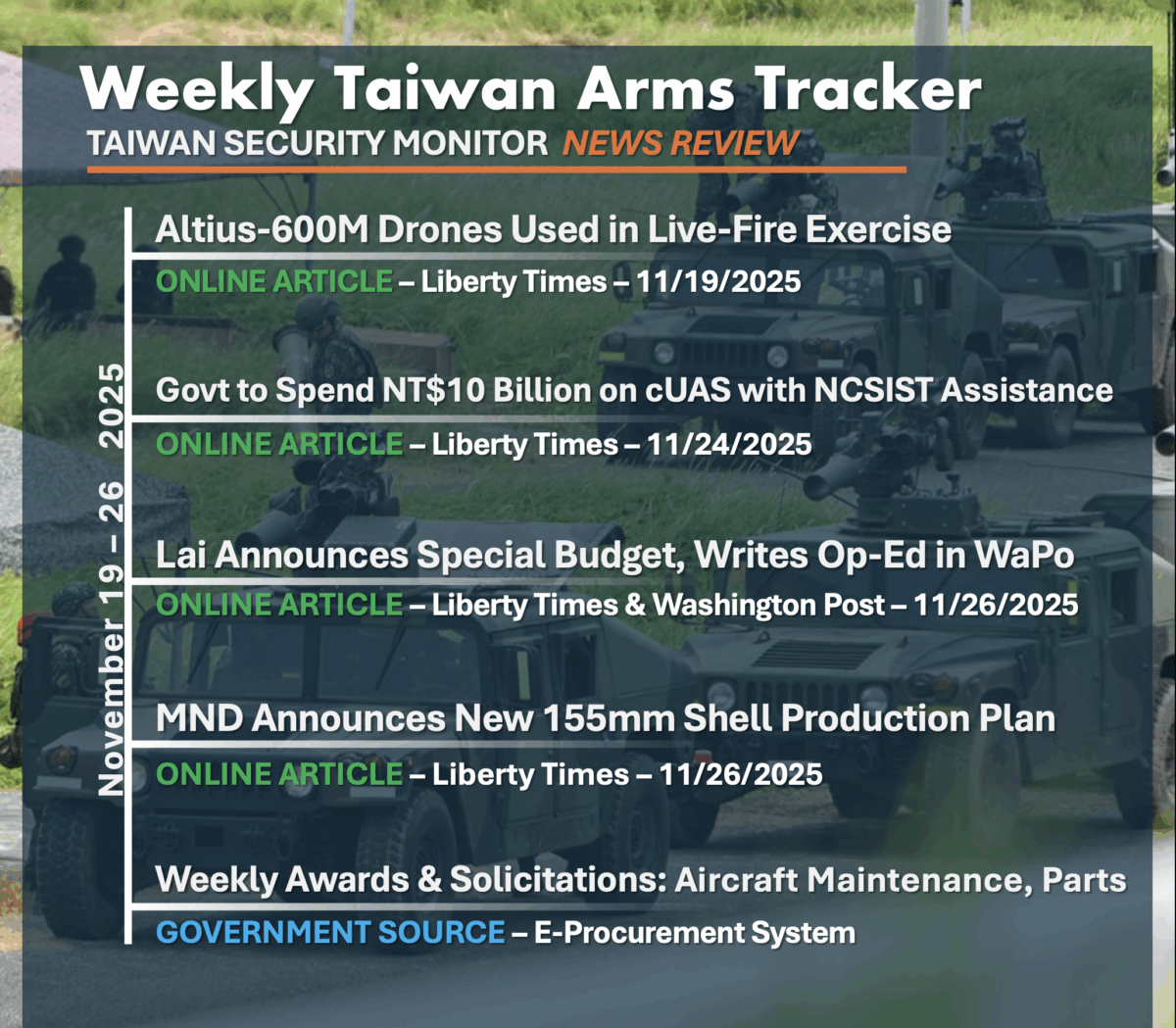
Weekly Taiwan Arms Sales Tracker: 11/26/25

Author: Joe O’Connor


See this weekโ€™s Taiwan Arms Tracker update, covering news relating to arms sales, indigenous production, and defense procurement in Taiwan, all below!

Altius-600M Drones Used in Live-Fire Exercise

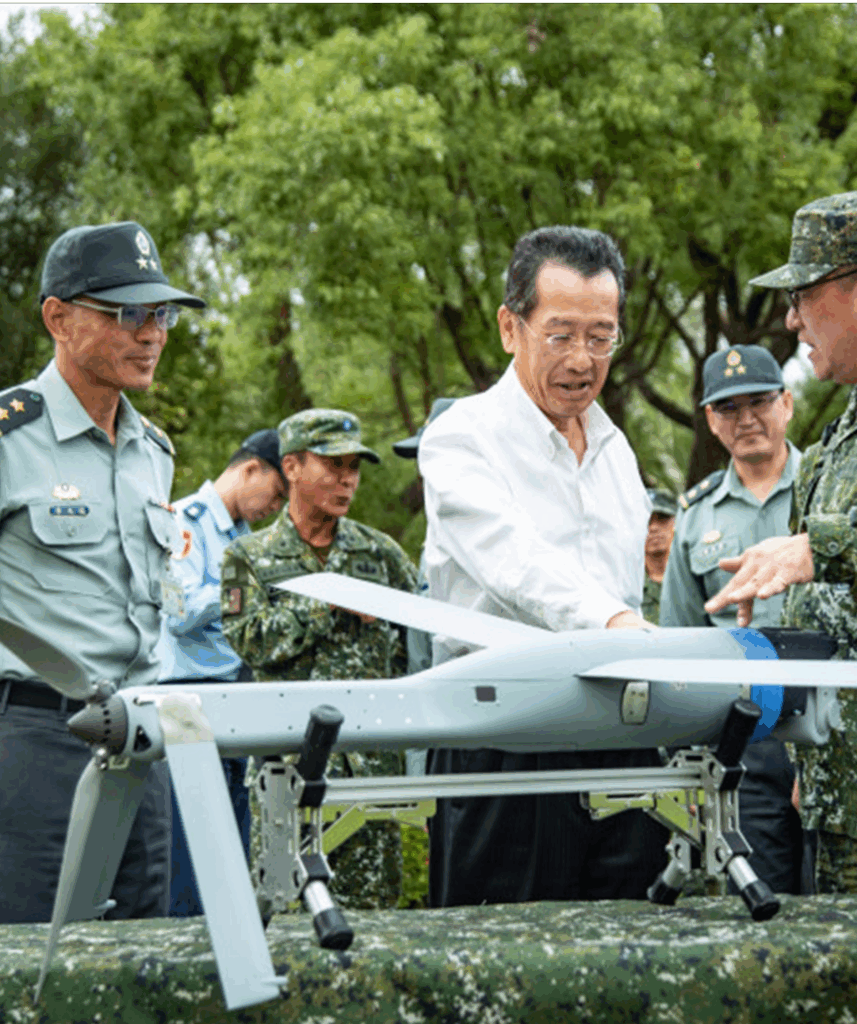
Last Wednesday, the first live-fire exercises of Altius 600M drones took place at the Armyโ€™s UAV Training Center, being observed by Minister of Defense Wellington Koo. The drones, produced by the US defense company Anduril, represent the culmination of a sale announced in June 2024 and increased integration of UAVs into the Taiwanese military.

SOURCE: Fang Wei-li, Liberty Times

Govt to Spend NT$10 Billion on cUAS with NCSIST Assistance

With assistance from the National Chung-Shan Institute of Science and Technology (NCSIST), the Taiwanese government will invest NT$10 billion into counter-unmanned aerial systems (cUAS) technology. While not known on specifics, NCSIST will assist with an industry briefing, specifically on procuring bomb-dropping drones, loitering munitions, and coastal surveillance UAVs.

SOURCE: Tu Ju-min, Liberty Times

Lai Announces Special Budget, Writes Op-Ed in WaPo

In a public speech on Tuesday, President Lai Ching-te officially announced a special defense budget of NT$1.25 trillion (US$40 billion) for โ€œstrengthening defense resilience and asymmetric capabilities.โ€ In an opinion piece in the Washington Post also published Tuesday, Lai stated that the โ€œT-Domeโ€ air defense system and drone development will be included in the budget.

SOURCE: Luo Tian-bin, Liberty Times, & Lai Ching-te, Washington Post

MND Announces New 155mm Shell Production Plan

On the heels of Tuesdayโ€™s announcement of a special defense budget, Minister of Defense Wellington Koo announced that NT$14 billion (US$447 million) from that budget will be invested in an automated production line at Factory 202 for 155mm artillery shells and 120mm tank ammunition. This, among other initiatives, is part of a budget objective to โ€œenhance armament production capacity.โ€

SOURCE: Wu Zheyu, Liberty Times

Weekly Awards & Solicitations: Aircraft Maintenance, Parts

โ€ขOn Monday, the Air Force Command awarded a NT$285.76 million (US$9.11 million) contract for maintenance of commercial aircraft, including the presidential aircraft.

โ€ขAlso, on Monday, the Ministry of National Defense solicited bids for RDX minesweeping and maritime clearance items, worth NT$824.67 million (US$26.30 million).

โ€ขOn Tuesday, the Air Force Command issued a request for information for parts for E-2T and P-3C aircraft, as well as EC-225 Super Puma helicopters.

SOURCE: Taiwanese Government E-Procurement System

Visualization: Japan’s First Island Chain Military Infrastructure

Authors: Noah Reed and Joe O’Connor


Recently, comments by Japanese PM Sanae Takaichi regarding China and the announcement of surface-to-air missiles being deployed at Yonaguni Island have attracted attention and discussion about Japanese military infrastructure in the First Island Chain.

Above is our visualization of JSDF facilities in the First Island Chain, including Okinawa.

Visualization: Yonaguni Missile System Deployment

Authors: Noah Reed, Joe O’Connor


Today, Japanese Minister of Defense Shinjiro Koizumi visited Yonaguni, the westernmost Japanese island in the Senkakus. After inspecting a JGSDF garrison, Koizumi announced that the JSDF will deploy a Type 03 Chลซ-SAM missile battery on the island, to โ€œreduce the likelihood of an armed attack against our country.โ€ The Type 03 has an effective range of approximately 50 km, while Yonaguni itself is approximately 105 km from Taiwan.

Above is our visualization of the Type 03’s future deployment on Yonaguni.