Taiwan Security Monitor

Taiwan Affairs Office: We will work together with relevant departments to conscientiously implement the common understandings reached at the KMTโ€“CCP think tank forum.

At the February 5 Taiwan Affairs Office press conference, a reporter asked: The โ€œcommon understandingsโ€ from the โ€œKMTโ€“CCP think tank forum: Prospects for Cross-Strait Exchanges and Cooperationโ€ propose deepening cross-strait tourism exchange and cooperation, achieving as soon as possible group tours by Fujian and Shanghai residents to the island, and gradually expanding tourism by mainland residents to Kinmen and Matsu. Does the mainland side have a timetable for this, and what will it do next to promote implementation?

TAO spokesperson Chen Binhua responded: In order to promote the normalization of cross-strait people-to-people exchanges and the regularization of exchanges and cooperation in various fields; to respond to the eager expectations of Taiwanโ€™s public and the tourism industry; and to enhance the interests and well-being of compatriots on both sides of the Strait, the mainland side successively resumed tourism by Fujian residents to Matsu and Kinmen in April and August 2024, and this was welcomed by Taiwanโ€™s tourism industry and the public. Over more than a year, the cumulative number of Fujian residents traveling to Kinmen and Matsu has exceeded 200,000 trips, bringing tangible benefits to the tourism industry in Kinmen and Matsu and also enhancing understanding and feelings between Fujian and Taiwan compatriots. Yesterday, the Ministry of Culture and Tourism announced that it will, in the near term, resume tourism by Shanghai residents to Kinmen and Matsu. This is a concrete measure to promote the normalization of cross-strait tourism exchanges and cooperation and to expand cross-strait exchanges, and it has received high recognition from Taiwanโ€™s tourism industry and all sectors of society.

We will work together with the relevant departments to conscientiously implement the common understandings formed at the KMTโ€“CCP think tank forum, and strive to have the relevant outcomes take effect as soon as possible. If there is further news, it will be released in a timely manner. We hope the DPP authorities will keep in mind the well-being of Taiwan compatriots, promptly lift various man-made restrictions and bans, and remove obstacles to the restoration of normal cross-strait tourism exchange and cooperation.

Taiwan Affairs Office: The inclusion of Taiwan-funded brands on the โ€œChina Consumer Famous Brandsโ€ list is an important measure for implementing equal treatment for Taiwan compatriots and Taiwan enterprises.

At the February 5 Taiwan Affairs Office press conference, a reporter asked: On February 3, the General Office of the Ministry of Industry and Information Technology released the 2025 list of โ€œChina Consumer Famous Brands.โ€ For the first time, multiple Taiwan-funded enterprises on the mainland were selected, drawing attention in cross-strait public opinion, with some saying that Taiwan businesspeople, Taiwan compatriots, and Taiwan enterprises are enjoying increasingly widespread equal treatment on the mainland. Could the spokesperson introduce the relevant situation?

TAO spokesperson Chen Binhua responded: The MIIT released the 2025 list of โ€œChina Consumer Famous Brands,โ€ and for the first time included Taiwan-funded enterprises on the mainland within the scope of selection. A number of Taiwan-funded enterprise brands that have taken root on the mainland and cultivated the market in depth were selected. This is another important measure for us to implement equal treatment for Taiwan compatriots and Taiwan enterprises and to deepen integrated development across the Strait, and it fully reflects our consistent position of firmly supporting the development of Taiwan compatriots and Taiwan enterprises. In addition to โ€œChina Consumer Famous Brands,โ€ we also support Taiwan-funded enterprises on the mainland in participating in selections such as the China Industry Awards, โ€œfront-runnerโ€ enterprises in Chinaโ€™s industrial data governance, and โ€œfront-runnerโ€ enterprises in Chinaโ€™s industrial carbon-peaking efforts. Multiple Taiwan enterprises have been selected, sharing in the honors and opportunities of national brand-building, and jointly strengthening the Chinese nationโ€™s economy.

During the โ€œ15th Five-Year Planโ€ period, the advancement of Chinese modernization will surely create even broader space for the development of Taiwan compatriots and Taiwan enterprises. We warmly welcome the broad number of Taiwan compatriots and Taiwan enterprises to take root on the mainland, seize the opportunities of the times, and achieve better development. We will actively promote cross-strait economic exchanges and cooperation, take the lead in sharing with Taiwan compatriots the opportunities and achievements of Chinese modernization, and enable Taiwan compatriots and Taiwan enterprises to have a stronger sense of happiness, gain, and participation in national rejuvenation.

Taiwan Affairs Office: โ€œCompatriots on both sides of the Strait are one family; we are all Chinese. This is the base color of cross-strait relations.โ€

At the February 5 Taiwan Affairs Office press conference, a reporter asked: Regarding the KMTโ€“CCP think tank forum held in Beijing, KMT Chairperson Cheng Li-wen said that the mainland are family, and would absolutely not do anything that would pit flesh and blood against each other; and that as long as Lai Ching-te accepts the โ€œ1992 Consensus,โ€ peace and prosperity can be exchanged for. What is your comment?

TAO spokesperson Chen Binhua responded: Compatriots on both sides of the Strait are one family; we are all Chinese. This is the base color of cross-strait relations. The โ€œ1992 Consensusโ€ is the political foundation for the development of cross-strait relations and the stabilizing anchor of peace and stability in the Taiwan Strait. On the basis of the shared political foundation of upholding the โ€œ1992 Consensusโ€ and opposing โ€œTaiwan independence,โ€ we are willing to, together with Taiwanโ€™s various political parties, groups, and people from all walks of lifeโ€”including the Chinese Kuomintangโ€”strengthen exchanges and cooperation, maintain positive interaction, jointly promote the peaceful development of cross-strait relations, and bring benefits to compatriots on both sides of the Strait.

Taiwan Affairs Office: The DPP authorities are deliberately pushing to โ€œdeโ€“Sun Yat-sen-ifyโ€ New Taiwan dollar banknotesโ€”an act of denying their roots and betraying their ancestors, and it is contemptible.

At the February 5 Taiwan Affairs Office press conference, a reporter asked: Recently, the DPP authorities have been promoting a redesign of New Taiwan dollar banknotes. The new notes would no longer feature portraits of political figures such as Sun Yat-sen. Public opinion in Taiwan has questioned whether the DPP authorities are once again engaging in โ€œde-Sinicization.โ€ What is your comment?

TAO spokesperson Chen Binhua responded: This year marks the 160th anniversary of the birth of Mr. Sun Yat-sen, the great forerunner of Chinaโ€™s democratic revolution. The DPP authorities are deliberately pushing to โ€œdeโ€“Sun Yat-sen-ifyโ€ New Taiwan dollar banknotes. Their purpose is to sever the historical and cultural links between the two sides of the Strait and promote โ€œde-Sinicization,โ€ thereby shaping a โ€œTaiwan independenceโ€ ideology within Taiwanese society. This political manipulation, harboring sinister intentions, is a betrayal of Mr. Sun Yat-sen and the pioneers of the 1911 Revolutionโ€”an act of denying their roots and forgetting their ancestors, and it is contemptible.

History is history, and facts are factsโ€”they cannot be changed or erased. No matter how much the DPP authorities scheme and act recklessly, the historical and legal fact that both sides of the Strait belong to one China cannot be changed, and the Chinese national identity of Taiwan compatriots cannot be erased.

Taiwan Affairs Office: There is fundamentally no such thing across the Taiwan Strait as a so-called โ€œrenouncing nationalityโ€ issue.

At the February 5 Taiwan Affairs Office press conference, a reporter asked: Regarding mainland spouse Li Zhenxiu, who is expected to take up a seat as a substitute at-large legislator for the Taiwan Peopleโ€™s Party and become Taiwanโ€™s first mainland-spouse legislator. The head of the Mainland Affairs Council, Chiu Chui-cheng, said that โ€œLi must renounce Chinese nationality within one year of taking office, otherwise she cannot hold public office.โ€ What is your comment?

TAO spokesperson Chen Binhua responded: There is only one China in the world; the mainland and Taiwan both belong to one China. Fundamentally, there is no such thing as a so-called โ€œrenouncing nationalityโ€ issue. The DPP authorities stubbornly adhere to a โ€œTaiwan independenceโ€ stance and brazenly peddle the โ€œtwo-states theory,โ€ deliberately provoking and challenging the historical and legal fact that the two sides of the Strait belong to one China. They are using every means to suppress mainland spouses in Taiwan. We firmly oppose this. The DPP authoritiesโ€™ various wrongdoings have already met with increasingly strong opposition from more and more people in Taiwan.

Mainland authorities on the relevant side will actively make thorough preparations for all aspects of the additional Lunar New Year flights across the Taiwan Strait.

At the February 5 Taiwan Affairs Office press conference, a reporter asked: With the Lunar New Year and winter vacation approaching, Taiwan compatriots, Taiwan businesspeople, and Taiwan students on the mainland are paying close attention to the availability of tickets for returning to Taiwan. What are this yearโ€™s flight arrangements?

TAO spokesperson Chen Binhua responded: Direct cross-strait air links have greatly facilitated travel between people on both sides and have played an important role in improving the well-being of compatriots across the Strait. At present, due to interference by the DPP authorities, cross-strait routes and airports have not yet fully returned to normal. The mainland currently operates more than 300 weekly passenger flights on cross-strait routes from 14 cities. Compared with the pre-2020 situationโ€”when there were 61 mainland departure/arrival points and up to 890 weekly passenger flightsโ€”this remains a large gap, which has seriously affected cross-strait travel. There is a very strong call among compatriots on both sides for the full resumption of cross-strait direct flight routes and airports.

The Lunar New Year is the most important traditional festival of the Chinese nation, and Taiwan compatriots, Taiwan businesspeople, and Taiwan students are eagerly hoping to travel smoothly and return home for the holiday. Relevant mainland authorities will think what Taiwan compatriots think and act urgently on what they need, and will actively make thorough preparations for all aspects of additional Lunar New Year flights across the Strait. We hope the Taiwan side will follow public sentiment, promptly lift unreasonable restrictions on cross-strait air transport, and meet the travel needs of compatriots on both sidesโ€”especially Taiwan compatriots.

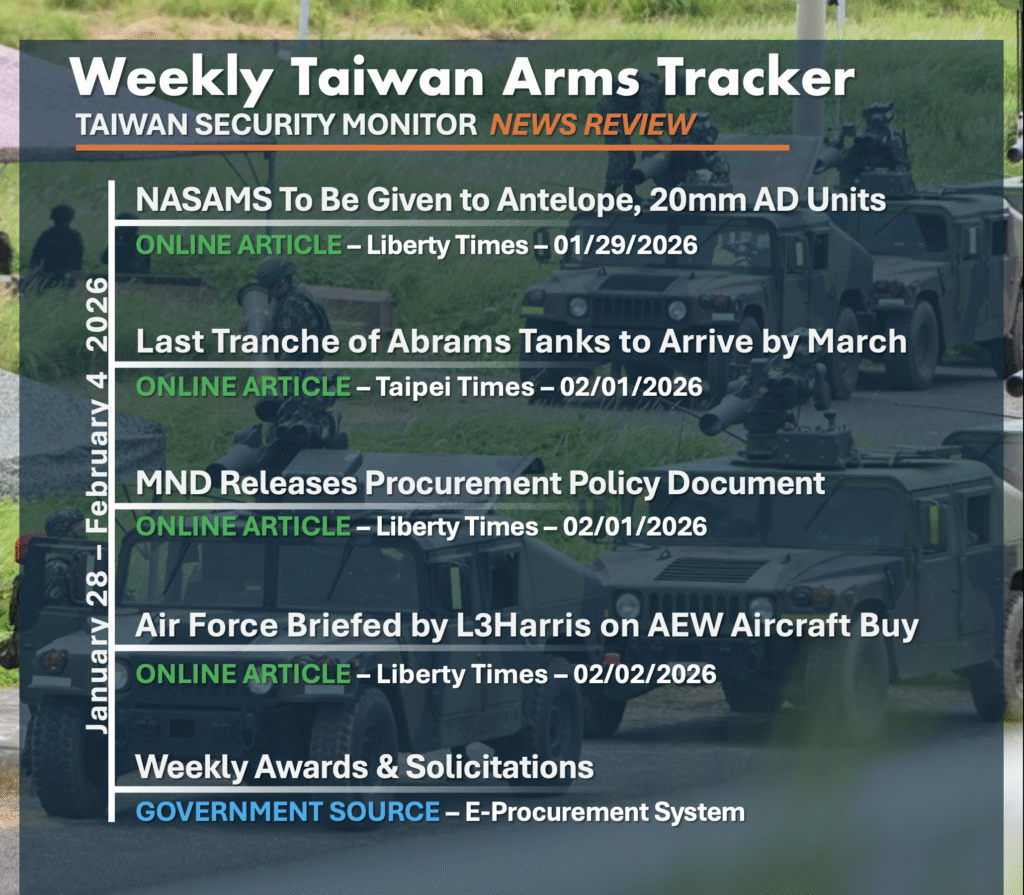
Weekly Arms Update: 2/4/26

Authors: Joe Oโ€™Connor, Shikhar Chaturvedi, Danielle Kremer, and Wyeth Lindberg

This week: MND announces that NASAMS will be deployed to current SHORAD units, a status update on last Abrams tank deliveries emerged, the MND released a policy document with details about naval, wheeled vehicle, and missile procurement, and the Air Force expressed interest in buying new early warning aircraft, alongside weekly awards and solicitations.

NASAMS To Be Given to Antelope, 20mm AD Units

As part of Taiwanโ€™s ongoing air defense modernization, the MND announced this week that US-sold National Advanced Surface-to-Air Missile System (NASAMS) medium-range air defense batteries will replace Antelope and 20-mm short-range capabilities currently used by air-defense units. Per our Taiwan Arms Sales Backlog, this case remains in progress since its notification in November 2024, though a recent US$698.95 million (NT$21.8 billion) U.S. Army production contract awarded to Raytheon for the first three NASAMS fire units signals the beginning of the manufacturing phase, with completion expected by 2031.

Last Tranche of Abrams Tanks to Arrive by March

Taiwanโ€™s MND reported that it would receive its final batch of 28 M1A2T Abrams tanks by March of this year, confirming an MND report to the LY submitted in May 2025. This will be the third batch of Abrams, originally approved in July 2019 sent from the United States to the Taiwanese Army. The first batch of 38 tanks arrived in December 2024, being commissioned in October 2025; and the second batch, sent in July 2025, is still awaiting commissioning; totaling 108 tanks. The sale, which remains backlogged until delivery is confirmed, is worth $1.28 billion USD (NT$40.52 billion).

MND Releases Procurement Policy Document

On Friday, the MND released their โ€œList of Regulated Military Products for the Second Half of 2025,โ€ a policy document outlining controlled procurement items and timelines for future projects, including naval vessels, wheeled vehicles, and indigenous missile programs.

Most importantly, the Navy listed plans to procure several classes of vessels, including five next-generation light anti-air frigates, five light anti-submarine frigates, two rescue ships, one submarine rescue ship, one new Yushan-class dock landing ship, and one oil/ammunition replenishment ship. These projects have a total estimated cost of NT$315 billion (US$9.97 billion) and are expected to be built between 2027 and 2040.

The MND also announced plans to produce 500 additional Clouded Leopard infantry fighting vehicle variants equipped with 105mm cannons, alongside 468 โ€œreconnaissance and tactical wheeled vehicles,โ€ beginning in 2028. Lastly, the list announced plans to procure 2 launchers and 128 missiles for the Strong Bow anti-ballistic missile defense system, still under development and part of the proposed โ€œT-Domeโ€ air defense system.

Air Force Briefed by L3Harris on AEW Aircraft Buy


Per UpMedia, the Air Force Command recently received a briefing from American defense contractor L3Harris on options for commercial procurement of early-warning aircraft. This comes after repeated requests for procurement of E-2D Hawkeye aircraft and MH-60R Black Hawk anti-submarine helicopters were blocked by the United States, and the Air Forceโ€™s desire to upgrade aging early warning airframes. L3Harris is the primary manufacturer of the EA-37B Compass Call aircraft, a modified Gulfstream G550 business jet that has recently been commercially sold to other US allies, including Italy.

Weekly Awards/Solicitations

Last Thursday, the Naval Command awarded Van Halteren Technologies a NT$756.06 million (US$23.89 million) open-ended contract for naval โ€œdrive and controlโ€ spare parts. The contract will be fulfilled throughout the southern region of Taiwan, including Kaohsiung.

Also on Thursday, the Air Force Command awarded a NT$589.83 million (US$18.64 million) contract to Rheinmetall Italia SPA for maintenance of aircraft training simulator systems. This contract is to be fulfilled throughout the southern region of Taiwan.

On Friday, the Naval Commandโ€™s Magong Logistics Support Command made a repeat bid solicitation for the renovation of Magong Naval Baseโ€™s mobilization depot, worth NT$49.00 million (US$1.55 million).

On Monday, the Army Logistics Command solicited bids for rifle magazine bags, worth NT$32.48 million (US$1.03 million).

On Wednesday, the Air Force Command solicited bids for a high-voltage power supply renovation turnkey project at Tainan Air Base, part of Tainan Airport, worth NT$402.67 million (US$12.75 million).

Strait Snapshot, January 2026 Update

Author: Ethan Connell & Jonathan Walberg


Key Findings

  • In January 2026, Taiwan’s Ministry of National Defense recorded 270 PLA aerial sorties around the island, a 21 percent decrease compared to the 340 sorties in January 2025. This month marks the first complete period of post-Justice Mission activity, following the December 29, 2025, exercise that deployed 130 aircraft in a single day.
  • Four Joint Combat Readiness Patrols (JCRPs) occurred during the month, with the January 15 JCRP involving 34 aircraft, marking the highest single-day total. The consistent scheduling of JCRPs throughout January demonstrates that the PLA retains the capability for high-intensity, multi-platform demonstrations around Taiwan, despite a reduction in routine sortie volumes compared to 2025.
  • PLAN vessel detections averaged 6.6 per day in January, with a peak of 11 vessels, aligning with the five-to-nine vessel baseline observed throughout 2025. Naval presence remained stable during the month and was largely unaffected by fluctuations in air activity.
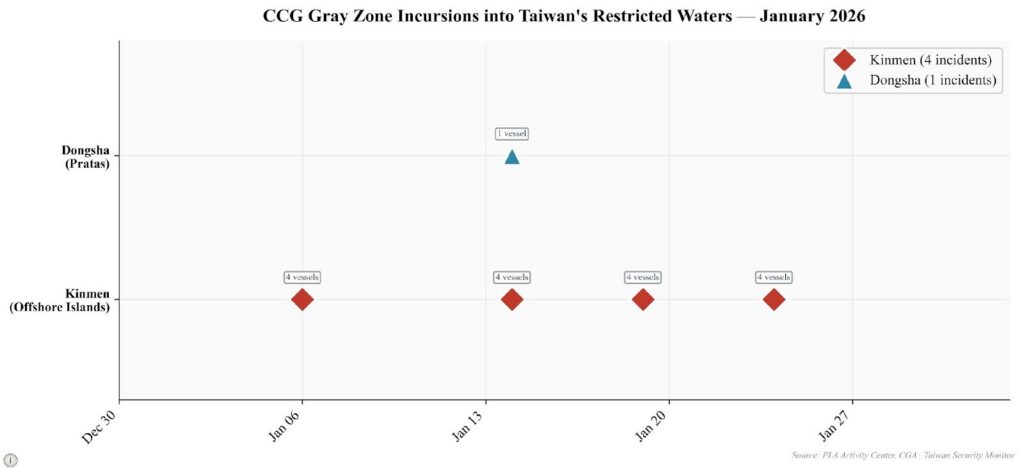
  • The Coast Guard Administration documented five CCG incursions into Taiwan’s restricted waters in January: four near Kinmen and one near Dongsha Island (Pratas). The January 14 Dongsha incident involved CCG vessel 3501, a larger-class cutter, highlighting a qualitative distinction in Beijing’s operational approach to these two locations.

January 2026 Air Activity

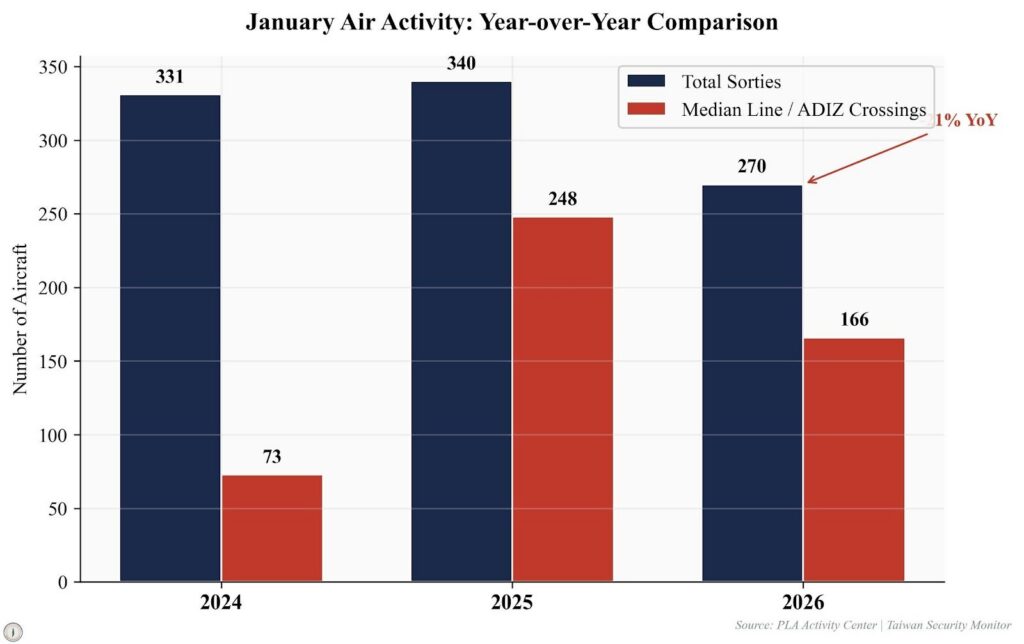
January 2026 opened a new chapter in the pattern of PLA air activity around Taiwan. The month’s total of 270 detected aircraft sorties, of which 166 entered Taiwan’s Air Defense Identification Zone, represents a 21 percent decline compared with January 2025’s 340 sorties. This figure must be read in context: the Justice Mission-2025 exercise of December 29, 2025, which saw 130 aircraft deployed around Taiwan in a single day, the largest such operation since comprehensive daily reporting began, may have temporarily exhausted forward-deployed assets and maintenance capacity in the Eastern Theater Command, contributing to a lower sustained tempo in the weeks that followed.

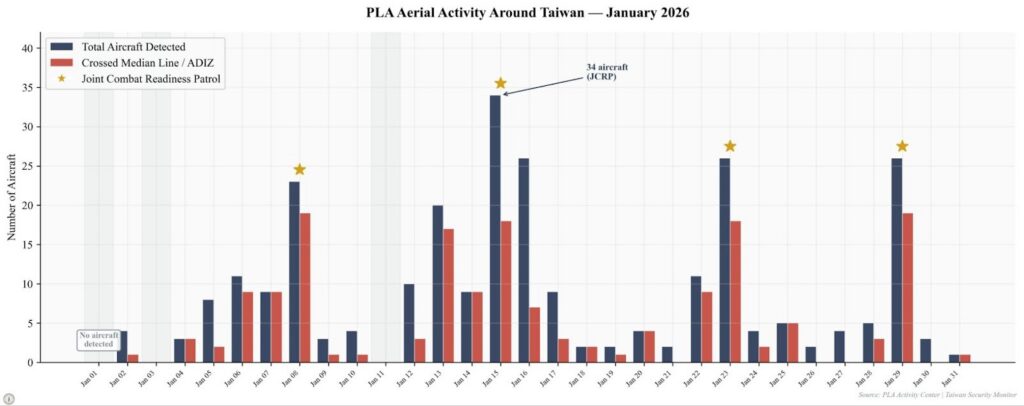
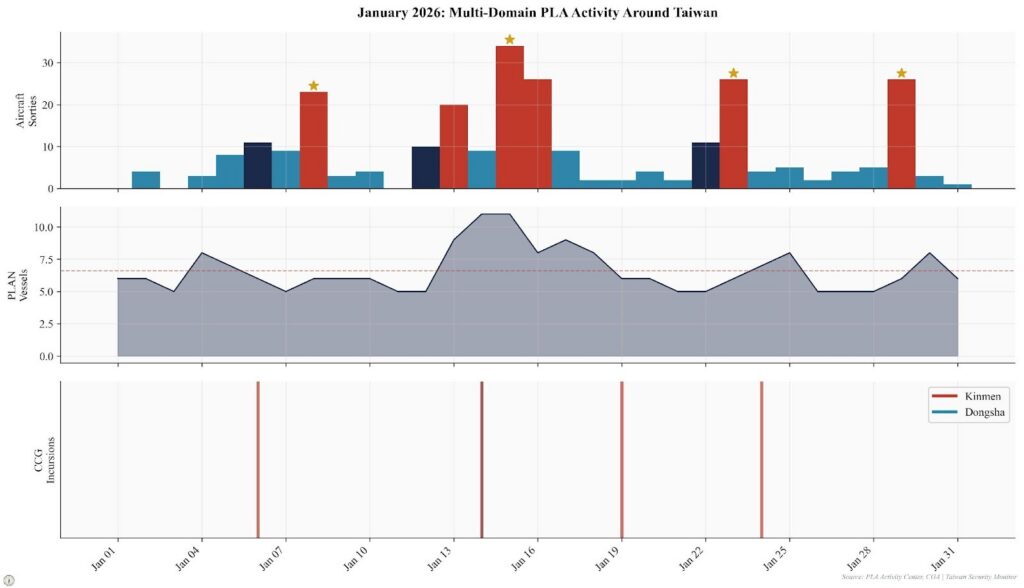
The daily pattern was characterized by a sawtooth rhythm: brief surges tied to Joint Combat Readiness Patrols, interspersed with days of minimal or zero activity. January saw 3 days in which no aircraft were detected (New Year’s Day, January 3, and January 11), punctuated by four JCRPs (January 8, 15, 23, and 29) that produced single-day peaks of 23, 34, 26, and 26 aircraft, respectively. The January 15 JCRP, involving 34 aircraft, was the month’s most significant single-day event and demonstrated multi-platform coordination across fighter, early warning, and anti-submarine warfare aircraft.

Figure 1. Daily PLA activity around Taiwan, January 2026. Gold stars denote JCRP days; shaded columns mark days with zero aircraft detected.

The removal of two senior Central Military Commission vice-chairmen in January, as part of an ongoing anti-corruption campaign within the PLA that had already affected several high-ranking officers in 2025, introduces an additional variable in interpreting the month’s air activity data. Although it is premature to establish a direct causal relationship between personnel changes and operational tempo, disruptions to command authority at the highest levels may have fostered institutional caution, potentially reducing routine sortie generation.

Monthly Trajectory: Where January Fits

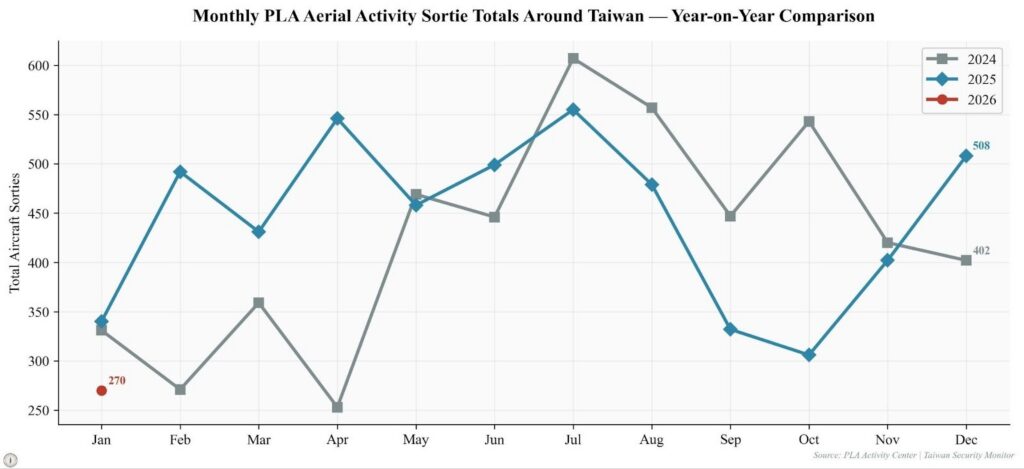
January’s 270 sorties place the month at the low end of the range observed in recent years. For comparison, January 2024 recorded 331 sorties and January 2025 recorded 340. The year-over-year decline is more modest than the raw numbers might suggest: January historically sits below the annual average, as the PLA’s operational calendar typically builds toward spring and fall peaks. What distinguishes January 2026 is the extent to which the month was shaped by the aftereffects of the December 2025 Justice Mission exercise, which represented an operational high-water mark that appears to have drawn forward maintenance and logistics resources.

Figure 2. Monthly PLA sortie totals, 2024โ€“2026. For 2026, only January data is available.

The frequency of joint combat readiness patrols in January 2026, totaling four events, surpassed the typical January cadence observed in previous years. This indicates that the decrease in total sortie volume has not corresponded with a reduction in the PLA’s readiness to conduct large-scale, multi-domain demonstrations on short notice, a trend warranting continued observation in the coming months.

At Sea: Naval Presence in January

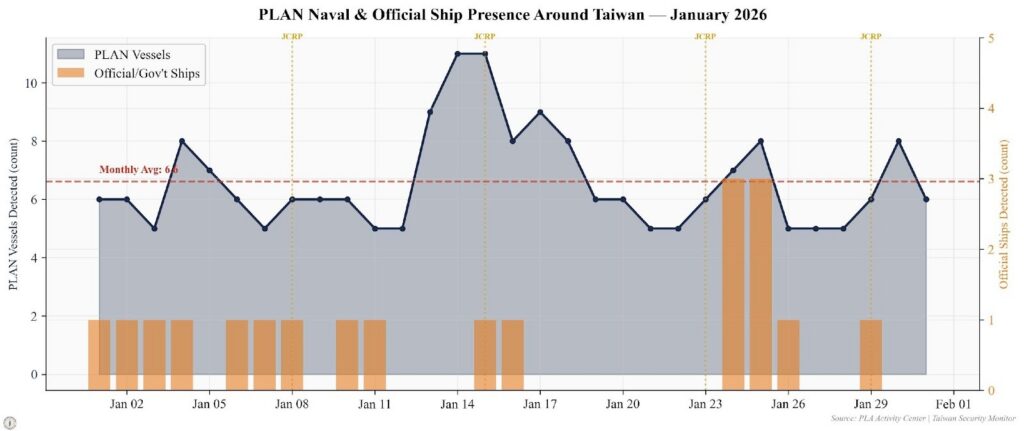
In January, PLAN vessel detections in the waters around Taiwan averaged 6.6 per day, peaking at 11 vessels on January 14 and 15. These numbers align with the five-to-nine vessel baseline that has defined PLAN presence throughout 2025 and into the new year. The stability of naval posture during the post-Justice Mission period, when air activity was moderating, reinforces a key structural observation from Taiwan Security Monitor’s multi-domain tracking: PLAN presence around Taiwan follows a different operational cycle from PLA aerial activity, showing less sensitivity to the political and institutional factors that influence air sortie fluctuations.

Figure 3. PLAN vessel and official ship detections around Taiwan, January 2026.

Official and government ship detections remained generally low throughout January, with a notable increase on January 24 and 25, when three official ships were detected each day. This decoupling between air and naval activity is analytically significant: analysts focusing solely on sortie counts may interpret January’s data as evidence of moderation, yet the stable naval footprint demonstrates that the PLA’s overall maritime posture has not significantly diminished. China Coast Guard activity in Taiwan’s restricted waters constitutes a third, frequently underreported dimension of cross-strait pressure. In January 2026, the CCG conducted at least 5 documented incursions: 4 around Kinmen and 1 near Dongsha Island (Pratas). The Kinmen operations follow a recognizable pattern: typically three to four CCG cutters entering restricted waters near Liaoluo and Lieyu for two to three hours before withdrawing. Recurring hull numbers (14529, 14603, 14605, 14609, and 14533) indicate a dedicated patrol rotation rather than ad hoc deployments.

Figure 4. CCG incursions into Taiwan’s restricted waters, January 2026, by location and vessel count.

The January 14 Dongsha incursion differed qualitatively from the Kinmen pattern. CCG vessel 3501, a larger-class cutter, was detected west of Dongsha at 05:14 and remained in restricted waters for approximately eleven hours before departing. Although this duration was shorter than the twenty-five-hour dwell times observed at Dongsha in subsequent months, the deployment of a 3500-class cutter to Taiwan’s most remote holding indicates sustained interest in testing the Coast Guard Administration’s ability to maintain a presence at Dongsha, located approximately 450 kilometers southwest of the main island and over 300 kilometers from the nearest Taiwan-controlled port.

Multi-Domain Overview

Figure 5. January 2026 multi-domain PLA activity: air sorties, naval presence, and CCG incursions.

When considered across all three domains, January 2026 exhibits the characteristic pattern of multi-domain PLA pressure that the Taiwan Security Monitor has documented since the post-2022 period. Air activity was concentrated in distinct JCRP-driven surges, separated by extended periods of minimal activity. Naval presence remained steady and was largely uncorrelated with the daily fluctuations in air operations. Coast Guard incursions persisted along established geographic patterns, with the Dongsha deployment introducing a longer-range element to an otherwise Kinmen-focused gray-zone campaign.

Figure 6. January air activity year-over-year: total sorties and ADIZ crossings, 2024โ€“2026.

Analysts and policymakers should avoid interpreting a reduction in one domain as indicative of an overall decrease in pressure. The combined multi-domain posture, encompassing air, naval, and coast guard activities, does not reflect a significant departure from the sustained pattern of PLA activity around Taiwan that has shaped the cross-strait military balance since August 2022.

Methodology & Sources

Air and naval detection data are drawn from daily press releases issued by Taiwan’s Ministry of National Defense and compiled in the PLA Activity Center database maintained by Taiwan Security Monitor. Coast Guard incident data are compiled from Coast Guard Administration press releases and verified against contemporaneous media reporting. Japan ADIZ scramble data are sourced from Japan Joint Staff Office press releases and reporting by USNI News. “Median line” refers to the informal centerline of the Taiwan Strait historically observed by both sides. “JCRP” denotes Joint Combat Readiness Patrols as designated by Taiwan’s MND. All analysis and commentary are by Taiwan Security Monitor.

ยฉ 2026 Taiwan Security Monitor. All rights reserved.

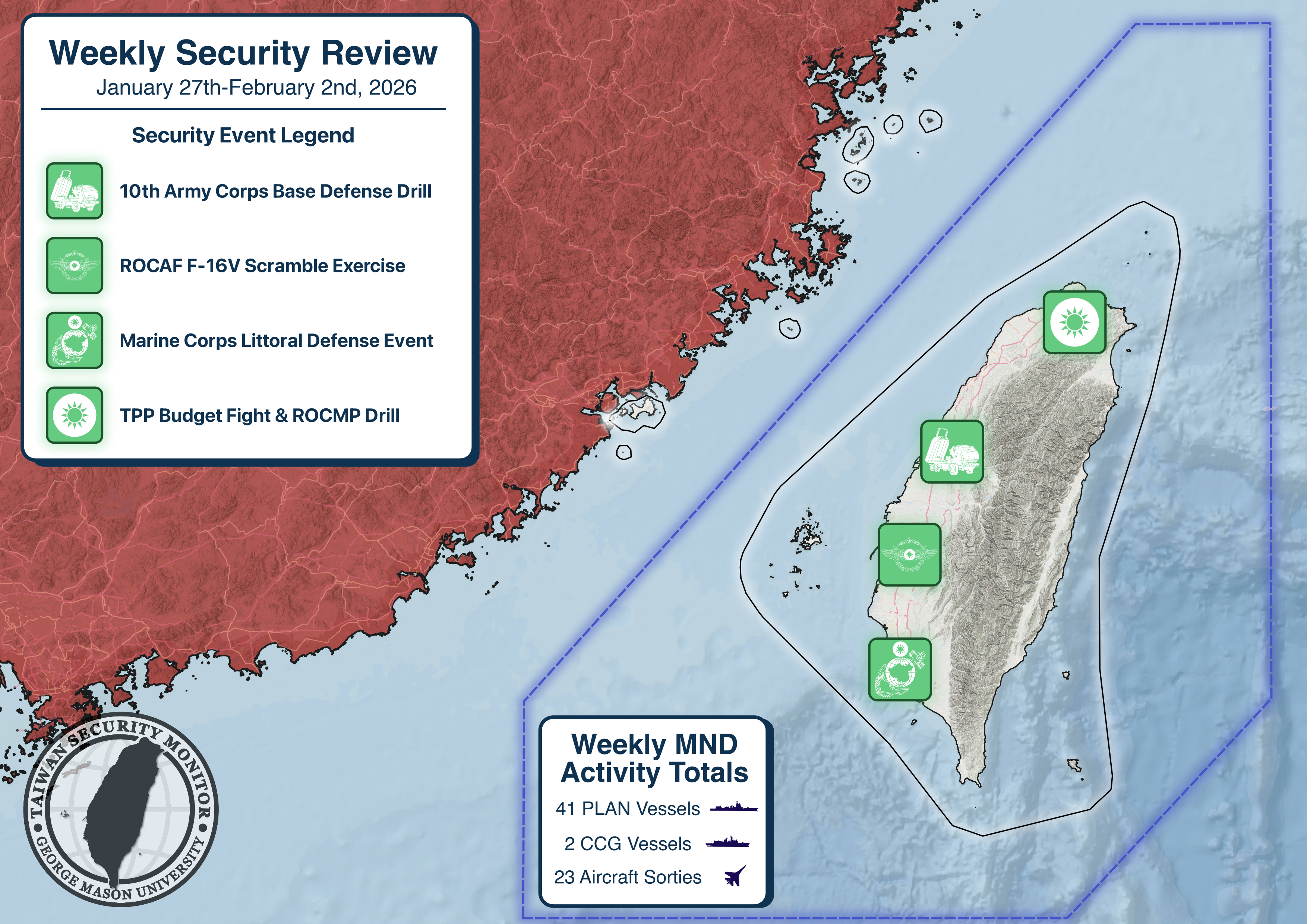
Weekly Security Review: 2/2/26

Author: Jaime Ocon


Welcome to the Weekly Security Review, where we highlight key military, security, and political developments around Taiwan in one straightforward summary!

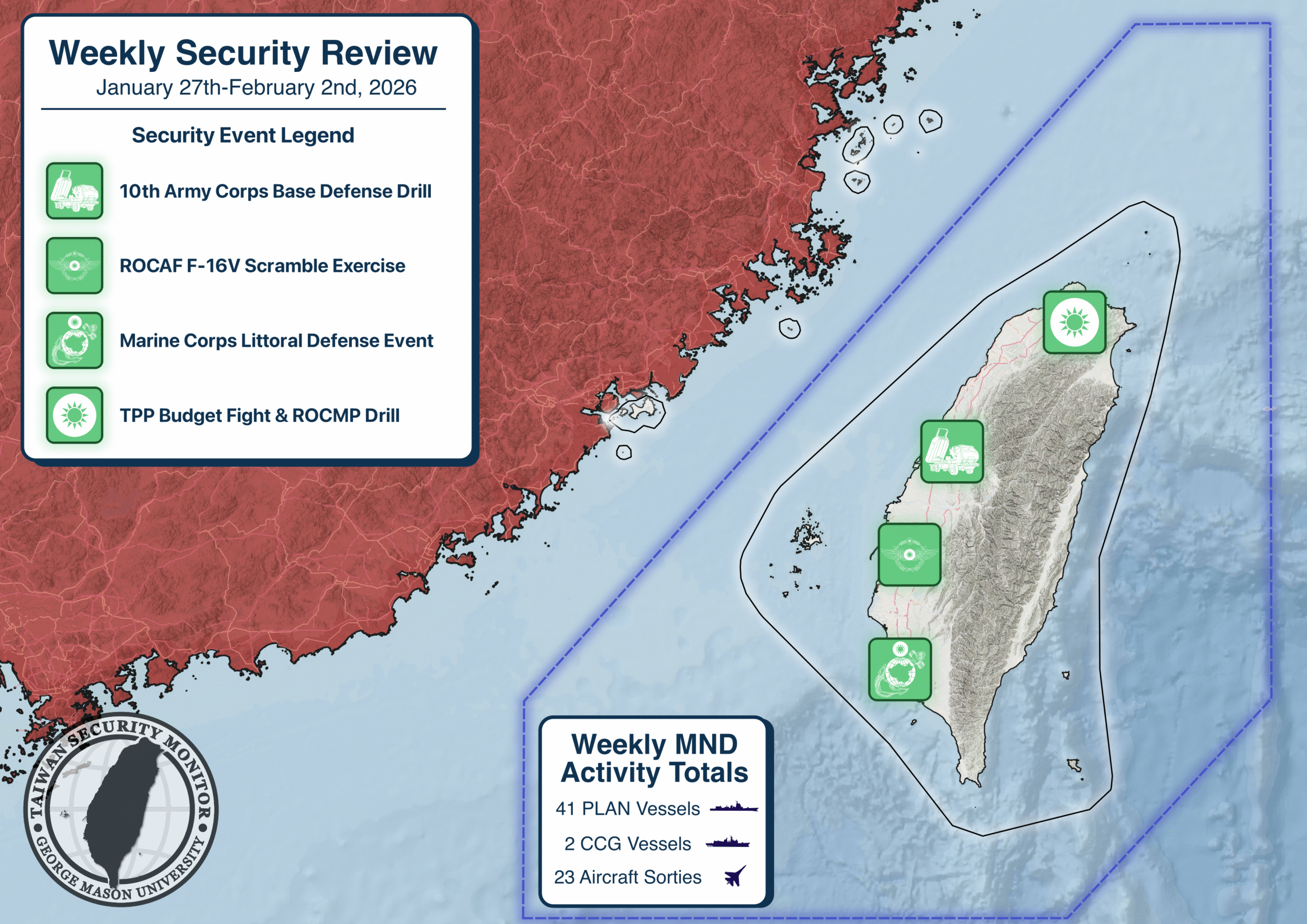
This week, Taiwanโ€™s military conducted nationwide combat readiness drills ahead of the Lunar New Year, military police sharpened urban-warfare and close-quarters combat skills, and opposition lawmakers moved to cut supplementary defense funding.

Military Conducts Lunar New Year Exercises 

Ahead of the Lunar New Year, Taiwanโ€™s military is conducting its annual combat readiness exercises to demonstrate that the armed forces will maintain vigilance and operational preparedness throughout the holiday period. For this iteration, the military held air, land, and sea media demonstrations over three days. Itโ€™s important to mention that there were other LNY exercises conducted away from the cameras in other parts of the country. 

Army Deploys HIMARS, UAVs in Base Defense Drill 

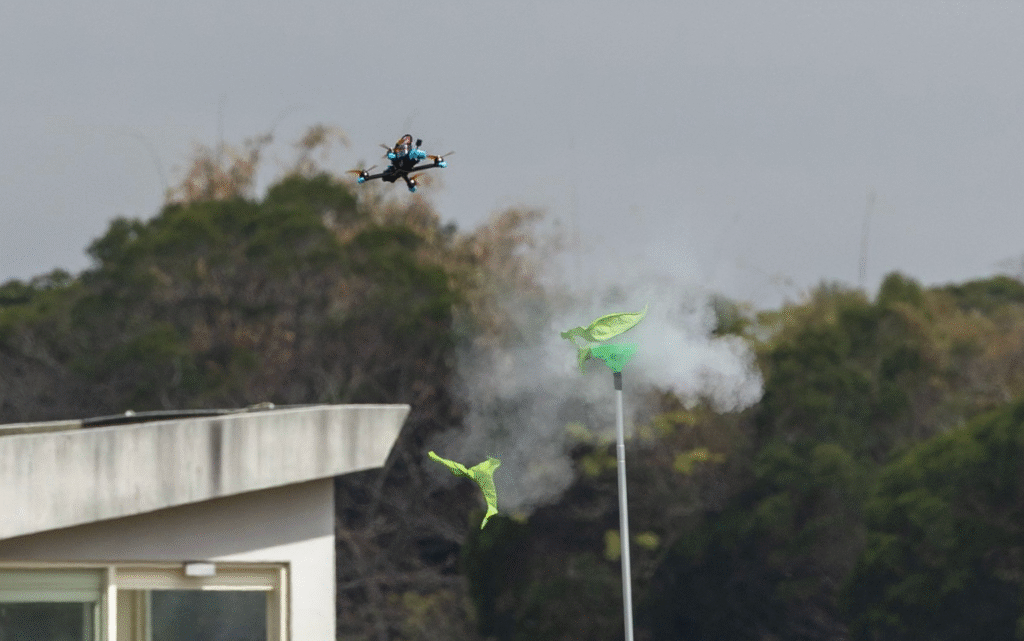
On Tuesday, 27 January, the 10th Army Corps conducted a โ€œrapid combat readinessโ€ scenario in which an opposing force, mostly fifth column operatives, attacked a small military base. The force was equipped with machine guns and used technical-style pickup trucks to launch an assault, with additional forces arriving by helicopter to support the broader attack. Taiwanโ€™s army responded to this scenario by deploying troops from the 586th Armored Brigade, 58th Artillery Command, supported by the 602nd Army Aviation Brigade. Assets used included M60A3 tanks, CM33/34 Clouded Leopard infantry fighting vehicles, Humvees equipped with TOW-2B anti-tank missiles, Land Sword-2 SAM systems, UH-60M Black Hawk helicopters, AH-1W Super Cobra attack helicopters, and, for the first time, HIMARS and small-scale first-person-view (FPV) drones.

The exercises demonstrated small-scale counterinsurgency operations. Further, the MND said the drills were an opportunity for the 58th Artillery Command to test the effectiveness of new equipment. Most notable was the use of new HIMARS systems and FPV drones to provide additional firepower against potential enemy attacks. FPV drones were used to target balloons simulating enemy targets, while HIMARS demonstrated mobile โ€œscoot-and-shootโ€ tactics,  coordinating fire with troops on the ground. The tactic involves friendly forces practicing target engagement before relocating to avoid detection from the enemy.

Itโ€™s important to remember that late last year, the U.S. approved the sale of 82 HIMARS systems and 420 ATACMS worth more than $4 billion. Taiwanโ€™s military considers these systems crucial to the islandโ€™s defense, and recent reports indicate the Army could deploy them to the outlying islands, closer to China. You can see our own visualization of that deployment here: 

Air Force Demonstrates F-16V Scramble, Air Defense Operationsย 

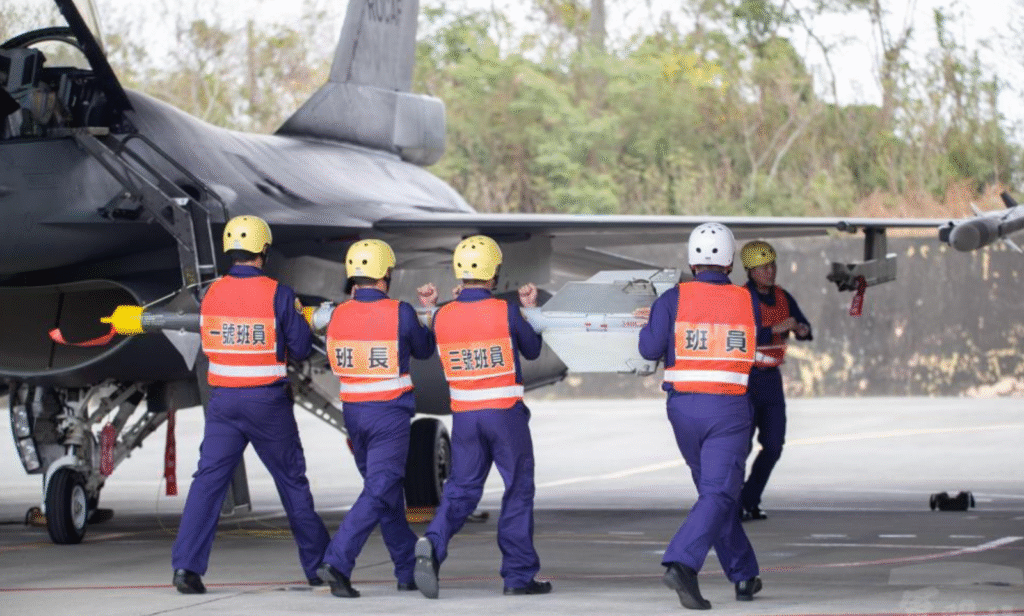
For two consecutive days (27-28 January), the media demonstrations moved south to Chiayi Air Base, home to the 4th Tactical Fighter Wingโ€™s F-16V fighter jets. The exercises began with a demonstration of how pilots scramble to intercept enemy aircraft flying close to the countryโ€™s airspace. From the moment the alarm sounded to take off, the entire procedure reportedly took place in under six minutes. The Air Force also demonstrated various daily maintenance operations, including weaponsโ€‘loading teams mounting different types of missiles, such as AIMโ€‘120 AMRAAMs and AIMโ€‘9 Sidewinders. Officers told the media that โ€œthrough integrated combat turnaround procedures, the aircraft can swiftly transition between airโ€‘toโ€‘air, airโ€‘toโ€‘sea and airโ€‘toโ€‘ground missions, enabling it to respond effectively to the rapidly changing conditions of the battlefieldโ€.ย 

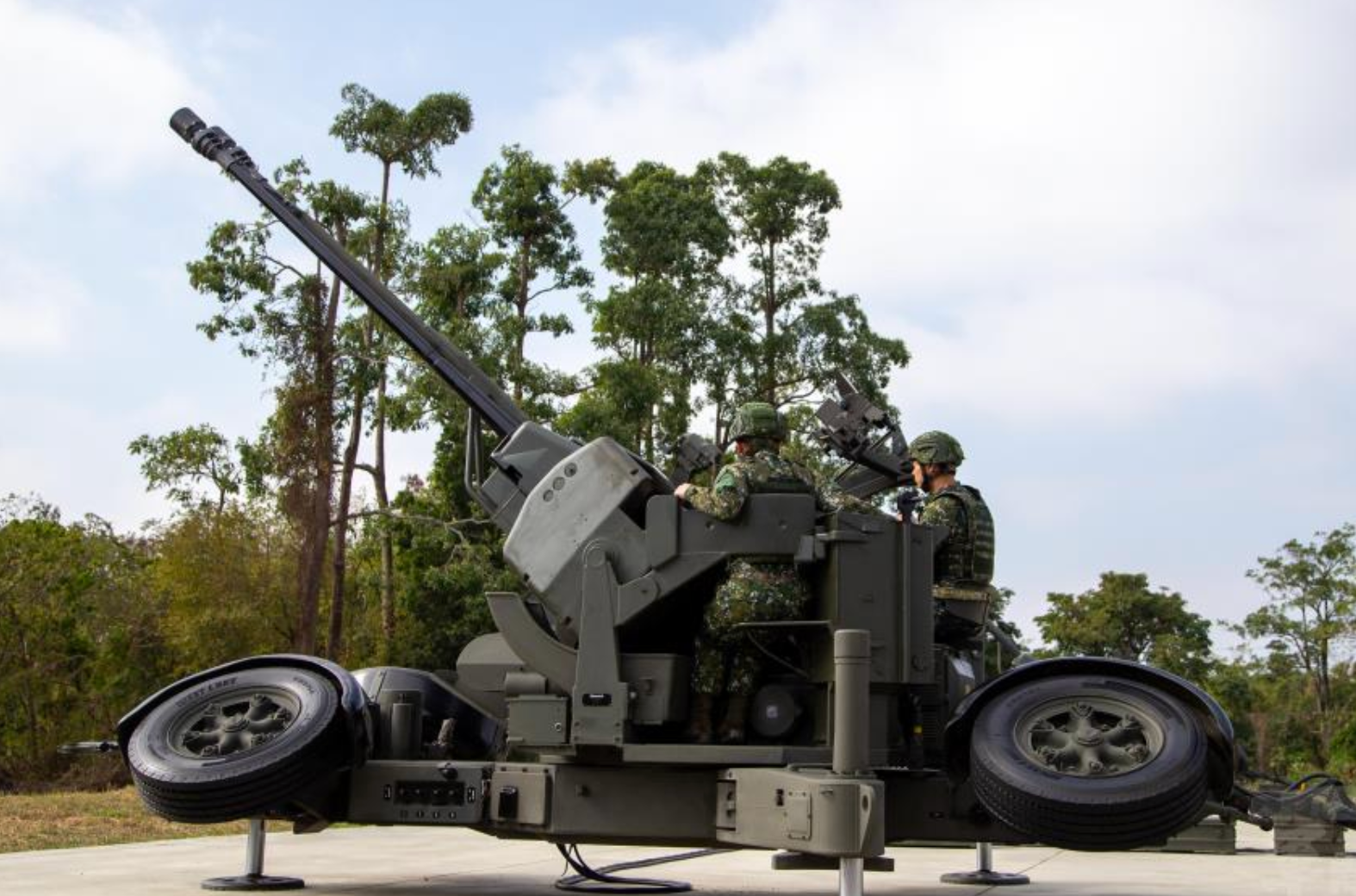
Along with the scramble exercises, units from the Air Forceโ€™s 301st Air Defense and Missile Battalion were also deployed to practice defending the surrounding airspace. Assets deployed included Skyguard GDFโ€‘006 antiโ€‘aircraft guns, Skyguard radar systems, and AIM-7 Sparrow SAM systems. 

Navy, Marines Showcase Coastal Strike and Littoral Defense Capabilities

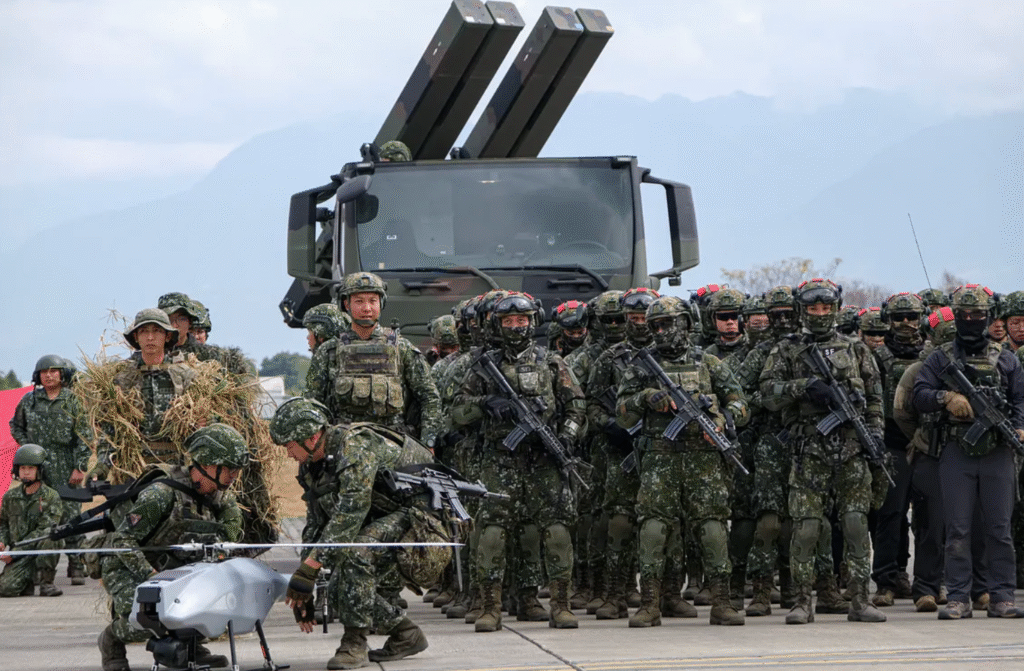
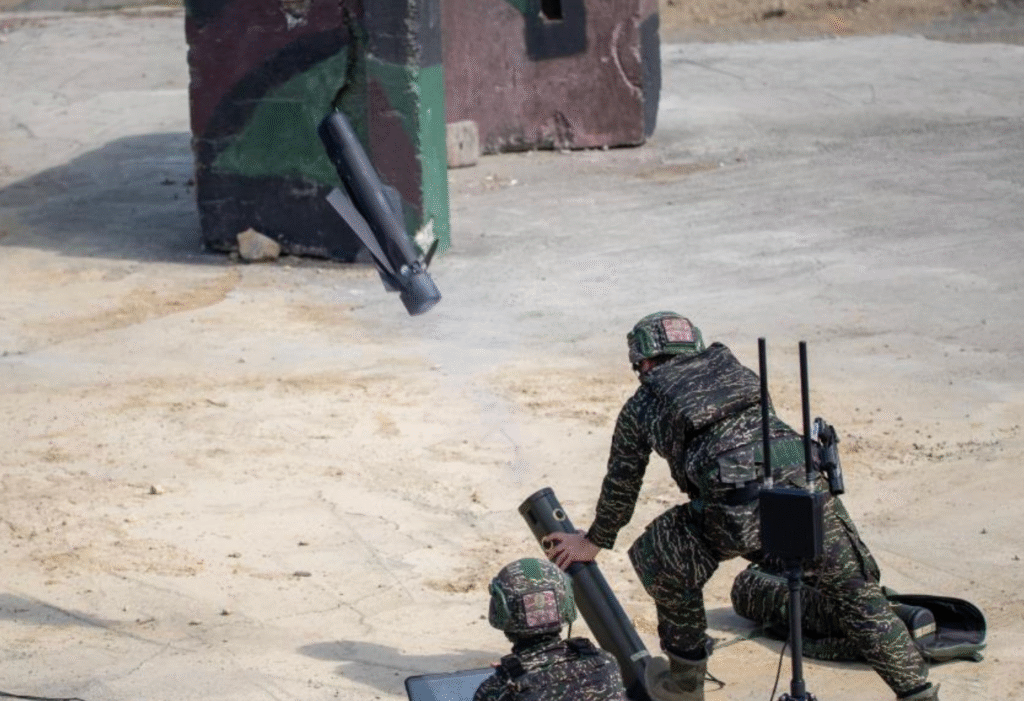
On the last day of the exercises (29 January), the Navy and Marine Corps hosted members of the media to demonstrate how they would defend against enemy vessels attempting to make it ashore. During the demonstration, ROCMC units held the first public live-fire test of the Chien Feng I attack UAV. This is a tube-launched drone that is similar to the American Switchblade system. One drone crashed shortly after takeoff, but the second backup drone launched successfully and struck a maritime target.ย 

One component of the drill also featured enemy vessels rushing to shore, as Marine units aboard M109 speedboats and Kuang Hua-class missile boats raced to intercept and defend against the attack. In the background and along the shore, Haifeng Brigade mobile anti-ship missile launchers were deployed alongside snipers hidden in the tall grass. The MND says the overall goal of the drill was to demonstrate โ€œintegrated reconnaissance UAVs, mobile radar, and missile unitsโ€ฆexecuting coordinated ISR, strike, and battle damage assessment operationsโ€.

After the exercise, the National Chung-Shan Institute of Science and Technology (NCSIST), which produces the Chin Feng I drone, said the initial crash was due to wing control failure and that reliability improvements are underway. 

Military Police Conducts Urban Defense Drills in Taipei

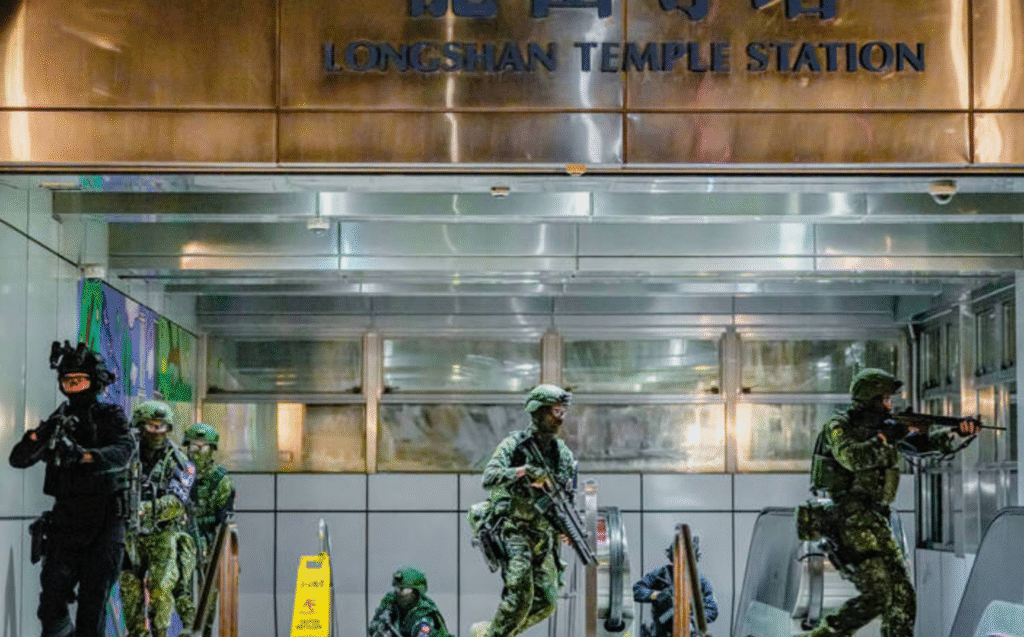
Taiwanโ€™s military police were also busy this week as some units completed a four-day, three-night training exercise in the capital, Taipei. The drills tested defenses in both urban and mountainous environments, close-quarters battle (CQB), and counter-drone tactics.

Units from the 211th, 229th, and 332nd Battalions operated under the Military Policeโ€™s 202nd Command. The 211th Battalion, or โ€œIron Guard Battalion,โ€ is responsible for guarding the Presidential Office and other key heads of state in downtown Taipei. Images show military personnel conducting CQB and seizing key positions as they exit Taiwanโ€™s subway system. Other scenarios also included simulated artillery, gas, and drone attacks, forcing troops to shift constantly between underground and surface operations.

During last yearโ€™s annual Han Kuang military exercises, ROCMP troops made headlines as they were filmed using the subway system to transport Stinger and Javelin missiles across the city. The MND says the Military Police play an important role in the countryโ€™s defense, as they would be responsible for protecting key infrastructure from sabotage, terrorism, and other internal attacks.  

TPP Agrees on Initial Passing of Supplemental Budget 

After weeks of back and forth, Taiwanโ€™s Legislative Yuan (LY) has voted to send the Taiwan People’s Party’s (TPP) proposed โ€œnational security and asymmetric warfare procurement billโ€ to committee review.

Originally, the ruling Democratic Progressive Party (DPP) proposed a special supplementary defense budget of roughly US$40 billion, comprising eight major categories of spending. You can find a complete breakdown here. 

The TPPโ€™s alternative proposal lists five line items and caps annual spending at US$12.6 billion, approximately one-third of the MNDโ€™s original request. The TPPโ€™s proposal keeps 5 cases, including additionalย  HIMARS, 60 Paladin self-propelled howitzers, Javelin anti-armor missiles, TOW anti-armor missiles, and ALTIUS loitering munitions. However, the proposal omits Tactical Mission Network software, AH-1W helicopter parts, and Harpoon missile support. Additional funding for production agreements with local arms industries, including the procurement of 200,000 drones and the T-Dome multilayered air defense system, has also been cut.ย 

Taiwanโ€™s MND says the TPPโ€™s proposal lacks supporting measures, and without proper funding, weapon systems and defense procurement would be harder to implement and may have serious long-term repercussions.

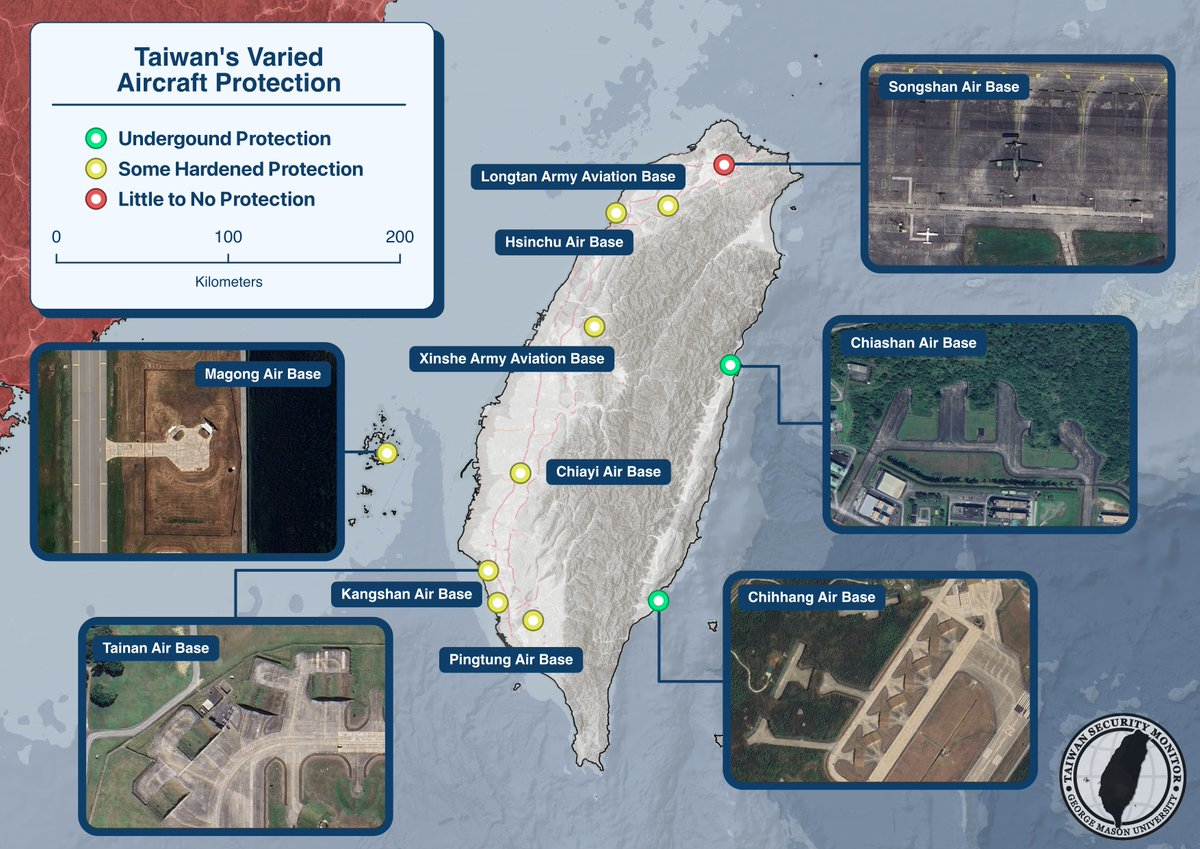
Visualization: Taiwan’s Varied Aircraft Protection


Authors: Chris Dayton & Noah Reed


Recent drone attacks on airfields in global conflicts have placed a heightened focus on aircraft protection at Taiwanโ€™s major military bases. Improving ROCAF survivability is now a priority for the MND, with plans to significantly expand hardened shelters at Chihhang AFB by 2028 to protect future F-16C/D Block 70 fighters. Above is our visualization of the level of hardened protection at each of Taiwanโ€™s airbases.