Taiwan Security Monitor

Taiwan Affairs Office: Preparations for the 18th Straits Forum are basically complete.

At the June 10 State Council Taiwan Affairs Office press conference, a reporter asked:

The 18th Straits Forum is about to convene. Please introduce the progress of preparations. Which Taiwanese guests will attend this yearโ€™s Straits Forum?

State Council Taiwan Affairs Office spokesperson Zhang Han said in response that the main conference of the 18th Straits Forum will be held in Xiamen on June 13. Kuomintang Vice Chairman Chang Jung-kung and other representatives from various sectors in Taiwan will attend. At present, preparations for the forum are basically complete. The forumโ€™s series of activities have already begun across Fujian, with four events held so far: the Taiwan Talent Xiamen Matchmaking Conference, the Straits Peopleโ€™s Forum, the Cross-Strait Dragon Boat Race, and the Common Homeland Forum. Nearly 1,000 Taiwanese compatriots have participated enthusiastically.

Zhang Han said this yearโ€™s forum continues to focus on and serve grassroots and youth groups, allowing the fruits of cross-Strait integrated development to benefit more compatriots on both sides. Activities cover a diverse range of fields, including grassroots governance, marriage and family, social welfare, sports competitions, folk religion, song and dance arts, financial technology, rural revitalization, agricultural and fisheries cooperation, and new media creation. The forum will also innovatively promote connections between the two sides in education, e-commerce, biomedicine, and small and medium-sized enterprises, protect the growth of children and teenagers, and help Taiwanese youth broaden their paths for employment and entrepreneurship. We warmly welcome compatriots from all sectors in Taiwan to cross the sea and gather together, renew friendships, share opportunities, pursue development together, and jointly create the future.
Taiwan Affairs Office: The DPP authoritiesโ€™ sabotage of cross-Strait exchanges and cooperation exposes their essence as โ€œfake democracy, real dictatorship.โ€

At the June 10 State Council Taiwan Affairs Office press conference, a reporter asked:

The 18th Straits Forum will soon be held. Taiwanโ€™s Mainland Affairs Council said that โ€œthe Straits Forum is a mainland united-front platformโ€ and has further expanded restrictions this year, requiring county and city governments as well as public officials not to attend related activities. Public opinion on the island holds that banning exchanges with a single official document makes people feel very threatened. What is your comment?

State Council Taiwan Affairs Office spokesperson Zhang Han said in response that the Straits Forum is a cross-Strait people-to-people exchange platform that upholds a โ€œpeople-oriented, grassroots, and broad-basedโ€ character. It has played an important and positive role in promoting exchanges and cooperation across various fields on both sides of the Strait and in enhancing the interests and well-being of compatriots, and is widely welcomed by compatriots on both sides.

Zhang Han said the DPP authorities, out of their stubborn โ€œTaiwan independenceโ€ position, disregard public wishes and local development needs, and have neither the willingness nor the ability to properly handle cross-Strait relations. For their own political self-interest, they smear and slander the Straits Forum, undermine cross-Strait exchanges and cooperation, and restrict the freedom of movement and speech of Taiwanโ€™s people, seriously harming the interests and well-being of compatriots on the island. Their actions fully expose their essence as โ€œfake democracy, real dictatorship.โ€ I want to emphasize that compatriots on both sides of the Strait are one family, and no force can stop the great trend of people on both sides becoming closer and coming together.

Taiwan Affairs Office: After peaceful reunification, Taiwan will become an island of peace, security, and prosperity.

At the June 10 State Council Taiwan Affairs Office press conference, a reporter asked:

At previous press conferences, State Council Taiwan Affairs Office spokespersons have already explained five of the โ€œseven bettersโ€ for Taiwan after peaceful reunification, drawing close attention from public opinion on both sides of the Strait. How would the spokesperson explain the idea that โ€œafter peaceful reunification, with a powerful motherland as its backing, Taiwanโ€™s security guarantees will be betterโ€?

State Council Taiwan Affairs Office spokesperson Zhang Han said in response that after peaceful reunification, with a powerful motherland as its backing, the people of Taiwan will be safer. The risk of war brought by โ€œTaiwan independenceโ€ will be eliminated at the root. Taiwanโ€™s people will no longer be coerced by โ€œTaiwan independenceโ€ into becoming โ€œcannon fodder,โ€ their hard-earned money will no longer be squandered on buying weapons, and ammunition will not be stockpiled in private homes or temples. The black hand of external forces interfering in the internal affairs of the Chinese people on both sides of the Strait will be completely cut off. Taiwan will no longer be a โ€œpawnโ€ of external forces, nor the โ€œpowder keg,โ€ โ€œlandmine island,โ€ or โ€œhellscapeโ€ that the DPP authorities have colluded with external forces in an attempt to create. Taiwan will escape the fate of being sacrificed at any time by โ€œTaiwan independenceโ€ and external forces. Taiwanโ€™s economy will be able to develop sustainably and steadily, its industrial and supply chains will become more independently controllable, secure, and reliable, achieving a positive combination of high-quality development and high-level security. The lawful rights and interests of Taiwan fishermen operating in the waters surrounding Taiwan Island will receive timely and strong protection from national maritime forces.

Zhang Han said that after peaceful reunification, Taiwan will become an island of peace, security, and prosperity, jointly protected by all sons and daughters of the Chinese nation. Taiwan compatriots will be able to truly live and work in peace and contentment in a peaceful and tranquil environment, and fully enjoy the peaceful times brought by national reunification and national rejuvenation.

Taiwan Affairs Office: More and more Taiwan compatriots hope for peace and stability in the Taiwan Strait and for improved development of cross-Strait relations.

At the June 10 State Council Taiwan Affairs Office press conference, a reporter asked:

A recent poll by Taiwanโ€™s โ€œDemocracy Cultural and Educational Foundationโ€ showed that nearly 60 percent of Taiwanese people support proactively conducting peace talks with the mainland, and nearly 70 percent believe cross-Strait relations should be improved and peace should be pursued. Some opinion on the island holds that when cross-Strait issues shift from a choice between โ€œunification and independenceโ€ to one between โ€œwar and peace,โ€ Taiwan public opinion โ€” especially among younger groups โ€” has already begun to change. What is your comment?

State Council Taiwan Affairs Office spokesperson Zhang Han said in response that the mainstream public opinion in Taiwan society in favor of peace, development, exchanges, and cooperation cannot be suppressed. The relevant poll once again proves that compatriots on both sides of the Strait are all Chinese, one family, and all hope for peace and stability in the Taiwan Strait, hope for improved development of cross-Strait relations, and hope for a better life.

Zhang Han said the future of the motherland and the nation rests with young people. More and more Taiwan compatriots, especially young friends, recognize that Taiwanโ€™s development and the interests and well-being of Taiwan compatriots are tied to the peaceful development of cross-Strait relations, national reunification, and the great rejuvenation of the Chinese nation. We welcome and support more young people from both sides of the Strait visiting each other often, deepening understanding, moving forward together with one heart, and firmly keeping the future of cross-Strait relations in the hands of the Chinese people themselves.

Taiwan Affairs Office: Lai Ching-te is pursuing โ€œindependenceโ€ under the banner of โ€œdemocracy.โ€

At the June 10 State Council Taiwan Affairs Office press conference, a reporter asked:

Recently, Lai Ching-te said in an interview that he โ€œwithstood pressure from Chinaโ€ and made a โ€œsurprise visitโ€ to Eswatini. He also said Taiwanese people are unwilling to accept โ€œChinese ruleโ€ and hope to continue living a life of โ€œfreedom, democracy, and human rights.โ€ What is your comment?

State Council Taiwan Affairs Office spokesperson Zhang Han said in response that Lai Ching-te has squandered the hard-earned money of the Taiwanese people, engaged heavily in โ€œdollar diplomacy,โ€ and spent huge sums to buy โ€œtransit diplomacy.โ€ He has become a laughingstock in the international community and on the island, yet instead of feeling ashamed, he takes pride in it. This fully exposes his โ€œTaiwan independenceโ€ nature and his paranoid, base character.

Zhang Han said the DPP authorities constantly shout โ€œfreedomโ€ on the island, yet for a long time they have manipulated the media, maintained online troll armies, suppressed public opinion, and obstructed and restricted cross-Strait personnel exchanges as well as exchanges and cooperation in various fields. They flaunt โ€œdemocracy,โ€ yet engage in โ€œgreen terror,โ€ abusing judicial and administrative means to suppress and persecute political opponents, while constantly manipulating and provoking political infighting. They talk at length about โ€œhuman rights,โ€ yet disregard the interests and well-being of people on the island, repeatedly discriminate against and create difficulties for mainland spouses, and label and smear relevant people on the island, losing the support of the people.

Zhang Han said differences in social systems are not an excuse for separatism. As long as one recognizes the one-China principle and advances national reunification, speaking properly and discussing matters in good faith, there are no contradictions or differences that cannot be resolved. We hope the broad range of Taiwan compatriots will correctly understand the mainlandโ€™s social system and development path, see clearly the true face and sinister intentions of the DPP authorities as they pursue โ€œindependenceโ€ under the banner of โ€œdemocracy,โ€ draw a clear line between themselves and โ€œTaiwan independenceโ€ separatist forces and their activities, and work together with us to safeguard peace and stability in the Taiwan Strait.

Taiwan Affairs Office: The DPP authoritiesโ€™ obstruction of cross-Strait industrial division of labor and cooperation is self-defeating.

At the June 10 State Council Taiwan Affairs Office press conference, a reporter asked:

A recent survey by Taiwanโ€™s CommonWealth Magazine pointed out that Taiwanโ€™s AI-related industries are growing rapidly, but a large number of traditional industries are becoming marginalized. Some public opinion holds that one of the important reasons Taiwanโ€™s traditional industries were able to maintain competitiveness in the past was cross-Strait division of labor. For traditional industries to save themselves, they must seize opportunities for cross-Strait economic cooperation, especially by relying on the mainlandโ€™s complete supply chains, enormous market scale, and manufacturing advantages. What is your comment?

State Council Taiwan Affairs Office spokesperson Zhang Han said in response that Taiwanโ€™s industries can currently be described as โ€œone industry flourishing while a hundred industries decline.โ€ The problem of an overly narrow industrial structure is becoming increasingly apparent, and the vulnerability of economic development is more pronounced. Traditional industries are in difficult circumstances, their room for development is shrinking, most residentsโ€™ incomes are far below the median, and unpaid leave is becoming longer and longer. People on the island are strongly dissatisfied with this. The DPP authorities not only refuse to face up to the prominent problems and serious hidden risks in the islandโ€™s industries or find a way forward for them, but instead repeatedly push cross-Strait โ€œdecoupling and supply-chain severanceโ€ and obstruct cross-Strait industrial division of labor and cooperation. This can be described as trapping themselves in a cocoon of their own making and being foolish beyond measure.

Zhang Han said the mainlandโ€™s โ€œ15th Five-Year Planโ€ outline proposes โ€œbuilding a modernized industrial systemโ€ and โ€œoptimizing and upgrading traditional industries.โ€ Traditional industries are closely related to peopleโ€™s livelihoods and development, and with strong support from industrial chains, supply chains, and markets, they can fully achieve innovative development through intelligentization, green transformation, and integration. We will, as always, actively support cross-Strait industrial cooperation and support the broad range of Taiwanese enterprises, including traditional-industry operators, in giving full play to their own advantages, seizing the development opportunities of the โ€œ15th Five-Year Plan,โ€ and achieving better and greater development.

Taiwan Affairs Office: If the DPP authorities dare to provoke in the relevant waters, they must bear all consequences.

At the June 10 State Council Taiwan Affairs Office press conference, a reporter asked:

The DPP authorities said that on June 5, a mainland China Coast Guard vessel entered the โ€œrestricted watersโ€ of the Dongsha Islands, and vessels from both sides became involved in a standoff. What is your comment?

State Council Taiwan Affairs Office spokesperson Zhang Han said in response that China has sovereignty over the South China Sea islands, including the Dongsha Islands, and their adjacent waters. Law-enforcement patrols by mainland China Coast Guard authorities in the relevant waters are normal performance of duty. If the DPP authorities dare to provoke, they must bear all consequences arising from it.

Taiwan Affairs Office: Those who forget their ancestors and betray the nation will be nailed to historyโ€™s pillar of shame.

At the June 10 State Council Taiwan Affairs Office press conference, a reporter asked:

In response to Japan and the Philippines announcing the launch of โ€œmaritime delimitation talks,โ€ the mainland emphasized the one-China principle and said both sides of the Strait should jointly safeguard national sovereignty and territorial integrity. The DPP authorities, however, falsely claimed that โ€œthe two sides of the Strait are not subordinate to each other, China has no right to interfere and no right to speak on Taiwanโ€™s behalf,โ€ and said Taiwan has signed โ€œfisheries agreementsโ€ with Japan and the Philippines respectively and will continue to consult with Japan and the Philippines on maritime issues. Some media reports also said Japan has rejected the DPP authoritiesโ€™ request for dialogue. What is your comment?

State Council Taiwan Affairs Office spokesperson Zhang Han said in response that the maritime area Japan and the Philippines announced they intend to delimit lies east of Taiwan Island, and China possesses an exclusive economic zone and continental shelf in those waters. Japan and the Philippines bypassing China and unilaterally launching so-called โ€œdelimitation talksโ€ seriously infringes upon Chinaโ€™s maritime rights and interests, seriously violates international law and basic norms of international relations, and is completely illegal and invalid.

Zhang Han said the DPP authorities have humbled themselves and pandered to external forces, degenerating into out-and-out national traitors. Faced with the unanimous condemnation of compatriots on both sides of the Strait, the DPP authorities have changed their tune again, reheating the fallacy of โ€œTaiwan independenceโ€ in an attempt to shift focus and deceive the public. We sternly warn the DPP authorities: anyone who forgets their ancestors and betrays the nation will, without exception, be nailed to historyโ€™s pillar of shame.

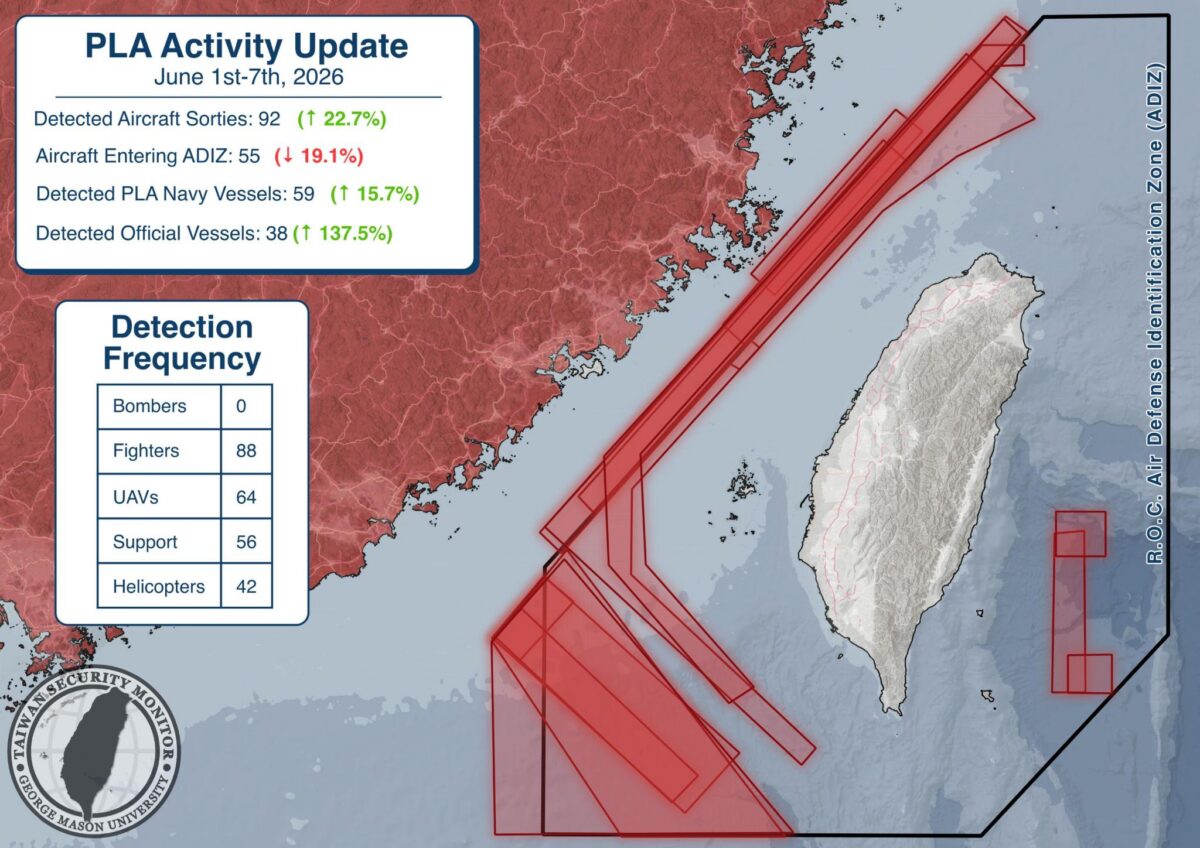
PLA Activity Update, 6/7/26


Author: Ethan Connell


Notes:

  • All data from Taiwan’s MND / TSM’s PLA Activity Center
  • Percentage increases/decreases represent change from week to week.
  • Detection frequency refers to the number of times an airframe type is mentioned in updates, not the total number of aircraft sorties per airframe type.
  • “Official vessels” refers to China Coast Guard vessels and official PRC research ships.

More information at the PLA Activity Tracker.

Strait Snapshot, May 2026 Update

In The Summit’s Shadow

Authors: Ethan Connell & Jonathan Walberg


KEY FINDINGS
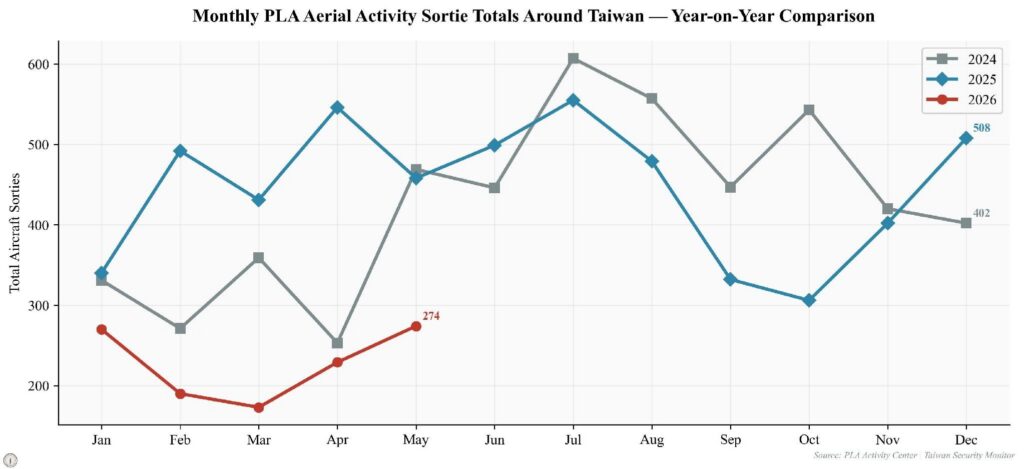
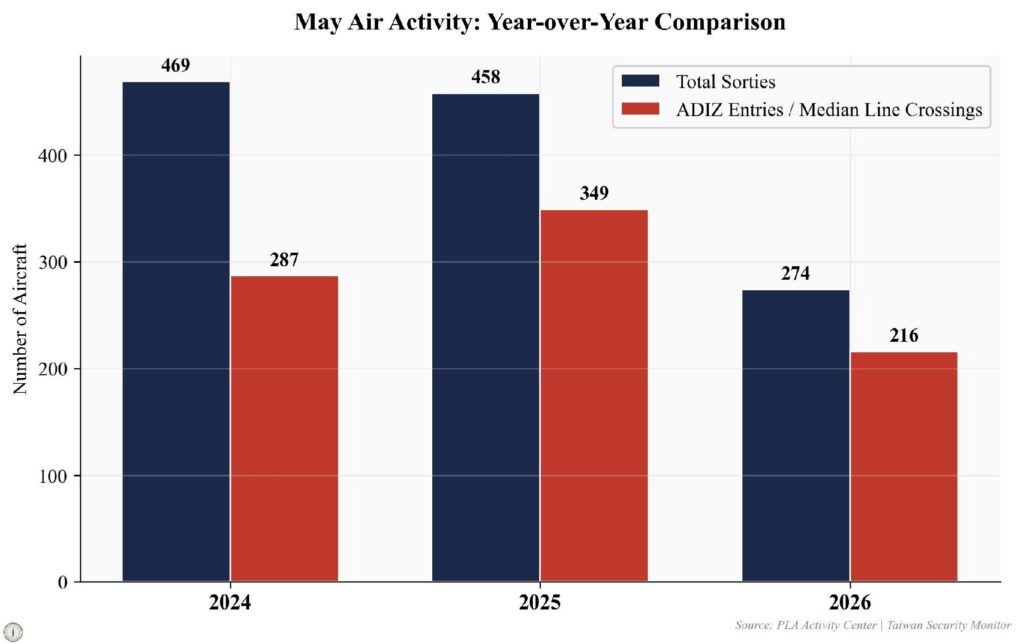
  • In May 2026, Taiwan’s Ministry of National Defense recorded 274 PLA aerial sorties around the island. Of these, 216 entered Taiwan’s Air Defense Identification Zone, representing an ADIZ-penetration rate of approximately 79 percent, the highest in 2026. This monthly total is the largest of the year, surpassing January’s 270 and continuing April’s rebound, signaling the end of the first-quarter lull. However, it remains 40 percent below the 458 sorties recorded in May 2025.
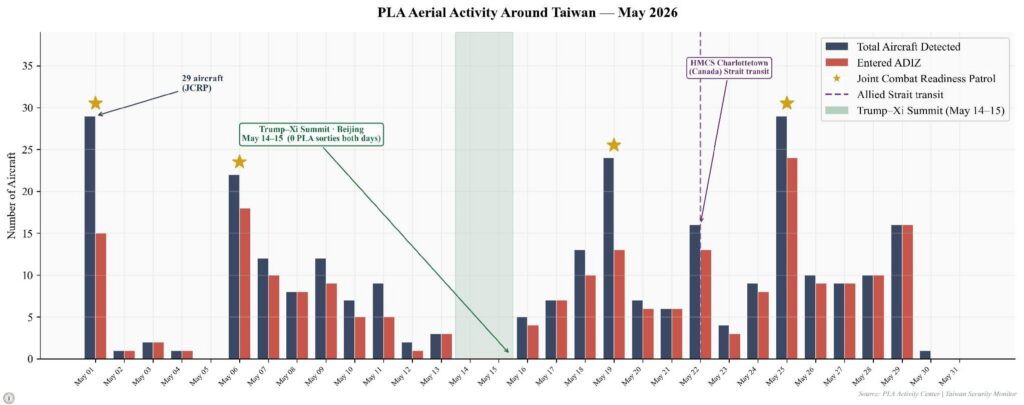
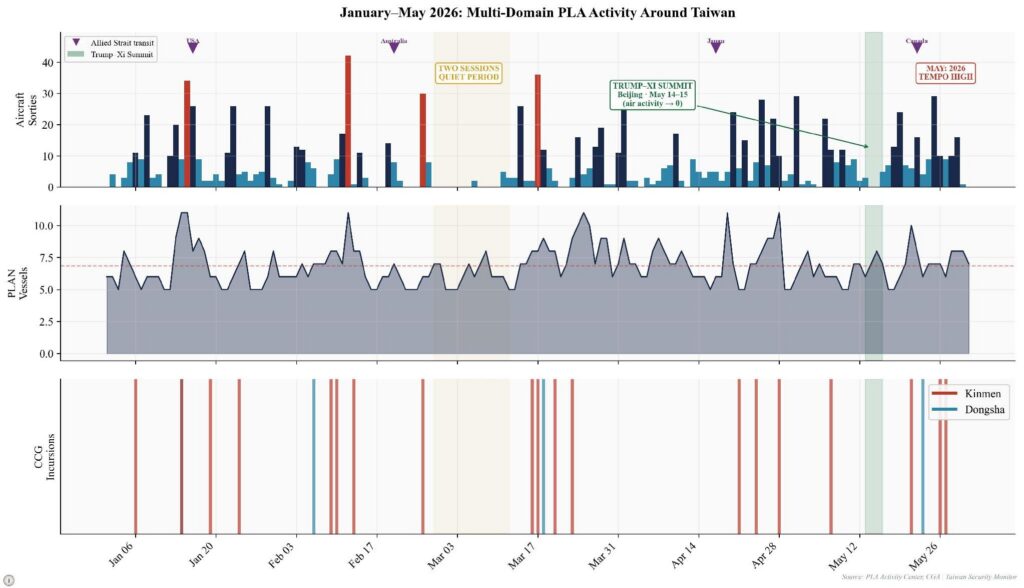
  • The PLA conducted four joint combat readiness patrols on May 1, May 6, May 19, and May 25, restoring the four-per-month cadence last observed in January. Single-day totals peaked at 29 aircraft on both May 1 and May 25. Air activity dropped to zero on May 14 and 15, coinciding with the Trump-Xi summit in Beijing, before surging during the May 19 and May 25 patrols.
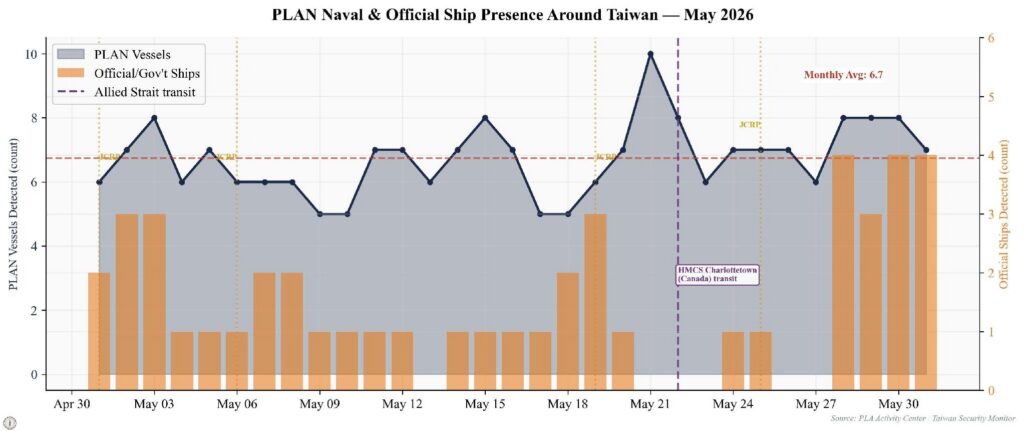
  • PLAN vessel detections averaged 6.7 per day in May, peaking at 10 on May 21, consistent with the five-to-nine vessel baseline maintained since 2025. While air activity reached a yearly high, naval presence remained steady, continuing the decoupling between sortie volume and naval activity observed throughout the year. One allied Strait transit occurred: HMCS Charlottetown on May 22, between two late-month patrols, marking the latest instance of a transit coinciding with heightened patrol activity in 2026.
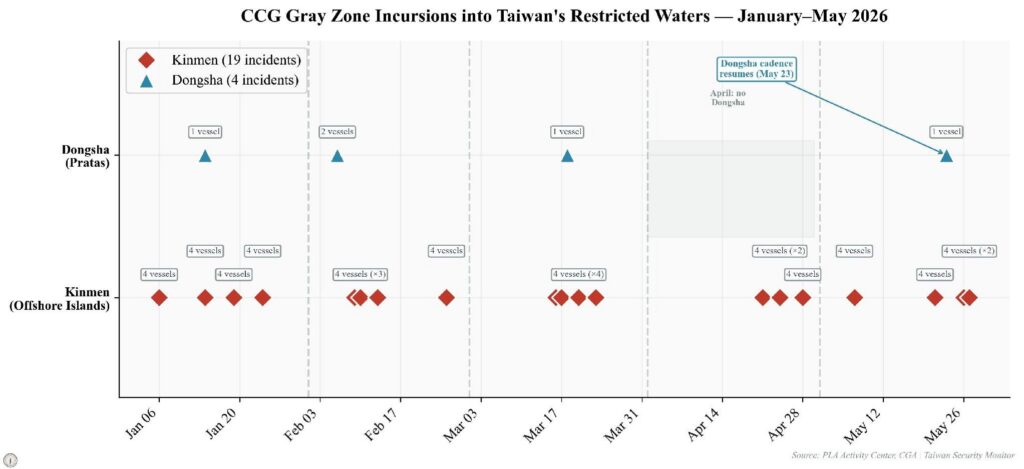
  • The Coast Guard Administration recorded five CCG incursions in May (four at Kinmen, one at Dongsha), restoring the once-monthly Dongsha pattern that lapsed in April. From January through May, cumulative incursions totaled 23: 19 at Kinmen and 4 at Dongsha. This increase occurred during a month focused on the May 14-15 Trump-Xi summit in Beijing, after which Washington paused arms transfers and deferred a Trump-Lai call ahead of a planned autumn visit by Xi to the United States.

In the Summit’s Shadow

PLA air activity around Taiwan reached its highest monthly level of 2026 in May, with 274 detected sorties, 216 of which entered Taiwan’s Air Defense Identification Zone. This total surpassed April’s 229 by 45 and exceeded January’s 270, making May the peak month so far. The five-month sequence is 270, 190, 173, 229, and 274, with March as the low point and activity rising for a second consecutive month. However, May’s total remains 40 percent below the 458 sorties of May 2025, and 2026 overall is still well below the previous year.

Four joint combat readiness patrols occurred on May 1, May 6, May 19, and May 25. The first and last patrols each involved 29 aircraft, with the May 25 count being the second-highest single-day total of 2026. Between patrols, activity followed a familiar pattern of alternating high-intensity demonstrations and quiet days. May saw four zero-detection days: May 5, May 14, May 15, and May 31. Notably, May 14 and 15 coincided with the Trump-Xi summit in Beijing, during which PLA air activity around Taiwan ceased entirely. Despite these pauses, May produced the year’s highest total, with an ADIZ-penetration rate of about 79 percent, indicating that more daily activity entered Taiwan’s southwestern ADIZ rather than remaining outside it.

Figure 1. Daily PLA aerial activity around Taiwan, May 2026. Gold stars mark JCRP days; red bars show aircraft entering the ADIZ. The green band marks the May 14-15 Trump-Xi summit in Beijing, when PLA air activity fell to zero. The purple marker denotes the May 22 HMCS Charlottetown (Canada) Strait transit, which fell between the May 19 and May 25 patrols.

May’s activity should be viewed in context. President Trump and President Xi Jinping met in Beijing on May 14 and 15, during which PLA air activity around Taiwan dropped to zero, marking the only consecutive shutdown of the month. Activity then increased for the May 19 and May 25 patrols, making the summit period a quiet interval between two surges. Naval presence remained steady during these days, indicating the stand-down was limited to the air domain. Diplomatic developments continued after the summit. At the Shangri-La Dialogue on May 29, U.S. Secretary of Defense Pete Hegseth stated that the pause in Taiwan arms deliveries was not due to munitions conservation related to the Middle East. Late in the month, reports indicated a planned Trump-Lai call was postponed, and Trump was not expected to speak with Lai before a reciprocal Xi visit to the United States in the autumn. The PLA ended May with its highest air activity of 2026, even as Washington’s signals shifted toward Beijing.

Monthly Trajectory: The Lull Reverses

May’s 274 sorties mark a full reversal of the first-quarter decline. The 2026 monthly totals form a V-shaped pattern: 270, 190, 173, 229, and 274, with March as the low point and a climb above January’s starting figure. April signaled the end of the lull, and May confirms a sustained recovery, with gains extending beyond any single exercise period.

Figure 2. Monthly PLA aerial activity sortie totals, 2024โ€“2026. May 2026 is the year’s high, completing a V-shaped recovery from the March low.

JCRP frequency is a more reliable indicator of PLA intent than total sortie counts, and it rebounded in May. The four patrols matched January’s level and exceeded the two conducted in each of February, March, and April. Holding roughly one large-scale exercise per week for the first time since January suggests the first-quarter drop in routine sorties was temporary, not a reduction in the PLA’s readiness for high-intensity demonstrations. JCRP frequency, more than total sorties, signals the end of the early-year lull.

At Sea: A Baseline That Does Not Move

PLAN vessel detections averaged 6.7 per day in May, peaking at 10 on May 21. Both figures remain within the five-to-nine vessel range that has characterized PLAN presence since 2025. In contrast, aerial sorties reached a yearly high, and ADIZ penetration peaked in 2026, while naval presence remained unchanged. The air and naval domains operate under different dynamics: air activity responds to political events and institutional factors, while naval presence serves as a consistent baseline in cross-strait military activity.

Figure 3. PLAN vessel and official ship detections around Taiwan, May 2026. The purple marker denotes the May 22 HMCS Charlottetown Strait transit.

Official and government-ship detections stayed low through the month, clustering in the first week before settling to one or two per day. The naval baseline held steady during a month of elevated air activity, consistent with the pattern seen all year: a change in air sortie volume, whether the May increase or the March decline, does not signal a matching shift in the maritime posture, which stays decoupled from the air domain.

One allied Taiwan Strait transit fell within the month. The Canadian frigate HMCS Charlottetown (FFH 339) transited the strait on May 22, Canada’s first reported transit of 2026 and the fourth allied passage of the year, after the USS John Finn and the survey ship USNS Mary Sears on January 16, the Australian frigate HMAS Toowoomba on February 20, and the Japanese destroyer JS Ikazuchi on April 17. The May 22 transit fell between the month’s third and fourth joint combat readiness patrols, on May 19 and May 25. The proximity is not limited to May. Through 2026, allied transits have repeatedly coincided with periods of heavy JCRP activity, the January and February passages each within a day of a patrol. The sequencing is inconsistent, since in those two cases the patrol came before the transit rather than after, and the sample stays too small to support a causal reading. The clustering warrants continued observation, not firm inference.

Coast Guard Gray Zone Operations

China Coast Guard activity in Taiwan’s restricted waters returned to its monthly rhythm in May. The CCG conducted 5 documented incursions: 4 around Kinmen, on May 7, May 21, May 26, and May 27, and one at Dongsha on May 23. The Kinmen operations followed the institutionalized pattern seen throughout 2026, a rotating four-cutter formation drawn from a consistent hull pool, with numbers 14530, 14531, 14606, and 14609 recurring most often, entering in the afternoon and leaving within about two hours. The May 26 and May 27 incursions came within a twenty-four-hour span, a tempo the CGA itself flagged as unusual. Cumulative CCG incursions for January through May total 23: 19 at Kinmen and 4 at Dongsha.

Figure 4. CCG incursions into Taiwan’s restricted waters, Januaryโ€“May 2026, by location and vessel count.

The main CCG development in May was the resumption of Dongsha (Pratas) operations. After the once-monthly Dongsha pattern lapsed in April, the May 23 incursion restored it, with a single vessel, hull 3501, detected at 07:25 and entering restricted waters at 08:34. Dongsha operations remain distinct from the Kinmen rotation, involving longer transits, single large cutters instead of four-hull formations, and much longer dwell times. The longest in 2026 was the March 18 incursion, lasting about twenty-five hours. The April pause reflected operational rhythm rather than a binding commitment, and May’s return indicates Dongsha presence is an intentional, though intermittent, aspect of CCG activity. One late-period development warrants continued observation: on May 31, the CCG announced “law enforcement patrols” in waters east of Taiwan in response to Japan and the Philippines, and on June 1, a CCG incursion southeast of Orchid Island involved vessels 2304 and 2502, an area not previously recorded in 2026.

Regional Context: An Arms Pause, Summit Diplomacy, and Taiwan’s Own Build-Up

May’s activity occurred against a backdrop of U.S.-China diplomacy that shaped Taiwan coverage for the month. The Trump-Xi summit in Beijing on May 14 and 15 set the tone. In the following weeks, the pause in U.S. arms deliveriesโ€”which Secretary Hegseth did not attribute to munitions conservationโ€”and the postponement of a Trump-Lai call ahead of a planned autumn Xi visit to the United States signaled a Washington approach focused on avoiding friction with Beijing. In response, Taiwan advanced its own procurement. On May 29, the Legislative Yuan approved an initial NT$8.811 billion (about US$259 million) installment for five U.S. weapons systems, including M109A7 self-propelled howitzers, HIMARS, and anti-armor drones. Two days earlier, the House Armed Services Committee’s preliminary version of the FY27 National Defense Authorization Act authorized US$1 billion for the Taiwan Security Cooperation Initiative. Congressional support for Taiwan’s defense remains strong, even as executive-branch deliveries are delayed.

Taiwan’s force development also progressed. On June 1, the Republic of China Navy established a Littoral Combat Command, consolidating naval surveillance and anti-ship missile forces under one headquarters, advancing the distributed, asymmetric posture pursued since 2022. Allied presence operations remained steady: the HMCS Charlottetown transit marked Canada’s entry into a 2026 transit pattern already featuring U.S., Australian, and Japanese passages. These regional developments highlight a growing gap between a cautious U.S. executive approach and the consistent allied presence and Taiwanese self-strengthening. The PLA intensified its air activity in this environment.

The Full Picture: Multi-Domain Overview

Figure 5. Januaryโ€“May 2026 multi-domain PLA activity: air sorties, naval presence, and CCG incursions. The green band marks the May 14-15 Trump-Xi summit in Beijing; the gold band marks the early-March Two Sessions quiet period. Inverted triangles atop the air panel mark allied Taiwan Strait transits (United States, January 16; Australia, February 20; Japan, April 17; Canada, May 22).

Throughout the first five months of 2026, all three domains have shown a steady upward trend. Air activity was volatile and responsive to political events, dipping to a low in early March before rebounding through April and May to reach the year’s highest point. A key political signal was the pause in sorties during the Trump-Xi summit in mid-March, which was followed by a resumption of activity. Naval presence stayed stable, unaffected by fluctuations in air activity. Coast Guard incursions averaged around five per month, with May reestablishing the Dongsha pattern seen in April and adding a new east-of-Taiwan area at month’s end. Each domain should be analyzed in context. The early-year decline in sortie numbers did not indicate de-escalation, and May’s rebound alone does not suggest escalation. The overall multi-domain posture continues to reflect the sustained PLA activity around Taiwan since August 2022. In May, the PLA maintained this posture at the high end of its 2026 range, despite shifting signals from Washington.

Figure 6. May air activity year-over-year: total sorties and ADIZ entries, 2024โ€“2026.

Methodology & Sources

Air and naval detection data are drawn from daily press releases issued by Taiwan’s Ministry of National Defense and compiled in the PLA Activity Center database maintained by the Taiwan Security Monitor. Coast Guard incident data are compiled from Coast Guard Administration press releases and verified against contemporaneous media reporting in the China Coast Guard Incident Tracker Database. Allied Taiwan Strait transit records are drawn from the Taiwan Strait Transit Tracker maintained by the Taiwan Security Monitor. Contextual and allied developments draw on Taiwan Security Monitor reporting through late May and early June 2026. “ADIZ” denotes Taiwan’s Air Defense Identification Zone; “median line” refers to the informal centerline of the Taiwan Strait historically observed by both sides. “JCRP” denotes Joint Combat Readiness Patrols as designated by Taiwan’s MND. All analysis and commentary are by the Taiwan Security Monitor.

ยฉ 2026 Taiwan Security Monitor. All rights reserved.