
The Gray Zone Widens
Authors: Ethan Connell & Jonathan Walberg
KEY FINDINGS
- Taiwan’s Ministry of National Defense documented 208 PLA aerial sorties around the island in June 2026, with 134 entering the Air Defense Identification Zone. The total fell 66 sorties, or about 24 percent, from May’s year-high 274, and sat 58 percent below June 2025’s 499 sorties. June ranks fourth among 2026’s six months in the sequence 270, 190, 173, 229, 274, 208.
- The PLA conducted a single joint combat readiness patrol on June 3 (32 aircraft, 25 ADIZ entries), down from four in May. The month’s second-largest day, 23 aircraft on June 21, was a “long-distance flight” rather than a patrol, and the tempo was otherwise sustained through dispersed median-line crossings instead of large set-piece operations.
- PLAN vessel detections averaged 7.4 per day and peaked at 10, holding the five-to-nine vessel baseline, while official and government-ship detections more than doubled to 110 for the month against May’s 46, a maritime-presence signal that ran counter to the decline in the air. One allied Strait transit fell within the month, the Netherlands frigate HNLMS De Ruyter on June 5.
- The Coast Guard Administration recorded 11 China Coast Guard incursions in June, the highest monthly count of 2026 and the first to break the Kinmen-and-Dongsha pattern: alongside four Kinmen and two Dongsha operations, the CCG conducted two east-of-Taiwan patrols, a South China Sea approach at Taiping Island, and Taiwan’s first recorded incursion off Penghu. Cumulative 2026 incursions reached 34.
After the High-Water Mark
June’s 208 detected sorties reversed the climb that had carried PLA air activity to a 2026 high in May. The month-on-month drop of 66 sorties returned the count to the middle of the year’s range, below April’s 229 and well beneath May’s 274, and left the six-month sequence reading 270, 190, 173, 229, 274, 208. Against June 2025’s 499 sorties, the shortfall was 58 percent, consistent with the suppressed year-on-year pattern that has held across 2026.
Joint combat readiness patrols, a firmer indicator of operational intent than raw sortie counts, all but disappeared. Only the June 3 patrol, 32 aircraft with 25 crossing into the ADIZ and the month’s single largest day, was officially given the designation, against four such patrols in May. The June 21 long-distance flight of 23 aircraft was the next-largest day, and the remaining elevated days took the form of dispersed median-line crossings recorded on June 22, 23, 24, and 30 rather than concentrated multi-axis exercises. 7 days registered no aircraft at all, including an unbroken stretch of quiet from June 14 through June 17.
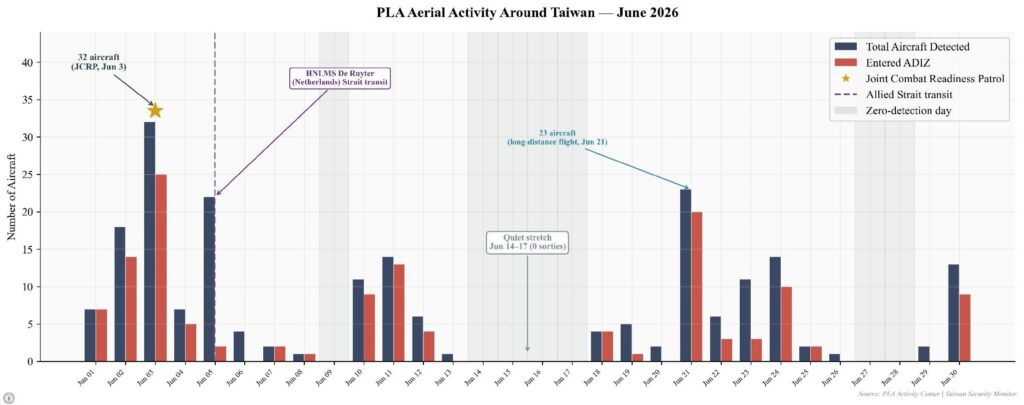
Figure 1. Daily PLA aerial activity around Taiwan, June 2026. The gold star marks the June 3 joint combat readiness patrol; red bars show aircraft entering the ADIZ; shaded columns denote zero-detection days. The purple marker denotes the June 5 HNLMS De Ruyter (Netherlands) Strait transit.
The pullback followed the May 14-15 Beijing summit and the cautious posture Washington adopted afterward. U.S. arms deliveries to Taiwan remained paused, a planned Trump-Lai conversation stayed on hold, and the reciprocal autumn Xi visit to the United States had yet to be scheduled. As in earlier months, a lighter month in the air should not be read on its own as an easing of pressure. ADIZ-penetration share held at roughly 64 percent of detected sorties, so the activity that did occur still pressed toward Taiwan’s southwestern approaches rather than skirting them.
Monthly Trajectory: The Rebound Stalls
May’s rebound did not carry into June. Whereas the spring recovery had restored a near-weekly patrol cadence, June returned to a single large-scale operation, the type of frequency last seen during the February-April lull, while total sorties stayed comparatively high at 208. That combination is the month’s central puzzle: activity remained substantial, but the concentrated readiness patrols that signal deliberate demonstration gave way to a more routine presence and long-range flights. Read against the full run of 2026, June looks less like renewed de-escalation than like a redistribution of effort away from the air.
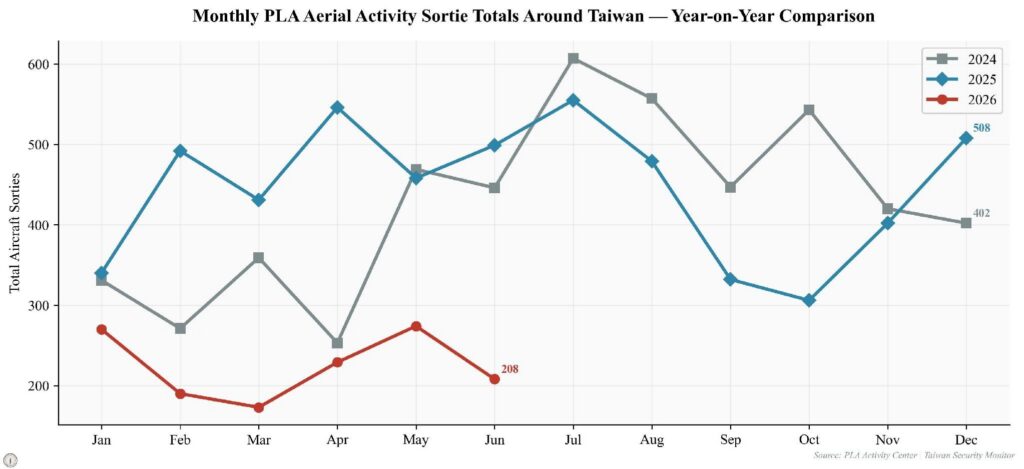
Figure 2. Monthly PLA aerial activity sortie totals, 2024–2026. June 2026 falls back from May’s year high while remaining far below the 2024 and 2025 comparables.
At Sea: The Baseline Holds, Official Traffic Doubles
Naval presence again refused to track the swings in the air. PLAN detections averaged 7.4 vessels daily and peaked at 10, squarely within the five-to-nine band that has defined 2025-2026 operations, and the decoupling between air and maritime domains held through a month in which sorties fell by nearly a quarter. Air activity appears responsive to political calendars and institutional dynamics, whereas naval presence functions as a persistent baseline feature of cross-strait military activity.
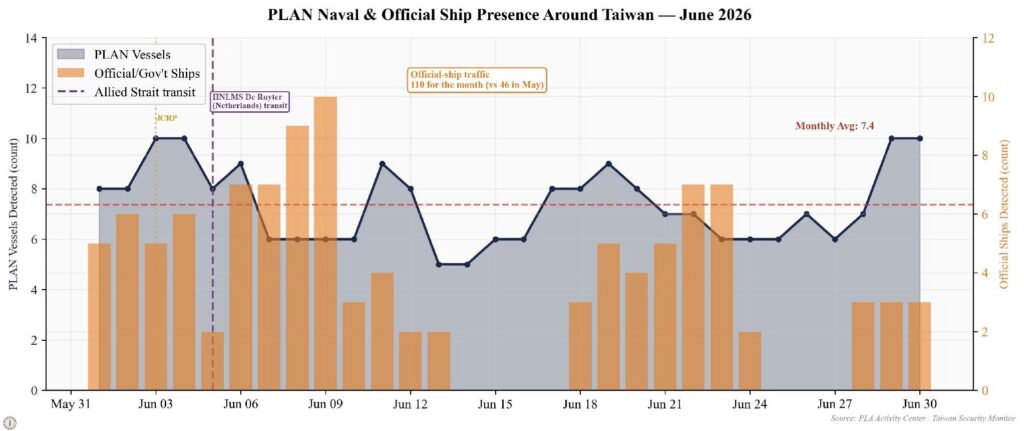
Figure 3. PLAN vessel and official-ship detections around Taiwan, June 2026. Official-ship traffic more than doubled month-on-month. The purple marker denotes the June 5 HNLMS De Ruyter Strait transit.
The exception was official and government-ship traffic, which more than doubled to 110 detections for the month against 46 in May, peaking at ten government vessels on June 9, a day with no aircraft at all. The surge in non-navy state shipping, coming as air activity receded, reinforces the sense that Beijing shifted weight toward maritime and constabulary presence in June. One allied transit occurred: the Netherlands frigate HNLMS De Ruyter passed through the strait on June 5, the fifth allied transit of 2026 and the first by a Dutch vessel, following U.S., Australian, Japanese, and Canadian passages earlier in the year.
Coast Guard Gray Zone Operations
The clearest escalation in June came below the waterline. The Coast Guard Administration documented at least 11 China Coast Guard incursions, more than double any previous month in 2026 and the first to move decisively beyond the established Kinmen-and-Dongsha rhythm. Four Kinmen operations, on June 3, 16, 18, and 29, maintained the institutionalized four-cutter rotation drawing on hulls 14530, 14531, 14602, 14606, and 14607, including a June 18 approach in which the cutters ran in single file with their transponders switched off. Two Dongsha operations, on June 5 and 19, preserved the once-monthly southern pattern with single large cutters.
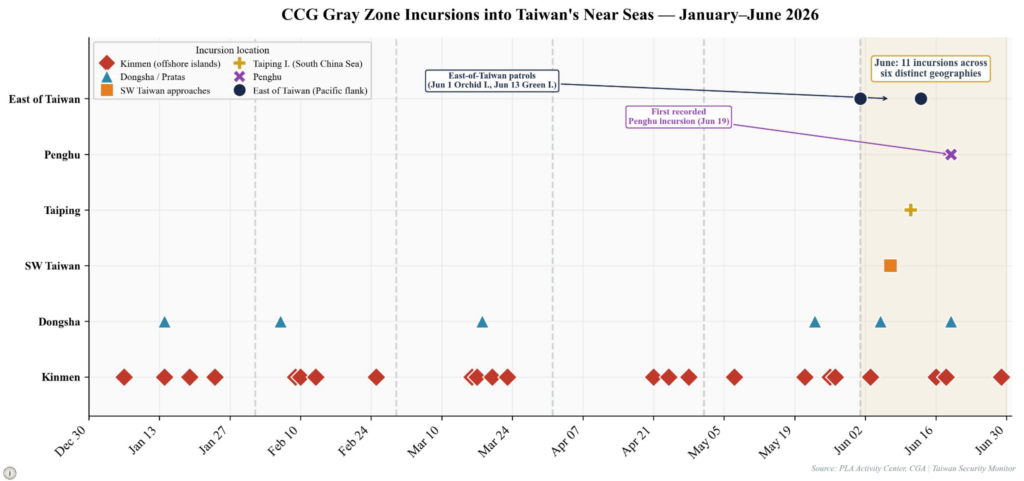
Figure 4. CCG incursions into Taiwan’s near seas, January–June 2026, by location. Filled markers are logged in the TSM tracker; hollow markers are confirmed from CGA releases and pending entry. June’s activity spans six distinct geographies, the year’s widest.
What set June apart was geography. On June 11, a Sansha law-enforcement formation entered waters two nautical miles off Taiping Island, extending gray-zone pressure into the South China Sea. On June 19 the CCG mounted Taiwan’s first recorded incursion off Penghu, sending cutter 2102 into waters west of Huayu the day after Taiwan’s Coast Guard seized an illegal mainland fishing vessel, a pretextual patrol shadowed by the CGA cutter Lianjiang. Most consequential were two patrols east of Taiwan: the June 1 formation that declared law-enforcement jurisdiction some fifty nautical miles southeast of Orchid Island, the first such assertion in open Pacific waters, and a June 13 transit past Green Island during which cutter 2502 broadcast that “the ROC does not exist” before a CGA vessel intervened. Cumulative 2026 incursions reached 34.
Regional Context: East of Taiwan, a New Patrol Line
June confirmed that the east-of-Taiwan patrols flagged at the end of May were not a one-off. By declaring law-enforcement jurisdiction in the open Pacific and rotating formations to sustain it, with the Xiushan task force relieving the June formation in early July, the CCG began to institutionalize a presence on Taiwan’s Pacific flank, the approaches through which any allied resupply from Guam, Yokosuka, or Luzon would run. Conducted under a civilian flag, the patrols are calibrated to complicate an allied response without the escalation a naval deployment would carry. Taipei answered on both fronts: the Coast Guard Administration pledged to expel harassing vessels and advised Taiwanese ships to ignore any boarding demands, while the Republic of China Navy stood up a Littoral Combat Command on June 1 to consolidate its surveillance and anti-ship missile forces. Washington’s posture, by contrast, stayed cautious in the summit’s aftermath even as Congressional support for Taiwan held.
The Full Picture: Multi-Domain Overview
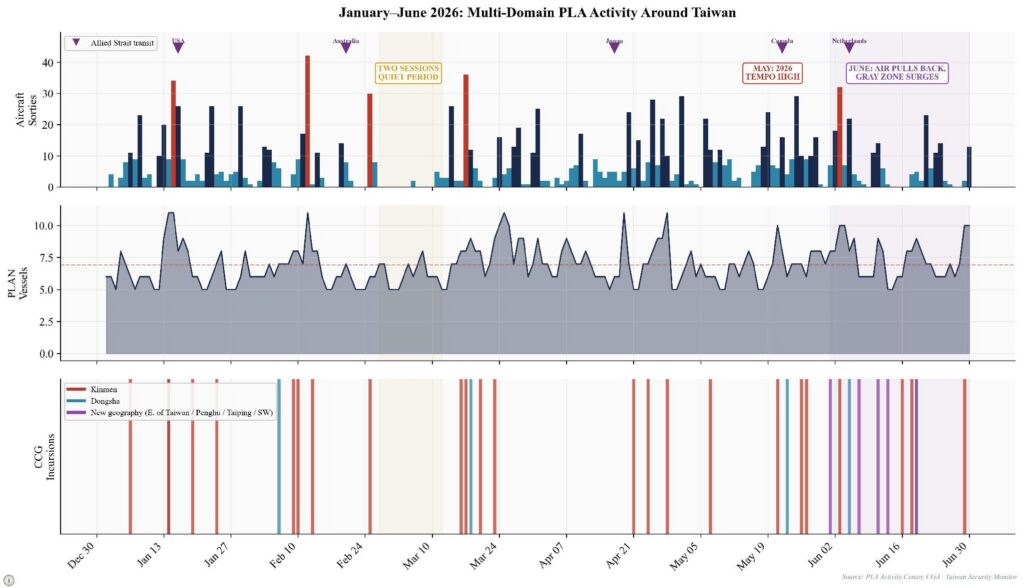
Figure 5. January–June 2026 multi-domain PLA activity: air sorties, naval presence, and CCG incursions. The gold band marks the early-March Two Sessions quiet period; the shaded June column marks the month’s air pullback and gray-zone surge. Inverted triangles atop the air panel mark allied Taiwan Strait transits (United States, January 16; Australia, February 20; Japan, April 17; Canada, May 22; Netherlands, June 5).
June is the sharpest illustration to date of a posture that moves along several tracks at once. Air activity, the most visible and politically responsive domain, fell back from its May peak and shed nearly all of its set-piece patrols; naval presence did not move; official-ship traffic and coast-guard operations rose, the latter both in number and in geographic reach. Taken together, the month does not describe a de-escalation so much as a shift in where pressure is applied, from the air toward the maritime and constabulary domains, and from the strait’s familiar flashpoints toward Taiwan’s eastern and southern approaches. The overall multi-domain posture continues to reflect the sustained PLA activity around Taiwan maintained since August 2022.
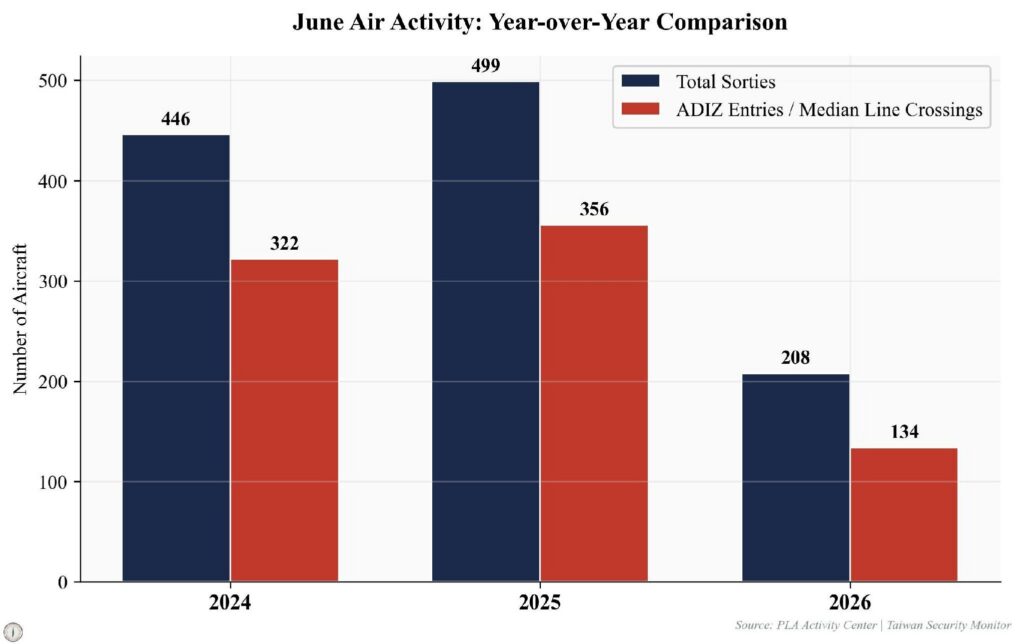
Figure 6. June air activity year-over-year: total sorties and ADIZ entries, 2024–2026.
Methodology & Sources
Air and naval detection data are drawn from daily press releases issued by Taiwan’s Ministry of National Defense and compiled in the PLA Activity Center database maintained by the Taiwan Security Monitor. Figures for June 1-21 are drawn from the PLA Activity Center; figures for June 22-30 are compiled from MND daily releases, which do not carry the joint-patrol labeling used earlier in the month. Coast Guard incident data are compiled from Coast Guard Administration statements and verified against contemporaneous media reporting in the China Coast Guard Incident Tracker Database; seven of June’s incursions appear in the tracker, and four are confirmed from CGA releases pending entry, so the monthly total should be read as a minimum. Allied Taiwan Strait transit records are drawn from the Taiwan Strait Transit Tracker maintained by the Taiwan Security Monitor. “ADIZ” denotes Taiwan’s Air Defense Identification Zone; “median line” refers to the informal centerline of the Taiwan Strait historically observed by both sides; “JCRP” denotes Joint Combat Readiness Patrols as designated by Taiwan’s MND. All analysis and commentary are by the Taiwan Security Monitor.
© 2026 Taiwan Security Monitor. All rights reserved.