Taiwan Security Monitor

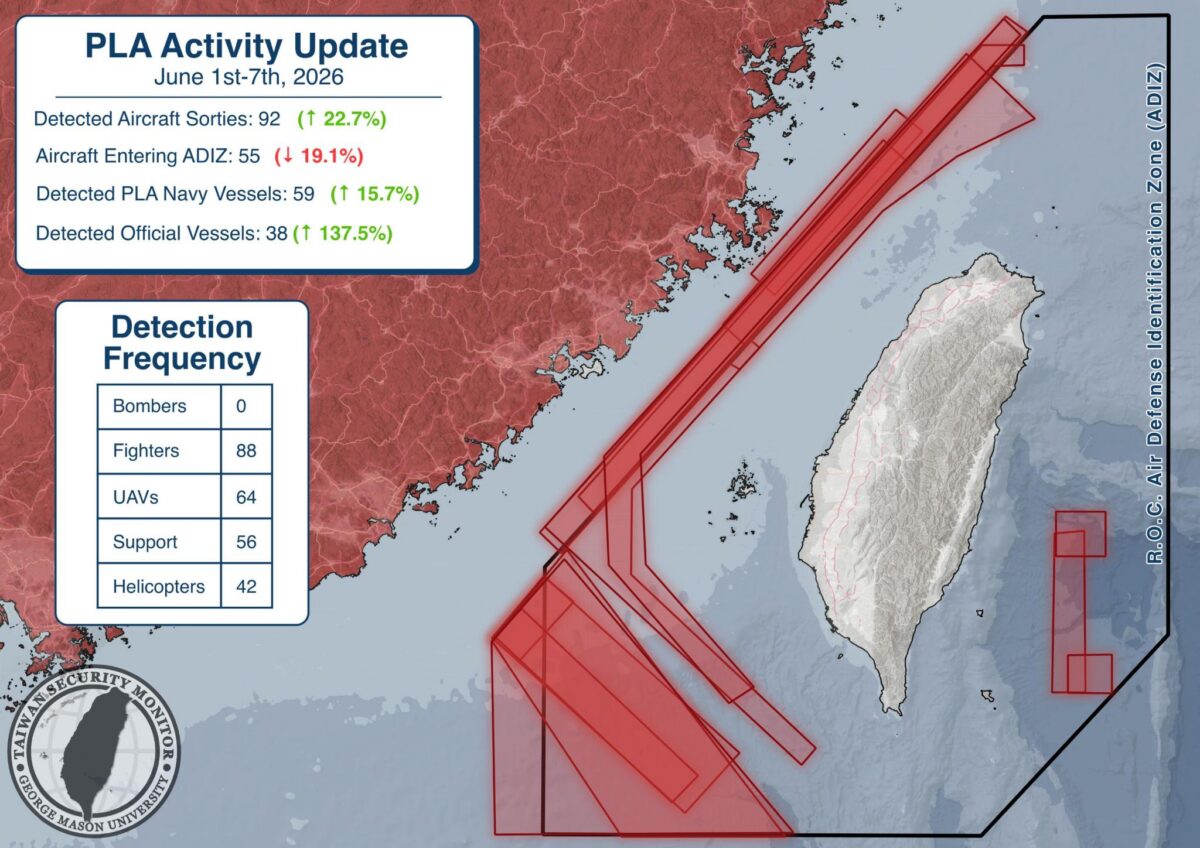
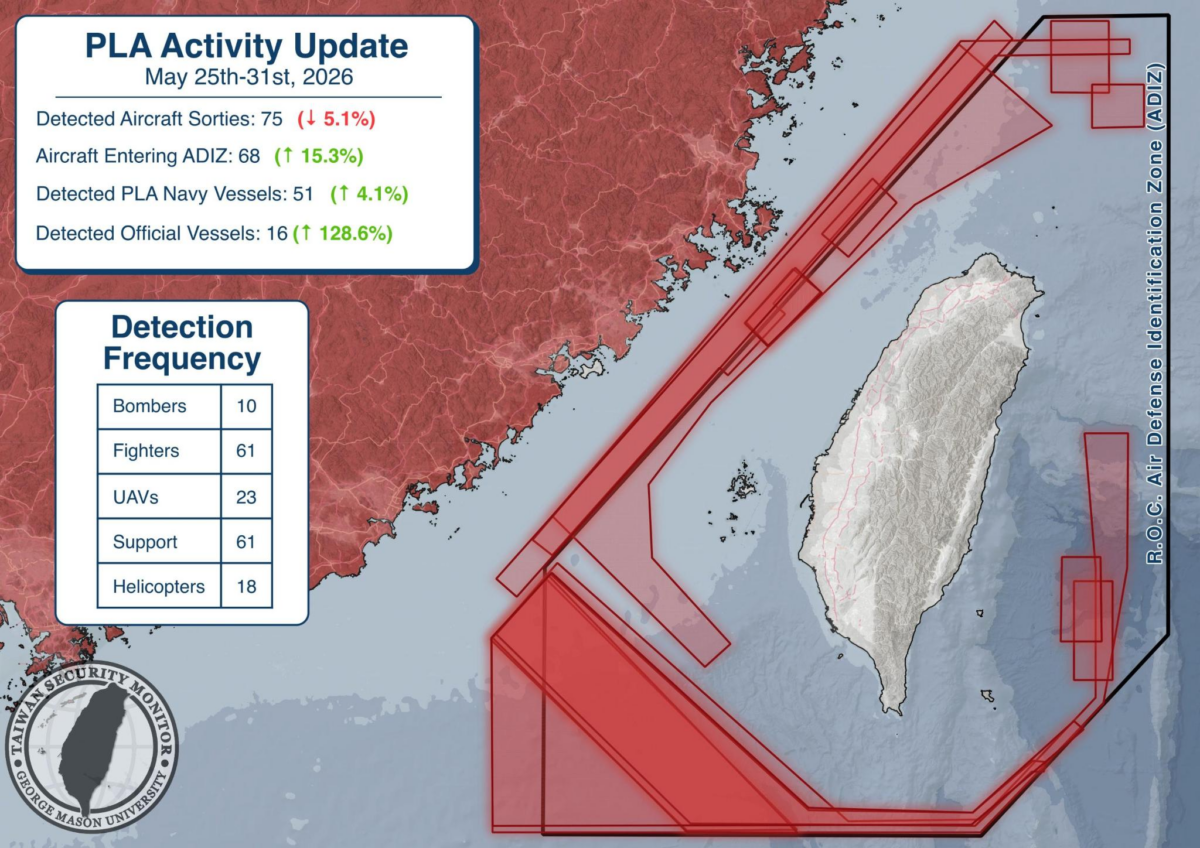
PLA Activity Update, 6/7/26


Author: Ethan Connell


Notes:

  • All data from Taiwan’s MND / TSM’s PLA Activity Center
  • Percentage increases/decreases represent change from week to week.
  • Detection frequency refers to the number of times an airframe type is mentioned in updates, not the total number of aircraft sorties per airframe type.
  • “Official vessels” refers to China Coast Guard vessels and official PRC research ships.

More information at the PLA Activity Tracker.

Strait Snapshot, May 2026 Update

In The Summit’s Shadow

Authors: Ethan Connell & Jonathan Walberg


KEY FINDINGS
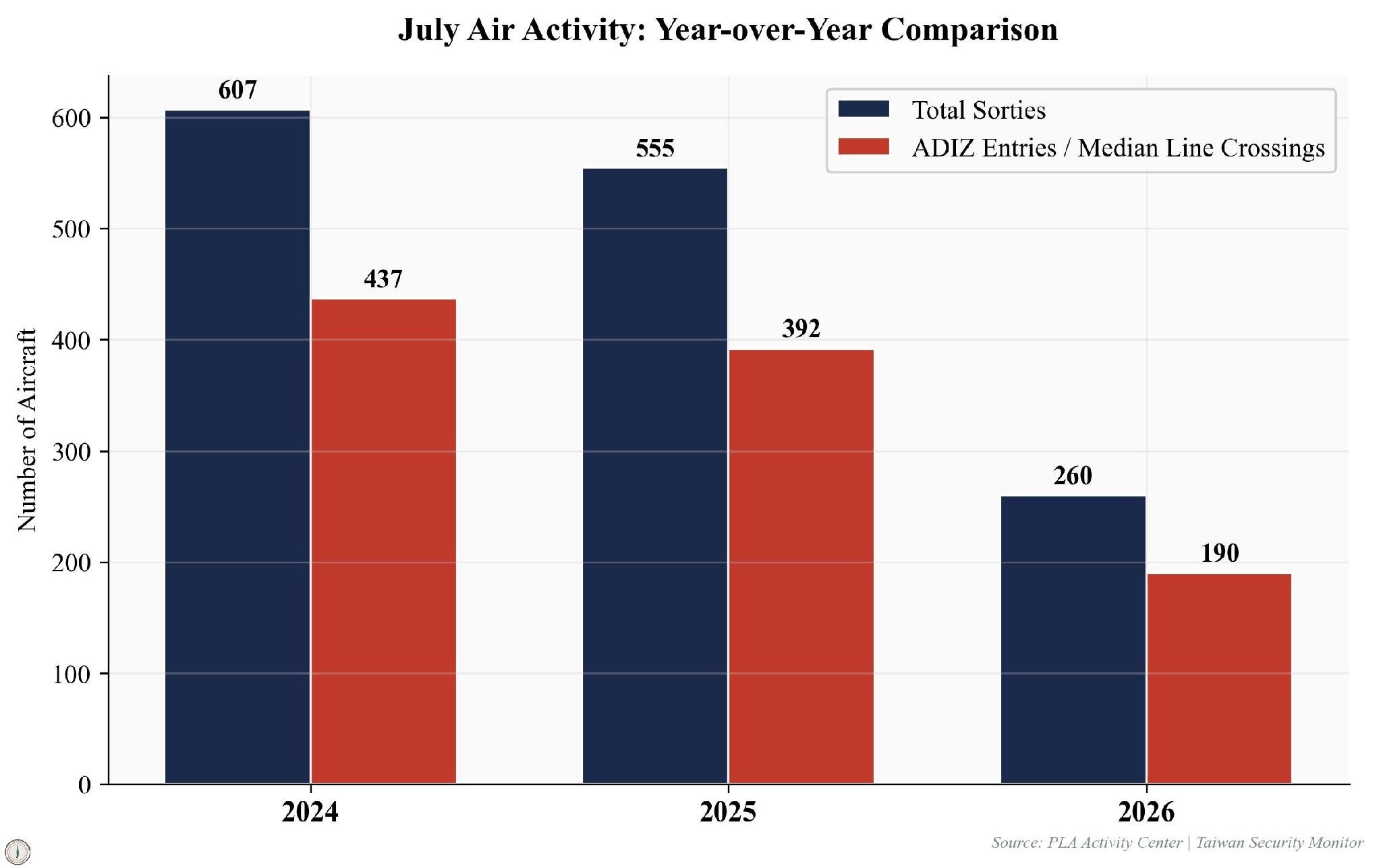
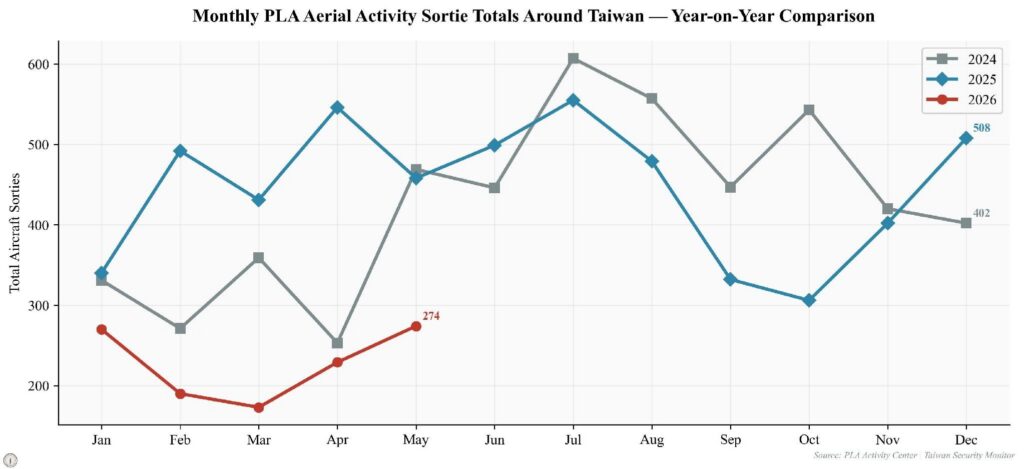
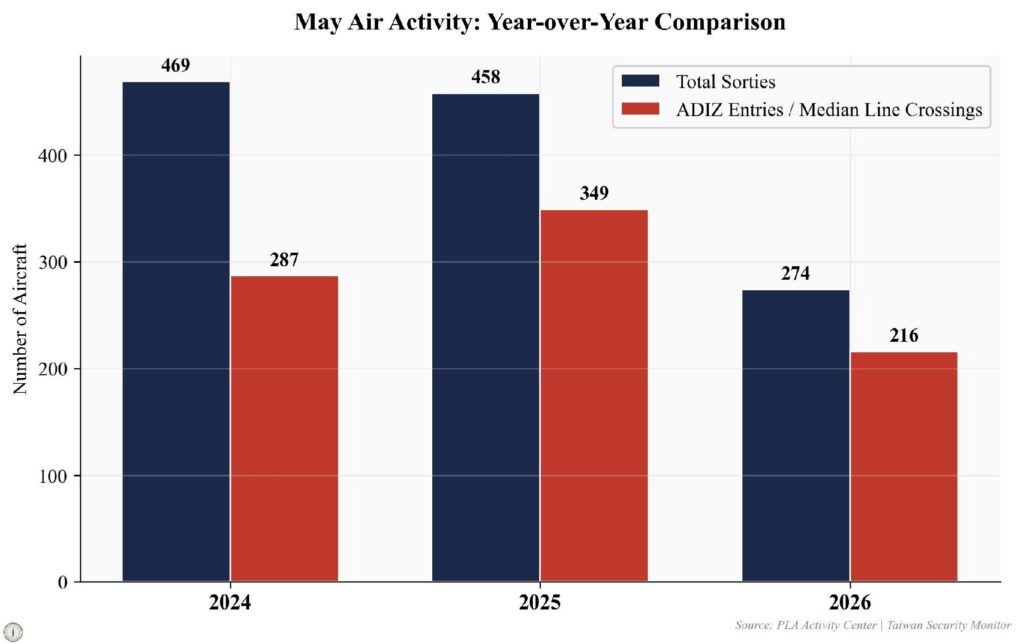
  • In May 2026, Taiwan’s Ministry of National Defense recorded 274 PLA aerial sorties around the island. Of these, 216 entered Taiwan’s Air Defense Identification Zone, representing an ADIZ-penetration rate of approximately 79 percent, the highest in 2026. This monthly total is the largest of the year, surpassing January’s 270 and continuing April’s rebound, signaling the end of the first-quarter lull. However, it remains 40 percent below the 458 sorties recorded in May 2025.
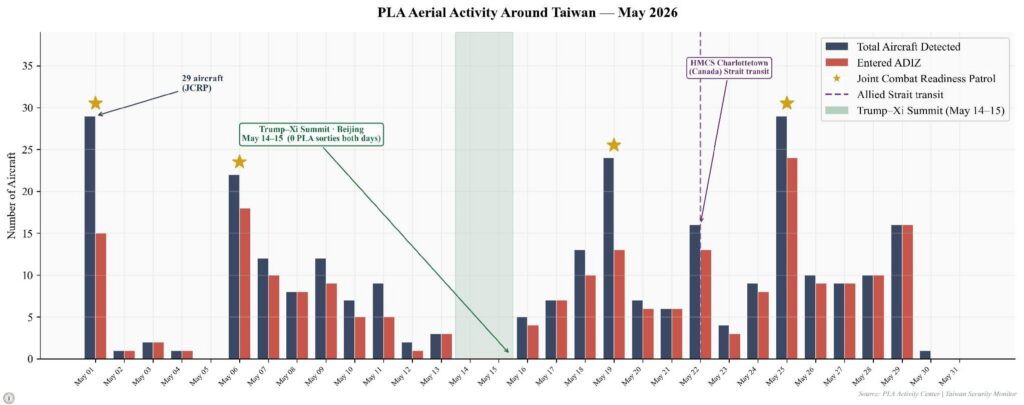
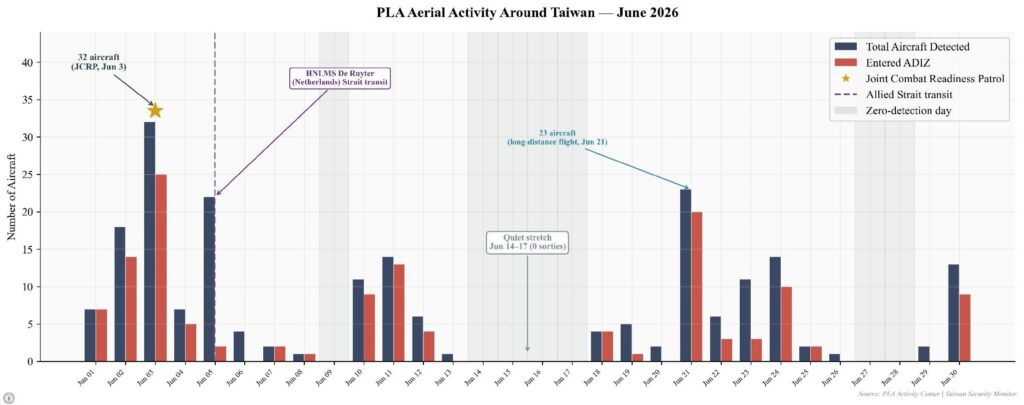
  • The PLA conducted four joint combat readiness patrols on May 1, May 6, May 19, and May 25, restoring the four-per-month cadence last observed in January. Single-day totals peaked at 29 aircraft on both May 1 and May 25. Air activity dropped to zero on May 14 and 15, coinciding with the Trump-Xi summit in Beijing, before surging during the May 19 and May 25 patrols.
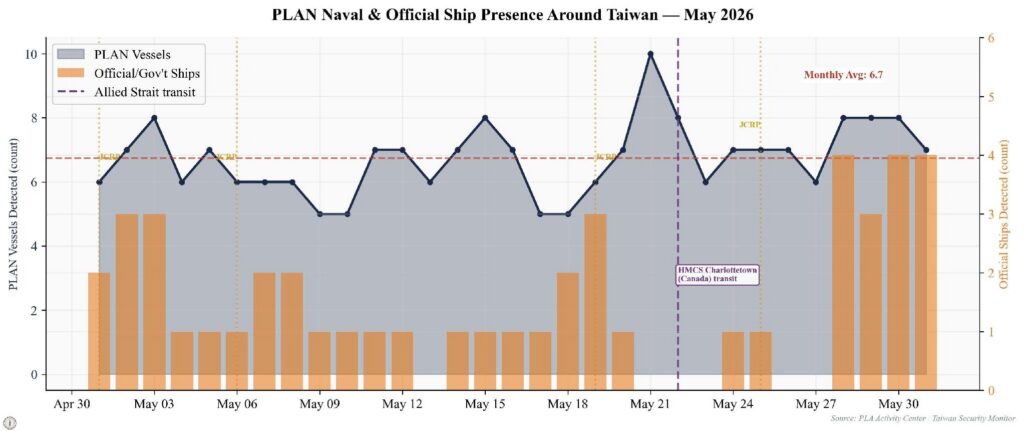
  • PLAN vessel detections averaged 6.7 per day in May, peaking at 10 on May 21, consistent with the five-to-nine vessel baseline maintained since 2025. While air activity reached a yearly high, naval presence remained steady, continuing the decoupling between sortie volume and naval activity observed throughout the year. One allied Strait transit occurred: HMCS Charlottetown on May 22, between two late-month patrols, marking the latest instance of a transit coinciding with heightened patrol activity in 2026.
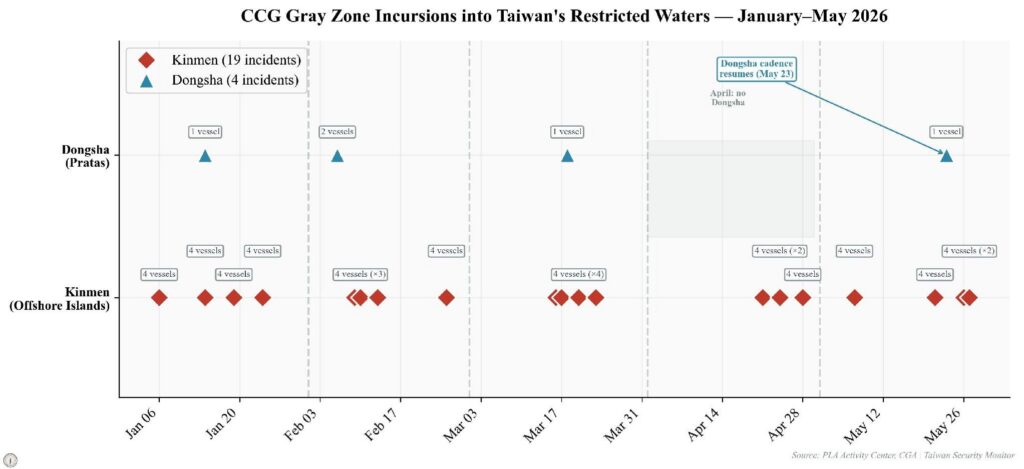
  • The Coast Guard Administration recorded five CCG incursions in May (four at Kinmen, one at Dongsha), restoring the once-monthly Dongsha pattern that lapsed in April. From January through May, cumulative incursions totaled 23: 19 at Kinmen and 4 at Dongsha. This increase occurred during a month focused on the May 14-15 Trump-Xi summit in Beijing, after which Washington paused arms transfers and deferred a Trump-Lai call ahead of a planned autumn visit by Xi to the United States.

In the Summit’s Shadow

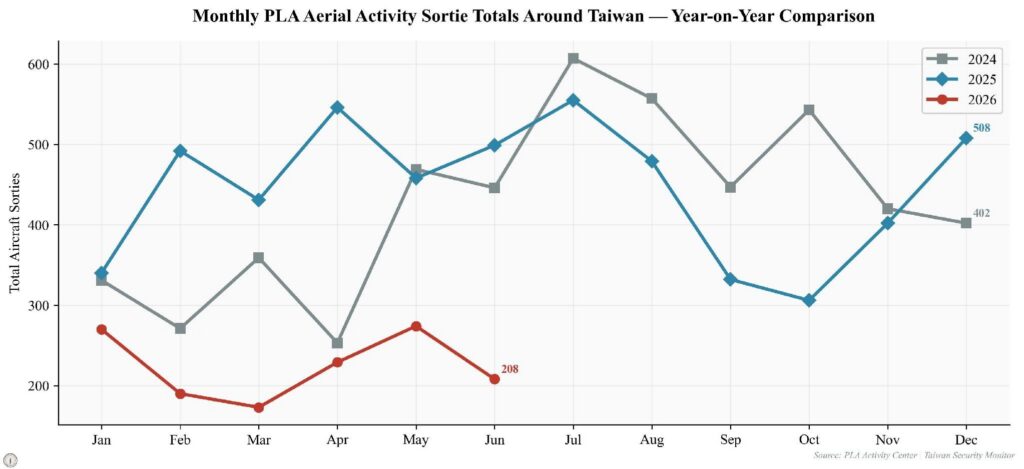
PLA air activity around Taiwan reached its highest monthly level of 2026 in May, with 274 detected sorties, 216 of which entered Taiwan’s Air Defense Identification Zone. This total surpassed April’s 229 by 45 and exceeded January’s 270, making May the peak month so far. The five-month sequence is 270, 190, 173, 229, and 274, with March as the low point and activity rising for a second consecutive month. However, May’s total remains 40 percent below the 458 sorties of May 2025, and 2026 overall is still well below the previous year.

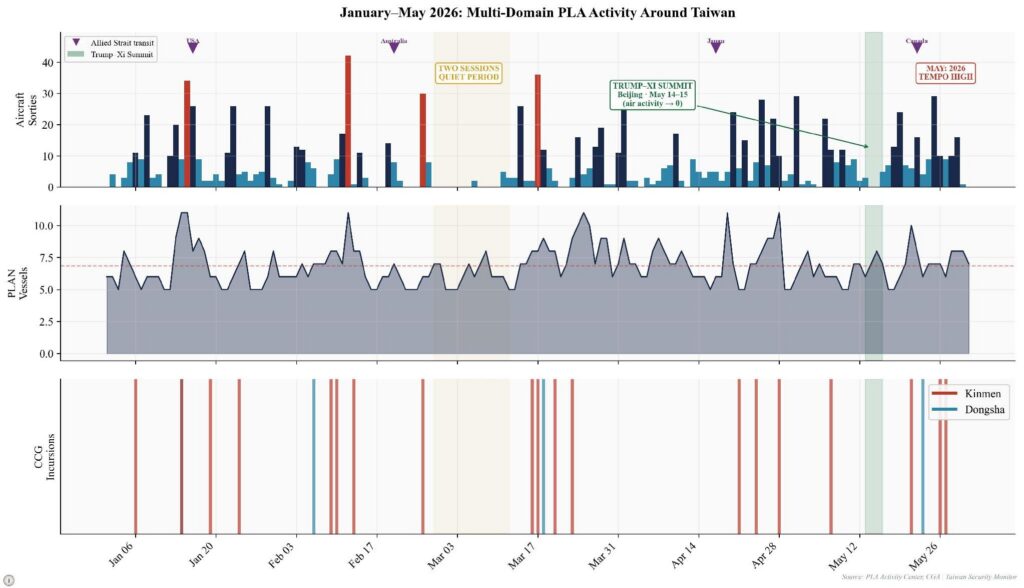
Four joint combat readiness patrols occurred on May 1, May 6, May 19, and May 25. The first and last patrols each involved 29 aircraft, with the May 25 count being the second-highest single-day total of 2026. Between patrols, activity followed a familiar pattern of alternating high-intensity demonstrations and quiet days. May saw four zero-detection days: May 5, May 14, May 15, and May 31. Notably, May 14 and 15 coincided with the Trump-Xi summit in Beijing, during which PLA air activity around Taiwan ceased entirely. Despite these pauses, May produced the year’s highest total, with an ADIZ-penetration rate of about 79 percent, indicating that more daily activity entered Taiwan’s southwestern ADIZ rather than remaining outside it.

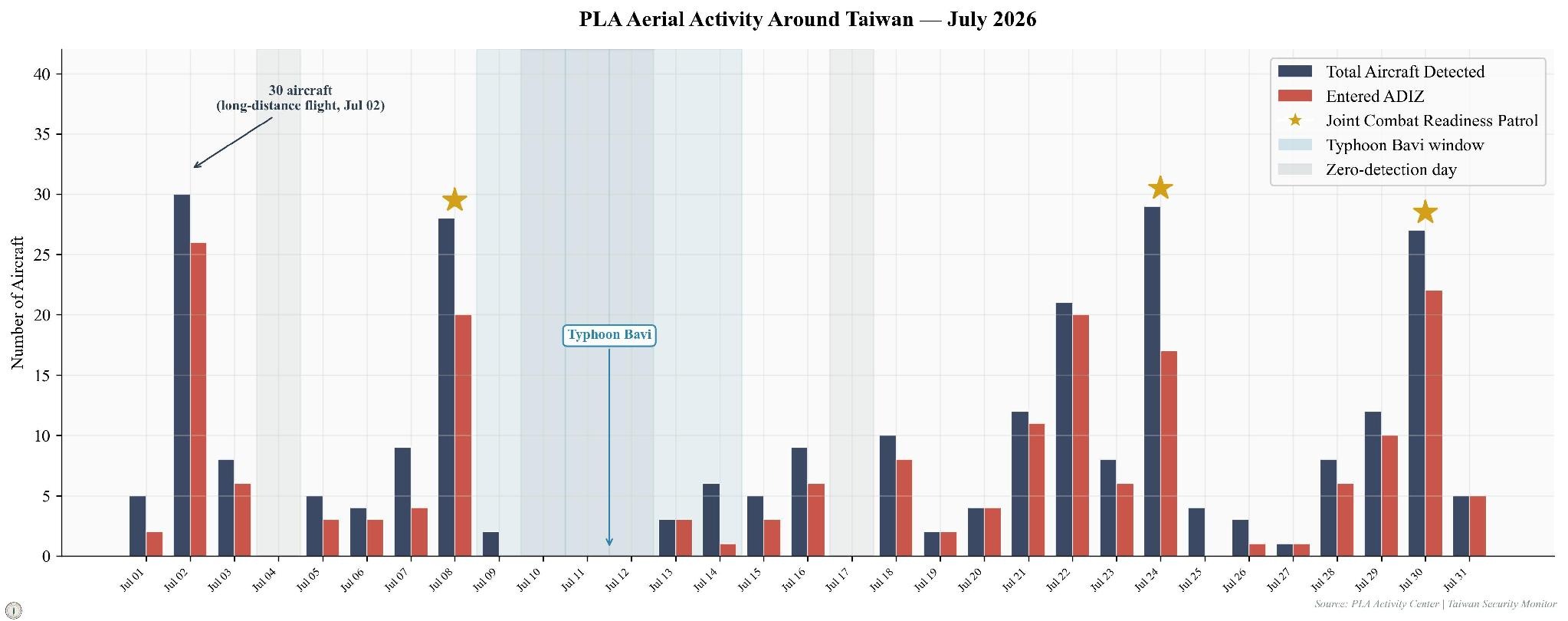
Figure 1. Daily PLA aerial activity around Taiwan, May 2026. Gold stars mark JCRP days; red bars show aircraft entering the ADIZ. The green band marks the May 14-15 Trump-Xi summit in Beijing, when PLA air activity fell to zero. The purple marker denotes the May 22 HMCS Charlottetown (Canada) Strait transit, which fell between the May 19 and May 25 patrols.

May’s activity should be viewed in context. President Trump and President Xi Jinping met in Beijing on May 14 and 15, during which PLA air activity around Taiwan dropped to zero, marking the only consecutive shutdown of the month. Activity then increased for the May 19 and May 25 patrols, making the summit period a quiet interval between two surges. Naval presence remained steady during these days, indicating the stand-down was limited to the air domain. Diplomatic developments continued after the summit. At the Shangri-La Dialogue on May 29, U.S. Secretary of Defense Pete Hegseth stated that the pause in Taiwan arms deliveries was not due to munitions conservation related to the Middle East. Late in the month, reports indicated a planned Trump-Lai call was postponed, and Trump was not expected to speak with Lai before a reciprocal Xi visit to the United States in the autumn. The PLA ended May with its highest air activity of 2026, even as Washington’s signals shifted toward Beijing.

Monthly Trajectory: The Lull Reverses

May’s 274 sorties mark a full reversal of the first-quarter decline. The 2026 monthly totals form a V-shaped pattern: 270, 190, 173, 229, and 274, with March as the low point and a climb above January’s starting figure. April signaled the end of the lull, and May confirms a sustained recovery, with gains extending beyond any single exercise period.

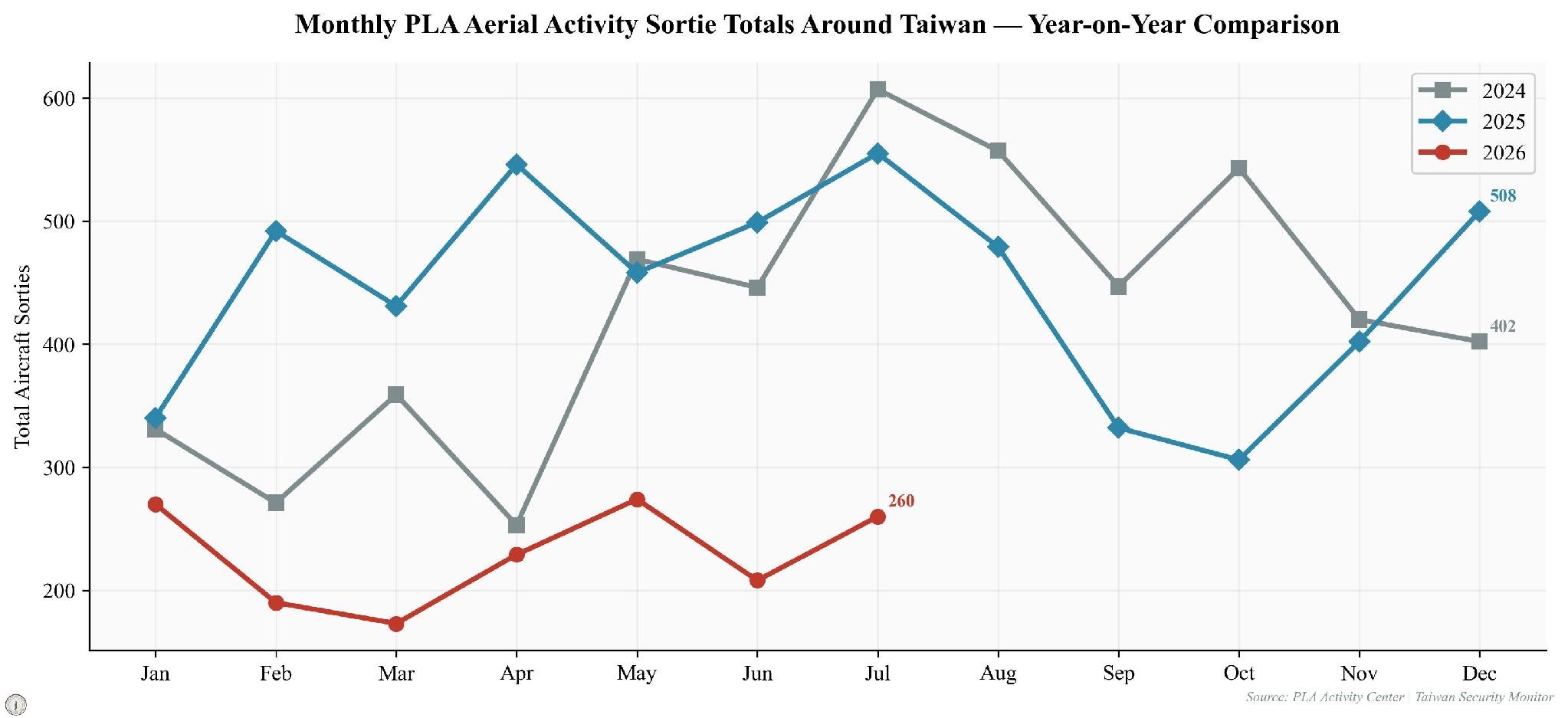
Figure 2. Monthly PLA aerial activity sortie totals, 2024โ€“2026. May 2026 is the year’s high, completing a V-shaped recovery from the March low.

JCRP frequency is a more reliable indicator of PLA intent than total sortie counts, and it rebounded in May. The four patrols matched January’s level and exceeded the two conducted in each of February, March, and April. Holding roughly one large-scale exercise per week for the first time since January suggests the first-quarter drop in routine sorties was temporary, not a reduction in the PLA’s readiness for high-intensity demonstrations. JCRP frequency, more than total sorties, signals the end of the early-year lull.

At Sea: A Baseline That Does Not Move

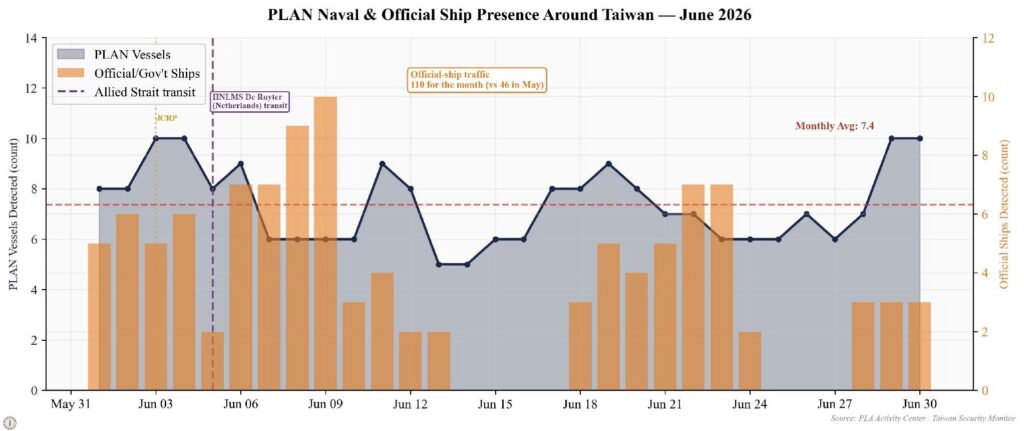
PLAN vessel detections averaged 6.7 per day in May, peaking at 10 on May 21. Both figures remain within the five-to-nine vessel range that has characterized PLAN presence since 2025. In contrast, aerial sorties reached a yearly high, and ADIZ penetration peaked in 2026, while naval presence remained unchanged. The air and naval domains operate under different dynamics: air activity responds to political events and institutional factors, while naval presence serves as a consistent baseline in cross-strait military activity.

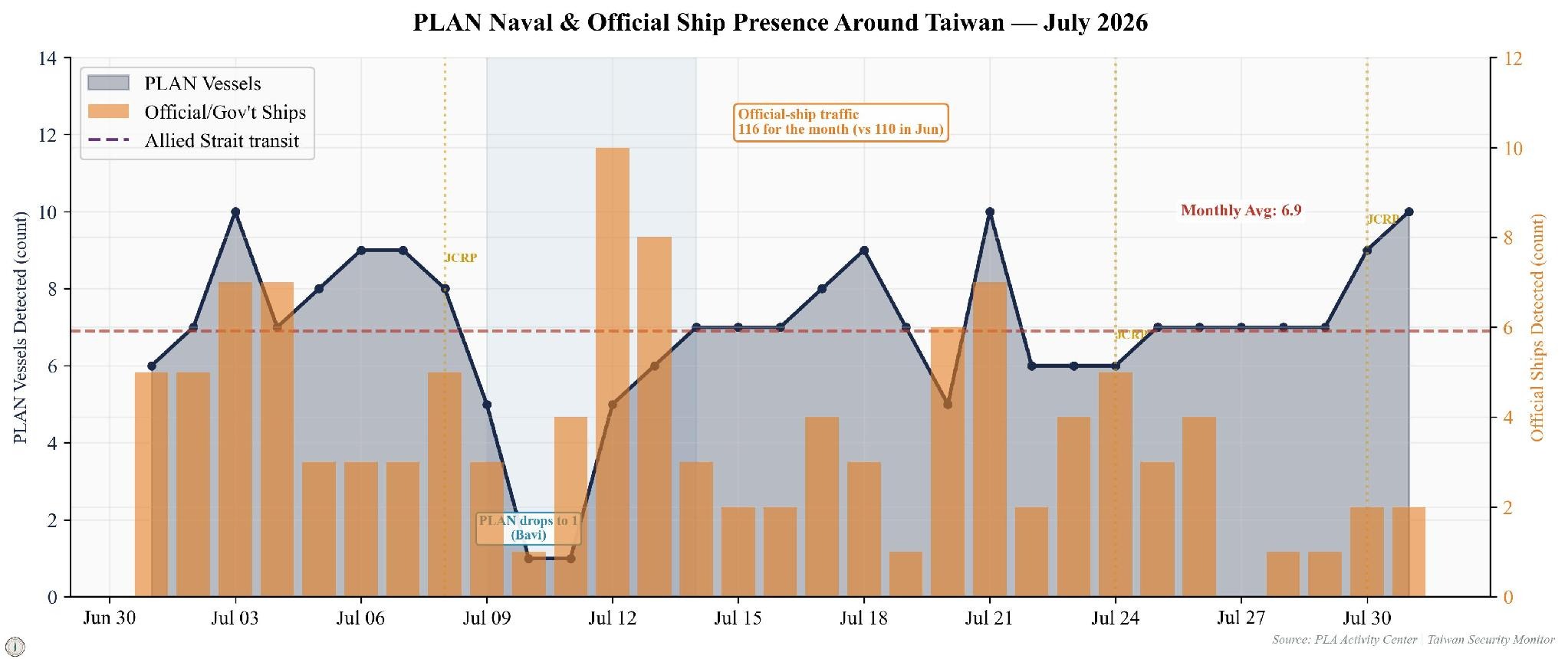
Figure 3. PLAN vessel and official ship detections around Taiwan, May 2026. The purple marker denotes the May 22 HMCS Charlottetown Strait transit.

Official and government-ship detections stayed low through the month, clustering in the first week before settling to one or two per day. The naval baseline held steady during a month of elevated air activity, consistent with the pattern seen all year: a change in air sortie volume, whether the May increase or the March decline, does not signal a matching shift in the maritime posture, which stays decoupled from the air domain.

One allied Taiwan Strait transit fell within the month. The Canadian frigate HMCS Charlottetown (FFH 339) transited the strait on May 22, Canada’s first reported transit of 2026 and the fourth allied passage of the year, after the USS John Finn and the survey ship USNS Mary Sears on January 16, the Australian frigate HMAS Toowoomba on February 20, and the Japanese destroyer JS Ikazuchi on April 17. The May 22 transit fell between the month’s third and fourth joint combat readiness patrols, on May 19 and May 25. The proximity is not limited to May. Through 2026, allied transits have repeatedly coincided with periods of heavy JCRP activity, the January and February passages each within a day of a patrol. The sequencing is inconsistent, since in those two cases the patrol came before the transit rather than after, and the sample stays too small to support a causal reading. The clustering warrants continued observation, not firm inference.

Coast Guard Gray Zone Operations

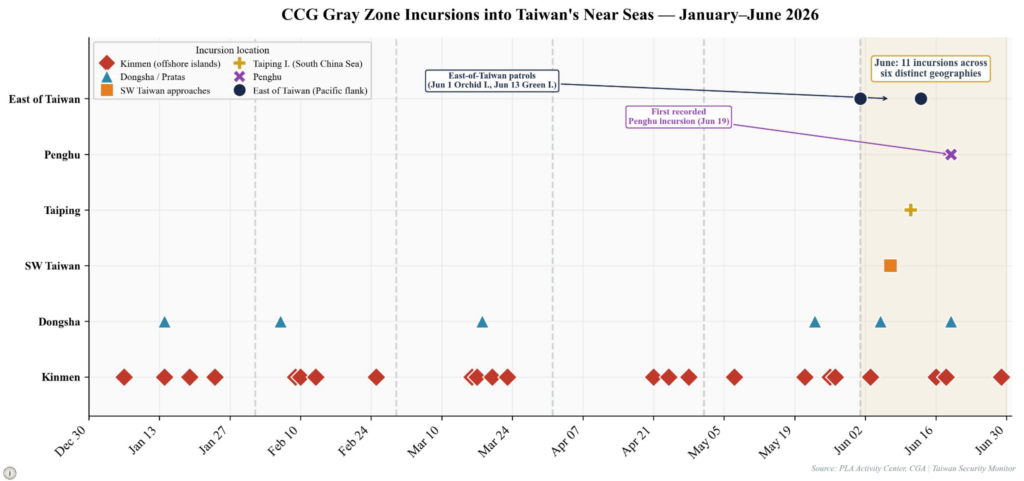
China Coast Guard activity in Taiwan’s restricted waters returned to its monthly rhythm in May. The CCG conducted 5 documented incursions: 4 around Kinmen, on May 7, May 21, May 26, and May 27, and one at Dongsha on May 23. The Kinmen operations followed the institutionalized pattern seen throughout 2026, a rotating four-cutter formation drawn from a consistent hull pool, with numbers 14530, 14531, 14606, and 14609 recurring most often, entering in the afternoon and leaving within about two hours. The May 26 and May 27 incursions came within a twenty-four-hour span, a tempo the CGA itself flagged as unusual. Cumulative CCG incursions for January through May total 23: 19 at Kinmen and 4 at Dongsha.

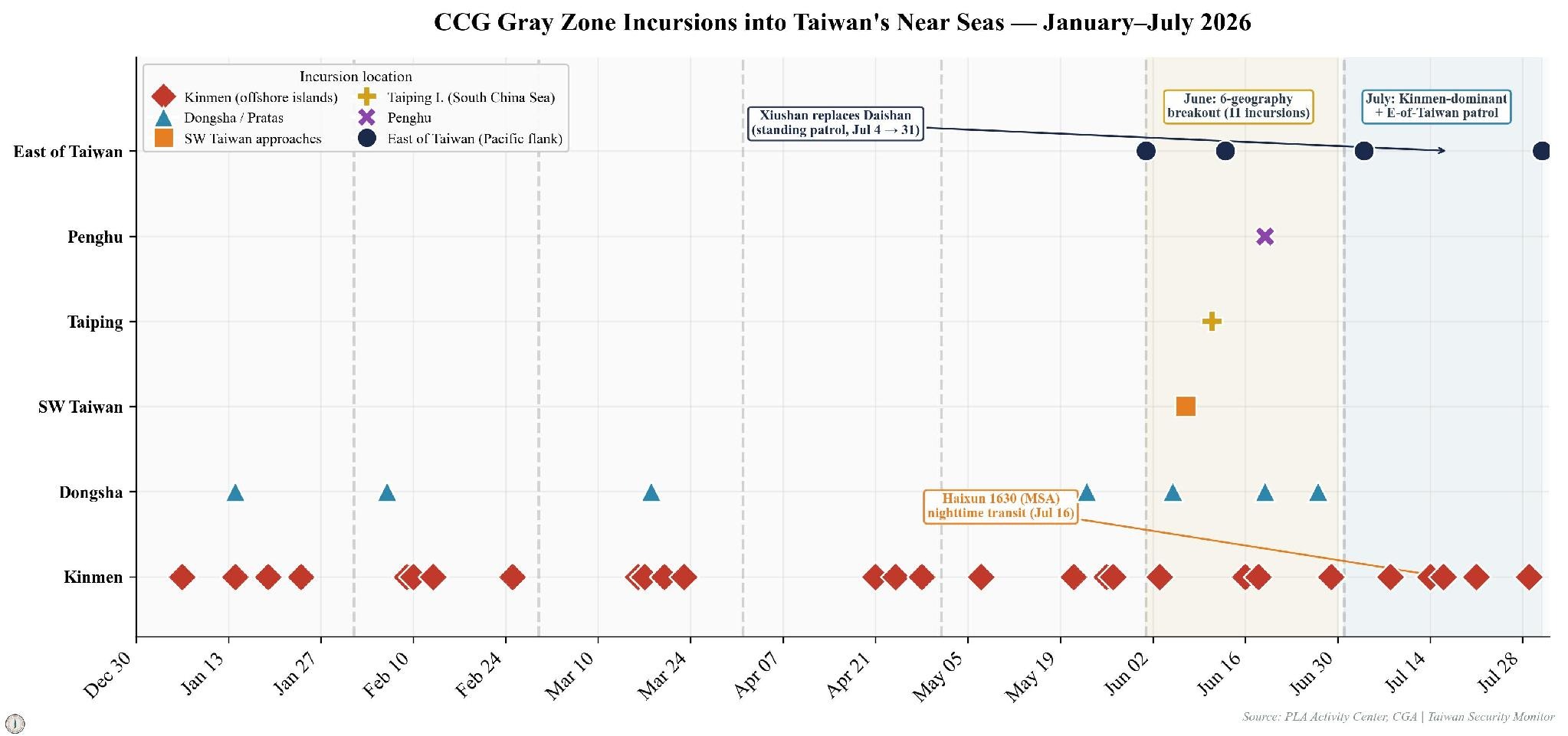
Figure 4. CCG incursions into Taiwan’s restricted waters, Januaryโ€“May 2026, by location and vessel count.

The main CCG development in May was the resumption of Dongsha (Pratas) operations. After the once-monthly Dongsha pattern lapsed in April, the May 23 incursion restored it, with a single vessel, hull 3501, detected at 07:25 and entering restricted waters at 08:34. Dongsha operations remain distinct from the Kinmen rotation, involving longer transits, single large cutters instead of four-hull formations, and much longer dwell times. The longest in 2026 was the March 18 incursion, lasting about twenty-five hours. The April pause reflected operational rhythm rather than a binding commitment, and May’s return indicates Dongsha presence is an intentional, though intermittent, aspect of CCG activity. One late-period development warrants continued observation: on May 31, the CCG announced “law enforcement patrols” in waters east of Taiwan in response to Japan and the Philippines, and on June 1, a CCG incursion southeast of Orchid Island involved vessels 2304 and 2502, an area not previously recorded in 2026.

Regional Context: An Arms Pause, Summit Diplomacy, and Taiwan’s Own Build-Up

May’s activity occurred against a backdrop of U.S.-China diplomacy that shaped Taiwan coverage for the month. The Trump-Xi summit in Beijing on May 14 and 15 set the tone. In the following weeks, the pause in U.S. arms deliveriesโ€”which Secretary Hegseth did not attribute to munitions conservationโ€”and the postponement of a Trump-Lai call ahead of a planned autumn Xi visit to the United States signaled a Washington approach focused on avoiding friction with Beijing. In response, Taiwan advanced its own procurement. On May 29, the Legislative Yuan approved an initial NT$8.811 billion (about US$259 million) installment for five U.S. weapons systems, including M109A7 self-propelled howitzers, HIMARS, and anti-armor drones. Two days earlier, the House Armed Services Committee’s preliminary version of the FY27 National Defense Authorization Act authorized US$1 billion for the Taiwan Security Cooperation Initiative. Congressional support for Taiwan’s defense remains strong, even as executive-branch deliveries are delayed.

Taiwan’s force development also progressed. On June 1, the Republic of China Navy established a Littoral Combat Command, consolidating naval surveillance and anti-ship missile forces under one headquarters, advancing the distributed, asymmetric posture pursued since 2022. Allied presence operations remained steady: the HMCS Charlottetown transit marked Canada’s entry into a 2026 transit pattern already featuring U.S., Australian, and Japanese passages. These regional developments highlight a growing gap between a cautious U.S. executive approach and the consistent allied presence and Taiwanese self-strengthening. The PLA intensified its air activity in this environment.

The Full Picture: Multi-Domain Overview
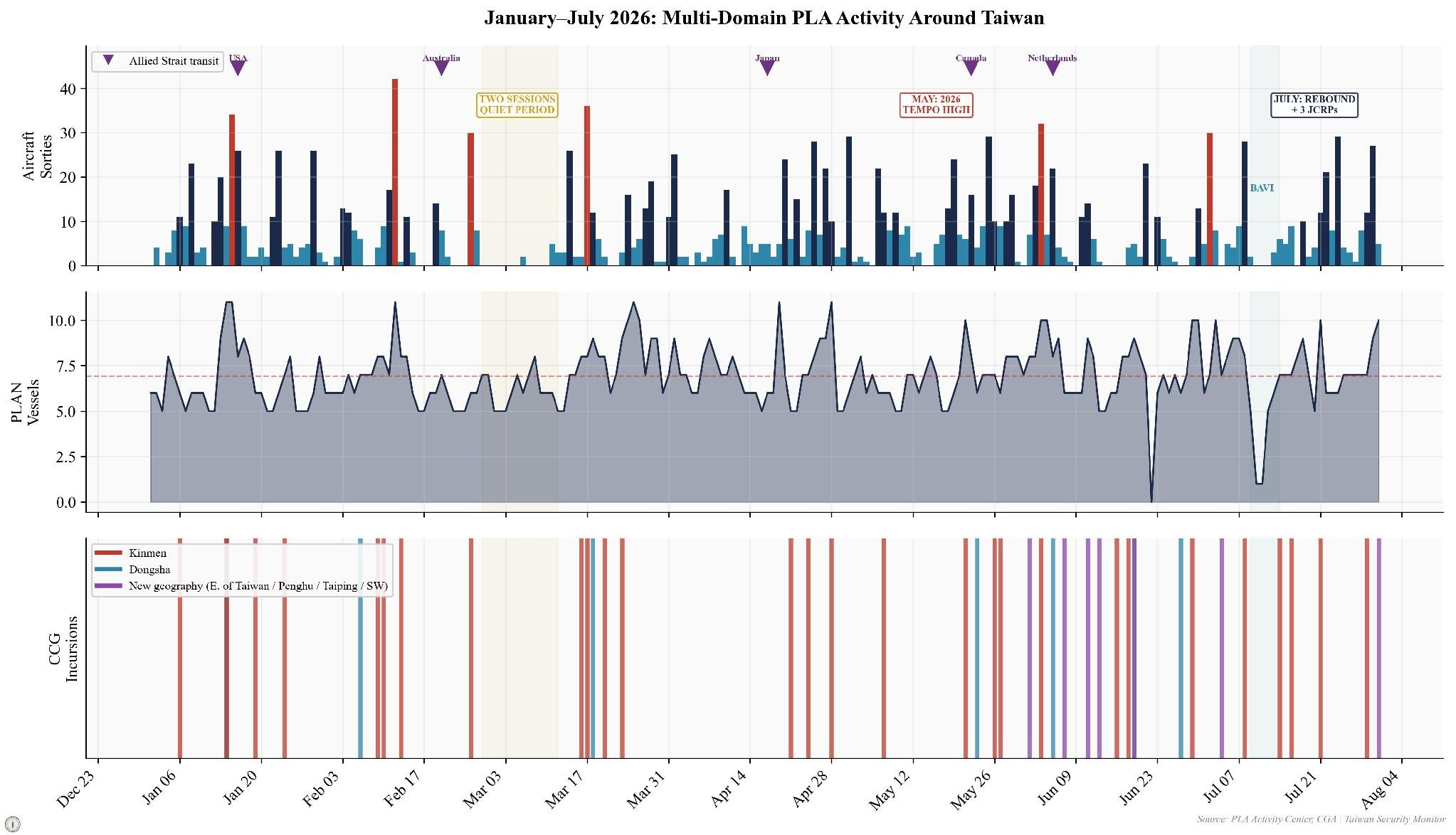
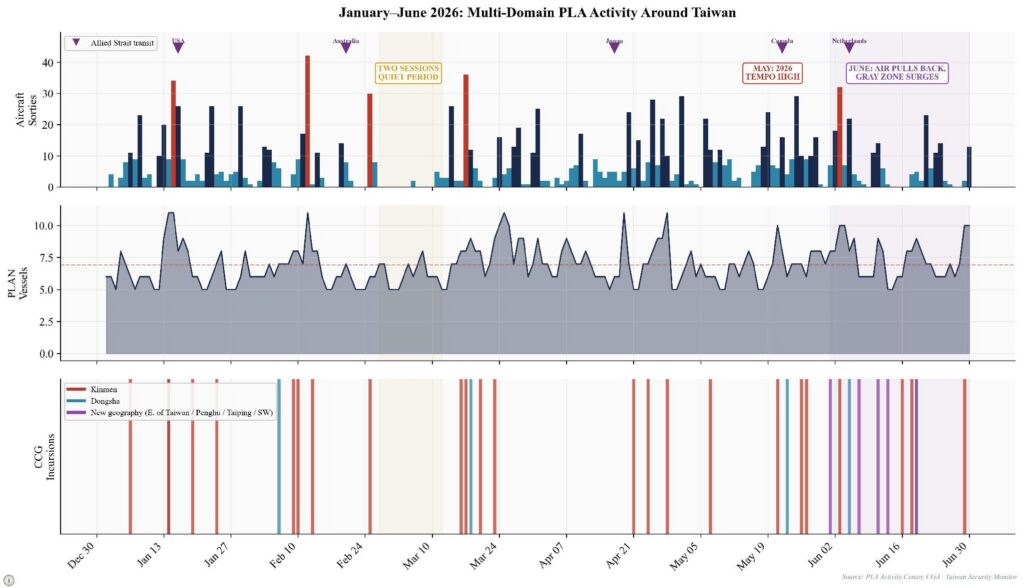
Figure 5. Januaryโ€“May 2026 multi-domain PLA activity: air sorties, naval presence, and CCG incursions. The green band marks the May 14-15 Trump-Xi summit in Beijing; the gold band marks the early-March Two Sessions quiet period. Inverted triangles atop the air panel mark allied Taiwan Strait transits (United States, January 16; Australia, February 20; Japan, April 17; Canada, May 22).

Throughout the first five months of 2026, all three domains have shown a steady upward trend. Air activity was volatile and responsive to political events, dipping to a low in early March before rebounding through April and May to reach the year’s highest point. A key political signal was the pause in sorties during the Trump-Xi summit in mid-March, which was followed by a resumption of activity. Naval presence stayed stable, unaffected by fluctuations in air activity. Coast Guard incursions averaged around five per month, with May reestablishing the Dongsha pattern seen in April and adding a new east-of-Taiwan area at month’s end. Each domain should be analyzed in context. The early-year decline in sortie numbers did not indicate de-escalation, and May’s rebound alone does not suggest escalation. The overall multi-domain posture continues to reflect the sustained PLA activity around Taiwan since August 2022. In May, the PLA maintained this posture at the high end of its 2026 range, despite shifting signals from Washington.

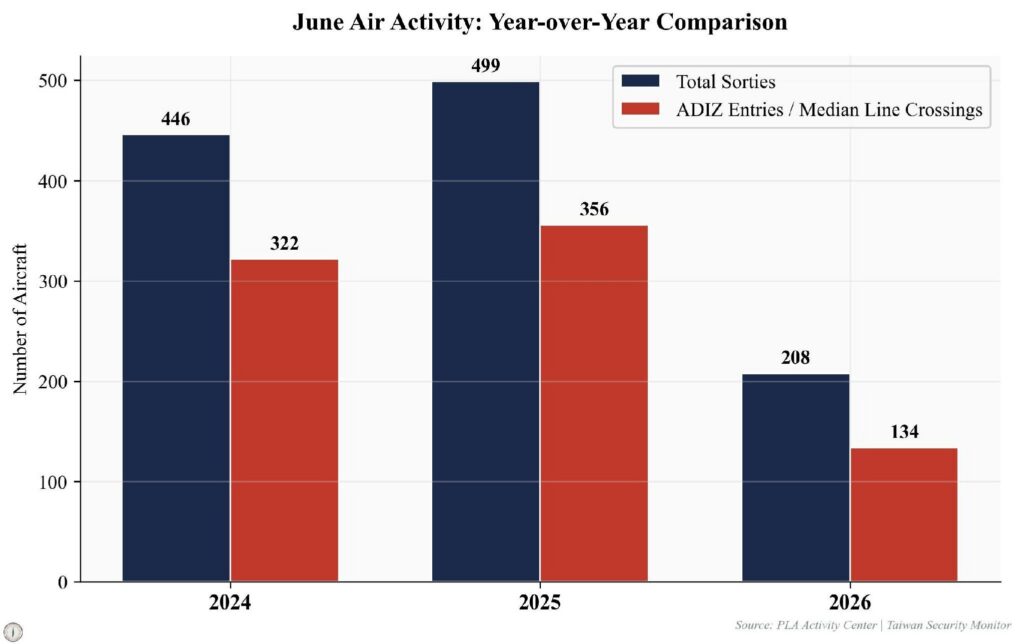
Figure 6. May air activity year-over-year: total sorties and ADIZ entries, 2024โ€“2026.

Methodology & Sources

Air and naval detection data are drawn from daily press releases issued by Taiwan’s Ministry of National Defense and compiled in the PLA Activity Center database maintained by the Taiwan Security Monitor. Coast Guard incident data are compiled from Coast Guard Administration press releases and verified against contemporaneous media reporting in the China Coast Guard Incident Tracker Database. Allied Taiwan Strait transit records are drawn from the Taiwan Strait Transit Tracker maintained by the Taiwan Security Monitor. Contextual and allied developments draw on Taiwan Security Monitor reporting through late May and early June 2026. “ADIZ” denotes Taiwan’s Air Defense Identification Zone; “median line” refers to the informal centerline of the Taiwan Strait historically observed by both sides. “JCRP” denotes Joint Combat Readiness Patrols as designated by Taiwan’s MND. All analysis and commentary are by the Taiwan Security Monitor.
ยฉ 2026 Taiwan Security Monitor. All rights reserved.

PLA Activity Monthly Update, May 2026


Author: Ethan Connell


Notes:

  • All data from Taiwan’s MND / TSM’s PLA Activity Center
  • Percentage increases/decreases represent change from April to May.
  • Detection frequency refers to the number of times an airframe type is mentioned in updates, not the total number of aircraft sorties per airframe type.
  • “Official vessels” refers to China Coast Guard vessels and official PRC research ships.

More information available at the PLA Activity Tracker.

PLA Activity Update, 5/31/2026


Author: Ethan Connell


Notes:

  • All data from Taiwan’s MND
  • Percentage increases/decreases represent change from week to week.
  • Detection frequency refers to the number of times an airframe type is mentioned in updates, not the total number of aircraft sorties per airframe type.
  • “Official vessels” refers to China Coast Guard vessels and official PRC research ships.

More information at the PLA Activity Tracker.

Strait Snapshot, April 2026 Update

Authors: Ethan Connell & Jonathan Walberg


KEY FINDINGS

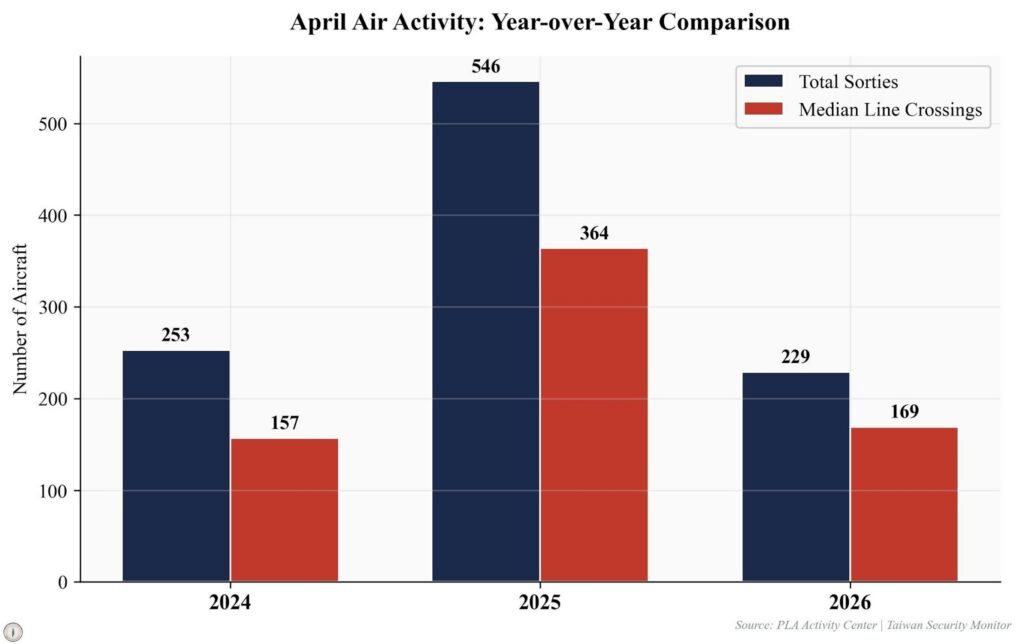
  • Taiwan’s Ministry of National Defense recorded 229 PLA aerial sorties around the island in April 2026, of which 169 entered Taiwan’s southwestern Air Defense Identification Zone. The total represents a 58 percent year-on-year decline from April 2025’s 546 sorties, but a 56-sortie increase from March, interrupting the consecutive monthly declines observed across the first quarter.
  • Two joint combat readiness patrols framed the month, on April 1 (25 aircraft) and April 25 (28 aircraft), and the PLA’s Liaoning aircraft carrier transited the Taiwan Strait on April 20. The contraction in routine sortie volume since January has not extended to either surge capacity or strategic signaling.
  • PLAN vessel detections averaged 7.1 per day in April, peaking at 11. These figures remain within the five-to-nine vessel baseline observed throughout 2025, reaffirming the structural decoupling between air sortie volume and naval presence.
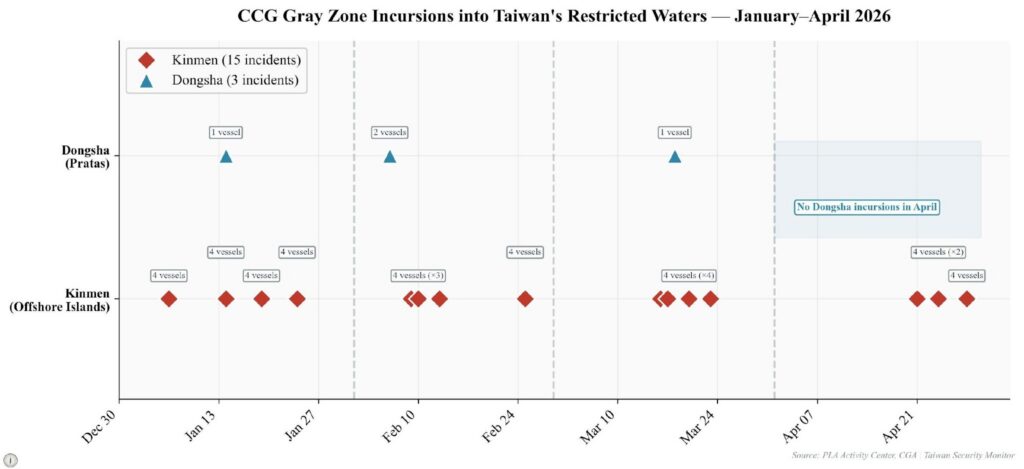
  • The Taiwanese Coast Guard Administration recorded three incursions by CCG vessels into Taiwan’s restricted waters in April, all around Kinmen. April is the first month of 2026 without a Dongsha (Pratas) incursion, breaking a monthly cadence sustained from January through March. Cumulative incursions across the first four months of the year total 18, with 15 around Kinmen and three around Dongsha.

Above the Floor

April 2026 marked a partial reversal of a three-month decline that had defined the first quarter. The month’s 229 detected sorties, including 169 that crossed the Taiwan Strait median line or entered the southwestern Air Defense Identification Zone, exceeded March’s 173-sortie total by 56 but remained 58 percent below the 546 sorties recorded in April 2025. The sequential trajectory across the first four months of 2026 (270 โ†’ 190 โ†’ 173 โ†’ 229)  places March’s lull as a floor rather than the continuation of a sustained downward trend, with overall activity holding well below the 2025 baseline.

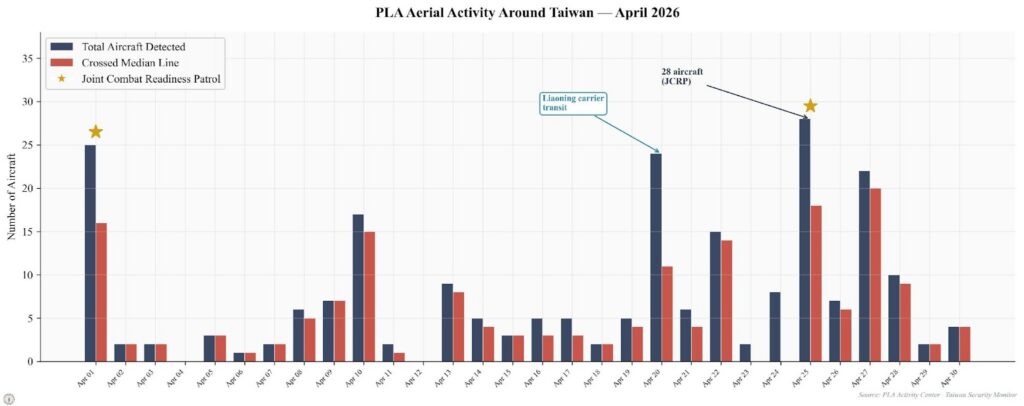
The month opened and closed with joint combat readiness patrols: the April 1 JCRP involved 25 aircraft, continuing the late-March return to operations after the Two Sessions lull, while the April 25 JCRP involved 28 aircraft and coincided with the final day of Taiwan’s annual Han Kuang 42 computer-simulated wargames. Between these two patrols, daily activity remained subdued, with two zero-detection days (April 4 and April 12) and a string of single-digit days through the mid-month. The final third of April produced elevated single-day totals, with 24 aircraft on April 20, 22 aircraft on April 27, and 17 aircraft on April 10.

Figure 1. Daily PLA aerial activity around Taiwan, April 2026. Gold stars mark JCRP days; the April 20 surge corresponds with the Liaoning carrier transit.

The April 20 spike coincided with the transit of the Liaoning aircraft carrier and escorts (CV-16) through the Taiwan Strait. The PLA’s Eastern Theater Command described the movement as part of long-range combat training in the western Pacific, and Taiwan’s MND released images of the carrier’s air wing during the transit. Japan’s JS Ikazuchi (DD-107) had transited the Strait three days earlier, on April 17 (the anniversary of the Treaty of Shimonoseki) drawing Beijing’s condemnation as a deliberate provocation. Together with the two JCRPs, these events indicate that the contraction in routine sortie volume since January has not extended to surge capacity or strategic signaling.

Monthly Trajectory: A Floor, Not a Trend

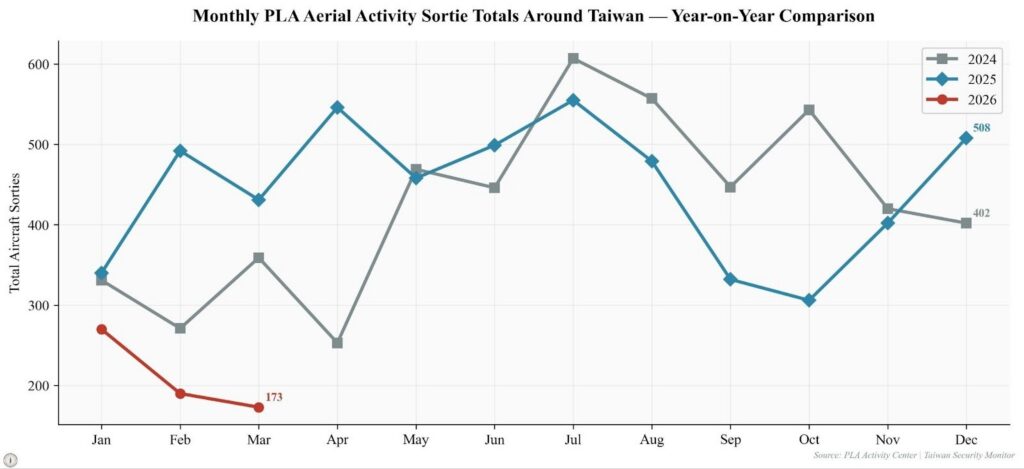
Viewed against the preceding three months, April’s 229-sortie total interrupts the consecutive decline that ran from January through March. Monthly totals across the first four months of 2026 (270, 190, 173, and 229) show a curve that fell sharply through Q1 before stabilizing.

Figure 2. Monthly PLA aerial activity sortie totals, 2024โ€“2026. April 2026 marks a modest rebound from March’s three-month low.

JCRP cadence offers a more stable read on PLA intent than aggregate sortie counts. April’s two JCRPs match February’s two and fall one short of March’s three. The April 25 peak of 28 aircraft is comparable to the 36-aircraft peak observed on March 17 and consistent with the cadence of roughly one large-format exercise per month sustained since August 2022. Reductions in routine sortie volume have not yet been accompanied by a comparable decline in the PLA’s willingness to mount high-intensity demonstrations on short notice.

At Sea: Carrier Transit and a Steady Baseline

PLAN vessel detections averaged 7.1 per day in April, peaking at 11 vessels on April 19 and again on April 28. These figures fall within the five-to-nine vessel range that has characterized PLAN presence throughout 2025 and the first four months of 2026. The Liaoning transit on April 20 registers in qualitative rather than quantitative terms: a single-day strategic signaling operation that did not move the monthly aggregate. Eastern Theater Command’s framing of the transit as long-range combat training in the western Pacific points to posture rather than escalation.

Figure 3. PLAN vessel and official ship detections around Taiwan, April 2026.

Naval presence held at baseline levels through April, reinforcing a structural observation that has held throughout 2026: air sorties appear responsive to political calendars and institutional dynamics, whereas naval presence functions as a persistent baseline feature of cross-strait military activity. The April carrier transit shows that this baseline coexists with episodic surge operations of strategic weight rather than displacing them.

Coast Guard Gray Zone Operations

China Coast Guard (CCG) activity in Taiwan’s restricted waters continued through April but contracted geographically. The CCG conducted 3 documented incursions on April 21, April 24, and April 28, all of them around Kinmen. Each incursion involved the same four-cutter rotation (hull numbers 14530, 14531, 14604, and 14609) and concluded within roughly two hours of entering restricted waters, consistent with the institutionalized two-to-three-hour Kinmen pattern documented in earlier months. Cumulative CCG incursions across the first four months of 2026 now total 18, with 15 around Kinmen and 3 around Dongsha.

Figure 4. CCG incursions into Taiwan’s restricted waters, Januaryโ€“April 2026, by location and vessel count.

The April pause around Dongsha is perhaps the most analytically distinctive feature of the month’s CCG activity. January, February, and March each included a single Dongsha (Pratas) operation, several with dwell times exceeding twenty-four hours; April’s gap breaks that monthly cadence for the first time in 2026. The narrower reading is that the once-monthly Dongsha rhythm reflected an operational pattern rather than a binding institutional commitment, and that May or June observations will either restore it or confirm its discontinuation. A broader reading is that the CCG temporarily consolidated around the proximate Kinmen rotation while the PLA Navy carried the month’s strategic signaling through the Liaoning transit. The Coast Guard Administration’s announcement earlier in April of US$1.88 billion in Pratas-area infrastructure and patrol upgrades indicates continuing Taiwanese concern about the durability of presence at its most remote outlying holding.

The Full Picture: Multi-Domain Overview

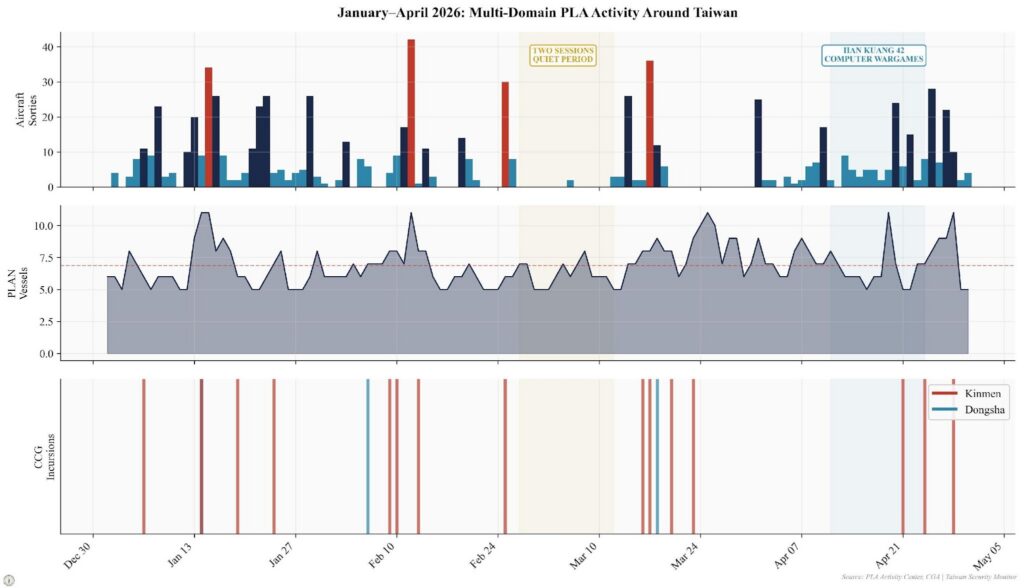
Figure 5. Januaryโ€“April 2026 multi-domain PLA activity: air sorties, naval presence, and CCG incursions.

Viewed across all three domains, the first four months of 2026 reinforce an analytical pattern visible since January. Air activity has been volatile and politically responsive, with a pronounced lull in early March and a partial rebound in April. Naval presence has been held within the established baseline throughout, including during the week of the Liaoning carrier transit. Coast Guard incursions have continued at roughly five incidents per month, with the April pattern narrowing geographically and interrupting the once-monthly Dongsha cadence. Analysts and policymakers would be well served by resisting the temptation to interpret a reduction in the headline sortie count as evidence of overall de-escalation. The multi-domain posture, taken as a whole, does not indicate a meaningful departure from the sustained pattern of PLA activity around Taiwan that has defined cross-strait military dynamics since August 2022.

Figure 6. April air activity year-over-year: total sorties and median line crossings, 2024โ€“2026.

Methodology & Sources

Air and naval detection data are drawn from daily press releases issued by Taiwan’s Ministry of National Defense and compiled in the PLA Activity Center database maintained by the Taiwan Security Monitor. Coast Guard incident data are compiled from Coast Guard Administration press releases and verified against contemporaneous media reporting in the China Coast Guard Incident Tracker Database. Allied and contextual events draw on Taiwan Security Monitor’s Weekly Security Reviews of April 6, April 16, April 20, and April 27. “Median line” refers to the informal centerline of the Taiwan Strait historically observed by both sides. “JCRP” denotes Joint Combat Readiness Patrols as designated by Taiwan’s MND. All analysis and commentary are by the Taiwan Security Monitor.
ยฉ 2026 Taiwan Security Monitor. All rights reserved.

Taiwanโ€™s Mine Warfare Gap: The Distance Between Concept and Capability

Author: Ethan Connell


Naval mines represent one of the few weapon systems capable of imposing disproportionate costs on an amphibious assault force. In a potential Taiwan contingency, mines could delay Peopleโ€™s Liberation Army (PLA) shipping, channel invasion routes into designated kill zones, deny port access, and compel an attacker to allocate valuable time to mine clearance before initiating troop landings. Given that Taiwanโ€™s survival in a cross-Strait conflict relies on gaining time for mobilization and potential external intervention, mines should occupy a central role in defense planning.

The effectiveness of Taiwanโ€™s mine warfare (MIW) and mine countermeasures (MCM) posture depends on several factors: the number of platforms, delivery methods, survivability in combat, mine quality, and the operational geography and threat environment. When evaluated against these criteria, Taiwan presents a mixed picture. While significant investments in offensive minelaying have occurred since 2020, the MCM fleet remains outdated and insufficient for modern threats; minelayers are slow and lightly armed, and there is no confirmed air-delivered mine capability. The gap between doctrinal ambition and practical wartime capability remains substantial. Rather than exhibiting asymmetric innovation, Taiwanโ€™s MIW and MCM posture illustrates the challenges of translating strategic concepts into a survivable, operational force structure.

The Operational Logic of Mining the Strait

Any PLA amphibious assault would require moving large numbers of troops, vehicles, and supplies across 130 to 220 kilometers of open water. That crossing force must load at embarkation ports, transit the strait, and arrive at a limited set of suitable landing areas on Taiwanโ€™s western coastline. Mines can impose costs at each stage.

Taiwan can mine its own coastal waters, port approaches, and landing beaches to slow or funnel an invasion fleet. Mines laid in the strait or near PLA embarkation points could delay loading operations and force PLA commanders to commit mine countermeasures assets before the crossing begins. The Taiwan Straitโ€™s bathymetry favors mining, with average depths of about 60 meters, the Taiwan Banks (averaging 20 meters) at the southern entrance, and the Changyun Ridge extending westward from Taiwan at around 30 meters depth. These conditions make the strait especially suitable for bottom and moored mines while compressing commercial and military traffic into predictable routes. The entire strait sits on Asiaโ€™s continental shelf, within the operational envelope of all modern mine types.[1]

Three categories of capability matter here: Offensive mining targets the adversaryโ€™s waters and transit routes. Defensive mining protects oneโ€™s own ports, littorals, and landing areas. Mine countermeasures, including the detection, classification, and neutralization of enemy mines, protect oneโ€™s own freedom of movement. Taiwan needs all three, and faces different constraints in each.

Effectiveness in each category relies not only on hardware but also on the supporting operational infrastructure. This includes pre-delegation of authority to conduct mining before hostilities commence, dispersed stockpiles at multiple embarkation points, rehearsed loading and deployment procedures, integration with broader coastal defense plans, and hydrographic preparation of minefields. While it is difficult to determine from open sources whether Taiwan has established this architecture, this uncertainty significantly influences assessments of the subsequent force structure.

Taiwanโ€™s Minelaying Capability

Taiwanโ€™s most notable recent investment is the Min Jiang-class fast minelayer, built by Lung Teh Shipbuilding in Yilan County. These 347-ton vessels are the Republic of China Navyโ€™s (ROCN) first purpose-built minelaying platforms. The ROCN commissioned four hulls in January 2022, assigning them to the 192nd Fleetโ€™s Mine Laying Unit at Zuoying Naval Base in Kaohsiung.[2] In March 2025, Taiwanโ€™s Ministry of National Defense (MND) opened a third tender for six additional vessels, budgeted at NT$1.8 billion (US$54.8 million), after two prior tenders failed to attract the minimum number of bids required under procurement law.[3] If that procurement project succeeds, Taiwan will operate 10 dedicated minelayers by around 2027.

Each Min Jiang-class vessel can carry up to 64 Mk-6 mines, 64 Wan Xiang I conical mines, 36 Wan Xiang I cylindrical mines, 40 Wan Xiang II moored mines, or 32 Wan Xiang II bottom mines.[4] The vessels use an automated mine-laying system developed by the National Chung-Shan Institute of Science and Technology (NCSIST), a significant improvement over the manual methods used on the converted landing craft that served as Taiwanโ€™s improvised minelayers before 2022.

The mine inventory spans two families. The Wan Xiang family, developed by NCSIST, includes influence, moored, and bottom variants. NCSIST has also pursued development of self-propelled mines and new shallow- and deep-water influence types, though open-source confirmation of their operational status is limited.[5] Alongside these indigenous systems, Taiwan maintains stockpiles of the U.S.-designed Mk-6 moored contact mine, a design dating to 1917. The ROCN used Mk-6 mines in training exercises as late as 2024.[6]

Reliable estimates of Taiwanโ€™s total mine stockpile are unavailable in open sources. This issue is significant: even with 10 minelayers, each capable of carrying 32 to 64 mines per sortie, the total number of mines that could be deployed in the initial hours of a conflict depends on the depth of the stockpile, distribution across multiple loading points, and the number of sorties each vessel can complete before suffering losses. 10 minelayers, each conducting two sorties, could deploy between 640 and 1,280 mines, which is notable but not decisive given the straitโ€™s width and the number of potential approaches. Whether Taiwanโ€™s inventory can sustain mining operations beyond the initial wave remains uncertain and carries important operational implications.

Available open-source reporting indicates that Taiwan does not possess a confirmed air-delivered mine capability. Reports from approximately 2018 noted Taipeiโ€™s interest in acquiring U.S. Quickstrike mines, which can be deployed by aircraft at range and glide to their targets; however, this acquisition did not occur.[7] Air-delivered mines offer faster and longer-range deployment compared to ship-based methods and eliminate the need for slow surface platforms to enter contested waters. The absence of this capability constitutes a significant operational gap.

Taiwanโ€™s Mine Countermeasures Fleet

Taiwanโ€™s mine countermeasures posture tells a different story than its investment in minelaying. The ROCNโ€™s MCM fleet consists of four Yung Feng-class minehunters built in Germany by Abeking and Rasmussen in 1991, two Yung Jin-class minehunters (ex-U.S. Navy Osprey-class), and a single remaining Yung Yang-class minesweeper, a former U.S. Navy Aggressive-class vessel whose design dates to the 1950s.[8]

PlatformTypeNumberStatus / Notes
Min Jiang-classFast minelayer4 (+ 6 planned)347 tons; commissioned 2022; 14 kt max; 32โ€“64 mines per sortie
Yung Feng-classMinehunter4German-built (Abeking & Rasmussen), 1991; aging sonar and mechanical sweeping
Yung Jin-classMinehunter2Ex-USN Osprey-class; fiberglass hull; limited against modern mine threats
Yung Yang-classMinesweeper1Ex-USN Aggressive-class; 1950s-era design; wooden hull

These platforms are capable of conducting limited coastal mine clearance under permissive conditions. However, none are equipped to address the full spectrum of modern mine threats, such as rocket-rising mines, smart mines with anti-sweep features, or mines with target discrimination algorithms, all of which the PLA is assessed to possess or be developing.[9]

A failed modernization program compounds the problem. In 2014, the MND awarded a NT$35 billion (about US$1.2 billion) contract to a consortium of Ching Fu Shipbuilding, Lockheed Martin, and Italyโ€™s Intermarine to build six new MCM vessels. In 2017, prosecutors raided Ching Fuโ€™s offices. The companyโ€™s chairman was charged with forgery and loan fraud. The contract collapsed.[10] No replacement program has been announced. Taiwanโ€™s MCM fleet has been frozen in time for over a decade, with no confirmed path to modernization.

Operational Constraints and Wartime Viability

Despite Taiwanโ€™s investments, operational constraints significantly limit the potential effectiveness of its mine warfare forces in combat. These constraints differ between minelaying and mine clearance, but both are fundamentally shaped by the disparity between theoretical platform capabilities and their survivability under PLA attack.

The Min Jiang-class maxes out at 14 knots. That speed cannot outrun any modern combatant, anti-ship missile, or armed helicopter. For self-defense, the vessels carry a single T-75 20mm autocannon and two 7.62mm machine guns, with negligible protection against PLA anti-ship cruise missiles. A Beaufort 3 sea-state limitation on the class restricts operations to calm weather, meaning rougher conditions could prevent the vessels from laying mines when needed most or confine them to predictable windows that the PLA could monitor and target. Minelaying also demands that ships follow predetermined tracks at consistent, low speeds, turning them into predictable targets.[11]

PLA intelligence, surveillance, and reconnaissance (ISR) capabilities compound these problems. Chinaโ€™s ISR satellite constellation exceeded 359 systems as of early 2024, triple that of 2018, covering electro-optical, synthetic aperture radar, and signals intelligence. PLA aircraft conducted over 3,600 flights into Taiwanโ€™s air defense identification zone in 2024.[12] Under these conditions, minelayers departing Zuoying would face a high probability of detection and tracking, particularly in the pre-conflict period when PLA surveillance is already at elevated levels. Whether continuous tracking would persist amid the fog and friction of active combat is less certain, but the vulnerability in peacetime and the crisis phase is clear.

This presents a timing problem with no clear answer. Mines work best when laid before hostilities begin or in the first hours of a conflict.[13] Pre-war mining of international waters, however, would be politically provocative and could accelerate escalation. Waiting until conflict starts risks PLA missile strikes suppressing minelayers before they finish their runs. Taiwanโ€™s Overall Defense Concept envisions minelaying during a crisis or mobilization phase, but whether Taiwanese political leadership would authorize mining before the first shots are fired, and whether the operational architecture for rapid, pre-delegated deployment exists, remain open questions.[14]

Mine warfare effectiveness in this context is influenced by more than the number of dedicated platforms. Factors such as air superiority over the strait, missile suppression of embarkation areas, hydrographic knowledge of planned minefields, availability of pre-surveyed mine positions, and external assistance from partners all affect the number of mines deployed and their operational impact. Taiwanโ€™s minelaying capacity should be assessed as part of an integrated coastal defense architecture, recognizing that other components of this system also face significant constraints.

On the minelaying side, even a small number of mines laid in the strait or near PLA embarkation points could impose real costs: PLA commanders would have to commit MCM assets, delaying the crossing timeline and introducing uncertainty into an operation that demands precise coordination. The psychological burden of mines is well-documented: the suspicion of a minefield, even an unconfirmed one, can halt or reroute naval operations for days.

However, Taiwanโ€™s capacity to realize this potential under combat conditions is limited. With four operational minelayers (potentially 10 by 2027), each with a maximum speed of 14 knots and minimal self-defense capabilities, and operating under intense surveillance in the Western Pacific, the likelihood of successfully conducting large-scale mining operations after hostilities commence is low. The absence of air-delivered mines further deprives Taiwan of the most survivable and responsive means of delivery.

The imbalance is even more pronounced regarding mine countermeasures. Mine clearance is inherently slow, hazardous, and resource-intensive. Taiwanโ€™s current MCM fleet is insufficient for the scale of the threat. Should the PLA mine Kaohsiung, which manages over 60 percent of Taiwanโ€™s cargo trade, the islandโ€™s capacity to sustain itself during a blockade or invasion would rely on mine clearance capabilities that are presently inadequate to meet the challenge.[15]

The MCM problem runs in the opposite direction from minelaying. The PLA holds an estimated 50,000 to 100,000 naval mines and can deliver them by submarine, aircraft, surface ship, or, conceivably, civilian vessel.[16] If the PLA mines Taiwanโ€™s port approaches before or during an assault, Taiwanโ€™s aging MCM fleet would be overwhelmed. The PLA can seed Taiwanโ€™s ports with mines far faster than Taiwan can clear them.

The PLAโ€™s Own Mine Clearance Problem

The discussion so far has treated the PLA primarily as a mine-laying actor and an ISR threat. But an amphibious crossing of the Taiwan Strait would also require the PLA to clear mines from its own approach routes: either mines laid defensively by the ROCN in coastal waters and around landing beaches, or mines laid by the PLAN itself to deny port access or deter outside involvement. This is not a trivial requirement to overcome.

The PLA Navy (PLAN) operates a fleet of Type 082 (Wozang-class) and Type 081 (T-43-class) minesweepers, supplemented by newer Type 082-II MCM vessels. Open-source assessments suggest the PLAN has roughly 24โ€“36 dedicated MCM platforms, a modest number relative to the scale of an amphibious operation across a strait that could be mined at multiple points.[17][18] The PLAN has invested in unmanned mine-clearance systems and towed sweeping gear, but whether these assets could clear defended minefields under fire, while Taiwanโ€™s anti-ship missiles, shore-based artillery, and surviving naval units remain in play, is far from certain.

This reciprocal vulnerability is analytically significant. While Taiwanโ€™s mine warfare gap is genuine, the PLA also faces substantial MCM constraints. If Taiwan succeeds in deploying even a moderate number of mines in critical locations before or during the initial phase of conflict, the PLAโ€™s limited MCM capacity could create a bottleneck in the amphibious operation timeline. Thus, the mine warfare balance reflects not only Taiwanโ€™s limitations but also the mutual clearance challenges faced by both sides.

Mine Warfare in the Broader Force Design Debate

Taiwanโ€™s mine warfare posture aligns with the broader argument for asymmetric defense. The ODC, formulated by former Chief of the General Staff Admiral Lee Hsi-min, places mines among the key littoral and beach defense capabilities alongside anti-ship cruise missiles and mobile coastal defense systems.[19] President Lai Ching-te personally inspected a live mine-laying drill during the Han Kuang 41 exercise in July 2025, signaling political commitment.[20]

However, political commitment does not necessarily translate into operational capability. Several critical questions remain unresolved in open-source analysis. Is the mine inventory sufficient in both quantity and sophistication to impose a meaningful delay on a PLA crossing force, or does it serve primarily as a symbolic deterrent? Has Taiwan developed the necessary doctrine, training, and operational infrastructure to employ mines effectively under wartime conditions, including pre-delegation of authority, pre-positioned stocks at dispersed locations, protected embarkation points, and rehearsed rapid-deployment procedures? Furthermore, does the MCM gap represent a strategic vulnerability that cannot be mitigated solely through increased investment in minelaying?

Regarding the final point, available open-source evidence strongly supports this concern. If Taiwan is unable to keep its own ports operational, the denial strategy becomes untenable. A navy capable of mining adversary approaches but unable to clear mines from its own harbors faces a significant strategic asymmetry. While this conclusion is not definitive (classified programs or undisclosed procurement efforts may exist), the publicly observable MCM posture does not inspire confidence.

Taiwan has made modest investments in minelaying capabilities while permitting its mine clearance capacity to decline. Although offensive mining is more cost-effective within a denial strategy and thus defensible in theory, this approach leaves Taiwan vulnerable to a PLA mining campaign with limited options for remediation.

The failed Ching Fu procurement remains a significant setback. The collapse of a billion-dollar program due to fraud, with no replacement in the subsequent nine years, exemplifies the institutional obstacles that can prevent well-designed defense strategies from being implemented.[21]

Implications

Taiwanโ€™s mine warfare posture offers three findings for analysts and policymakers.

First, Taiwanโ€™s leaders have grasped the value of asymmetric, cost-imposing tools and have acted on that understanding in the minelaying domain. The Min Jiang-class program, the Wan Xiang mine family, and the planned expansion to ten vessels represent a deliberate effort to build a capability that did not exist a decade ago. This is a modest but real achievement.

Second, developing a capability that is both survivable and operationally executable is considerably more challenging than simply recognizing its strategic value. Taiwanโ€™s minelayers are slow and lightly armed, operating in an environment characterized by pervasive PLA ISR. The absence of air-delivered mines persists. The issue of when political leaders would authorize mining operations remains unresolved and has not been publicly addressed. Mine warfare effectiveness is determined by multiple factors beyond platforms, including air superiority, pre-positioned stockpiles, hydrographic preparation, and doctrinal readiness, all of which influence whether the capability can be employed effectively at the outset of a conflict.

Third, the gap in mine countermeasures is the most revealing indicator of Taiwanโ€™s procurement challenges. For the United States and other partners, this suggests the need for targeted actions such as capability transfers, technology sharing, and joint planning in the mine warfare domain, which may be as important as platform sales. Unmanned MCM systems, an area where Taiwanโ€™s domestic defense industry has not succeeded, represent a clear opportunity for collaboration. The stalled Quickstrike transfer warrants renewed focus, and joint exercises should rigorously test mine warfare scenarios.

For analysts evaluating Taiwanโ€™s defense preparedness, the mine warfare gap serves as a clear test case. The credibility of any strategy depends on the existence of a deployable force structure to support it. In Taiwanโ€™s situation, the persistent gap between strategic concepts and actual capabilities, between the vision of the Overall Defense Concept and the fleet available to implement it, remains the central challenge.


[1]Taiwan Strait geographic parametersโ€”width, depth, and bathymetric featuresโ€”are drawn from โ€œTaiwan Strait,โ€ Encyclopedia Britannica, and U.S. National Geospatial-Intelligence Agency, Sailing Directions (Enroute), Publication 157.

https://www.britannica.com/place/Taiwan-Strait

https://msi.nga.mil/Publications/SDEnroute

[2] Taiwanโ€™s Ministry of National Defense commissioned the first four Min Jiang-class minelayers on January 14, 2022, assigning them to the 192nd Fleetโ€™s Mine Laying Unit at Zuoying Naval Base. See Mike Yeo, โ€œTaiwan Adds Minelaying to Defenses Against China,โ€ Defense News, January 14, 2022.                                       

https://www.defensenews.com/naval/2022/01/14/taiwan-adds-minelaying-to-defenses-against-china

[3] The March 2025 tender for six additional Min Jiang-class vessels, budgeted at NT$1.8 billion, was the third attempt after two prior tenders failed to attract sufficient bids. See โ€œTaiwan Seeks Contractor for Six Minelayers,โ€ The Defense Post, March 6, 2025.

https://thedefensepost.com/2025/03/06/taiwan-contractor-six-minelayers

[4] Min Jiang-class specifications, including displacement, speed, mine capacity, and armament, are drawn from publicly available technical data. See โ€œTaiwan Seeks Contractor for Six Minelayers,โ€ The Defense Post, March 6, 2025; and Republic of China Ministry of National Defense, ROC National Defense Report, 2023.

https://www.ustaiwandefense.com/taiwan-ministry-of-national-defense-mnd-reports/

[5] Taiwanโ€™s Wan Xiang mine family was developed by the National Chung-Shan Institute of Science and Technology (NCSIST). Open-source reporting on self-propelled mine development appears in the 2023 ROC National Defense Report. Confirmation of operational deployment of advanced variants remains limited.

https://www.ustaiwandefense.com/taiwan-ministry-of-national-defense-mnd-reports/

[6] Taiwan continues to train with the Mk-6 Mod 14 moored contact mine, a design dating to 1917. See Tyler Rogoway, โ€œTaiwan Trains to Use Naval Mines Designed Over a Century Ago Against China,โ€ The War Zone, 2024.

https://www.twz.com/taiwan-trains-to-use-naval-mines-designed-a-century-ago-against-china

[7] Reports of Taiwanโ€™s interest in U.S. Quickstrike air-delivered mines circa 2018, and the failure of that acquisition, appear in Blake Herzinger, โ€œDelay, Disrupt, Degrade: Mine Warfare in Taiwanโ€™s Porcupine Defense,โ€ War on the Rocks.

https://warontherocks.com/delay-disrupt-degrade-mine-warfare-in-taiwans-porcupine-defense

[8] Taiwanโ€™s MCM fleet compositionโ€”four Yung Feng-class (German-built, 1991), two Yung Jin-class (ex-USN Osprey-class), and one remaining Yung Yang-class (ex-USN Aggressive-class)โ€”is documented in International Institute for Strategic Studies, The Military Balance 2025 (London: IISS, 2025); and Janeโ€™s Fighting Ships 2024โ€“2025.

https://www.iiss.org/publications/the-military-balance/2025/the-military-balance-2025

[9] PLA mine types, including the EM-52 rocket-rising mine, EM-53 bottom influence mine, and EM-55 mobile mine, are cataloged in Office of Naval Intelligence, The PLA Navy: New Capabilities and Missions for the 21st Century (2015); and in the Naval War Collegeโ€™s China Maritime Studies Institute publications. PLA MCM platforms are assessed in The Military Balance 2025 by IISS.

https://news.usni.org/2015/04/09/document-office-of-naval-intelligence-2015-assessment-of-chinese-peoples-liberation-army-navy

https://nuke.fas.org/guide/china/plan-2015.pdf

[10] The Ching Fu Shipbuilding scandal, involving an NT$35 billion MCM contract awarded in 2014 that collapsed by 2017 amid fraud charges, is documented in โ€œTaiwan to Build Six New MCM Ships with U.S., Italian Help,โ€ USNI News, November 3, 2014; and subsequent Taipei Times reporting, 2017.

https://news.usni.org/2014/11/03/taiwan-build-six-new-mcm-ships-u-s-italian-help-china-displeased

https://globaltaiwan.org/2017/11/crux-of-ching-fus-case-concerns-china/

https://www.taipeitimes.com/News/taiwan/archives/2019/09/29/200372310

[11] Min Jiang-class specifications, including displacement, speed, mine capacity, and armament, are drawn from publicly available technical data. See โ€œTaiwan Seeks Contractor for Six Minelayers,โ€ The Defense Post, March 6, 2025; and Republic of China Ministry of National Defense, ROC National Defense Report, 2023.

https://www.ustaiwandefense.com/taiwan-ministry-of-national-defense-mnd-reports/

[12] Chinaโ€™s ISR satellite constellation exceeded 359 systems as of January 2024. PLA aircraft conducted 3,615 flights into Taiwanโ€™s ADIZ in 2024. See โ€œAll Quiet in the Taiwan Strait? Explaining the Recent Drop in PLA Aircraft Activity Around Taiwan,โ€ Taiwan Security Monitor, and U.S.-China Economic and Security Review Commission, 2024 Annual Report to Congress.https://tsm.schar.gmu.edu/all-quiet-in-the-taiwan-strait-explaining-the-recent-drop-in-pla-aircraft-activity-around-taiwan

https://www.uscc.gov/annual-report/2024-annual-report-congress

https://www.uscc.gov/sites/default/files/2024-03/J.Michael_Dahm_Testimony.pdf

[13] Joint Chiefs of Staff, Joint Publication 3-15: Barriers, Obstacles, and Mine Warfare for Joint Operations (Washington, DC: Joint Chiefs of Staff, September 6, 2016; validated March 5, 2018), https://www.bits.de/NRANEU/others/jp-doctrine/jp3_15pa%282018%29.pdf

[14] The Overall Defense Concept (ODC), formulated by former Chief of the General Staff Admiral Lee Hsi-min, envisions mines as a key capability for littoral defense. See Lee Hsi-min and Eric Lee, โ€œTaiwanโ€™s Overall Defense Concept, Explained,โ€ The Diplomat, November 3, 2020.

https://thediplomat.com/2020/11/taiwans-overall-defense-concept-explained

[15] Kaohsiung handles over 60 percent of Taiwanโ€™s cargo throughput. About 44 percent of the worldโ€™s container fleet transits the Taiwan Strait each year. See Bureau of Transportation and Communications, Taiwan Statistical Yearbook 2024; and Bloomberg, โ€œTaiwan Strait Shipping Traffic Analysis,โ€ 2024.

https://www.usni.org/magazines/proceedings/2023/november/taiwan-strait-oceans-most-contested-place https://www.statista.com/statistics/1045142/container-throughput-volume-in-kaohsiung-port-taiwan/

[16] Chinaโ€™s naval mine inventory is estimated at 50,000 to 100,000 mines comprising over 30 varieties. See Andrew S. Erickson, Lyle J. Goldstein, and William S. Murray, Chinese Mine Warfare: A PLA Navy โ€œAssassinโ€™s Maceโ€ Capability, China Maritime Studies Institute, U.S. Naval War College, 2009. The estimate has been widely cited in subsequent assessments, including the U.S. Department of Defense, Military and Security Developments Involving the Peopleโ€™s Republic of China, annual reports.

https://digital-commons.usnwc.edu/cmsi-red-books/7

[17] Chinaโ€™s naval mine inventory is estimated at 50,000 to 100,000 mines comprising over 30 varieties. See Andrew S. Erickson, Lyle J. Goldstein, and William S. Murray, Chinese Mine Warfare: A PLA Navy โ€œAssassinโ€™s Maceโ€ Capability, China Maritime Studies Institute, U.S. Naval War College, 2009. The estimate has been widely cited in subsequent assessments, including the U.S. Department of Defense, Military and Security Developments Involving the Peopleโ€™s Republic of China, annual reports.

https://digital-commons.usnwc.edu/cmsi-red-books/7

[18] PLA mine types, including the EM-52 rocket-rising mine, EM-53 bottom influence mine, and EM-55 mobile mine, are cataloged in Office of Naval Intelligence, The PLA Navy: New Capabilities and Missions for the 21st Century (2015); and in the Naval War Collegeโ€™s China Maritime Studies Institute publications. PLA MCM platforms are assessed in The Military Balance 2025 by IISS.

https://news.usni.org/2015/04/09/document-office-of-naval-intelligence-2015-assessment-of-chinese-peoples-liberation-army-navy

https://nuke.fas.org/guide/china/plan-2015.pdf

[19] The Overall Defense Concept (ODC), formulated by former Chief of the General Staff Admiral Lee Hsi-min, envisions mines as a key capability for littoral defense. See Lee Hsi-min and Eric Lee, โ€œTaiwanโ€™s Overall Defense Concept, Explained,โ€ The Diplomat, November 3, 2020.

https://thediplomat.com/2020/11/taiwans-overall-defense-concept-explained

[20] President Lai Ching-te inspected a live mine-laying drill during the Han Kuang 41 exercise in July 2025. See โ€œLai Inspects Mine Drill,โ€ Focus Taiwan, July 14, 2025.

https://focustaiwan.tw/politics/202507140021

[21] The Ching Fu Shipbuilding scandal, involving an NT$35 billion MCM contract awarded in 2014 that collapsed by 2017 amid fraud charges, is documented in โ€œTaiwan to Build Six New MCM Ships with U.S., Italian Help,โ€ USNI News, November 3, 2014; and subsequent Taipei Times reporting, 2017.

https://news.usni.org/2014/11/03/taiwan-build-six-new-mcm-ships-u-s-italian-help-china-displeased

https://globaltaiwan.org/2017/11/crux-of-ching-fus-case-concerns-china/

https://www.taipeitimes.com/News/taiwan/archives/2019/09/29/200372310

Strait Snapshot, March 2026 Update

Author: Ethan Connell & Jonathan Walberg


Key Findings

  • In March 2026, Taiwan’s Ministry of National Defense recorded 173 PLA aerial sorties around the island, representing a 60 percent year-over-year decline and extending the downward trend observed since the December 2025 Justice Mission exercises.
  • Between late February and mid-March, air operations declined to near-zero levels for thirteen days. This lull coincided with China’s annual Two Sessions legislative period of the National Peopleโ€™s Congress and followed the dismissal of two senior Central Military Commission vice-chairmen in January. This pattern aligns with previously documented instances of institutional caution during politically sensitive periods.
  • Taiwanese Coast Guard Administration data shows 15 documented CCG incursions into Taiwan’s restricted waters from January through March, concentrated around Kinmen (12 incidents) and Dongsha Island (three incidents), with dwell times in the Dongsha incursions exceeding 24 hours.
  • In March, PLAN vessel detections around Taiwan averaged approximately seven per day, consistent with the five-to-nine vessel baseline observed throughout 2025. The continued naval presence during a period of reduced air activity suggests that the air and maritime domains are governed by distinct operational logics.

The March Lull

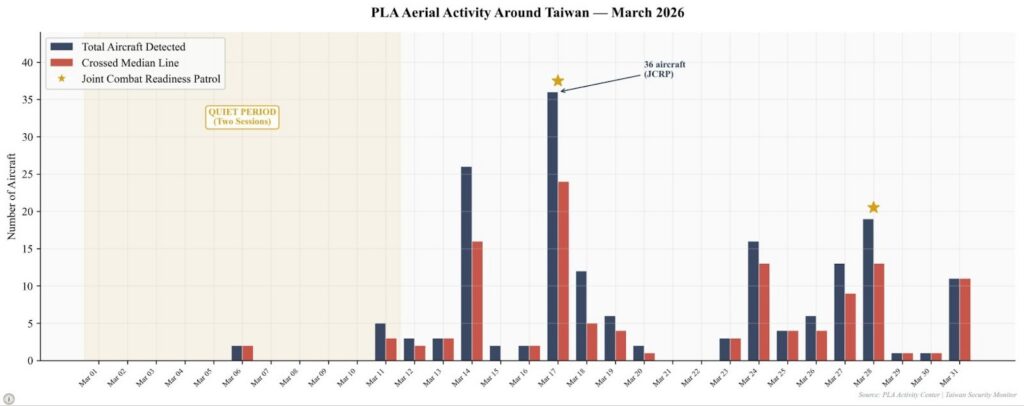
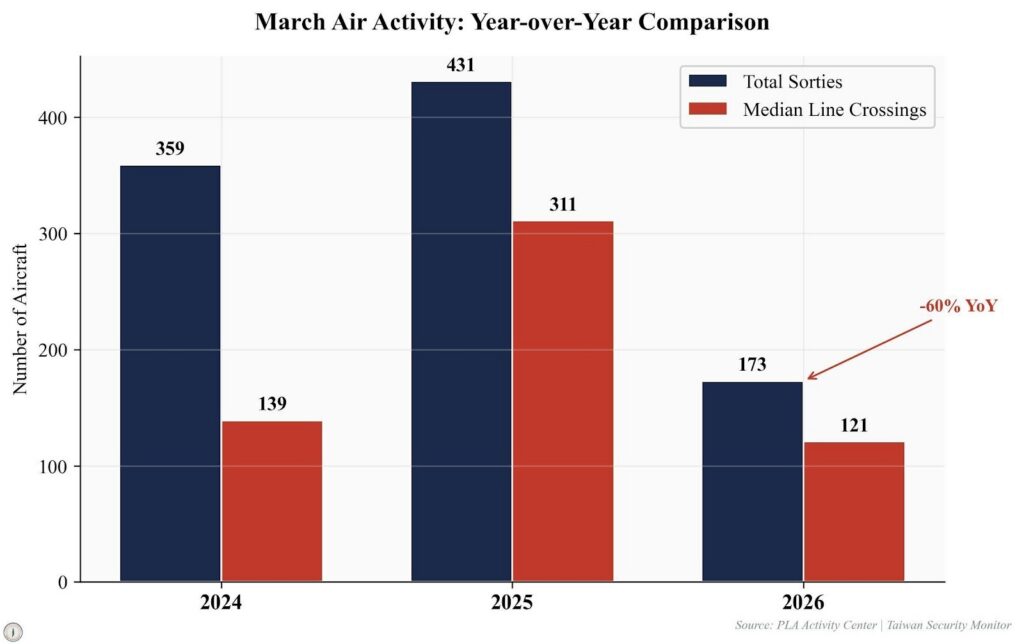
March 2026 marked a significant deviation from the Peopleโ€™s Liberation Army (PLA) air activity patterns observed around Taiwan during the previous twelve months. The 173 detected aircraft sorties, including 121 that entered Taiwan’s Air Defense Identification Zone, constitute a 60 percent reduction from March 2025, when 431 sorties were recorded. This figure also continues the sequential decline observed in the first three months of 2026: January recorded 270 sorties, February recorded 190, and March recorded 173.

A notable feature of the month was the lull in PLA air activity in early March, during which Taiwan detected only limited aircraft activity around the island. Rather than pointing to a single discrete cause, this slowdown is better understood as the product of overlapping factors. The strongest explanation remains the PRCโ€™s domestic calendar: the annual โ€œTwo Sessions,โ€ combined with the tail end of the Spring Festival period, has historically aligned with a lower operational tempo around Taiwan. Other theories, including the idea that leadership turmoil within the PLA or fuel pressures linked to Middle East instability drove the reduction, are harder to sustain. As TSM noted in The Monitor, those explanations fit the available evidence less well, especially given continued Chinese activity in the East and South China Seas during the same period.

Figure 1. Daily PLA activity around Taiwan, March 2026. The shaded region marks the quiet period.

Air operations resumed in the second half of March. On March 17, Taiwan’s Ministry of National Defense (MND) reported a joint combat readiness patrol (JCRP) involving thirty-six aircraft, marking the month’s single-day peak. This was followed by a second JCRP on March 28 with nineteen aircraft and a third on April 1. The resumption of large-scale exercises after a period of relative quiet aligns with patterns observed in previous years. The PLA appears to adjust its daily sortie rate in response to political calendars and internal dynamics while maintaining the capacity for periodic high-intensity demonstrations.

Monthly Trajectory: A Sustained Decline

March’s figures are a continuation of a three-month decline. From January through March 2026, monthly sortie totals fell from 270 to 190 to 173, respectively. This trajectory comes on the heels of the elevated activity of late 2025, when the PLA’s Justice Mission-2025 exercise on December 29 saw the use of 130 aircraft in a single day, the largest single-day operation around Taiwan since comprehensive daily reporting began.

Figure 2. Monthly PLA sortie totals, 2024โ€“2026. The Januaryโ€“March 2026 trend shows consecutive declines.

However, the frequency of Joint Combat Readiness Patrols (JCRPs), which represent the highest-intensity format of PLA air operations around Taiwan, has remained broadly stable. March 2026 included three JCRPs, matching the number in March 2025 and exceeding the two recorded in March 2024. This continuity indicates that the reduction in routine sortie volume has not been accompanied by a corresponding decrease in the PLA’s willingness or ability to conduct large-scale, multi-domain demonstrations on short notice.

At Sea: Persistent Naval Presence

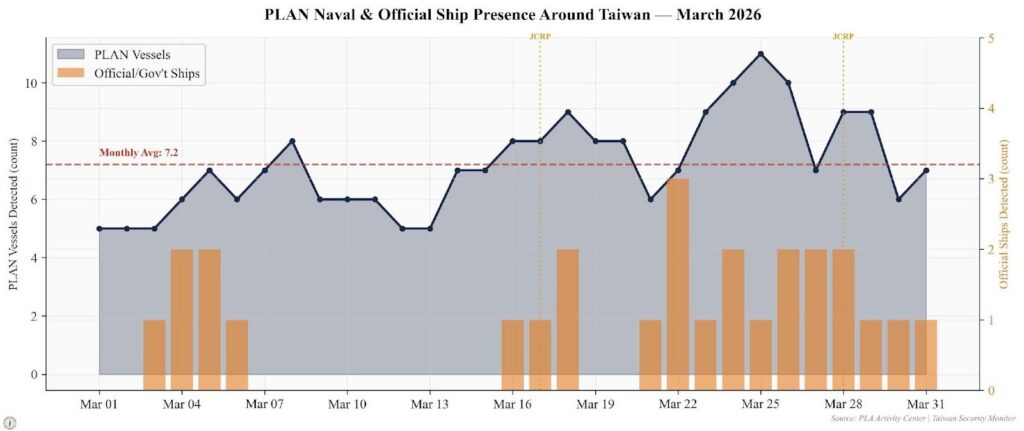
PLAN vessel detections in the waters around Taiwan averaged 7.2 per day in March, with a peak of eleven on a single day. These figures are consistent with the range of 5-9 vessels that have characterized PLAN presence throughout 2025. The stability of the naval posture during a month of minimal air activity highlights a structural difference in how the PLA manages its air and maritime components around Taiwan. Air sorties appear responsive to political calendars and institutional dynamics, whereas naval presence serves as a persistent baseline feature of cross-strait military activity.

Figure 3. PLAN vessel and official ship detections around Taiwan, March 2026.

This divergence between air and naval activity patterns holds analytical significance for assessments of cross-strait tension. Analysts who focus solely on sortie counts may interpret the March figures as evidence of de-escalation, however the unchanged naval footprint demonstrates that the PLA’s overall posture in the Taiwan Strait has not meaningfully decreased.

Coast Guard Gray Zone Operations

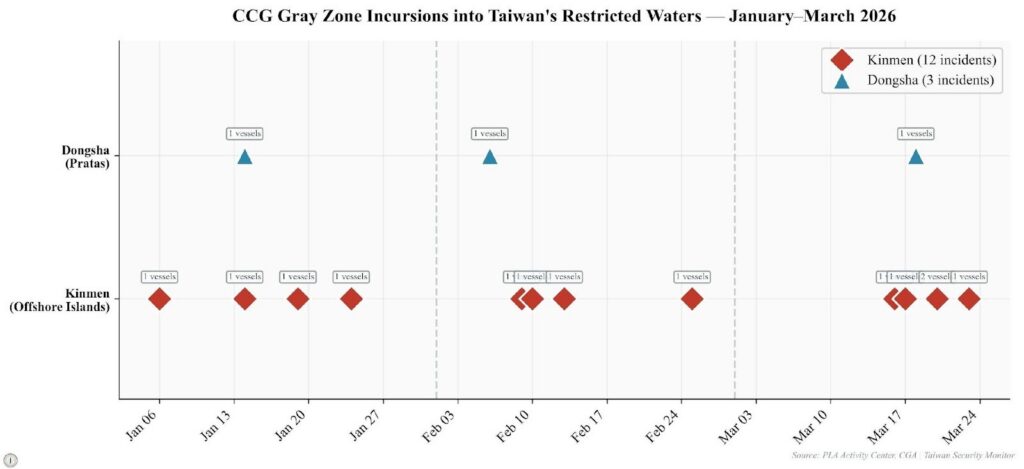
China Coast Guard (CCG) activity in Taiwan’s restricted waters represents a third, often underreported, dimension of cross-strait pressure. From January through March 2026, the CCG conducted at least 15 documented incursions: 12 around Kinmen and three near Dongsha Island (Pratas). The Kinmen operations have developed into a recognizable pattern, typically involving two to four CCG cutters entering restricted waters for two to three hours before withdrawing. This approach appears intended to establish a regular CCG presence in waters considered under the jurisdiction of Taiwan’s Coast Guard Administration.

Figure 4. CCG incursions into Taiwan’s restricted waters, Januaryโ€“March 2026, by location and vessel count.

The Kinmen incursions have involved a recurring set of CCG cutters (specifically, hull numbers 14529, 14603, 14605, and 14609), indicating a dedicated patrol rotation rather than ad hoc deployments. The Dongsha operations differ qualitatively, involving larger vessels from the 3101 and 3102 classes and featuring extended dwell times, with the March 18th incursion east of Dongsha lasting over twenty-five consecutive hours. The increasing dwell times at Dongsha merit particular attention, as they challenge the Coast Guard Administration’s capacity to maintain a sustained presence at Taiwan’s most remote holding.

The Full Picture: Multi-Domain Overview

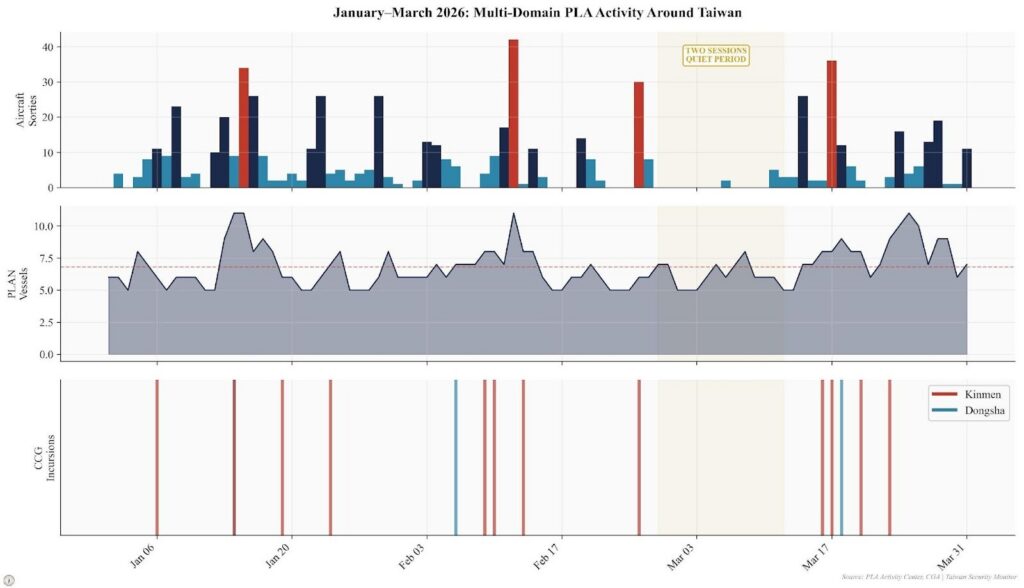
Figure 5. Januaryโ€“March 2026 multi-domain PLA activity: air sorties, naval presence, and CCG incursions.

An examination of all three domains simultaneously reveals that the first three months of 2026 present a more complex situation than any single metric suggests. Air activity has been volatile and responsive to political events, while naval presence has remained steady and largely unaffected by fluctuations in the air domain. Coast Guard incursions have persisted and, in the Dongsha cases, have increased in duration. Analysts and policymakers should avoid interpreting a reduction in one domain as an overall reduction in pressure. The multi-domain posture, considered in its entirety, does not indicate meaningful de-escalation.

Figure 6. March air activity year-over-year: total sorties and median line crossings, 2024โ€“2026.

Methodology & Sources

Air and naval detection data are drawn from daily press releases issued by Taiwan’s Ministry of National Defense and compiled in the PLA Activity Center database maintained by Taiwan Security Monitor. Coast Guard incident data are compiled from Coast Guard Administration press releases, verified against contemporaneous media reporting, and compiled in the China Coast Guard Incident Tracker Database. “Median line” refers to the informal centerline of the Taiwan Strait historically observed by both sides. “JCRP” denotes Joint Combat Readiness Patrols as designated by Taiwan’s MND. All analysis and commentary are by Taiwan Security Monitor.
ยฉ 2026 Taiwan Security Monitor. All rights reserved.
From 16 Aircraft to Surrounded: Fear, Virality, and the Misinformation Cascade in ADIZ Discourse

Authors: Jonathan Walberg, Noah Reed, & Ethan Connell


On March 15th, 2026, Politico published an article titled โ€œTaiwan reports large-scale Chinese military aircraft presence near island.โ€[i] This title exaggerated what was in actuality a relatively normal day of PLA activity around Taiwan. Nevertheless, the piece caught the eye of many observers on social media. Within hours, thousands of finance and Open-Source Intelligence (OSINT) accounts began to regurgitate the headline, without linking the article or explaining the nuance behind the report of โ€œlarge-scaleโ€ activity.[ii] These posts, which seemed to imply that China was preparing significant military action against Taiwan, accumulated tens of thousands of likes, and began trending on both Twitter/X and Bluesky. 

Essentially, we witnessed a game of telephone taking place on the internet. A single headline was rapidly shared, rephrased, and simplified across platforms, with each iteration shedding context and adding interpretation. Within hours, an observation about aircraft activity became a claim about encirclement, with accounts sharing posts that declared Taiwan as โ€œsurroundedโ€ by the Peopleโ€™s Liberation Army (PLA).

An AI-generated map that circulated on X/Bluesky during the wave of misinformation

This incident provides a useful window into how even relatively small actions by the PLA around Taiwan have the potential to significantly swing social media coverage of Taiwan by actors engaged in disinformation. In a crisis-prone environment such as Taiwanโ€™s, where China has carefully shaped the narrative environment for years through large exercises, even one article can cascade into a broader wave of false and misleading claims, using recycled visuals and improvised escalation narratives.[iii]

The Problem With ADIZ Reporting

Following two weeks of depressed PLA activity in and around Taiwanโ€™s Air Defense Identification Zone (ADIZ), Taiwanโ€™s MND reported that 26 Chinese aircraft were detected operating around Taiwan, with 16 aircraft entering its IZ[iv]. While this instance is indeed above 2026โ€™s daily average of 4.5, it is in fact only โ€œlarge-scaleโ€ if compared to the previous two weeks of little to no activity, something that the Politico article make[v] clear. However, when viewed holistically, March 14thโ€™s numbers are less significant, representing only the 8th largest ADIZ incursion of 2026. The eventโ€™s significance is further diminished due to the resumption of low aerial activity the following day, March 15th.[vi]

It is routine for news organizations outside Taiwan to report on PLA activity in Taiwanโ€™s ADIZ, especially when violation numbers seem to be abnormally high or low. During the recent period of lower activity, for example, many major news organizations published stories on the unusual lull.[vii]

Reporting on something as niche as Taiwanโ€™s ADIZ creates a structural vulnerability. Headlines often compress complex operational data into simplified, attention-grabbing phrases that lack important context. On social media, these headlines are frequently detached from the underlying reporting, leaving readers to infer meaning from incomplete signals.

This dynamic does not require deliberate manipulation. Headline framing can make routine activity appear more consequential than it is, creating openings for exaggerated interpretations. A similar pattern appears during PLA joint exercises, when maps of exercise zones or footage of missile launches circulate without context, prompting observers to interpret routine demonstrations as evidence of blockade preparations or imminent invasion.

The Misinformation Cascade Begins

The cascade began with a flurry of financial news accounts simply sharing the article title on social media, something they likely received from news wire services. The simplicity of the title, specifically the fact it could very easily be misconstrued as suggesting that China was preparing a military build-up, instantly attracted massive attention from OSINT accounts that simply aggregate the news headlines, usually in a way that exaggerates the severity of events.[viii]

What began as โ€œTaiwan reports large-scale Chinese military aircraft presence near islandโ€ became โ€œTAIWAN DETECTS MASSIVE CHINESE MILITARY PRESENCE SURROUNDING ISLANDโ€ and โ€œBREAKING; TAIWAN ON HIGH ALERT.โ€[ix] As these posts began to circulate, generating tens of thousands of likes and reposts, commentary accounts began to post uninformed analysis.[x] This fed into the algorithm and expanded the audience to circles outside of the โ€œOSINT communityโ€. Less than six hours after the publication of the original Politico article, the dominant discourse surrounding it became completely unrecognizable from its actual substance.

As the social media posts spread rapidly, some posts referencing the Politico report began to adopt the phrase โ€œTaiwan surrounded.โ€[xi]

This linguistic shift was not trivial. Describing aircraft and ships โ€œaround Taiwanโ€ conveys an operational snapshot: an observation about detected activity. Describing Taiwan as โ€œsurrounded,โ€ however, implies a fundamentally different military posture. The term suggests physical enclosure, coercive leverage, or even the early stages of blockade operations. The difference between these descriptions marks the point where an activity report becomes a strategic claim.

In many viral posts, the progression followed a familiar pattern: The original numbers were omitted, but the language of heightened military activity and encirclement remained. As the messaging grew stronger, the belief that we were seeing something larger beginning grew as a seemingly logical conclusion. At that moment, the misinformation cascade began.

The initial spread of the Politico headline was driven by rapid reposting across financial news and OSINT accounts, many of which likely received the story through news wire services. Each repost preserved the sense of urgency while shedding the context needed to interpret the underlying activity.

But repetition alone does not explain why the narrative gained traction. Ongoing global events, emotional responses such as fear, and the pressure to keep pace with breaking news all contributed to how the headline was interpreted. Together, these forces helped transform an activity report into something that appeared far more consequential.

Context Collapse and the Vulnerability of Breaking News

This transformation illustrates a recurring problem in the information environment surrounding security crises: context collapse.[xii] Technical military reporting often relies on specialized terminology, whose meaning depends heavily on operational context. As a result, phrases like โ€œlarge-scale activity,โ€ โ€œoperating near the island,โ€ or โ€œaround Taiwanโ€ can be easily misinterpreted when removed from the operational reporting framework used by defense institutions. This is especially relevant during the ongoing operations in the Middle East. With airstrikes, bombings, and naval fires filling up algorithms on social media, the public is hyper fixated on action, worried about the conflict spilling over with global consequences.

On media platforms that reward simplicity and emotional clarity, those phrases can quickly evolve into stronger claims. A surge becomes an escalation. Activity becomes encirclement. A snapshot becomes a strategic turning point.

Research on crisis communication shows that information environments characterized by uncertainty and urgency often degrade shared situational awareness.[xiii] In these environments, audiences rely increasingly on simplified narratives rather than technical explanations, making complex military developments easier to misinterpret or exaggerate.[xiv]

The Taiwan Strait is particularly vulnerable to this dynamic because even routine military movements carry geopolitical significance. For audiences with limited familiarity with PLA operational patterns, the difference between an activity spike and a strategic shift may not be obvious. As a result, ambiguity can easily be filled with worst-case interpretations.

Fear as a Carrier of Misinformation

One of the major factors fueling the spread of discussion around the activity was a sense of urgency and fear. What had begun as a description of aircraft counts was quickly processed as a signal of possible escalation. This shift mattered because it changed the role of the audience. Rather than evaluating a technical report, users were reacting to what appeared to be the early stages of a crisis.

Fear alters how individuals process information under uncertainty. Research on information diffusion shows that emotionally arousing content, particularly content that evokes anxiety, reduces the likelihood that individuals will pause to verify claims before sharing them.[xv] When the perceived stakes are high, the cost of inaction can feel greater than the risk of being wrong.[xvi] In this context, sharing becomes a precautionary behavior: a way of responding to a potential threat rather than confirming a verified fact.

This dynamic helps explain how the narrative evolved so quickly. As users encountered repeated claims that Taiwan was being โ€œsurrounded,โ€ the framing itself encouraged a particular interpretation of events, one in which time was limited and escalation plausible. Under those conditions, ambiguity is often resolved in the direction of worst-case assumptions.

The Taiwan Strait is especially susceptible to this process because it is already widely understood as a high-risk flashpoint.[xvii] Reports of increased military activity therefore do not enter a neutral information environment. They are received by audiences primed to expect crisis, making emotionally charged interpretations more intuitive and more difficult to dislodge.

Rather than distorting an already existing stable understanding of events, in this case, fear constructed a distorted understanding of events from first principles.

As the narrative spread, emotional reactions reinforced the interpretation that something larger was unfolding, even though the underlying data had not changed. By the time more precise context emerged, the initial framing had already taken hold.

The โ€œUse It or Lose Itโ€ Logic of Virality

The initial posts that circulated widely were not detailed analyses, but rapid reposts of the headline, often stripped of its original context. As the story began to trend, users encountered a familiar dilemma: whether to wait for additional information or to share immediately while the topic was gaining attention. In fast-moving situations, that window can close quickly. Waiting to verify information risks missing the moment when a story is most visible.

This dynamic creates what can be understood as a โ€œuse it or lose itโ€ logic. Information is most valuable when it is new and circulating widely. As a result, users are incentivized to share content as soon as they encounter it, even if the underlying details remain unclear. In the case of the Taiwan activity report, this pressure contributed to the rapid spread of simplified and, at times, misleading interpretations of the original article.

Research on information diffusion suggests that time pressure plays a significant role in reducing verification behavior. When individuals are required to make quick decisions about whether to share content, they rely more heavily on heuristic cues, such as the tone of a headline or the apparent urgency of a claim, rather than engaging in careful evaluation.[xviii] When the valence of the emotions is negative (fear or anger), and the arousal stronger, we see an even larger effect, effectively bypassing internal โ€™factcheckingโ€™ mechanisms.  In practice, this means that speed can substitute for accuracy in shaping what information circulates most widely.

In the hours following the Politico report, this mechanism was visible in how the story evolved. As more users shared increasingly simplified versions of the original claim, the narrative moved further away from the underlying data. Each iteration prioritized immediacy over precision, reinforcing a version of events that was easier to transmit but less accurate.

Importantly, this process does not require intentional deception. The users participating in the spread of the narrative are often responding rationally to platform incentives that reward speed, visibility, and engagement. The result, however, is an information environment in which early interpretations, rather than verified ones, play a disproportionate role in shaping collective understanding.

Visual Misinformation and the Power of the Map

The misinformation surge surrounding the Taiwan activity report was further amplified by the circulation of a misleading map.

Images carry a particular authority online. A map, diagram, or chart often appears more credible than text because it looks technical and objective. For many readers, visual representation functions as evidence rather than interpretation.[xix]

In this case, users circulated a map that purported to show Taiwan surrounded by Chinese forces. The image appeared to provide visual confirmation of the encirclement narrative.[xx] However, the map was not current, instead containing information from a Chinese exercise in May of 2024 (Joint Sword 2024A).

Despite this discrepancy, the image spread widely because it aligned with the narrative already circulating online. Once paired with the phrase โ€œTaiwan surrounded,โ€ the map helped transform a contested claim into something that looked authoritative.

This illustrates the powerful role visual content plays in misinformation ecosystems. Textual claims invite debate. Images often suppress it.

Why Taiwan Is Particularly Vulnerable

The Taiwan information environment is especially susceptible to rapid misinformation cascades due to several reinforcing factors.

First, Chinaโ€™s activity around Taiwan is both real and visible. The PLA regularly conducts air and naval exercises that simulate encirclement. Because these activities are genuine, reports about them carry immediate credibility and are easily incorporated into alarmist interpretations. Because these activities are genuine, reports about them easily gain traction.

Second, many audiences lack the context needed to interpret these developments. Without familiarity with PLA operational patterns, even routine activity can appear extraordinary.

Third, these factors combine with a media environment that rewards simplification. With the Taiwan Strait being a flashpoint that many fixate on, often viewed through the lens of great-power rivalry, social media platforms reward provocative messaging. Complex operational data rarely goes viral; emotionally resonant narratives do.

Together, these factors create what might be described as a fear market: where worst-case interpretations consistently attract attention and engagement.

The Anatomy of a Misinformation Cascade

The episode surrounding the โ€œTaiwan surroundedโ€ narrative illustrates a broader pattern in contemporary disinformation dynamics.

The process often follows a recognizable sequence:

  1. A real event occurs.
  2. Initial reporting frames the event in simplified terms.
  3. Emotionally charged interpretations amplify the story.
  4. Users rapidly repost the information without verification.
  5. Speculative narratives accumulate around the original claim.
  6. Visual content reinforces the narrativeโ€™s apparent credibility.
  7. The story stabilizes as a widely accepted, but inaccurate, account.

Importantly, this sequence does not require deliberate fabrication. The most effective misinformation often begins with something that is true. What changes is the interpretation.

Precision as Resilience

The lesson from this episode is not that analysts should dismiss reports of PLA activity or treat social-media reactions as irrelevant. Instead, it highlights the importance of maintaining precision in the way military developments are described and interpreted. In the Taiwan information environment, the difference between โ€œincreased PLA activityโ€ and โ€œTaiwan is surroundedโ€ is not a matter of rhetorical nuance. It represents the boundary between analysis and alarmism.

Once that boundary is crossed, the information environment becomes difficult to correct. Viral narratives spread faster than careful explanations, and emotionally compelling interpretations often outcompete technical accuracy.

Precision therefore becomes a form of resilience. Analysts, journalists, and policymakers who communicate clearly about military developments help prevent routine operational activity from being misinterpreted as strategic escalation.

The recent surge of misinformation surrounding the Taiwan activity report demonstrates how quickly ambiguity can be converted into certainty online. It also serves as a reminder that in crisis-prone environments, the first casualty is often not truth itself, but proportion.


[i] https://www.politico.com/news/2026/03/15/taiwan-reports-large-scale-chinese-military-aircraft-presence-near-island-00829219

[ii] https://x.com/unusual_whales/status/2033235867616383090?s=20

[iii] https://tsm.schar.gmu.edu/justice-mission-2025-the-narrative-battle-inside-chinas-latest-taiwan-exercise/

[iv] https://www.mnd.gov.tw/en/news/plaact/86327

[v] https://www.politico.com/news/2026/03/15/taiwan-reports-large-scale-chinese-military-aircraft-presence-near-island-00829219?utm_medium=twitter&utm_source=dlvr.it

[vi] https://www.mnd.gov.tw/en/news/plaact/86330

[vii] https://www.cnn.com/2026/03/12/asia/china-taiwan-buzzing-mystery-intl-hnk, https://www.bbc.com/zhongwen/articles/c2lr8ejq0w8o/simp

[viii] https://x.com/rawsalerts/status/2033282084282695857?s=20, https://x.com/Defence_Index/status/2033172908277891415?s=20, https://x.com/Globalsurv/status/2033265245582413860?s=20

[ix] https://x.com/SpencerHakimian/status/2033282256962208210?s=20, https://x.com/Globalsurv/status/2033257539291242981?s=20

[x] https://x.com/krassenstein/status/2033284541788324217?s=20, https://x.com/HotSotin/status/2033292605811798043?s=20

[xi] https://x.com/GlobalIJournal/status/2033362180351852786?s=20, https://x.com/drhossamsamy65/status/2033270501947081180?s=20 , https://x.com/PrimeH12995/status/2033572921365647430?s=20

[xii] Brandtzaeg, Petter Bae, and Marika Lรผders. “Time collapse in social media: Extending the context collapse.” Social Media+ Society 4, no. 1 (2018): 2056305118763349.

[xiii] Hilberts, Sonya, Mark Govers, Elena Petelos, and Silvia Evers. “The impact of misinformation on social media in the context of natural disasters: Narrative review.” JMIR infodemiology 5 (2025): e70413.

[xiv] Shahbazi, Maryam, and Deborah Bunker. “Social media trust: Fighting misinformation in the time of crisis.” International Journal of Information Management 77 (2024): 102780

[xv] Stieglitz, Stefan, and Linh Dang-Xuan. “Emotions and information diffusion in social mediaโ€”sentiment of microblogs and sharing behavior.” Journal of management information systems 29, no. 4 (2013): 217-248.

[xvi] Ecker, Ullrich KH, Stephan Lewandowsky, John Cook, Philipp Schmid, Lisa K. Fazio, Nadia Brashier, Panayiota Kendeou, Emily K. Vraga, and Michelle A. Amazeen. “The psychological drivers of misinformation belief and its resistance to correction.” Nature Reviews Psychology 1, no. 1 (2022): 13-29., Marcus, George E., W. Russell Neuman, and Michael MacKuen. Affective intelligence and political judgment. University of Chicago Press, 2000.

[xvii] https://www.bloomberg.com/news/articles/2026-02-10/the-10-trillion-fight-modeling-a-us-china-war-over-taiwan

[xviii] Talwar, Shalini, Amandeep Dhir, Dilraj Singh, Gurnam Singh Virk, and Jari Salo. “Sharing of fake news on social media: Application of the honeycomb framework and the third-person effect hypothesis.” Journal of Retailing and Consumer Services 57 (2020): 102197

[xix] Rama, Daniele, Tiziano Piccardi, Miriam Redi, and Rossano Schifanella. “A large scale study of reader interactions with images on Wikipedia.” EPJ Data Science 11, no. 1 (2022): 1.

[xx] https://x.com/WealthWatcherCo/status/2033280246254895138?s=20

All Quiet in the Taiwan Strait? Explaining the Recent Drop in PLA Aircraft Activity Around Taiwan

Authors: Noah Reed, Jonathan Walberg, Ethan Connell, & Joe Oโ€™Connor


From February 27th to March 5th, Taiwanโ€™s Ministry of National Defense (MND) reported no Peopleโ€™s Liberation Army aircraft operating in the airspace near Taiwanโ€™s Air Defense Identification Zone (ADIZ), an unusually long pause in activity that drew significant attention among regional observers. No supply flights, no repositioning of aircraft, and not even any training exercises.  While long pauses in ADIZ violations have occurred in the past, it has become extremely rare in recent years for Taiwanโ€™s military to detect no aircraft operating in the nearby airspace outside the ADIZ for a prolonged period. The reason for this is quite simple: ADIZ violations are almost always directed at Taiwan, while activity outside Taiwanโ€™s ADIZ could involve routine training flights or transits between coastal airbases. Thus, it is more common for the PRC to halt incursions into Taiwanโ€™s ADIZ than to reduce aviation activity in the Eastern Theater Command writ large over a long period of time.

This pause naturally sparked speculation, however many popular theories are as of yet unsupported by observable patterns and regional events. Observers have forwarded several possible explanations, to include the ongoing operations in Iran, the upcoming summit between President Trump and Xi, an inability to operate routinely following a series of major officer purges, and domestic politics in Taiwan. Below, we parse through the most prominent suggested theories and examine if they hold up to historical trends and further scrutiny. As our central argument suggests, it remains too early to make definitive judgments given the available data. Instead, we focus on understanding the factors behind several of the leading explanations for this break from pattern.

I: Domestic Explanations and Leadership Struggles

Two domestic events in the PRC could reasonably explain the dive in PLA activity in February. First, this week marked the beginning of the โ€œTwo Sessions,โ€ an annual meeting of the PRCโ€™s National Peopleโ€™s Congress (NPC).[i] Historically, this event coincided with lower ADIZ violations, with a notable exception of 2025.[ii] The heightened level of activity seen during 2025โ€™s NPC meeting relative to prior years could be explained by the higher cross-Strait tension at the time, with the PLA holding its Strait Thunder-2025Aย joint exercise around Taiwan less than a month later.

Second, the end of the Spring Festival and the beginning of the Lantern Festival in the PRC could play some part in the lower activity. The Spring Festival has empirically propelled lower reported ADIZ numbers from late January into February over the last couple of years.[iii] Still, it is difficult to discern if the holidays alone drive these trends, or if it is merely one element of a broader rationale.

Finally, it is worth addressing the rumors that the PLA is simply incapable of conducting aerial activity around Taiwan due to recent turmoil in its leadership. This appears to be a less convincing explanation. After all, PLAN activity around Taiwan remains somewhat consistent, and the PLA and China Coast Guard (CCG) remain active in the Senkaku Islands and the South China Sea. Moreover, it is not clear why the removal of senior leadership would cause the PLA to be incapable of flying aircraft around Taiwan, as such activity has become routine, even mundane, for several years. It also cannot explain why several waves of aerial activity occurred around Taiwan in February after the leadership investigations took place.

Overall, the National Peopleโ€™s Congress, as well as Spring/Lantern festivals, have historically contributed to lower numbers of ADIZ and airspace violations. However, it is rare for these events to coincide with total stoppages in incursions.

II: Trumpโ€“Xi Meeting and the โ€œBest Behaviorโ€ Hypothesis

Another explanation is that the pause reflects a temporary โ€œbest behaviorโ€ or truce period ahead of a pending meeting between Donald Trump and Xi Jinping later this spring.[iv] Under this interpretation, Beijing may be attempting to avoid incidents or tensions that could complicate or even cancel the meeting.[v] This suggests that China would reduce visible military pressure around Taiwan to create a more stable atmosphere prior to the meeting.

While plausible, the explanation doesnโ€™t fit the observed pattern of activity.

First, the lull extended beyond just a halt in ADIZ incursions, but rather to all aircraft activity in the area, where regular flights and movements occur with training flights and movements between coastal bases. If the goal were to signal intent to Washington regarding Taiwan, Beijing could easily continue routine training flights in these areas while avoiding breaching Taiwanโ€™s ADIZ. A complete halt of flights in the area goes beyond just signaling that Beijing doesnโ€™t want to โ€˜rock the boat.โ€™ It also assumes that Washington views the ADIZ as the principal outlet of PRC signaling over Taiwan, something that cannot necessarily be accepted at face value.

Second, the logic of a pre-summit truce, while plausible, would require a much longer pause in operations. This would become more plausible if the lull had continued. Further, it would commit the PLA to maintaining a break for a period following the summit, as a resumption of regular patrols would risk creating the impression that the summit had failed. In practice, maintaining the appearance of diplomatic restraint would likely require months of reduced activity, which is unlikely given the PLAโ€™s ongoing pressure campaign that has seen few pauses since 2022.

 Finally, the broader geopolitical context makes the argument less convincing. Some analysts frame ADIZ incursions as a signaling mechanism directed at Washington, meaning that temporarily halting them could itself be a signal, a tacit gesture of restraint ahead of a summit. But even under this logic, the timing is difficult to reconcile with current events. The United States is presently engaged in an escalating conflict with Iran involving large-scale strikes and the possibility of wider regional escalation.[vi] In that environment, it is not obvious why Beijing would view the suspension of routine PLA sorties near Taiwan as a necessary diplomatic signal. If Beijing is prepared to pursue high-level diplomacy with Washington while the United States is conducting major military operations elsewhere, it is difficult to see why the symbolic value of turning off routine Taiwan-related flights would suddenly become decisive.

Put simply, a snapshot of the rest of the world makes the idea that Beijing is shelving routine Taiwan-related air activity purely to preserve summit optics less convincing.

III: Signaling to Taiwan

Yet another explanation being advanced is that Beijing is signaling its lack of concern over Taiwanโ€™s ongoing special defense budget debate. However, the timeline of PLA activity does not support this interpretation. The debate has been ongoing for months, yet PLA air activity remained elevated throughout that period.[vii] For example, Taiwanโ€™s Ministry of National Defense reported 19 PLA aircraft operating around Taiwan on January 29, just days after the Taiwan Peopleโ€™s Party unveiled its alternative special budget proposal. Activity continued shortly afterward, with 32 PLA aircraft detected on February 12, two days after Lai publicly urged the Legislative Yuan to pass the proposal during a press conference. Similarly, 22 PLA aircraft were detected on February 26, the day after Taiwanโ€™s legislature agreed to send multiple budget proposals to committee review. These patterns suggest that PLA air activity has continued regardless of developments in Taiwanโ€™s defense budget debate.

The PRC is likely to react to developments in Taiwanโ€™s special defense budget proposals as they move through the Legislative Yuan. Beijing has repeatedly framed major Taiwanese defense initiatives as provocations, often responding with diplomatic pressure or military signaling. The PLAโ€™s most recent exercise, Justice-Mission 2025A, reflects this pattern.[viii] Much of the iconography and messaging released before and during the exercise framed the drills in punitive terms, portraying them as a warning to Taipei. In that sense, the exercise reinforced the perception that advances in Taiwanโ€™s defense budgeting process can trigger demonstrative military responses from Beijing.

Others advance this as rewarding Lai for his statements during a Spring Festival event where he referred to โ€œMainland Chinaโ€ instead of just โ€œChina,โ€ a term that the PRC prefers.[ix] This reference, while not necessarily insignificant in meaning, is unlikely to prompt Beijing to depart three years of policy and โ€œrewardโ€ the Lai administration by giving them time to breathe over a difference in terminology.

IV: Middle East and Fuel Hypothesis, Regional activity

One external explanation for the Eastern Theater Commandโ€™s pause in flight activity is that Beijing is temporarily conserving aviation fuel amid uncertainty about the ongoing conflict in the Middle East and potential supply disruptions. Sustained air operations require significant fuel resources, and the PLA may reduce nonessential sorties if leadership anticipates a prolonged price increase or broader market volatility.

However, the fuel-constraint explanation presents two significant challenges:

First, China has invested decades in developing strategic petroleum stockpiles to mitigate supply shocks. Public estimates indicate that Beijing maintains hundreds of millions of barrels in state strategic reserves, supplemented by commercial storage.[x] Recent planning documents and reports further suggest that China continues to expand these undisclosed strategic holdings, rather than signaling scarcity.[xi] Therefore, if the PLA were experiencing immediate operational constraints due to fuel availability, it would indicate a far more acute, system-wide stress than current stockpiling trends imply.

Second, if fuel conservation were the primary factor, a broader reduction in activity would be expected across all PLA operating areas, rather than a distinct, localized pause in aircraft activity detected around Taiwan. Chinese military activity in other regions, however, appeared to remain consistent with typical patterns.

For example, in the South China Sea, the PLAโ€™s Southern Theater Command publicly released footage of naval and air units conducting a readiness patrol around Scarborough Shoal on February 28.[xii] The patrol involved coordinated use of early warning aircraft, anti-submarine aircraft, fighters, and bombers, accompanied by messaging that forces remain โ€œon high alertโ€ and prepared to take countermeasures. A subsequent Weibo post by the Southern Theater Command highlighted a PLAAF unit undergoing โ€œrigorous combat training,โ€ with a follow-on Global Times report stating that these patrols and exercises have continued โ€œsince Februaryโ€ and are explicitly linked to responses to external โ€œjoint patrolโ€ activity.[xiii] This reinforces that PRC operational signaling in the south has not paused during this period.

Japanese public reporting over the past week indicates continued and routine activity around the Senkaku Islands. In its March 1, 2026, update, Japanโ€™s Ministry of Foreign Affairs notes that Chinese government vessels, mainly from the China Coast Guard, have continued to enter Japanโ€™s contiguous zone near the Senkakus almost daily.[xiv] On February 28th, Japanโ€™s Joint Staff reported that two Peopleโ€™s Liberation Army (PLA) Y-9 intelligence, surveillance, and reconnaissance (ISR) aircraft flew from the East China Sea, passed between Okinawa and Miyako, and continued into the Pacific as far as the Amami island chain, then reversed course and returned, prompting Japan Air Self-Defense Force (JASDF) scrambles.[xv] Overall, Japanโ€™s official statements and recent Joint Staff reports indicate that PRC operations in the East China Sea remain active, even as aviation patterns near Taiwan fluctuate.

V. Preparing for an Invasion or Major Exercise

A more dramatic explanation is that the pause reflects preparations for a major PLA exercise. Others have posited that it could possibly be the โ€˜calmโ€™ before an invasion or move on one of Taiwanโ€™s outlying islands. Under this interpretation, the halt in routine aviation activity signifies an operational pause while forces reposition, conduct planning, or prepare for a larger coordinated operation.

It is true that large exercises or operations are sometimes preceded by short-term changes in routine activity, particularly if units are redeploying, conducting maintenance, or consolidating forces in preparation for a larger event.

However, there was little evidence during the pause to support the idea that it reflected imminent large-scale operations. Even a preparation for a theater-level exercise would likely generate additional changes and disruptions in observable patterns, including major changes in naval deployments, unusual airbase activity, logistical movements, and more. Many of these indicators are regularly detected through open-source monitoring and satellite imagery. At present, there are no clear signs of these types of preparatory activities occurring on a scale that would suggest a major operation is imminent.

More broadly, if the PLA were preparing a large exercise around Taiwan, it is not obvious why routine aviation activity across the Eastern Theater Command would need to halt. Training flights and patrols would normally continue alongside preparations unless airspace was being cleared for a specific operation, something that would likely be accompanied by other visible signals.

For these reasons, while the possibility of future exercises should never be discounted given the PLAโ€™s recent pattern of demonstrations around Taiwan, the current pause alone is not strong evidence that a major operation is imminent.

Taken together, the available evidence suggests that the brief pause in PLA aviation activity around Taiwan was unlikely to be driven by any single factor. Domestic political events in China, including the NPC โ€œTwo Sessionsโ€ and the seasonal slowdown associated with the Spring Festival period, likely contributed to a temporary reduction in operational tempo. At the same time, explanations centered on diplomatic signaling, energy constraints, or preparations for major military operations remain less consistent with observed patterns of activity both around Taiwan and in other regions.

The resumption of PLA flights shortly after this lull reinforces a broader pattern that has characterized Chinese military pressure around Taiwan in recent years: cyclical activity. Periods of heightened sorties are often followed by short pauses before returning to baseline levels. Rather than indicating a change in Beijingโ€™s strategy, the episode likely reflects the routine variability inherent in sustained military operations.

The more important analytical question is not why the PLA paused for several days, but how Beijing calibrates these cycles of pressure. Short interruptions in activity can create the perception of sudden shifts in intent, even when the underlying strategy remains unchanged.


[i] https://asiasociety.org/policy-institute/what-watch-chinas-two-sessions-2026

[ii] PLA Tracker: https://docs.google.com/spreadsheets/d/1qbfYF0VgDBJoFZN5elpZwNTiKZ4nvCUcs5a7oYwm52g/edit?gid=905433190#gid=905433190

[iii] https://chinadrew.substack.com/p/the-pla-has-stopped-flying-aircraft?triedRedirect=true&_src_ref=t.co

[iv] https://www.reuters.com/business/aerospace-defense/chinese-military-flights-around-taiwan-fall-trump-xi-meeting-may-be-factor-2026-03-05/

[v] https://www.taipeitimes.com/News/taiwan/archives/2026/03/05/2003853320

[vi] https://www.war.gov/Spotlights/Operation-Epic-Fury/

[vii] PLA Tracker: https://docs.google.com/spreadsheets/d/1qbfYF0VgDBJoFZN5elpZwNTiKZ4nvCUcs5a7oYwm52g/edit?gid=905433190#gid=905433190

[viii] https://tsm.schar.gmu.edu/justice-mission-2025-the-narrative-battle-inside-chinas-latest-taiwan-exercise/

[ix] https://chinadrew.substack.com/p/the-pla-has-stopped-flying-aircraft?triedRedirect=true&_src_ref=t.co

[x] https://www.eia.gov/international/analysis/country/chn

[xi] https://www.reuters.com/business/energy/china-targets-steady-oil-output-more-gas-stockpiling-five-year-plan-2026-03-05

[xii] https://www.globaltimes.cn/page/202603/1355963.shtml

[xiii] https://weibo.com/7468777622?tabtype=album&uid=7468777622&index=0; https://www.globaltimes.cn/page/202603/1356043.shtml; https://www.globaltimes.cn/page/202603/1355963.shtml

[xiv] https://www.mofa.go.jp/files/100857530.pdf; https://www.mofa.go.jp/region/page23e_000021.html

[xv] https://www.mod.go.jp/js/pdf/2026/p20260302_01.pdf

Strait Snapshot, February 2026 Update

Author: Ethan Connell & Jonathan Walberg


Key Findings

  • Taiwan’s Ministry of National Defense recorded 190 PLA aerial sorties around the island in February 2026, a 30 percent decline from January’s 270 and a continuation of the downward trajectory that began after the December 2025 Justice Mission exercise. Year-over-year, February’s figure represents a 61 percent decline from 492 sorties in February 2025.
  • Three joint combat readiness patrols occurred during the month: February 12 (42 aircraft), February 19 (14 aircraft), and February 25 (30 aircraft). These operations demonstrate that the PLA’s capacity for large-scale multi-domain demonstrations remains intact, despite a contraction in routine sortie volume.
  • No aircraft were detected around Taiwan on February 27 and 28, marking the onset of a quiet period that extended through the first half of March in anticipation of the National People’s Congress and Chinese People’s Political Consultative Conference (the ‘Two Sessions’).
  • PLAN vessel detections averaged approximately seven per day in February, with a peak of eleven, consistent with the five-to-nine vessel baseline observed throughout 2025. The persistence of naval presence during a month of declining air activity demonstrates the operational decoupling between the air and maritime domains.
  • Coast Guard Administration data indicate ten documented China Coast Guard (CCG) incursions into Taiwan’s restricted waters from January through February, concentrated around Kinmen (eight incidents) and Dongsha Island (two incidents).

February 2026 Air Activity

In February 2026, 190 aircraft sorties were detected around Taiwan, with 147 entering the southwestern portion of Taiwanโ€™s Air Defense Identification Zone. This total represents a significant reduction from January’s 270 sorties and continues a downward trajectory that began after the PLA’s Justice Mission-2025 exercise on December 29, 2025. That exercise involved 130 aircraft in a single day, marking the largest single-day operation around Taiwan since comprehensive daily reporting began. The post-exercise period has been characterized by a gradual normalization of activity levels, although the pace of this decline is not unprecedented in the historical record.

February exhibited a familiar pattern of quiet periods punctuated by activity surges. The peak occurred on February 12, when 42 aircraft were detected as part of a Joint Combat Readiness Patrol (JCRP), representing the largest single-day figure since the Justice Mission exercise. Two additional JCRPs followed on February 19 (14 aircraft) and February 25 (30 aircraft). Outside these exercises, daily sortie counts typically ranged from two to thirteen aircraft, with several days recording zero detections. The final two days of the month, February 27 and 28, both recorded zero aircraft, indicating the onset of the quiet period associated with China’s annual Two Sessions legislative meetings, which extended through mid-March. The Chinese Military Commission (CMC) leadership purges that began in January 2026, including the dismissal of two senior vice-chairmen, may have reinforced this pattern of restraint by introducing additional institutional caution among theater-level commanders.

Figure 1. Daily PLA activity around Taiwan, February 2026. Gold stars denote JCRP days; shaded region marks the onset of the Two Sessions quiet period.

Monthly Trajectory: Postโ€“Justice Mission Cooling

The decline from 270 sorties in January to 190 in February aligns with the broader pattern of post-exercise normalization observed after major PLA operations around Taiwan in recent years. The December 2025 Justice Mission exercise caused a significant spike in both single-day and monthly activity. The first two months of 2026 appear to reflect a return to a lower operational baseline rather than a strategic decision to permanently de-escalate. January 2026 remained elevated relative to the monthly averages of mid-2025, and February’s figure, while lower, falls within the range of monthly totals observed during non-exercise periods.

Figure 2. Monthly PLA sortie totals, 2024โ€“2026. For 2026, January and February data are shown.

The frequency of joint combat readiness patrols offers a counterpoint to the overall decline in sortie numbers. February’s three JCRPs are comparable to January’s four, indicating that the PLA’s exercise tempo has not significantly slowed, even as routine patrol activity has contracted. This distinction between routine and surge operations is analytically important: reductions in daily sortie volume do not necessarily indicate a diminished PLA capacity or willingness to conduct large-scale operations on short notice.

At Sea: Naval Presence

PLAN vessel detections in the waters around Taiwan averaged 6.6 per day in February, with a peak of eleven vessels on a single day. These figures are broadly consistent with the range of 5-9 vessels that has characterized PLAN presence throughout 2025 and into 2026. The stability of naval posture during a month when air activity declined by nearly 30 percent from January highlights a structural feature of cross-strait military dynamics: the air and maritime components of PLA activity around Taiwan appear to operate under distinct operational logics and respond to different drivers.

Figure 3. PLAN vessel and official ship detections around Taiwan, February 2026.

This decoupling is analytically significant. Observers who track sortie counts as a proxy for cross-strait tension may interpret the January-to-February decline as evidence of easing pressure. However, naval data present a different perspective: the PLAN’s sustained presence at sea indicates that the military’s overall posture in the Taiwan Strait has not meaningfully contracted, even as the air component adjusts to post-exercise and politically sensitive rhythms.

Coast Guard Gray Zone Operations

China Coast Guard activity in Taiwan’s restricted waters constitutes a third, and often underreported, dimension of cross-strait pressure. From January through February 2026, the CCG conducted at least ten documented incursions: eight around Kinmen and two near Dongsha Island (Pratas). The Kinmen operations have developed into a recognizable pattern, typically involving two to four CCG cutters entering restricted waters for two to three hours before withdrawing. This approach appears designed to normalize a regular CCG presence in waters that Taiwan’s Coast Guard Administration considers under its jurisdiction.

Figure 4. CCG incursions into Taiwan’s restricted waters, Januaryโ€“February 2026, by location and vessel count.

The Kinmen incursions have involved a recurring set of CCG cutters, including hull numbers 14529, 14603, 14609, and 14530, suggesting a dedicated patrol rotation rather than ad hoc deployments. The Dongsha operations are qualitatively different. The February 6 incursion near Dongsha involved vessels 3501 and 3107, with the CCG presence lasting approximately eight hours. Although shorter than the extended dwell times observed in later months, the Dongsha deployments represent a more logistically demanding operation due to the island’s distance from Chinese territorial waters. Their continuation into February suggests an established rather than exploratory program.

Multi-Domain Overview

Figure 5. Januaryโ€“February 2026 multi-domain PLA activity: air sorties, naval presence, and CCG incursions.

An integrated view of all three domains during the first two months of 2026 reveals a more complex picture than any single metric suggests. Air activity has declined sequentially, reflecting sensitivity to both post-exercise normalization and political calendars. Naval presence has remained steady and largely unaffected by fluctuations in the air domain. Coast Guard incursions have continued at a pace consistent with an institutionalized patrol program. Analysts and policymakers assessing cross-strait dynamics should examine all three domains collectively, rather than relying solely on sortie counts as a barometer of PLA intent.

Figure 6. February air activity year-over-year: total sorties and median line crossings, 2024โ€“2026.

Methodology & Sources

Air and naval detection data are drawn from daily press releases issued by Taiwan’s Ministry of National Defense and compiled in the PLA Activity Center database maintained by Taiwan Security Monitor. Coast Guard incident data are compiled from Coast Guard Administration press releases and verified against contemporaneous media reporting. “Median line” refers to the informal centerline of the Taiwan Strait historically observed by both sides. “JCRP” denotes Joint Combat Readiness Patrols as designated by Taiwan’s MND. All analysis and commentary are by Taiwan Security Monitor.
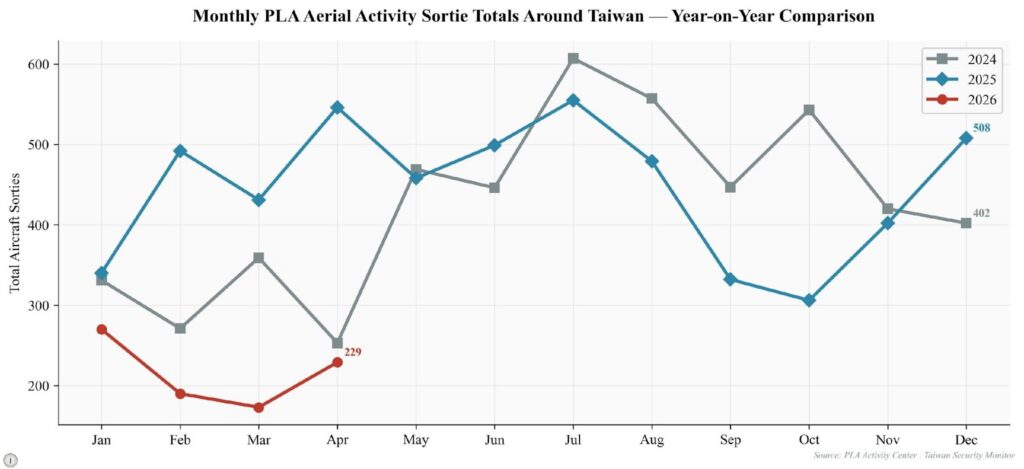
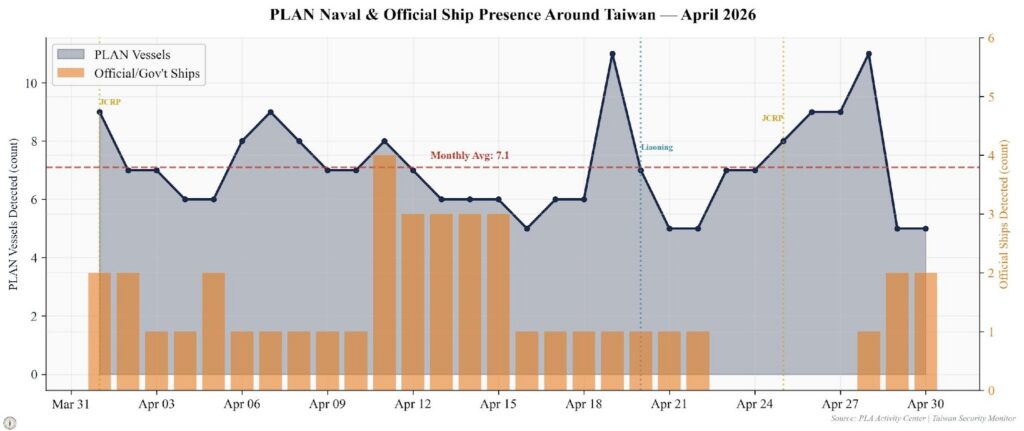
ยฉ 2026 Taiwan Security Monitor. All rights reserved.