Authors: Ethan Connell & Jonathan Walberg
KEY FINDINGS
- Taiwan’s Ministry of National Defense recorded 229 PLA aerial sorties around the island in April 2026, of which 169 entered Taiwan’s southwestern Air Defense Identification Zone. The total represents a 58 percent year-on-year decline from April 2025’s 546 sorties, but a 56-sortie increase from March, interrupting the consecutive monthly declines observed across the first quarter.
- Two joint combat readiness patrols framed the month, on April 1 (25 aircraft) and April 25 (28 aircraft), and the PLA’s Liaoning aircraft carrier transited the Taiwan Strait on April 20. The contraction in routine sortie volume since January has not extended to either surge capacity or strategic signaling.
- PLAN vessel detections averaged 7.1 per day in April, peaking at 11. These figures remain within the five-to-nine vessel baseline observed throughout 2025, reaffirming the structural decoupling between air sortie volume and naval presence.
- The Taiwanese Coast Guard Administration recorded three incursions by CCG vessels into Taiwan’s restricted waters in April, all around Kinmen. April is the first month of 2026 without a Dongsha (Pratas) incursion, breaking a monthly cadence sustained from January through March. Cumulative incursions across the first four months of the year total 18, with 15 around Kinmen and three around Dongsha.
Above the Floor
April 2026 marked a partial reversal of a three-month decline that had defined the first quarter. The month’s 229 detected sorties, including 169 that crossed the Taiwan Strait median line or entered the southwestern Air Defense Identification Zone, exceeded March’s 173-sortie total by 56 but remained 58 percent below the 546 sorties recorded in April 2025. The sequential trajectory across the first four months of 2026 (270 → 190 → 173 → 229) places March’s lull as a floor rather than the continuation of a sustained downward trend, with overall activity holding well below the 2025 baseline.
The month opened and closed with joint combat readiness patrols: the April 1 JCRP involved 25 aircraft, continuing the late-March return to operations after the Two Sessions lull, while the April 25 JCRP involved 28 aircraft and coincided with the final day of Taiwan’s annual Han Kuang 42 computer-simulated wargames. Between these two patrols, daily activity remained subdued, with two zero-detection days (April 4 and April 12) and a string of single-digit days through the mid-month. The final third of April produced elevated single-day totals, with 24 aircraft on April 20, 22 aircraft on April 27, and 17 aircraft on April 10.
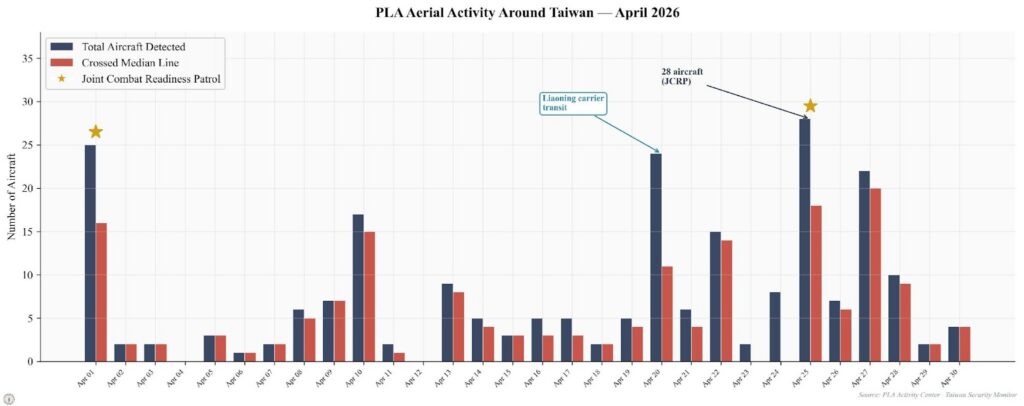
Figure 1. Daily PLA aerial activity around Taiwan, April 2026. Gold stars mark JCRP days; the April 20 surge corresponds with the Liaoning carrier transit.
The April 20 spike coincided with the transit of the Liaoning aircraft carrier and escorts (CV-16) through the Taiwan Strait. The PLA’s Eastern Theater Command described the movement as part of long-range combat training in the western Pacific, and Taiwan’s MND released images of the carrier’s air wing during the transit. Japan’s JS Ikazuchi (DD-107) had transited the Strait three days earlier, on April 17 (the anniversary of the Treaty of Shimonoseki) drawing Beijing’s condemnation as a deliberate provocation. Together with the two JCRPs, these events indicate that the contraction in routine sortie volume since January has not extended to surge capacity or strategic signaling.
Monthly Trajectory: A Floor, Not a Trend
Viewed against the preceding three months, April’s 229-sortie total interrupts the consecutive decline that ran from January through March. Monthly totals across the first four months of 2026 (270, 190, 173, and 229) show a curve that fell sharply through Q1 before stabilizing.
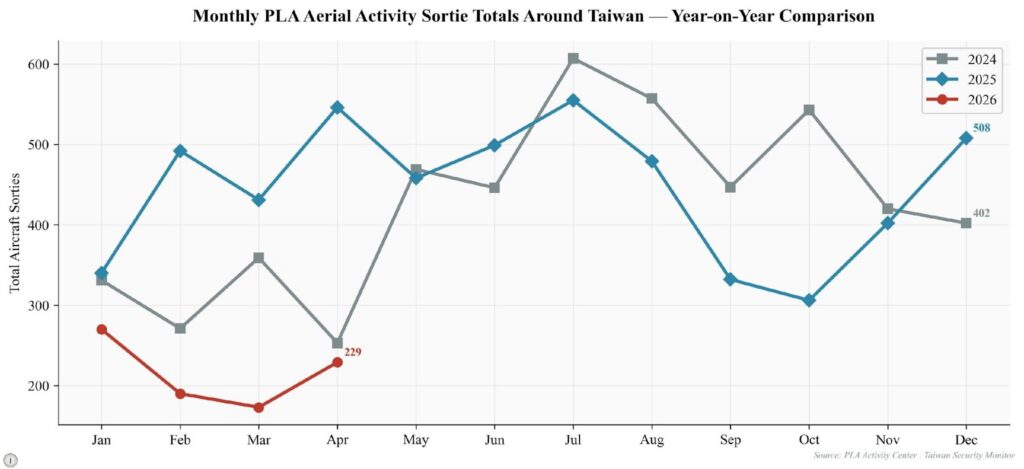
Figure 2. Monthly PLA aerial activity sortie totals, 2024–2026. April 2026 marks a modest rebound from March’s three-month low.
JCRP cadence offers a more stable read on PLA intent than aggregate sortie counts. April’s two JCRPs match February’s two and fall one short of March’s three. The April 25 peak of 28 aircraft is comparable to the 36-aircraft peak observed on March 17 and consistent with the cadence of roughly one large-format exercise per month sustained since August 2022. Reductions in routine sortie volume have not yet been accompanied by a comparable decline in the PLA’s willingness to mount high-intensity demonstrations on short notice.
At Sea: Carrier Transit and a Steady Baseline
PLAN vessel detections averaged 7.1 per day in April, peaking at 11 vessels on April 19 and again on April 28. These figures fall within the five-to-nine vessel range that has characterized PLAN presence throughout 2025 and the first four months of 2026. The Liaoning transit on April 20 registers in qualitative rather than quantitative terms: a single-day strategic signaling operation that did not move the monthly aggregate. Eastern Theater Command’s framing of the transit as long-range combat training in the western Pacific points to posture rather than escalation.
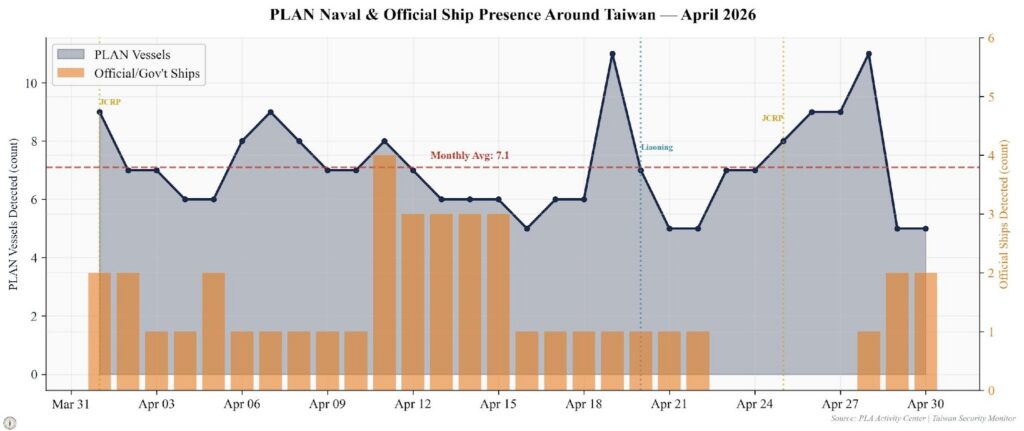
Figure 3. PLAN vessel and official ship detections around Taiwan, April 2026.
Naval presence held at baseline levels through April, reinforcing a structural observation that has held throughout 2026: air sorties appear responsive to political calendars and institutional dynamics, whereas naval presence functions as a persistent baseline feature of cross-strait military activity. The April carrier transit shows that this baseline coexists with episodic surge operations of strategic weight rather than displacing them.
Coast Guard Gray Zone Operations
China Coast Guard (CCG) activity in Taiwan’s restricted waters continued through April but contracted geographically. The CCG conducted 3 documented incursions on April 21, April 24, and April 28, all of them around Kinmen. Each incursion involved the same four-cutter rotation (hull numbers 14530, 14531, 14604, and 14609) and concluded within roughly two hours of entering restricted waters, consistent with the institutionalized two-to-three-hour Kinmen pattern documented in earlier months. Cumulative CCG incursions across the first four months of 2026 now total 18, with 15 around Kinmen and 3 around Dongsha.
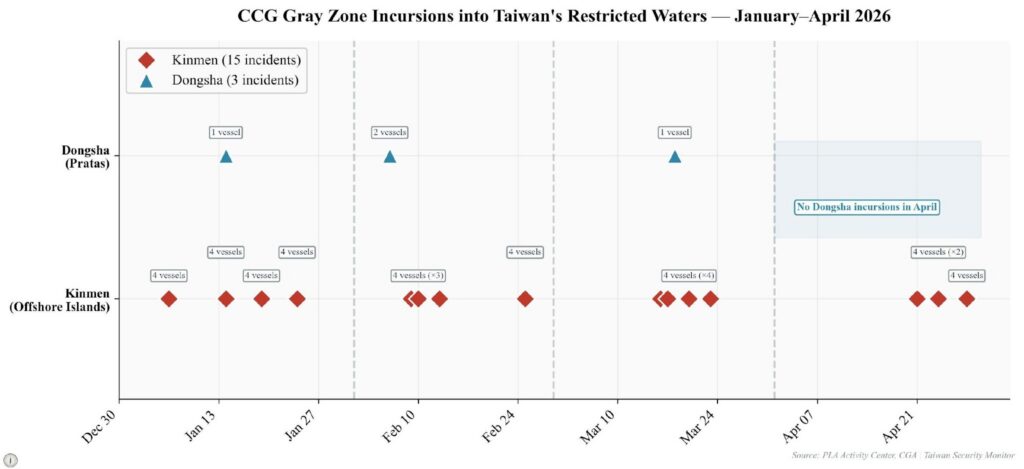
Figure 4. CCG incursions into Taiwan’s restricted waters, January–April 2026, by location and vessel count.
The April pause around Dongsha is perhaps the most analytically distinctive feature of the month’s CCG activity. January, February, and March each included a single Dongsha (Pratas) operation, several with dwell times exceeding twenty-four hours; April’s gap breaks that monthly cadence for the first time in 2026. The narrower reading is that the once-monthly Dongsha rhythm reflected an operational pattern rather than a binding institutional commitment, and that May or June observations will either restore it or confirm its discontinuation. A broader reading is that the CCG temporarily consolidated around the proximate Kinmen rotation while the PLA Navy carried the month’s strategic signaling through the Liaoning transit. The Coast Guard Administration’s announcement earlier in April of US$1.88 billion in Pratas-area infrastructure and patrol upgrades indicates continuing Taiwanese concern about the durability of presence at its most remote outlying holding.
The Full Picture: Multi-Domain Overview
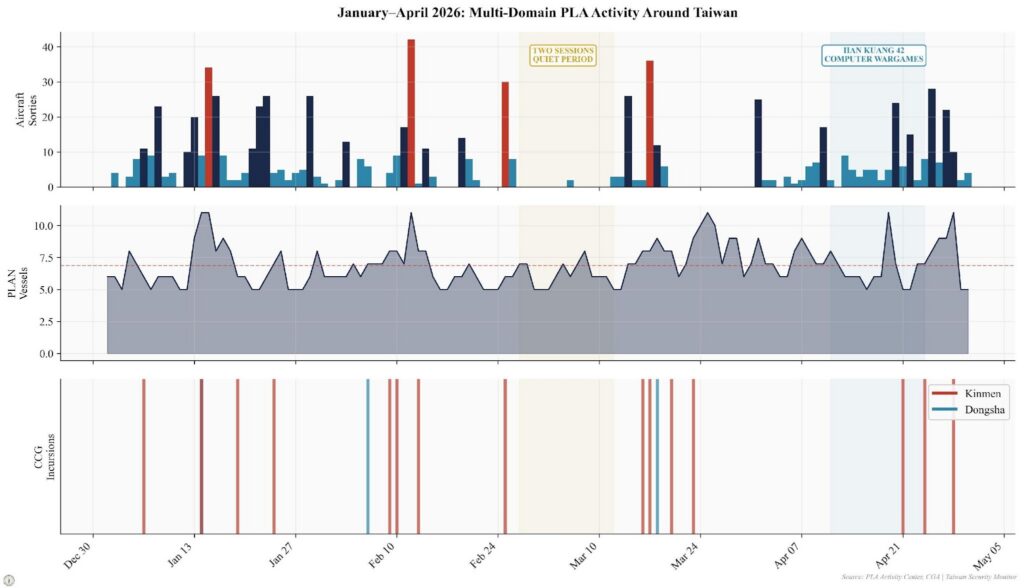
Figure 5. January–April 2026 multi-domain PLA activity: air sorties, naval presence, and CCG incursions.
Viewed across all three domains, the first four months of 2026 reinforce an analytical pattern visible since January. Air activity has been volatile and politically responsive, with a pronounced lull in early March and a partial rebound in April. Naval presence has been held within the established baseline throughout, including during the week of the Liaoning carrier transit. Coast Guard incursions have continued at roughly five incidents per month, with the April pattern narrowing geographically and interrupting the once-monthly Dongsha cadence. Analysts and policymakers would be well served by resisting the temptation to interpret a reduction in the headline sortie count as evidence of overall de-escalation. The multi-domain posture, taken as a whole, does not indicate a meaningful departure from the sustained pattern of PLA activity around Taiwan that has defined cross-strait military dynamics since August 2022.
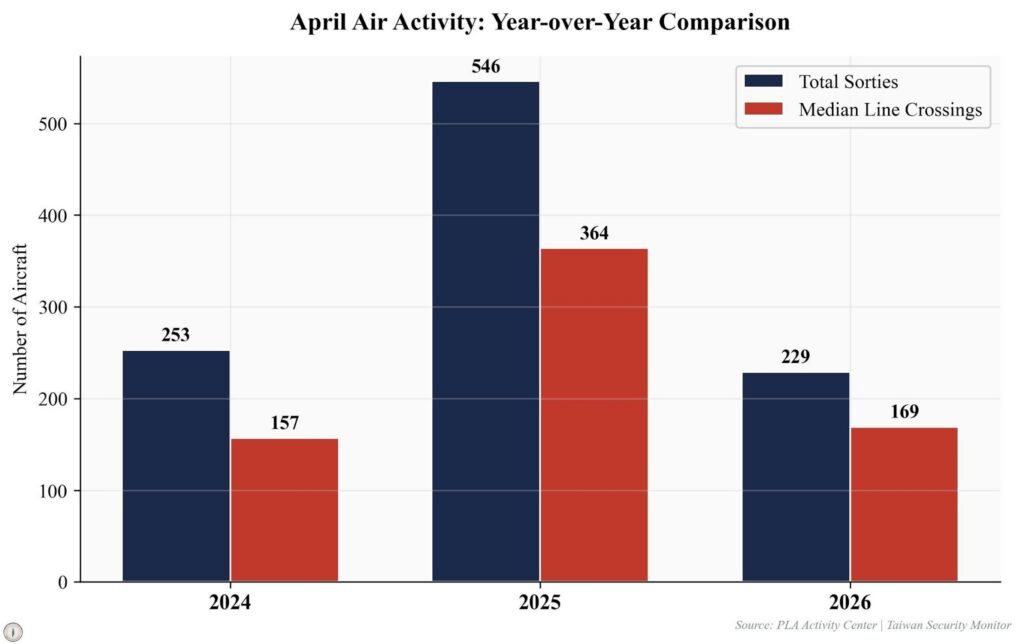
Figure 6. April air activity year-over-year: total sorties and median line crossings, 2024–2026.
Methodology & Sources
Air and naval detection data are drawn from daily press releases issued by Taiwan’s Ministry of National Defense and compiled in the PLA Activity Center database maintained by the Taiwan Security Monitor. Coast Guard incident data are compiled from Coast Guard Administration press releases and verified against contemporaneous media reporting in the China Coast Guard Incident Tracker Database. Allied and contextual events draw on Taiwan Security Monitor’s Weekly Security Reviews of April 6, April 16, April 20, and April 27. “Median line” refers to the informal centerline of the Taiwan Strait historically observed by both sides. “JCRP” denotes Joint Combat Readiness Patrols as designated by Taiwan’s MND. All analysis and commentary are by the Taiwan Security Monitor.
© 2026 Taiwan Security Monitor. All rights reserved.