Taiwan Security Monitor

Visualization: Red Beaches Named in Coastal Survey Plan


Author: Ethan Connell


Taiwan’s MND plans to contract civilian fishing boats and aircraft to survey potential PLA amphibious landing beaches, a senior military official told the Taipei Times on Oct. 17.

Under the plan from the MND’s Defense Innovation Division, survey firms would equip fishing boats with multibeam echo sounders to map waters up to 3m deep and charter aircraft for LiDAR mapping of beach terrain. The official said the data would support counter-landing planning and defensive mine-laying.

Above is TSM’s visualization of certain landing sites named in the piece.
Strait Snapshot, September 2026 update

Surge Before the Summit

Authors: Ethan Connell & TSM Staff

_____________________________________________________________________________________

KEY FINDINGS

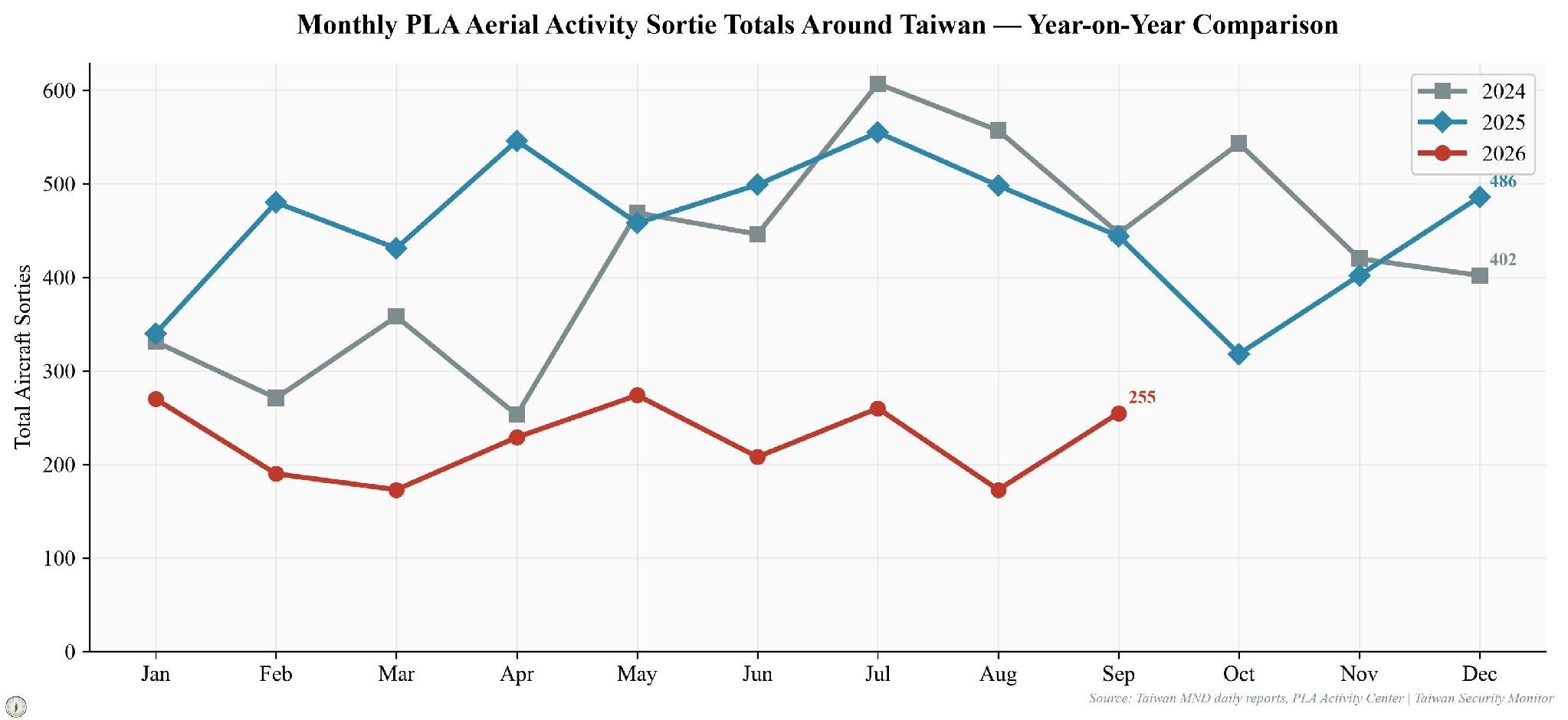
  • Taiwan’s Ministry of National Defense documented 255 PLA aerial sorties around the island in September 2026, with 181 entering the Air Defense Identification Zone. The total rose 47 percent from August’s 173, the largest month-on-month gain of the year, but sat 43 percent below September 2025’s 444. The nine-month sequence: 270, 190, 173, 229, 274, 208, 260, 173, 255.
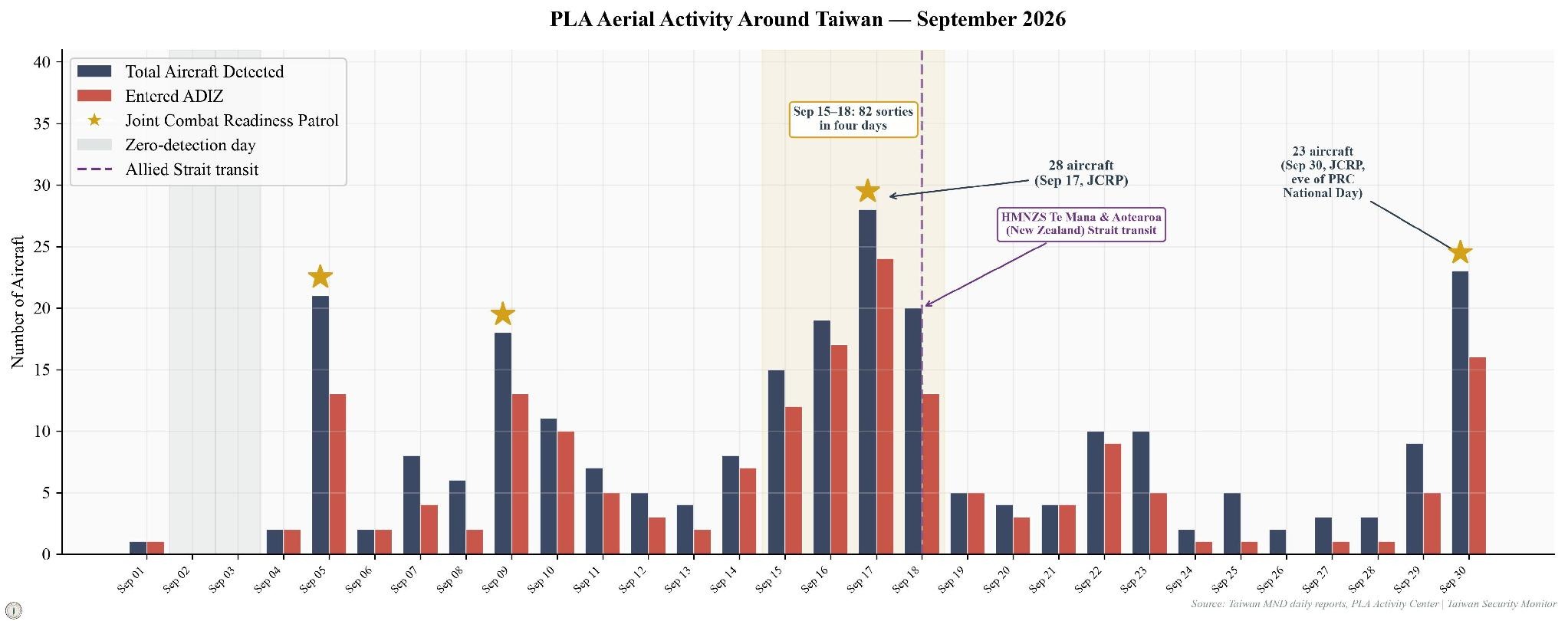
  • The PLA conducted four joint combat readiness patrols on September 5 (21 aircraft, 13 ADIZ entries), September 9 (18 aircraft, 13 ADIZ entries), September 17 (28 aircraft, 24 ADIZ entries, with H-6K bombers), and September 30 (23 aircraft, 16 ADIZ entries), the eve of PRC National Day. The September 15โ€“18 run produced 82 sorties, nearly a third of the month. Activity then fell to 15 sorties over September 24โ€“28, the days around Xi Jinping’s state visit to Washington, before the fourth patrol closed the month.
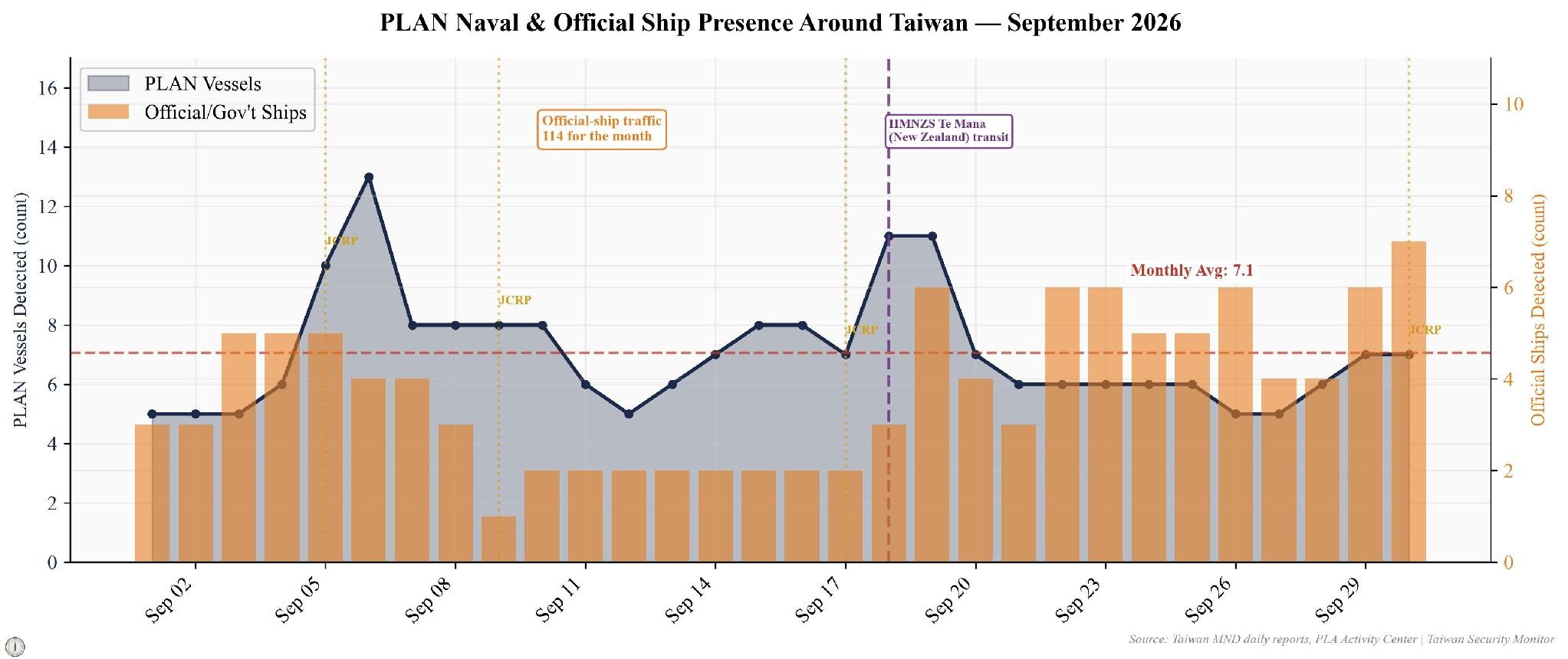
  • PLAN vessel detections averaged 7.1 per day and peaked at 13 on September 6, the day after the first patrol. Official and government-ship detections fell to 114 from August’s 160 but stayed well above the Januaryโ€“May range. New Zealand’s HMNZS Te Mana and HMNZS Aotearoa transited the Taiwan Strait on September 18, the first allied warship transit since June 5.
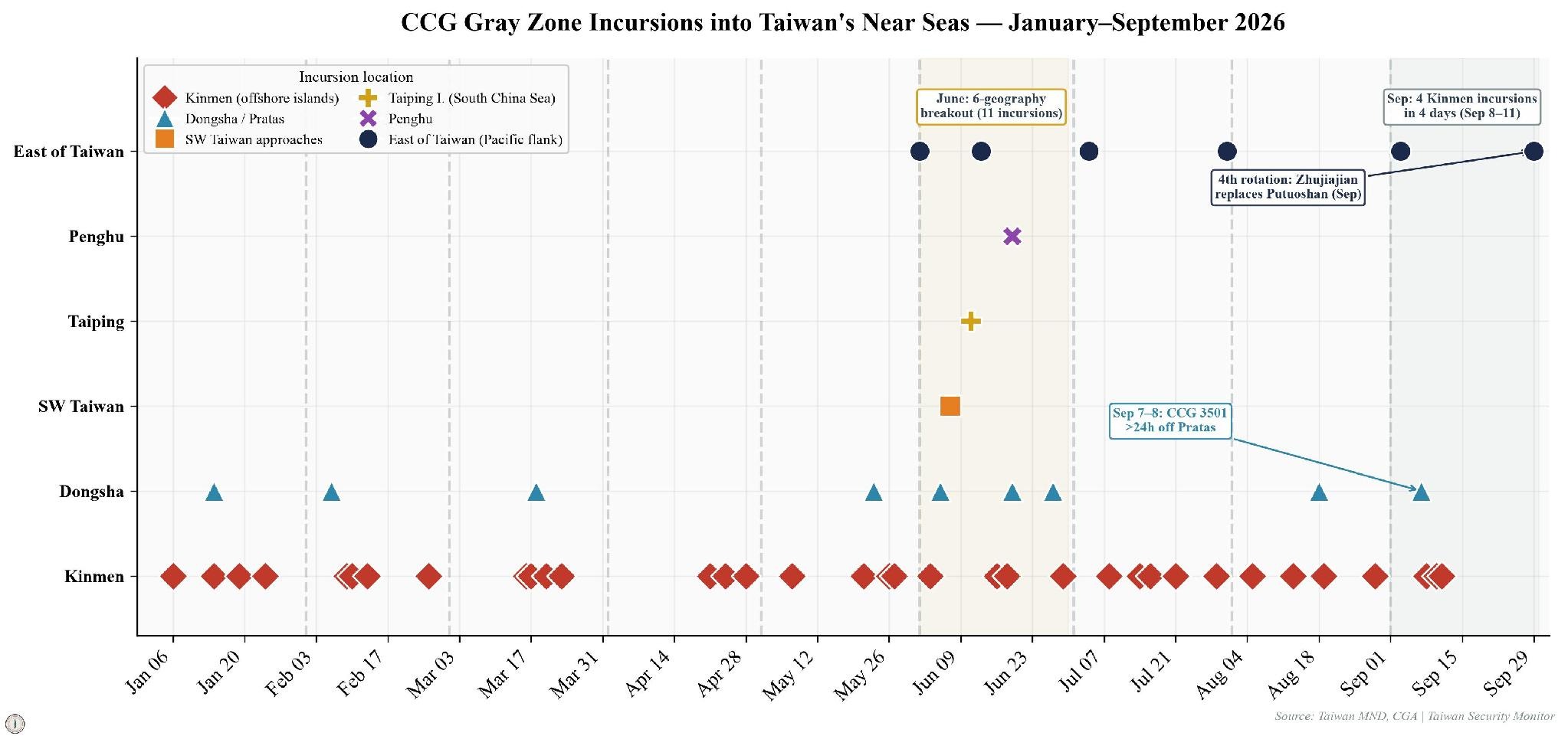
  • The Coast Guard Administration documented seven PRC government-vessel incursions in September: four into Kinmen restricted waters in four days (two on September 8, then September 10 and 11) by the same four-ship formation, one at Dongsha (September 7), and two east-of-Taiwan position reports (September 3 and 29). The Zhujiajian formation replaced the Putuoshan formation east of Taiwan, the fourth rotation since June. Cumulative 2026 incursions reached 54.

Air Activity: The Rebound

Taiwan’s MND detected 255 PLA sorties in September, up 82 from August’s 173. That was the largest single-month gain of 2026 and lifted September to the fourth-busiest month of the year, behind May (274), January (270), and July (260). The year-on-year gap held: September 2025 recorded 444 sorties and September 2024 recorded 447, putting this September 43 percent below both.

The first two weeks of the month carried two patrols, 21 aircraft on September 5 and 18 on September 9, around otherwise light days. The second phase of the month contained a sustained push: 82 sorties over September 15โ€“18, peaking at 28 on September 17, when MND reported J-11, J-16, JH-7, H-6K, KJ-500, and Y-8EW aircraft operating with PLAN vessels under the patrol label. Median-line crossings were recorded on ten consecutive days, September 14 through 23. The third phase was relatively quiet: from September 24 through 28, the daily count never exceeded five, for 15 sorties in total. September 30 then produced 23 aircraft, 16 of them across the median line, in a fourth patrol that MND announced at 14:10 and dated from 09:12, when J-10, J-11, J-16, JH-7, Su-30, KJ-500, and Y-8 aircraft and drones went out to sea with PLAN vessels.

Seventy-one percent of sorties entered the ADIZ (181 of 255), in line with August’s 72 percent. Median-line crossings totaled 145, 57 percent of sorties, on 16 of the month’s 30 days. Only two days, September 2 and 3, registered no aircraft, against seven in August.

Figure 1. Daily PLA aerial activity around Taiwan, September 2026. Gold stars mark joint combat readiness patrols on September 5, 9, 17, and 30; the shaded band marks the September 15โ€“18 surge; the dashed purple line marks the September 18 New Zealand Strait transit; gray columns denote zero-detection days.

Surge, Then Summit

The surge and the lull bracketed a dense political calendar. Taiwan held joint live-fire precision-strike exercises from September 16 to 18, and President Lai Ching-te inspected the tri-service missile firing in Pingtung on September 18. New Zealand’s two-ship transit came on September 18, the last day of the surge. Beijing formally announced Xi’s state visit on September 21, and Xi was in Washington from September 23 to 25. In the September 24 talks, he urged the United States to handle the Taiwan question with prudence. No new U.S. arms sales to Taiwan were notified during the month.

The air picture tracked that sequence closely. The heaviest four days of the month came in the week before the visit was announced. The five days from September 24 to 28, during and just after it, produced 15 sorties. The pattern fits a PLA that applies pressure ahead of high-level diplomacy and stands down while it is underway. Neither the PRC Ministry of National Defense, the Eastern Theater Command, nor the Taiwan Affairs Office commented on the September patrols, so the timing is the only evidence for intent. The fourth patrol, on September 30, the eve of National Day, showed the lull was a pause, not a new floor.

Monthly Trajectory: The Sawtooth Returns

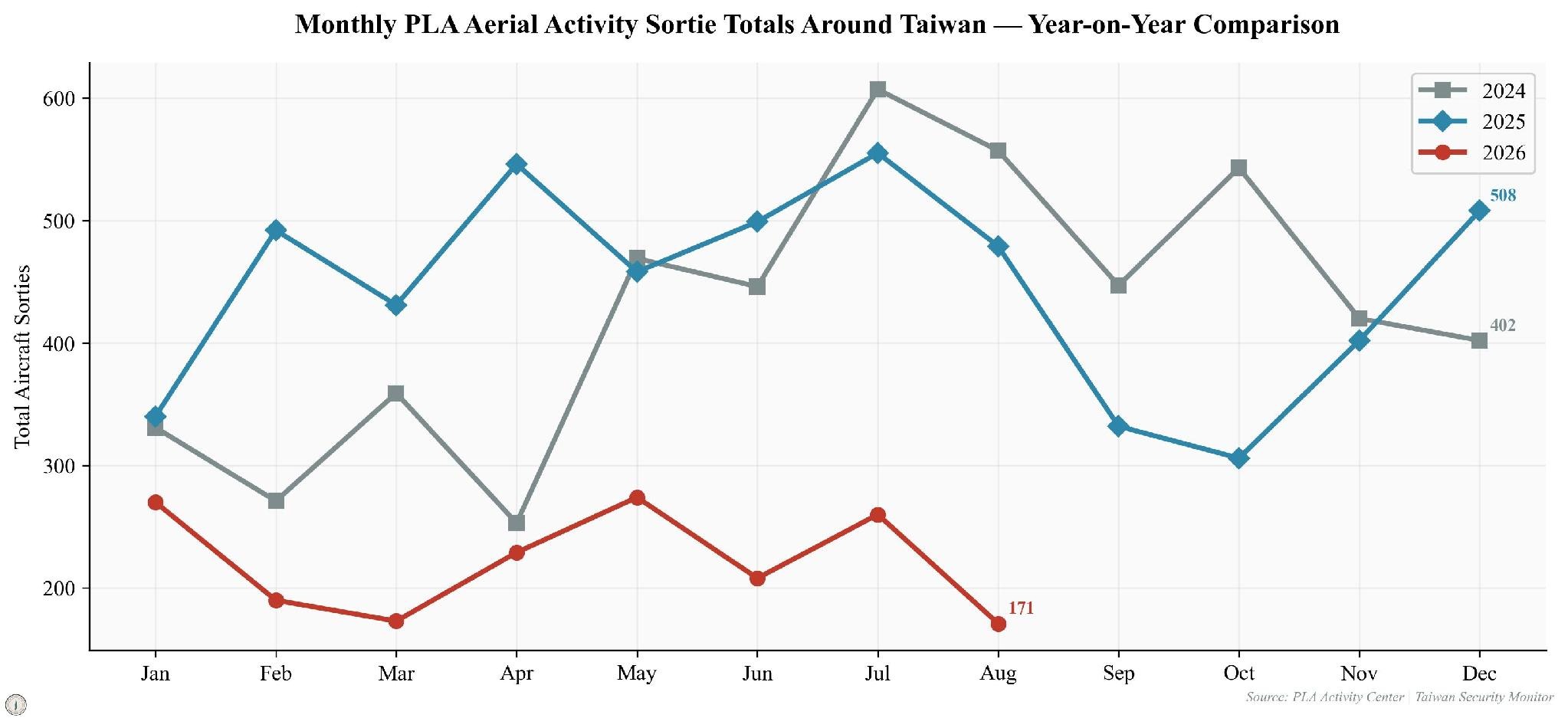
August looked like a break in the 2026 pattern: the count fell to 173 with no rebound in sight. September restored the sawtooth. The sequence now reads 270, 190, 173, 229, 274, 208, 260, 173, 255, and each trough this year (March, June, August) has been followed by a rebound the next month. The four September patrols averaged 22 aircraft, up from 17 in August but below the 26-to-32 range of the first seven months.

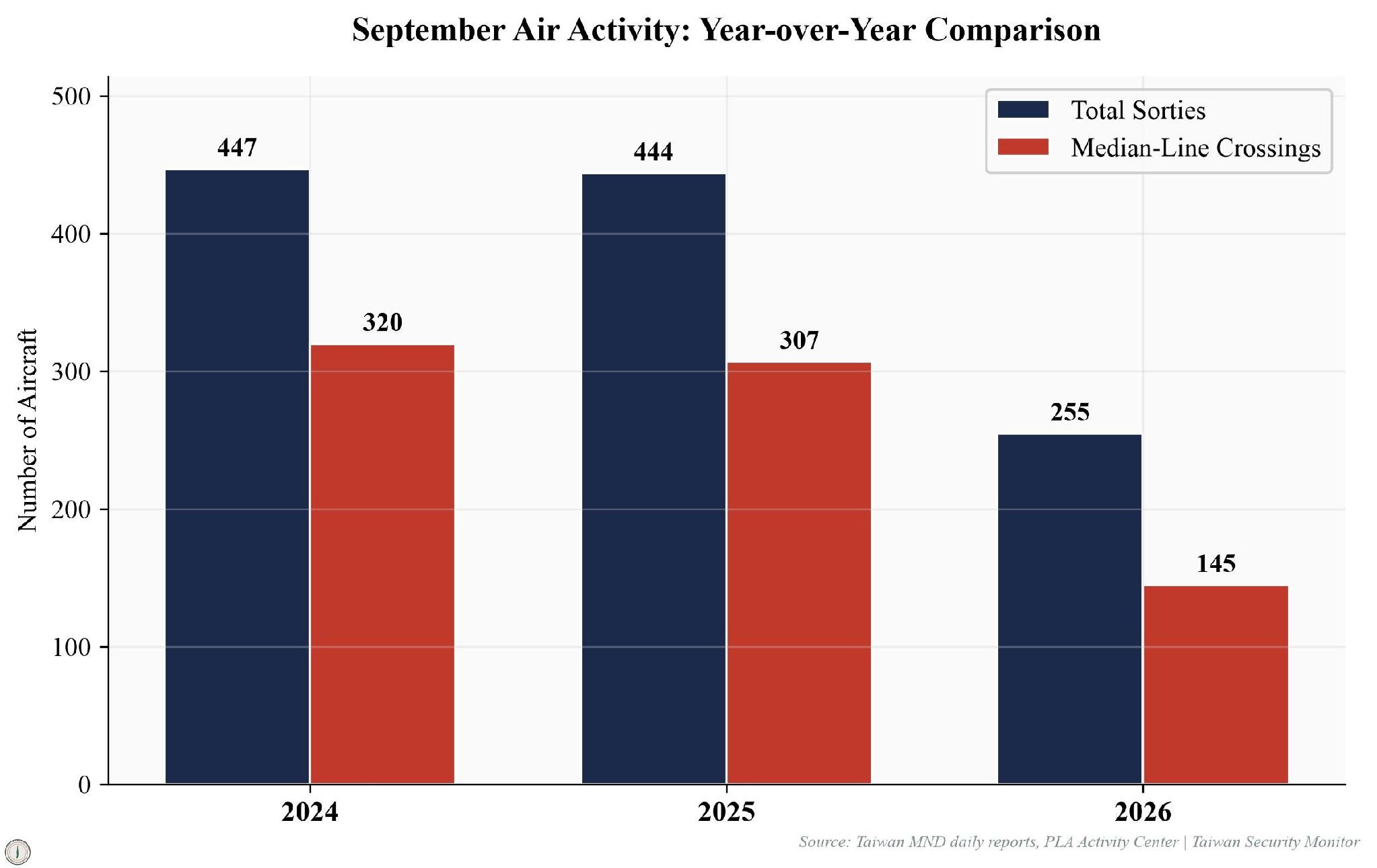
The comparison with prior years has not moved. September 2024 (447) and September 2025 (444) were nearly identical. September 2026 recovered to 255 and remains more than 40 percent below both. Median-line crossings show the same gap: 145 this September against 307 in 2025 and 320 in 2024.

Figure 2. Monthly PLA aerial activity sortie totals, 2024โ€“2026. September 2026 rebounds from August’s low and restores the year’s sawtooth pattern, while remaining well below 2024 and 2025.

At Sea: Baseline Steady, Allied Hulls Return

PLAN detections averaged 7.1 vessels per day, inside the five-to-nine band that has defined the 2025โ€“2026 baseline. The two peaks followed air activity: 13 vessels on September 6, the day after the first patrol, and 11 on September 18 and 19, at the end of the surge. The naval presence again moved less than the air, rising briefly around patrols and settling back to five or six vessels within days.

Official and government-ship detections totaled 114, down from August’s 160 and in line with June (110) and July (116). The monthly totals for January through May never exceeded 46. Daily counts sat at two from September 10 to 17, then ran between three and seven over the last ten days of the month.

On September 18, the New Zealand frigate HMNZS Te Mana and replenishment oiler HMNZS Aotearoa transited the Taiwan Strait during a three-month Indo-Pacific deployment, en route to an exercise with the Philippines. It was the sixth allied warship transit of 2026 and the first since the Netherlands frigate HNLMS De Ruyter on June 5. The PLAโ€™s Eastern Theater Command issued no statement; PRC defense ministry spokesperson Jiang Bin said on September 24 that naval and air forces had tracked and monitored the ships.

Figure 3. PLAN vessel and official-ship detections around Taiwan, September 2026. Dotted gold lines mark joint combat readiness patrols; the dashed purple line marks the September 18 New Zealand transit.

Coast Guard Gray Zone Operations

The Coast Guard Administration documented seven PRC government-vessel incursions in September, concentrated in one week. The same four-ship formation, hulls 14527, 14531, 14604, and 14608, entered Kinmen restricted waters four times between September 8 and 11: southwest of Damaoshan on the morning of September 8 (09:00 to 11:09), again that afternoon in a split east-west approach (about 15:00 to 17:03), and south of Kinmen on September 10 and 11, each time massing from 09:00 and gone by 11:13. The September 10 incursion included Mid-Autumn Festival broadcasts. Two incursions in one day, and four in four days, is the densest set of Kinmen activity in the tracker this year.

At Dongsha, CCG 3501 entered restricted waters southwest of the island at 08:00 on September 7, radioed that the area was “China’s Taiwan,” and was shadowed by the CGA cutter Yunlin. The CGA counted it as the twelfth CCG incursion at Dongsha in 2026.

East of Taiwan, the patrol line rotated again. On September 3, the CGA located CCG 1306 Putuoshan and 2502 Daishan about 105 and 74 nautical miles east of Green Island. By September 29, the station was held by 2503 Zhujiajian and 1401 Chongming, which the CCG said had been there since September. That is the fourth formation on the line since June (Daishan, Xiushan, Putuoshan, Zhujiajian). The same da,y the CCG’s East China Sea branch described its Kinmen operations as routine law-enforcement patrols; the CGA replied that it had recorded 35 CCG transits of Kinmen restricted waters so far in 2026. Cumulative incursions in the tracker reached 54.

Figure 4. CCG incursions into Taiwan’s near seas, Januaryโ€“September 2026, by location. September brings four Kinmen incursions in four days and a fourth rotation of the east-of-Taiwan patrol.

The Full Picture: Multi-Domain Overview

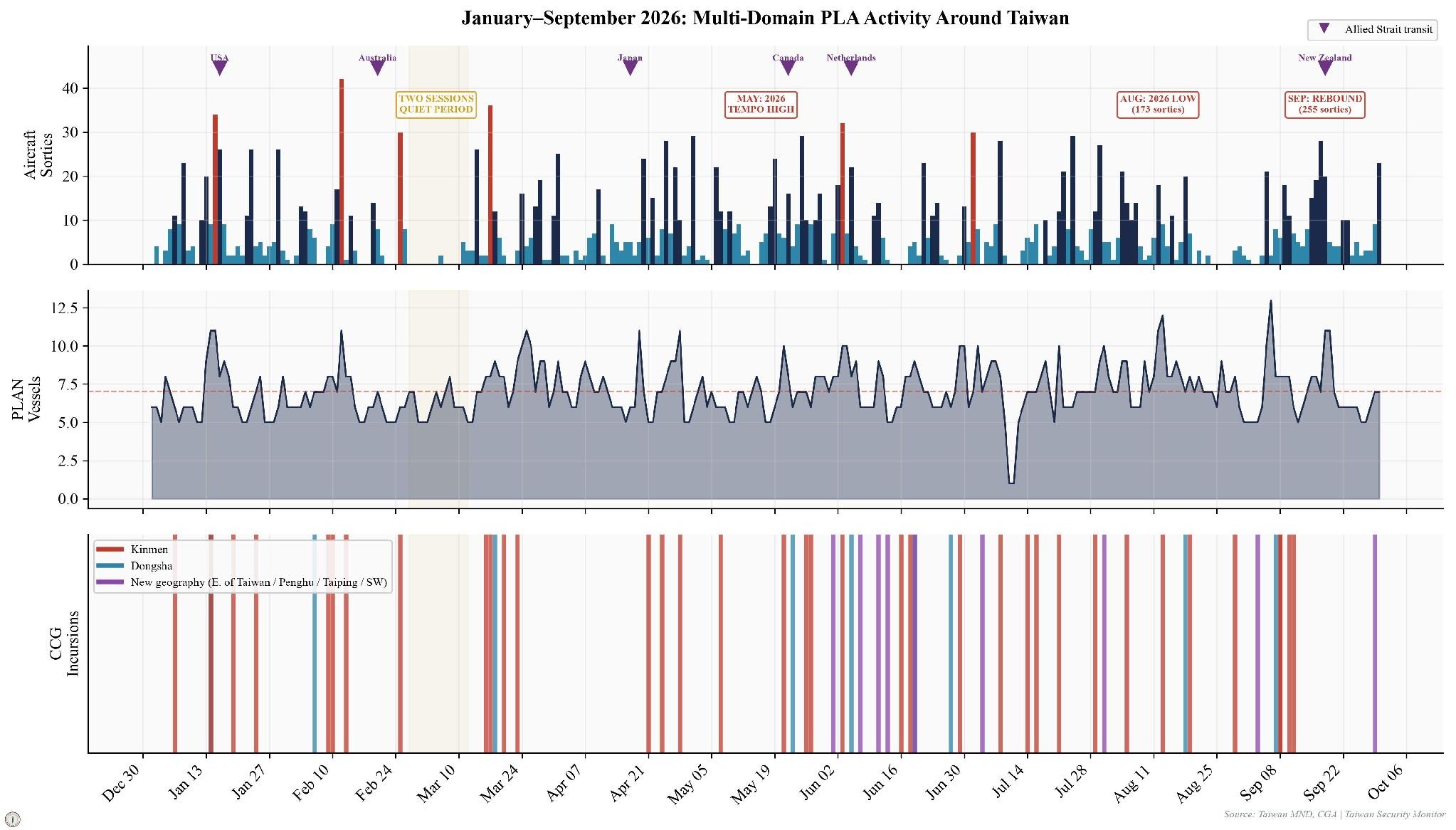
Figure 5. Januaryโ€“September 2026 multi-domain PLA activity: air sorties, naval presence, and CCG incursions. Inverted triangles atop the air panel mark allied warship transits of the Taiwan Strait (United States, January 16; Australia, February 20; Japan, April 17; Canada, May 22; Netherlands, June 5; New Zealand, September 18).

September reversed August’s split between the different activity domains. In August, air activity sank to the year’s floor while the maritime and constabulary presence held. In September, air activity rebounded, the CCG ran its most compressed Kinmen sequence of the year, and the east-of-Taiwan station rotated without a gap. Only official-ship traffic eased, and it still stayed far above the springโ€™s numbers.

The month’s shape matters more than its total. Pressure built through mid-September, eased during the Washington visit, and returned on the eve of National Day. Read that way, the PLA’s air tempo appears to be timed around diplomacy rather than reduced by it. Every month of 2026 has run below the same month of 2025, which marks this as a lower-volume year in the air, but not a quieter one at sea.

Figure 6. September air activity year-over-year: total sorties and median-line crossings, 2024โ€“2026.

Methodology & Sources

Air and naval detection data are drawn from daily reports issued by Taiwan’s Ministry of National Defense. Each day in this report covers the MND reporting window from 06:00 that day to 06:00 the next (Taiwan time), so September figures come from reports posted September 2 through October 1. Januaryโ€“August figures are taken from the PLA Activity Center database maintained by the Taiwan Security Monitor; September figures are compiled directly from the MND reports. ADIZ entries are the aircraft MND reports as entering Taiwan’s ADIZ; median-line crossings are the subset MND reports as crossing the median line. Joint combat readiness patrols are those announced in MND press releases; patrol-day counts use the full daily window, so they can exceed the figure in the press release. Comparisons with 2024 and 2025 use the Taiwan Security Monitor’s comprehensive PLA activity tracker, with days missing from it filled from the historical PLAAF activity series; the September 2024 and 2025 figures cited in the text were re-derived day by day from MND’s archived reports. Coast Guard incident data are compiled from Coast Guard Administration press releases (cga.gov.tw) and verified against contemporaneous media reporting. Allied Taiwan Strait transit records are drawn from the Taiwan Strait Transit Tracker maintained by the Taiwan Security Monitor and contemporaneous reporting. โ€œADIZโ€ denotes Taiwan’s Air Defense Identification Zone; โ€œmedian lineโ€ refers to the informal centerline of the Taiwan Strait historically observed by both sides; โ€œJCRPโ€ denotes Joint Combat Readiness Patrols as designated by Taiwan’s MND. All analysis and commentary are by the Taiwan Security Monitor.

ยฉ 2026 Taiwan Security Monitor. All rights reserved.

Strait Snapshot, August 2026 Update

Authors: Ethan Connell & TSM Staff


KEY FINDINGS
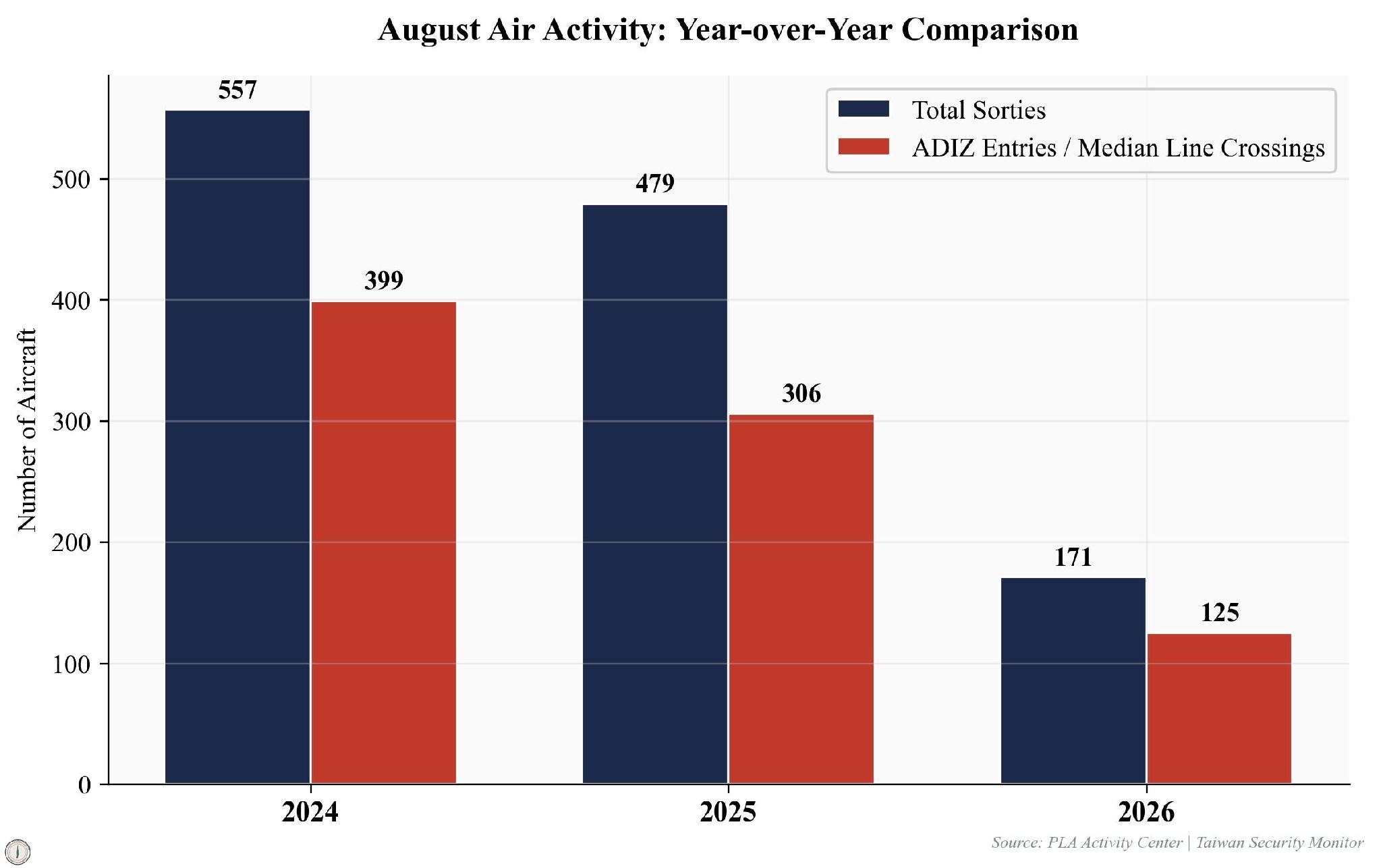
  • Taiwanโ€™s Ministry of National Defense documented 171 PLA aerial sorties around the island in August 2026, of which 125 entered the Air Defense Identification Zone. August tied with March for the lowest monthly total of the year, 34% below Julyโ€™s 260 and 69% below August 2025โ€™s 555.
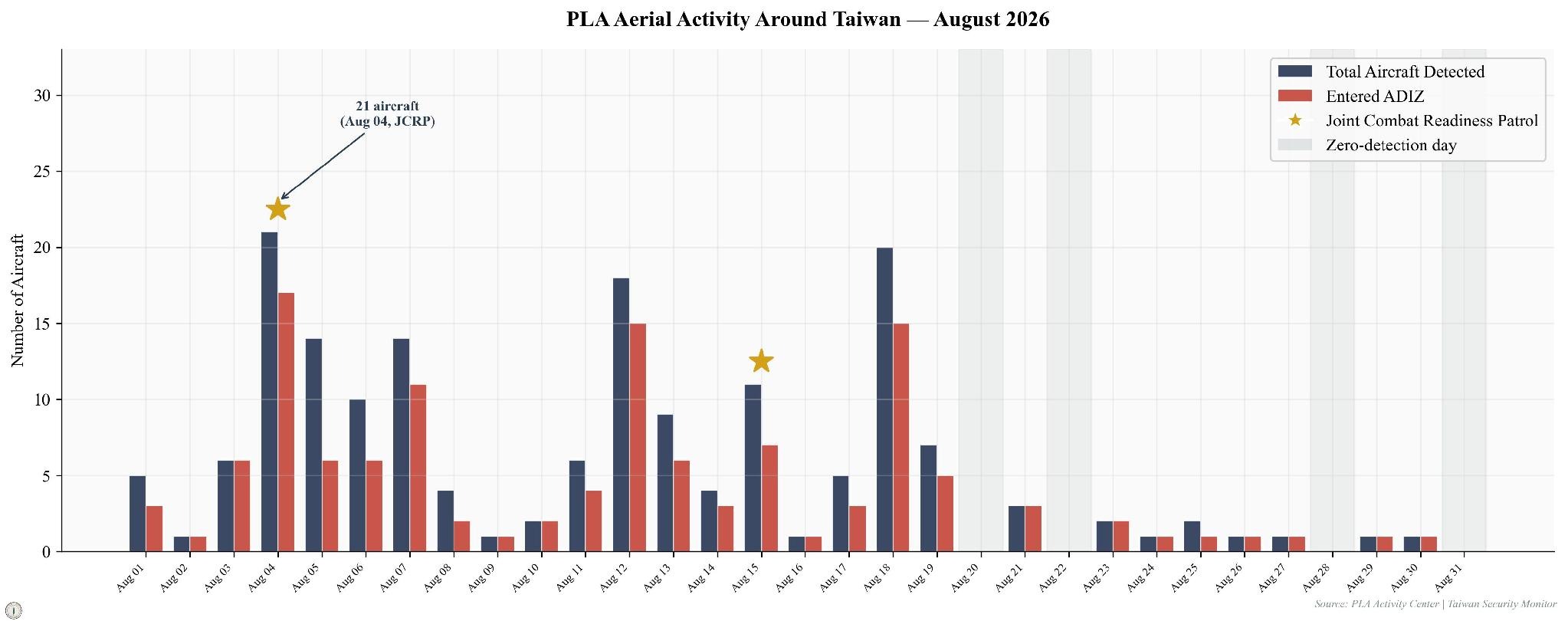
  • The PLA conducted two joint combat readiness patrols, on August 4 (21 aircraft, 17 ADIZ entries) and August 15 (11 aircraft, 7 ADIZ entries). Both were smaller than any JCRP earlier in 2026. Taiwanโ€™s MND designated no long-distance flights. A 20-aircraft day on August 18 carried no patrol label but produced the monthโ€™s second-largest single-day total.
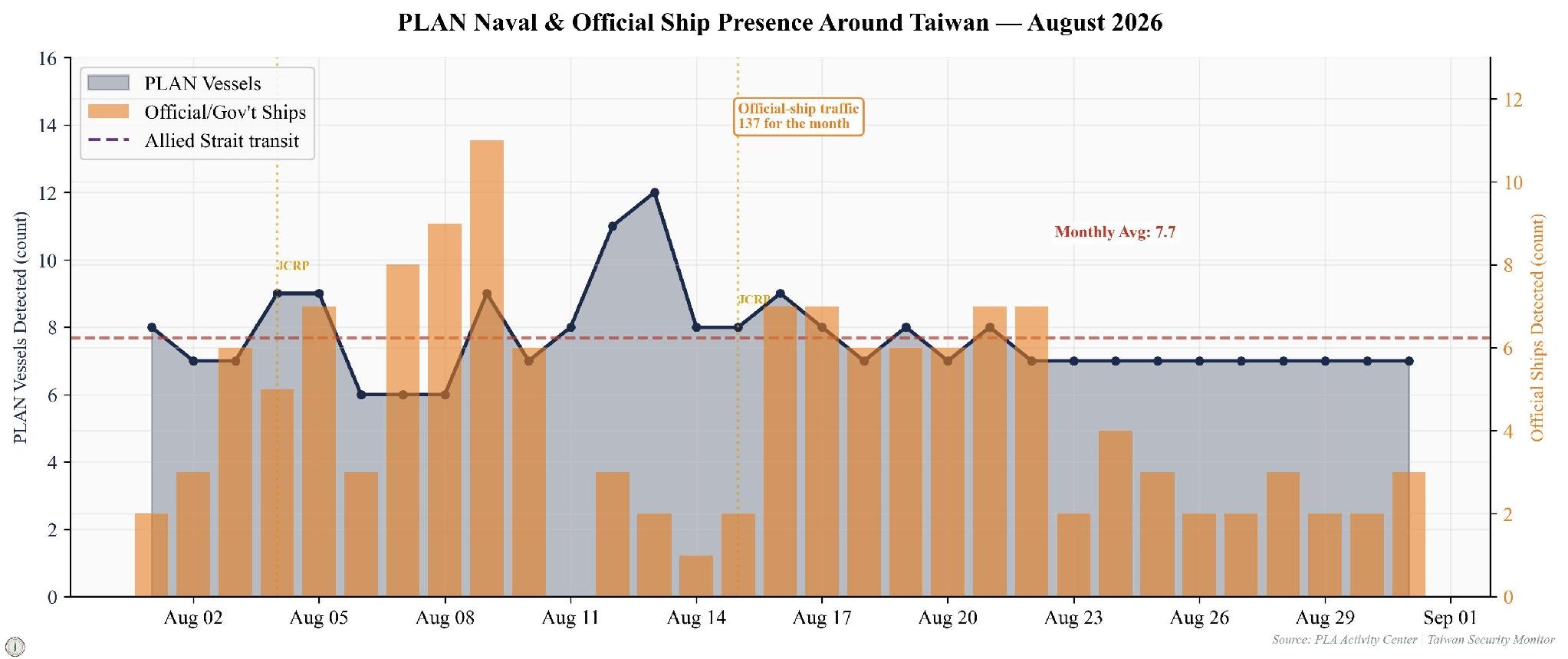
  • PLAN vessel detections averaged 7.7 per day and peaked at 12, holding the baseline from mid-2025. Official and government-ship detections stayed elevated, well above the sub-fifty levels of early 2026. Julyโ€™s 244 government-vessel sightings set the 2026 record; August ran lower but kept the elevated floor.
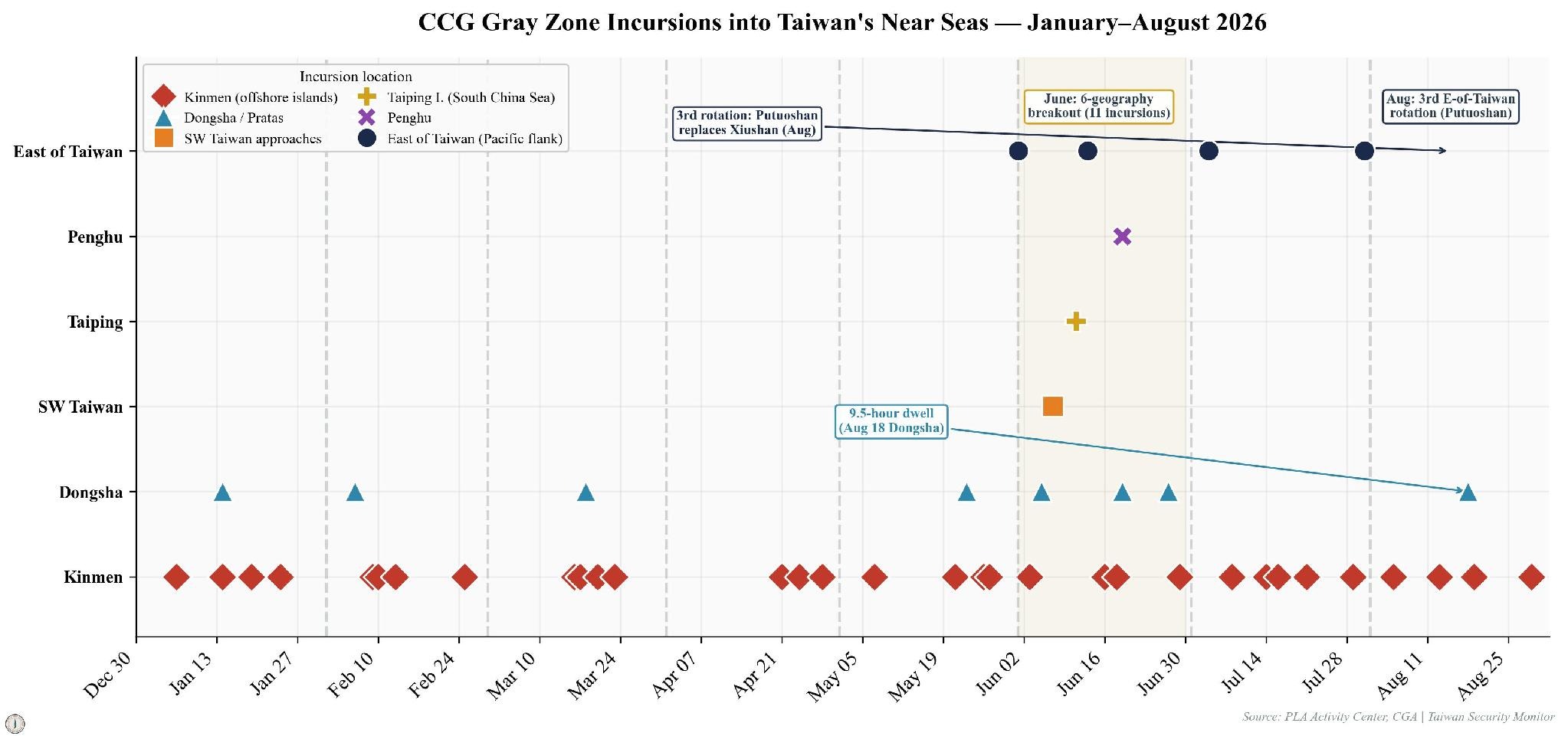
  • The Coast Guard Administration documented five PRC government-vessel incursions in August: four into Kinmenโ€™s restricted waters (August 5, 13, 19, and 29) and one into Dongshaโ€™s restricted waters (August 18), during which a CCG vessel remained on station for 9.5 hours. Cumulative 2026 incursions reached 49.

Air Activity: The Floor

Taiwanโ€™s MND detected 171 PLA sorties in August, matching Marchโ€™s 173 at the bottom of the 2026 range. The month-on-month drop of 89 sorties (34 percent) from July was the steepest single-month fall of the year. Against August 2025โ€™s 555, the gap was 69 percent; against August 2024โ€™s 589, 71 percent, the widest year-on-year deficit in 2026.

The two JCRPs produced the monthโ€™s two largest single-day totals: 21 aircraft on August 4 (17 ADIZ entries) and 11 on August 15 (7 ADIZ entries). Both were smaller than any JCRP earlier in the year. August 18 saw 20 aircraft with 15 ADIZ entries but no patrol designation. The first week (August 3-7) ran hot, with daily counts of 6, 21, 14, 10, and 14 sorties. After that, the tempo collapsed. Four days registered zero aircraft: August 20, 22, 28, and 31, the most zero-detection days of any month in 2026.

73% of detected sorties entered the ADIZ, matching Julyโ€™s rate. Even as volume fell, the share of flights approaching Taiwanโ€™s airspace remained constant. Helicopters northeast and southeast of Taiwan flew more often than fixed-wing aircraft, a mix that points toward anti-submarine warfare training and intelligence collection.

Figure 1. Daily PLA aerial activity around Taiwan, August 2026. Gold stars mark joint combat readiness patrols on August 4 and 15; red bars show aircraft entering the ADIZ; shaded columns denote zero-detection days.

Monthly Trajectory: The Sawtooth Breaks

For seven months, the 2026 sortie count followed a sawtooth: each dip (February, March, June) bounced back the next month. August broke the pattern, falling to 171. The descent from Mayโ€™s peak has not stopped. The two JCRPs kept the patrols at active status but were the smallest by aircraft count of any month in 2026.

The PLA ran large-scale exercises in August 2024 (589 sorties) and August 2025 (555 sorties). August 2026 produced less than a third of either of the prior years on record (171 sorties), making this suppression anomalous. September will show whether Beijingโ€™s air tempo has shifted to a lower gear or is coiled for a rebound.

Figure 2. Monthly PLA aerial activity sortie totals, 2024โ€“2026. August 2026 hits the yearโ€™s floor, breaking the sawtooth pattern.

At Sea: The Ships Stay

PLAN detections averaged 7.7 vessels per day and peaked at 12, inside the five-to-nine band that has shown consistently throughout 2025 and 2026. 

Official and government-ship detections ran lower than Julyโ€™s record of 244 but stayed well above the sub-fifty readings from January through May. Non-naval state shipping has continued to hold at elevated levels for three consecutive months. About 60 percent of Augustโ€™s government vessels were Coast Guard ships; the rest were research vessels and other government boats. No allied warship transited the Taiwan Strait in August. The last transit, the Netherlands frigate HNLMS De Ruyter on June 5, is now nearly three months old.

Figure 3. PLAN vessel and official-ship detections around Taiwan, August 2026.

Coast Guard Gray Zone Operations

Five PRC government-vessel incursions in August returned to the Kinmen-dominant pattern. Four targeted Kinmen restricted waters: August 5, August 13, August 19, and August 29. 

Two CCG vessels entered restricted waters around Pratas Island on August 18. The CGA dispatched cutters Yunlin and Tainan to monitor and broadcast warnings. One CCG vessel stayed on station for 9.5 hours, the longest single-vessel dwell at Dongsha in 2026 and a break from the brief transits that had defined earlier Dongsha operations.

Figure 4. CCG incursions into Taiwanโ€™s near seas, Januaryโ€“August 2026, by location. August reverts to the Kinmen-Dongsha baseline, while the east-of-Taiwan patrol rotates for a third time.

The Full Picture: Multi-Domain Overview

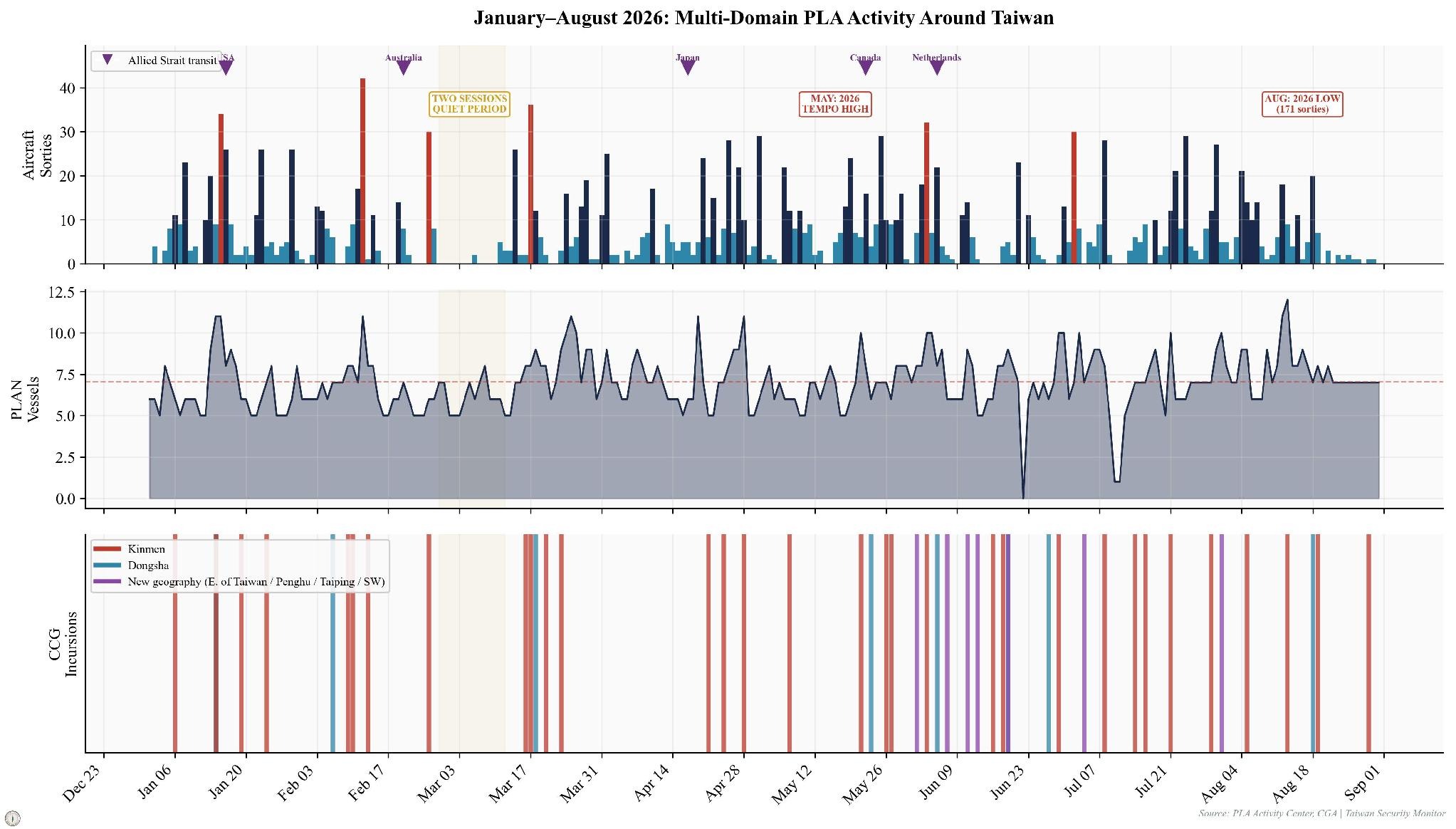
Figure 5. Januaryโ€“August 2026 multi-domain PLA activity: air sorties, naval presence, and CCG incursions. Inverted triangles atop the air panel mark allied Taiwan Strait transits.

 Air activity compressed to its 2026 low. Naval presence, government shipping, coast guard operations, and the east-of-Taiwan patrol held or expanded. In the first half of the year, air and maritime surges moved together (the May peak, the June JCRP-plus-CCG breakout). In August, they appeared to decouple. Air sorties fell to 171, while PLAN vessel detections held at 7.7 per day. Official ships stayed on their elevated plateau. The CCG rotated a third formation to the east of Taiwan.

No allied warship has transited the strait since June 5. Beijing expanded its constabulary presence to record levels over that same quarter. The multi-domain posture Beijing has maintained since August 2022 has not shrunk in the first eight months of 2026. 

Figure 6. August air activity year-over-year: total sorties and ADIZ entries, 2024โ€“2026.

ยฉ 2026 Taiwan Security Monitor. All rights reserved.

Strait Snapshot, July 2026 Update

After the Storm

Authors: Ethan Connell & Jonathan Walberg


KEY FINDINGS

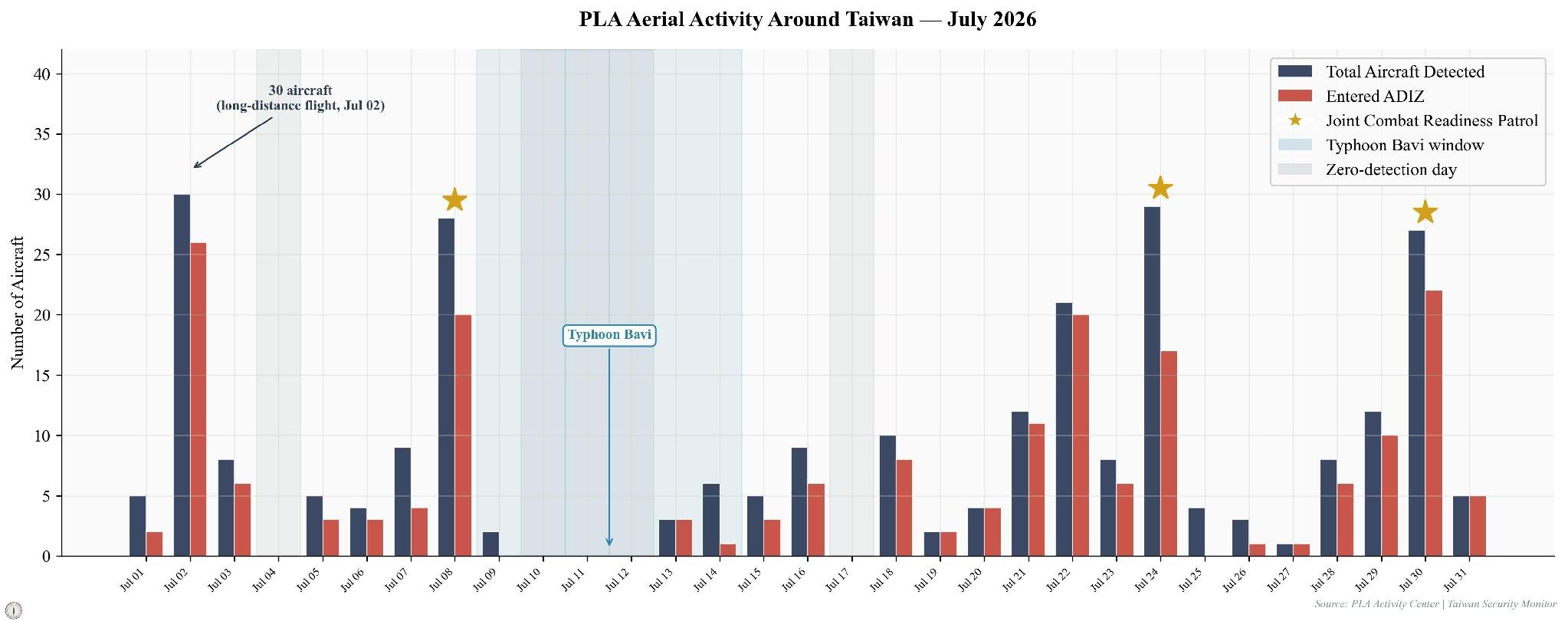
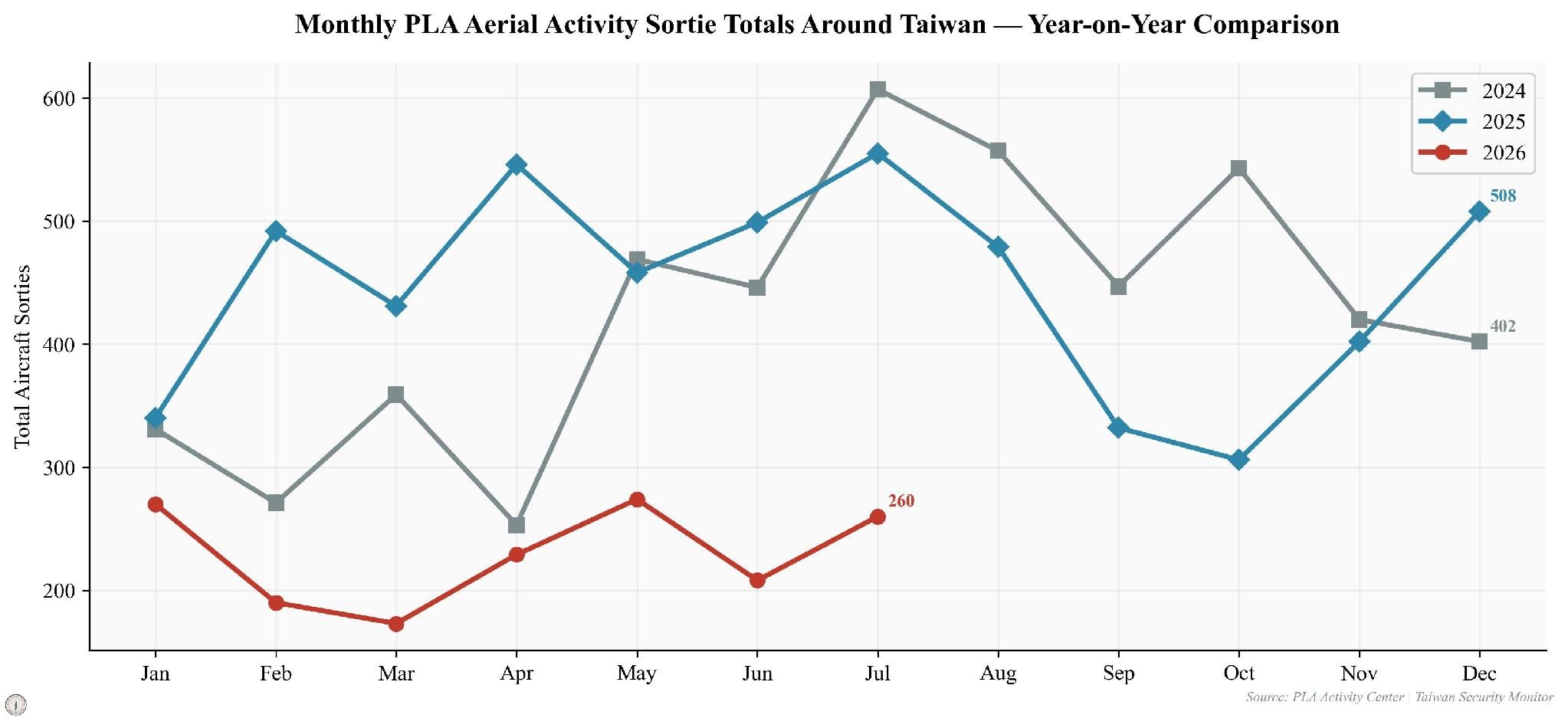
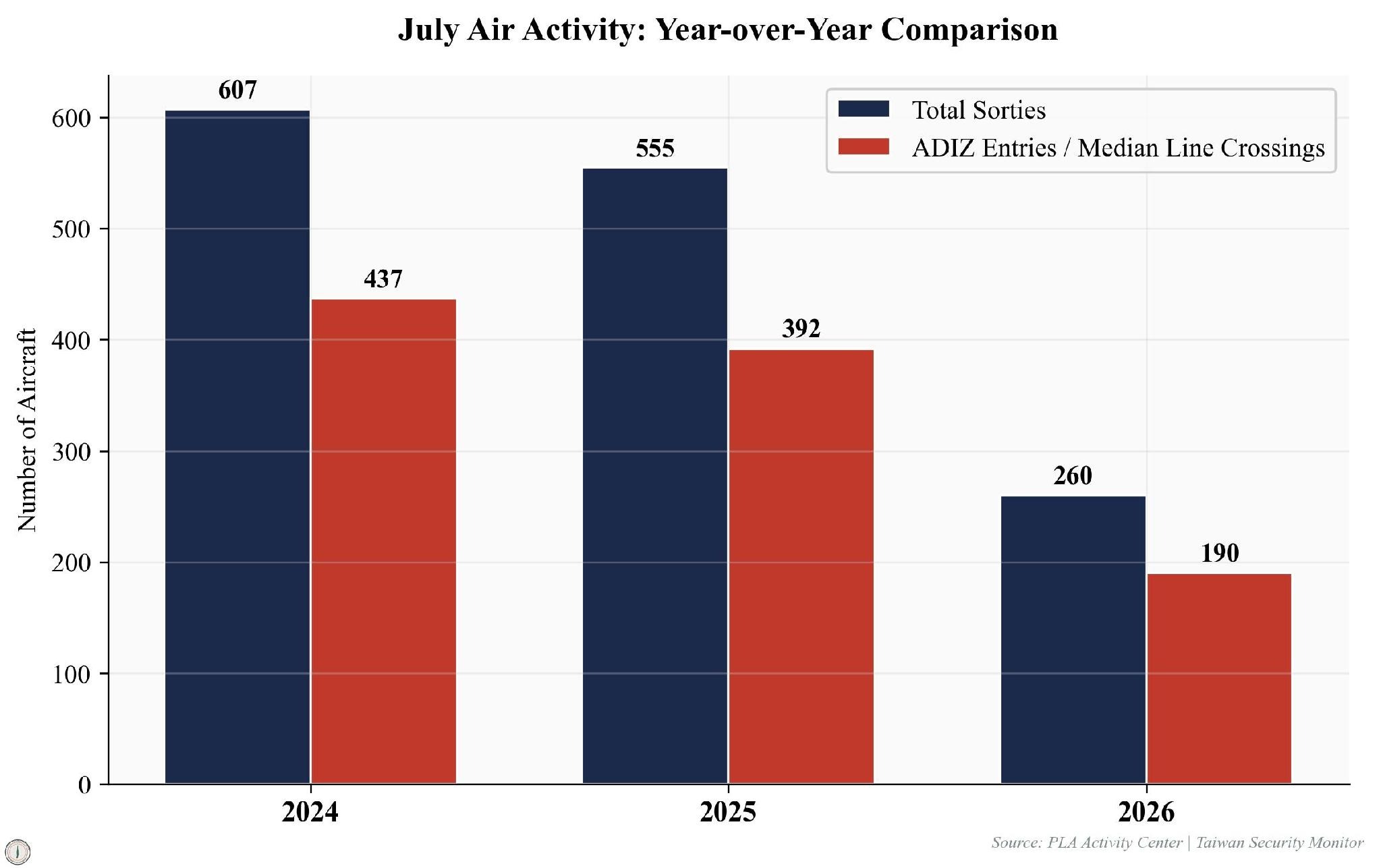
  • Taiwanโ€™s Ministry of National Defense documented 260 PLA aerial sorties around the island in July 2026, with 190 entering the Air Defense Identification Zone. The total rose 25 percent from Juneโ€™s 208 to the second-highest month of the year, while remaining 53 percent below July 2025โ€™s 555 sorties. The seven-month sequence reads 270, 190, 173, 229, 274, 208, 260.
  • The PLA conducted three joint combat readiness patrols on July 8 (28 aircraft, 20 ADIZ entries), July 24 (29 aircraft, 17 ADIZ entries), and July 30 (27 aircraft, 22 ADIZ entries), restoring the patrol cadence that had dropped to a single operation in June. Typhoon Bavi suppressed activity from July 9 through 14, during which only 11 aircraft were detected, and PLAN vessel counts fell to one on consecutive days.
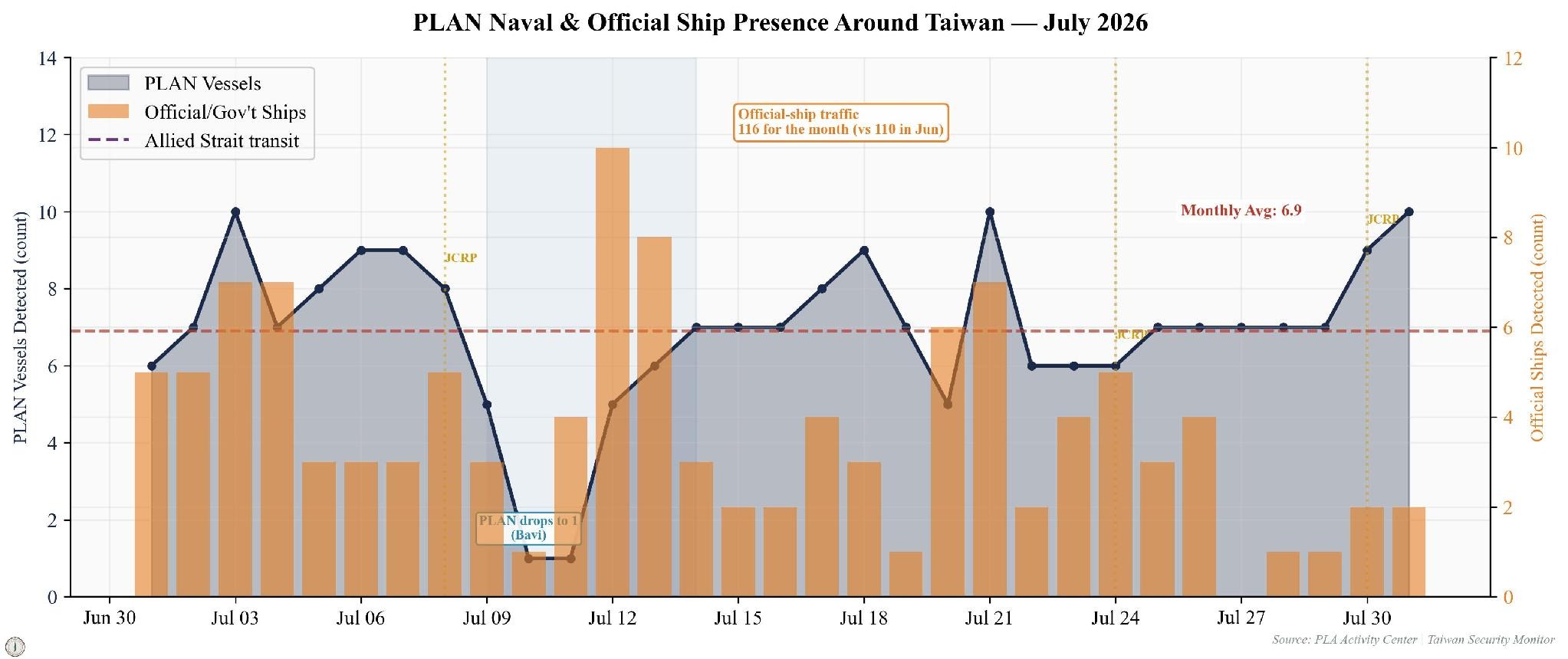
  • PLAN vessel detections averaged 6.9 per day and peaked at 10, remaining within the five-to-nine baseline. Official and government-ship detections totaled 116 for the month, comparable to Juneโ€™s 110 and well above the 46 recorded in May.
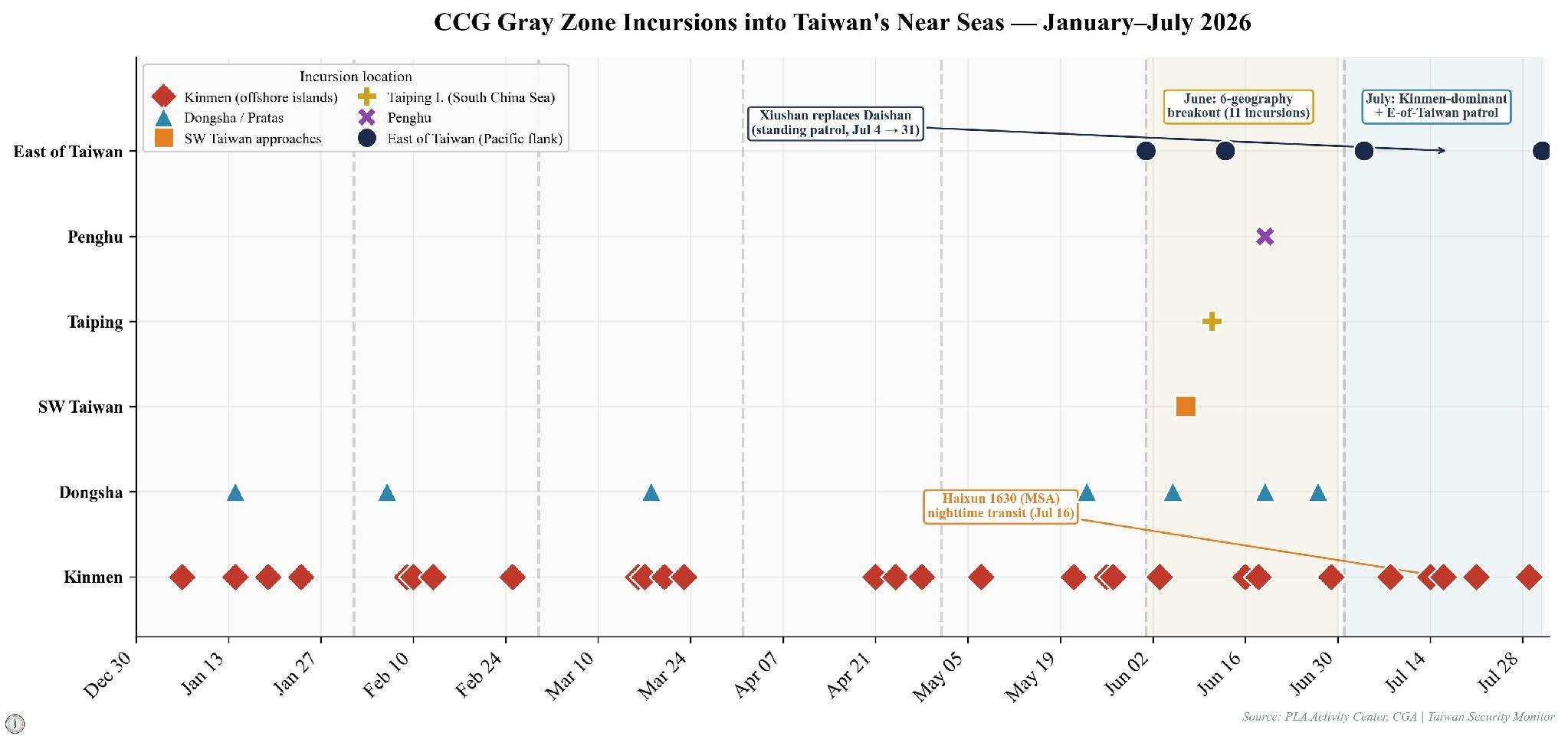
  • The Coast Guard Administration documented seven PRC government-vessel incursions in July: five into Kinmen restricted waters (July 8, 14, 16, 21, and 29), including a nighttime transit by PRC Maritime Safety Administration vessel Haixun 1630 on July 16, the first non-CCG government ship recorded in the series; and two east-of-Taiwan patrol reports (July 4 and 31), confirming the Xiushan formationโ€™s rotation into a standing presence east of the island. Cumulative 2026 incursions reached 42.

Air Activity: Rebound from the June Dip

Julyโ€™s 260 detected sorties reversed the pullback that had brought PLA air activity to its second-lowest month of the year in June. The 52-sortie increase returned the count above Aprilโ€™s 229 and close to Januaryโ€™s 270, though still well below the May peak of 274. Against July 2025โ€™s 555 sorties, the shortfall was 53 percent, and against July 2024โ€™s 607, it was 57 percent, consistent with the year-on-year suppression that has defined 2026.

Three joint combat readiness patrols accounted for the monthโ€™s three largest single-day totals: 29 aircraft on July 24, 28 on July 8, and 27 on July 30. The July 2 long-distance flight of 30 aircraft was the monthโ€™s single busiest day but carried no patrol designation. Five days registered zero aircraft, four of them clustered in the Typhoon Bavi window between July 10 and 17.

Typhoon Baviโ€™s passage across the strait between July 9 and 14 produced the sharpest disruption to air activity recorded in 2026. Over six days, only 11 aircraft were detected, and PLAN vessel counts dropped to one on July 10 and 11, the lowest daily figures in the dataset. Activity resumed immediately: the July 14 post-storm CCG incursion into Kinmen waters and the 6-aircraft detection that day marked the start of a sustained late-month recovery that carried through the July 24 and 30 patrols.

Figure 1. Daily PLA aerial activity around Taiwan, July 2026. Gold stars mark joint combat readiness patrols on July 8, 24, and 30; the shaded band denotes the Typhoon Bavi disruption window.

Monthly Trajectory: The Sawtooth Continues

Julyโ€™s rebound from June extended the sawtooth-like rhythm that has characterized 2026: 270, 190, 173, 229, 274, 208, 260. Each uptick (April, May, July) has been followed or preceded by a downtick, and no month has sustained the pace of either 2024 or 2025. The three JCRPs in July matched Januaryโ€™s four and Mayโ€™s four as the months with the highest patrol frequency, while Juneโ€™s single patrol remains the yearโ€™s low.

Figure 2. Monthly PLA aerial activity sortie totals, 2024โ€“2026. July 2026 rebounds from June but remains far below the 2024 and 2025 comparables.

At Sea: Bavi Disrupts the Baseline

Naval presence held within the five-to-nine band for most of July, with a daily average of 6.9 PLAN vessels and a peak of 10, but the Typhoon Bavi window broke the pattern. PLAN detections dropped to one vessel on both July 10 and 11, the only single-digit-low readings in the 2026 dataset. By July 12, the count had recovered to five and by monthโ€™s end reached 10, restoring the baseline.

Official and government-ship detections totaled 116 for the month, roughly flat against Juneโ€™s 110 and confirming that the step-change from Mayโ€™s 46 has held. The highest single-day official-ship count was 10 on July 12, a day with zero aircraft. No allied Taiwan Strait transits were recorded in July; the last logged transit was the Netherlands frigate HNLMS De Ruyter on June 5.

Figure 3. PLAN vessel and official-ship detections around Taiwan, July 2026. The shaded band marks the Typhoon Bavi disruption.

Coast Guard Gray Zone Operations

Julyโ€™s seven PRC government-vessel incursions were fewer than Juneโ€™s eleven and geographically narrower, but introduced a new actor. Five operations targeted Kinmen restricted waters, conducted on July 8, 14, 21, and 29 by standard four-ship CCG formations drawing on hulls 14530, 14532, 14533, 14602, 14605, 14606, and 14607, with the pre-storm July 8 and post-storm July 14 incursions sharing three of four hull numbers. The July 29 operation employed a two-axis pincer entry, with pairs approaching simultaneously from east of Liaoluo and southwest of Damaoshan.

The July 16 incursion was anomalous. Haixun 1630, a PRC Maritime Safety Administration vessel rather than a China Coast Guard cutter, transited Kinmen restricted waters at night, entering five nautical miles southeast of Liaoluo at 20:44 and exiting southwest of Shaxi Fort at 22:54. The CGA described it as an โ€œedge-cutting transitโ€ and noted it was the first recorded incursion by a non-CCG PRC government vessel. As of July 16, the CGA counted 24 CCG intrusions into Kinmen waters in 2026.

East of Taiwan, the Xiushan formation (CCG 2305 and CCG 1401 Chongming) relieved the Daishan formation on July 4, 54 nautical miles east of Hualien, and remained on station through July 31, when CCG 2305 was reported drifting 151 nautical miles east of Lanyu. The CGA deployed frigates Bali, Hualien, and Taipei for continuous monitoring across the month. The standing rotation confirms that the east-of-Taiwan patrol declared in June has become an institutionalized presence.

Figure 4. CCG incursions into Taiwanโ€™s near seas, Januaryโ€“July 2026, by location. July reverts to a Kinmen-dominant pattern after Juneโ€™s six-geography breakout, while the east-of-Taiwan patrol line continues.

The Full Picture: Multi-Domain Overview

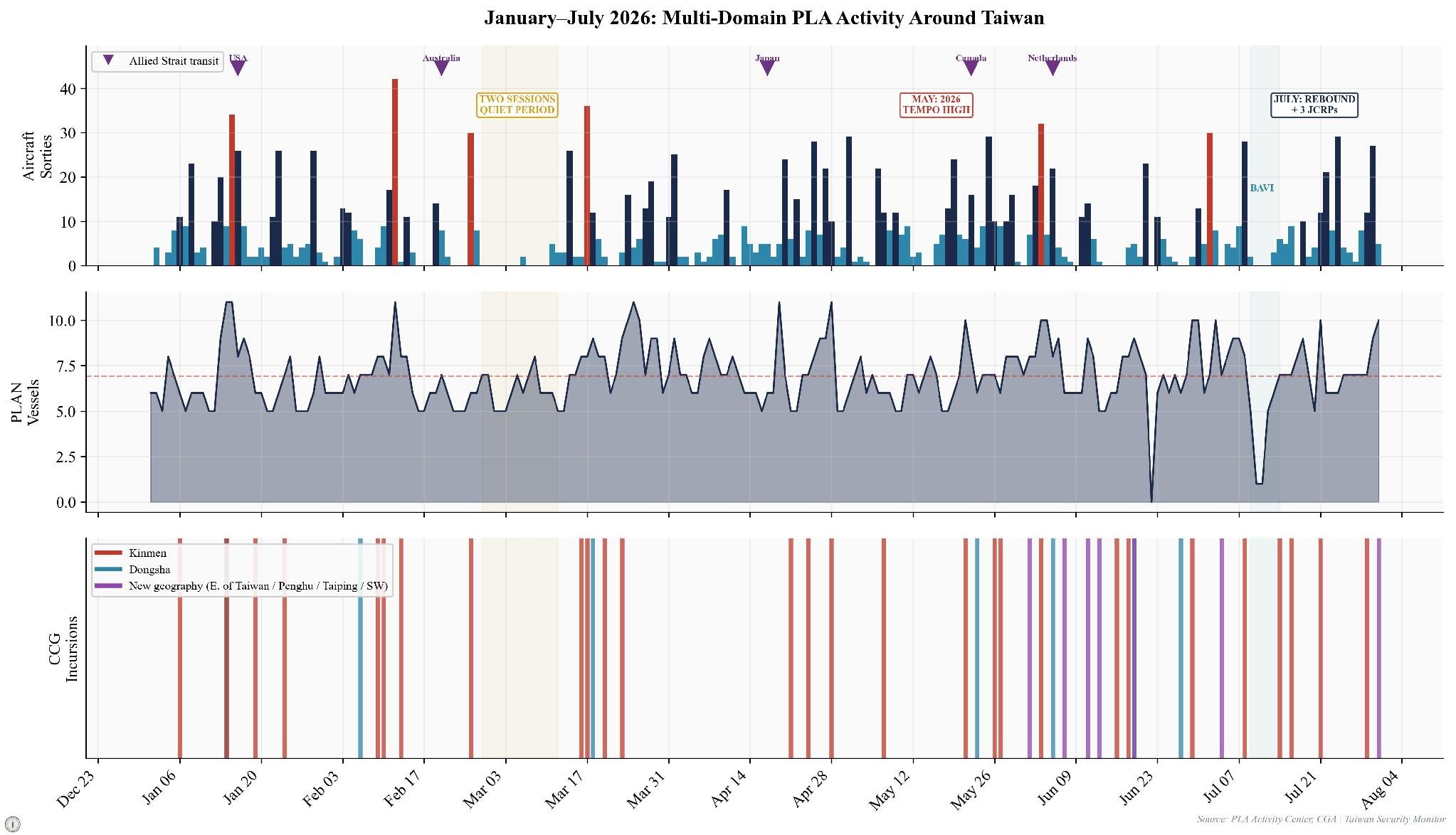
Figure 5. Januaryโ€“July 2026 multi-domain PLA activity: air sorties, naval presence, and CCG incursions. The shaded band in July marks the Typhoon Bavi disruption. Inverted triangles atop the air panel mark allied Taiwan Strait transits.

Julyโ€™s data reinforces the observation that air activity fluctuates while naval presence holds a persistent baseline and coast-guard operations follow their own institutional rhythm. The Typhoon Bavi window is the starkest illustration: air sorties and PLAN detections both cratered, but the CCG conducted incursions on either side of the storm, and the east-of-Taiwan formation remained on station throughout. Across seven months, the overall multi-domain posture has not meaningfully decreased from the level sustained since August 2022.

Figure 6. July air activity year-over-year: total sorties and ADIZ entries, 2024โ€“2026.

Methodology & Sources

Air and naval detection data are drawn from the PLA Activity Center database maintained by the Taiwan Security Monitor, which compiles daily press releases issued by Taiwanโ€™s Ministry of National Defense. The PLA Activity Center data are complete through July 31, 2026. Coast Guard incident data are compiled from Coast Guard Administration gray-zone press releases (cga.gov.tw) and verified against contemporaneous media reporting. Allied Taiwan Strait transit records are drawn from the Taiwan Strait Transit Tracker maintained by the Taiwan Security Monitor; no allied transits were recorded in July 2026. โ€œADIZโ€ denotes Taiwanโ€™s Air Defense Identification Zone; โ€œmedian lineโ€ refers to the informal centerline of the Taiwan Strait historically observed by both sides; โ€œJCRPโ€ denotes Joint Combat Readiness Patrols as designated by Taiwanโ€™s MND. All analysis and commentary are by the Taiwan Security Monitor.

Strait Snapshot, June 2026 Update

The Gray Zone Widens

Authors: Ethan Connell & Jonathan Walberg


KEY FINDINGS
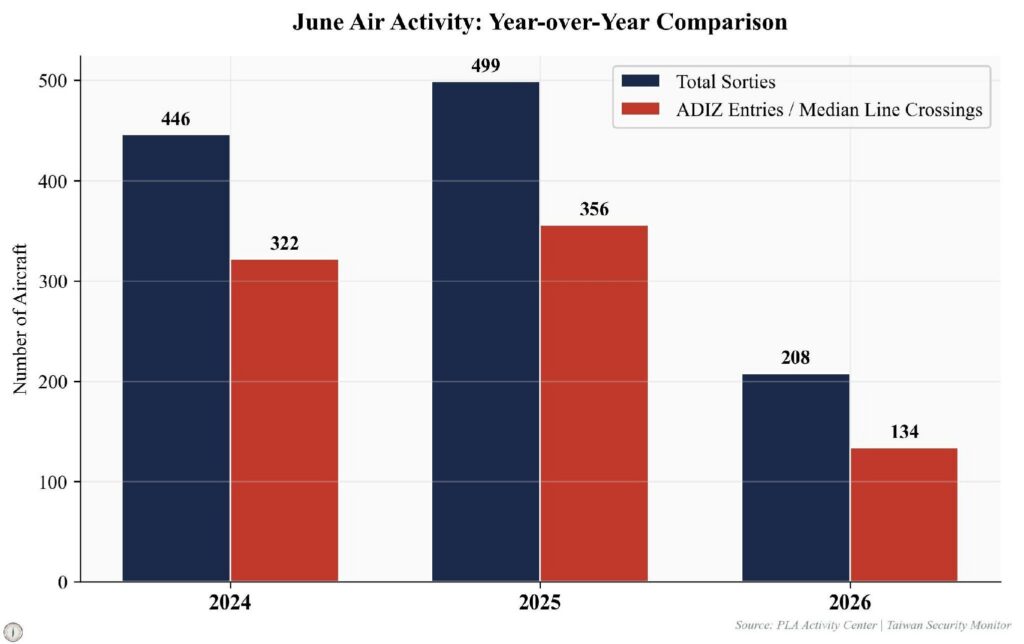
  • Taiwan’s Ministry of National Defense documented 208 PLA aerial sorties around the island in June 2026, with 134 entering the Air Defense Identification Zone. The total fell 66 sorties, or about 24 percent, from May’s year-high 274, and sat 58 percent below June 2025’s 499 sorties. June ranks fourth among 2026’s six months in the sequence 270, 190, 173, 229, 274, 208.
  • The PLA conducted a single joint combat readiness patrol on June 3 (32 aircraft, 25 ADIZ entries), down from four in May. The month’s second-largest day, 23 aircraft on June 21, was a โ€œlong-distance flightโ€ rather than a patrol, and the tempo was otherwise sustained through dispersed median-line crossings instead of large set-piece operations.
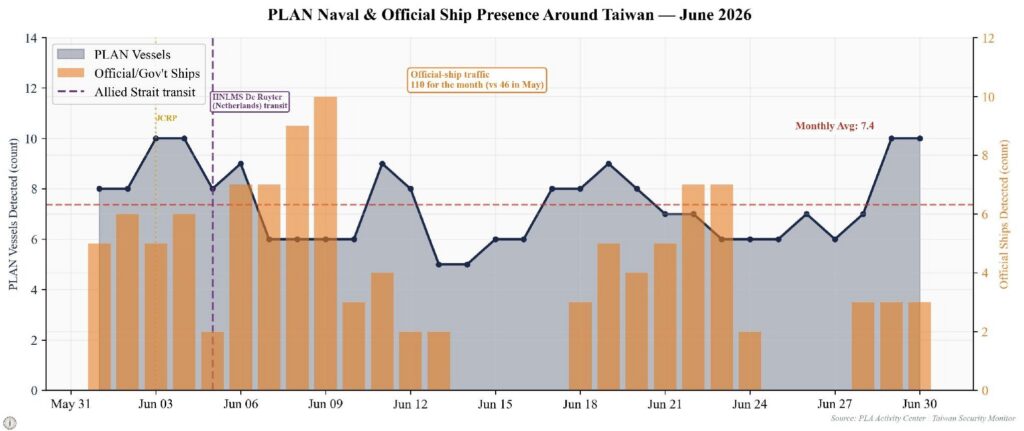
  • PLAN vessel detections averaged 7.4 per day and peaked at 10, holding the five-to-nine vessel baseline, while official and government-ship detections more than doubled to 110 for the month against May’s 46, a maritime-presence signal that ran counter to the decline in the air. One allied Strait transit fell within the month, the Netherlands frigate HNLMS De Ruyter on June 5.
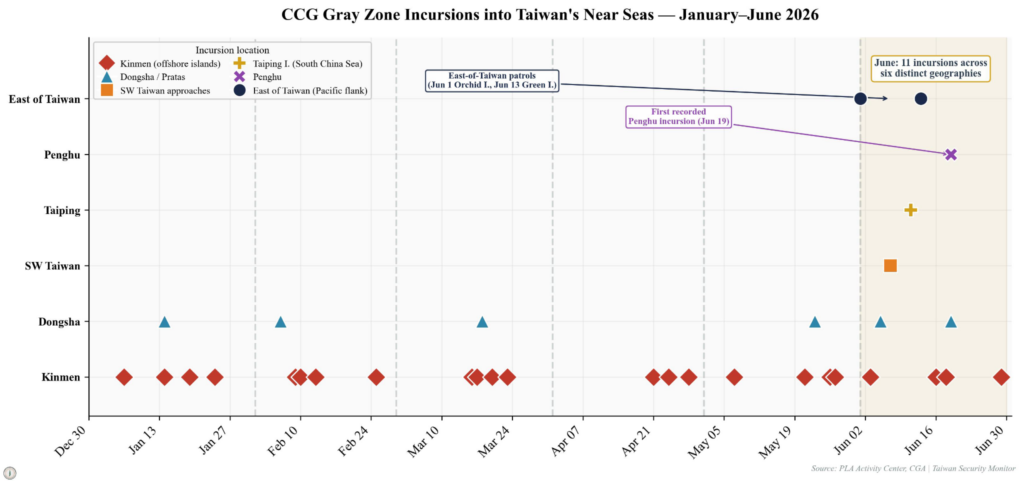
  • The Coast Guard Administration recorded 11 China Coast Guard incursions in June, the highest monthly count of 2026 and the first to break the Kinmen-and-Dongsha pattern: alongside four Kinmen and two Dongsha operations, the CCG conducted two east-of-Taiwan patrols, a South China Sea approach at Taiping Island, and Taiwan’s first recorded incursion off Penghu. Cumulative 2026 incursions reached 34.

After the High-Water Mark

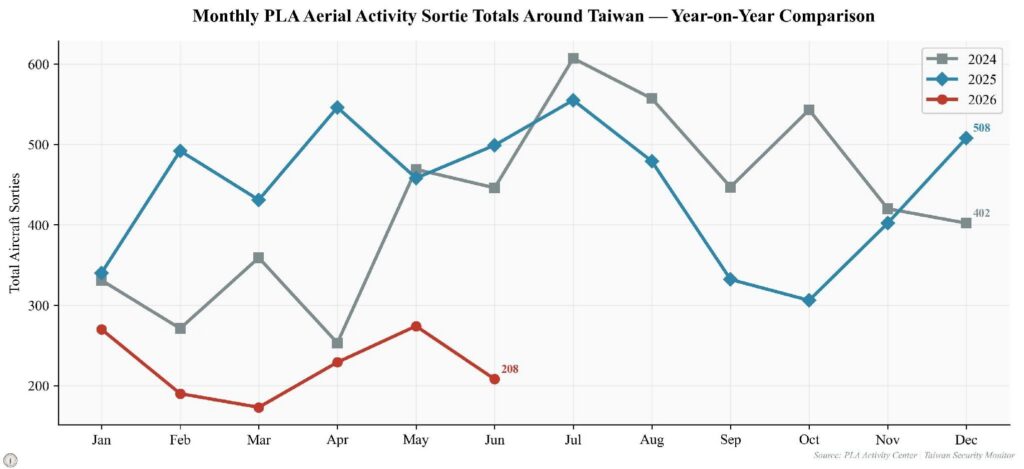
June’s 208 detected sorties reversed the climb that had carried PLA air activity to a 2026 high in May. The month-on-month drop of 66 sorties returned the count to the middle of the year’s range, below April’s 229 and well beneath May’s 274, and left the six-month sequence reading 270, 190, 173, 229, 274, 208. Against June 2025’s 499 sorties, the shortfall was 58 percent, consistent with the suppressed year-on-year pattern that has held across 2026.

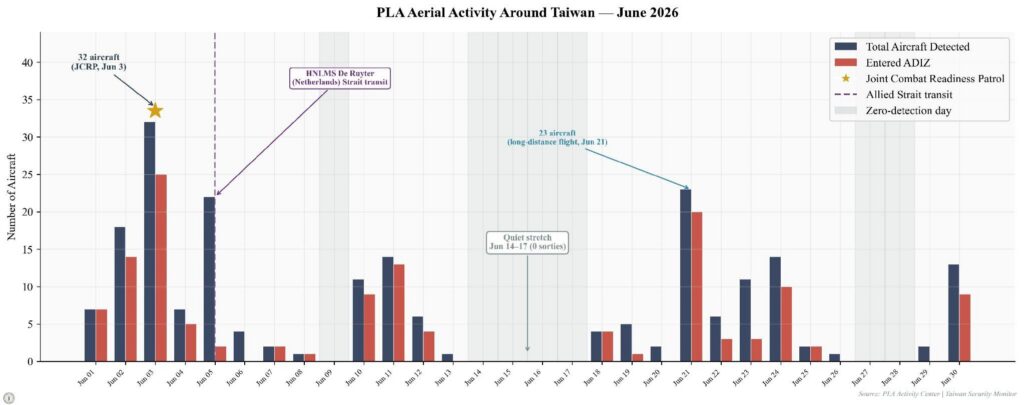
Joint combat readiness patrols, a firmer indicator of operational intent than raw sortie counts, all but disappeared. Only the June 3 patrol, 32 aircraft with 25 crossing into the ADIZ and the month’s single largest day, was officially given the designation, against four such patrols in May. The June 21 long-distance flight of 23 aircraft was the next-largest day, and the remaining elevated days took the form of dispersed median-line crossings recorded on June 22, 23, 24, and 30 rather than concentrated multi-axis exercises. 7 days registered no aircraft at all, including an unbroken stretch of quiet from June 14 through June 17.

Figure 1. Daily PLA aerial activity around Taiwan, June 2026. The gold star marks the June 3 joint combat readiness patrol; red bars show aircraft entering the ADIZ; shaded columns denote zero-detection days. The purple marker denotes the June 5 HNLMS De Ruyter (Netherlands) Strait transit.

The pullback followed the May 14-15 Beijing summit and the cautious posture Washington adopted afterward. U.S. arms deliveries to Taiwan remained paused, a planned Trump-Lai conversation stayed on hold, and the reciprocal autumn Xi visit to the United States had yet to be scheduled. As in earlier months, a lighter month in the air should not be read on its own as an easing of pressure. ADIZ-penetration share held at roughly 64 percent of detected sorties, so the activity that did occur still pressed toward Taiwan’s southwestern approaches rather than skirting them.

Monthly Trajectory: The Rebound Stalls

May’s rebound did not carry into June. Whereas the spring recovery had restored a near-weekly patrol cadence, June returned to a single large-scale operation, the type of frequency last seen during the February-April lull, while total sorties stayed comparatively high at 208. That combination is the month’s central puzzle: activity remained substantial, but the concentrated readiness patrols that signal deliberate demonstration gave way to a more routine presence and long-range flights. Read against the full run of 2026, June looks less like renewed de-escalation than like a redistribution of effort away from the air.

Figure 2. Monthly PLA aerial activity sortie totals, 2024โ€“2026. June 2026 falls back from May’s year high while remaining far below the 2024 and 2025 comparables.

At Sea: The Baseline Holds, Official Traffic Doubles

Naval presence again refused to track the swings in the air. PLAN detections averaged 7.4 vessels daily and peaked at 10, squarely within the five-to-nine band that has defined 2025-2026 operations, and the decoupling between air and maritime domains held through a month in which sorties fell by nearly a quarter. Air activity appears responsive to political calendars and institutional dynamics, whereas naval presence functions as a persistent baseline feature of cross-strait military activity.

Figure 3. PLAN vessel and official-ship detections around Taiwan, June 2026. Official-ship traffic more than doubled month-on-month. The purple marker denotes the June 5 HNLMS De Ruyter Strait transit.

The exception was official and government-ship traffic, which more than doubled to 110 detections for the month against 46 in May, peaking at ten government vessels on June 9, a day with no aircraft at all. The surge in non-navy state shipping, coming as air activity receded, reinforces the sense that Beijing shifted weight toward maritime and constabulary presence in June. One allied transit occurred: the Netherlands frigate HNLMS De Ruyter passed through the strait on June 5, the fifth allied transit of 2026 and the first by a Dutch vessel, following U.S., Australian, Japanese, and Canadian passages earlier in the year.

Coast Guard Gray Zone Operations

The clearest escalation in June came below the waterline. The Coast Guard Administration documented at least 11 China Coast Guard incursions, more than double any previous month in 2026 and the first to move decisively beyond the established Kinmen-and-Dongsha rhythm. Four Kinmen operations, on June 3, 16, 18, and 29, maintained the institutionalized four-cutter rotation drawing on hulls 14530, 14531, 14602, 14606, and 14607, including a June 18 approach in which the cutters ran in single file with their transponders switched off. Two Dongsha operations, on June 5 and 19, preserved the once-monthly southern pattern with single large cutters.

Figure 4. CCG incursions into Taiwan’s near seas, Januaryโ€“June 2026, by location. Filled markers are logged in the TSM tracker; hollow markers are confirmed from CGA releases and pending entry. June’s activity spans six distinct geographies, the year’s widest.

What set June apart was geography. On June 11, a Sansha law-enforcement formation entered waters two nautical miles off Taiping Island, extending gray-zone pressure into the South China Sea. On June 19 the CCG mounted Taiwan’s first recorded incursion off Penghu, sending cutter 2102 into waters west of Huayu the day after Taiwan’s Coast Guard seized an illegal mainland fishing vessel, a pretextual patrol shadowed by the CGA cutter Lianjiang. Most consequential were two patrols east of Taiwan: the June 1 formation that declared law-enforcement jurisdiction some fifty nautical miles southeast of Orchid Island, the first such assertion in open Pacific waters, and a June 13 transit past Green Island during which cutter 2502 broadcast that โ€œthe ROC does not existโ€ before a CGA vessel intervened. Cumulative 2026 incursions reached 34.

Regional Context: East of Taiwan, a New Patrol Line

June confirmed that the east-of-Taiwan patrols flagged at the end of May were not a one-off. By declaring law-enforcement jurisdiction in the open Pacific and rotating formations to sustain it, with the Xiushan task force relieving the June formation in early July, the CCG began to institutionalize a presence on Taiwan’s Pacific flank, the approaches through which any allied resupply from Guam, Yokosuka, or Luzon would run. Conducted under a civilian flag, the patrols are calibrated to complicate an allied response without the escalation a naval deployment would carry. Taipei answered on both fronts: the Coast Guard Administration pledged to expel harassing vessels and advised Taiwanese ships to ignore any boarding demands, while the Republic of China Navy stood up a Littoral Combat Command on June 1 to consolidate its surveillance and anti-ship missile forces. Washington’s posture, by contrast, stayed cautious in the summit’s aftermath even as Congressional support for Taiwan held.

The Full Picture: Multi-Domain Overview

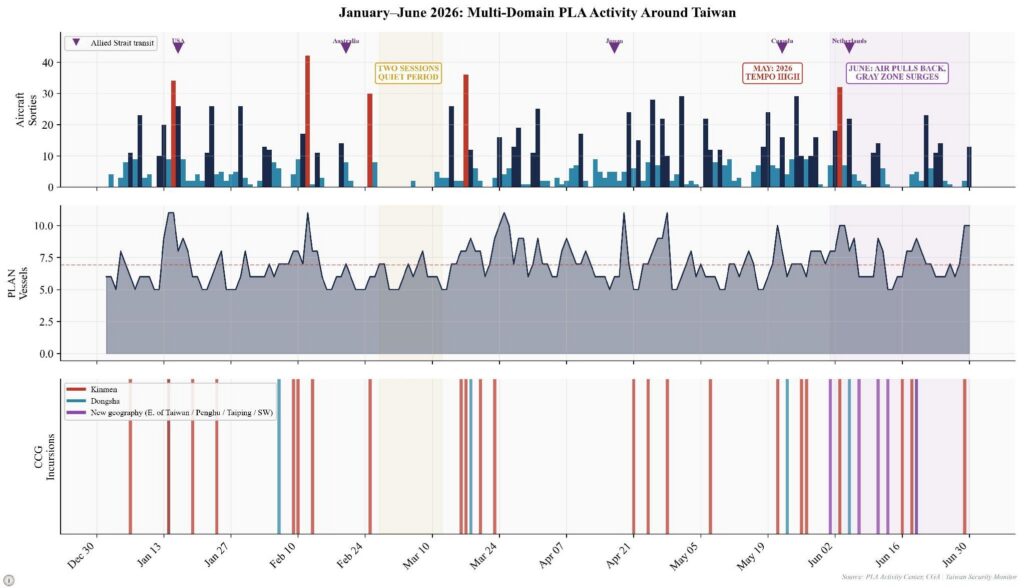
Figure 5. Januaryโ€“June 2026 multi-domain PLA activity: air sorties, naval presence, and CCG incursions. The gold band marks the early-March Two Sessions quiet period; the shaded June column marks the month’s air pullback and gray-zone surge. Inverted triangles atop the air panel mark allied Taiwan Strait transits (United States, January 16; Australia, February 20; Japan, April 17; Canada, May 22; Netherlands, June 5).

June is the sharpest illustration to date of a posture that moves along several tracks at once. Air activity, the most visible and politically responsive domain, fell back from its May peak and shed nearly all of its set-piece patrols; naval presence did not move; official-ship traffic and coast-guard operations rose, the latter both in number and in geographic reach. Taken together, the month does not describe a de-escalation so much as a shift in where pressure is applied, from the air toward the maritime and constabulary domains, and from the strait’s familiar flashpoints toward Taiwan’s eastern and southern approaches. The overall multi-domain posture continues to reflect the sustained PLA activity around Taiwan maintained since August 2022.

Figure 6. June air activity year-over-year: total sorties and ADIZ entries, 2024โ€“2026.

Methodology & Sources

Air and naval detection data are drawn from daily press releases issued by Taiwan’s Ministry of National Defense and compiled in the PLA Activity Center database maintained by the Taiwan Security Monitor. Figures for June 1-21 are drawn from the PLA Activity Center; figures for June 22-30 are compiled from MND daily releases, which do not carry the joint-patrol labeling used earlier in the month. Coast Guard incident data are compiled from Coast Guard Administration statements and verified against contemporaneous media reporting in the China Coast Guard Incident Tracker Database; seven of June’s incursions appear in the tracker, and four are confirmed from CGA releases pending entry, so the monthly total should be read as a minimum. Allied Taiwan Strait transit records are drawn from the Taiwan Strait Transit Tracker maintained by the Taiwan Security Monitor. โ€œADIZโ€ denotes Taiwan’s Air Defense Identification Zone; โ€œmedian lineโ€ refers to the informal centerline of the Taiwan Strait historically observed by both sides; โ€œJCRPโ€ denotes Joint Combat Readiness Patrols as designated by Taiwan’s MND. All analysis and commentary are by the Taiwan Security Monitor.

ยฉ 2026 Taiwan Security Monitor. All rights reserved.

PLA Activity Update, 6/14/26


Author: Ethan Connell


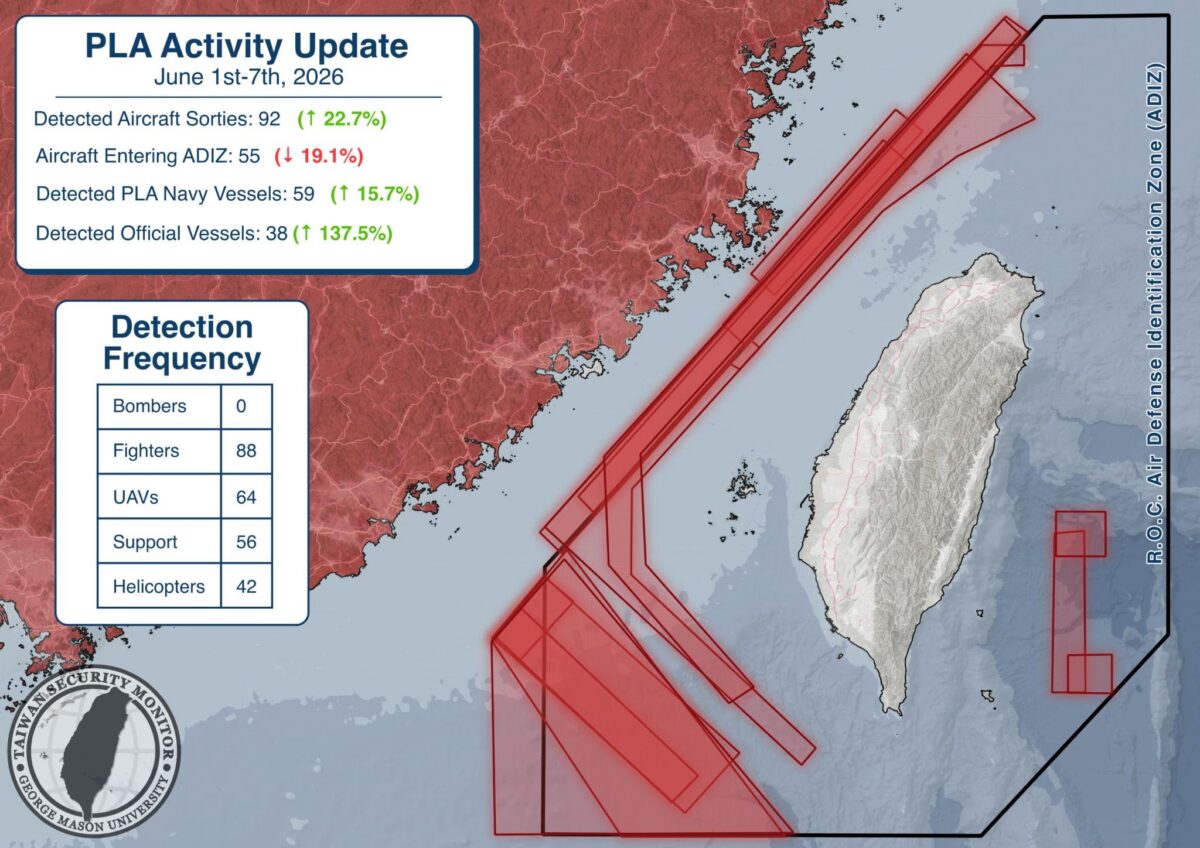
Visualization of PLA activity around Taiwan covering June 8th through June 14th.

For more information, visit the PLA Activity Tracker.

PLA Activity Update, 6/7/26


Author: Ethan Connell


Notes:

  • All data from Taiwan’s MND / TSM’s PLA Activity Center
  • Percentage increases/decreases represent change from week to week.
  • Detection frequency refers to the number of times an airframe type is mentioned in updates, not the total number of aircraft sorties per airframe type.
  • “Official vessels” refers to China Coast Guard vessels and official PRC research ships.

More information at the PLA Activity Tracker.

Strait Snapshot, May 2026 Update

In The Summit’s Shadow

Authors: Ethan Connell & Jonathan Walberg


KEY FINDINGS
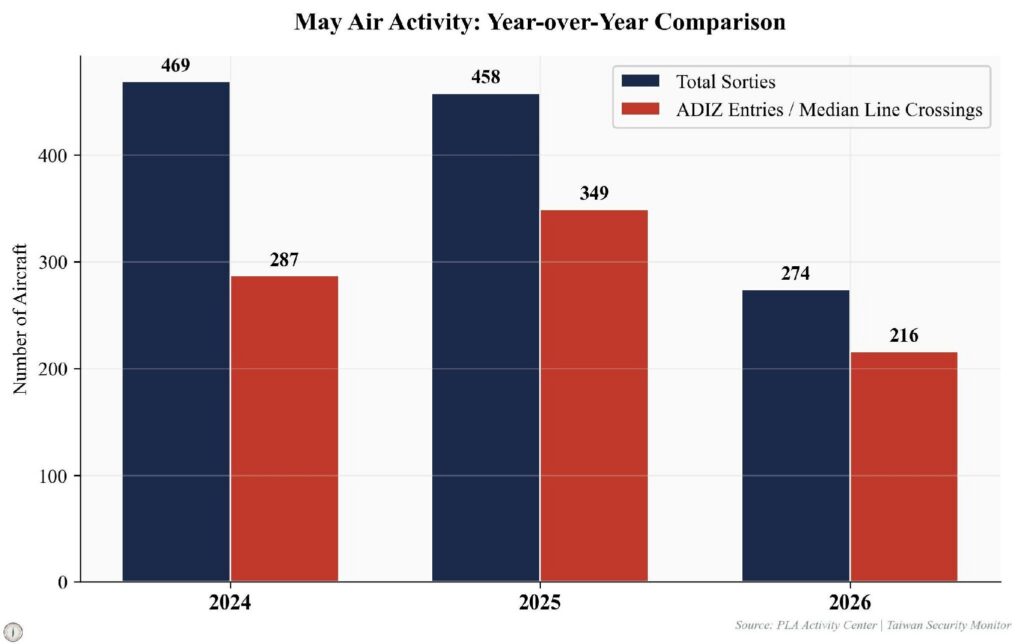
  • In May 2026, Taiwan’s Ministry of National Defense recorded 274 PLA aerial sorties around the island. Of these, 216 entered Taiwan’s Air Defense Identification Zone, representing an ADIZ-penetration rate of approximately 79 percent, the highest in 2026. This monthly total is the largest of the year, surpassing January’s 270 and continuing April’s rebound, signaling the end of the first-quarter lull. However, it remains 40 percent below the 458 sorties recorded in May 2025.
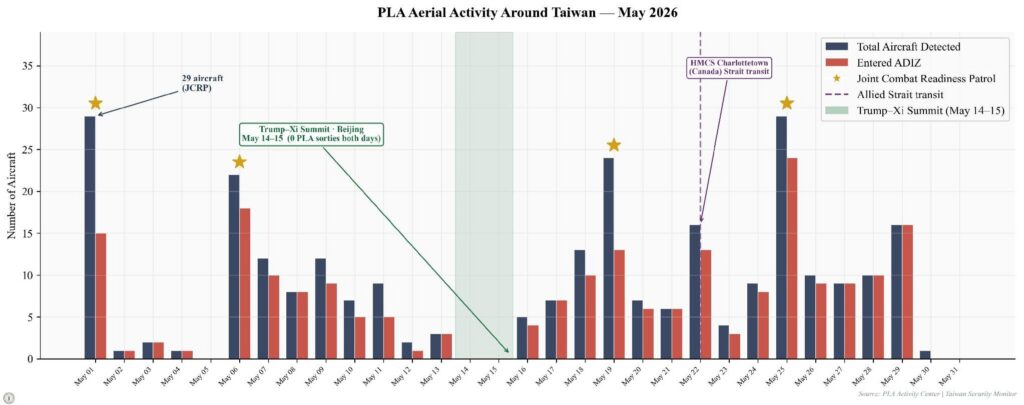
  • The PLA conducted four joint combat readiness patrols on May 1, May 6, May 19, and May 25, restoring the four-per-month cadence last observed in January. Single-day totals peaked at 29 aircraft on both May 1 and May 25. Air activity dropped to zero on May 14 and 15, coinciding with the Trump-Xi summit in Beijing, before surging during the May 19 and May 25 patrols.
  • PLAN vessel detections averaged 6.7 per day in May, peaking at 10 on May 21, consistent with the five-to-nine vessel baseline maintained since 2025. While air activity reached a yearly high, naval presence remained steady, continuing the decoupling between sortie volume and naval activity observed throughout the year. One allied Strait transit occurred: HMCS Charlottetown on May 22, between two late-month patrols, marking the latest instance of a transit coinciding with heightened patrol activity in 2026.
  • The Coast Guard Administration recorded five CCG incursions in May (four at Kinmen, one at Dongsha), restoring the once-monthly Dongsha pattern that lapsed in April. From January through May, cumulative incursions totaled 23: 19 at Kinmen and 4 at Dongsha. This increase occurred during a month focused on the May 14-15 Trump-Xi summit in Beijing, after which Washington paused arms transfers and deferred a Trump-Lai call ahead of a planned autumn visit by Xi to the United States.

In the Summit’s Shadow

PLA air activity around Taiwan reached its highest monthly level of 2026 in May, with 274 detected sorties, 216 of which entered Taiwan’s Air Defense Identification Zone. This total surpassed April’s 229 by 45 and exceeded January’s 270, making May the peak month so far. The five-month sequence is 270, 190, 173, 229, and 274, with March as the low point and activity rising for a second consecutive month. However, May’s total remains 40 percent below the 458 sorties of May 2025, and 2026 overall is still well below the previous year.

Four joint combat readiness patrols occurred on May 1, May 6, May 19, and May 25. The first and last patrols each involved 29 aircraft, with the May 25 count being the second-highest single-day total of 2026. Between patrols, activity followed a familiar pattern of alternating high-intensity demonstrations and quiet days. May saw four zero-detection days: May 5, May 14, May 15, and May 31. Notably, May 14 and 15 coincided with the Trump-Xi summit in Beijing, during which PLA air activity around Taiwan ceased entirely. Despite these pauses, May produced the year’s highest total, with an ADIZ-penetration rate of about 79 percent, indicating that more daily activity entered Taiwan’s southwestern ADIZ rather than remaining outside it.

Figure 1. Daily PLA aerial activity around Taiwan, May 2026. Gold stars mark JCRP days; red bars show aircraft entering the ADIZ. The green band marks the May 14-15 Trump-Xi summit in Beijing, when PLA air activity fell to zero. The purple marker denotes the May 22 HMCS Charlottetown (Canada) Strait transit, which fell between the May 19 and May 25 patrols.

May’s activity should be viewed in context. President Trump and President Xi Jinping met in Beijing on May 14 and 15, during which PLA air activity around Taiwan dropped to zero, marking the only consecutive shutdown of the month. Activity then increased for the May 19 and May 25 patrols, making the summit period a quiet interval between two surges. Naval presence remained steady during these days, indicating the stand-down was limited to the air domain. Diplomatic developments continued after the summit. At the Shangri-La Dialogue on May 29, U.S. Secretary of Defense Pete Hegseth stated that the pause in Taiwan arms deliveries was not due to munitions conservation related to the Middle East. Late in the month, reports indicated a planned Trump-Lai call was postponed, and Trump was not expected to speak with Lai before a reciprocal Xi visit to the United States in the autumn. The PLA ended May with its highest air activity of 2026, even as Washington’s signals shifted toward Beijing.

Monthly Trajectory: The Lull Reverses

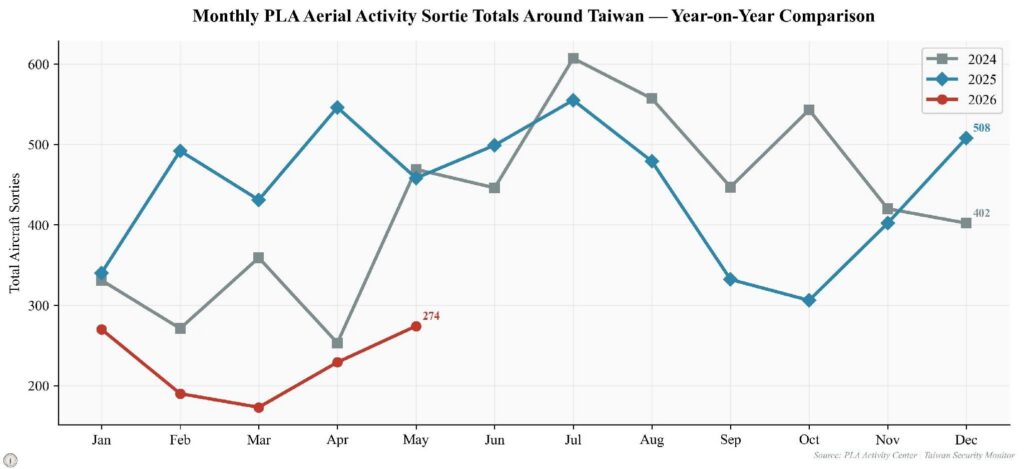
May’s 274 sorties mark a full reversal of the first-quarter decline. The 2026 monthly totals form a V-shaped pattern: 270, 190, 173, 229, and 274, with March as the low point and a climb above January’s starting figure. April signaled the end of the lull, and May confirms a sustained recovery, with gains extending beyond any single exercise period.

Figure 2. Monthly PLA aerial activity sortie totals, 2024โ€“2026. May 2026 is the year’s high, completing a V-shaped recovery from the March low.

JCRP frequency is a more reliable indicator of PLA intent than total sortie counts, and it rebounded in May. The four patrols matched January’s level and exceeded the two conducted in each of February, March, and April. Holding roughly one large-scale exercise per week for the first time since January suggests the first-quarter drop in routine sorties was temporary, not a reduction in the PLA’s readiness for high-intensity demonstrations. JCRP frequency, more than total sorties, signals the end of the early-year lull.

At Sea: A Baseline That Does Not Move

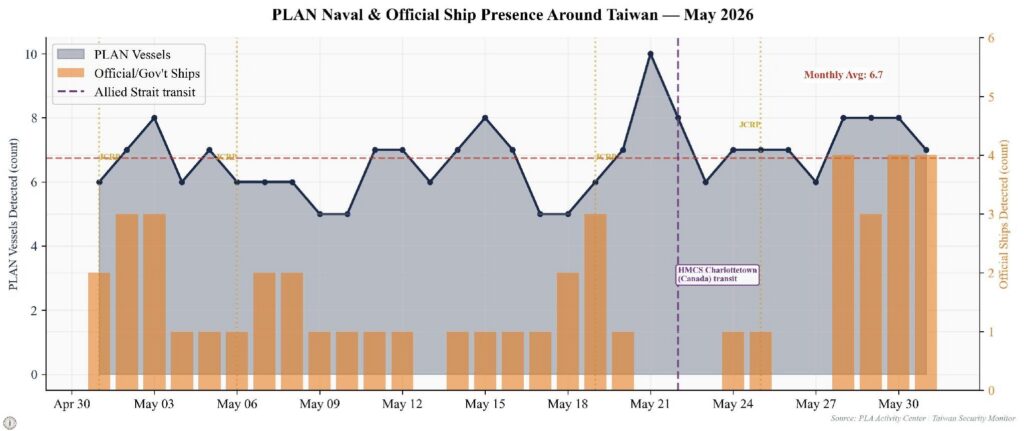
PLAN vessel detections averaged 6.7 per day in May, peaking at 10 on May 21. Both figures remain within the five-to-nine vessel range that has characterized PLAN presence since 2025. In contrast, aerial sorties reached a yearly high, and ADIZ penetration peaked in 2026, while naval presence remained unchanged. The air and naval domains operate under different dynamics: air activity responds to political events and institutional factors, while naval presence serves as a consistent baseline in cross-strait military activity.

Figure 3. PLAN vessel and official ship detections around Taiwan, May 2026. The purple marker denotes the May 22 HMCS Charlottetown Strait transit.

Official and government-ship detections stayed low through the month, clustering in the first week before settling to one or two per day. The naval baseline held steady during a month of elevated air activity, consistent with the pattern seen all year: a change in air sortie volume, whether the May increase or the March decline, does not signal a matching shift in the maritime posture, which stays decoupled from the air domain.

One allied Taiwan Strait transit fell within the month. The Canadian frigate HMCS Charlottetown (FFH 339) transited the strait on May 22, Canada’s first reported transit of 2026 and the fourth allied passage of the year, after the USS John Finn and the survey ship USNS Mary Sears on January 16, the Australian frigate HMAS Toowoomba on February 20, and the Japanese destroyer JS Ikazuchi on April 17. The May 22 transit fell between the month’s third and fourth joint combat readiness patrols, on May 19 and May 25. The proximity is not limited to May. Through 2026, allied transits have repeatedly coincided with periods of heavy JCRP activity, the January and February passages each within a day of a patrol. The sequencing is inconsistent, since in those two cases the patrol came before the transit rather than after, and the sample stays too small to support a causal reading. The clustering warrants continued observation, not firm inference.

Coast Guard Gray Zone Operations

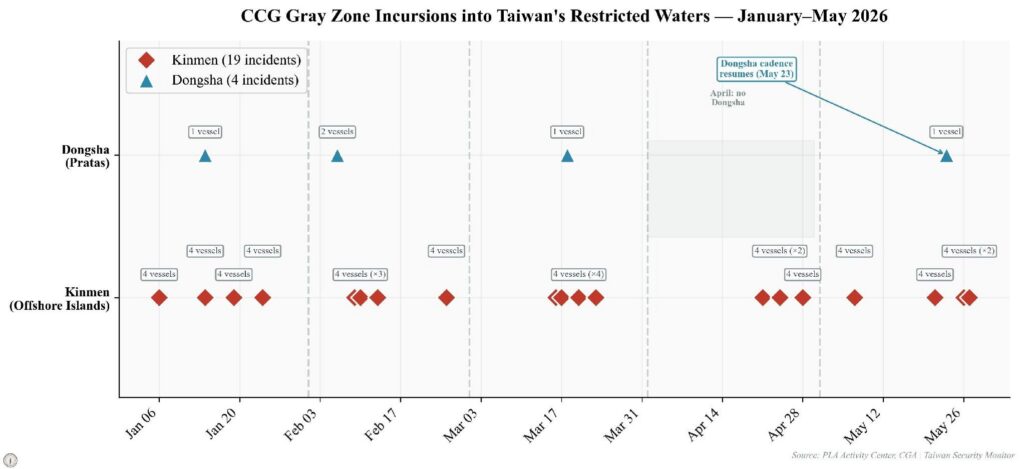
China Coast Guard activity in Taiwan’s restricted waters returned to its monthly rhythm in May. The CCG conducted 5 documented incursions: 4 around Kinmen, on May 7, May 21, May 26, and May 27, and one at Dongsha on May 23. The Kinmen operations followed the institutionalized pattern seen throughout 2026, a rotating four-cutter formation drawn from a consistent hull pool, with numbers 14530, 14531, 14606, and 14609 recurring most often, entering in the afternoon and leaving within about two hours. The May 26 and May 27 incursions came within a twenty-four-hour span, a tempo the CGA itself flagged as unusual. Cumulative CCG incursions for January through May total 23: 19 at Kinmen and 4 at Dongsha.

Figure 4. CCG incursions into Taiwan’s restricted waters, Januaryโ€“May 2026, by location and vessel count.

The main CCG development in May was the resumption of Dongsha (Pratas) operations. After the once-monthly Dongsha pattern lapsed in April, the May 23 incursion restored it, with a single vessel, hull 3501, detected at 07:25 and entering restricted waters at 08:34. Dongsha operations remain distinct from the Kinmen rotation, involving longer transits, single large cutters instead of four-hull formations, and much longer dwell times. The longest in 2026 was the March 18 incursion, lasting about twenty-five hours. The April pause reflected operational rhythm rather than a binding commitment, and May’s return indicates Dongsha presence is an intentional, though intermittent, aspect of CCG activity. One late-period development warrants continued observation: on May 31, the CCG announced “law enforcement patrols” in waters east of Taiwan in response to Japan and the Philippines, and on June 1, a CCG incursion southeast of Orchid Island involved vessels 2304 and 2502, an area not previously recorded in 2026.

Regional Context: An Arms Pause, Summit Diplomacy, and Taiwan’s Own Build-Up

May’s activity occurred against a backdrop of U.S.-China diplomacy that shaped Taiwan coverage for the month. The Trump-Xi summit in Beijing on May 14 and 15 set the tone. In the following weeks, the pause in U.S. arms deliveriesโ€”which Secretary Hegseth did not attribute to munitions conservationโ€”and the postponement of a Trump-Lai call ahead of a planned autumn Xi visit to the United States signaled a Washington approach focused on avoiding friction with Beijing. In response, Taiwan advanced its own procurement. On May 29, the Legislative Yuan approved an initial NT$8.811 billion (about US$259 million) installment for five U.S. weapons systems, including M109A7 self-propelled howitzers, HIMARS, and anti-armor drones. Two days earlier, the House Armed Services Committee’s preliminary version of the FY27 National Defense Authorization Act authorized US$1 billion for the Taiwan Security Cooperation Initiative. Congressional support for Taiwan’s defense remains strong, even as executive-branch deliveries are delayed.

Taiwan’s force development also progressed. On June 1, the Republic of China Navy established a Littoral Combat Command, consolidating naval surveillance and anti-ship missile forces under one headquarters, advancing the distributed, asymmetric posture pursued since 2022. Allied presence operations remained steady: the HMCS Charlottetown transit marked Canada’s entry into a 2026 transit pattern already featuring U.S., Australian, and Japanese passages. These regional developments highlight a growing gap between a cautious U.S. executive approach and the consistent allied presence and Taiwanese self-strengthening. The PLA intensified its air activity in this environment.

The Full Picture: Multi-Domain Overview

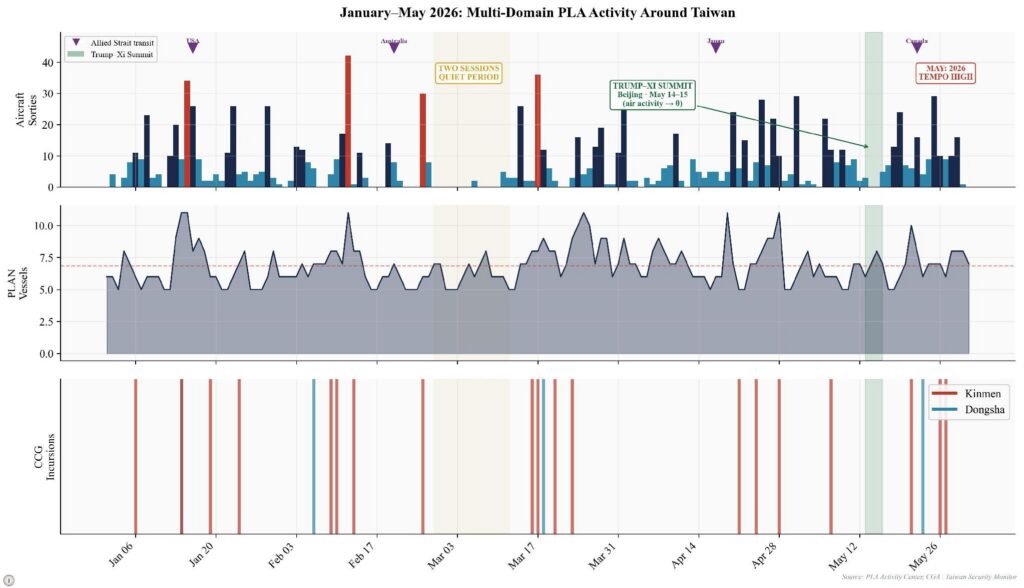
Figure 5. Januaryโ€“May 2026 multi-domain PLA activity: air sorties, naval presence, and CCG incursions. The green band marks the May 14-15 Trump-Xi summit in Beijing; the gold band marks the early-March Two Sessions quiet period. Inverted triangles atop the air panel mark allied Taiwan Strait transits (United States, January 16; Australia, February 20; Japan, April 17; Canada, May 22).

Throughout the first five months of 2026, all three domains have shown a steady upward trend. Air activity was volatile and responsive to political events, dipping to a low in early March before rebounding through April and May to reach the year’s highest point. A key political signal was the pause in sorties during the Trump-Xi summit in mid-March, which was followed by a resumption of activity. Naval presence stayed stable, unaffected by fluctuations in air activity. Coast Guard incursions averaged around five per month, with May reestablishing the Dongsha pattern seen in April and adding a new east-of-Taiwan area at month’s end. Each domain should be analyzed in context. The early-year decline in sortie numbers did not indicate de-escalation, and May’s rebound alone does not suggest escalation. The overall multi-domain posture continues to reflect the sustained PLA activity around Taiwan since August 2022. In May, the PLA maintained this posture at the high end of its 2026 range, despite shifting signals from Washington.

Figure 6. May air activity year-over-year: total sorties and ADIZ entries, 2024โ€“2026.

Methodology & Sources

Air and naval detection data are drawn from daily press releases issued by Taiwan’s Ministry of National Defense and compiled in the PLA Activity Center database maintained by the Taiwan Security Monitor. Coast Guard incident data are compiled from Coast Guard Administration press releases and verified against contemporaneous media reporting in the China Coast Guard Incident Tracker Database. Allied Taiwan Strait transit records are drawn from the Taiwan Strait Transit Tracker maintained by the Taiwan Security Monitor. Contextual and allied developments draw on Taiwan Security Monitor reporting through late May and early June 2026. “ADIZ” denotes Taiwan’s Air Defense Identification Zone; “median line” refers to the informal centerline of the Taiwan Strait historically observed by both sides. “JCRP” denotes Joint Combat Readiness Patrols as designated by Taiwan’s MND. All analysis and commentary are by the Taiwan Security Monitor.

ยฉ 2026 Taiwan Security Monitor. All rights reserved.

PLA Activity Monthly Update, May 2026


Author: Ethan Connell


Notes:

  • All data from Taiwan’s MND / TSM’s PLA Activity Center
  • Percentage increases/decreases represent change from April to May.
  • Detection frequency refers to the number of times an airframe type is mentioned in updates, not the total number of aircraft sorties per airframe type.
  • “Official vessels” refers to China Coast Guard vessels and official PRC research ships.

More information available at the PLA Activity Tracker.

PLA Activity Update, 5/31/2026


Author: Ethan Connell


Notes:

  • All data from Taiwan’s MND
  • Percentage increases/decreases represent change from week to week.
  • Detection frequency refers to the number of times an airframe type is mentioned in updates, not the total number of aircraft sorties per airframe type.
  • “Official vessels” refers to China Coast Guard vessels and official PRC research ships.

More information at the PLA Activity Tracker.