In The Summit’s Shadow
Authors: Ethan Connell & Jonathan Walberg
KEY FINDINGS
- In May 2026, Taiwan’s Ministry of National Defense recorded 274 PLA aerial sorties around the island. Of these, 216 entered Taiwan’s Air Defense Identification Zone, representing an ADIZ-penetration rate of approximately 79 percent, the highest in 2026. This monthly total is the largest of the year, surpassing January’s 270 and continuing April’s rebound, signaling the end of the first-quarter lull. However, it remains 40 percent below the 458 sorties recorded in May 2025.
- The PLA conducted four joint combat readiness patrols on May 1, May 6, May 19, and May 25, restoring the four-per-month cadence last observed in January. Single-day totals peaked at 29 aircraft on both May 1 and May 25. Air activity dropped to zero on May 14 and 15, coinciding with the Trump-Xi summit in Beijing, before surging during the May 19 and May 25 patrols.
- PLAN vessel detections averaged 6.7 per day in May, peaking at 10 on May 21, consistent with the five-to-nine vessel baseline maintained since 2025. While air activity reached a yearly high, naval presence remained steady, continuing the decoupling between sortie volume and naval activity observed throughout the year. One allied Strait transit occurred: HMCS Charlottetown on May 22, between two late-month patrols, marking the latest instance of a transit coinciding with heightened patrol activity in 2026.
- The Coast Guard Administration recorded five CCG incursions in May (four at Kinmen, one at Dongsha), restoring the once-monthly Dongsha pattern that lapsed in April. From January through May, cumulative incursions totaled 23: 19 at Kinmen and 4 at Dongsha. This increase occurred during a month focused on the May 14-15 Trump-Xi summit in Beijing, after which Washington paused arms transfers and deferred a Trump-Lai call ahead of a planned autumn visit by Xi to the United States.
In the Summit’s Shadow
PLA air activity around Taiwan reached its highest monthly level of 2026 in May, with 274 detected sorties, 216 of which entered Taiwan’s Air Defense Identification Zone. This total surpassed April’s 229 by 45 and exceeded January’s 270, making May the peak month so far. The five-month sequence is 270, 190, 173, 229, and 274, with March as the low point and activity rising for a second consecutive month. However, May’s total remains 40 percent below the 458 sorties of May 2025, and 2026 overall is still well below the previous year.
Four joint combat readiness patrols occurred on May 1, May 6, May 19, and May 25. The first and last patrols each involved 29 aircraft, with the May 25 count being the second-highest single-day total of 2026. Between patrols, activity followed a familiar pattern of alternating high-intensity demonstrations and quiet days. May saw four zero-detection days: May 5, May 14, May 15, and May 31. Notably, May 14 and 15 coincided with the Trump-Xi summit in Beijing, during which PLA air activity around Taiwan ceased entirely. Despite these pauses, May produced the year’s highest total, with an ADIZ-penetration rate of about 79 percent, indicating that more daily activity entered Taiwan’s southwestern ADIZ rather than remaining outside it.
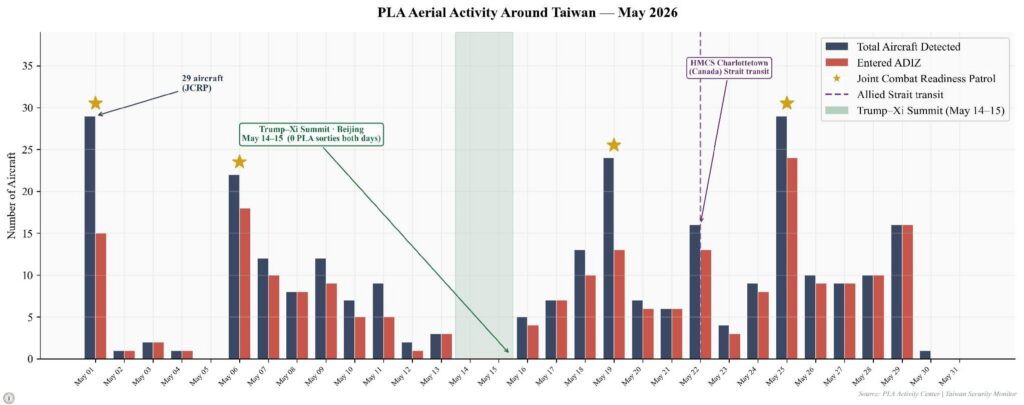
Figure 1. Daily PLA aerial activity around Taiwan, May 2026. Gold stars mark JCRP days; red bars show aircraft entering the ADIZ. The green band marks the May 14-15 Trump-Xi summit in Beijing, when PLA air activity fell to zero. The purple marker denotes the May 22 HMCS Charlottetown (Canada) Strait transit, which fell between the May 19 and May 25 patrols.
May’s activity should be viewed in context. President Trump and President Xi Jinping met in Beijing on May 14 and 15, during which PLA air activity around Taiwan dropped to zero, marking the only consecutive shutdown of the month. Activity then increased for the May 19 and May 25 patrols, making the summit period a quiet interval between two surges. Naval presence remained steady during these days, indicating the stand-down was limited to the air domain. Diplomatic developments continued after the summit. At the Shangri-La Dialogue on May 29, U.S. Secretary of Defense Pete Hegseth stated that the pause in Taiwan arms deliveries was not due to munitions conservation related to the Middle East. Late in the month, reports indicated a planned Trump-Lai call was postponed, and Trump was not expected to speak with Lai before a reciprocal Xi visit to the United States in the autumn. The PLA ended May with its highest air activity of 2026, even as Washington’s signals shifted toward Beijing.
Monthly Trajectory: The Lull Reverses
May’s 274 sorties mark a full reversal of the first-quarter decline. The 2026 monthly totals form a V-shaped pattern: 270, 190, 173, 229, and 274, with March as the low point and a climb above January’s starting figure. April signaled the end of the lull, and May confirms a sustained recovery, with gains extending beyond any single exercise period.
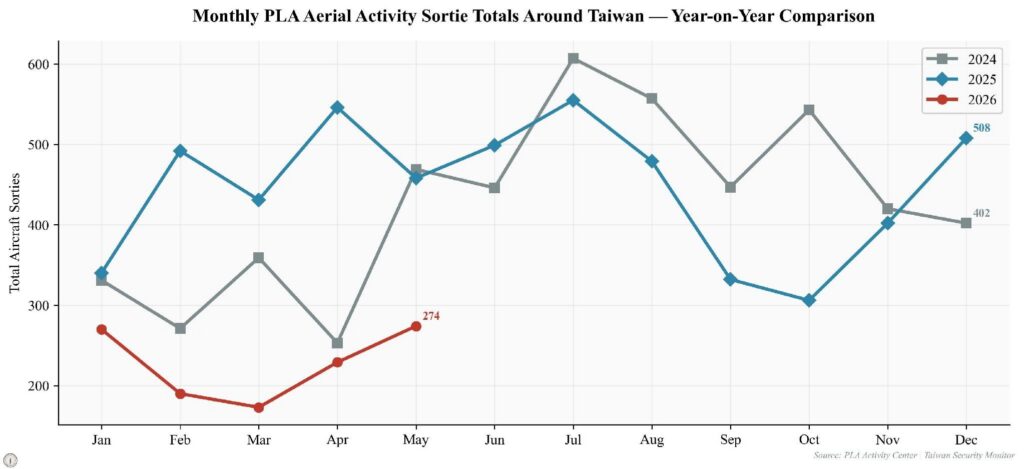
Figure 2. Monthly PLA aerial activity sortie totals, 2024–2026. May 2026 is the year’s high, completing a V-shaped recovery from the March low.
JCRP frequency is a more reliable indicator of PLA intent than total sortie counts, and it rebounded in May. The four patrols matched January’s level and exceeded the two conducted in each of February, March, and April. Holding roughly one large-scale exercise per week for the first time since January suggests the first-quarter drop in routine sorties was temporary, not a reduction in the PLA’s readiness for high-intensity demonstrations. JCRP frequency, more than total sorties, signals the end of the early-year lull.
At Sea: A Baseline That Does Not Move
PLAN vessel detections averaged 6.7 per day in May, peaking at 10 on May 21. Both figures remain within the five-to-nine vessel range that has characterized PLAN presence since 2025. In contrast, aerial sorties reached a yearly high, and ADIZ penetration peaked in 2026, while naval presence remained unchanged. The air and naval domains operate under different dynamics: air activity responds to political events and institutional factors, while naval presence serves as a consistent baseline in cross-strait military activity.
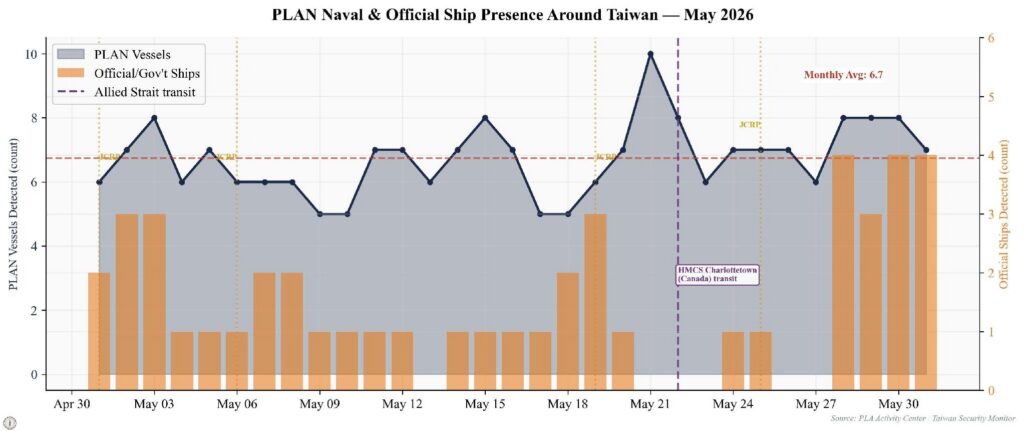
Figure 3. PLAN vessel and official ship detections around Taiwan, May 2026. The purple marker denotes the May 22 HMCS Charlottetown Strait transit.
Official and government-ship detections stayed low through the month, clustering in the first week before settling to one or two per day. The naval baseline held steady during a month of elevated air activity, consistent with the pattern seen all year: a change in air sortie volume, whether the May increase or the March decline, does not signal a matching shift in the maritime posture, which stays decoupled from the air domain.
One allied Taiwan Strait transit fell within the month. The Canadian frigate HMCS Charlottetown (FFH 339) transited the strait on May 22, Canada’s first reported transit of 2026 and the fourth allied passage of the year, after the USS John Finn and the survey ship USNS Mary Sears on January 16, the Australian frigate HMAS Toowoomba on February 20, and the Japanese destroyer JS Ikazuchi on April 17. The May 22 transit fell between the month’s third and fourth joint combat readiness patrols, on May 19 and May 25. The proximity is not limited to May. Through 2026, allied transits have repeatedly coincided with periods of heavy JCRP activity, the January and February passages each within a day of a patrol. The sequencing is inconsistent, since in those two cases the patrol came before the transit rather than after, and the sample stays too small to support a causal reading. The clustering warrants continued observation, not firm inference.
Coast Guard Gray Zone Operations
China Coast Guard activity in Taiwan’s restricted waters returned to its monthly rhythm in May. The CCG conducted 5 documented incursions: 4 around Kinmen, on May 7, May 21, May 26, and May 27, and one at Dongsha on May 23. The Kinmen operations followed the institutionalized pattern seen throughout 2026, a rotating four-cutter formation drawn from a consistent hull pool, with numbers 14530, 14531, 14606, and 14609 recurring most often, entering in the afternoon and leaving within about two hours. The May 26 and May 27 incursions came within a twenty-four-hour span, a tempo the CGA itself flagged as unusual. Cumulative CCG incursions for January through May total 23: 19 at Kinmen and 4 at Dongsha.
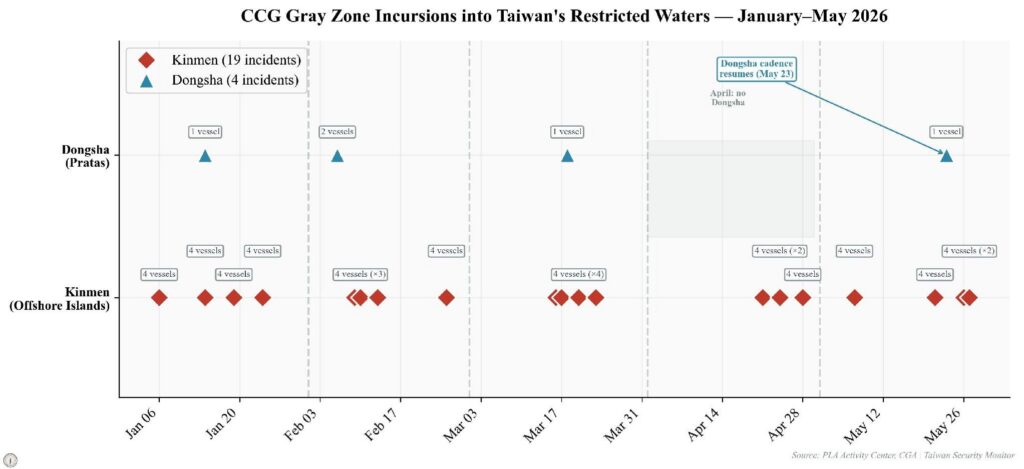
Figure 4. CCG incursions into Taiwan’s restricted waters, January–May 2026, by location and vessel count.
The main CCG development in May was the resumption of Dongsha (Pratas) operations. After the once-monthly Dongsha pattern lapsed in April, the May 23 incursion restored it, with a single vessel, hull 3501, detected at 07:25 and entering restricted waters at 08:34. Dongsha operations remain distinct from the Kinmen rotation, involving longer transits, single large cutters instead of four-hull formations, and much longer dwell times. The longest in 2026 was the March 18 incursion, lasting about twenty-five hours. The April pause reflected operational rhythm rather than a binding commitment, and May’s return indicates Dongsha presence is an intentional, though intermittent, aspect of CCG activity. One late-period development warrants continued observation: on May 31, the CCG announced “law enforcement patrols” in waters east of Taiwan in response to Japan and the Philippines, and on June 1, a CCG incursion southeast of Orchid Island involved vessels 2304 and 2502, an area not previously recorded in 2026.
Regional Context: An Arms Pause, Summit Diplomacy, and Taiwan’s Own Build-Up
May’s activity occurred against a backdrop of U.S.-China diplomacy that shaped Taiwan coverage for the month. The Trump-Xi summit in Beijing on May 14 and 15 set the tone. In the following weeks, the pause in U.S. arms deliveries—which Secretary Hegseth did not attribute to munitions conservation—and the postponement of a Trump-Lai call ahead of a planned autumn Xi visit to the United States signaled a Washington approach focused on avoiding friction with Beijing. In response, Taiwan advanced its own procurement. On May 29, the Legislative Yuan approved an initial NT$8.811 billion (about US$259 million) installment for five U.S. weapons systems, including M109A7 self-propelled howitzers, HIMARS, and anti-armor drones. Two days earlier, the House Armed Services Committee’s preliminary version of the FY27 National Defense Authorization Act authorized US$1 billion for the Taiwan Security Cooperation Initiative. Congressional support for Taiwan’s defense remains strong, even as executive-branch deliveries are delayed.
Taiwan’s force development also progressed. On June 1, the Republic of China Navy established a Littoral Combat Command, consolidating naval surveillance and anti-ship missile forces under one headquarters, advancing the distributed, asymmetric posture pursued since 2022. Allied presence operations remained steady: the HMCS Charlottetown transit marked Canada’s entry into a 2026 transit pattern already featuring U.S., Australian, and Japanese passages. These regional developments highlight a growing gap between a cautious U.S. executive approach and the consistent allied presence and Taiwanese self-strengthening. The PLA intensified its air activity in this environment.
The Full Picture: Multi-Domain Overview
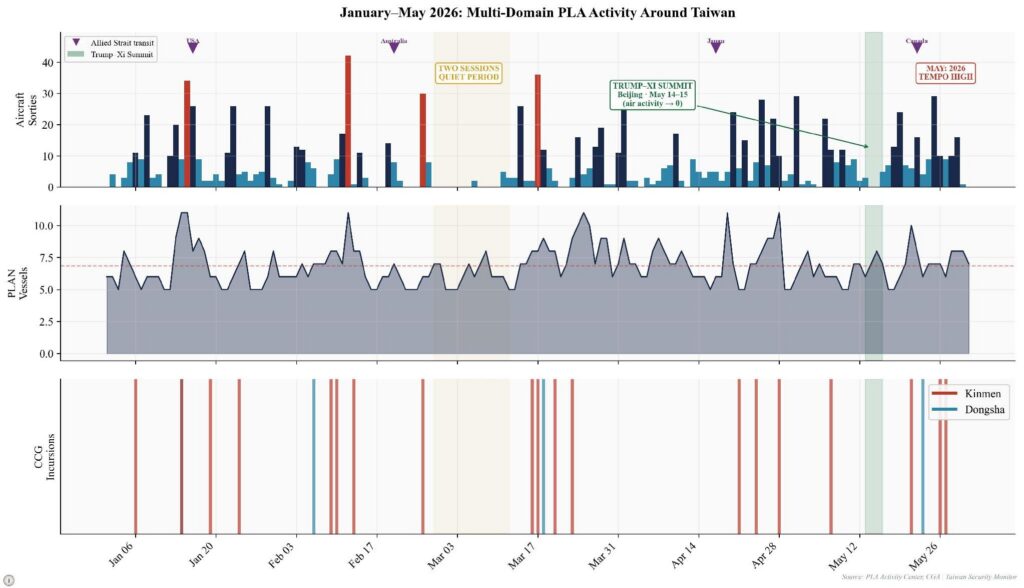
Figure 5. January–May 2026 multi-domain PLA activity: air sorties, naval presence, and CCG incursions. The green band marks the May 14-15 Trump-Xi summit in Beijing; the gold band marks the early-March Two Sessions quiet period. Inverted triangles atop the air panel mark allied Taiwan Strait transits (United States, January 16; Australia, February 20; Japan, April 17; Canada, May 22).
Throughout the first five months of 2026, all three domains have shown a steady upward trend. Air activity was volatile and responsive to political events, dipping to a low in early March before rebounding through April and May to reach the year’s highest point. A key political signal was the pause in sorties during the Trump-Xi summit in mid-March, which was followed by a resumption of activity. Naval presence stayed stable, unaffected by fluctuations in air activity. Coast Guard incursions averaged around five per month, with May reestablishing the Dongsha pattern seen in April and adding a new east-of-Taiwan area at month’s end. Each domain should be analyzed in context. The early-year decline in sortie numbers did not indicate de-escalation, and May’s rebound alone does not suggest escalation. The overall multi-domain posture continues to reflect the sustained PLA activity around Taiwan since August 2022. In May, the PLA maintained this posture at the high end of its 2026 range, despite shifting signals from Washington.
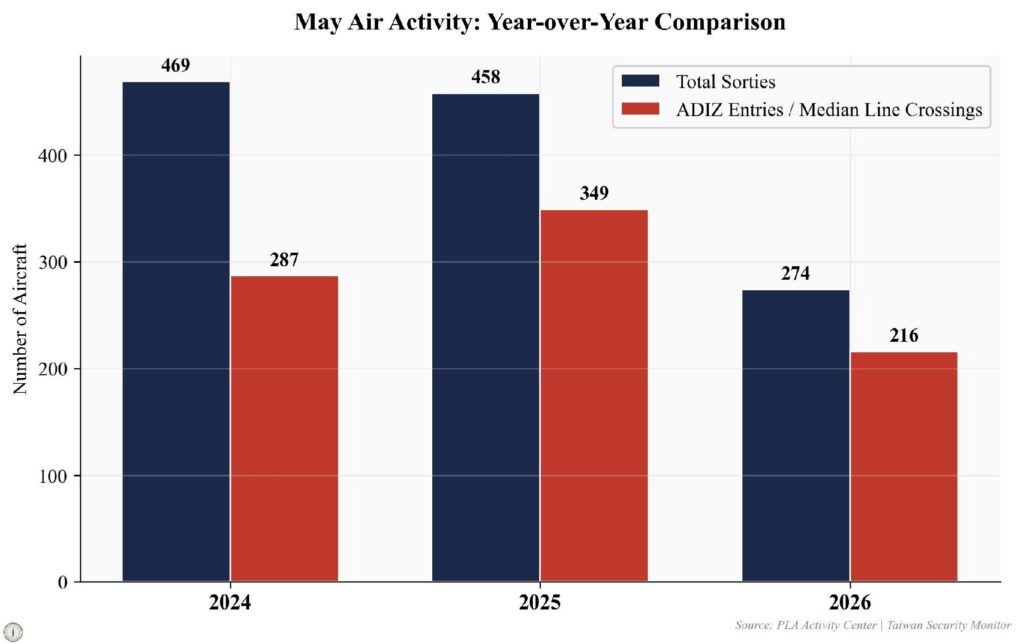
Figure 6. May air activity year-over-year: total sorties and ADIZ entries, 2024–2026.
Methodology & Sources
Air and naval detection data are drawn from daily press releases issued by Taiwan’s Ministry of National Defense and compiled in the PLA Activity Center database maintained by the Taiwan Security Monitor. Coast Guard incident data are compiled from Coast Guard Administration press releases and verified against contemporaneous media reporting in the China Coast Guard Incident Tracker Database. Allied Taiwan Strait transit records are drawn from the Taiwan Strait Transit Tracker maintained by the Taiwan Security Monitor. Contextual and allied developments draw on Taiwan Security Monitor reporting through late May and early June 2026. “ADIZ” denotes Taiwan’s Air Defense Identification Zone; “median line” refers to the informal centerline of the Taiwan Strait historically observed by both sides. “JCRP” denotes Joint Combat Readiness Patrols as designated by Taiwan’s MND. All analysis and commentary are by the Taiwan Security Monitor.
© 2026 Taiwan Security Monitor. All rights reserved.