Taiwan Security Monitor

Weekly Security Review: 1/12/26

Author: Jaime Ocon

Happy New Year! Welcome to the first Weekly Security Review of 2026, where we highlight key military, security, and political developments around Taiwan in one straightforward summary!

For those of you subscribed to my Defending Taiwan substack, thank you for your continued support โ€” Iโ€™ll be posting here from now on!

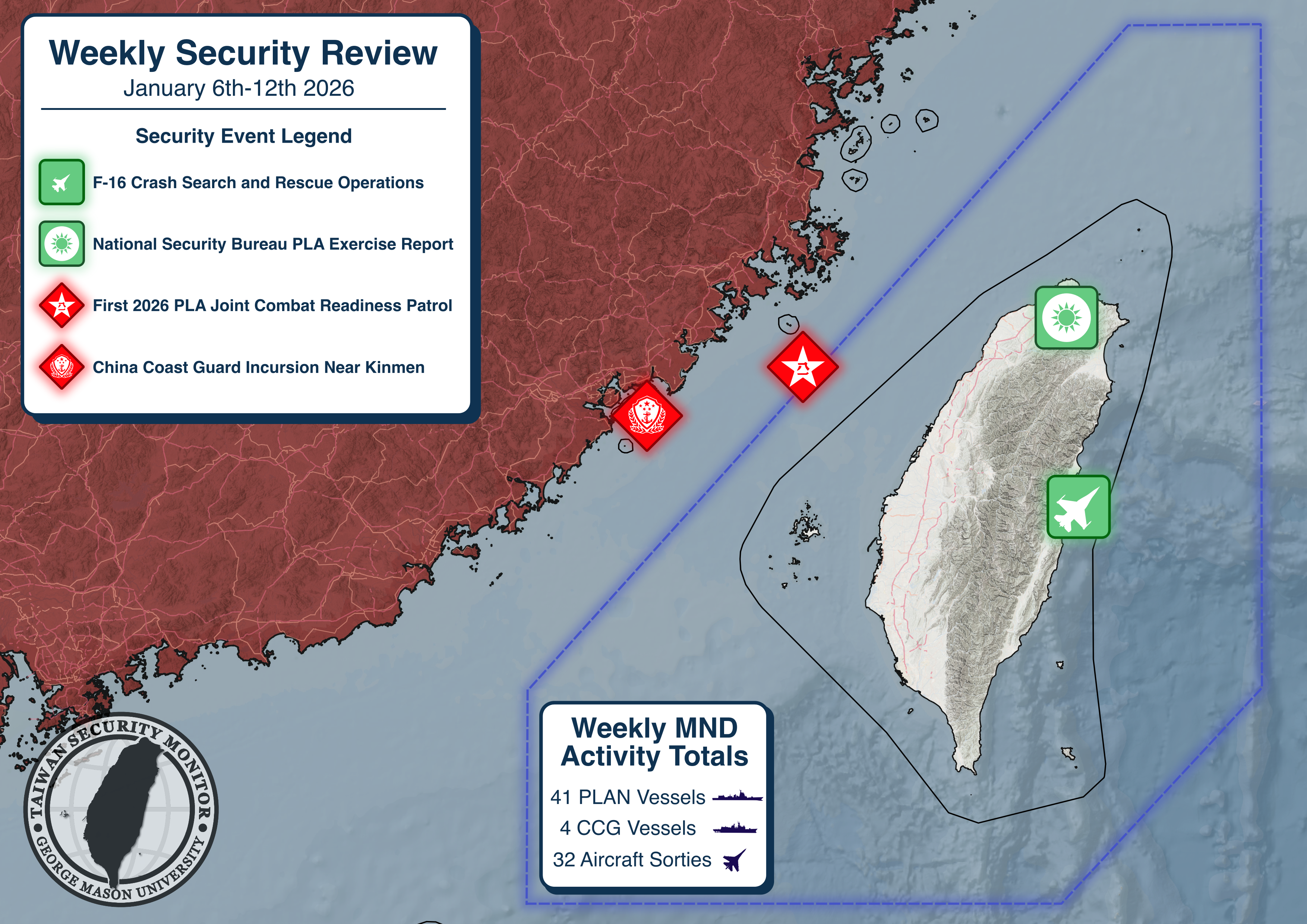
This week, an F-16 pilot is feared dead after crashing into the sea during a routine nighttime training. The National Security Bureau revealed more information regarding the recently concluded Justice Mission-2025 exercise, the PLA conducted its first โ€œJoint Combat Readiness Patrolโ€ of 2026, and several China Coast Guard vessels briefly entered Kinmenโ€™s restricted waters.

Military โ€œNot Losing Hopeโ€ as Search Continues After F-16V Crash

An ROCAF F-16V, serial no. 6700 of the 5th Tactical Fighter Wing in Hualien, crashed into the waters east of Taiwan during a routine nighttime training exercise late on Tuesday (6 January). The military is still unaware whether or not the pilot, Captain Hsin Po-yi (่พ›ๆŸๆฏ…), ejected from the aircraft, despite noticing he was โ€œpreparing to eject, eject, ejectโ€. The Air Force lost radar contact with the fighter jet at 1928, and no transponder signal from an ejection seat has been found.

Coast Guard personnel conduct nighttime search and rescue operations

Rescue efforts have been slowly expanding as Army and National Airborne Service Corps Black Hawk helicopters conduct frequent low-altitude search flights over waters off Taitung and Hualien. Meanwhile, vessels from the Coast Guard Administration (CGA) continue 24/7 search-and-rescue operations. As of 9 a.m. Friday (9 January), the Navy and CGA dispatched a total of 22 vessels, involving roughly 300 ground personnel and 30 aircraft sorties, including 2 UAVs. Taiwanโ€™s fleet of F-16s was grounded for inspection following the crash, but is now back in service.

A press conference from the Air Force revealed that audio logs indicate the pilot lost contact with his formation at 1927 after flying into clouds. Flight conditions showed visibility at 9km, with light rain. Capt. Hsin then reported that his altitude was continuing to drop and that he would eject from his aircraft. That was roughly eight seconds before its radar signal vanished at an altitude of 1700ft and roughly 36 nautical miles (66.6 kilometers) south of Hualien Air Force Base.

Local media have speculated that an engine may have exploded, citing nearby dashcam footage that appears to show a fireball descending in the vicinity of the crash site. Others have suggested a possible software issue involving the aircraftโ€™s Modular Mission Computer (MMC). The military has not yet identified the cause and says it is conducting a full investigation.

Minister of National Defense  Wellington Koo oversees search and rescue efforts for a missing F-16V pilot

In response to Tuesdayโ€™s crash, Minister of National Defense Wellington Koo announced that the Air Force would move quickly to install Automatic Ground Collision Avoidance Systems (Auto-GCAS) on all of its F-16V jets by next year. Taiwan has the largest fleet of F-16s deployed in Asia, with 141 upgraded F-16A/Bs and 66 newer F-16V Block 70s expected to arrive starting this year. Tuesdayโ€™s incident is the latest in a series of unfortunate training accidents that have not only resulted in lost aircraft but have also taken the lives of a handful of armed service members. Below is a list of recent F-16 accidents:

  • August 1999: Aircraft suffers a likely mechanical failure during training, the pilot ejects safely, and the jet crashes.
  • March 2008: Aircraft crashes into the sea during a nighttime training mission near Hualien; pilot Ting Shih-pao (ไธไธ–ๅฏถ) is later formally declared dead.
  • May 2013: Aircraft crashes into the sea near Chiayi during a training mission; the pilot ejects safely, and the jet crashes.
  • January 2016: Pilot Kao Ting-cheng (้ซ˜้ผŽ็จ‹) killed in a crash during a training exercise at Luke Air Force Base in the United States.
  • June 2018: Aircraft crashes into Wufen Mountain in Keelung City during Han Kuang military exercises, pilot Wu Yen-ting killed.
  • November 2020: Aircraft disappears from radar shortly after takeoff from Hualien Air Base, pilot Chiang Cheng-chih (่”ฃๆญฃๅฟ—) later formally declared dead.
  • January 2022: Aircraft crashes into the sea during a ground-attack training mission at Shuixi Shooting Range near Chiayi Air Base, pilot Andy Chen (้™ณๅฅ•) killed.

NSB Report of Chinaโ€™s โ€œJustice Mission-2025โ€

On 8 January, Taiwanโ€™s National Security Bureau (NSB) submitted a report and testified to the Legislative Yuan regarding Chinaโ€™s recent JusticeMission-2025 military exercises. The full public report can be found here: NSB Report, Justice-Mission 2025

In short, the NSB  told lawmakers that Chinaโ€™s โ€œJustice Mission-2025โ€ drills were intended to counter growing international support for Taiwan and possibly distract from Beijingโ€™s economic difficulties. The exercises involved dozens of rocket launches and a large-scale deployment of warships and aircraft, disrupting Taiwanโ€™s air traffic and raising concerns among regional and Western partners. The drills were among the most expansive to date in terms of geographic coverage and were intended to advance a political goal of pushing back against support from democratic countries.  The NSB said that Beijing wanted to redirect domestic discontent in China into nationalist sentiment under the banner of โ€œresisting external interference.โ€โ€‹

Legislators in the LY question Defense and National Security officials

In the report, the NSB also highlighted that recent statements by Japanese Prime Minister Sanae Takaichi, including concerns that an attack on Taiwan could constitute an existential threat to Japan, could have added to Beijingโ€™s efforts to reassert its claims in the region.

The report described Chinaโ€™s heavy use of information operations and cyber activity during the drills, ranging from state-media narratives and AI-generated content to coordinated โ€œtroll armies.โ€ The NSB said these networks produced more than 19,000 inflammatory posts from nearly 800 accounts over five days, aiming to erode confidence in Taiwanโ€™s military and sow doubt about U.S. support. It also reported more than two million cyberattacks on government systems in the first two days of the exercises, and identified PLA-linked groups, such as APT24 and BlackTech, as key actors.

According to the NSB, Beijing is increasingly synchronizing cyber operations with military exercises to weaken public morale and degrade Taiwanโ€™s information environment by amplifying fear and uncertainty.

Chinaโ€™s First Joint Combat Readiness Patrol of 2026

Also on 8 January, the MND reported the 1st PLA Joint Combat Readiness Patrol of 2026. Starting from 1456, a total of 21 PLAAF aircraft, including J-10 fighters, H-6K bombers, KJ-500 early warning aircraft, and UAVs, were detected operating around Taiwan. 19 of the aircraft crossed the median line of the Taiwan Strait and its Air Defense Identification Zone (ADIZ). Taiwanโ€™s military added that these aircraft operated in coordination with Chinese naval vessels and harassed Taiwanโ€™s surrounding air and maritime areas.

Taiwanโ€™s military said it employed joint intelligence, surveillance, and reconnaissance measures to maintain close oversight of the situation and dispatched aircraft, naval vessels, and land-based missile systems as a response. Both in 2024 and 2025, the PLA conducted 40 combat readiness patrols, typically taking place every other week.

Earlier in 2025, an intelligence officer explained that the phrase โ€œJoint Combat Readiness Patrolโ€ (่ฏๅˆๆˆฐๅ‚™่ญฆๅทก) is used by the MND to signal a difference from the PLAโ€™s routine patrols around Taiwan. Colonel Hu Zhong-hua, deputy director of the MNDโ€™s Intelligence Research Center, said the ministry defines Joint Combat Readiness Patrols as PLA joint training that involves coordinated activities from both sea and air forces, and is derived from gathering years of PLA behavior and patterns.

China Coast Guard Incursion into Kinmenโ€™s Restricted Waters

Finally, this week also marked the yearโ€™s first incursion by China Coast Guard (CCG) vessels into the restricted waters surrounding the outlying island of Kinmen. Four CCG vessels were detected by Taiwanโ€™s Coast Guard Administration (CGA) at 1400 local on 6 December. These vessels entered Kinmenโ€™s restricted waters at 1510 before exiting two hours later at 1712.

Taiwanโ€™s CGA deployed its own vessels to conduct parallel shadowing throughout the incursion, which it condemned as an instance of Beijingโ€™s strategy of gray-zone harassment towards Taiwan.

Taiwan Arms Sale Backlog, December 2025 Update

Trump Administration Notifies Congress of $11 Billion in New Taiwan Arms Sales

By Eric Gomez and Joseph Oโ€™Connor

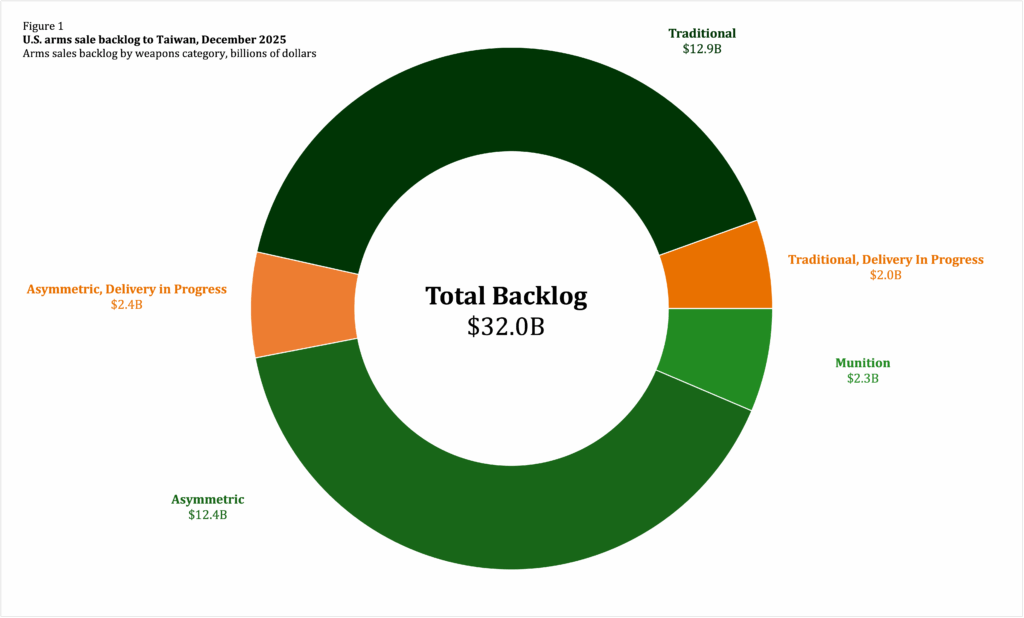
On December 17, 2025, the Trump administration notified Congress of over $11 billion worth of new Foreign Military Sales (FMS) cases to Taiwan, the largest ever package of US arms sales to Taiwan by dollar value. This new package raises the total dollar value of the US arms sale backlog to Taiwan to approximately $32 billion. At least $4.4 billion of this amount has been partially delivered to Taiwan.

Seeing such a steep growth in the total dollar value of the backlog seems alarming at first glance, but overall, the December 2025 FMS cases are a good thing for Taiwan. The new arms sales are heavily weighted in favor of asymmetric systems that will likely be produced and delivered rapidly.

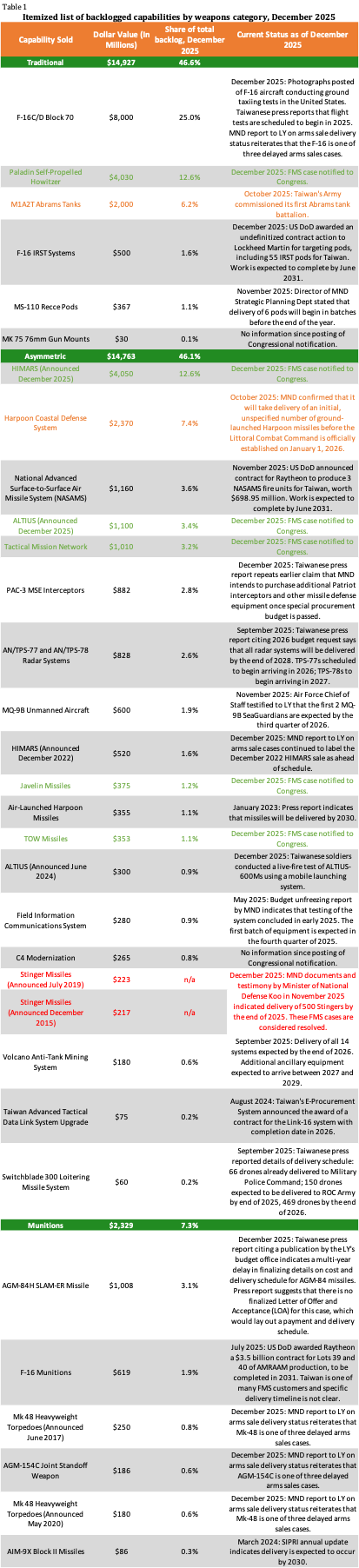
As always, Figure 1 shows how the backlog is divided between traditional systems, asymmetric systems, and munitions. Table 1 is an itemized list of the FMS cases that Taiwan is waiting to receive, with the latest information on delivery schedules. In Table 1, items in green text are new additions to the backlog; those in red text are newly delivered items that have been removed from the backlog, and yellow/orange text represents arms sales worth at least $1 billion that are partially delivered.

Breaking Down the December Package

The Arms Export Control Act requires that Congress receive notification of new FMS cases above a certain dollar threshold before those cases can advance. After notification, Congress has a specified period, depending on the recipient country (30 days in Taiwanโ€™s case), during which it can block the sale by passing a joint resolution of disapproval. If Congress does not pass such a resolution, then the FMS sale goes ahead. Congressional notifications are how Taiwan Security Monitor establishes its universe of arms sales for the backlog.

The $11 billion package contains eight unique FMS cases. The new cases are heavily weighted in favor of asymmetric capabilities, which represent five cases worth approximately $6.9 billion. The other three sales are for one traditional capability (Paladin self-propelled howitzers) and two maintenance sales (spare and repair parts for Harpoon missiles and attack helicopters).

The distinction between asymmetric capabilities, traditional capabilities, and munitions is explained in a November 2023 article by Eric Gomez, published with the Cato Institute, during the nascency of the backlog dataset. Additionally, the two maintenance sales have not been added to the backlog because they support capabilities that Taiwan already possesses, and tracking the delivery of spare parts is not possible with the available data.

Asymmetric Capabilities: 5 Cases, $6.9 Billion

The most heartening aspect of the December 2025 FMS package to Taiwan is its heavy emphasis on asymmetric weapons systems. Taiwan has historically under-invested in asymmetric capabilities, which are less flexible, but tend to be less expensive, more mobile, and harder for Chinaโ€™s military to counter in a high-intensity conflict.

When Gomez published the first version of the Taiwan arms backlog dataset in late 2023, asymmetric capabilities were $4.2 billion out of $19.17 billion, or 22 percent. With the December 2025 arms sales, these numbers are now $14.7 billion out of $32 billion, or 46 percent. This growing emphasis on asymmetric capabilities is a step in the right direction for Taiwan.

The five December 2025 asymmetric capabilities arms sales are:

  1. HIMARS launchers and munitions, $4.05 billion
  2. ALTIUS loitering munitions/drones, $1.1 billion
  3. Tactical Mission Network, $1.01 billion
  4. Javelin Missiles, $375 million
  5. TOW Missiles, $353 million

There are several things to note with this mix of capabilities:

Firstly, the two largest arms sales in this categoryโ€”HIMARS rocket artillery launchers and ALTIUS dronesโ€”are on efficient production lines, which means they will likely be delivered to Taiwan relatively quickly. According to Taiwanโ€™s Ministry of National Defense, a December 2022 sale of HIMARS launchers and munitions that should arrive in 2026 is the only FMS case out of 14 that is considered ahead of schedule. ALTIUS drones likewise have arrived in Taiwan rapidly, with an initial tranche arriving in Taiwan (August 2025) only a little over one year after Congress was notified of the sale (June 2024).

Secondly, our dataset codes Javelin and TOW missiles as asymmetric weapons and not munitions because both FMS cases include other systems besides the missiles themselves that make it more appropriate to see them as an asymmetric capability rather than just munition reloads. The Javelin sale includes additional launcher units, while the TOW sale includes kits to mount launchers to Humvee vehicles.

Finally, once Taiwan receives the 82 HIMARS launchers from the December sale on top of the 29 from previous arms sales, it will have the second-largest inventory of HIMARS in the world after the United States. HIMARS has demonstrated its value as an asymmetric, long-range precise rocket artillery system in the ongoing war in Ukraine, and it is in high demand in Taiwan, alongside many frontline NATO countries. The range and mobility of HIMARS make it an excellent choice for an asymmetric defense strategy.

Traditional Capabilities: 1 Case, $4.03 Billion

The only traditional capability in the December 2025 arms sale package is the sale of 60 M109A7 Paladin self-propelled howitzers plus support equipment such as ammunition carriers and armored recovery vehicles. Taiwan previously attempted to purchase 40 M109A6 Paladins in 2021, but shortly after the Ukraine war began, the sale was cancelled, and Taiwan instead focused on buying additional HIMARS.

Taiwan could have probably found better ways to spend $4 billion, but in the world of traditional capabilities, self-propelled howitzers are not that bad an investment. Artillery pieces are still important in modern battlefields, and while it may not be as mobile as a HIMARS launcher, a Paladin can still use mobility to improve its survivability. Taiwan also already operates earlier variants of the Paladin, which should help with the quick absorption of the new systems. Finally, the defense industrial base has improved its production rates of 155mm artillery shells and Paladin howitzers because of the Ukraine war, which will hopefully mean a shorter gap between Congressional notification and delivery to Taiwan.

Stinger Delivery Completed

While the massive recent arms sale package has understandably received most of the attention this month, there were two arms sales that were removed from the backlog. Taiwan was waiting on the delivery of 500 Stinger man-portable air defense missiles that were sold across two FMS cases (December 2015 and July 2019) worth a combined $440 million.

Though Taiwan originally planned on purchasing just 250 for the Navy, and got relatively close to finalizing a contract a few years after the 2015 notification to Congress, the Taiwanese Army desired Stingers of its own, halting progress on the sale to allow for renegotiations. A 2024 MND document further mentions that supply chain issues and material shortages exacerbated by the COVID-19 pandemic contributed to sluggish progress on Stinger production, and that since 2021, there have been two official letters of protest submitted about the project.

A budget unfreezing report from earlier in 2025 and testimony by Defense Minister Wellington Koo to the Legislative Yuan in November indicated that Taiwan would finally receive a delivery of 500 Stingers, which would satisfy the two FMS cases, by the end of 2025. Taiwan has reportedly developed plans to purchase approximately 2,000 additional Stingers from the United States, but such a sale has not yet received Congressional notification.

Other Case Updates: F-16 Testing and IRST Production

News emerged about the status of F-16V production this month, as the first Taiwanese airframe, #6831, underwent taxiing tests on December 20 and a flight test on December 30, both at Lockheed Martinโ€™s production facility in Greenville, South Carolina. Delivery of the aircraft and additional testing of more airframes are expected to begin early this year. Once the first airframe arrives in Taiwan, we will mark the F-16 case as being a delivery in progress.

On December 31, the U.S. Air Force awarded a $328.5 million undefinitized contract action (UCA) to Lockheed Martin for production of three types of targeting pods, including Sniper, IRST, and LANTIRN pods. Of this, 55 IRST pods are to be produced for the ROCAF, using $157.3 million worth of FMS funds for Taiwan, and work is expected to be completed by June 2031. It is worth noting that a UCA is expressly not final in terms of cost and quantity, but authorizes production of those systems. The last update for the IRST case was in June 2024, when a contract was signed for production.

Conclusion

The December 2025 arms sale package significantly increases the size of the backlog while also improving its underlying composition. Unlike previous FMS cases that added slow-to-deliver, traditional capabilities like F-16s and Abrams tanks, the new cases prioritize asymmetric systems, which will likely have faster production times and have a lower per-unit cost. A Taiwanese military that is better prepared to implement an asymmetric defense strategy should be able to impose costs on China through dispersed fires, expendable unmanned systems, and mobile air defense.

This update also highlights the main challenge for 2026: closing the gap between FMS notification to Congress and weapons in the hands of Taiwanโ€™s soldiers. The recently completed Stinger cases show how even sales of asymmetric capabilities can be slowed down by bureaucratic inefficiencies, supply chain disruption, and defense industry bottlenecks. Maintaining progress on HIMARS, ALTIUS, and other asymmetric programs will require ongoing prioritization by both governments, transparent delivery timelines, and consistent follow-through on training, basing, and sustainment.

Weekly PRC Media Review: 1/9/26

Author: Ethan Connell


Hereโ€™s the latest edition of the TSM PRC State Media Tracker. Each Friday, we highlight key excerpts from Chinaโ€™s state media organs, such as the Ministry of Foreign Affairs, the Ministry of National Defense, and the Taiwan Affairs Office, all below!

“Legal Taiwan Independence” Will Be Crushed

7 January 2026

On the recent initiative by Taiwanese DPP lawmaker Lin I-chin to codify a two-state solution, with the aim to “legally define the relationship between Taiwan and the People’s Republic of China (PRC) as an equal, state-to-state relationship”:

At the January 7 press conference of the Taiwan Affairs Office of the State Council, a reporter asked: According to Taiwanese media reports, a Democratic Progressive Party (DPP) legislator proposed amending the current โ€œAct Governing Relations Between the People of the Taiwan Area and the Mainland Areaโ€ to define cross-Strait relations as โ€œTaiwan and the Peopleโ€™s Republic of China,โ€ and to delete the wording โ€œbefore national reunificationโ€ from the original provisions. Other media reports say that the proposer has already withdrawn the bill, while the proposer himself claims that โ€œit has not yet been formally submitted.โ€ What is your comment?

In response, Chen Binhua, spokesperson for the Taiwan Affairs Office of the State Council, said that they are paying close attention to these developments. He said that the proposal ignores the mainstream public opinion in Taiwan and the peace and well-being of Taiwan compatriots, openly challenges the historical and legal fact that Taiwan is part of China, and attempts to change the status quo in the Taiwan Strait in which there is only one China and both the mainland and Taiwan belong to one China. He said it is a naked attempt to push โ€œlegal Taiwan independence,โ€ deliberately escalating cross-Strait tensions and undermining peace and stability in the Taiwan Strait and the region. Its intentions are sinister and its nature is egregious, fully demonstrating that the Lai Ching-te authorities and the DPP are nothing less than โ€œdestroyers of peace,โ€ โ€œmanufacturers of crises,โ€ and โ€œinstigators of war.โ€

Chen said that โ€œTaiwan independenceโ€ means war and is a dead end with no way out. He said China has full confidence and sufficient capability to smash any attempt at โ€œlegal Taiwan independenceโ€ in any form, and will never allow โ€œTaiwan independenceโ€ separatist forces, under any name or in any way, to split Taiwan from China.

Chen added that history has already proven and will continue to prove that pursuing โ€œTaiwan independenceโ€ separatism will never end well and will only lead to complete defeat. If โ€œTaiwan independenceโ€ separatist forces dare to take reckless risks and cross red lines, China will, in accordance with the Anti-Secession Law, take resolute measures and deliver a head-on blow. He expressed the hope that Taiwan compatriots will clearly recognize the evil nature and grave harm of โ€œTaiwan independence,โ€ firmly stand on the correct side of history, resolutely oppose โ€œTaiwan independenceโ€ separatist activities, and join together to safeguard peace and stability in the Taiwan Strait and protect the shared home of the Chinese nation.

“Taiwan Independence” Will be Punished For Life

7 January 2026

On the announcement of another round of “Taiwan independence elements”, which brings the total to 26 individuals:

At the January 7 press conference of the Taiwan Affairs Office of the State Council, a reporter asked: In recent years, the mainland has released several batches of lists of โ€œdiehard Taiwan independenceโ€ elements and โ€œTaiwan independenceโ€ enforcers and accomplices. How many people are currently on each list? Will punishment be further intensified in the future to bring them to justice? Some public opinion on the island says that the mainlandโ€™s punitive measures currently have no substantive impact on these individuals. What is the spokespersonโ€™s comment on this?

In response, Chen Binhua, spokesperson for the Taiwan Affairs Office of the State Council, said that โ€œTaiwan independenceโ€ elements are criminals who split the country and undermine cross-Strait relations, and are also national traitors who seek โ€œindependence,โ€ provoke war, and harm the interests and well-being of their compatriots. As of now, 14 โ€œdiehard Taiwan independenceโ€ elements and 12 โ€œTaiwan independenceโ€ enforcers and accomplices have been announced.

He said that any โ€œTaiwan independenceโ€ elements who break the law, no matter where they are, will face all necessary measures: they will be punished in accordance with the law and held accountable for life.

Momentum Builds For National Reunification

7 January 2026

A summary of developments in cross-Strait relations in the past year and predictions for the year ahead:

At the January 7 press conference of the Taiwan Affairs Office of the State Council, a reporter asked the spokesperson to summarize developments in cross-Strait relations in 2025 and to look ahead to cross-Strait relations in 2026.

In response, Chen Binhua, spokesperson for the Taiwan Affairs Office of the State Council, said that 2025 was a year in which cross-Strait relations pressed ahead through difficulties and momentum was built for national reunification. They firmly grasped the initiative and leadership in cross-Strait relations, pushed exchanges, cooperation, and integrated development to a higher level, demonstrated stronger capabilities to deter โ€œTaiwan independenceโ€ separatism and external interference, accumulated stronger momentum for advancing reunification, and gathered greater strength for promoting the great rejuvenation of the Chinese nation.

First, they broke through obstacles and continued to expand cross-Strait exchanges and cooperation. They worked to overcome obstruction and restrictions imposed by the Democratic Progressive Party (DPP) authorities, continued to expand people-to-people exchanges and cooperation across various fields, and promoted closer ties between compatriots on both sides and deeper, more substantive cooperation. They significantly increased the number of ports where Taiwan compatriots can obtain permits on arrival, introduced policies such as waiving the Taiwan Compatriot Permit application fee for โ€œfirst-time applicantsโ€ and offering airfare discounts, and provided โ€œgreater openness, maximum convenience, and greater safetyโ€ for Taiwan compatriots traveling to and from the mainland. They successfully held events such as the Straits Forum, the Cross-Strait Chinese Culture Summit, and the Cross-Strait Grassroots Livelihood Development Exchange Conference, leading a new wave of exchanges. The numbers of Taiwan compatriots, Taiwanese youth, and โ€œfirst-time visitorsโ€ coming to the mainland rose sharply. More and more Taiwan compatriots personally experienced the magnificence of the motherlandโ€™s landscapes, felt the dynamic vitality of Chinese-style modernization, appreciated the unique charm of Chinese culture, and took pride in being upright and dignified Chinese.

Second, they continued to deepen cross-Strait integrated development and share the opportunities of Chinese-style modernization. The Fourth Plenary Session of the 20th CPC Central Committee reviewed and adopted the recommendations for the 15th Five-Year Plan, making top-level design and strategic planning for development over the next five years. This provides strong impetus for Chinese-style modernization and opens broader space for Taiwan compatriots and enterprises to establish themselves and develop on the mainland. They respect, care for, and benefit Taiwan compatriots, implement policies of equal treatment for Taiwan compatriots and enterprises, and push for policies benefiting them to be implemented effectively. They advanced the construction of the cross-Strait integrated development demonstration zone with high quality, introduced a new batch of policies to deepen integrated development, and achieved new progress and results in Fujianโ€“Taiwan integration. They held the 2025 Cross-Strait Entrepreneurs Summit Annual Meeting and dozens of cross-Strait economic and trade exchange activities, sharing the opportunities and achievements of Chinese-style modernization with Taiwan businesspeople and enterprises. They effectively responded to external tariff bullying, safeguarded the Chinese nationโ€™s economy, and protected the interests of Taiwan businesses and enterprises on the mainland. More and more Taiwan compatriots have come to deeply recognize that both sides of the Strait form an inseparable community of shared destiny, and that the mainland is always a strong backing for Taiwan compatriots and enterprises.

Third, they resolutely opposed โ€œTaiwan independenceโ€ separatism and external interference and firmly safeguarded the shared home of the Chinese nation. They held a symposium marking the 20th anniversary of the implementation of the Anti-Secession Law, conducted the โ€œStrait Thunderโ€“2025Aโ€ and โ€œJustice Missionโ€“2025โ€ exercises, firmly defended national sovereignty and territorial integrity, and resolutely safeguarded the common interests of compatriots on both sides of the Strait and the fundamental interests of the Chinese nation. They punished in accordance with the law โ€œdiehard Taiwan independenceโ€ elements and their enforcers and accomplices, effectively deterring separatist provocations. They firmly upheld the authority of UN General Assembly Resolution 2758, continued to consolidate the international one-China framework, and effectively curbed external forcesโ€™ use of the โ€œTaiwan card.โ€ They united the broad masses of Taiwan compatriots, upheld the one-China principle and the โ€œ1992 Consensus,โ€ jointly opposed โ€œTaiwan independenceโ€ separatism and external interference, firmly safeguarded the shared home of the Chinese nation, and kept the future and destiny of the nation firmly in the hands of Chinese on both sides of the Strait. More and more people on the island have seen clearly the historical trend that the motherland will inevitably be reunified and have voiced hopes that cross-Strait relations will return to the correct track of peaceful development.

Chen said that on the eve of the New Year in 2026, President Xi Jinping delivered a New Year address, extending New Year greetings to Chinese at home and abroad, in which he emphasized that โ€œcompatriots on both sides of the Strait are bound by blood, and the historical trend toward national reunification is unstoppable.โ€ In the new year, they will thoroughly implement the Partyโ€™s overall strategy for resolving the Taiwan question in the new era, uphold the one-China principle and the โ€œ1992 Consensus,โ€ resolutely oppose โ€œTaiwan independenceโ€ separatism and external interference, unite the broad masses of Taiwan compatriots, promote the peaceful development of cross-Strait relations, and advance the great cause of national reunification.

He expressed the hope that Taiwan compatriots will continue to strengthen their resolve, backbone, and confidence in being Chinese, work together to promote the peaceful development of cross-Strait relations and advance the cause of national reunification, and strive unremittingly for the shared future of Chinese on both sides of the Strait.

Sanctions against Liu Shifang, Cheng Yingyao, and Chen Shuyi

7 January 2026

On the announcement that Taiwanese Interior Minister Liu Shih-fang and Education Minister Cheng Ying-yao had been designated as “die-hard pro-independence elements,” along with Taiwan High Prosecutors Office prosecutor Chen Shu-yi, who was labeled as a henchman and accomplice of pro-independence forces, with threats of lifelong prosecution:

At the January 7 press conference of the Taiwan Affairs Office of the State Council, spokesperson Chen Binhua announced that the mainland has designated Liu Shifang and Cheng Yingyao as โ€œdiehard Taiwan independenceโ€ elements, and Chen Shuyi as a โ€œTaiwan independenceโ€ enforcer and accomplice.

Chen Binhua said that he was announcing two decisions by the mainland. First, Liu Shifang and Cheng Yingyao are being designated as โ€œdiehard Taiwan independenceโ€ elements and will be punished in accordance with the law. Compatriots on both sides of the Strait share the same roots, culture, and heritage, and the common aspiration of people on both sides is for peace, development, exchange, and cooperation. Liu Shifang and Cheng Yingyao have gone against this trend, committed numerous โ€œTaiwan independenceโ€ misdeeds, and aroused strong indignation among compatriots on both sides of the Strait. Many members of the public have reported them to the Taiwan Affairs Office of the State Council, demanding that they be punished.

Chen said that Liu Shifang has openly propagated โ€œTaiwan independenceโ€ separatist fallacies, harshly suppressed Taiwanese figures who support or participate in cross-Strait exchanges and cooperation, persecuted mainland spouses in Taiwan, and tried by every means to set up obstacles to cross-Strait travel and block channels for communication between people on both sides. Cheng Yingyao has vigorously promoted provocative โ€œindependence-seekingโ€ rhetoric, organized the compilation of โ€œTaiwan independenceโ€ teaching materials to poison young people on the island, and obstructed cross-Strait educational exchanges and cooperation. Both Liu and Cheng are stubborn in their โ€œTaiwan independenceโ€ ideology, brazen in their separatist rhetoric, and egregious in their actions. They have openly sought to split the country and incited secession, seriously undermined cross-Strait exchanges and cooperation, gravely damaged the peaceful development of cross-Strait relations, and seriously harmed the interests and well-being of compatriots on both sides of the Strait.

Chen said that, in accordance with relevant laws and regulations, the mainland has decided to place Liu Shifang and Cheng Yingyao on the list of โ€œdiehard Taiwan independenceโ€ elements and impose sanctions on them. They and their family members are banned from entering the mainland and the Hong Kong and Macao Special Administrative Regions; institutions associated with them are restricted from cooperating with relevant organizations and individuals on the mainland; their associated enterprises and financial backers will not be allowed to seek profits on the mainland; and other necessary punitive measures will be taken. They will be held legally accountable for life. Compatriots on both sides of the Strait are welcome to continue providing information on the illegal and criminal activities of Liu Shifang and Cheng Yingyao.

Chen pointed out that โ€œTaiwan independenceโ€ separatism is a serious scourge to the peaceful development of cross-Strait relations, and that punishing in accordance with the law the very small number of โ€œdiehard Taiwan independenceโ€ elements is meant to fundamentally safeguard national sovereignty and territorial integrity and protect the vital interests and well-being of Taiwan compatriotsโ€”it is by no means directed at the broad masses of Taiwan compatriots. He expressed the hope that Taiwan compatriots will clearly recognize the Taiwan-harming nature, sinister intentions, and ugly true face of this tiny number of โ€œdiehard Taiwan independenceโ€ elements, consciously draw a clear line between themselves and people like Liu Shifang and Cheng Yingyao, resolutely oppose โ€œTaiwan independenceโ€ separatist activities, firmly promote cross-Strait exchanges, cooperation, and integrated development, safeguard the shared home of the Chinese nation, and jointly create enduring well-being for compatriots on both sides of the Strait.

Chen then announced the second decision: Chen Shuyi, described as a โ€œgreen judicial thug,โ€ is being designated a โ€œTaiwan independenceโ€ enforcer and accomplice and will be held legally accountable for life. According to investigations, Chen Shuyi, a prosecutor with Taiwanโ€™s โ€œHigh Prosecutors Office,โ€ has willingly acted as an enforcer and accomplice of โ€œTaiwan independence,โ€ fabricated charges, manufactured wrongful cases, persecuted Taiwanese individuals who support or participate in cross-Strait exchanges and cooperation, intimidated the public, and created a โ€œgreen terror.โ€ Her actions are of a vile nature and constitute serious crimes. The authorities are hereby continuing to solicit clues and evidence of Chen Shuyiโ€™s illegal and criminal activities from both sides of the Strait (which can be sent to: [email protected]). They will base their actions on facts and the law and will punish Chen Shuyi in accordance with the law and hold her accountable for life.

Trump’s Statement on Taiwan

9 January 2026

On US President Donald Trump, who told the New York Times itโ€™s โ€œup toโ€ Xi Jinping what China does regarding Taiwan, and said he warned Xi heโ€™d be โ€œvery unhappyโ€ if Beijing changed the status quo:

Reuters reporter: Some analysts say China might draw lessons from the U.S. military strike on Venezuela. President Trump told The New York Times that if China seeks to change the status quo in Taiwan during his term, he would be very displeased. What is the Foreign Ministryโ€™s comment on Trumpโ€™s remarks? Mao Ning: Taiwan is an inalienable part of Chinaโ€™s territory. The Taiwan question is purely Chinaโ€™s internal affair. Resolving the Taiwan question is a matter for the Chinese people themselves and brooks no external interference.

Taiwan Affairs Office: Announces that Liu Shifang and Cheng Yingyao have been listed as โ€œdiehard Taiwan independenceโ€ elements, and that Chen Shuyi has been listed as a โ€œTaiwan independenceโ€ enforcer and accomplice.

At the January 7 press conference of the Taiwan Affairs Office of the State Council, spokesperson Chen Binhua announced that the mainland has designated Liu Shifang and Cheng Yingyao as โ€œdiehard Taiwan independenceโ€ elements, and Chen Shuyi as a โ€œTaiwan independenceโ€ enforcer and accomplice.

Chen Binhua said that he was announcing two decisions by the mainland. First, Liu Shifang and Cheng Yingyao are being designated as โ€œdiehard Taiwan independenceโ€ elements and will be punished in accordance with the law. Compatriots on both sides of the Strait share the same roots, culture, and heritage, and the common aspiration of people on both sides is for peace, development, exchange, and cooperation. Liu Shifang and Cheng Yingyao have gone against this trend, committed numerous โ€œTaiwan independenceโ€ misdeeds, and aroused strong indignation among compatriots on both sides of the Strait. Many members of the public have reported them to the Taiwan Affairs Office of the State Council, demanding that they be punished.

Chen said that Liu Shifang has openly propagated โ€œTaiwan independenceโ€ separatist fallacies, harshly suppressed Taiwanese figures who support or participate in cross-Strait exchanges and cooperation, persecuted mainland spouses in Taiwan, and tried by every means to set up obstacles to cross-Strait travel and block channels for communication between people on both sides. Cheng Yingyao has vigorously promoted provocative โ€œindependence-seekingโ€ rhetoric, organized the compilation of โ€œTaiwan independenceโ€ teaching materials to poison young people on the island, and obstructed cross-Strait educational exchanges and cooperation. Both Liu and Cheng are stubborn in their โ€œTaiwan independenceโ€ ideology, brazen in their separatist rhetoric, and egregious in their actions. They have openly sought to split the country and incited secession, seriously undermined cross-Strait exchanges and cooperation, gravely damaged the peaceful development of cross-Strait relations, and seriously harmed the interests and well-being of compatriots on both sides of the Strait.

Chen said that, in accordance with relevant laws and regulations, the mainland has decided to place Liu Shifang and Cheng Yingyao on the list of โ€œdiehard Taiwan independenceโ€ elements and impose sanctions on them. They and their family members are banned from entering the mainland and the Hong Kong and Macao Special Administrative Regions; institutions associated with them are restricted from cooperating with relevant organizations and individuals on the mainland; their associated enterprises and financial backers will not be allowed to seek profits on the mainland; and other necessary punitive measures will be taken. They will be held legally accountable for life. Compatriots on both sides of the Strait are welcome to continue providing information on the illegal and criminal activities of Liu Shifang and Cheng Yingyao.

Chen pointed out that โ€œTaiwan independenceโ€ separatism is a serious scourge to the peaceful development of cross-Strait relations, and that punishing in accordance with the law the very small number of โ€œdiehard Taiwan independenceโ€ elements is meant to fundamentally safeguard national sovereignty and territorial integrity and protect the vital interests and well-being of Taiwan compatriotsโ€”it is by no means directed at the broad masses of Taiwan compatriots. He expressed the hope that Taiwan compatriots will clearly recognize the Taiwan-harming nature, sinister intentions, and ugly true face of this tiny number of โ€œdiehard Taiwan independenceโ€ elements, consciously draw a clear line between themselves and people like Liu Shifang and Cheng Yingyao, resolutely oppose โ€œTaiwan independenceโ€ separatist activities, firmly promote cross-Strait exchanges, cooperation, and integrated development, safeguard the shared home of the Chinese nation, and jointly create enduring well-being for compatriots on both sides of the Strait.

Chen then announced the second decision: Chen Shuyi, described as a โ€œgreen judicial thug,โ€ is being designated a โ€œTaiwan independenceโ€ enforcer and accomplice and will be held legally accountable for life. According to investigations, Chen Shuyi, a prosecutor with Taiwanโ€™s โ€œHigh Prosecutors Office,โ€ has willingly acted as an enforcer and accomplice of โ€œTaiwan independence,โ€ fabricated charges, manufactured wrongful cases, persecuted Taiwanese individuals who support or participate in cross-Strait exchanges and cooperation, intimidated the public, and created a โ€œgreen terror.โ€ Her actions are of a vile nature and constitute serious crimes. The authorities are hereby continuing to solicit clues and evidence of Chen Shuyiโ€™s illegal and criminal activities from both sides of the Strait (which can be sent to: [email protected]). They will base their actions on facts and the law and will punish Chen Shuyi in accordance with the law and hold her accountable for life.

Taiwan Affairs Office: Thoroughly implement the spirit of President Xi Jinpingโ€™s New Year address, promote the peaceful development of cross-Strait relations, and advance the great cause of national reunification.

At the January 7 press conference of the Taiwan Affairs Office of the State Council, a reporter asked: In his 2026 New Year address, President Xi Jinping emphasized that โ€œcompatriots on both sides of the Strait are bound by blood, and the historical trend toward national reunification is unstoppable.โ€ How does the Taiwan Affairs Office interpret this, and how will it implement it?

In response, Chen Binhua, spokesperson for the Taiwan Affairs Office of the State Council, said that President Xiโ€™s New Year address is lofty in vision, profound in thought, and rich in content. It profoundly points out that compatriots on both sides of the Strait share the same roots, culture, and heritage, and form a community of shared destiny bound by blood and by honor and disgrace. Resolving the Taiwan question and achieving complete national reunification is the shared aspiration of all Chinese people. As the building of a strong country and the great rejuvenation of the Chinese nation advance in all respects, China has even greater capability, confidence, and resolve to turn this aspiration into reality. The historical wheel of national reunification and national rejuvenation is rolling forward, and complete reunification of the motherland must be achieved and will certainly be achieved.

Chen said that they will thoroughly implement the spirit of President Xiโ€™s New Year address, uphold the one-China principle and the โ€œ1992 Consensus,โ€ broadly unite Taiwan compatriots, deepen cross-Strait exchanges and cooperation and integrated development, resolutely oppose โ€œTaiwan independenceโ€ separatist activities and external interference, promote the peaceful development of cross-Strait relations, and advance the great cause of national reunification.

He expressed the hope that Taiwan compatriots will follow the historical trend, uphold the greater national cause, and join together with them to safeguard the beautiful home of the Chinese nation, jointly create enduring well-being for the Chinese nation, and share in the great glory of national reunification and national rejuvenation.

Taiwan Affairs Office: Director Song Taoโ€™s New Year message to Taiwan compatriots calls on them to join together in advancing the great cause of national reunification and national rejuvenation.

At the January 7 press conference of the Taiwan Affairs Office of the State Council, a reporter asked: Song Tao, Director of the Taiwan Work Office of the CPC Central Committee and the Taiwan Affairs Office of the State Council, has issued a New Year message titled โ€œForge Ahead Together, Create Well-Being Together.โ€ Please provide an interpretation.

In response, Chen Binhua, spokesperson for the Taiwan Affairs Office of the State Council, said that Director Song Tao issued the New Year message on January 2, first extending New Year greetings and sincere regards to Taiwan compatriots on behalf of the Taiwan Work Office of the CPC Central Committee and the Taiwan Affairs Office of the State Council.

The message reviewed and summarized Taiwan-related work in 2025, stating that it was a year in which all Chinese people remembered history and shared in glory, in which Chinese-style modernization carried forward the past and opened the future through continued effort, and in which cross-Strait relations pressed ahead through difficulties while momentum was built for national reunification. It noted that over the past year, cross-Strait exchanges and cooperation achieved a series of new developments, that the forces safeguarding the peace and security of the homeland grew stronger, and that measures to enhance the interests and well-being of Taiwan compatriots increased. It called on compatriots on both sides of the Strait to follow the trend and seize the momentum, work hand in hand to create enduring well-being for the Chinese nation, and jointly write a splendid chapter in the great rejuvenation of the Chinese nation.

Chen said that the message also elaborated on the key priorities of Taiwan-related work for this year, making clear that they will uphold the one-China principle and the โ€œ1992 Consensus,โ€ promote the peaceful development of cross-Strait relations, and advance the great cause of national reunification. They will create better conditions for Taiwan compatriots to study, work, and live on the mainland, further expand exchanges and cooperation, deepen integrated development, resolutely oppose โ€œTaiwan independenceโ€ separatism and external interference, support patriotic pro-reunification forces on the island, and conduct dialogue and consultations with Taiwanโ€™s political parties, political groups, and people from all sectors on cross-Strait relations and national reunification.

He expressed the hope that Taiwan compatriots will join together with them to firmly safeguard the shared home of the Chinese nation and work together to advance the great cause of national reunification and national rejuvenation.

Taiwan Affairs Office: In 2025, cross-Strait relations pressed ahead through difficulties, while momentum and strength continued to build for national reunification.

At the January 7 press conference of the Taiwan Affairs Office of the State Council, a reporter asked the spokesperson to summarize developments in cross-Strait relations in 2025 and to look ahead to cross-Strait relations in 2026.

In response, Chen Binhua, spokesperson for the Taiwan Affairs Office of the State Council, said that 2025 was a year in which cross-Strait relations pressed ahead through difficulties and momentum was built for national reunification. They firmly grasped the initiative and leadership in cross-Strait relations, pushed exchanges, cooperation, and integrated development to a higher level, demonstrated stronger capabilities to deter โ€œTaiwan independenceโ€ separatism and external interference, accumulated stronger momentum for advancing reunification, and gathered greater strength for promoting the great rejuvenation of the Chinese nation.

First, they broke through obstacles and continued to expand cross-Strait exchanges and cooperation. They worked to overcome obstruction and restrictions imposed by the Democratic Progressive Party (DPP) authorities, continued to expand people-to-people exchanges and cooperation across various fields, and promoted closer ties between compatriots on both sides and deeper, more substantive cooperation. They significantly increased the number of ports where Taiwan compatriots can obtain permits on arrival, introduced policies such as waiving the Taiwan Compatriot Permit application fee for โ€œfirst-time applicantsโ€ and offering airfare discounts, and provided โ€œgreater openness, maximum convenience, and greater safetyโ€ for Taiwan compatriots traveling to and from the mainland. They successfully held events such as the Straits Forum, the Cross-Strait Chinese Culture Summit, and the Cross-Strait Grassroots Livelihood Development Exchange Conference, leading a new wave of exchanges. The numbers of Taiwan compatriots, Taiwanese youth, and โ€œfirst-time visitorsโ€ coming to the mainland rose sharply. More and more Taiwan compatriots personally experienced the magnificence of the motherlandโ€™s landscapes, felt the dynamic vitality of Chinese-style modernization, appreciated the unique charm of Chinese culture, and took pride in being upright and dignified Chinese.

Second, they continued to deepen cross-Strait integrated development and share the opportunities of Chinese-style modernization. The Fourth Plenary Session of the 20th CPC Central Committee reviewed and adopted the recommendations for the 15th Five-Year Plan, making top-level design and strategic planning for development over the next five years. This provides strong impetus for Chinese-style modernization and opens broader space for Taiwan compatriots and enterprises to establish themselves and develop on the mainland. They respect, care for, and benefit Taiwan compatriots, implement policies of equal treatment for Taiwan compatriots and enterprises, and push for policies benefiting them to be implemented effectively. They advanced the construction of the cross-Strait integrated development demonstration zone with high quality, introduced a new batch of policies to deepen integrated development, and achieved new progress and results in Fujianโ€“Taiwan integration. They held the 2025 Cross-Strait Entrepreneurs Summit Annual Meeting and dozens of cross-Strait economic and trade exchange activities, sharing the opportunities and achievements of Chinese-style modernization with Taiwan businesspeople and enterprises. They effectively responded to external tariff bullying, safeguarded the Chinese nationโ€™s economy, and protected the interests of Taiwan businesses and enterprises on the mainland. More and more Taiwan compatriots have come to deeply recognize that both sides of the Strait form an inseparable community of shared destiny, and that the mainland is always a strong backing for Taiwan compatriots and enterprises.

Third, they resolutely opposed โ€œTaiwan independenceโ€ separatism and external interference and firmly safeguarded the shared home of the Chinese nation. They held a symposium marking the 20th anniversary of the implementation of the Anti-Secession Law, conducted the โ€œStrait Thunderโ€“2025Aโ€ and โ€œJustice Missionโ€“2025โ€ exercises, firmly defended national sovereignty and territorial integrity, and resolutely safeguarded the common interests of compatriots on both sides of the Strait and the fundamental interests of the Chinese nation. They punished in accordance with the law โ€œdiehard Taiwan independenceโ€ elements and their enforcers and accomplices, effectively deterring separatist provocations. They firmly upheld the authority of UN General Assembly Resolution 2758, continued to consolidate the international one-China framework, and effectively curbed external forcesโ€™ use of the โ€œTaiwan card.โ€ They united the broad masses of Taiwan compatriots, upheld the one-China principle and the โ€œ1992 Consensus,โ€ jointly opposed โ€œTaiwan independenceโ€ separatism and external interference, firmly safeguarded the shared home of the Chinese nation, and kept the future and destiny of the nation firmly in the hands of Chinese on both sides of the Strait. More and more people on the island have seen clearly the historical trend that the motherland will inevitably be reunified and have voiced hopes that cross-Strait relations will return to the correct track of peaceful development.

Chen said that on the eve of the New Year in 2026, President Xi Jinping delivered a New Year address, extending New Year greetings to Chinese at home and abroad, in which he emphasized that โ€œcompatriots on both sides of the Strait are bound by blood, and the historical trend toward national reunification is unstoppable.โ€ In the new year, they will thoroughly implement the Partyโ€™s overall strategy for resolving the Taiwan question in the new era, uphold the one-China principle and the โ€œ1992 Consensus,โ€ resolutely oppose โ€œTaiwan independenceโ€ separatism and external interference, unite the broad masses of Taiwan compatriots, promote the peaceful development of cross-Strait relations, and advance the great cause of national reunification.

He expressed the hope that Taiwan compatriots will continue to strengthen their resolve, backbone, and confidence in being Chinese, work together to promote the peaceful development of cross-Strait relations and advance the cause of national reunification, and strive unremittingly for the shared future of Chinese on both sides of the Strait.

Taiwan Affairs Office: In 2025, cross-Strait economic and trade ties maintained growth, and integrated development took new steps forward.

At the January 7 press conference of the Taiwan Affairs Office of the State Council, a reporter asked: Please briefly introduce the state of cross-Strait economic exchanges and cooperation in 2025. What were the main features? What is the outlook for cross-Strait economic exchanges and cooperation in 2026?

In response, Chen Binhua, spokesperson for the Taiwan Affairs Office of the State Council, said that 2025 was the concluding year of the 14th Five-Year Plan. Under the strong leadership of the Party Central Committee with Comrade Xi Jinping at its core, the mainland economy pressed ahead under pressure and advanced toward new and higher-quality development, providing solid support and strong momentum for strengthening cross-Strait economic cooperation and deepening cross-Strait integrated development.

First, mainland Taiwan-invested businesses and entrepreneurs continued to develop in a healthy and stable manner. Localities introduced a series of measures to support the development of Taiwan-invested enterprises and entrepreneurs on the mainland. The production and operations of mainland Taiwan-invested enterprises remained stable, and Taiwan investment and cross-Strait economic and trade ties maintained a growth trend. From January to October last year, 6,423 new Taiwan-funded enterprises were established on the mainland, with US$1.75 billion in actually utilized Taiwan investment, a year-on-year increase of 53%. From January to November, cross-Strait trade reached US$285.395 billion, up 7.3% year on year.

Second, cross-Strait integrated development took new steps forward. They strengthened policy supply and improved supporting policy measures, and promoted the implementation of key tasks for building the cross-Strait integrated development demonstration zone. More than 30 departments have issued a series of supporting documents and policy measures, and a new pattern of integrated development across all of Fujian is being accelerated. From January to October last year, Fujianโ€“Taiwan trade reached RMB 72.82 billion, with 2,043 newly established Taiwan-funded enterprises and US$670 million in actually utilized Taiwan investment.

Third, cross-Strait travel and exchanges and cooperation opened up a new situation. They adopted a series of measures to facilitate cross-Strait travel and promote cross-Strait economic exchanges and cooperation, held many cross-Strait economic and trade exchange activities, and widely invited industrial and commercial groups and important business figures from Taiwan to visit. More and more Taiwan compatriots came to the mainland to experience its magnificent landscapes and rapid development. According to statistics, airlines on both sides of the Strait operated more than 610 passenger flights per week. From January to November last year, the โ€œMini Three Linksโ€ operated 10,997 sailings, up 38.69% year on year, carrying 1.7543 million passengers, up 45.77% year on year.

Fourth, new progress was made in building cross-Strait cooperation platforms. They steadily advanced the construction of platforms such as the Cross-Strait Industrial Cooperation Zones and the Pingtan, Kunshan, and Dongguan cross-Strait cooperation platforms, promoted further opening of mainland emerging industrial chains to Taiwan-invested enterprises, and encouraged localities to carry out targeted cross-Strait industrial matchmaking. A number of key Taiwan-funded projects have gone into operation, and cooperation in cross-Strait industrial and supply chains has continued to deepen, expand in scope, and grow more resilient.

Chen said that 2026 will be the first year of the 15th Five-Year Plan. They will take the guiding principles of the 20th CPC National Congress, the plenary sessions of the 20th Central Committee, and the Central Economic Work Conference as guidance, thoroughly implement General Secretary Xi Jinpingโ€™s important statements on Taiwan-related work and the Partyโ€™s overall strategy for resolving the Taiwan question in the new era, continuously improve systems and policies to promote cross-Strait economic and cultural exchanges and cooperation, advance the construction of the cross-Strait integrated development demonstration zone with high quality, strengthen industrial cooperation, and promote cross-Strait economic cooperation.

They will implement policies granting Taiwan compatriots equal treatment, provide more opportunities, a better environment, and a broader stage for Taiwan compatriots to establish themselves and develop on the mainland, actively help Taiwan businesses and enterprises integrate into the new development pattern and achieve high-quality development, enhance the well-being of compatriots on both sides of the Strait, and jointly strengthen the Chinese nationโ€™s economy.

Taiwan Affairs Office: In 2025, cross-Strait travel surpassed 5 million visits, with exchanges across all fields flourishing.

At the January 7 press conference of the Taiwan Affairs Office of the State Council, a reporter asked: Please introduce the situation regarding cross-Strait travel and exchanges in various fields in 2025. What are the main characteristics? What plans are there for cross-Strait travel and exchanges in 2026?

In response, Chen Binhua, spokesperson for the Taiwan Affairs Office of the State Council, said that in 2025, they resolutely broke through obstruction and restrictions imposed by the Democratic Progressive Party (DPP) authorities, continued to advance cross-Strait travel and exchanges and cooperation in various fields, and continued to improve systems and policies to help Taiwan compatriots integrate into development on the mainland. Over the past year, cross-Strait exchanges were vibrant and full of highlights, with compatriots on both sides drawing closer and strengthening their bonds. Specifically, the following features stood out:

First, the scale of cross-Strait travel continued to expand. Over the year, guided by the principles of โ€œgreater openness, maximum convenience, and greater safety,โ€ the mainland announced the resumption of group tours to Taiwan for residents of Fujian and Shanghai, introduced measures such as waiving the document fee for โ€œfirst-time applicantsโ€ for Taiwan compatriot permits, expanding the number of ports where permits can be issued on arrival from 58 to 100, issuing electronic temporary Taiwan compatriot permits to those who lose their documents, and including Taiwan compatriots in pilot programs for lanes that do not require document presentation. This series of facilitation measures has continuously generated momentum and created favorable conditions for supporting and promoting exchanges between compatriots on both sides. In 2025, cross-Strait travel exceeded 5 million trips, reaching a new high in nearly six years.

Second, cross-Strait exchange activities were rich and continuous. Over the year, regions and departments organized a wide variety of exchange activities with diverse content. Cultural and grassroots exchanges remained lively, and cooperation and exchanges were widely carried out in fields such as education, publishing, medical and health services, sports, journalism, trade unions, womenโ€™s organizations, ethnic minorities, and religious affairs. Tens of thousands of Taiwan compatriots enthusiastically participated in major events such as the 17th Straits Forum and the Second Cross-Strait Chinese Culture Summit, showcasing a new atmosphere of shared affinity between compatriots in the new era and new journey. Around the important milestone of the 80th anniversary of Taiwanโ€™s restoration, a series of events were held, including a commemorative conference and a Taiwan Restoration Day reception, and the book Major Events of the Chinese Peopleโ€™s War of Resistance Against Japanese Aggression was published, with compatriots on both sides jointly remembering history and carrying forward the spirit of resistance.

Third, cross-Strait youth exchanges were particularly vibrant. Various regions and departments either upgraded and expanded existing flagship events or created new exchange platforms, incorporating elements such as intangible cultural heritage, Chinese animation, and sports. Activities such as the 2025 Cross-Strait Youth Summit, the Fifth Cross-Strait Youth Culture Month, and the Twelfth Taiwan Youth Lingnan Tour attracted tens of thousands of Taiwanese young people to the mainland, where they made friends with mainland youth, built mutual understanding, shared aspirations, and worked together toward the future.

Fourth, practical progress in cross-Strait integrated development achieved phased results. Relevant departments and Fujian Province actively implemented the Opinions of the CPC Central Committee and the State Council on Supporting Fujian in Exploring a New Path for Cross-Strait Integrated Development and Building a Demonstration Zone for Cross-Strait Integrated Development, strongly promoting pilot policies that benefit Taiwan compatriots and improve livelihoods, providing better conditions for Taiwanese to study, work, and live in Fujian, and pushing forward solid progress in building the demonstration zone. The system of policies for equal treatment has been further improved, and Taiwan compatriots and youth have actively participated in development on the mainland, sharing development opportunities and achieving substantial results through professional exchanges and project cooperation.

Chen said that compatriots on both sides of the Strait share common bloodlines, culture, and history, bear a shared responsibility to the nation, and hold common expectations for the future. In 2026, they will resolutely implement General Secretary Xi Jinpingโ€™s important statements on Taiwan-related work and the Partyโ€™s overall strategy for resolving the Taiwan question in the new era, continue to deepen exchanges, interactions, and integration across the Strait, strive to promote greater mutual affinity between compatriots, steadily advance the peaceful and integrated development of cross-Strait relations, and unwaveringly push forward the great cause of national reunification.

Taiwan Affairs Office: In 2025, exchanges and dialogue with Taiwan-related political parties, groups, and representative figures achieved positive results.

At the January 7 press conference of the Taiwan Affairs Office of the State Council, a reporter asked: Please introduce the situation regarding exchanges and dialogue with Taiwanโ€™s political parties, groups, and representative figures in 2025. What are the plans for 2026?

In response, Chen Binhua, spokesperson for the Taiwan Affairs Office of the State Council, said that in 2025, on the shared political basis of adhering to the โ€œ1992 Consensusโ€ and opposing โ€œTaiwan independence,โ€ they maintained positive interactions with relevant Taiwanese political parties, groups, and representative figures, consolidated and enhanced mutual trust, strengthened exchanges and cooperation, and achieved positive results.

First, they helped set the direction for the development of cross-Strait relations. On October 19, General Secretary of the CPC Central Committee Xi Jinping sent a congratulatory message to Cheng Li-wen on her election as chair of the Chinese Kuomintang, noting that over the years, on the shared political basis of adhering to the โ€œ1992 Consensusโ€ and opposing โ€œTaiwan independence,โ€ the two parties had promoted cross-Strait exchanges and cooperation, worked to safeguard peace and stability in the Taiwan Strait, and enhanced the well-being and bonds between compatriots on both sides, with positive results. On the same day, Cheng Li-wen sent a reply message expressing her thanks to General Secretary Xi. Xiโ€™s congratulatory message pointed the way forward for the development of relations between the two parties and across the Strait, and received widespread attention and high praise from all sectors on both sides of the Strait and from the international community.

Second, they commemorated the 80th anniversary of victory in the War of Resistance Against Japanese Aggression and Taiwanโ€™s restoration, jointly remembering history and defending its achievements. Representatives of island political parties such as the Kuomintang, the New Party, the Non-Partisan Solidarity Union, and the People First Party were invited to attend the commemorative events marking the 80th anniversary of the victory in the Chinese Peopleโ€™s War of Resistance Against Japanese Aggression and the World Anti-Fascist War. Wang Huning met with Hung Hsiu-chu and other Taiwanese representatives who came to attend the events, promoting joint remembrance of the history of the national war of resistance, defense of the victoryโ€™s achievements, and joint efforts to advance the peaceful development of cross-Strait relations and the process of national reunification. Taiwanโ€™s restoration is a shared glory of compatriots on both sides of the Strait and a collective memory of all Chinese people. Relevant political parties, groups, and figures in Taiwan held various commemorative activities to honor the martyrs and heroes, express national sentiments, share pride and dignity in being Chinese, and safeguard the shared home of the Chinese nation.

Third, they added momentum to cross-Strait exchanges and cooperation. Ma Ying-jeou, Hung Hsiu-chu, Wu Cheng-tien, Lin Bing-kun, and other representative figures from the Kuomintang, New Party, People First Party, Non-Partisan Solidarity Union, and other parties and groups led delegations to the mainland to attend the 17th Straits Forum, the Cross-Strait Grassroots Livelihood Development Exchange Conference, the 2025 Mid-Autumn Festival Exchange for Compatriots on Both Sides of the Strait, and other exchange activities and visits. They voiced positive messages about adhering to the โ€œ1992 Consensus,โ€ opposing โ€œTaiwan independence,โ€ deepening cross-Strait exchanges and cooperation, and benefiting compatriots on both sides.

Fourth, they sought to bring benefits to Taiwan compatriots. Relevant parties on both sides jointly held the 5th โ€œJoining Hands to Realize Dreamsโ€”Cross-Strait Compatriots Exchange and Seminar,โ€ reaching five consensuses including adherence to the one-China principle and safeguarding the shared home. Insightful figures from both sides conducted dialogue on issues such as the situation in the Taiwan Strait, cross-Strait relations, and prospects for reunification, voicing strong calls to oppose โ€œTaiwan independenceโ€ separatism and foreign interference and to promote national reunification and the great rejuvenation of the Chinese nation. Several Taiwan county and city heads led delegations to visit the mainland, the Shanghaiโ€“Taipei City Forum was successfully held, and exchanges between counties, cities, and municipalities across the Strait continued to expand, with tangible results in areas such as Taiwan agricultural and fishery products entering the mainland market, youth exchanges, urban management, and grassroots governance experience-sharing.

Chen said that in the new year, they will focus on changes in the situation in the Taiwan Strait and the development of cross-Strait relations, thoroughly implement General Secretary Xi Jinpingโ€™s important instructions and the Party Central Committeeโ€™s decisions and deployments on Taiwan-related work, and, on the shared political basis of adhering to the โ€œ1992 Consensusโ€ and opposing โ€œTaiwan independence,โ€ deepen exchanges, build consensus, consolidate mutual trust with relevant Taiwanese political parties, groups, and representative figures, and unite the broad masses of Taiwan compatriots to jointly promote the peaceful development of cross-Strait relations and work together to advance the great cause of national reunification and national rejuvenation.