Taiwan Security Monitor

Strait Snapshot, May 2026 Update

In The Summit’s Shadow

Authors: Ethan Connell & Jonathan Walberg


KEY FINDINGS
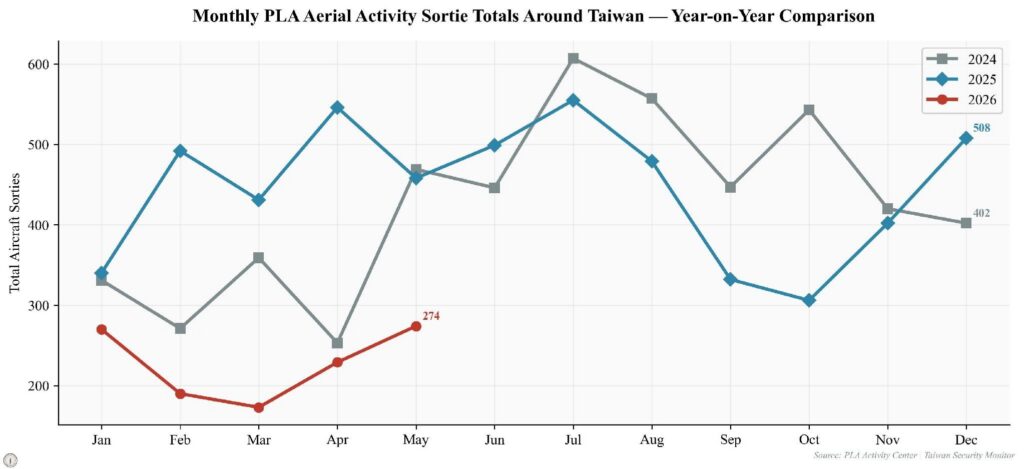
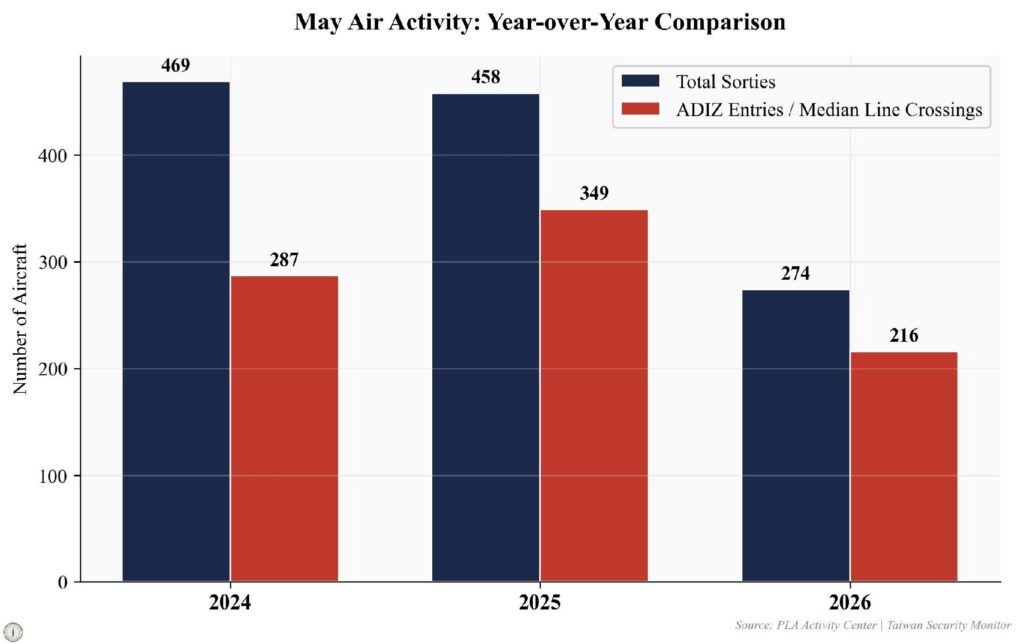
  • In May 2026, Taiwan’s Ministry of National Defense recorded 274 PLA aerial sorties around the island. Of these, 216 entered Taiwan’s Air Defense Identification Zone, representing an ADIZ-penetration rate of approximately 79 percent, the highest in 2026. This monthly total is the largest of the year, surpassing January’s 270 and continuing April’s rebound, signaling the end of the first-quarter lull. However, it remains 40 percent below the 458 sorties recorded in May 2025.
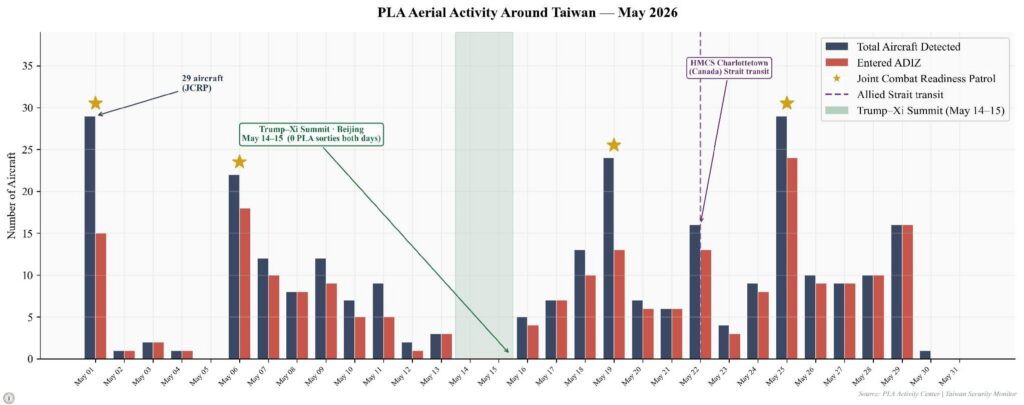
  • The PLA conducted four joint combat readiness patrols on May 1, May 6, May 19, and May 25, restoring the four-per-month cadence last observed in January. Single-day totals peaked at 29 aircraft on both May 1 and May 25. Air activity dropped to zero on May 14 and 15, coinciding with the Trump-Xi summit in Beijing, before surging during the May 19 and May 25 patrols.
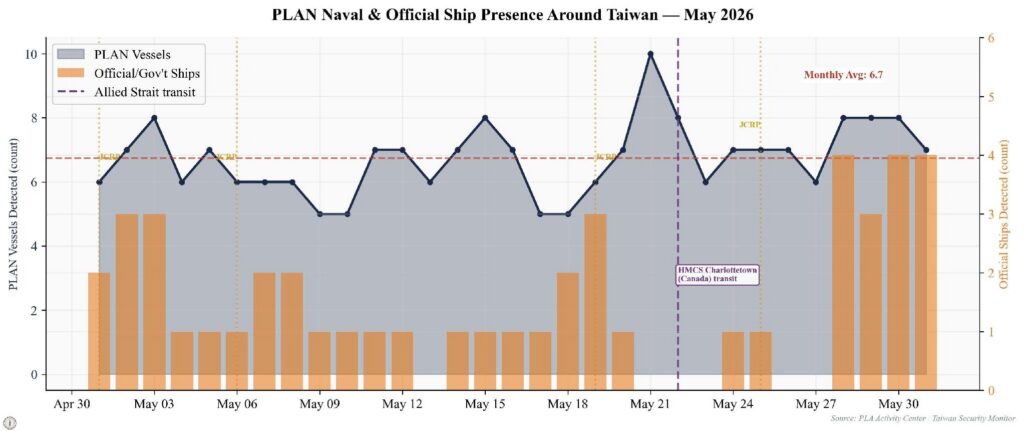
  • PLAN vessel detections averaged 6.7 per day in May, peaking at 10 on May 21, consistent with the five-to-nine vessel baseline maintained since 2025. While air activity reached a yearly high, naval presence remained steady, continuing the decoupling between sortie volume and naval activity observed throughout the year. One allied Strait transit occurred: HMCS Charlottetown on May 22, between two late-month patrols, marking the latest instance of a transit coinciding with heightened patrol activity in 2026.
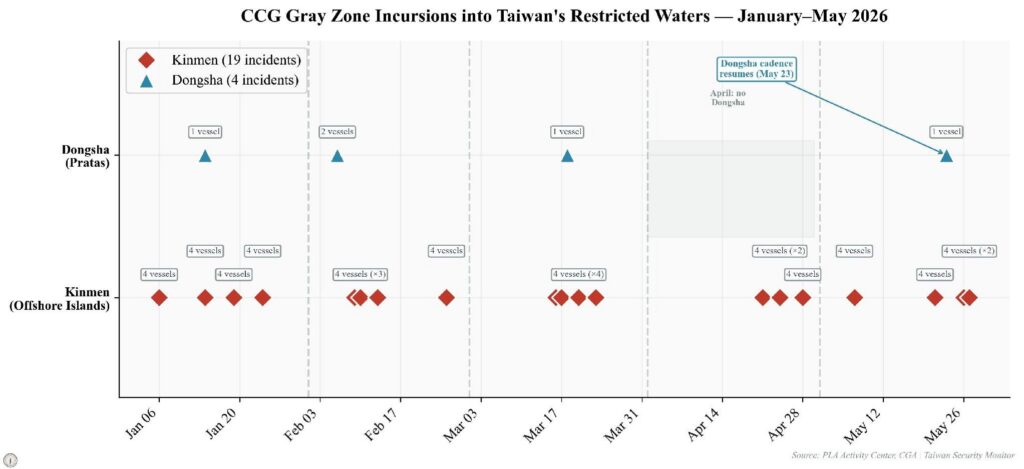
  • The Coast Guard Administration recorded five CCG incursions in May (four at Kinmen, one at Dongsha), restoring the once-monthly Dongsha pattern that lapsed in April. From January through May, cumulative incursions totaled 23: 19 at Kinmen and 4 at Dongsha. This increase occurred during a month focused on the May 14-15 Trump-Xi summit in Beijing, after which Washington paused arms transfers and deferred a Trump-Lai call ahead of a planned autumn visit by Xi to the United States.

In the Summit’s Shadow

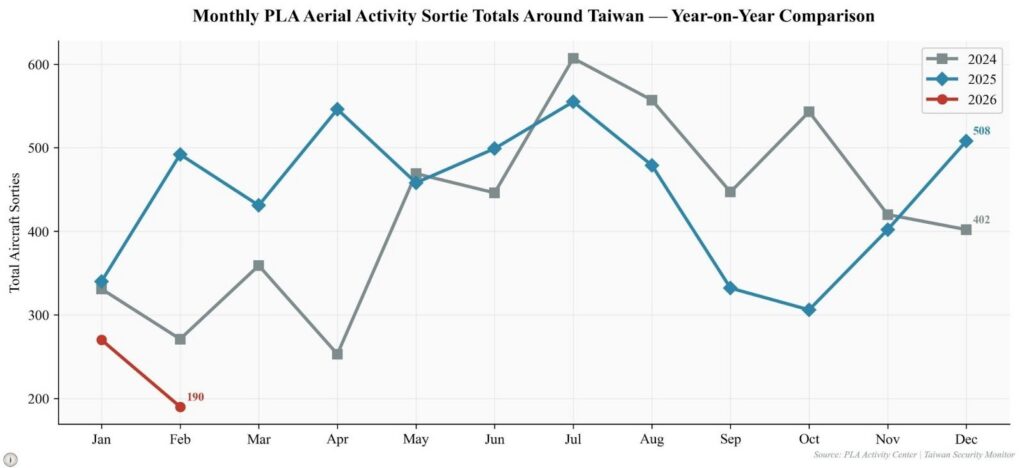
PLA air activity around Taiwan reached its highest monthly level of 2026 in May, with 274 detected sorties, 216 of which entered Taiwan’s Air Defense Identification Zone. This total surpassed April’s 229 by 45 and exceeded January’s 270, making May the peak month so far. The five-month sequence is 270, 190, 173, 229, and 274, with March as the low point and activity rising for a second consecutive month. However, May’s total remains 40 percent below the 458 sorties of May 2025, and 2026 overall is still well below the previous year.

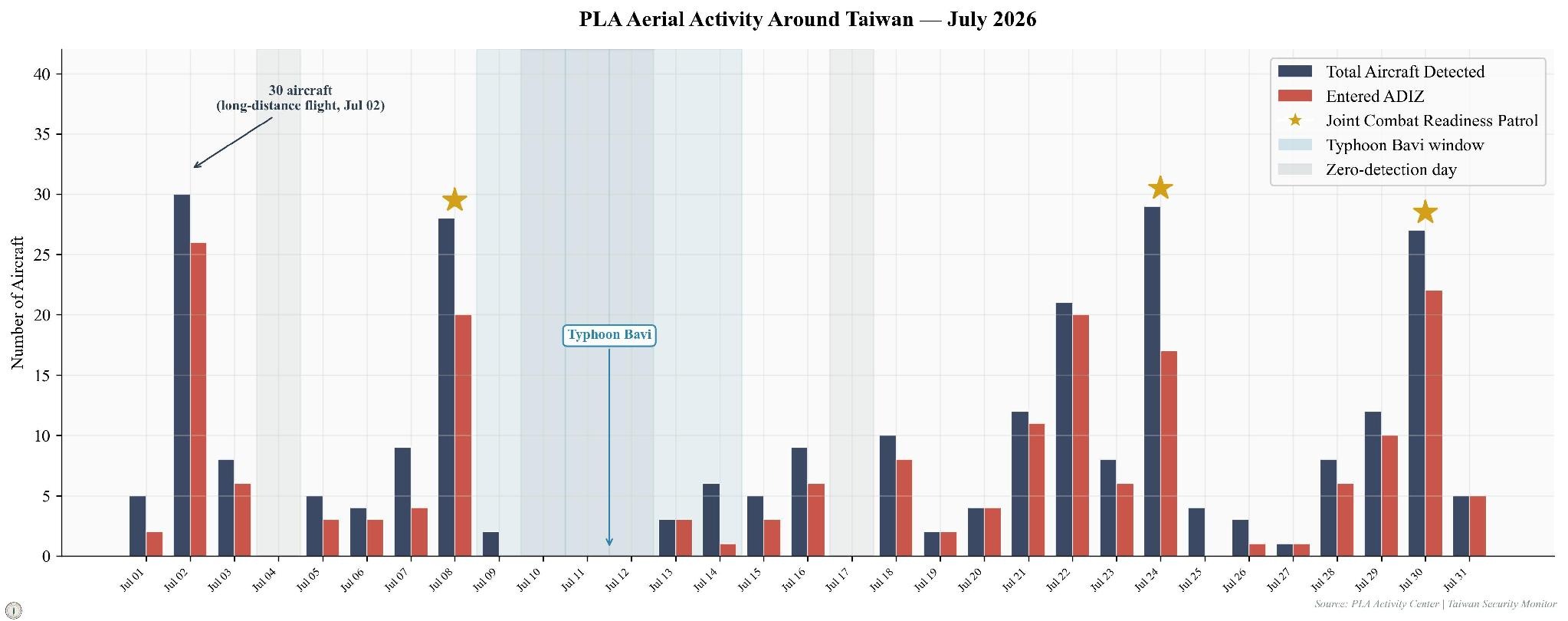
Four joint combat readiness patrols occurred on May 1, May 6, May 19, and May 25. The first and last patrols each involved 29 aircraft, with the May 25 count being the second-highest single-day total of 2026. Between patrols, activity followed a familiar pattern of alternating high-intensity demonstrations and quiet days. May saw four zero-detection days: May 5, May 14, May 15, and May 31. Notably, May 14 and 15 coincided with the Trump-Xi summit in Beijing, during which PLA air activity around Taiwan ceased entirely. Despite these pauses, May produced the year’s highest total, with an ADIZ-penetration rate of about 79 percent, indicating that more daily activity entered Taiwan’s southwestern ADIZ rather than remaining outside it.

Figure 1. Daily PLA aerial activity around Taiwan, May 2026. Gold stars mark JCRP days; red bars show aircraft entering the ADIZ. The green band marks the May 14-15 Trump-Xi summit in Beijing, when PLA air activity fell to zero. The purple marker denotes the May 22 HMCS Charlottetown (Canada) Strait transit, which fell between the May 19 and May 25 patrols.

May’s activity should be viewed in context. President Trump and President Xi Jinping met in Beijing on May 14 and 15, during which PLA air activity around Taiwan dropped to zero, marking the only consecutive shutdown of the month. Activity then increased for the May 19 and May 25 patrols, making the summit period a quiet interval between two surges. Naval presence remained steady during these days, indicating the stand-down was limited to the air domain. Diplomatic developments continued after the summit. At the Shangri-La Dialogue on May 29, U.S. Secretary of Defense Pete Hegseth stated that the pause in Taiwan arms deliveries was not due to munitions conservation related to the Middle East. Late in the month, reports indicated a planned Trump-Lai call was postponed, and Trump was not expected to speak with Lai before a reciprocal Xi visit to the United States in the autumn. The PLA ended May with its highest air activity of 2026, even as Washington’s signals shifted toward Beijing.

Monthly Trajectory: The Lull Reverses

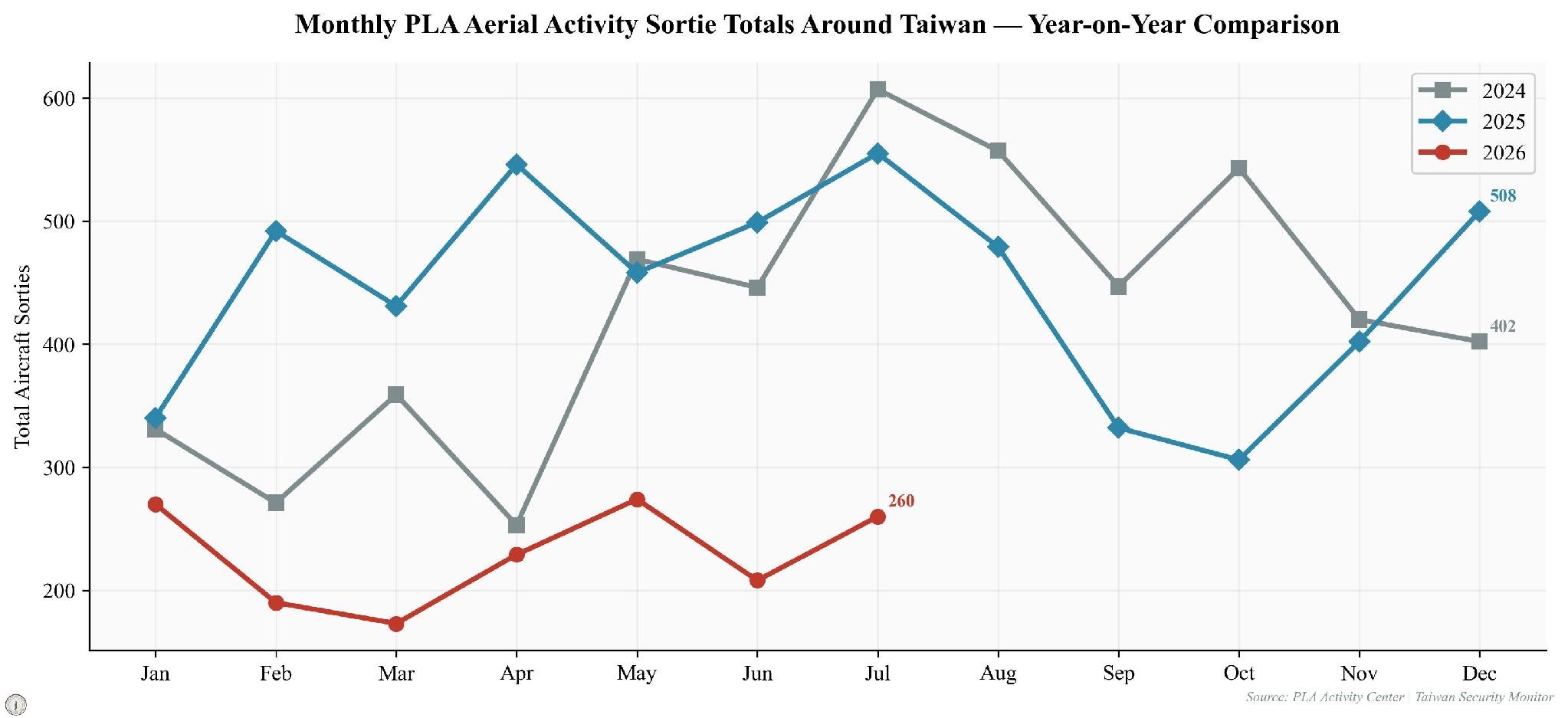
May’s 274 sorties mark a full reversal of the first-quarter decline. The 2026 monthly totals form a V-shaped pattern: 270, 190, 173, 229, and 274, with March as the low point and a climb above January’s starting figure. April signaled the end of the lull, and May confirms a sustained recovery, with gains extending beyond any single exercise period.

Figure 2. Monthly PLA aerial activity sortie totals, 2024โ€“2026. May 2026 is the year’s high, completing a V-shaped recovery from the March low.

JCRP frequency is a more reliable indicator of PLA intent than total sortie counts, and it rebounded in May. The four patrols matched January’s level and exceeded the two conducted in each of February, March, and April. Holding roughly one large-scale exercise per week for the first time since January suggests the first-quarter drop in routine sorties was temporary, not a reduction in the PLA’s readiness for high-intensity demonstrations. JCRP frequency, more than total sorties, signals the end of the early-year lull.

At Sea: A Baseline That Does Not Move

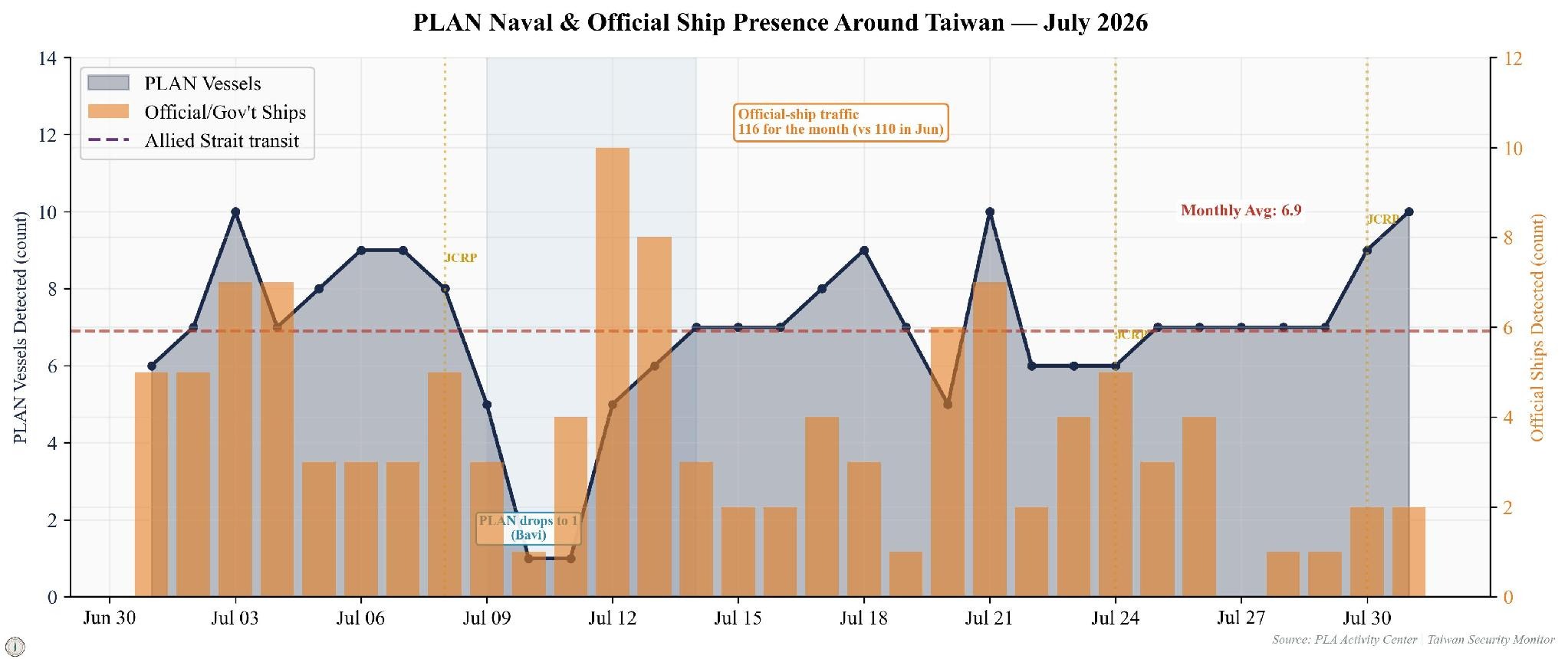
PLAN vessel detections averaged 6.7 per day in May, peaking at 10 on May 21. Both figures remain within the five-to-nine vessel range that has characterized PLAN presence since 2025. In contrast, aerial sorties reached a yearly high, and ADIZ penetration peaked in 2026, while naval presence remained unchanged. The air and naval domains operate under different dynamics: air activity responds to political events and institutional factors, while naval presence serves as a consistent baseline in cross-strait military activity.

Figure 3. PLAN vessel and official ship detections around Taiwan, May 2026. The purple marker denotes the May 22 HMCS Charlottetown Strait transit.

Official and government-ship detections stayed low through the month, clustering in the first week before settling to one or two per day. The naval baseline held steady during a month of elevated air activity, consistent with the pattern seen all year: a change in air sortie volume, whether the May increase or the March decline, does not signal a matching shift in the maritime posture, which stays decoupled from the air domain.

One allied Taiwan Strait transit fell within the month. The Canadian frigate HMCS Charlottetown (FFH 339) transited the strait on May 22, Canada’s first reported transit of 2026 and the fourth allied passage of the year, after the USS John Finn and the survey ship USNS Mary Sears on January 16, the Australian frigate HMAS Toowoomba on February 20, and the Japanese destroyer JS Ikazuchi on April 17. The May 22 transit fell between the month’s third and fourth joint combat readiness patrols, on May 19 and May 25. The proximity is not limited to May. Through 2026, allied transits have repeatedly coincided with periods of heavy JCRP activity, the January and February passages each within a day of a patrol. The sequencing is inconsistent, since in those two cases the patrol came before the transit rather than after, and the sample stays too small to support a causal reading. The clustering warrants continued observation, not firm inference.

Coast Guard Gray Zone Operations

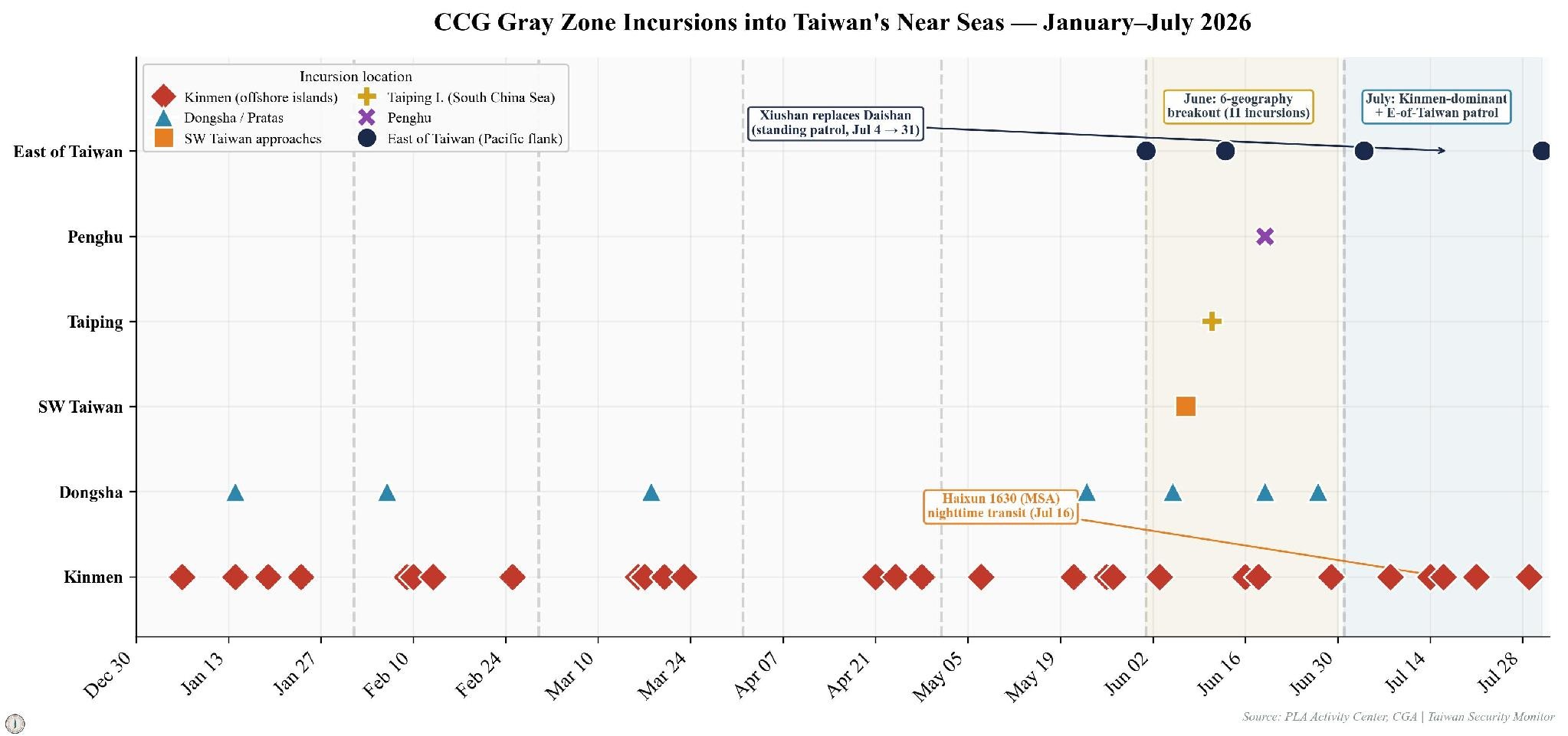
China Coast Guard activity in Taiwan’s restricted waters returned to its monthly rhythm in May. The CCG conducted 5 documented incursions: 4 around Kinmen, on May 7, May 21, May 26, and May 27, and one at Dongsha on May 23. The Kinmen operations followed the institutionalized pattern seen throughout 2026, a rotating four-cutter formation drawn from a consistent hull pool, with numbers 14530, 14531, 14606, and 14609 recurring most often, entering in the afternoon and leaving within about two hours. The May 26 and May 27 incursions came within a twenty-four-hour span, a tempo the CGA itself flagged as unusual. Cumulative CCG incursions for January through May total 23: 19 at Kinmen and 4 at Dongsha.

Figure 4. CCG incursions into Taiwan’s restricted waters, Januaryโ€“May 2026, by location and vessel count.

The main CCG development in May was the resumption of Dongsha (Pratas) operations. After the once-monthly Dongsha pattern lapsed in April, the May 23 incursion restored it, with a single vessel, hull 3501, detected at 07:25 and entering restricted waters at 08:34. Dongsha operations remain distinct from the Kinmen rotation, involving longer transits, single large cutters instead of four-hull formations, and much longer dwell times. The longest in 2026 was the March 18 incursion, lasting about twenty-five hours. The April pause reflected operational rhythm rather than a binding commitment, and May’s return indicates Dongsha presence is an intentional, though intermittent, aspect of CCG activity. One late-period development warrants continued observation: on May 31, the CCG announced “law enforcement patrols” in waters east of Taiwan in response to Japan and the Philippines, and on June 1, a CCG incursion southeast of Orchid Island involved vessels 2304 and 2502, an area not previously recorded in 2026.

Regional Context: An Arms Pause, Summit Diplomacy, and Taiwan’s Own Build-Up

May’s activity occurred against a backdrop of U.S.-China diplomacy that shaped Taiwan coverage for the month. The Trump-Xi summit in Beijing on May 14 and 15 set the tone. In the following weeks, the pause in U.S. arms deliveriesโ€”which Secretary Hegseth did not attribute to munitions conservationโ€”and the postponement of a Trump-Lai call ahead of a planned autumn Xi visit to the United States signaled a Washington approach focused on avoiding friction with Beijing. In response, Taiwan advanced its own procurement. On May 29, the Legislative Yuan approved an initial NT$8.811 billion (about US$259 million) installment for five U.S. weapons systems, including M109A7 self-propelled howitzers, HIMARS, and anti-armor drones. Two days earlier, the House Armed Services Committee’s preliminary version of the FY27 National Defense Authorization Act authorized US$1 billion for the Taiwan Security Cooperation Initiative. Congressional support for Taiwan’s defense remains strong, even as executive-branch deliveries are delayed.

Taiwan’s force development also progressed. On June 1, the Republic of China Navy established a Littoral Combat Command, consolidating naval surveillance and anti-ship missile forces under one headquarters, advancing the distributed, asymmetric posture pursued since 2022. Allied presence operations remained steady: the HMCS Charlottetown transit marked Canada’s entry into a 2026 transit pattern already featuring U.S., Australian, and Japanese passages. These regional developments highlight a growing gap between a cautious U.S. executive approach and the consistent allied presence and Taiwanese self-strengthening. The PLA intensified its air activity in this environment.

The Full Picture: Multi-Domain Overview
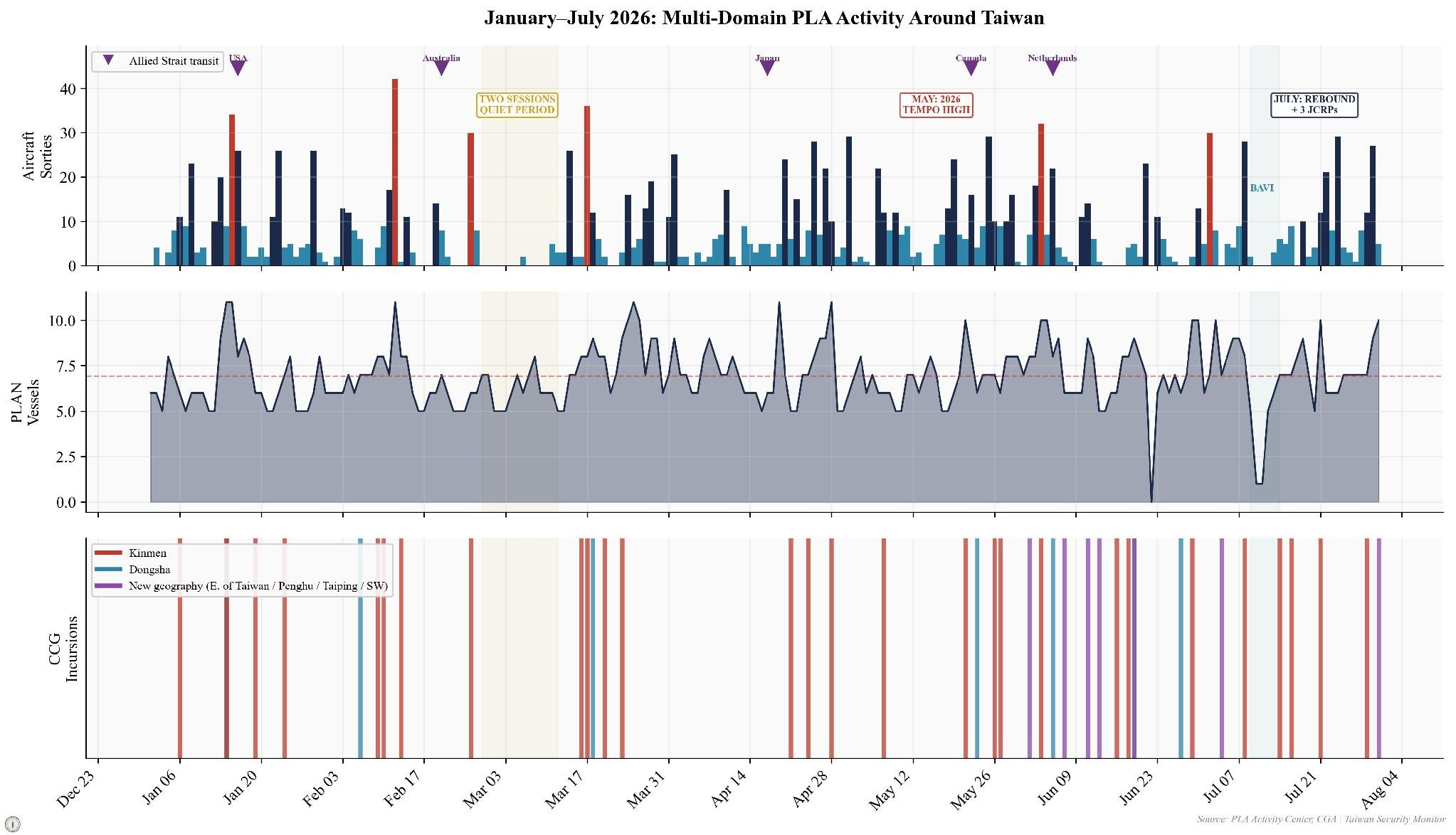
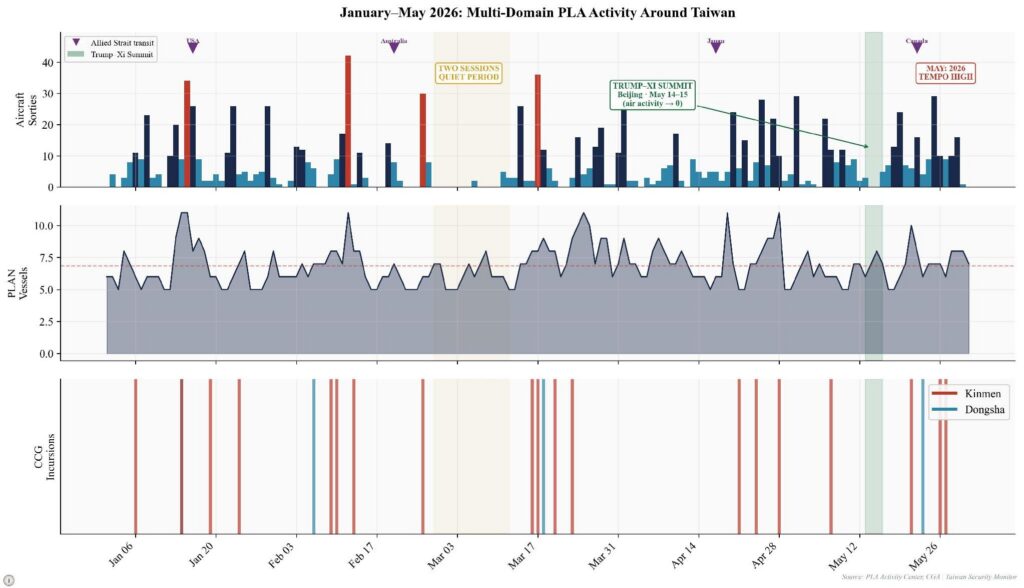
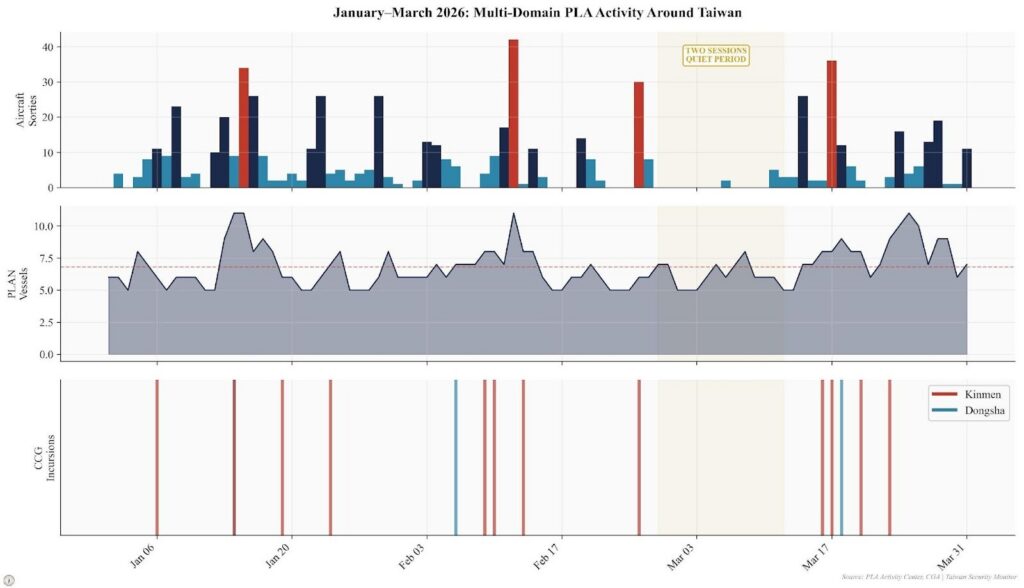
Figure 5. Januaryโ€“May 2026 multi-domain PLA activity: air sorties, naval presence, and CCG incursions. The green band marks the May 14-15 Trump-Xi summit in Beijing; the gold band marks the early-March Two Sessions quiet period. Inverted triangles atop the air panel mark allied Taiwan Strait transits (United States, January 16; Australia, February 20; Japan, April 17; Canada, May 22).

Throughout the first five months of 2026, all three domains have shown a steady upward trend. Air activity was volatile and responsive to political events, dipping to a low in early March before rebounding through April and May to reach the year’s highest point. A key political signal was the pause in sorties during the Trump-Xi summit in mid-March, which was followed by a resumption of activity. Naval presence stayed stable, unaffected by fluctuations in air activity. Coast Guard incursions averaged around five per month, with May reestablishing the Dongsha pattern seen in April and adding a new east-of-Taiwan area at month’s end. Each domain should be analyzed in context. The early-year decline in sortie numbers did not indicate de-escalation, and May’s rebound alone does not suggest escalation. The overall multi-domain posture continues to reflect the sustained PLA activity around Taiwan since August 2022. In May, the PLA maintained this posture at the high end of its 2026 range, despite shifting signals from Washington.

Figure 6. May air activity year-over-year: total sorties and ADIZ entries, 2024โ€“2026.

Methodology & Sources

Air and naval detection data are drawn from daily press releases issued by Taiwan’s Ministry of National Defense and compiled in the PLA Activity Center database maintained by the Taiwan Security Monitor. Coast Guard incident data are compiled from Coast Guard Administration press releases and verified against contemporaneous media reporting in the China Coast Guard Incident Tracker Database. Allied Taiwan Strait transit records are drawn from the Taiwan Strait Transit Tracker maintained by the Taiwan Security Monitor. Contextual and allied developments draw on Taiwan Security Monitor reporting through late May and early June 2026. “ADIZ” denotes Taiwan’s Air Defense Identification Zone; “median line” refers to the informal centerline of the Taiwan Strait historically observed by both sides. “JCRP” denotes Joint Combat Readiness Patrols as designated by Taiwan’s MND. All analysis and commentary are by the Taiwan Security Monitor.
ยฉ 2026 Taiwan Security Monitor. All rights reserved.

Strait Snapshot, April 2026 Update

Authors: Ethan Connell & Jonathan Walberg


KEY FINDINGS

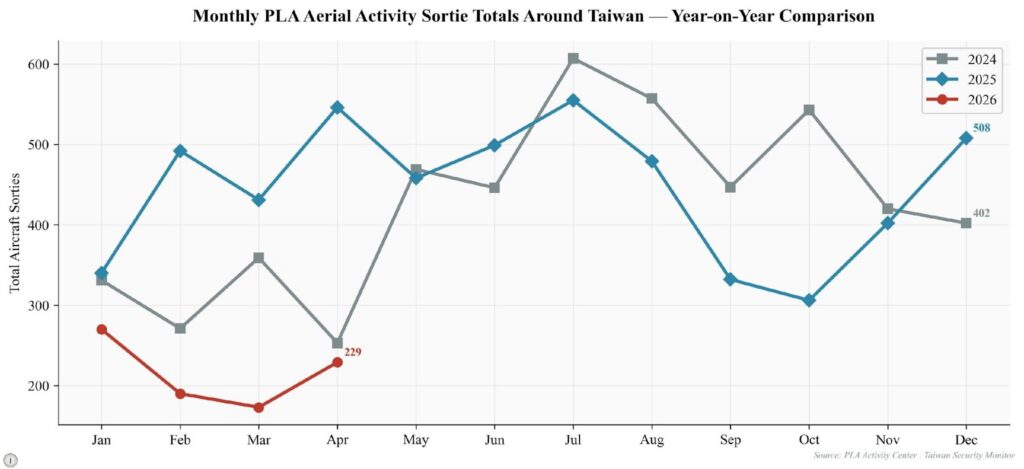
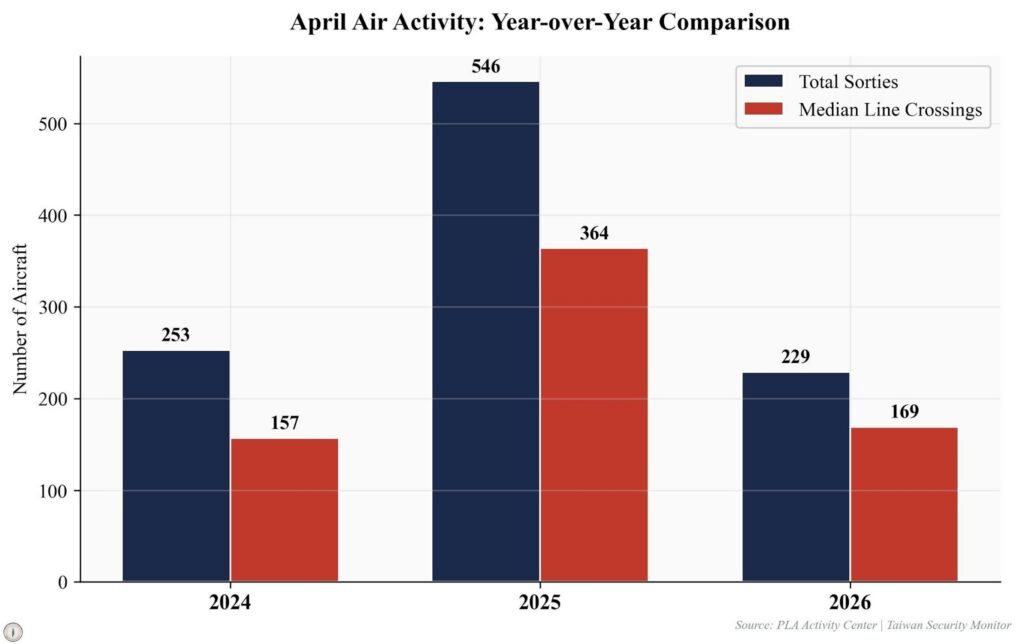
  • Taiwan’s Ministry of National Defense recorded 229 PLA aerial sorties around the island in April 2026, of which 169 entered Taiwan’s southwestern Air Defense Identification Zone. The total represents a 58 percent year-on-year decline from April 2025’s 546 sorties, but a 56-sortie increase from March, interrupting the consecutive monthly declines observed across the first quarter.
  • Two joint combat readiness patrols framed the month, on April 1 (25 aircraft) and April 25 (28 aircraft), and the PLA’s Liaoning aircraft carrier transited the Taiwan Strait on April 20. The contraction in routine sortie volume since January has not extended to either surge capacity or strategic signaling.
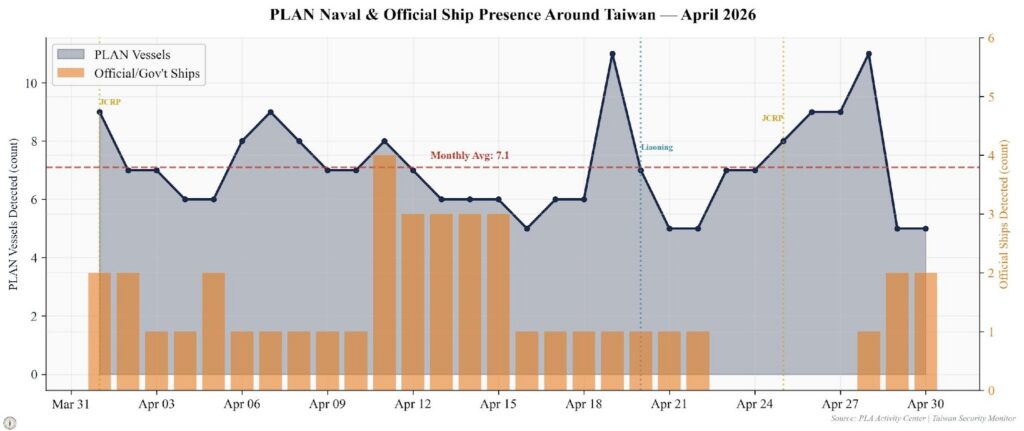
  • PLAN vessel detections averaged 7.1 per day in April, peaking at 11. These figures remain within the five-to-nine vessel baseline observed throughout 2025, reaffirming the structural decoupling between air sortie volume and naval presence.
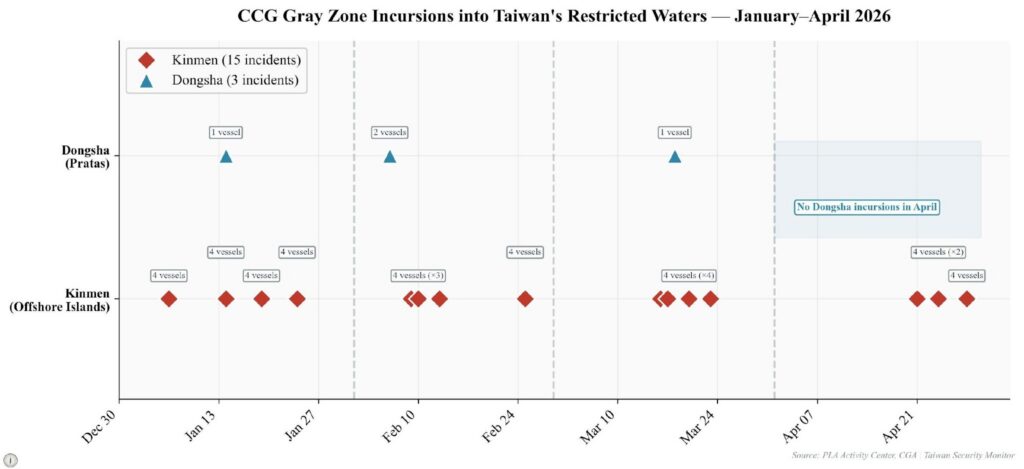
  • The Taiwanese Coast Guard Administration recorded three incursions by CCG vessels into Taiwan’s restricted waters in April, all around Kinmen. April is the first month of 2026 without a Dongsha (Pratas) incursion, breaking a monthly cadence sustained from January through March. Cumulative incursions across the first four months of the year total 18, with 15 around Kinmen and three around Dongsha.

Above the Floor

April 2026 marked a partial reversal of a three-month decline that had defined the first quarter. The month’s 229 detected sorties, including 169 that crossed the Taiwan Strait median line or entered the southwestern Air Defense Identification Zone, exceeded March’s 173-sortie total by 56 but remained 58 percent below the 546 sorties recorded in April 2025. The sequential trajectory across the first four months of 2026 (270 โ†’ 190 โ†’ 173 โ†’ 229)  places March’s lull as a floor rather than the continuation of a sustained downward trend, with overall activity holding well below the 2025 baseline.

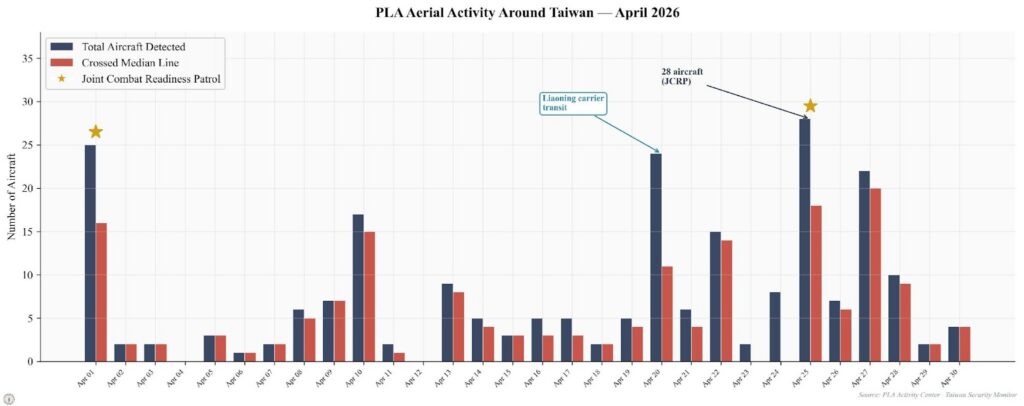
The month opened and closed with joint combat readiness patrols: the April 1 JCRP involved 25 aircraft, continuing the late-March return to operations after the Two Sessions lull, while the April 25 JCRP involved 28 aircraft and coincided with the final day of Taiwan’s annual Han Kuang 42 computer-simulated wargames. Between these two patrols, daily activity remained subdued, with two zero-detection days (April 4 and April 12) and a string of single-digit days through the mid-month. The final third of April produced elevated single-day totals, with 24 aircraft on April 20, 22 aircraft on April 27, and 17 aircraft on April 10.

Figure 1. Daily PLA aerial activity around Taiwan, April 2026. Gold stars mark JCRP days; the April 20 surge corresponds with the Liaoning carrier transit.

The April 20 spike coincided with the transit of the Liaoning aircraft carrier and escorts (CV-16) through the Taiwan Strait. The PLA’s Eastern Theater Command described the movement as part of long-range combat training in the western Pacific, and Taiwan’s MND released images of the carrier’s air wing during the transit. Japan’s JS Ikazuchi (DD-107) had transited the Strait three days earlier, on April 17 (the anniversary of the Treaty of Shimonoseki) drawing Beijing’s condemnation as a deliberate provocation. Together with the two JCRPs, these events indicate that the contraction in routine sortie volume since January has not extended to surge capacity or strategic signaling.

Monthly Trajectory: A Floor, Not a Trend

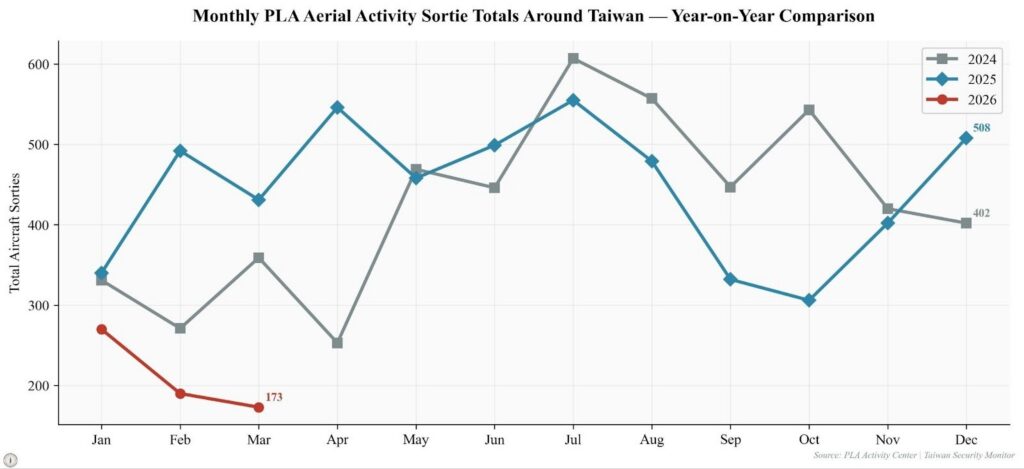
Viewed against the preceding three months, April’s 229-sortie total interrupts the consecutive decline that ran from January through March. Monthly totals across the first four months of 2026 (270, 190, 173, and 229) show a curve that fell sharply through Q1 before stabilizing.

Figure 2. Monthly PLA aerial activity sortie totals, 2024โ€“2026. April 2026 marks a modest rebound from March’s three-month low.

JCRP cadence offers a more stable read on PLA intent than aggregate sortie counts. April’s two JCRPs match February’s two and fall one short of March’s three. The April 25 peak of 28 aircraft is comparable to the 36-aircraft peak observed on March 17 and consistent with the cadence of roughly one large-format exercise per month sustained since August 2022. Reductions in routine sortie volume have not yet been accompanied by a comparable decline in the PLA’s willingness to mount high-intensity demonstrations on short notice.

At Sea: Carrier Transit and a Steady Baseline

PLAN vessel detections averaged 7.1 per day in April, peaking at 11 vessels on April 19 and again on April 28. These figures fall within the five-to-nine vessel range that has characterized PLAN presence throughout 2025 and the first four months of 2026. The Liaoning transit on April 20 registers in qualitative rather than quantitative terms: a single-day strategic signaling operation that did not move the monthly aggregate. Eastern Theater Command’s framing of the transit as long-range combat training in the western Pacific points to posture rather than escalation.

Figure 3. PLAN vessel and official ship detections around Taiwan, April 2026.

Naval presence held at baseline levels through April, reinforcing a structural observation that has held throughout 2026: air sorties appear responsive to political calendars and institutional dynamics, whereas naval presence functions as a persistent baseline feature of cross-strait military activity. The April carrier transit shows that this baseline coexists with episodic surge operations of strategic weight rather than displacing them.

Coast Guard Gray Zone Operations

China Coast Guard (CCG) activity in Taiwan’s restricted waters continued through April but contracted geographically. The CCG conducted 3 documented incursions on April 21, April 24, and April 28, all of them around Kinmen. Each incursion involved the same four-cutter rotation (hull numbers 14530, 14531, 14604, and 14609) and concluded within roughly two hours of entering restricted waters, consistent with the institutionalized two-to-three-hour Kinmen pattern documented in earlier months. Cumulative CCG incursions across the first four months of 2026 now total 18, with 15 around Kinmen and 3 around Dongsha.

Figure 4. CCG incursions into Taiwan’s restricted waters, Januaryโ€“April 2026, by location and vessel count.

The April pause around Dongsha is perhaps the most analytically distinctive feature of the month’s CCG activity. January, February, and March each included a single Dongsha (Pratas) operation, several with dwell times exceeding twenty-four hours; April’s gap breaks that monthly cadence for the first time in 2026. The narrower reading is that the once-monthly Dongsha rhythm reflected an operational pattern rather than a binding institutional commitment, and that May or June observations will either restore it or confirm its discontinuation. A broader reading is that the CCG temporarily consolidated around the proximate Kinmen rotation while the PLA Navy carried the month’s strategic signaling through the Liaoning transit. The Coast Guard Administration’s announcement earlier in April of US$1.88 billion in Pratas-area infrastructure and patrol upgrades indicates continuing Taiwanese concern about the durability of presence at its most remote outlying holding.

The Full Picture: Multi-Domain Overview

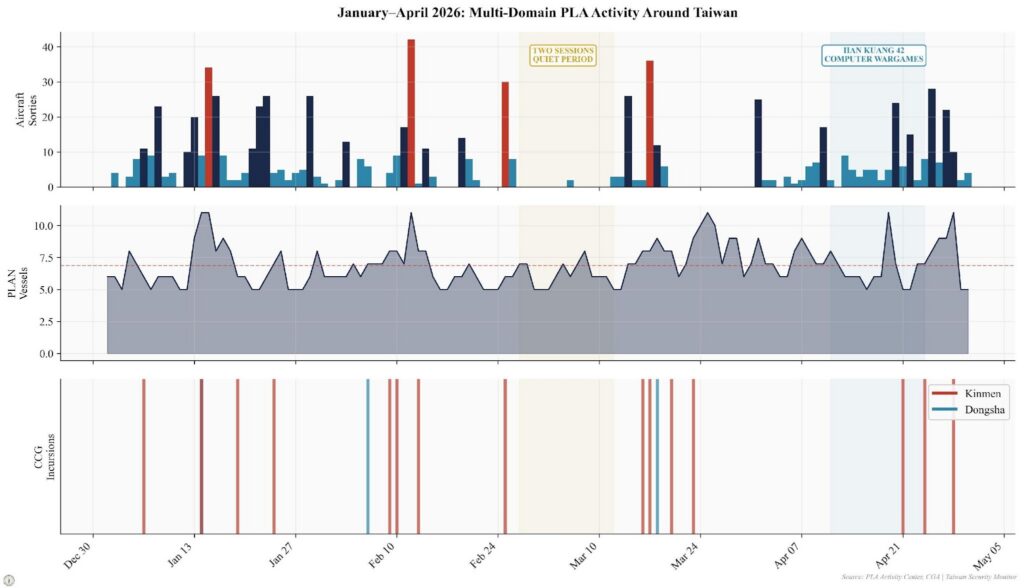
Figure 5. Januaryโ€“April 2026 multi-domain PLA activity: air sorties, naval presence, and CCG incursions.

Viewed across all three domains, the first four months of 2026 reinforce an analytical pattern visible since January. Air activity has been volatile and politically responsive, with a pronounced lull in early March and a partial rebound in April. Naval presence has been held within the established baseline throughout, including during the week of the Liaoning carrier transit. Coast Guard incursions have continued at roughly five incidents per month, with the April pattern narrowing geographically and interrupting the once-monthly Dongsha cadence. Analysts and policymakers would be well served by resisting the temptation to interpret a reduction in the headline sortie count as evidence of overall de-escalation. The multi-domain posture, taken as a whole, does not indicate a meaningful departure from the sustained pattern of PLA activity around Taiwan that has defined cross-strait military dynamics since August 2022.

Figure 6. April air activity year-over-year: total sorties and median line crossings, 2024โ€“2026.

Methodology & Sources

Air and naval detection data are drawn from daily press releases issued by Taiwan’s Ministry of National Defense and compiled in the PLA Activity Center database maintained by the Taiwan Security Monitor. Coast Guard incident data are compiled from Coast Guard Administration press releases and verified against contemporaneous media reporting in the China Coast Guard Incident Tracker Database. Allied and contextual events draw on Taiwan Security Monitor’s Weekly Security Reviews of April 6, April 16, April 20, and April 27. “Median line” refers to the informal centerline of the Taiwan Strait historically observed by both sides. “JCRP” denotes Joint Combat Readiness Patrols as designated by Taiwan’s MND. All analysis and commentary are by the Taiwan Security Monitor.
ยฉ 2026 Taiwan Security Monitor. All rights reserved.
Strait Snapshot, March 2026 Update

Author: Ethan Connell & Jonathan Walberg


Key Findings

  • In March 2026, Taiwan’s Ministry of National Defense recorded 173 PLA aerial sorties around the island, representing a 60 percent year-over-year decline and extending the downward trend observed since the December 2025 Justice Mission exercises.
  • Between late February and mid-March, air operations declined to near-zero levels for thirteen days. This lull coincided with China’s annual Two Sessions legislative period of the National Peopleโ€™s Congress and followed the dismissal of two senior Central Military Commission vice-chairmen in January. This pattern aligns with previously documented instances of institutional caution during politically sensitive periods.
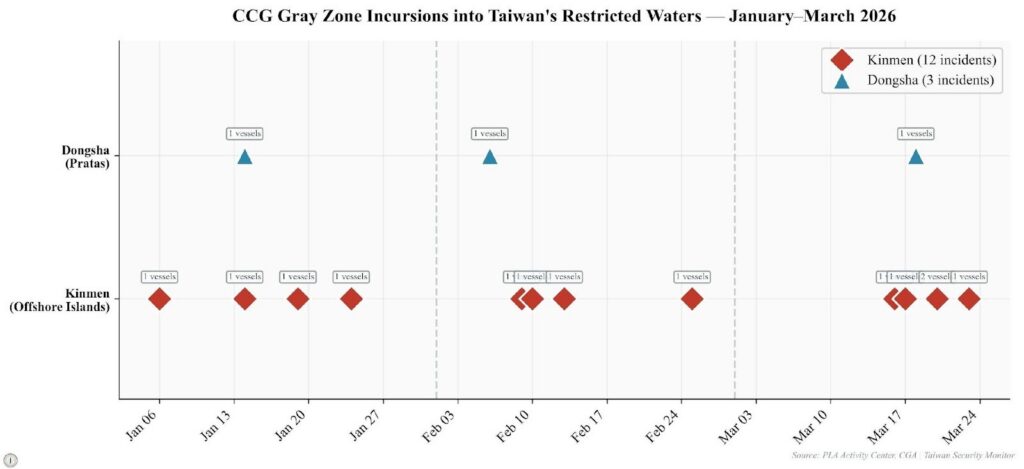
  • Taiwanese Coast Guard Administration data shows 15 documented CCG incursions into Taiwan’s restricted waters from January through March, concentrated around Kinmen (12 incidents) and Dongsha Island (three incidents), with dwell times in the Dongsha incursions exceeding 24 hours.
  • In March, PLAN vessel detections around Taiwan averaged approximately seven per day, consistent with the five-to-nine vessel baseline observed throughout 2025. The continued naval presence during a period of reduced air activity suggests that the air and maritime domains are governed by distinct operational logics.

The March Lull

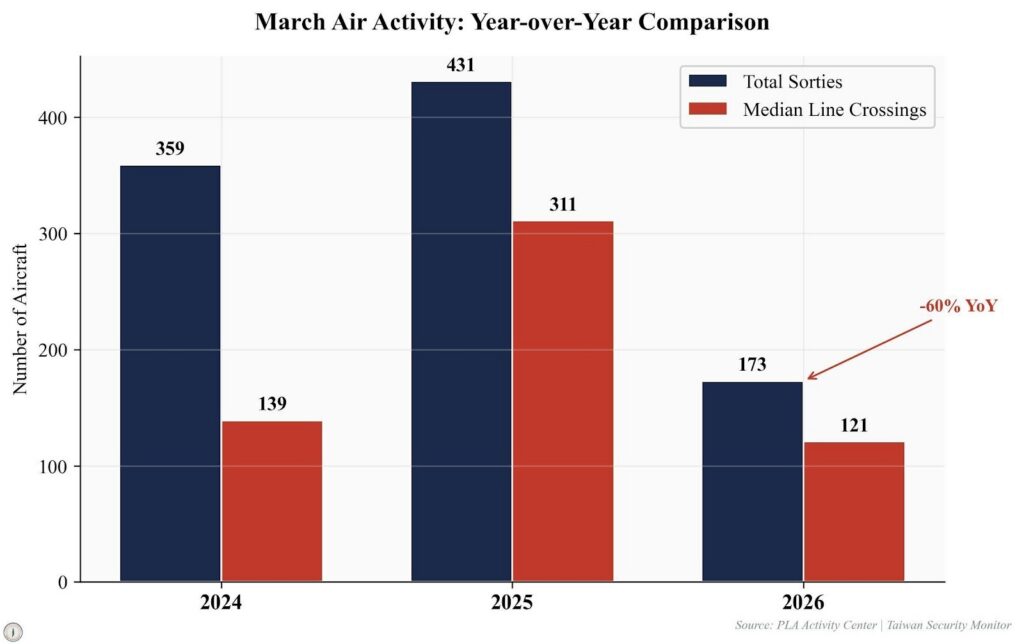
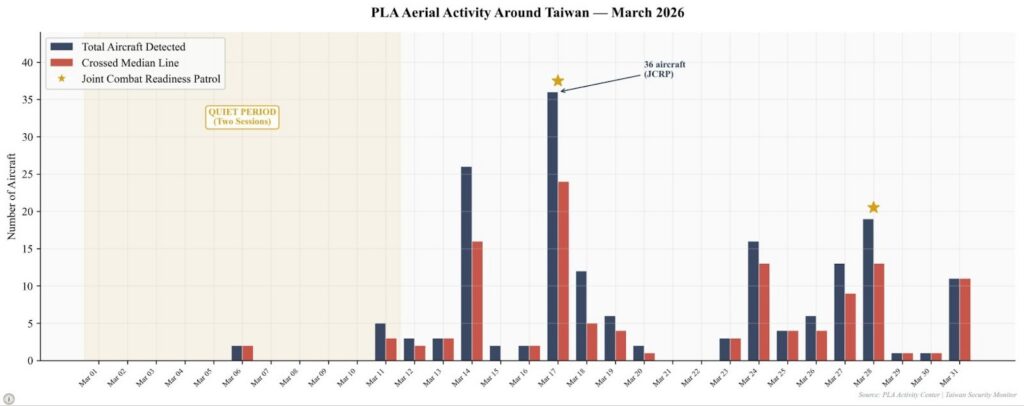
March 2026 marked a significant deviation from the Peopleโ€™s Liberation Army (PLA) air activity patterns observed around Taiwan during the previous twelve months. The 173 detected aircraft sorties, including 121 that entered Taiwan’s Air Defense Identification Zone, constitute a 60 percent reduction from March 2025, when 431 sorties were recorded. This figure also continues the sequential decline observed in the first three months of 2026: January recorded 270 sorties, February recorded 190, and March recorded 173.

A notable feature of the month was the lull in PLA air activity in early March, during which Taiwan detected only limited aircraft activity around the island. Rather than pointing to a single discrete cause, this slowdown is better understood as the product of overlapping factors. The strongest explanation remains the PRCโ€™s domestic calendar: the annual โ€œTwo Sessions,โ€ combined with the tail end of the Spring Festival period, has historically aligned with a lower operational tempo around Taiwan. Other theories, including the idea that leadership turmoil within the PLA or fuel pressures linked to Middle East instability drove the reduction, are harder to sustain. As TSM noted in The Monitor, those explanations fit the available evidence less well, especially given continued Chinese activity in the East and South China Seas during the same period.

Figure 1. Daily PLA activity around Taiwan, March 2026. The shaded region marks the quiet period.

Air operations resumed in the second half of March. On March 17, Taiwan’s Ministry of National Defense (MND) reported a joint combat readiness patrol (JCRP) involving thirty-six aircraft, marking the month’s single-day peak. This was followed by a second JCRP on March 28 with nineteen aircraft and a third on April 1. The resumption of large-scale exercises after a period of relative quiet aligns with patterns observed in previous years. The PLA appears to adjust its daily sortie rate in response to political calendars and internal dynamics while maintaining the capacity for periodic high-intensity demonstrations.

Monthly Trajectory: A Sustained Decline

March’s figures are a continuation of a three-month decline. From January through March 2026, monthly sortie totals fell from 270 to 190 to 173, respectively. This trajectory comes on the heels of the elevated activity of late 2025, when the PLA’s Justice Mission-2025 exercise on December 29 saw the use of 130 aircraft in a single day, the largest single-day operation around Taiwan since comprehensive daily reporting began.

Figure 2. Monthly PLA sortie totals, 2024โ€“2026. The Januaryโ€“March 2026 trend shows consecutive declines.

However, the frequency of Joint Combat Readiness Patrols (JCRPs), which represent the highest-intensity format of PLA air operations around Taiwan, has remained broadly stable. March 2026 included three JCRPs, matching the number in March 2025 and exceeding the two recorded in March 2024. This continuity indicates that the reduction in routine sortie volume has not been accompanied by a corresponding decrease in the PLA’s willingness or ability to conduct large-scale, multi-domain demonstrations on short notice.

At Sea: Persistent Naval Presence

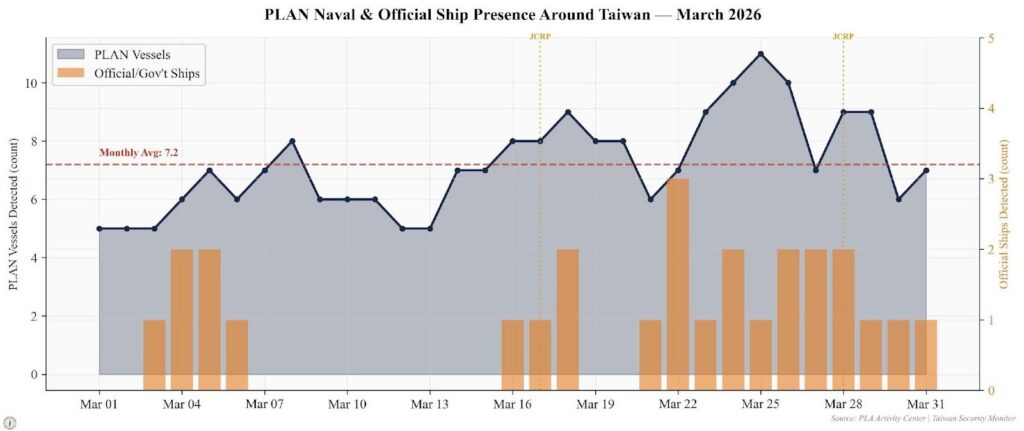
PLAN vessel detections in the waters around Taiwan averaged 7.2 per day in March, with a peak of eleven on a single day. These figures are consistent with the range of 5-9 vessels that have characterized PLAN presence throughout 2025. The stability of the naval posture during a month of minimal air activity highlights a structural difference in how the PLA manages its air and maritime components around Taiwan. Air sorties appear responsive to political calendars and institutional dynamics, whereas naval presence serves as a persistent baseline feature of cross-strait military activity.

Figure 3. PLAN vessel and official ship detections around Taiwan, March 2026.

This divergence between air and naval activity patterns holds analytical significance for assessments of cross-strait tension. Analysts who focus solely on sortie counts may interpret the March figures as evidence of de-escalation, however the unchanged naval footprint demonstrates that the PLA’s overall posture in the Taiwan Strait has not meaningfully decreased.

Coast Guard Gray Zone Operations

China Coast Guard (CCG) activity in Taiwan’s restricted waters represents a third, often underreported, dimension of cross-strait pressure. From January through March 2026, the CCG conducted at least 15 documented incursions: 12 around Kinmen and three near Dongsha Island (Pratas). The Kinmen operations have developed into a recognizable pattern, typically involving two to four CCG cutters entering restricted waters for two to three hours before withdrawing. This approach appears intended to establish a regular CCG presence in waters considered under the jurisdiction of Taiwan’s Coast Guard Administration.

Figure 4. CCG incursions into Taiwan’s restricted waters, Januaryโ€“March 2026, by location and vessel count.

The Kinmen incursions have involved a recurring set of CCG cutters (specifically, hull numbers 14529, 14603, 14605, and 14609), indicating a dedicated patrol rotation rather than ad hoc deployments. The Dongsha operations differ qualitatively, involving larger vessels from the 3101 and 3102 classes and featuring extended dwell times, with the March 18th incursion east of Dongsha lasting over twenty-five consecutive hours. The increasing dwell times at Dongsha merit particular attention, as they challenge the Coast Guard Administration’s capacity to maintain a sustained presence at Taiwan’s most remote holding.

The Full Picture: Multi-Domain Overview

Figure 5. Januaryโ€“March 2026 multi-domain PLA activity: air sorties, naval presence, and CCG incursions.

An examination of all three domains simultaneously reveals that the first three months of 2026 present a more complex situation than any single metric suggests. Air activity has been volatile and responsive to political events, while naval presence has remained steady and largely unaffected by fluctuations in the air domain. Coast Guard incursions have persisted and, in the Dongsha cases, have increased in duration. Analysts and policymakers should avoid interpreting a reduction in one domain as an overall reduction in pressure. The multi-domain posture, considered in its entirety, does not indicate meaningful de-escalation.

Figure 6. March air activity year-over-year: total sorties and median line crossings, 2024โ€“2026.

Methodology & Sources

Air and naval detection data are drawn from daily press releases issued by Taiwan’s Ministry of National Defense and compiled in the PLA Activity Center database maintained by Taiwan Security Monitor. Coast Guard incident data are compiled from Coast Guard Administration press releases, verified against contemporaneous media reporting, and compiled in the China Coast Guard Incident Tracker Database. “Median line” refers to the informal centerline of the Taiwan Strait historically observed by both sides. “JCRP” denotes Joint Combat Readiness Patrols as designated by Taiwan’s MND. All analysis and commentary are by Taiwan Security Monitor.
ยฉ 2026 Taiwan Security Monitor. All rights reserved.
Strait Snapshot, February 2026 Update

Author: Ethan Connell & Jonathan Walberg


Key Findings

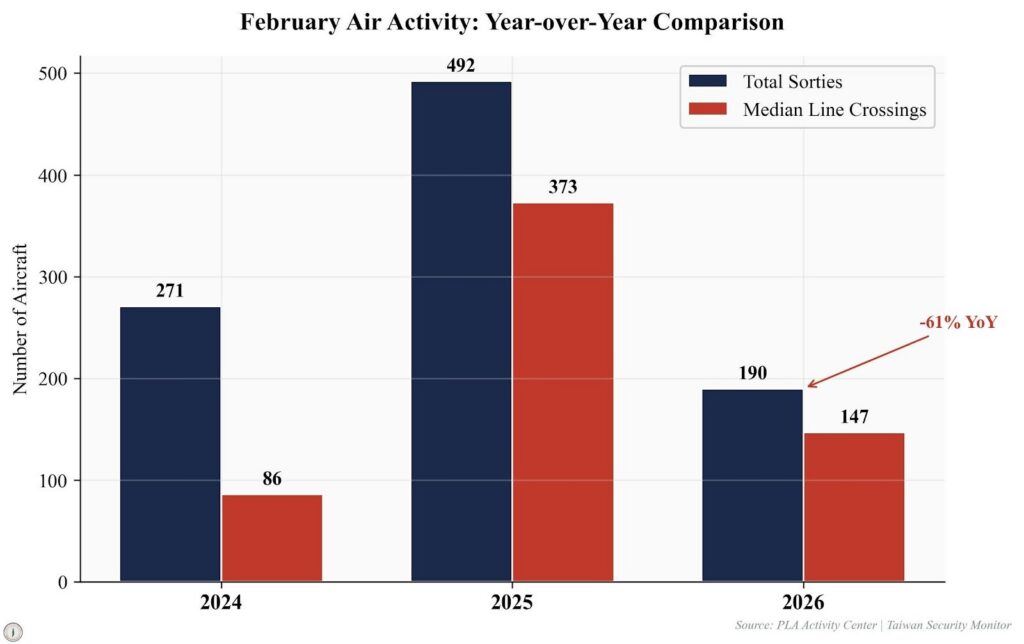
  • Taiwan’s Ministry of National Defense recorded 190 PLA aerial sorties around the island in February 2026, a 30 percent decline from January’s 270 and a continuation of the downward trajectory that began after the December 2025 Justice Mission exercise. Year-over-year, February’s figure represents a 61 percent decline from 492 sorties in February 2025.
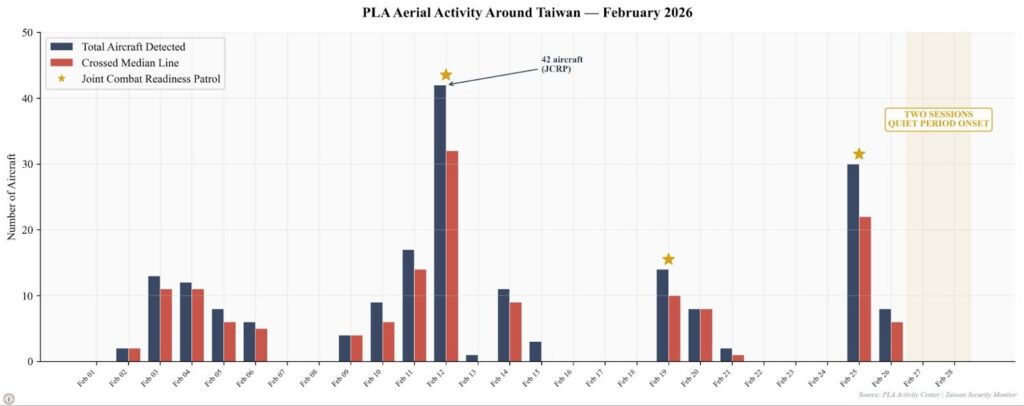
  • Three joint combat readiness patrols occurred during the month: February 12 (42 aircraft), February 19 (14 aircraft), and February 25 (30 aircraft). These operations demonstrate that the PLA’s capacity for large-scale multi-domain demonstrations remains intact, despite a contraction in routine sortie volume.
  • No aircraft were detected around Taiwan on February 27 and 28, marking the onset of a quiet period that extended through the first half of March in anticipation of the National People’s Congress and Chinese People’s Political Consultative Conference (the ‘Two Sessions’).
  • PLAN vessel detections averaged approximately seven per day in February, with a peak of eleven, consistent with the five-to-nine vessel baseline observed throughout 2025. The persistence of naval presence during a month of declining air activity demonstrates the operational decoupling between the air and maritime domains.
  • Coast Guard Administration data indicate ten documented China Coast Guard (CCG) incursions into Taiwan’s restricted waters from January through February, concentrated around Kinmen (eight incidents) and Dongsha Island (two incidents).

February 2026 Air Activity

In February 2026, 190 aircraft sorties were detected around Taiwan, with 147 entering the southwestern portion of Taiwanโ€™s Air Defense Identification Zone. This total represents a significant reduction from January’s 270 sorties and continues a downward trajectory that began after the PLA’s Justice Mission-2025 exercise on December 29, 2025. That exercise involved 130 aircraft in a single day, marking the largest single-day operation around Taiwan since comprehensive daily reporting began. The post-exercise period has been characterized by a gradual normalization of activity levels, although the pace of this decline is not unprecedented in the historical record.

February exhibited a familiar pattern of quiet periods punctuated by activity surges. The peak occurred on February 12, when 42 aircraft were detected as part of a Joint Combat Readiness Patrol (JCRP), representing the largest single-day figure since the Justice Mission exercise. Two additional JCRPs followed on February 19 (14 aircraft) and February 25 (30 aircraft). Outside these exercises, daily sortie counts typically ranged from two to thirteen aircraft, with several days recording zero detections. The final two days of the month, February 27 and 28, both recorded zero aircraft, indicating the onset of the quiet period associated with China’s annual Two Sessions legislative meetings, which extended through mid-March. The Chinese Military Commission (CMC) leadership purges that began in January 2026, including the dismissal of two senior vice-chairmen, may have reinforced this pattern of restraint by introducing additional institutional caution among theater-level commanders.

Figure 1. Daily PLA activity around Taiwan, February 2026. Gold stars denote JCRP days; shaded region marks the onset of the Two Sessions quiet period.

Monthly Trajectory: Postโ€“Justice Mission Cooling

The decline from 270 sorties in January to 190 in February aligns with the broader pattern of post-exercise normalization observed after major PLA operations around Taiwan in recent years. The December 2025 Justice Mission exercise caused a significant spike in both single-day and monthly activity. The first two months of 2026 appear to reflect a return to a lower operational baseline rather than a strategic decision to permanently de-escalate. January 2026 remained elevated relative to the monthly averages of mid-2025, and February’s figure, while lower, falls within the range of monthly totals observed during non-exercise periods.

Figure 2. Monthly PLA sortie totals, 2024โ€“2026. For 2026, January and February data are shown.

The frequency of joint combat readiness patrols offers a counterpoint to the overall decline in sortie numbers. February’s three JCRPs are comparable to January’s four, indicating that the PLA’s exercise tempo has not significantly slowed, even as routine patrol activity has contracted. This distinction between routine and surge operations is analytically important: reductions in daily sortie volume do not necessarily indicate a diminished PLA capacity or willingness to conduct large-scale operations on short notice.

At Sea: Naval Presence

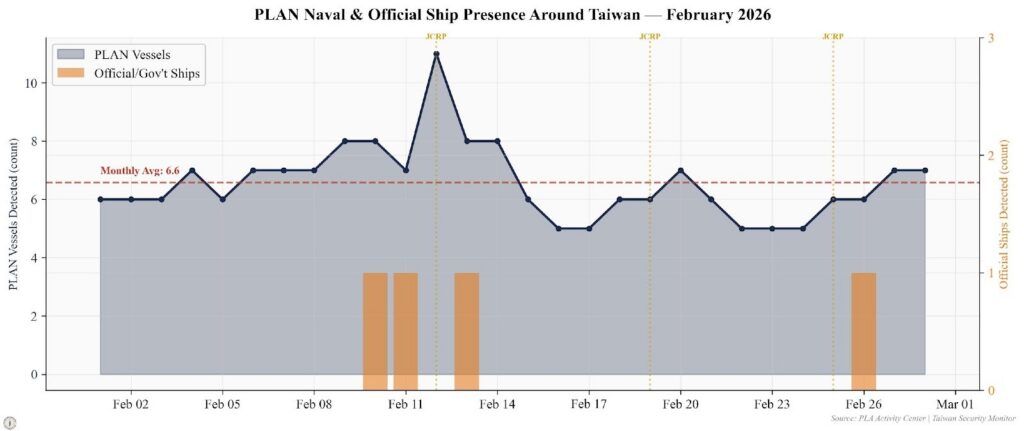
PLAN vessel detections in the waters around Taiwan averaged 6.6 per day in February, with a peak of eleven vessels on a single day. These figures are broadly consistent with the range of 5-9 vessels that has characterized PLAN presence throughout 2025 and into 2026. The stability of naval posture during a month when air activity declined by nearly 30 percent from January highlights a structural feature of cross-strait military dynamics: the air and maritime components of PLA activity around Taiwan appear to operate under distinct operational logics and respond to different drivers.

Figure 3. PLAN vessel and official ship detections around Taiwan, February 2026.

This decoupling is analytically significant. Observers who track sortie counts as a proxy for cross-strait tension may interpret the January-to-February decline as evidence of easing pressure. However, naval data present a different perspective: the PLAN’s sustained presence at sea indicates that the military’s overall posture in the Taiwan Strait has not meaningfully contracted, even as the air component adjusts to post-exercise and politically sensitive rhythms.

Coast Guard Gray Zone Operations

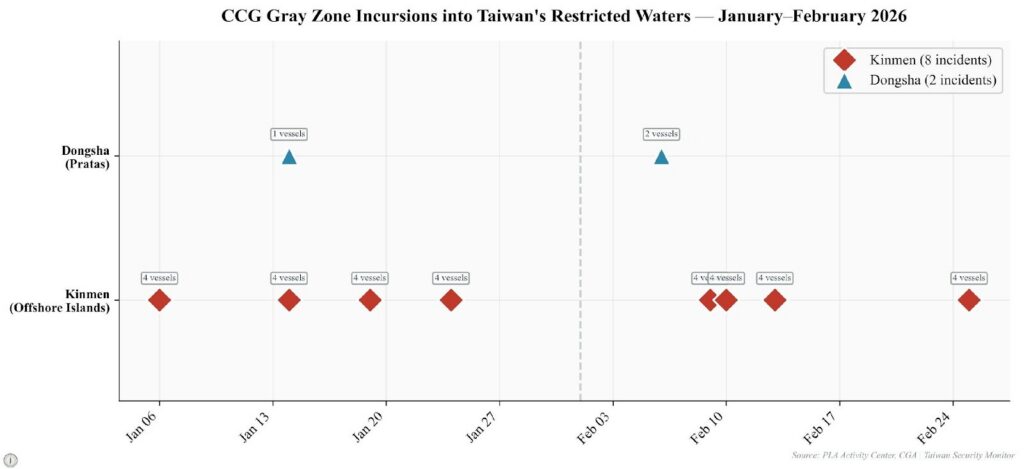
China Coast Guard activity in Taiwan’s restricted waters constitutes a third, and often underreported, dimension of cross-strait pressure. From January through February 2026, the CCG conducted at least ten documented incursions: eight around Kinmen and two near Dongsha Island (Pratas). The Kinmen operations have developed into a recognizable pattern, typically involving two to four CCG cutters entering restricted waters for two to three hours before withdrawing. This approach appears designed to normalize a regular CCG presence in waters that Taiwan’s Coast Guard Administration considers under its jurisdiction.

Figure 4. CCG incursions into Taiwan’s restricted waters, Januaryโ€“February 2026, by location and vessel count.

The Kinmen incursions have involved a recurring set of CCG cutters, including hull numbers 14529, 14603, 14609, and 14530, suggesting a dedicated patrol rotation rather than ad hoc deployments. The Dongsha operations are qualitatively different. The February 6 incursion near Dongsha involved vessels 3501 and 3107, with the CCG presence lasting approximately eight hours. Although shorter than the extended dwell times observed in later months, the Dongsha deployments represent a more logistically demanding operation due to the island’s distance from Chinese territorial waters. Their continuation into February suggests an established rather than exploratory program.

Multi-Domain Overview

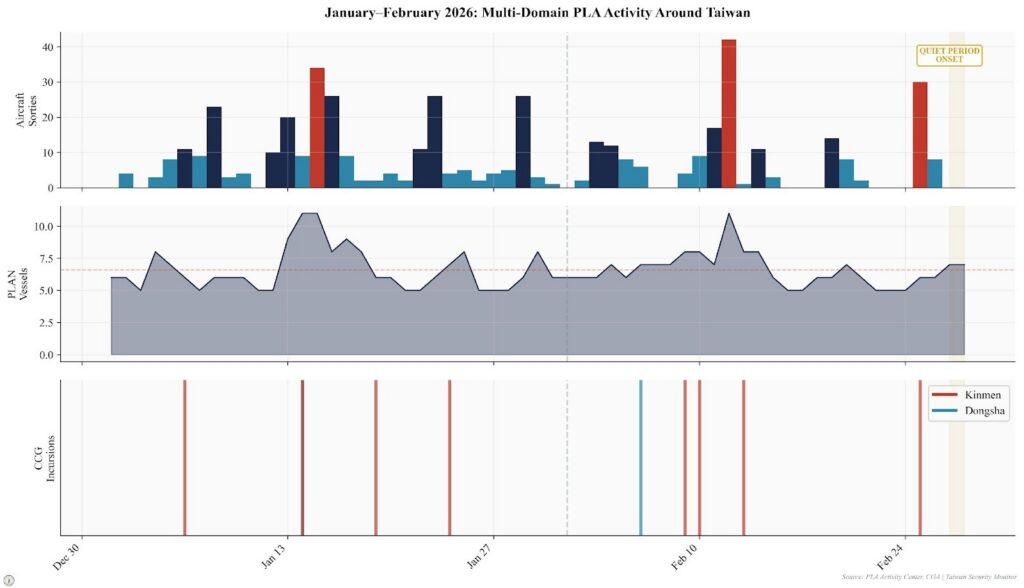
Figure 5. Januaryโ€“February 2026 multi-domain PLA activity: air sorties, naval presence, and CCG incursions.

An integrated view of all three domains during the first two months of 2026 reveals a more complex picture than any single metric suggests. Air activity has declined sequentially, reflecting sensitivity to both post-exercise normalization and political calendars. Naval presence has remained steady and largely unaffected by fluctuations in the air domain. Coast Guard incursions have continued at a pace consistent with an institutionalized patrol program. Analysts and policymakers assessing cross-strait dynamics should examine all three domains collectively, rather than relying solely on sortie counts as a barometer of PLA intent.

Figure 6. February air activity year-over-year: total sorties and median line crossings, 2024โ€“2026.

Methodology & Sources

Air and naval detection data are drawn from daily press releases issued by Taiwan’s Ministry of National Defense and compiled in the PLA Activity Center database maintained by Taiwan Security Monitor. Coast Guard incident data are compiled from Coast Guard Administration press releases and verified against contemporaneous media reporting. “Median line” refers to the informal centerline of the Taiwan Strait historically observed by both sides. “JCRP” denotes Joint Combat Readiness Patrols as designated by Taiwan’s MND. All analysis and commentary are by Taiwan Security Monitor.
ยฉ 2026 Taiwan Security Monitor. All rights reserved.
Strait Snapshot, January 2026 Update

Author: Ethan Connell & Jonathan Walberg


Key Findings

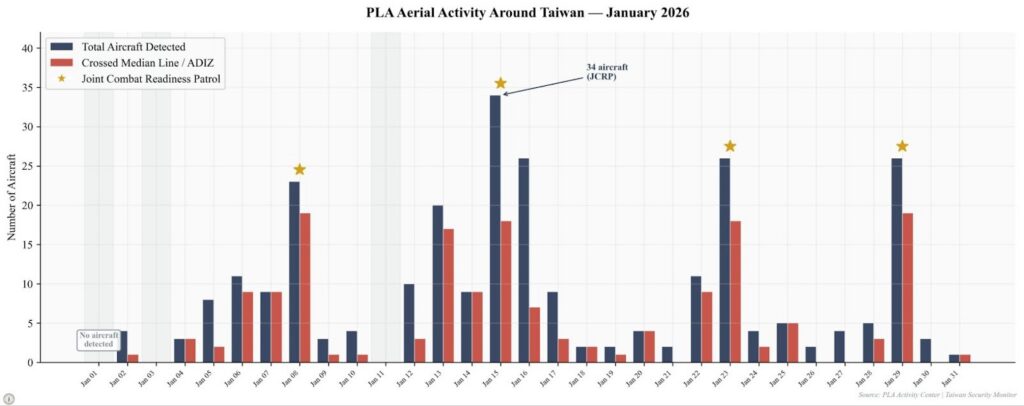
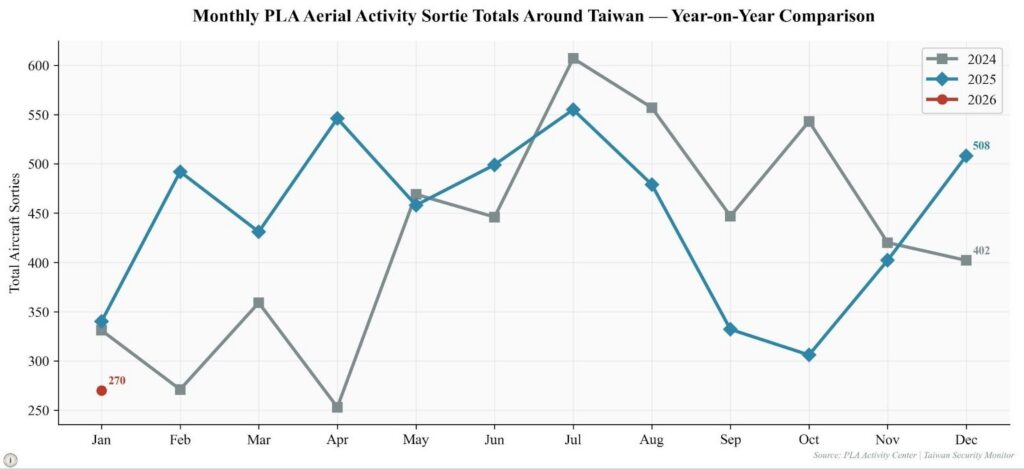
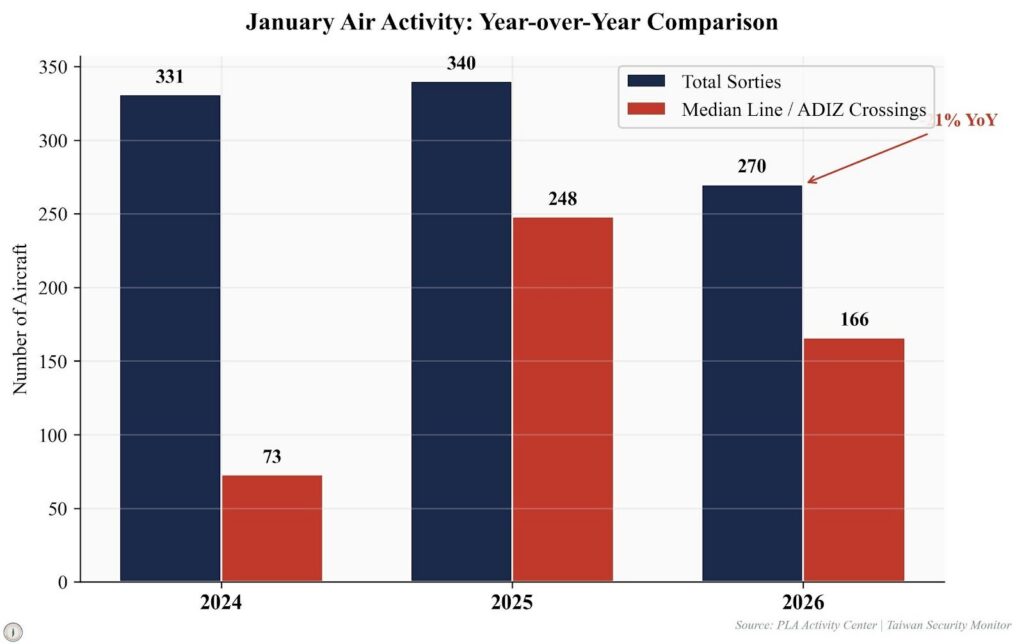
  • In January 2026, Taiwan’s Ministry of National Defense recorded 270 PLA aerial sorties around the island, a 21 percent decrease compared to the 340 sorties in January 2025. This month marks the first complete period of post-Justice Mission activity, following the December 29, 2025, exercise that deployed 130 aircraft in a single day.
  • Four Joint Combat Readiness Patrols (JCRPs) occurred during the month, with the January 15 JCRP involving 34 aircraft, marking the highest single-day total. The consistent scheduling of JCRPs throughout January demonstrates that the PLA retains the capability for high-intensity, multi-platform demonstrations around Taiwan, despite a reduction in routine sortie volumes compared to 2025.
  • PLAN vessel detections averaged 6.6 per day in January, with a peak of 11 vessels, aligning with the five-to-nine vessel baseline observed throughout 2025. Naval presence remained stable during the month and was largely unaffected by fluctuations in air activity.
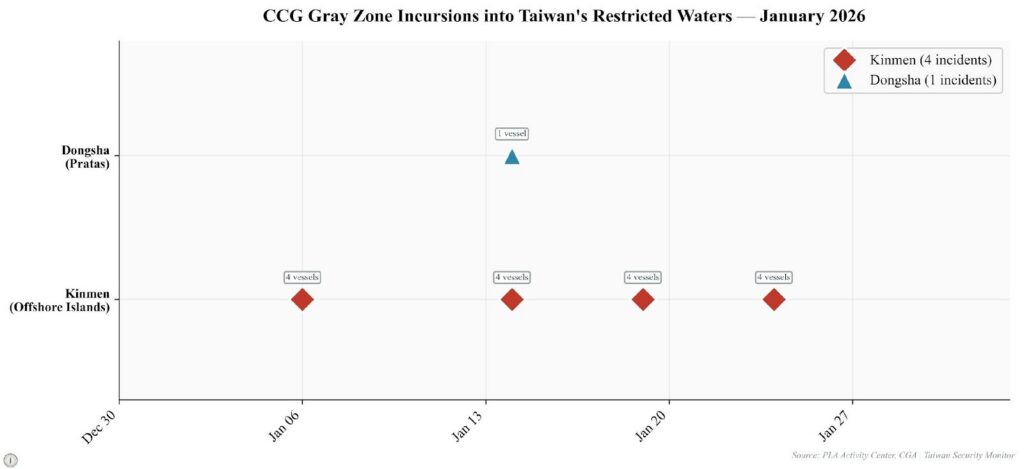
  • The Coast Guard Administration documented five CCG incursions into Taiwan’s restricted waters in January: four near Kinmen and one near Dongsha Island (Pratas). The January 14 Dongsha incident involved CCG vessel 3501, a larger-class cutter, highlighting a qualitative distinction in Beijing’s operational approach to these two locations.

January 2026 Air Activity

January 2026 opened a new chapter in the pattern of PLA air activity around Taiwan. The month’s total of 270 detected aircraft sorties, of which 166 entered Taiwan’s Air Defense Identification Zone, represents a 21 percent decline compared with January 2025’s 340 sorties. This figure must be read in context: the Justice Mission-2025 exercise of December 29, 2025, which saw 130 aircraft deployed around Taiwan in a single day, the largest such operation since comprehensive daily reporting began, may have temporarily exhausted forward-deployed assets and maintenance capacity in the Eastern Theater Command, contributing to a lower sustained tempo in the weeks that followed.

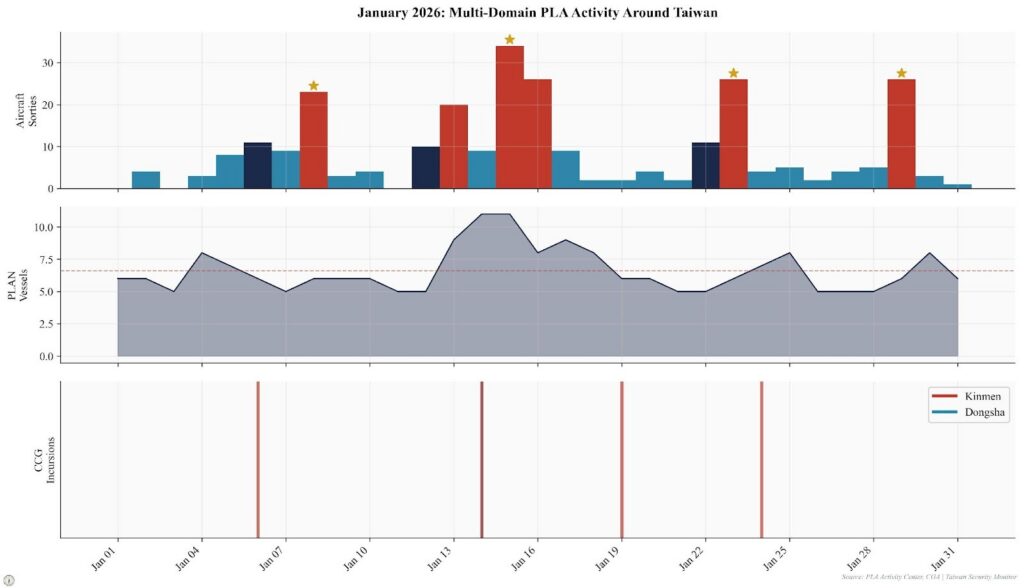
The daily pattern was characterized by a sawtooth rhythm: brief surges tied to Joint Combat Readiness Patrols, interspersed with days of minimal or zero activity. January saw 3 days in which no aircraft were detected (New Year’s Day, January 3, and January 11), punctuated by four JCRPs (January 8, 15, 23, and 29) that produced single-day peaks of 23, 34, 26, and 26 aircraft, respectively. The January 15 JCRP, involving 34 aircraft, was the month’s most significant single-day event and demonstrated multi-platform coordination across fighter, early warning, and anti-submarine warfare aircraft.

Figure 1. Daily PLA activity around Taiwan, January 2026. Gold stars denote JCRP days; shaded columns mark days with zero aircraft detected.

The removal of two senior Central Military Commission vice-chairmen in January, as part of an ongoing anti-corruption campaign within the PLA that had already affected several high-ranking officers in 2025, introduces an additional variable in interpreting the month’s air activity data. Although it is premature to establish a direct causal relationship between personnel changes and operational tempo, disruptions to command authority at the highest levels may have fostered institutional caution, potentially reducing routine sortie generation.

Monthly Trajectory: Where January Fits

January’s 270 sorties place the month at the low end of the range observed in recent years. For comparison, January 2024 recorded 331 sorties and January 2025 recorded 340. The year-over-year decline is more modest than the raw numbers might suggest: January historically sits below the annual average, as the PLA’s operational calendar typically builds toward spring and fall peaks. What distinguishes January 2026 is the extent to which the month was shaped by the aftereffects of the December 2025 Justice Mission exercise, which represented an operational high-water mark that appears to have drawn forward maintenance and logistics resources.

Figure 2. Monthly PLA sortie totals, 2024โ€“2026. For 2026, only January data is available.

The frequency of joint combat readiness patrols in January 2026, totaling four events, surpassed the typical January cadence observed in previous years. This indicates that the decrease in total sortie volume has not corresponded with a reduction in the PLA’s readiness to conduct large-scale, multi-domain demonstrations on short notice, a trend warranting continued observation in the coming months.

At Sea: Naval Presence in January

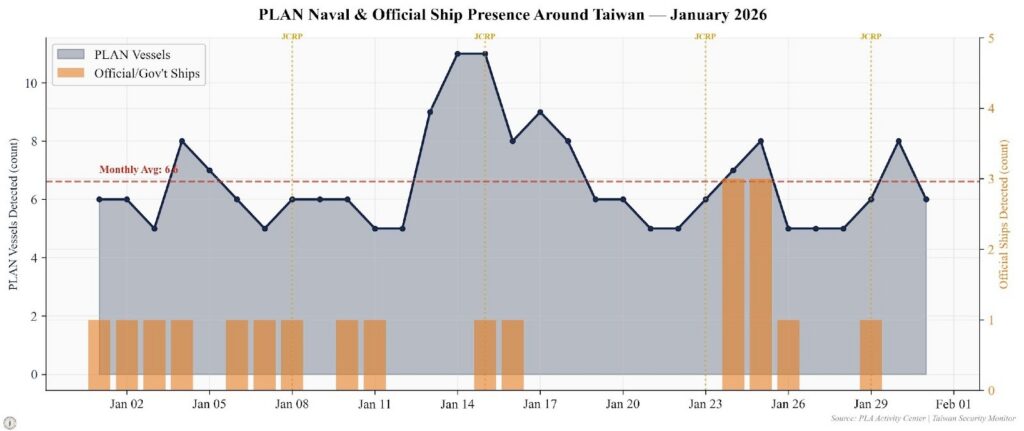
In January, PLAN vessel detections in the waters around Taiwan averaged 6.6 per day, peaking at 11 vessels on January 14 and 15. These numbers align with the five-to-nine vessel baseline that has defined PLAN presence throughout 2025 and into the new year. The stability of naval posture during the post-Justice Mission period, when air activity was moderating, reinforces a key structural observation from Taiwan Security Monitor’s multi-domain tracking: PLAN presence around Taiwan follows a different operational cycle from PLA aerial activity, showing less sensitivity to the political and institutional factors that influence air sortie fluctuations.

Figure 3. PLAN vessel and official ship detections around Taiwan, January 2026.

Official and government ship detections remained generally low throughout January, with a notable increase on January 24 and 25, when three official ships were detected each day. This decoupling between air and naval activity is analytically significant: analysts focusing solely on sortie counts may interpret January’s data as evidence of moderation, yet the stable naval footprint demonstrates that the PLA’s overall maritime posture has not significantly diminished. China Coast Guard activity in Taiwan’s restricted waters constitutes a third, frequently underreported dimension of cross-strait pressure. In January 2026, the CCG conducted at least 5 documented incursions: 4 around Kinmen and 1 near Dongsha Island (Pratas). The Kinmen operations follow a recognizable pattern: typically three to four CCG cutters entering restricted waters near Liaoluo and Lieyu for two to three hours before withdrawing. Recurring hull numbers (14529, 14603, 14605, 14609, and 14533) indicate a dedicated patrol rotation rather than ad hoc deployments.

Figure 4. CCG incursions into Taiwan’s restricted waters, January 2026, by location and vessel count.

The January 14 Dongsha incursion differed qualitatively from the Kinmen pattern. CCG vessel 3501, a larger-class cutter, was detected west of Dongsha at 05:14 and remained in restricted waters for approximately eleven hours before departing. Although this duration was shorter than the twenty-five-hour dwell times observed at Dongsha in subsequent months, the deployment of a 3500-class cutter to Taiwan’s most remote holding indicates sustained interest in testing the Coast Guard Administration’s ability to maintain a presence at Dongsha, located approximately 450 kilometers southwest of the main island and over 300 kilometers from the nearest Taiwan-controlled port.

Multi-Domain Overview

Figure 5. January 2026 multi-domain PLA activity: air sorties, naval presence, and CCG incursions.

When considered across all three domains, January 2026 exhibits the characteristic pattern of multi-domain PLA pressure that the Taiwan Security Monitor has documented since the post-2022 period. Air activity was concentrated in distinct JCRP-driven surges, separated by extended periods of minimal activity. Naval presence remained steady and was largely uncorrelated with the daily fluctuations in air operations. Coast Guard incursions persisted along established geographic patterns, with the Dongsha deployment introducing a longer-range element to an otherwise Kinmen-focused gray-zone campaign.

Figure 6. January air activity year-over-year: total sorties and ADIZ crossings, 2024โ€“2026.

Analysts and policymakers should avoid interpreting a reduction in one domain as indicative of an overall decrease in pressure. The combined multi-domain posture, encompassing air, naval, and coast guard activities, does not reflect a significant departure from the sustained pattern of PLA activity around Taiwan that has shaped the cross-strait military balance since August 2022.

Methodology & Sources

Air and naval detection data are drawn from daily press releases issued by Taiwan’s Ministry of National Defense and compiled in the PLA Activity Center database maintained by Taiwan Security Monitor. Coast Guard incident data are compiled from Coast Guard Administration press releases and verified against contemporaneous media reporting. Japan ADIZ scramble data are sourced from Japan Joint Staff Office press releases and reporting by USNI News. “Median line” refers to the informal centerline of the Taiwan Strait historically observed by both sides. “JCRP” denotes Joint Combat Readiness Patrols as designated by Taiwan’s MND. All analysis and commentary are by Taiwan Security Monitor.
ยฉ 2026 Taiwan Security Monitor. All rights reserved.