Taiwan Security Monitor

Taiwan Affairs Office: Peaceful reunification will make Taiwan better in all respects, including infrastructure development.

At the January 28 press conference of the Taiwan Affairs Office of the State Council, a reporter asked: Recently, news that the mainland’s high-speed railway network has exceeded 50,000 kilometers in operating length has sparked heated discussion in Taiwan. Some commentators say that Taiwan has long suffered from energy shortages and aging infrastructure, and that if mainland capital and technology were introduced, projects such as tunneling through the Central Mountain Range and improving transportation in eastern Taiwan would not be a problem. Traveling from Hualien or Taitung back to Taipei would no longer require worrying about road closures or landslides—that would be a real sense of security. Some netizens have also said they look forward to the day when they can take a high-speed train across the Taiwan Strait to travel between the two sides. What is your comment?

TAO spokesperson Zhang Han responded that the mainland’s high-speed rail construction is world-renowned. Since the start of the 14th Five-Year Plan period, the mainland has built and put into operation more than 12,000 kilometers of high-speed rail, bringing 128 counties into the high-speed rail era. At present, the total length of high-speed rail lines is 50,400 kilometers, covering 97% of cities with urban populations of more than 500,000, forming the world’s largest and most modern high-speed railway network. The fast-running high-speed trains make distances “smaller,” make dreams “bigger,” and make faraway places no longer distant.

He said that peaceful reunification will create enormous opportunities for Taiwan’s economic and social development. With a strong motherland as its backing, Taiwan will be better in all respects, including infrastructure development. Taiwan compatriots, together with mainland compatriots, will share in the dignity and glory of the great country, share in the achievements of Chinese-style modernization, and usher in a bright future of prosperity and stability.
Taiwan Affairs Office: Enable Taiwan compatriots to share in the mainland’s development achievements in every aspect of daily life—food, clothing, housing, and transportation.

At the January 28 press conference of the Taiwan Affairs Office of the State Council, a reporter asked: The Taiwan authorities recently released data showing that in 2025 Taiwan’s total imports of consumer goods reached US$49.4 billion, a record high, of which nearly one quarter (24.5%) came from the mainland, ranking first among sources. Mainland products have long been popular among Taiwanese consumers for being good quality and good value. What is your comment?

TAO spokesperson Zhang Han responded that the mainland has the world’s largest, most comprehensive, and most complete industrial system, and its manufacturing scale has ranked first globally for many consecutive years. Intelligent, green, and integrated development is accelerating. From leisure snacks, home appliances, and mobile phones to new-energy vehicles and industrial robots and other high-end equipment, a dazzling array of “Made in China” products has entered millions of households, gone all over the world, and led consumption trends.

He said that compatriots on both sides of the Strait share common cultural traditions and living habits, so it is natural that mainland consumer goods are deeply loved by the people of Taiwan. Strengthening cross-Strait economic cooperation and deepening cross-Strait integrated development is the right path that serves the common interests of compatriots on both sides. They will continue working to allow Taiwan compatriots to share in the mainland’s development achievements in all aspects of daily life—food, clothing, housing, and transportation—and also welcome more Taiwan compatriots to come to the mainland to look around and see for themselves, and personally experience the mainland’s rapid, day-by-day development and changes.

Taiwan Affairs Office: Our sincerity in restoring mainland residents’ travel to Taiwan remains unchanged.

At the January 28 press conference of the Taiwan Affairs Office of the State Council, a reporter asked: Recently, China’s Ministry of Culture and Tourism released the 2026 edition of model group-tour contract templates, including the Model Contract for Mainland Residents Traveling to Taiwan. Given that the resumption of cross-Strait tourism is currently obstructed, the simultaneous update of this text has drawn attention. Taiwan’s Tourism Administration said that if the mainland side has goodwill to restore cross-Strait tourism, it should reply as soon as possible and conduct consultations on tourism issues through the “two associations.” What is your comment on this? In addition, is the policy announced by the mainland in January last year to resume group tours to Taiwan for residents of Fujian and Shanghai still valid?

TAO spokesperson Zhang Han responded that between 2013 and 2014, the current group-tour contract model texts were successively issued, including five model contracts covering group tours, mainland residents traveling to Taiwan, and other categories. This revision is a package update of the existing texts. In 2024, the mainland resumed travel by Fujian residents to Kinmen and Matsu. The current revision of the Model Contract for Mainland Residents Traveling to Taiwan helps to meet market demand in a timely manner, further standardize market order, and safeguard the legitimate rights and interests of tourists and travel agencies.

He said that driven by their confrontational “Taiwan independence” nature and political self-interest, the Democratic Progressive Party (DPP) authorities turn a deaf ear to mainstream public opinion in Taiwan and the voices of the industry, turn a blind eye to the harm to the interests of grassroots people and businesses, and repeatedly use various pretexts to obstruct, restrict, and set up barriers to tourism and exchanges in various fields. This is deeply unpopular. The island’s tourism industry has already expressed extreme disappointment and strong indignation. If the authorities do not change course and continue to act out of selfish motives, they will only further lose public support and bring the consequences upon themselves.

Zhang said that the mainland has always upheld the concept that “people on both sides of the Strait are one family,” and has continuously worked to promote cross-Strait travel and exchanges and cooperation in tourism and other fields, releasing goodwill. Their sincerity in restoring mainland residents’ travel to Taiwan remains unchanged. The key question now is whether the DPP authorities can face up to mainstream public opinion in Taiwan and the voices of the industry, and create favorable conditions for cross-Strait travel and exchanges and cooperation.

Taiwan Affairs Office: Scenic area and tourist attraction ticket discounts/fee waivers apply to “first-time” Taiwan visitors (台胞“首来族”)

At the January 28 press conference of the Taiwan Affairs Office of the State Council, a reporter asked: Recently, a retired Taiwanese serviceman entered a scenic area on the mainland using his Taiwan military retirement ID and requested free admission on the same basis as retired PLA personnel, which has attracted attention online. May retired Taiwanese servicemen receive the same treatment as retired PLA personnel in mainland scenic areas?

TAO spokesperson Zhang Han responded that since 2024, some mainland scenic areas have introduced various facilitation measures for Taiwan compatriots visiting the mainland. Among them, Taiwan compatriots who hold a Taiwan Compatriot Permit issued for the first time (issuance number “01”) are eligible, within one year, for ticket fee reductions or waivers when visiting mainland scenic areas and tourist attractions. The scope of application of these facilitation measures is clearly defined as Taiwan compatriot “first-time visitors” (台胞“首来族”).

As for the specific provisions regarding preferential ticket policies for retired personnel of the Chinese People’s Liberation Army, he said that these can be checked separately.

Taiwan Affairs Office: Lai Ching-te’s retrograde actions will inevitably face a backlash from public opinion.

At the January 28 press conference of the Taiwan Affairs Office of the State Council, a reporter asked: Recently, Taiwan’s legislative body convened a review hearing on the “impeachment case against Lai Ching-te.” Lai Ching-te refused to attend and give explanations, and was sharply criticized by Kuomintang and Taiwan People’s Party legislators as being “arrogant and guilty,” “contemptuous of public opinion,” and “derelict in duty, incompetent, and unethical.” What is your comment?

TAO spokesperson Zhang Han responded that Lai Ching-te stubbornly adheres to a “Taiwan independence” separatist stance and, in pursuit of political self-interest, disregards the people’s livelihood and well-being on the island. He has repeatedly manipulated the judicial system to strike at political opponents, trampled on and obstructed democratic freedoms, and attempted to implement what was described as “green authoritarian rule.” These actions seriously run counter to mainstream public opinion on the island and will inevitably invite a backlash from public opinion.

Taiwan Affairs Office: The Democratic Progressive Party authorities’ hype about the “cybersecurity risks” of mainland apps is driven by sinister motives.

At the January 28 press conference of the Taiwan Affairs Office of the State Council, a reporter asked: Taiwanese media have reported that, in order to so-called “prevent minors from accessing age-inappropriate content and potential cybersecurity risks,” Taiwan’s “Ministry of Digital Affairs” has for the first time proposed a list of high cybersecurity-risk apps, which includes TikTok, Weibo, WeChat, Xiaohongshu, and Baidu Cloud, and has provided it to the education authorities for reference. What is your comment on this?

TAO spokesperson Zhang Han responded that the Democratic Progressive Party (DPP) authorities’ hype about so-called “cybersecurity risks” of mainland applications is driven by sinister motives. By doing so, they are depriving the people of Taiwan—especially young people—of their right to know and their freedom to use social media platforms, cutting off channels for cross-Strait exchanges, and deliberately stirring up the so-called “resist China, protect Taiwan” narrative. What this exposes is their inner fear and “unease.”

He said that the DPP authorities’ arbitrary behavior will inevitably backfire on them. Their retrograde actions cannot stop the popular trend among the people of Taiwan—especially young people—to learn about the mainland and to come to know and grow closer to their compatriots there.

Weekly Security Review: 1/26/26

Author: Jaime Ocon

Welcome to the Weekly Security Review, where we highlight key military, security, and political developments around Taiwan in one straightforward summary!

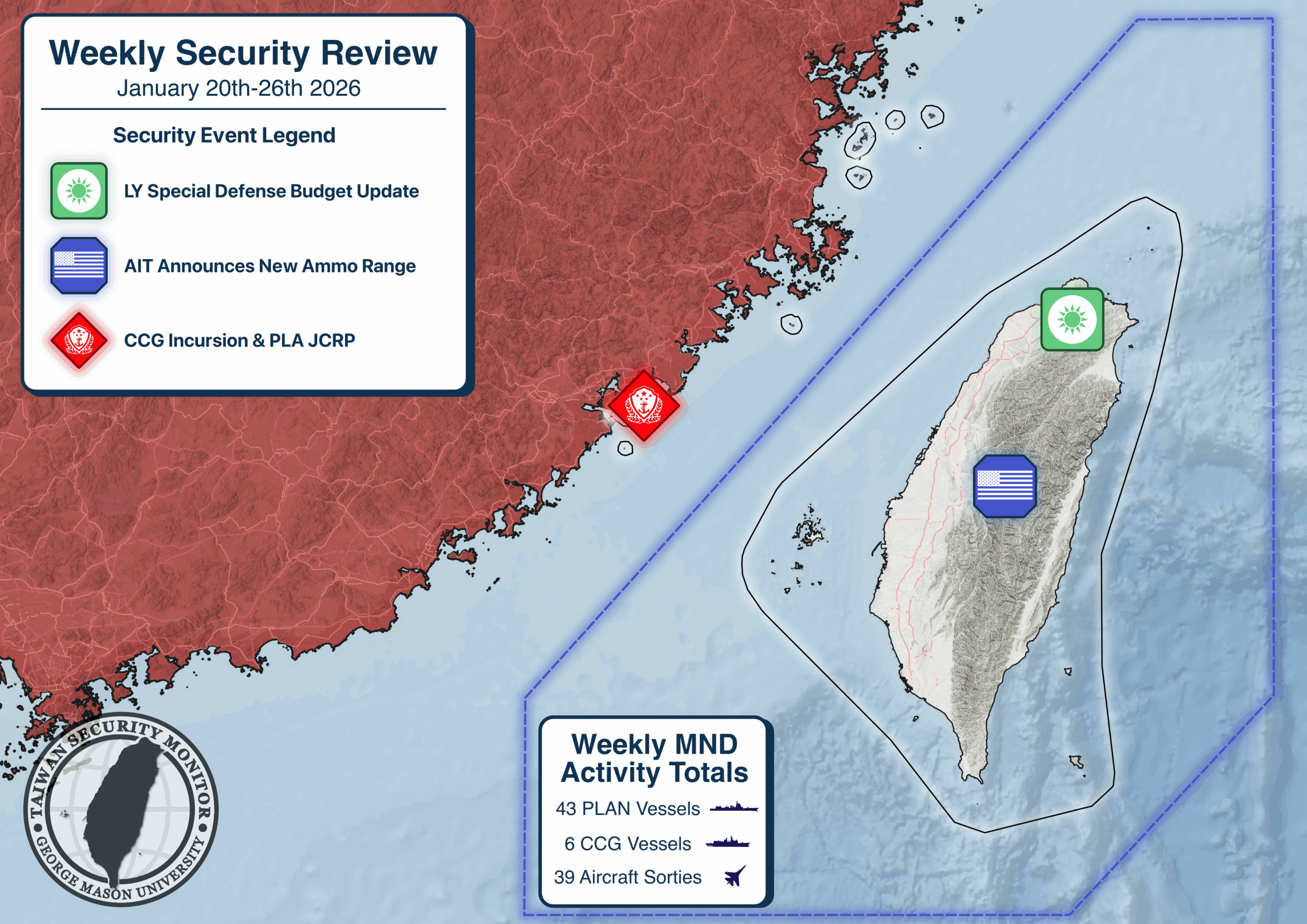
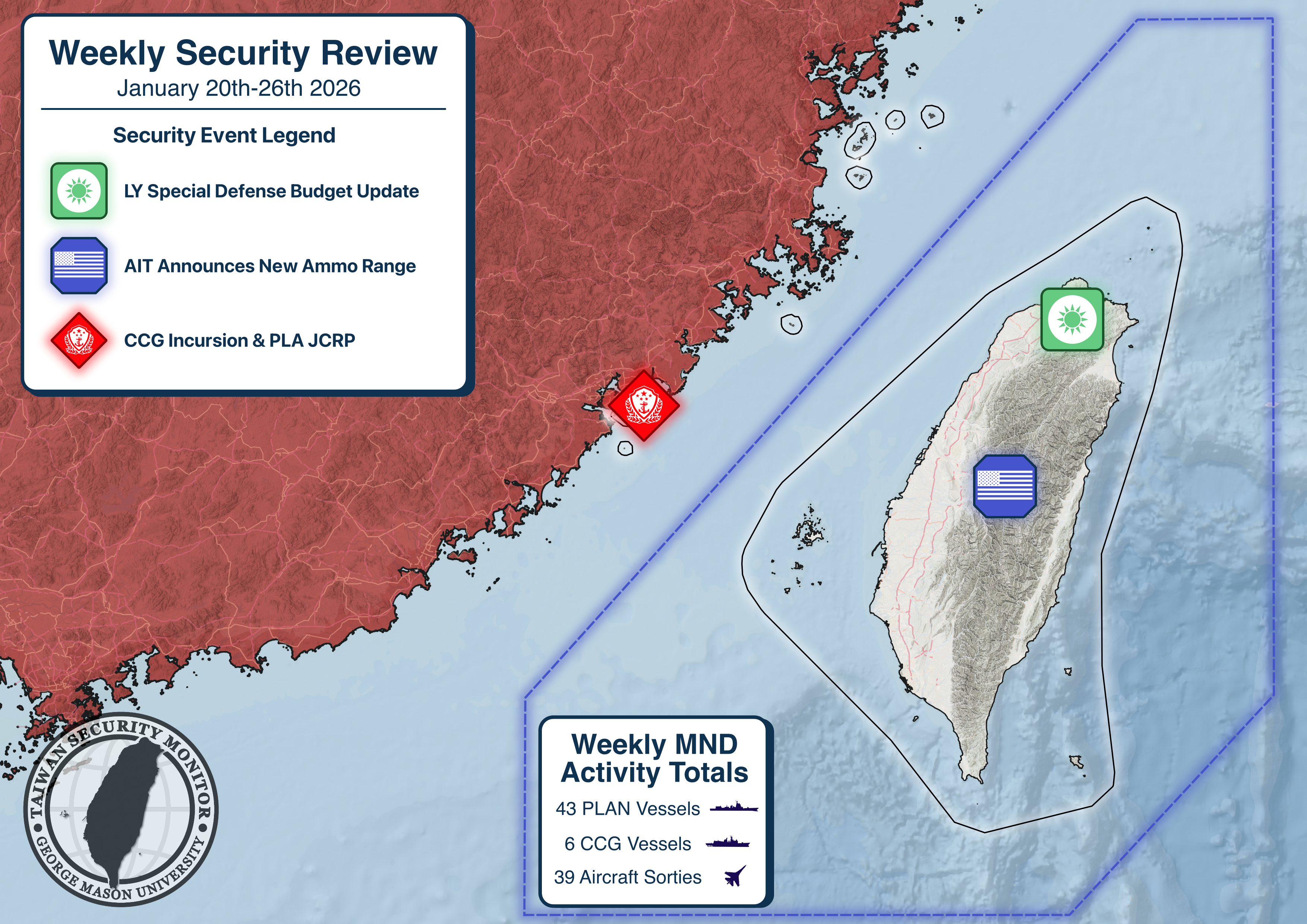
This week, Taiwan unveils details of its record-breaking supplemental defense budget, Washington and Taipei deepen industrial cooperation with a new joint ammunition-testing site, and Chinese forces intensify grey-zone patrols around the country.

Taiwan’s Defense Ministry Discloses Details of Record Supplemental Budget

Taiwan’s Ministry of National Defense (MND) delivered a classified special briefing on the NT$1.25 trillion (US$40 billion) special defense budget to the LY’s Foreign Affairs and National Defense Committee on 19 January. After that briefing, Minister of National Defense Wellington Koo revealed that Taiwan’s military is planning to procure seven categories of weapons systems: precision artillery, long-range strike missiles, air defense and anti-armor missiles, AI-assisted systems, and C5ISR capabilities.

Here is a complete list:

  1. Artillery
    1. M109A7 Paladin Self-Propelled Howitzers: 60 units
    2. Precision Guidance Ammunition  Kits: 4,080 rounds
    3. M992A3 Carrier Ammunition Tracked Vehicles: 60 units
    4. M88A2 Recovery Vehicles: 13 units
    5. Howitzer and Associated Equipment
  1. Long-Range Precision Strike Systems
    1. High Mobility Artillery Rocket Systems (HIMARS): 82 launchers
    2. Guided Multiple Launch Rocket System Rocket Pods: 1,203 (756 unitary pods, 447 alternative cluster pods)
    3. Army Tactical Missile System (ATACMS) Missiles: 420
  1. Unmanned Platforms and Counter-UAS Systems
    1. ALTIUS-700M Loitering Munitions: 1,554 units
    2. ALTIUS-600 ISR Systems: 478 units
    3. Various drones: ~200,000 units, including littoral surveillance and  littoral attack (submersible, bombing, and loitering) types
    4. Unmanned Surface Vessels (USVs): Over 1,000 vessels
    5. Counter-UAS Systems: Various types
  1. Air Defense and Anti-Armor Capabilities
    1. Javelin Anti-Tank missiles: 70 launchers, 1,050 missiles
    2. TOW-2B missiles: 24 launchers, 1,545 missiles
    3. Various Air Defense Missile Systems (including ammunition)
  1. AI Support and C5ISR
    1. AI-Enabled Decision Support Systems
    2. Tactical Network and Rapid Intelligence Sharing Applications
  1. Enhancing Combat Sustainability
    1. Wartime High-Consumption Armament Production Expansion: Establishment or expansion of production lines for ammunition, propellant charges, small-arms primers, new armored vehicle assembly, high-explosives, protective chemical masks, and night-vision devices.
    2. Related Mobile Obstruction Equipment: To enhance battlefield denial capabilities.
    3. Critical Ammunition Procurement: 120mm tank rounds, 105mm tank rounds, 30mm autocannon rounds, 155mm propellant charges, and high-explosives.
  1. Taiwan–U.S. Joint Development and Procurement Cooperation
    1. Acquisition of emerging technology systems to enhance operational resilience and strengthen asymmetric warfare capabilities.

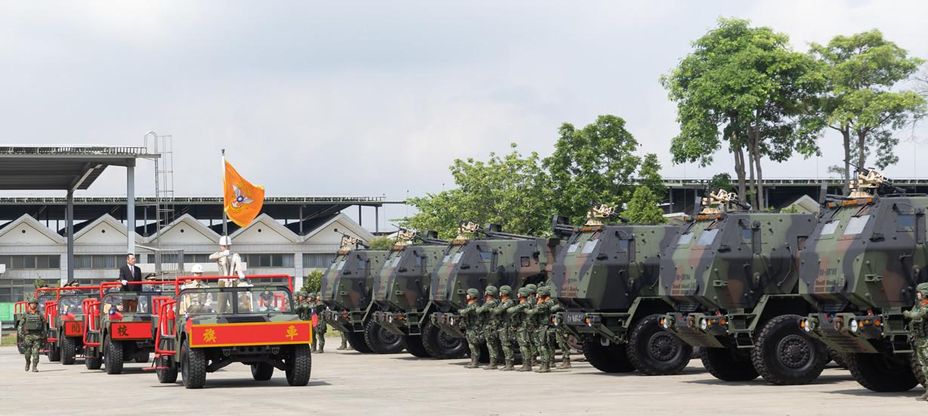
Defense Minister Wellington Koo oversees the first ROCA HIMARS battalion.

The special budget, officially referred to as the Special Act for the Procurement Program to Strengthen Defense Resilience and Asymmetric Capabilities, provides appropriations worth NT$1.25 trillion (US$40 billion) to fund various U.S. weapon systems and equipment. Back in November, Taiwan’s MND and the ruling Democratic Progressive Party (DPP) managed to pass this bill, separate from the general budget, through the Executive Yuan. However, there have been six attempts to pass the finalized act in the LY, all shut down by the opposition Kuomintang (KMT) and Taiwan People’s Party (TPP) due to a lack of oversight and demands that President Lai Ching-te provide more information on the budget’s content. Opposition lawmakers have been quite stern with their demands, declaring that they will not vote on the spending plans until Lai briefs the LY and responds to questions. President Lai continues to label these requests as unconstitutional, citing a 2024 Constitutional Court ruling that declared an opposition-backed legal revision, which would have mandated the President provide real-time responses to lawmakers’ questions, as unlawful.

Minister of National Defense Wellington Koo has already answered questions from the LY, and the MND says the spending plan would help construct a comprehensive defense system to build a “Taiwan Shield.” While a significant portion would be used to pay for U.S. weapon systems, another part of the special budget would introduce advanced technology and AI to accelerate Taiwan’s kill chain. MND officials also stated that it needs those funds to strengthen the domestic defense industry and develop a “non-red” (non-China-dependent) supply chain.

On top of that, in December, more than $11 billion in U.S. arms and equipment was approved for sale, and it is still unclear whether Taiwan needs these funds to start paying for that package.

If you’re interested in the status of U.S. arms sales to Taiwan, check out our Taiwan Arms Sales Backlog for a complete overview of publicly available data.

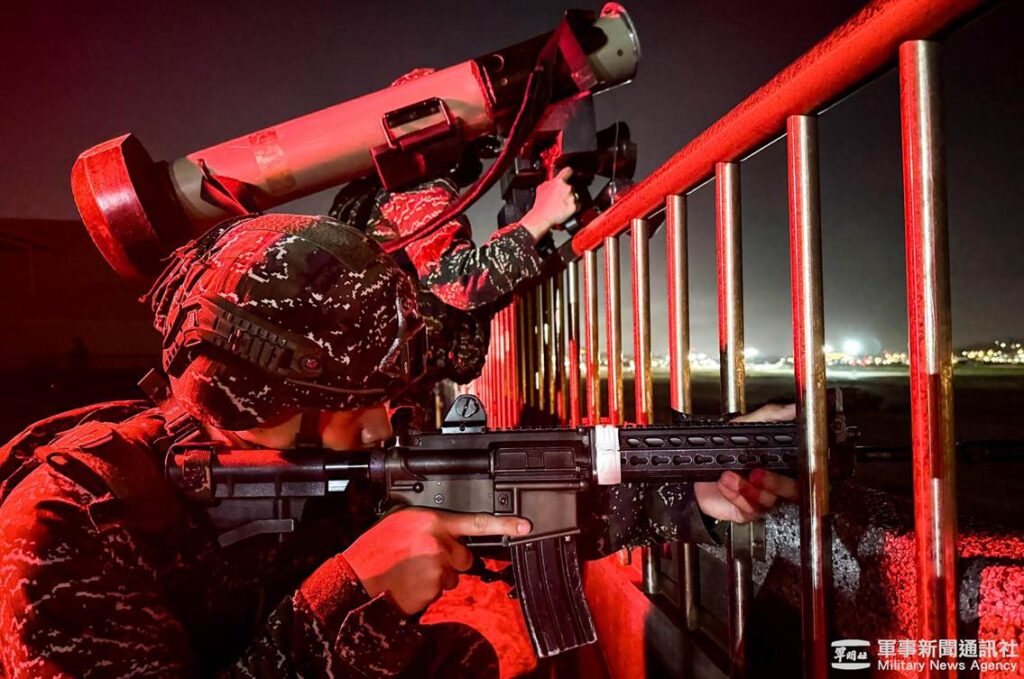
ROCMC units use a Javelin system during the Han Kuang exercises in 2025.

AIT, INDSR Announce Joint Medium-Caliber Ammunition Testing and Production Site

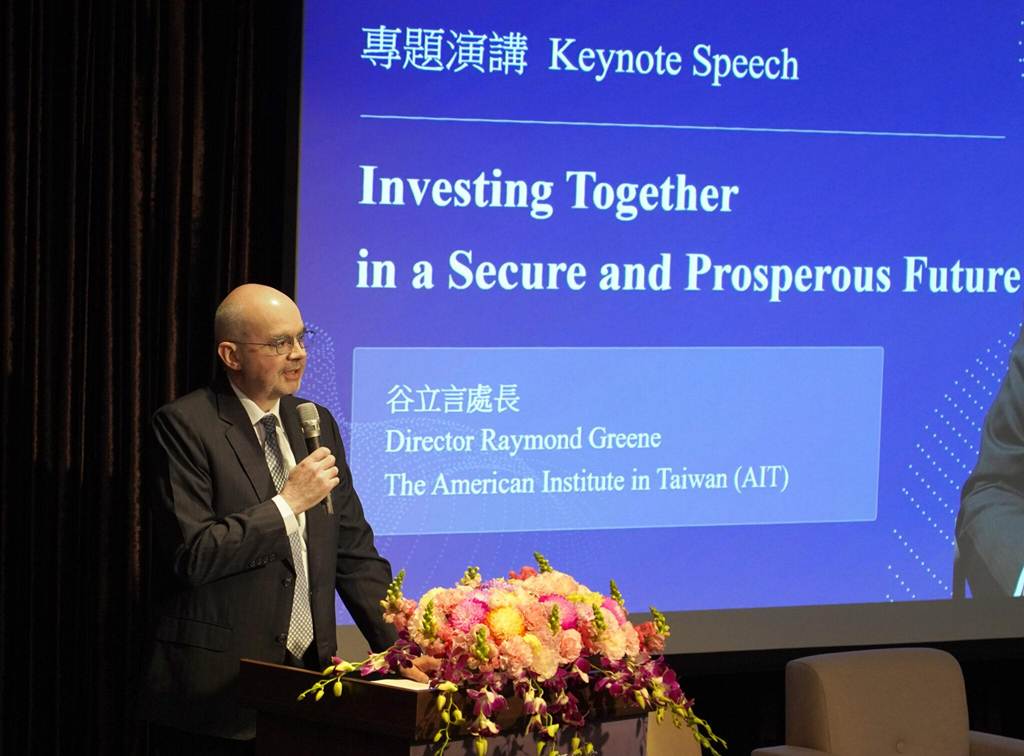
The Director of the American Institute in Taiwan (AIT), Raymond Greene, revealed that U.S. defense contractor Northrop Grumman has established a “medium-caliber ammunition test range” in Taiwan. AIT is the de facto embassy in Taiwan and manages all unofficial relationships between the two sides. Director Greene made the announcement at a forum with the Institute for National Defense and Security Research (INDSR), Taiwan’s top security think-tank, on 22 January. The facility would allow Taiwan’s MND to test ammunition in accordance with global industry standards and, through technology transfer and expert training, advance the country’s indigenous defense research and development projects.

The complete speech is here: https://www.ait.org.tw/speech-by-ait-dir-greene-at-indsr-seminar/

AIT Director, Raymond Greene, speaks at a forum in Taipei.

The announcement is the latest sign of stronger U.S.-Taiwan defense cooperation, as both actors work with Taiwan’s private sector to expand the island’s domestic defense industrial base. Just last week, the head of the MND’s Armaments Bureau said Taiwan’s military has already started working with the U.S. to co-produce 155mm howitzer shells. The MND has stated, “If successful, this will then be expanded to other weapons and munitions.” Other companies, like Anduril, have also announced plans to co-produce low-cost cruise missiles on the island, potentially providing a cheaper, faster way for Taiwan to arm itself.

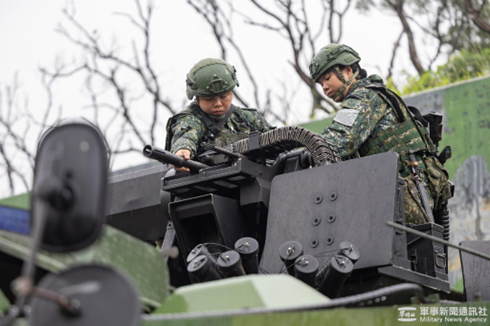
Various ROC units load ammunition into vehicles and aircraft.

This isn’t the first time Northrop Grumman has invested in Taiwan’s domestic production capabilities; in 2024, it committed to investing US$100 million annually in opportunities for Taiwan to become part of its global supply chain. Northrop Grumman, along with Lockheed Martin and Raytheon, has a long history of supplying Taiwan with weapons and equipment. E-2K Hawkeye early-warning aircraft, APG-83 radar systems for the F-16V fighter jets, and ammunition for 30 mm chain guns mounted on Clouded Leopard armored vehicles are just a few of those systems.

China Sustains Gray-Zone Military and Law Enforcement Operations Around Taiwan

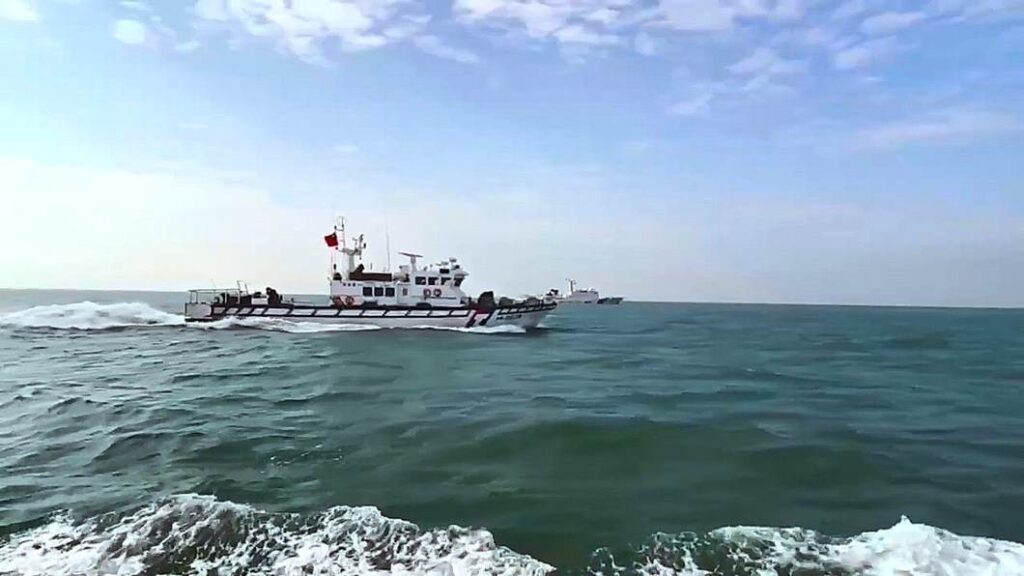
For the 4th time this month, Taiwan’s Coast Guard reported that multiple China Coast Guard vessels entered the restricted waters around Kinmen.

In the morning of 24 January, four Chinese vessels (hull no. 14529, 14605, 14603, and 14533) entered Kinmen’s restricted waters in two-ship formations, one group approaching from the southeast of Liaoluo, the other from south of Lieyu. Taiwan dispatched its own ships and broadcast radio warnings in both Mandarin Chinese and English. Roughly three hours later, the Chinese vessels left the area.

A Taiwanese patrol boat shadows a Chinese Coast Guard ship in the distance near Kinmen.

In an official statement, Taiwan’s Coast Guard Administration (CGA) accused Beijing of repeatedly exploiting false “law enforcement patrols” to justify incursions into Kinmen’s restricted waters. Taiwan’s CGA says China’s maneuvers are “routine harassment” that erodes cross-strait stability and threatens regional peace.

Earlier this week, the PLA Air Force (PLAAF) and PLA Navy (PLAN) also stepped up their presence around Taiwan, sending 23 sorties of various types to conduct a Joint Combat Readiness Patrol. The group of planes, which included PLAAF J-10 fighter jets, H-6K bombers, and KJ-500 Early Warning and Command aircraft, was detected breaching Taiwan’s air defense identification zone (ADIZ) at 1040 on 23 January. 17 out of 23 sorties crossed the median line of the Taiwan Strait and entered the northern, central, and southwestern ADIZ.

Taiwan Security Monitor operates a number of real-time trackers. For more information on PLA and CCG movements, you can find them here.

Taiwan Affairs Office: Strengthening cross-strait economic cooperation and deepening integrated development across the Strait is the right path that accords with the shared interests of compatriots on both sides.

At the January 21 press conference of the State Council Taiwan Affairs Office, a reporter asked: According to statistics from the General Administration of Customs, total cross-strait trade in 2025 reached US$314.33 billion, with mainland exports to Taiwan up 11.2% and the mainland’s imports from Taiwan up 6.0%. Public opinion on the island has analyzed this as fully showing that cross-strait economic cooperation has strong momentum, strong resilience, and great potential. What is your comment? What expectations do you have for the prospects of cross-strait economic exchange and cooperation going forward?

In response, Peng Qing’en, spokesperson for the State Council Taiwan Affairs Office, said: In 2025, despite the adverse impact of the external environment and obstruction and sabotage by the DPP authorities, cross-strait economic and trade exchanges still maintained a steady growth trend. This fully shows that strengthening cross-strait economic cooperation and deepening integrated development across the Strait is the right path that accords with the shared interests of compatriots on both sides, and that any attempt to promote “decoupling and breaking the chain” across the Strait or to weaken cross-strait economic ties runs counter to the trend and is doomed to fail.

Peng Qing’en said: As the mainland economy continues to develop in a sustained and healthy manner during the “15th Five-Year Plan” period, and as high-level opening up and the development of an open economy achieve notable progress, the foundations for cross-strait economic cooperation and integrated development will become even more solid, the areas involved will continue to expand, and the level will continue to rise. This will better benefit compatriots on both sides and help strengthen the Chinese nation’s economy.

Taiwan Affairs Office: The “consensus” reached in U.S.–Taiwan trade negotiations is a letter of capitulation by the DPP authorities to America’s economic bullying.

At the January 21 press conference of the State Council Taiwan Affairs Office, a reporter asked: Recently, after U.S.–Taiwan tariff negotiations concluded, the U.S. Department of Commerce announced that the overall reciprocal tariff rate applied to Taiwanese goods would not exceed 15%. Taiwan’s semiconductor and technology companies will make at least US$250 billion in additional direct investment in the United States, and the Taiwan authorities will also provide at least US$250 billion in credit guarantees. The DPP authorities said the tariff talks with the United States achieved their intended goals, and that the “Taiwan model” has won U.S. support. What is your comment?

In response, Peng Qing’en, spokesperson for the State Council Taiwan Affairs Office, said: The so-called U.S.–Taiwan trade negotiations are in essence the United States using tariffs as a big stick to apply maximum pressure, coercing Taiwan to sharply increase investment in the United States in an attempt to hollow out Taiwan’s advantageous industries. The so-called consensus that was reached is nothing more than a “sell-yourself voucher” by which the DPP authorities sell out the well-being of Taiwan’s people and the interests of industrial development; it is a letter of capitulation that bows and scrapes in the face of economic bullying.

Peng Qing’en said: Next, Taiwan will bear massive investment commitments totaling US$500 billion, and face the major risk of relocating 40% of the semiconductor supply chain to the United States, in exchange for nothing more than a reduction of the already unreasonable so-called “reciprocal tariff” rate from 20% to 15%. Whether this deal is fair or reasonable is obvious to anyone with eyes. But the DPP authorities are not ashamed of this; they take pride in it, trying to deceive Taiwan’s people—beautifying a “smash-the-pot-and-sell-the-iron”-style compromise as an “important breakthrough,” dressing up one-sided bullying as “equal cooperation,” and packaging a complete kneel-down as the “Taiwan model.” By letting the United States strip and carry off Taiwan’s industries and bleed Taiwan’s people dry in this way, such incompetence and shamelessness will only completely ruin Taiwan’s development prospects.

Taiwan Affairs Office: The Lai Ching-te authorities, in order to “seek independence by relying on external forces,” will stop at nothing—even to the point of destroying the roots of Taiwan’s industry.

At the January 21 press conference of the State Council Taiwan Affairs Office, a reporter asked: Recently, when meeting with a visiting delegation from the U.S. state of Arizona, Lai Ching-te said that in recent years the United States has become Taiwan’s largest destination for overseas direct investment. He said he hopes the two sides can sign an agreement to avoid double taxation as soon as possible, to help firms such as TSMC establish a long-term presence in the United States and also create high-paying jobs locally. What is your comment?

In response, Peng Qing’en, spokesperson for the State Council Taiwan Affairs Office, said: The United States has always put “America’s interests first,” is accustomed to wielding a “tariff big stick” to harm others for its own benefit, and the so-called U.S.–Taiwan trade and supply-chain cooperation will only drain Taiwan dry and force Taiwan to sever its own tendons and bones. In Americans’ eyes, Taiwan’s value is not as a “supply-chain partner,” but rather as a “pawn” for “using Taiwan to contain China,” a “cash cow” for the military–industrial complex, and an “ATM” for the reshoring of manufacturing. According to reports, labor costs at TSMC’s U.S. plants are more than twice those at its plants in Taiwan; equipment depreciation costs are as much as four times higher; and gross profit margin is one-eighth that of its plants in Taiwan.

Peng Qing’en said: In order to “seek independence by relying on external forces,” the DPP authorities have time and again fed the tiger with their own flesh, and now want TSMC to substantially increase investment in the United States to create so-called “high-paying jobs” for America. What will be destroyed is only the roots of industry on the island, and what will be chilled is only the hearts of Taiwan’s people.