Taiwan Security Monitor

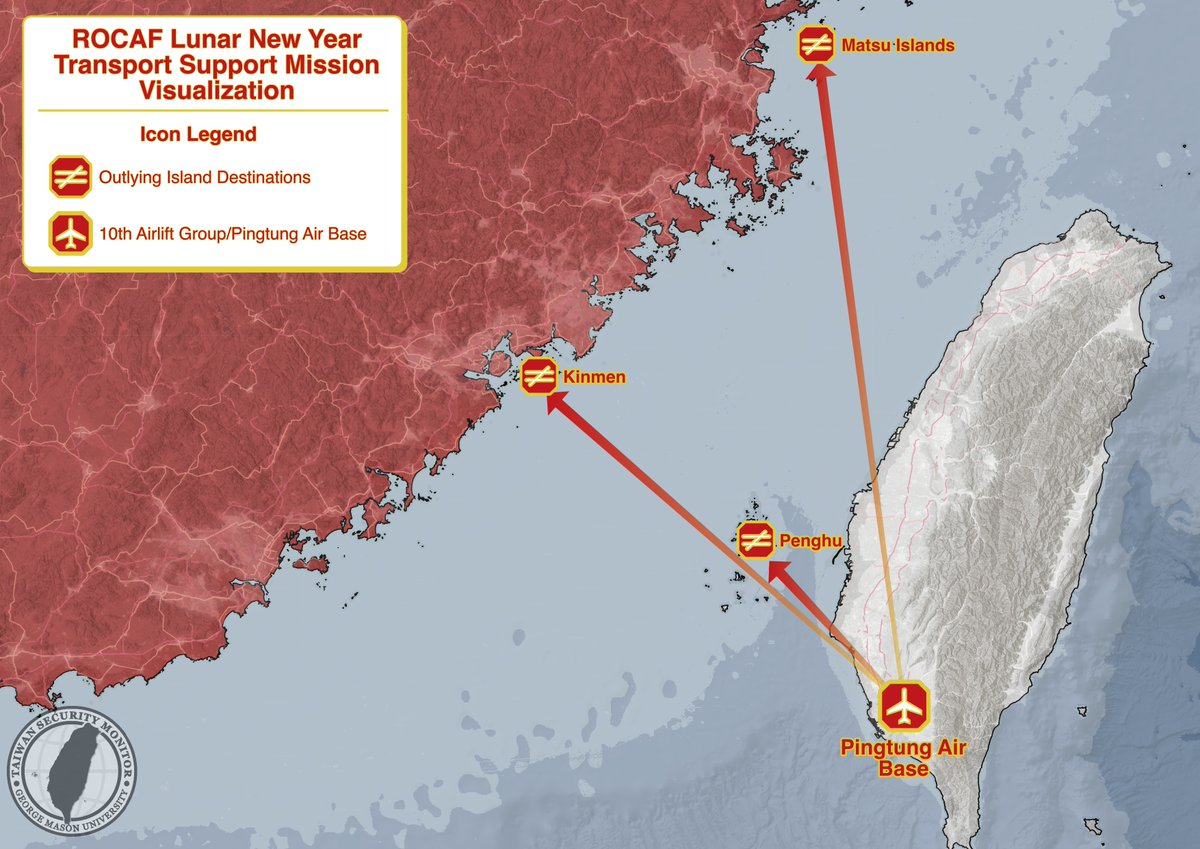
Visualization: ROCAF Lunar New Year Transport Support Mission

Author: Noah Reed

Happy Lunar New Year from Taiwan Security Monitor! Over the next several weeks, C-130H transport aircraft of the ROCAF’s 10th Airlift Group will undertake civilian transport support operations, helping people travel to their families in the outlying islands during the holiday. To support this mission, crews have reconfigured the interior cabins on the C-130 aircraft, and pilots have trained for smooth takeoffs and landings.
Weekly Security Review: 2/16/26

Author: Jaime Ocon


Welcome to the Weekly Security Review, where we highlight key military, security, and political developments around Taiwan in one straightforward summary!

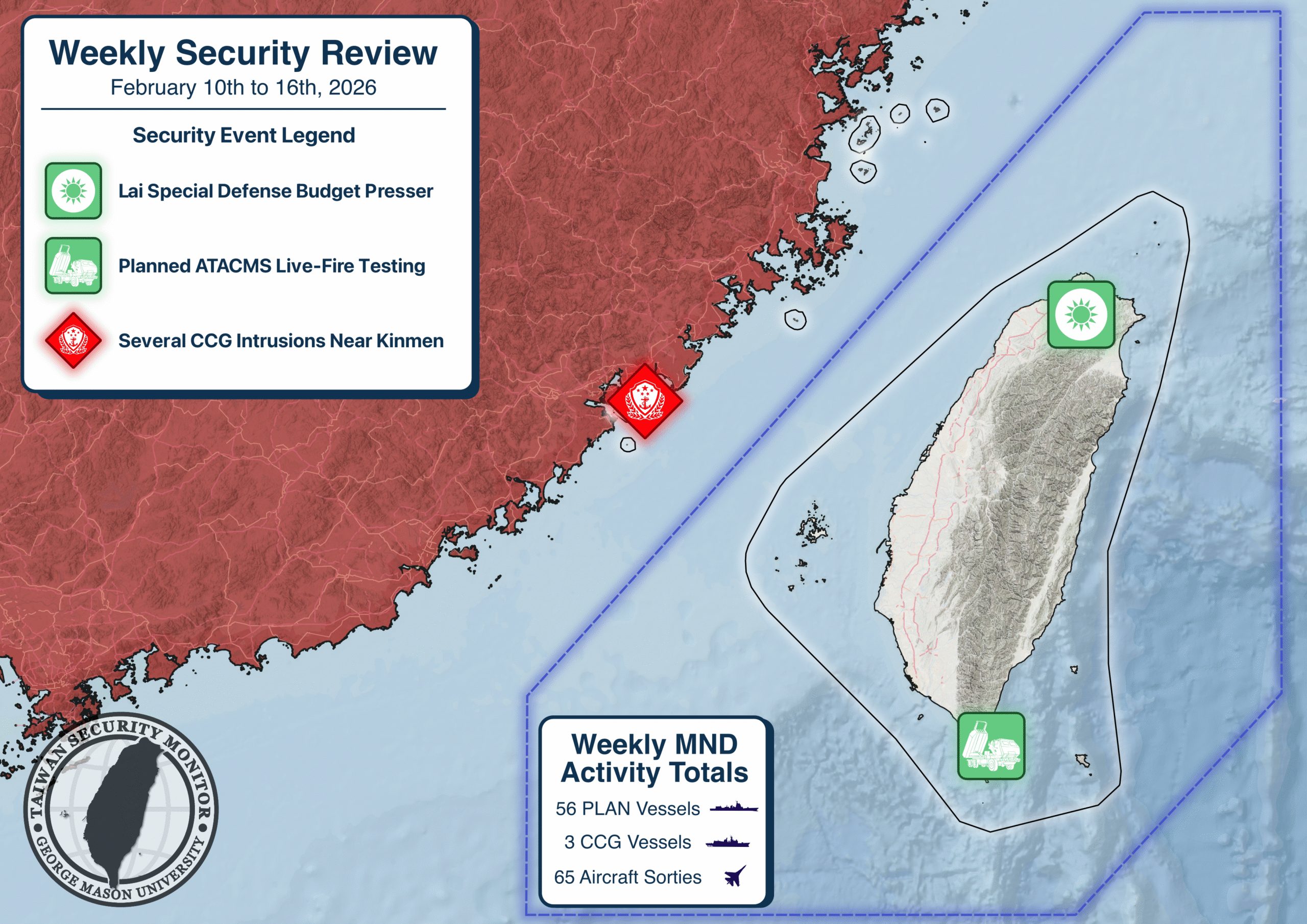
This week, President Lai urges the opposition to pass a $40B special budget, the military considers a live-fire test of ATACMS, and Chinaโ€™s Coast Guard breaches Taiwanโ€™s restricted waters in three separate incidents. 

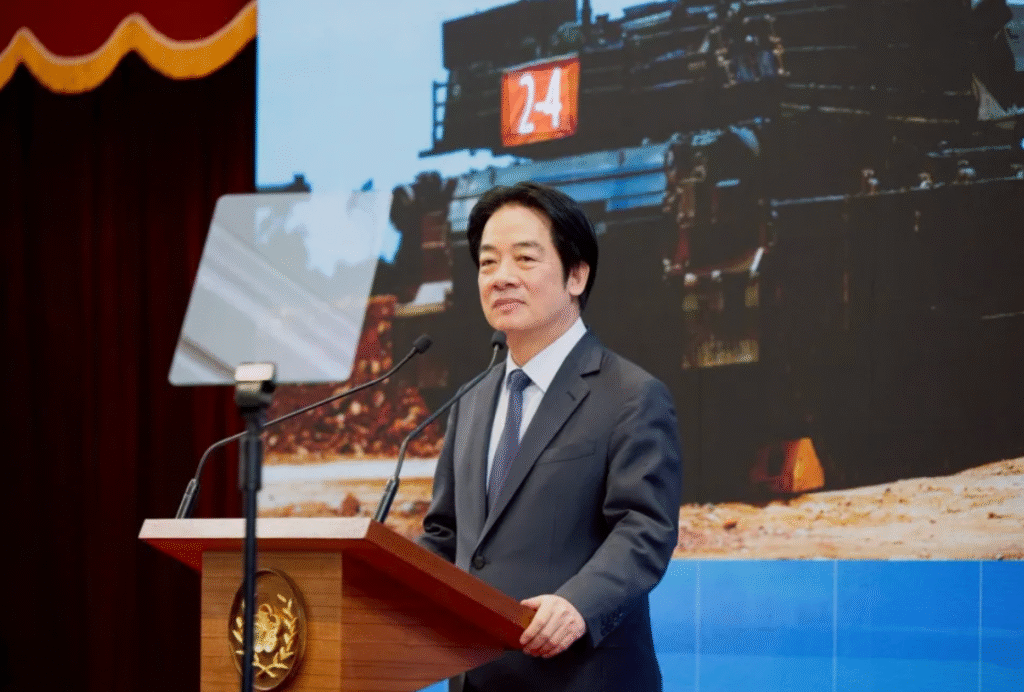
President Lai Holds Press Conference on Special Defense Budget 

Taiwanโ€™s President, Lai Ching-te, held a snap press conference on Wednesday, 11 February, to explain the rationale behind the countryโ€™s record NT$1.25 trillion (US$40 billion) supplemental defense budget. A spending package that was presented to the Legislative Yuan (LY) in December but has since been blocked more than 10 times by the opposition Taiwan Peopleโ€™s Party (TPP) and Kuomintang (KMT).  The press conference began with a plea from President Lai: โ€œNational defense cannot wait. Our safety cannot wait. Support for our troops cannot wait.โ€ Lai went on to urge the public to look at what other countries are doing to ensure their security. โ€œIndo-Pacific neighbors have also increased defense spending in reaction to Chinaโ€™s mounting military aggressionโ€ Lai added, saying that โ€œTaiwan cannot fallโ€. Laiโ€™s complete speech can be found here.

Also addressing the news conference was Minister of National Defense Wellington Koo, as well as Vice President Hsiao-Bi Khim and members of the Joint Chiefs of Staff. Minister Koo explained that the budget delay risks a “rupture” in the joint line of defense against China. “In the Indo-Pacific region, especially among the countries in the first island chain, Taiwan plays a critical and almost destined role,” Koo said. At the press conference,Koo repeated that โ€œTaiwan and the U.S. have continued to have intensive talks about what weapons Taiwan needs.โ€

The press conference comes after months of infighting between the DPP-backed Lai administration and the opposition Kuomintang (KMT) and Taiwan Peopleโ€™s Party (TPP) on the passage of a record-breaking supplemental defense budget.  The โ€œSpecial Act for the Procurement Program to Strengthen Defense Resilience and Asymmetric Capabilitiesโ€ is worth NT$1.25 trillion (US$40 billion) and would fund various U.S. weapon systems and equipment. A complete breakdown of approved U.S. systems can be found here

The opposition continues to delay and oppose the bill due to a lack of oversight and reservations about handing over a โ€œblank checkโ€ to President Lai. The DPP, however, says the KMT and TPPโ€™s demands are unconstitutional, citing a prior ruling that found requiring the President to provide real-time responses to lawmakersโ€™ questions to be unlawful. Recently, 37 U.S. senators and representatives signed a bipartisan letter, addressed to Taiwanโ€™s opposition party leaders in the KMT and TPP, urging politicians there to sign the deal. The letter included praise for Taiwanโ€™s recent military reforms but also worries about sustaining that momentum. “Nevertheless, we fear that without significant increases in Taiwan’s defense spending at levels reflected in President Lai’s proposed special budget, this progress will be insufficient,” the letter said. Taiwanโ€™s parliament, meanwhile, returns from winter recess at the end of February. 

Military Reportedly Prepping Rare ATACMS Live-Fire Test in Late 2026

Taiwanโ€™s military could be gearing up to conduct a rare live-fire test of the Army Tactical Missile System (ATACMS) in the weeks following Augustโ€™s Han Kuang military exercises, according to Liberty Times.

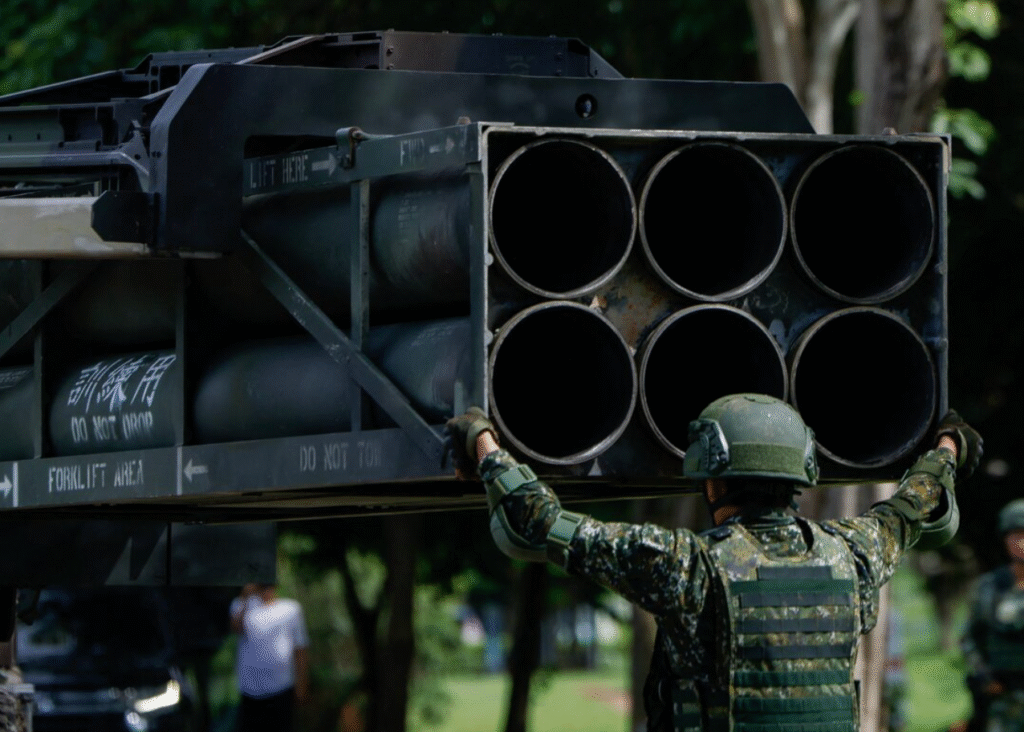
Every year in the summer, Taiwanโ€™s armed forces conduct live-fire missile tests to ensure the quality of their weapons and also conduct target practice with munitions approaching their expiration date. Last May was the first time that Taiwan conducted a live-fire test of recently delivered HIMARS, firing more than 30 Guided Multiple Launch Rocket Systems (GMLRS) pods. Other munitions like PAC-2 interceptors, Thunderbolt-2000 MLRS rockets, and Land Sword-2 missiles were also fired. 

Military officials quoted in the report say that they are looking to verify the performance of recently delivered ATACMS missiles, which can reach targets up to 300 km away. Taiwan has received the first batch of 64 ATACMS missiles in November 2024, originally from a deal notified in 2020. In December 2025, the U.S. approved an additional 420 ATACMS missiles as part of a sale of 82 additional HIMARS systems and munitions. There is, however, no contract or set delivery time for these munitions. Other systems like the Altius-700M loitering munitions might also be incorporated into the annual drill, but Taiwanโ€™s Ministry of National Defense has yet to comment on the future tests. 

TSM recently released its January Taiwan Arms Sales Backlog report, which includes a public repository of all publicly announced arms sales, including ATACMS. You can check that out here:

China Steps Up Maritime Pressure With Multiple Coast Guard Intrusions Near Taiwan

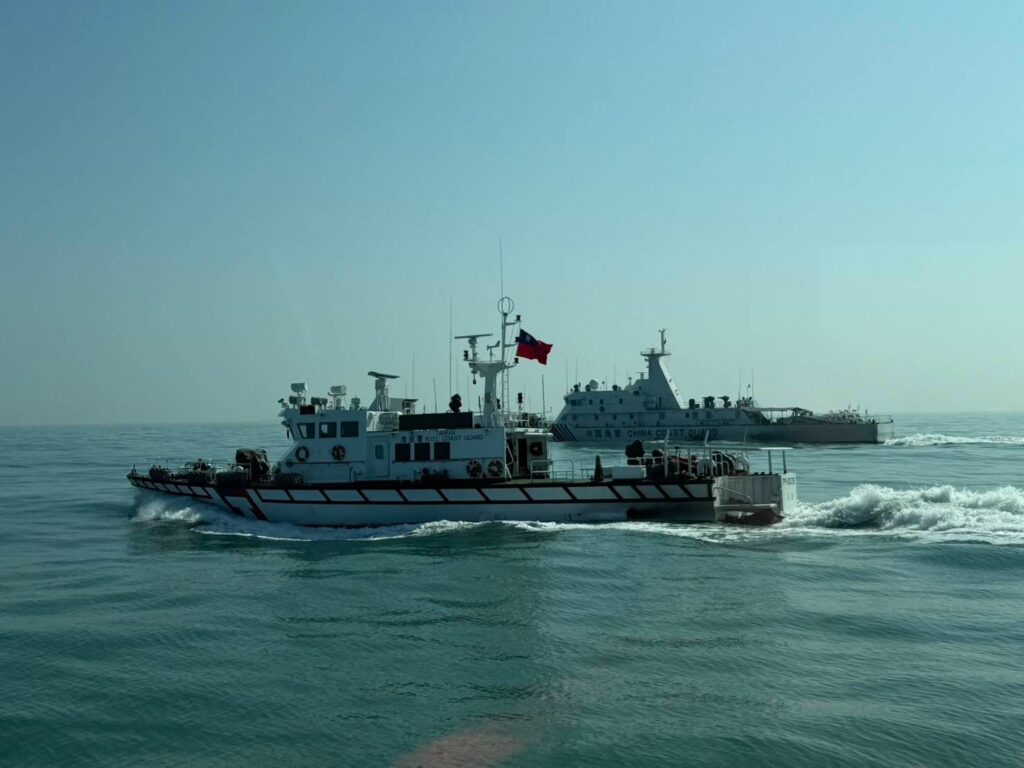
It was a busy week for Taiwanโ€™s Coast Guard Administration (CGA) as they saw three separate incidents involving Chinese Coast Guard ships breaching restricted waters near Kinmen. The intrusions are tied for the most in a single week, involving the same Chinese ships with hull nos. 14603, 14529, 14609, and 14530. The CGA said it deployed its own vessels to shadow and intercept Chinaโ€™s Coast Guard ships, as well as issued radio warnings. Each incident averaged roughly two hours of CCG ships breaching Kinmen’s restricted waters. This marks the seventh total incursion into Kinmenโ€™s waters for 2026. 

Taiwanโ€™s CGA has been trying to match Chinaโ€™s Coast Guard presence in the seas around the Taiwan Strait and has embarked on an ambitious ship-building initiative to combat Chinaโ€™s grey-zone tactics. Also this week, Taiwan accepted delivery of its newest Anping-class offshore patrol vessel, the Lanyu (่˜ญๅถผ่‰ฆ), the 11th vessel of its type. The ship is equipped for law enforcement, firefighting, and search-and-rescue missions but can also be fitted with Hsiung Feng II and III anti-ship missiles if needed during a conflict.

Taiwan Arms Sale Backlog, January 2026 Update

Special Budget Complications Continue

By Joseph Oโ€™Connor and Eric Gomez

The first month of 2026 was relatively slow for the US arms sale backlog to Taiwan. No new Foreign Military Sales (FMS) were notified to Congress or fully delivered; the topline value of the backlog saw no change since December. Deadlock on the special defense budget in the Legislative Yuan (LY) continued, with the opposition Taiwan Peopleโ€™s Party (TPP) submitting its own, reduced proposal. Additionally, the Department of Defense awarded a contract for the production of F-16 simulators being purchased by Taiwan.

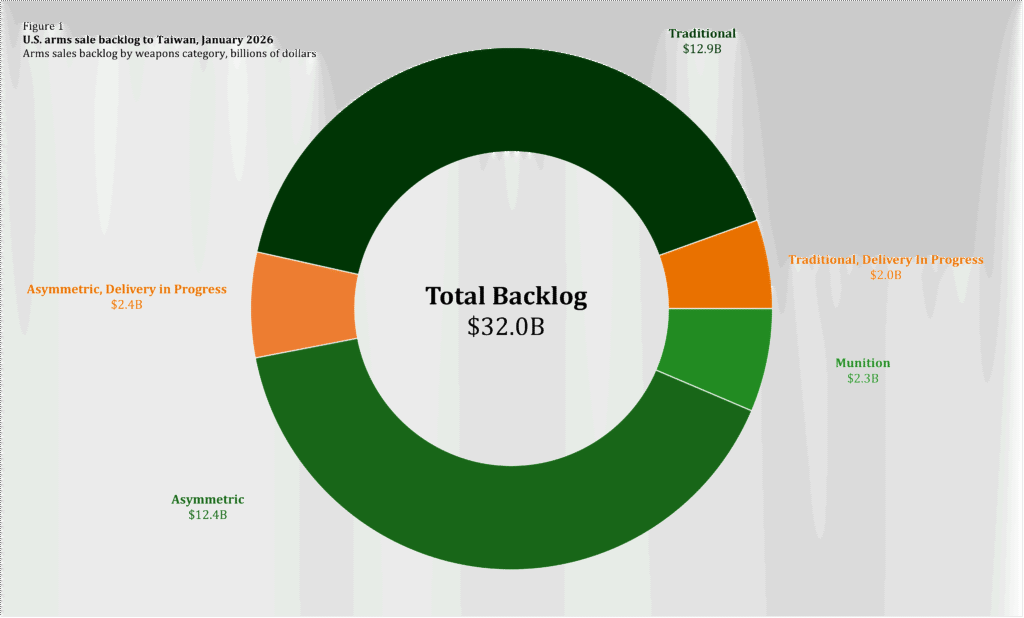
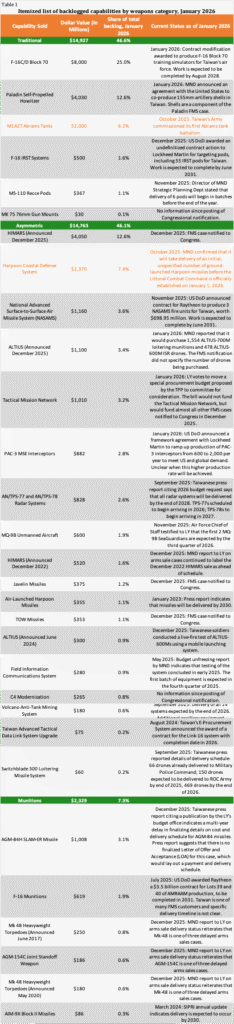
The arms sale backlog as of January 31, 2026, remains $32.0 billion. For arms sales valued at over $1 billion, deliveries in progress are marked in yellow-orange in our visualizations, meaning that the true dollar value is lower than the topline. Figure 1 illustrates the breakdown of the backlog between asymmetric weapons, traditional weapons, and munitions. Table 1 provides an itemized list of all arms sales in the backlog, including the most up-to-date information on their status.

Special Defense Budget Complications

The MNDโ€™s special defense budget, initially announced by President Lai in November 2025, continued its tumultuous journey through the LY in January. The administrationโ€™s proposal, a budget of NT$1.25 trillion (US$40 billion) to be spent over eight years, remained in the LYโ€™s Foreign Affairs and National Defense Committee. Legislators in the Kuomintang (KMT) and Taiwan Peopleโ€™s Party (TPP) โ€” which hold a combined 62 seats to the Democratic Progressive Partyโ€™s (DPP) 51โ€”have prevented Laiโ€™s budget from advancing to the full LY. On January 19, Minister of National Defense Wellington Koo delivered a closed-door, confidential briefing to the Foreign Affairs and National Defense Committee, but little concrete information about the budget was released.

Meanwhile, the TPP announced a counter proposal for the special defense budget, worth NT$400 billion (US$12.69 billion) on January 26 in a press conference, sending it to the LY Foreign Affairs and National Defense Committee for review on January 30. This reduced budget proposal contains funding for five of the eight cases announced in December, including Paladin self-propelled howitzers, HIMARS launchers and munitions, Javelin and TOW anti-tank missiles, and ALTIUS loitering munitions, for a total of NT$311.9 billion (US$9.90 billion). The December FMS cases not funded in the TPPโ€™s proposed budget are tactical mission networks, and spare parts for attack helicopters and Harpoon anti-ship missiles.  The proposal also omitted funding for local partnerships with the Taiwanese defense industrial base, including the procurement of some 200,000 drones. The NT$400 billion represents a spending ceiling, with the LY needing to vote on new funding each year until the total amount is reached. This gives the LY much more oversight power over arms sale spending, giving them multiple opportunities to pause or redirect funding if cases fall behind schedule.

Interestingly, the inclusion of the five most significant cases from December indicates an implicit desire to continue procurement of mostly asymmetric systems. The TPP proposal also includes oversight provisions, including โ€œcomprehensive special reportsโ€ on case statuses over the last five years, how said procurement cases improve joint operational effectiveness, acquisition timelines, and delivery dates, and fiscal impacts. An MND press conference on 26 January refuted these oversight provisions as being time-prohibitive and having effects on the progress of backlogged cases. If passed, however, this level of oversight would provide more effective monitoring of the backlog.

MND Hints at Further Sales

After a Cabinet meeting on 15 January, Vice Minister of National Defense Hsu Szu-chien stated that four more arms sales from the US were in the pipeline, but had yet to be notified to Congress, without giving more details. As of the end of January, it is thought that additional Patriot air defense missile batteries and PAC-3 MSE missiles are one of those sales, but no details have been confirmed by the MND. This, of course, presents more opportunities for the backlog to only grow, but only after these sales have been notified to the U.S. Congress.

F-16 Simulator Contract Awarded

On 29 January, the U.S. Air Force awarded a contract definitization modification valued at US$69.88 million (using US$59.42 million of Taiwan FMS funds) for the procurement of F-16 Block 70 training simulators for the ROC Air Force. This is an extension of a contract originally awarded in January 2023 and appears to be the sixth such extension. Work under the contract is expected to be completed by August 2028, pending further contract extensions. This contract award is part of the US$8 billion F-16 Block 70 sale approved in August 2019.

Other Updates

A few other updates on backlogged cases emerged this month. First, after the 19 January confidential hearing, Minister Koo revealed that from the December sale, 1,554 ALTIUS-700M loitering munitions and 478 ALTIUS-600ISR drones would be procured. This case is worth US$1.1 billion, and previously, the quantity of drones was not specified. Owing to the speed of the first sale of ALTIUS being delivered to Taiwan, we expect this December case to also be fulfilled quickly.

During the month, the MND released details about production line enhancement projects set to be funded under their special defense budget proposal. Among other projects, the 202nd Factory of the MNDโ€™s Armaments Bureau is set to increase 155mm artillery shell production. This affects the recent December sale of Paladin self-propelled howitzers, as those are the only systems in Taiwanโ€™s inventory that would use that caliber of shell. MND sources also stated that surplus 155mm shells would be sold via a partnership with the United States.

On 21 January, the U.S. Army awarded a contract extension worth US$202.78 million (using US$52.38 million in Taiwan FMS funds) to Lockheed Martin for inspection, recertification, and repair of PAC-3 missiles, presumably including missiles in Taiwanโ€™s possession or to be delivered to Taiwan. Similar to the above F-16 contract, this is an extension of a contract originally awarded in June 2022, and work is expected to be completed by June 2028.

Conclusion

January marked the continuation of ongoing budgetary battles in the LY, which have no intention of ending soon, particularly with an opposition alternative being proposed. The special defense budget debate is now the central variable: if the LY cannot reach a workable compromise soon, Taiwan risks procurement delays in the earliest phases of an FMS case. The budget drama also sends mixed signals to allies and adversaries of Taiwan on its willingness to provide for its own defense.  However, the TPPโ€™s emphasis on greater transparency and oversight would be welcome for providing more information about how arms sale cases are progressingโ€”or stalling.

Weekly Arms Update: 2/11/26

Author: Joe Oโ€™Connor, Shikhar Chaturvedi, Danielle Kremer, and Wyeth Lindberg


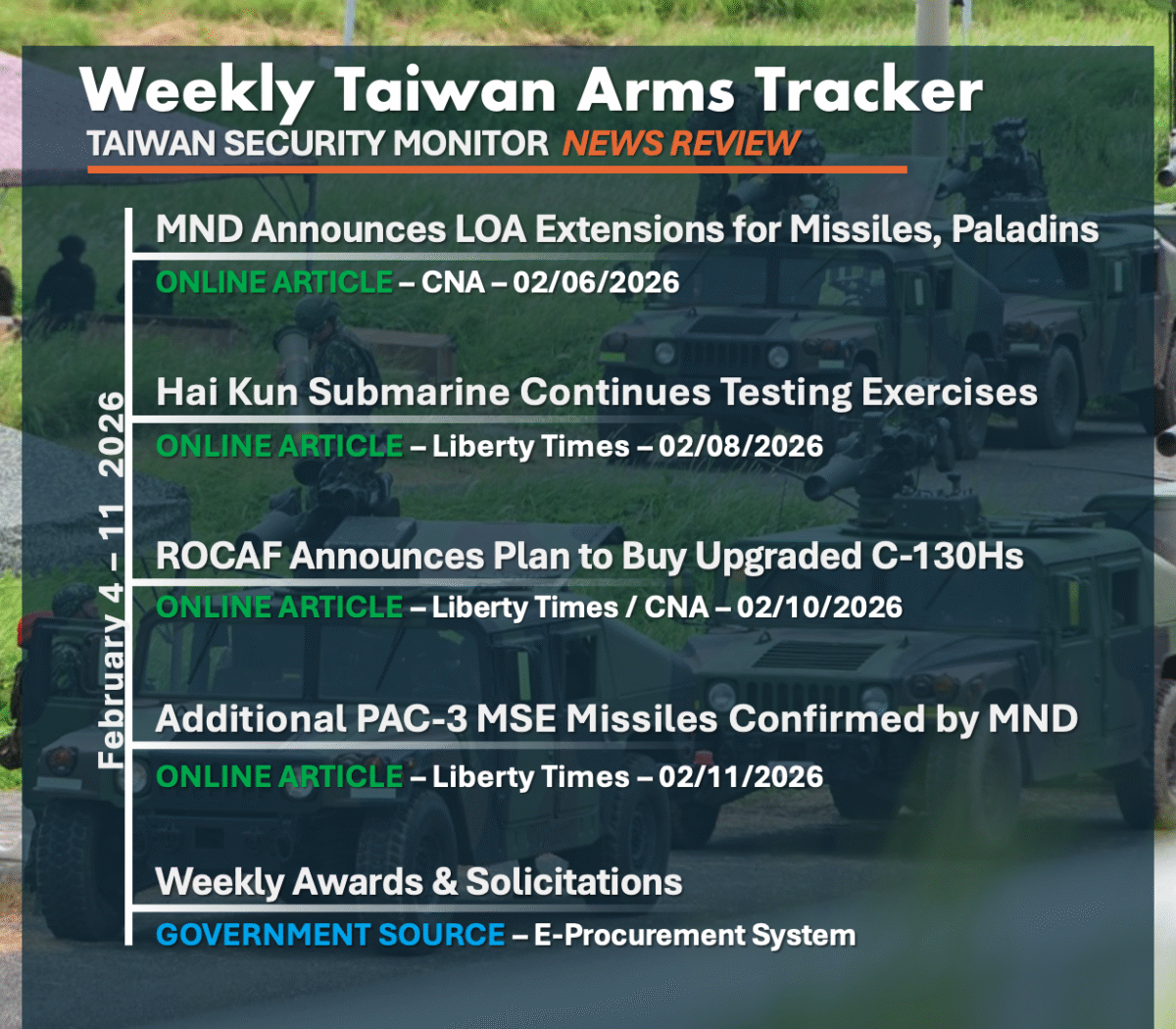
This week: the Ministry of National Defense warns that some sales are in peril due to budgetary constraints; the Navyโ€™s Hai Kun indigenous submarine finishes testing; the Air Force announces a plan to buy upgraded C-130H Hercules; and the MND announces additional PAC-3 MSE missiles on the way to Taiwan, alongside weekly awards and solicitations.

MND Announces LOA Extensions for Missiles, Paladins

On Friday, the MND announced that they would be seeking extensions to Letters of Offer and Acceptance (LOAs) for several arms sales announced in December, including TOW and Javelin anti-tank missiles, and Paladin self-propelled howitzers. LOAs are a critical first step in the Foreign Military Sales implementation process that sets out payment schedules and delivery timelines for items, and if not signed by March 15, the above cases would be subject to cancellation or renegotiation. Per the MND, the LOAs have not been signe,d and initial payments have not been made owing to ongoing battles in the Legislative Yuan over the special defense budget, including dueling proposals worth NT$1.25 trillion that the MND requested, and one worth NT$400 billion advanced by the opposition.

Hai Kun Submarine Continues Testing Exercises

With Taiwan’s indigenously produced Hai Kun submarine conducting its most recent underwater test of flare and decoy deployment, the first phase of the programโ€™s testing has officially come to a successful end. These tests off the coast of Kaohsiung included deep water dives with the submarine reaching 150 meters, and shallow water tests to verify the submarineโ€™s stability and watertightness. The second phase of testing, its timing having not been announced, will consist of sonar, combat system, and maneuver-torpedo tests. Taiwanese military and political officials plan to use this new phase to verify the reliability of the Hai Kun.

ROCAF Announces Plan to Buy Upgraded C-130Hs

Taiwanโ€™s Air Force has essentially abandoned its midโ€‘life โ€œTaiwushan IIIโ€ plan to upgrade all 20 Cโ€‘130H airlifters, moving instead to buying 10 new C-130J “Super Hercules,” after U.S. cost estimates ballooned from around NT$100 billion for cockpit and avionics upgrades to more than NT$250 billion once FAA certification and structural reinforcements were included.  According to Central News Agency reporting, the cancelled program aimed to integrate digital flight displays, improve maritime searchโ€‘andโ€‘rescue systems and add simulators, but senior officers said software costs and airframe reinforcement made the investment uneconomical. Under the new plan, the Air Force will pursue a โ€œhighโ€“low mixโ€: the advanced Cโ€‘130J, with more powerful engines, sixโ€‘bladed propellers and a fully digital cockpit, will handle demanding missions like nighttime and austere operations, while the remaining Cโ€‘130Hs will get domestic upgrades and support routine transport tasks.

Additional PAC-3 MSE Missiles Confirmed by MND

On Wednesday, MND sources confirmed that Taiwan is receiving 102 PAC-3 Missile Segment Enhancement (MSE) missiles for Patriot air defense systems, to be paid using surplus funds from a Patriot procurement program. This sale appears in our Arms Sales Backlog as a 2022 plus-up (modification) from a 2010 sale of Patriot systems to Taiwan, and includes the addition of 1-2 missiles, likely for testing. This tranche of PAC-3 MSEs is in addition to a planned, but not officially notified, future sale of Patriot batteries and PAC-3s that will be paid using the special defense budget.

Weekly Awards/Solicitations

Last Thursday, the All-Out Defense Mobilization Agency awarded Xinshifu Co., Ltd and Shencai Fashion Industry Co., Ltd a NT$142.85 million (US$4.53 million) contract for digital camouflage-patterned tents. The contract will be fulfilled nationwide.

On Monday, the Armaments Bureau solicited bids for combat battle vests, worth NT$868.40 million (US$27.70 million).

On Tuesday, the Naval Command awarded a NT$195.00 million (US$6.22 million) contract to the American Institute in Taiwan for the assessment of the use of underwater technology. The contract will be fulfilled in Taipeiโ€™s Zhongshan District and Taoyuanโ€™s Longtan District, respectively.

Taiwan Affairs Office: Fully implement the deployments and requirements set out at the 2026 conference on Taiwan-related work.

At the Feb. 11 Taiwan Affairs Office press briefing, a reporter asked: The 2026 conference on Taiwan-related work was recently held in Beijing. Please interpret the meetingโ€™s key points. How will you implement them going forward?

TAO spokesperson Zhu Fenglian replied: The 2026 conference on Taiwan-related work was held in Beijing from Feb. 9 to 10. Wang Huning, member of the Standing Committee of the CPC Central Committee Political Bureau and chairman of the National Committee of the CPPCC, attended and delivered remarks. The meeting fully affirmed the achievements of Taiwan-related work over the past year, deeply analyzed the current cross-strait situation and that of the period ahead, and put forward clear requirements for this yearโ€™s work.

Zhu said: This year marks the 105th anniversary of the founding of the Communist Party of China and is the first year of the 15th Five-Year Plan period. In accordance with the meetingโ€™s deployments and requirements, and guided by Xi Jinping Thought on Socialism with Chinese Characteristics for a New Era, we will fully implement General Secretary Xi Jinpingโ€™s important statements on Taiwan-related work and the Partyโ€™s overall strategy for resolving the Taiwan question in the new era. We will uphold the one-China principle and the โ€œ1992 Consensus,โ€ unite the broad masses of Taiwan compatriots, firmly support patriotic forces on the island that seek reunification, resolutely strike โ€œTaiwan independenceโ€ separatist forces and oppose interference by external forces, and safeguard peace and stability in the Taiwan Strait.

We will uphold the concept that โ€œcompatriots on both sides are one family,โ€ keep cross-strait personnel exchanges smooth and convenient, expand people-to-people and grassroots exchanges, support Taiwan residentsโ€”especially youthโ€”coming to the mainland to study, work, and live, promote the joint carrying-forward of Chinese culture, and foster greater spiritual affinity between compatriots on both sides.

We will also support the development of Taiwan businesspeople and Taiwan-funded enterprises on the mainland, improve policy measures that benefit Taiwan compatriots and Taiwan enterprises, deepen cross-strait integrated development, and enable compatriots on both sides to share in the opportunities and outcomes of Chinese-style modernization.

Taiwan Affairs Office: Song Tao visited and extended greetings to Taiwan businesspeople and Taiwan compatriots in Fuzhou, Fujian.

At the Feb. 11 Taiwan Affairs Office press briefing, a reporter asked: With the Spring Festivalโ€”the Chinese nationโ€™s traditional festivalโ€”approaching, does the TAO have any plans or arrangements to conduct visits and extend holiday greetings to Taiwan compatriots and Taiwan enterprises?

TAO spokesperson Zhu Fenglian replied: The Spring Festival is the Chinese nationโ€™s most important traditional festival, an important time to bid farewell to the old and welcome the new, and for families to reunite. Compatriots on both sides of the Strait are one family, and naturally should reunite to welcome the New Year and celebrate the festival together. From Feb. 10 to 12, Song Tao, Director of the Central Taiwan Affairs Office and the Taiwan Affairs Office of the State Council, visited and extended greetings to Taiwan businesspeople and Taiwan compatriots in Fuzhou, Fujian. He attended a New Year reception symposium for Taiwan businesspeople and Taiwan compatriots and an event where compatriots on both sides together celebrated the Bingwu Spring Festival, listened to views and suggestions, and spoke with Taiwan businesspeople, Taiwan compatriots, and Taiwan youth representatives, members of Taiwanโ€™s business and industrial circles, and fellow villagers from Kinmen and Matsu about family ties and welcoming the New Year together. On behalf of the Central Taiwan Affairs Office and the Taiwan Affairs Office of the State Council, he also extended Spring Festival greetings to Taiwan compatriots.

Taiwan Affairs Office: We hope the broad masses of Taiwan compatriots will work together with us to overcome interference and remove obstacles, and to help bring about exchanges and cooperation between the two sides across all fields.

At the Feb. 11 Taiwan Affairs Office press briefing, a reporter asked: Regarding the 15 points of common understanding reached at the KMTโ€“CCP think tank forum, Lai Ching-te said, โ€œWhether Taiwan will continue to join hands with allied countries and move toward the world, or once again push a westward turnโ€”our people can make a clear choice.โ€ MAC Minister Chiu Chui-cheng said the common understanding is full of accusations that the Taiwan authorities are obstructing cross-strait exchanges and blocking mainland tourists, calling it โ€œcompletely putting the cart before the horse,โ€ and said it โ€œwill not be accepted.โ€ What is your comment?

TAO spokesperson Zhu Fenglian replied: The KMTโ€“CCP think tank forum reached 15 points of common understanding across five areas, focusing on industrial development and peopleโ€™s livelihoods. It reflects the KMT and the CCPโ€™s sense of responsibility in seeking peace in the Taiwan Strait, pursuing well-being for compatriots, and striving for national rejuvenation, and it accords with the fundamental interests of compatriots on both sides of the Strait. The Lai Ching-te authorities stubbornly adhere to a separatist โ€œTaiwan independenceโ€ stance and, for the selfish interests of one party and one person, stop at nothing to ban, restrict, and obstruct cross-strait exchanges and cooperation. They are the biggest obstacle to cross-strait exchanges and interactions and the greatest source of turmoil undermining peace and stability in the Taiwan Strait, and they have already drawn strong criticism and dissatisfaction from all sectors in Taiwan. We hope the broad masses of Taiwan compatriots will work together with us to firmly oppose the Lai Ching-te authoritiesโ€™ retrograde actions, overcome interference and remove obstacles, promote exchanges and cooperation between the two sides across all fields, advance cross-strait relations, and enhance the interests and well-being of compatriots on both sides.

Taiwan Affairs Office: We hope the Taiwan side will follow public opinion and lift the unreasonable restrictions on cross-strait air transport as soon as possible.

At the Feb. 11 Taiwan Affairs Office press briefing, a reporter asked: Due to interference by the DPP authorities, cross-strait air routes have not yet fully returned to normal, seriously affecting travel between people on both sides. As compatriots on both sides strongly hope for the full resumption of all direct-flight routes and destinations, Taiwanโ€™s Mainland Affairs Council (MAC) has claimed that โ€œwithout group-tour sources, airlines lose money on every flight, so the incentive isnโ€™t great.โ€ What is your comment?

TAO spokesperson Zhu Fenglian replied: Cross-strait direct air links have greatly facilitated travel between people on both sides and have played an important role in enhancing the well-being of compatriots on both sides. At present, due to interference by the DPP authorities, cross-strait routes have not fully returned to normal. Passenger services currently operate from 14 mainland cities, with more than 300 cross-strait passenger flights per week. Compared with before 2020โ€”when there were 61 mainland destinations and up to a peak of 890 passenger flights per weekโ€”there remains a significant gap, which has seriously affected cross-strait travel. Public calls for the full resumption of all direct-flight destinations are very strong.

Zhu noted: The mainland side has consistently upheld the concept that โ€œcompatriots on both sides are one family,โ€ actively promoting cross-strait tourism exchanges and cooperation; our goodwill and sincerity are evident to all. In 2023, we announced the resumption of receiving group tours by Taiwan residents to the mainland; in 2024, we resumed allowing Fujian residents to travel to Kinmen and Matsu; in 2025, we announced the resumption of group tours from Fujian and Shanghai to Taiwan; and in early 2026, we again announced that we would resume allowing Shanghai residents to travel to Kinmen and Matsu. Yet the DPP authorities have not responded positivelyโ€”on the contrary, they have repeatedly obstructed and restricted cross-strait tourism and exchanges across various fields, setting up hurdles and barriers. The crux of the current cross-strait tourism issue, and the obstacles to its resolution, lie entirely in interference and obstruction by the DPP authorities.

Zhu added: Whether cross-strait routes have a passenger base is something the data will show. According to statistics, in 2025 more than 5.78 million passenger trips were made across the Strait on direct passenger flights, and the average load factor on cross-strait routes reached 80%โ€”fully reflecting strong demand for direct cross-strait flights. We hope the Taiwan side will follow public opinion and lift the unreasonable restrictions on cross-strait air transport as soon as possible, allowing airlines on both sides to arrange flight schedules independently in accordance with market demand. Whether there is demand for flights should be decided by the market. The DPP authorities can simply loosen the restrictionsโ€”then they will know once they try.

Taiwan Affairs Office: We warmly welcome more aspiring Taiwanese students to apply to mainland universities.

At the Feb. 11 Taiwan Affairs Office press briefing, a reporter asked: Enrollment work will soon begin for (1) mainland regular higher-education institutions admitting Taiwan high school graduates based on Taiwanโ€™s General Scholastic Ability Test (GSAT) scores, and (2) the joint admissions program through which regular higher-education institutions recruit overseas Chinese and students from Hong Kong, Macao, and Taiwan, among other channels. Please introduce the relevant arrangements.

TAO spokesperson Zhu Fenglian replied: It is understood that mainland universitiesโ€™ recruitment of Taiwan students will begin in succession in March. Taiwan students who hold a Mainland Travel Permit for Taiwan Residents and valid ID proving residence in Taiwan, or a Taiwan Resident Residence Permit, and who possess the required prior academic qualifications, may enroll in mainland universities through four pathways:

First, sit for the joint admissions exam for overseas Chinese and students from Hong Kong, Macao, and Taiwan to apply to 460 mainland universities (the โ€œNational Joint Admissions Examโ€). Applicants may register online via the โ€œNational Joint Admissions Management System (candidate portal)โ€ from March 1 to 15, and complete registration confirmation from March 11 to 31.

Second, apply to 451 mainland universities using Taiwan GSAT scores (the โ€œGSAT-based admissionsโ€). Applicants whose GSAT score in any one of the Chinese, mathematics, or English subjects reaches at least the โ€œstandardโ€ level (ๅ‡ๆ ‡็บง) may apply via the โ€œMainland (Motherland) regular higher-education institutions admitting Taiwan high school graduates based on Taiwan GSAT scoresโ€ system from March 1 to 31.

Third, sit for the โ€œtwo-university joint admissionsโ€ exam for Jinan University and Huaqiao University; details are available in the admissions brochures posted on the two universitiesโ€™ official websites.

Fourth, apply to 48 universities in Fujian via routes including Taiwanโ€™s technical/vocational unified test (็ปŸๆต‹), subject-based tests (ๅˆ†็ง‘ๆต‹้ชŒ), and separate admissions exams specifically oriented toward Taiwan; for specific requirements, please consult the โ€œMainland (Motherland) Higher Education Admissions Information Network for Hong Kong, Macao, and Taiwanโ€ and the official websites of the universities concerned.

Zhu added: We warmly welcome more aspiring Taiwanese students to apply to mainland universities, to study alongside mainland students and grow together. We will also continue to provide greater convenience and services for Taiwan students coming to the mainland to pursue further study, helping more Taiwan students realize their life dreams on the mainland.

Taiwan Affairs Office: Lai Ching-teโ€™s remarks expose his โ€œTaiwan independenceโ€ nature as a โ€œsaboteur of cross-strait peaceโ€ and a โ€œmaker of crises in the Taiwan Strait.โ€

At the Feb. 11 Taiwan Affairs Office press briefing, a reporter asked: Lai Ching-te recently said that โ€œfour invariantsโ€ should be maintained in U.S.โ€“Chinaโ€“Taiwan trilateral relations. KMT Vice Chairman Hsiao Hsu-tsen said the international landscape has already changed, yet Lai still clings to the โ€œnew two-states theoryโ€ and โ€œwants to go to war with the mainland,โ€ and that this strategy is completely wrong. What is your comment?

TAO spokesperson Zhu Fenglian replied: Lai Ching-teโ€™s remarks completely expose his sinister intentions of โ€œseeking independence by relying on the United Statesโ€ and โ€œseeking independence by relying on external forces,โ€ as well as his โ€œTaiwan independenceโ€ nature as a โ€œsaboteur of cross-strait peaceโ€ and a โ€œmaker of crises in the Taiwan Strait.โ€ All of the history, facts, and legal basis regarding Taiwan prove that Taiwan is Chinaโ€™s Taiwan and an inalienable part of Chinaโ€™s territory. The Taiwan question is purely Chinaโ€™s internal affair and brooks no external interference. No matter how bottomlessly the Lai Ching-te authorities flatter and curry favor with the United States, or how hard they try to concoct the lie that the United States โ€œsupports Taiwan,โ€ they cannot change the fact that Taiwan is part of China, nor can they shake the basic international pattern of the international communityโ€™s adherence to the one-China principle. We have firm will, strong resolve, and powerful capabilities to smash all โ€œTaiwan independenceโ€ separatist acts and external interference, and to safeguard national sovereignty and territorial integrity.