Taiwan Security Monitor

Taiwan Affairs Office: The DPP authorities are creating a โ€œgreen terrorโ€ to serve their โ€œTaiwan independence autocracy.โ€

At the December 24 press conference of the Taiwan Affairs Office of the State Council, a reporter asked: Recently, Taiwanโ€™s executive authorities passed draft amendments to the so-called โ€œNational Security Lawโ€ and other legislation, stating that anyone who advocates that foreign countries or mainland China wage war on Taiwan, or who expresses support for non-peaceful means to eliminate the so-called โ€œsovereignty of the Republic of China,โ€ will face heavy penalties, with even harsher punishment for active-duty military personnel and civil servants. What is your comment?

Spokesperson Peng Qingโ€™en replied that the Lai Ching-te administration stubbornly adheres to a separatist โ€œTaiwan independenceโ€ stance and ignores the mainstream public desire in Taiwan for peace, development, exchange, and cooperation. It deliberately stirs up โ€œanti-Chinaโ€ sentiment in an attempt to โ€œseek independence by relying on external forcesโ€ and โ€œseek independence by force,โ€ continuously escalating tensions in the Taiwan Strait. This move is a concrete action under its so-called โ€œ17-point strategy,โ€ aimed at heightening cross-Strait confrontation, undermining cross-Strait exchanges and cooperation, and intensifying the creation of a โ€œgreen terrorโ€ and a โ€œchilling effect,โ€ all in service of its โ€œTaiwan independence autocracyโ€ and โ€œgreen authoritarianism.โ€

He expressed the hope that the broad masses of Taiwan compatriots will clearly recognize the extreme danger and harmfulness of the Lai administrationโ€™s โ€œTaiwan independenceโ€ line, and stand with the mainland in firmly opposing separatism and external interference and in firmly opposing efforts to drag the Taiwan Strait toward war.
Taiwan Affairs Office: The โ€œTaiwan sicknessโ€ stems from the DPP authoritiesโ€™ provocations in pursuit of โ€œTaiwan independence.โ€

At the December 24 press conference of the Taiwan Affairs Office of the State Council, a reporter asked: The Economist recently published an article stating that although some of Taiwanโ€™s recent economic indicators appear favorable, ordinary people do not feel any improvement in their livelihoodsโ€”something it referred to as the โ€œTaiwan sickness.โ€ In response, the head of Taiwanโ€™s economic authorities claimed, โ€œWe are not sick; the ones who are sick are those who say we are,โ€ prompting widespread criticism on the island for being โ€œarrogant and self-deluded.โ€ What is your comment?

Spokesperson Peng Qingโ€™en replied that it is indeed a fact that uncertainty in Taiwanโ€™s economic development is rising and that economic imbalances are worsening. It is also a fact that the wealth gap continues to widen and that ordinary people do not feel any improvement in their standard of living. For the selfish interests of its party, the DPP authorities ignore the risks of Taiwanโ€™s high-tech industries being hollowed out by the United States and Western countries, disregard the deep difficulties traditional industries face amid high tariffs, and persist in currying favor with external forces without principle and selling out Taiwan without bottom line. They gloss over problems and deceive the public, but such self-deception and refusal to face reality cannot conceal their governance failures.

Ultimately, the root cause of the so-called โ€œTaiwan sicknessโ€ is the DPP authoritiesโ€™ malicious provocations in pursuit of โ€œTaiwan independenceโ€; the underlying pathology is their reckless disregard for peopleโ€™s livelihoods; and the symptoms are their shameless eagerness to exhaust Taiwanโ€™s resources in exchange for approval from external forces.

Taiwan Affairs Office: The DPP authoritiesโ€™ bottomless flattery of foreign powers and betrayal of Taiwan will destroy the islandโ€™s economic lifeline and its prospects for development.

At the December 24 press conference of the Taiwan Affairs Office of the State Council, a reporter asked: Recently, the DPP authorities sent representatives to attend the United Statesโ€™ first โ€œSilicon Peace Summit,โ€ claiming that Taiwan can play a key role in the so-called โ€œglobal democratic semiconductor supply chain.โ€ What is your comment?

Spokesperson Peng Qingโ€™en responded that China opposes the United States providing a stage for โ€œTaiwan independenceโ€ elements. Lai Ching-te and the DPP authorities, in pursuit of โ€œindependence,โ€ deliberately incite ideological confrontation and promote the false narrative of โ€œdemocracy versus authoritarianism,โ€ which wins no public support. The so-called โ€œdemocratic supply chainโ€ is, in essence, the Lai administration violating economic and market principles and currying favor with external forces without bottom lineโ€”selling off Taiwanโ€™s advantageous industries, sacrificing Taiwanโ€™s development prospects, and destroying the livelihoods of the Taiwan peopleโ€”all in exchange for external support for their separatist agenda. Their words and actions will only intensify tensions in the Taiwan Strait, increase the burden on the Taiwan public, and ultimately destroy Taiwanโ€™s economic lifeline and its future development prospects.

Taiwan Affairs Office: The DPP authorities are using foreign arms purchases to amass illicit gains, engaging in corruption.

At the December 24 press conference of the Taiwan Affairs Office of the State Council, a reporter asked: Lai Ching-te recently stated that he plans to allocate NT$1.25 trillion as a โ€œspecial defense budget.โ€ Immediately afterward, media on the island revealed that small companies in Tainan and Kaohsiungโ€”such as renovation firms and shoe manufacturersโ€”had unexpectedly won defense contracts worth hundreds of millions of NT dollars. Public opinion on the island is saying that โ€œtraditional industries in the south have suddenly become arms tycoons,โ€ questioning whether certain forces are โ€œescortingโ€ these deals and whether the defense industry has become โ€œa channel for profiting from war.โ€ What is your comment?

Spokesperson Peng Qingโ€™en replied that the DPP authorities, in order to โ€œseek independence through military means,โ€ are recklessly squandering the hard-earned money of the people of Taiwan to purchase foreign weapons, while also using the opportunity to line their own pockets through corruption and profiteering. He expressed hope that Taiwan compatriots will clearly see the malicious intentions and ugly face of the DPP authorities, guard their own wallets through concrete action, and stop being deceived.

Taiwan Affairs Office: The DPP authoritiesโ€™ political manipulation of the Hongtai 58 incident will only lead them to reap the consequences of their own actions.

At the December 24 press conference of the Taiwan Affairs Office of the State Council, a reporter asked: Today (December 24), public security authorities issued a reward notice seeking information on the criminal smuggling activities of Taiwan residents Jian Wensheng and Chen Shunjin, who allegedly operated the Togolese-flagged vessel Hongtai 58 and other ships to smuggle frozen goods into the mainland over a long period. In February this year, the DPP authorities falsely claimed that the Hongtai 58 cable-damage incident in the Taiwan Strait was โ€œdeliberate sabotageโ€ by the mainland and a form of โ€œgray-zone harassment.โ€ What is your comment?

Spokesperson Peng Qingโ€™en responded that investigations by public security authorities have determined that Taiwan residents Jian Wensheng and Chen Shunjin are habitual smugglers who operated the Hongtai 58 and other vessels to smuggle frozen products into the mainland over a long period. Public security authorities have now issued a reward notice for these two individuals and hope that compatriots on both sides of the Strait will actively provide clues regarding their illegal activities. Relevant authorities will strictly protect the informantsโ€™ information and lawful rights in accordance with the law.

Peng further stated that the Hongtai 58 incident that occurred in February was in fact the result of Jian and Chen engaging in smuggling activities while operating the vessel. The DPP authorities ignored the facts of the case and maliciously hyped claims of mainland โ€œgray-zone harassment,โ€ attempting to provoke confrontation and antagonism across the Strait. He warned that by shielding and condoning smuggling crimes and seizing the opportunity to carry out political manipulation that undermines cross-Strait relations, the DPP authorities will inevitably face united opposition from compatriots on both sides of the Straitโ€”and ultimately reap the consequences of their own actions.

Taiwan Arms Sale Backlog, November 2025 Update

New Report to LY, Special Budget, and NASAMS Contracts

By Joseph Oโ€™Connor and Eric Gomez

While November 2025 did not see any major topline activity in the backlog itself, the second Trump administration made its first maintenance sale of aircraft parts to Taiwan, valued at $330 million. Additionally, many valuable status updates emerged from a new MND report to the Legislative Yuan on arms sales, alongside regular hearings. Taiwanese President Lai Ching-te also publicly announced Taiwanโ€™s special budget for the first time, which will not directly affect the backlog but signals additional purchases in the future.

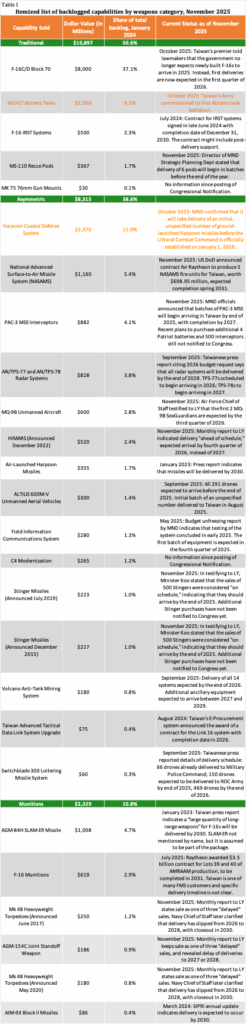
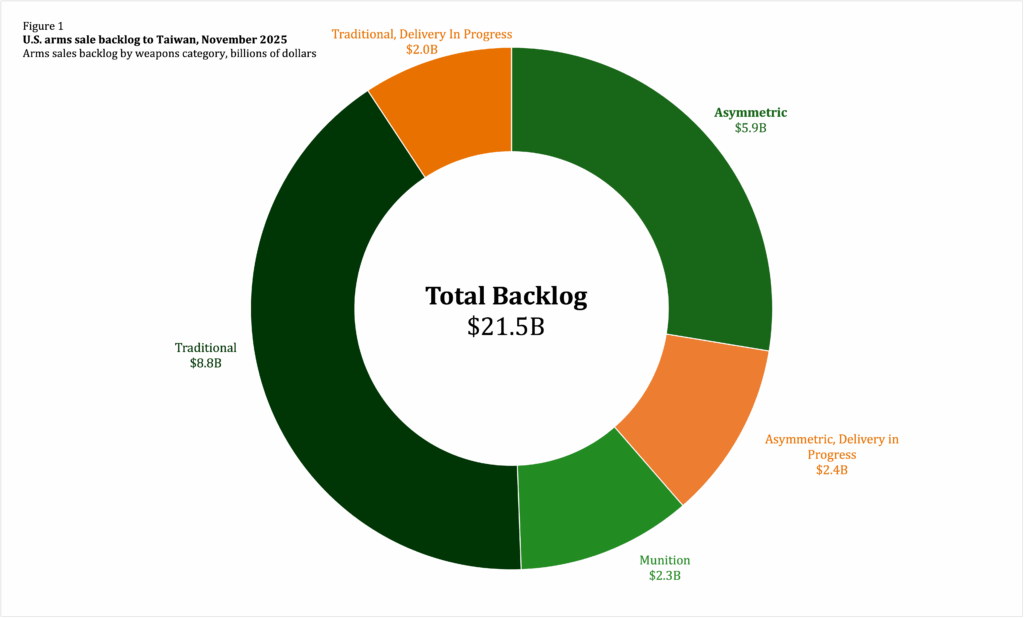
The U.S. arms sale backlog to Taiwan as of November 30, 2025, remains $21.54 billion. For arms sales valued at over $1 billion, deliveries in progress are marked in yellow-orange in our visualizations, meaning that the true dollar value is lower than the topline. Figure 1 illustrates the breakdown of the backlog between asymmetric weapons, traditional weapons, and munitions. Table 1 provides an itemized list of all arms sales in the backlog, including the most up-to-date information on their status.

Novemberโ€™s Report to LY and Other Status Updates

On November 3rd, the MND submitted a report to the Legislative Yuan on the status of US arms sales, noting a total of 25 FMS cases that are ongoing, up from 18 in June 2025. The report classified three major sales as โ€œdelayed,โ€ namely, F-16 Block 70/72 aircraft, AGM-154C Joint Standoff Weapons (JSOWs), and MK 48 torpedoes, corresponding with earlier statements in October from Minister of National Defense Wellington Koo about delays associated with those sales.

On AGM-154C JSOWs: The report indicates they will continue to be delayed, with delivery not expected until 2027 or 2028, instead of 2026; in line with Premier Cho Jung-taiโ€™s statements in October to that same effect. The AGM-154C has been categorized as a delayed sale by the MND since March 2024, and a contract to produce them was not signed until February 2024.

On MK 48 torpedoes: Novemberโ€™s report categorizes them as delayed for the first time, slipping from 2026 to 2028 and a closeout of 2030, per statements made by the Navyโ€™s Chief of Staff, Vice Adm. Chiu Chun-jung, after the LY report was submitted.

Though known for a while, the November report categorized the sale of 18 HIMARS launchers, 20 ATACMS missiles, and 864 GMLRS rockets as โ€œahead of schedule,โ€ expected by the fourth quarter of 2026, instead of the projected timeline of 2027. This is likely owing to significant production increases on the US side. Koo, while testifying to the LY concerning the monthly report, also stated that sales of Stinger and Harpoon missiles were on schedule.

A few other status updates appeared in November, from various MND announcements and statements by officials. First, Air Force Chief of Staff Lt. Gen. Lee Ching-jan informed the LY on November 6th that the first two MQ-9B SeaGuardian maritime surveillance drones will be delivered to Taiwan by the third quarter of 2026, continuing on a normal timeline. The MND announced on November 11th that as a part of the โ€œT-Domeโ€ air defense concept, batches of the 100 total PAC-3 MSE interceptors will begin arriving by the end of 2025, with expected completion by 2027. Lastly, Director of the MND Strategic Planning Department Maj. Gen. Huang Wen-chi stated that delivery of the 6 total MS-110 reconnaissance pods will begin in batches before the end of 2025.

The inclusion of these monthly reports by the MND to the LY is a useful and transparent step in determining the status of all sales, but, in particular, those that the MND considers โ€œdelayed.โ€

Lai Announces Special Budget Publicly

On November 25, President Lai Ching-te publicly announced, via a speech and an opinion piece in the Washington Post, a special defense budget worth NT$1.25 trillion (US$40 billion) for โ€œstrengthening defense resilience and asymmetric capabilities.โ€ This also included additional statements echoing Lai’s earlier calls to raise defense spending to 3.3% of GDP by 2026 and 5% by 2030.

What this means for the current backlog is unknown, but as of December 2025, significant new arms sales appear to be associated with the special budget funding announced here. Our analysis of the new sales is already published, but additional information about those sales and their relationship to the special budget will be included in the December 2025 backlog update.

NASAMS Update and FMS Sale

Two other major updates regarding backlogged sales also merit consideration. First, on November 17th, the U.S. Department of Defense announced a new contract award to Raytheon for the production of three National Advanced Surface-to-Air Missile System (NASAMS) fire units for Taiwan, worth $698.95 million (NT$21.8 billion). Expected to finish in spring 2031, this is part of a $1.16 billion sale of NASAMS approved in October 2024. Owing to this contractโ€™s timeline, it is expected that NASAMS will be an extremely delayed sale in the future.

On November 13th, the Defense Security Cooperation Agency notified Congress of a new sale to Taiwan of non-standard spare parts for use in F-16, C-130 and Indigenous Defense Fighter (IDF) aircraft, worth US$330 million (NT$10.28 billion). This marks the first sale during the second Trump administration (and as of the time of writing, certainly not the most recent), the last being approved in December 2024, 329 days prior. Maintenance sales are not counted toward the backlog because they support weapons already in Taiwanโ€™s possession, unlike weapons that have not been delivered, and tracking the delivery status of maintenance equipment is difficult given publicly available information.

Conclusion

The more frequent publication of reports on arms sale timelines to the LY is an encouraging and transparent step from Taiwanese officials. It is worth noting that there are many more than three sales that are delayed, but the MND only appears to categorize โ€œdelayedโ€ sales as those that Taiwan has paid for. TSM is working on a complete translation of Kooโ€™s testimony before the LY that we will publish in the new year; and will also have a more in-depth response to the issue of Taiwanese perception between โ€œdelayedโ€ and โ€œbackloggedโ€ sales.

As of the time of writing, there are many new developments in Taiwanese arms sales, in particular, the addition of a US$11 billion arms package. We at TSM will provide more detail on what that means for the backlog next month.

Taiwan Affairs Office: The DPP authorities should stop the unwarranted seizure and detention of, and even the use of dangerous and rough methods against, mainland fishing vessels and fishermen; otherwise, they must bear all the consequences.

A reporter asked: Recently, the China Coast Guard again entered the so-called โ€œprohibited watersโ€ near Kinmen to conduct law-enforcement patrols. Does the Taiwan Affairs Office have information on this, and what is your comment?

Spokesperson Chen Binhua of the Taiwan Affairs Office replied that Taiwan, Penghu, Kinmen, and Matsu are all parts of China. The waters between Xiamen and Kinmen have since ancient times been traditional fishing grounds used by fishermen on both sides of the Strait; the so-called โ€œprohibitedโ€ or โ€œrestricted watersโ€ simply do not exist. The China Coast Guardโ€™s routine law-enforcement patrols in the relevant waters help maintain order for maritime production activities and safeguard the lives and property of fishermen on both sides of the Strait. We sternly warn the DPP authorities to recognize the historical and objective fact that fishermen across the Strait have long worked together in these traditional fishing grounds, and to stop the unwarranted seizure and detention of, and especially the use of dangerous and rough methods against, mainland fishing vessels and fishermen. Otherwise, they must bear all the consequences.

The Taiwan Affairs Office of the State Council expressed strong dissatisfaction and firm opposition to the inclusion of erroneous content related to Taiwan in the U.S. National Defense Authorization Act for Fiscal Year 2026.

A reporter asked on December 19 about the signing into law of the U.S. โ€œFiscal Year 2026 National Defense Authorization Act,โ€ which includes provisions allocating US$1 billion for the โ€œTaiwan Security Cooperation Initiativeโ€ and other Taiwan-related items. What is your comment on this?

Chen Binhua, spokesperson for the Taiwan Affairs Office of the State Council, responded that the U.S. has inserted erroneous Taiwan-related content into the โ€œFY2026 National Defense Authorization Act,โ€ attempting to further โ€œarm Taiwan,โ€ interfere in Chinaโ€™s internal affairs, and send a seriously wrong signal to โ€œTaiwan independenceโ€ separatist forces. We are strongly dissatisfied with this and firmly oppose it.

We demand that the U.S. abide by the one-China principle and the stipulations of the three China-U.S. Joint Communiquรฉs, refrain from implementing the Actโ€™s Taiwan-related provisions and eliminate the negative impact, and handle the Taiwan question with utmost prudence. We sternly warn the DPP authorities that no matter how they attempt to โ€œrely on the U.S. to seek independence,โ€ they cannot change the fact that Taiwan is part of China, cannot change the doomed fate of โ€œTaiwan independence,โ€ and cannot stop the historical trend toward Chinaโ€™s inevitable reunification.

Weekly PRC Media Review: 12/19/2025

Author: Ethan Connell


Hereโ€™s the latest edition of the TSM PRC State Media Tracker. Each Friday, we highlight key excerpts from Chinaโ€™s state media organs, such as the Ministry of Foreign Affairs, the Ministry of National Defense, and the Taiwan Affairs Office, all below!


Ministry of Foreign Affairs Statement on the Honduras-Taiwan Relationship

16 December 2025

Taiwanโ€™s Minister of Foreign Affairs Lin Chia-lung, when asked how Taiwan can maintain friendly relations with Honduras while competing with mainland China, said that โ€œTaiwan is building a relationship based on trust and prosperity.โ€

China’s Ministry of Foreign Affairs’ response:

Guo Jiakun: Under the banner of โ€œtrustโ€ and โ€œprosperity,โ€ the Taiwan authorities are engaging in so-called โ€œdollar diplomacy,โ€ which cannot conceal their true nature of pursuing โ€œindependenceโ€ by any means, nor can it deceive public opinion or the people on the island. The โ€œTaiwan independenceโ€ forces and the Democratic Progressive Party authorities are going against the tide of history and are destined to fail. Since China and Honduras established diplomatic relations, cooperation in various fields has yielded fruitful results, significantly enhancing Hondurasโ€™ long-term development capacity and bringing tremendous benefits to both countries and their peoples. The facts fully demonstrate that upholding the one-China principle accords with the trend of historical development and the progress of the times, and serves the fundamental interests of the countries concerned and their peoples.

Taiwan Affairs Office Statement on the Taiwanese Special Defense Budget

17 December 2025

On President Lai Ching-te’s proposed US$40 billion special budget for purchasing armaments from the United States:

Zhu Fenglian: The Taiwan question is purely Chinaโ€™s internal affair, and resolving it is a matter for the Chinese people alone, allowing no external interference. The Lai Ching-te administration, for the selfish interests of its party, continues to provoke โ€œTaiwan independence,โ€ repeatedly increases the defense budget, and pushes a โ€œwhole-of-society militarization,โ€ tying the people of Taiwan to the separatist bandwagon. Its attempts to โ€œrely on foreign forces to seek independenceโ€ and โ€œuse force to seek independenceโ€ threaten the safety and interests of the Taiwan people. โ€œTaiwan independenceโ€ is a dead end; outsiders cannot be relied upon; reunification cannot be stopped. We have firm will, strong determination, and powerful capability to crush all separatist schemes for โ€œTaiwan independence,โ€ to resolutely oppose external interference, and to safeguard national sovereignty and territorial integrity.

Ministry of Foreign Affairs Statement on the Announcement of US Arms Sales to Taiwan

18 December 2025

On the news that the U.S. has initiated arms sales to Taiwan totaling about US$11 billion, one of the largest such packages:

Guo Jiakun: The U.S. has openly announced a massive plan to sell advanced weapons to Taiwan, which seriously violates the one-China principle and the three China-U.S. Joint Communiquรฉs, gravely harms Chinaโ€™s sovereignty, security, and territorial integrity, severely undermines peace and stability across the Taiwan Strait, and sends a seriously wrong signal to โ€œTaiwan independenceโ€ separatist forces. China firmly opposes and strongly condemns this.

The โ€œTaiwan independenceโ€ separatist forces on the island are seeking โ€œindependence through armed meansโ€ and โ€œresisting reunification with weapons,โ€ squandering taxpayersโ€™ money to purchase weaponry and willing to turn Taiwan into a โ€œpowder keg.โ€ This will not save the doomed fate of โ€œTaiwan independence.โ€ It will only accelerate the regionโ€™s slide toward heightened tension and danger. The U.S. policy of โ€œsupporting independence with weaponsโ€ will only backfire on itself, and attempts to โ€œuse Taiwan to contain Chinaโ€ will never succeed.

The Taiwan question is the core of Chinaโ€™s core interests and the first red line that cannot be crossed in China-U.S. relations. No one should underestimate the strong will and powerful capability of the Chinese government and the Chinese people to safeguard national sovereignty and territorial integrity. China urges the U.S. to abide by the one-China principle and the three China-U.S. Joint Communiquรฉs, honor the serious commitments made by its leaders, and immediately stop its dangerous act of arming Taiwan. China will take resolute and forceful measures to defend its national sovereignty, security, and territorial integrity.

Taiwan Affairs Office Statement on Announcement of US Arms Sales to Taiwan

18 December 2025

Continued arms sales commentary, this time from the Taiwan Affairs Office:

Chen Binhua: The Taiwan question concerns Chinaโ€™s core interests and is the first red line that must not be crossed in China-U.S. relations. The U.S. side has brazenly announced a massive arms sale plan to Chinaโ€™s Taiwan region, crudely interfering in Chinaโ€™s internal affairs and seriously violating the one-China principle and the three Chinaโ€“U.S. joint communiquรฉs, especially the August 17 Communiquรฉ. It gravely harms Chinaโ€™s sovereignty and security interests and sends a serious wrong signal to โ€œTaiwan independenceโ€ separatist forces. We firmly oppose this and strongly condemn it. We demand that the U.S. immediately stop โ€œarming Taiwan,โ€ stop condoning and supporting โ€œTaiwan independenceโ€ separatist forces, abide by the one-China principle and the three Chinaโ€“U.S. joint communiquรฉs, honor the commitments made by U.S. leaders, and handle the Taiwan issue with the utmost caution.

The DPP authorities stubbornly pursue โ€œseeking independence by relying on the U.S.โ€ and โ€œseeking independence by force,โ€ constantly hyping so-called โ€œdefense resolve,โ€ and are willing to turn Taiwan into a โ€œpowder kegโ€ and an โ€œammunition depot,โ€ even at the cost of turning the Taiwanese people into cannon fodder for โ€œTaiwan independence.โ€ This will only bring grave disaster to Taiwan compatriots and fully expose their vicious nature as โ€œdestroyers of peace,โ€ โ€œcreators of crises,โ€ and โ€œinstigators of war.โ€ People across Taiwan should clearly recognize the DPP authoritiesโ€™ bottomless, pernicious essence of โ€œselling out Taiwan and courting war.โ€ We solemnly warn the DPP authorities that national reunification is an unstoppable trend; if โ€œTaiwan independenceโ€ separatist forces dare to cross the red line, we will resolutely strike back.

Ministry of Foreign Affairs Statement on a Planned Radar Station on Kitadaito, Okinawa’s Easternmost Island

18 December 2025

On the news that Japanโ€™s Ministry of Defense signed a land lease agreement on the 15th, planning to deploy mobile radar equipment on the easternmost island of Okinawa to monitor the activities of Chinese aircraft carriers and aircraft in the waters between Okinawa and Miyako Island:

Guo Jiakun: In the relevant sea and air areas, all countries enjoy freedom of navigation and overflight in accordance with international law.

Due to the history of Japanese militarist aggression, Japanโ€™s military and security moves have long drawn close attention from its Asian neighbors and the international community. Japan has repeatedly strengthened targeted military deployments near Taiwan, and has even stated its intention to deploy intermediate-range missiles. Now it is further escalating by planning to deploy radar and troops to spy on its neighbors. Taken together with Prime Minister Takaichi’s series of erroneous and dangerous remarks regarding Taiwan, one must ask: Is Japan deliberately stirring up trouble, provoking China at close range, and seeking excuses to justify its military expansion and operations abroad? Is Japan following the design of right-wing forces to once again embark on the dangerous and disastrous path of militarism?

We urge Japan to learn from the lessons of history!

New Arms Sales for Taiwan: Details and Reactions

Author: Joe O’Connor


On Wednesday evening, the U.S. Defense Security Cooperation Agency and Department of State notified Congress and the public of eight proposed arms sales to Taiwan worth US$11.1 billion in total, confirming reporting from Reuters only hours before. Counted together, this is the largest single arms sale in Taiwanโ€™s history. Below is a detailed accounting of each sale and its contents, along with reactions from the Taiwanese Presidential Office and the PRCโ€™s Taiwan Affairs Office and Ministry of Foreign Affairs.

What Is Being Sold?ย 

It is worth prefacing that the below sales are mostly building on current capabilities that Taiwan has, either by expanding stockpiles (in the case of HIMARS, Javelins, TOWs, and ALTIUS) or receiving upgraded versions of equipment (in the case of the Paladins). This is significant as it means that Taiwan has determined how to use these capabilities and is not introducing new platforms that would require additional training time.

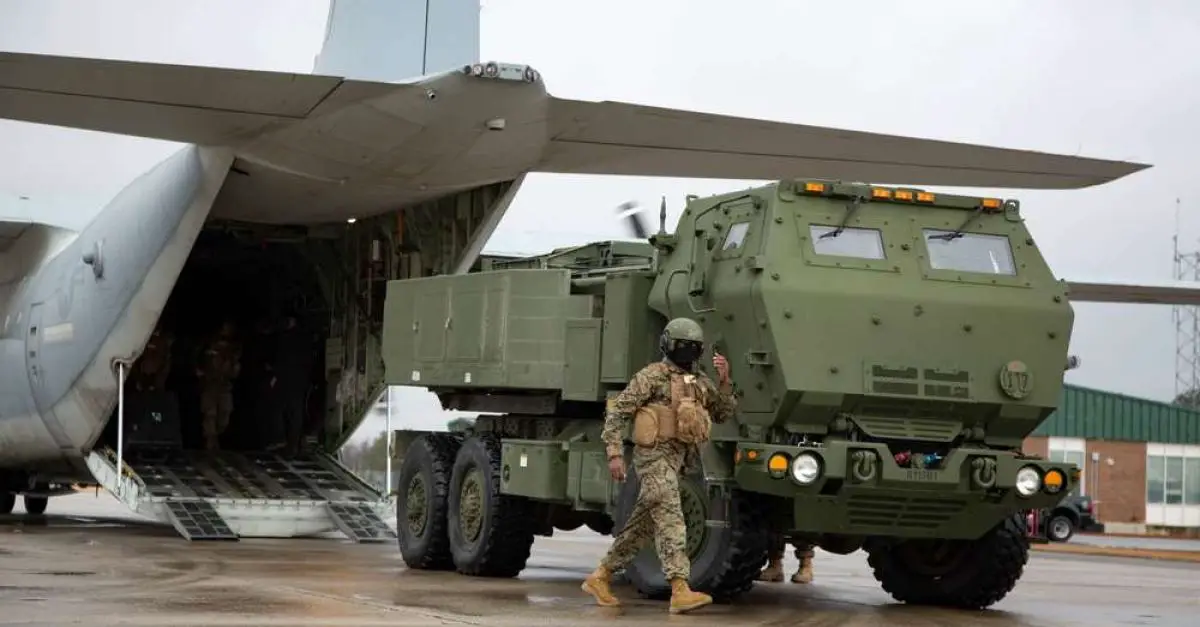
HIMARS: The single largest sale in this package, at US$4.05 billion (NT$127.2 billion), consists of 82 HIMARS launchers, 420 Army Tactical Missile System (ATACMS) missiles, 756 Guided Multiple Rocket Launch System (GMLRS) unitary rocket pods, 447 GMLRS-Alternative Warhead (GMLRS-AW) rocket pods, and 39 High-Mobility Multipurpose Wheeled Vehicles (HMMWV or Humvees). This sale comes after a plus-up sale approved in December 2022 for 29 HIMARS launchers, 20 ATACMS, and 144 GMLRS pods; as of December 2025, Taiwan has only received 11 launchers and is expected to receive the remaining 18, plus munitions, in 2026.

M109A7 Paladin Self-Propelled Howitzers: Worth US$4.03 billion (NT$126.6 billion), this sale consists of 60 Paladins, 60 M992A3 Carrier Ammunition Tracked Vehicles (CATVs), 13 M88A2 Recovery Vehicles, 4,080 Precision Guidance Kits, and 42 International Field Artillery Tactical Data Systems (IFATDS), as well as an unspecified number of M2A1 machine guns and M795 155-mm ammunition. This sale is expected to be half of the proposed 120 Paladins, a deal that was reduced from 168 and then cancelled by Taiwanโ€™s Ministry of National Defense in 2022 due to concerns about delays caused by the war in Ukraine.

ALTIUS-700M and 600 Systems: Worth US$1.10 billion (NT$34.54 billion), this sale consists of an unknown quantity of ALTIUS-700M loitering munitions and ALTIUS-600 intelligence, surveillance, and reconnaissance systems. A previous sale of 291 ALTIUS-600M-V loitering munitions was authorized in June 2024, and an unknown quantity was delivered in August 2025, with all expected to be delivered by the end of this year.

Tactical Mission Network: Worth US$1.01 billion (NT$31.71 billion). The congressional notification for this sale appears to refer to it as a single network, and per Janes, it is a concept explored recently by the U.S. Special Operations Command to โ€œoperationalize chat and data-sharing environmentsโ€ similarly to platforms such as Signal and WhatsApp. The sale also includes unspecified unmanned aerial systems as well as software.

Javelin Missiles: Worth US$375 million (NT$11.78 billion), consisting of 1,050 Javelin FGM-148F missiles, 10 Javelin fly-to-buy missiles, and 70 Javelin Lightweight Command Launch Units (LwCLUs). The last Javelin sale authorized to Taiwan was in December 2015, and was modified in 2019 to total 400 missiles and 46 LwCLUs. Despite delays owing to the war in Ukraine, those Javelins were delivered in July 2024, per an October 2024 MND report cited by TSM Fellow Eric Gomez.

TOW-2B Missiles: Worth US$353 million (NT$11.08 billion), consisting of 1,545 TOW-2B BGM-71F-7-RF missiles, 16 TOW-2B fly-to-buy missiles, and 24 Improved Target Acquisition Systems. Taiwan was last authorized sales of TOW missiles in December 2015 and July 2019, having all 1,700 across both sales delivered in December 2024, despite the original timeline stating delivery in 2022.

AH-1W Helicopter Spare/Repair Parts: Worth US$96 million (NT$3.01 billion), consisting of an unknown quantity of AH-1W SuperCobra helicopter unclassified spare and repair parts. This is a routine maintenance sale for AH-1Ws that Taiwan was authorized to buy in July 1997.

Harpoon Missile Repair Follow-on Support: Worth US$91.4 million (NT$2.87 billion), consisting of an unknown quantity of Harpoon radar seekers, as well as return, repair, and reshipment of Naval Harpoon missiles. This is a routine maintenance sale for what appears to be RGM-84 Harpoons on ROCN vessels, as opposed to the Harpoon Coastal Defense System authorized in 2020 or air-launched Harpoons approved in 2022.

Reaction to the Sales

Immediately after the announcement, a spokesperson for Taiwanโ€™s Presidential Office stated that they were โ€œsincerely grateful to the US government for once again demonstrating that it continues to fulfill its security commitments.โ€ The spokesperson also noted it was the โ€œsecond arms sale to Taiwan announced during the Trump administration,โ€ and reiterated statements made previously by Lai administration officials concerning increased defense spending to 3% of GDP by 2026 and 5% by 2030. No statements have thus far been made by Taiwanโ€™s Ministry of Foreign Affairs, Ministry of National Defense, or TECRO Mission in the United States.

In Beijing, the news of the sale was met with a flurry of condemnations from several PRC state organs. Chinaโ€™s Ministry of Foreign Affairs commented on the sale in a press conference on Thursday, condemning it and promising to โ€œtake resolute and strong measures to defend its national sovereignty, security, and territorial integrity.โ€ Additionally, the Taiwan Affairs Office of the State Council, an organ responsible for cross-Strait relations, accused Taipei of โ€œseeking independence by relying on the U.S.โ€ and said such sales would turn Taiwan into a โ€œpowder keg.โ€

In Washington, however (as of the time of writing, Thursday morning), there have been no statements aside from the initial DSCA congressional notifications, including none from senior members of the Senate and House Foreign Affairs Committees, or Secretary of State Marco Rubio. The American Institute in Taiwan also has not commented.

What Does This Mean?

This batch of proposed sales represents a large commitment on the part of the Trump administration to support Taiwan, but is not immune from challenges. Legislative Yuan approval of the DPPโ€™s proposed NT$1.25 trillion special budget is hamstrung by KMT and TPP opposition legislators, who demurred on placing it on the agenda until President Lai testified, an action that the LY cannot compel (causing a minor constitutional crisis). This threatens to delay delivery of not only current sales, but also these future ones, particularly if the special budget is cut or fails to pass.

The issue of production challenges also merits consideration. HIMARS production has increased, so much so that the MND has classified its remaining 18 launchers from the 2022 sale to be ahead of schedule, and it is likely that these additional HIMARS will not be excessively delayed. A potential decrease in support to Ukraine also means that Paladins and Javelins could be focused on Taiwan instead, decreasing timelines further. But it merits remembering that currently (not counting these recent sales), over US$21 billion in already authorized equipment is delayed, including F-16C/D Block 70s and AGM-154C Joint Standoff Weapons, due to production issues.

Watching the progress of the special budget through the LY, as well as other arms developments, will be valuable in determining how these new sales will work. Overall, however, this is an encouraging development for Taiwanโ€™s security.