Taiwan Security Monitor

Taiwan Arms Sale Backlog, February 2026 Update

Special Budget Complications Continue

Authors: Joseph Oโ€™Connor, Eric Gomez, & Shikhar Chaturvedi


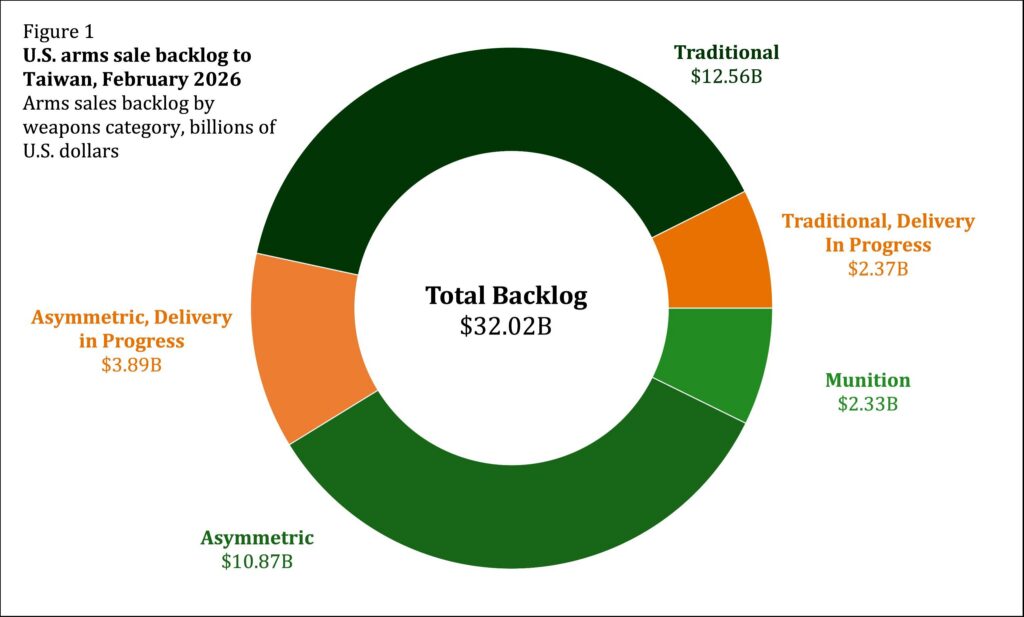
Political gridlock over the Lai administrationโ€™s special procurement budget continued in February 2026, leading to concerns about recently announced U.S. arms sales to Taiwan. No new Foreign Military Sales (FMS) cases were notified to Congress, and no existing sales were delivered in February. The total value of FMS cases notified to Congress but not delivered to Taiwan remains $32 billion.

Eagle-eyed readers will notice that there is a change in Figure 1. Arms sales cases are fully removed from our dataset once final delivery occurs, but we do not reduce the dollar value of the backlog for partial deliveries. We have explained our thinking in other articles.

We indicate partially delivered arms sales through color coding in our data visualizations, with the yellow-orange color representing cases that are partially delivered to the best of our knowledge. Previously, we have only done this for arms sales valued at $1 billion or more because these were the most militarily significant sales and because, given the quantities and types of capabilities involved, they tended to be the easiest to track.

However, we realize that a $1 billion threshold has its own problems. We have therefore decided to adjust our methodology for data visualizations, and from now on, any arms sale that we can verify as partially delivered will be visually indicated with the yellow-orange color. The dollar value of the backlog will only be reduced when a sale is fully delivered, but we think this new approach represents a reasonable way to show in-progress deliveries.

This methodology change moves five arms sales cases worth $1.89 billion into the partially delivered category. Combined with the two cases above, the $1 billion threshold that we were already tracking as partially deliveredโ€”M1A2T Abrams tanks and Harpoon Coastal Defense Cruise Missile systemsโ€”there are seven arms sales cases worth $6.26 billion that are partially delivered, just shy of 20 percent of the backlogโ€™s total dollar value.  

Special Budget Updates in February

Ongoing deliberations in the Legislative Yuan (LY) relating to a special defense budget slowed down in February, as the LY recessed for the Lunar New Year holiday. Prior to recess, the legislature voted to advance a proposal made by the opposition Taiwan Peopleโ€™s Party (TPP) to committee review, leaving the Lai administrationโ€™s NT$1.25 trillion (US$40 billion) proposal in limbo. During the recess, 37 U.S. senators and representatives, including senior members of the House and Senate foreign affairs committees and from both parties in Congress, sent a letter to LY Speaker Han Kuo-yu and party caucus leaders, expressing concern about โ€œongoing deliberations in the Legislative Yuan to only partially fund a supplemental budget request.โ€ Han, responding on February 16, stated that the budget would be one of the โ€œvery firstโ€ items to be debated, and upon re-convening on February 24, the LY voted to advance the governmentโ€™s proposal, ending the month with both proposals under review by the Foreign Affairs and National Defense Committee.
The differences between the competing proposals largely center on flexibility and holistic spending, as opposed to narrower and targeted procurements of established systems, as discussed in detail in our recent article comparing the two proposals. On the sidelines, the Kuomintang (KMT), the third and largest major party in the LY, announced in late February that they would be releasing their own special budget proposal, which they did in early March. As of the end of February, the proposal had ranged from NT$350 billion (US$11.19 billion) to NT$750 billion (US$23.97 billion) but turned out to be only NT$380 billion (US$12 billion) when announced on March 6.

Taiwan’s MND, on February 6, sounded the alarm about three Letters of Offer and Acceptance (LOAs) that are set to expire on March 15. The LOAs, which are for the December sales of Paladin self-propelled howitzers, TOW-2B anti-armor missiles, and Javelin anti-armor missiles, were not signed because of ongoing battles in the LY. MND officials stated they were seeking extensions to the LOAs if a deal was not reached soon. Signing a LOA quickly is an important milestone in the FMS process. A LOA has a payment schedule, whereby Taiwan would pay the U.S. government in installments for the capabilities it is purchasing. The U.S. government negotiates a contract with the defense industry and pays for the capabilities using the funds that Taiwan transfers per the LOA. Importantly, until a LOA is signed and a first payment is made, the Department of Defense cannot enter a contract to produce the weapons. If a LOA is not signed before it expires, then certain steps in the FMS process must be repeated or renegotiated due to potential changes in pricing.

Updates to Abrams, PAC-3 Sales

On February 2, MND officials reported that the final batch of 28 M1A2T Abrams tanks will arrive in Taiwan by the end of March. Delivery of the total 108 tanks has been ongoing since December 2024, when the first batch of 38 arrived in Taiwan.

On February 11, MND officials confirmed to the press that they would be procuring 102 PAC-3 Missile Segment Enhancement (MSE) missiles for Patriot air defense systems, which would be paid via surplus funds from a prior Patriot procurement program.  This is a positive development for the backlog, as the 102 PAC-3 MSEs are a 2022 modification to a 2010 Patriot case and can be funded through surplus from the earlier program. They are separate from and (additive to) the planned but not yet notified Patriot follow-on package (additional batteries and PAC-3 MSEs) expected to be financed through the Lai administrationโ€™s special defense budget.

Amidst these updates, reporting from the Financial Times, New York Times, and Taipei Times has revealed a future arms sale package to Taiwan, including PAC-3 MSE missiles, additional Patriot batteries, Integrated Battle Command Systems, and Lower Tier Air and Missile Defense Sensors radars, all designed to integrate into the Lai administrationโ€™s planned โ€œT-Domeโ€ air defense system. The timeline of this sale, however, is in flux owing to Trumpโ€™s summit with Xi in April.

Trump Administration Announces Arms Sale Reforms

On February 6, the Trump administration launched a new round of arms-transfer reforms through Executive Order 14383 and its accompanying White House fact sheet, establishing an โ€œAmerica First Arms Transfer Strategy.โ€ The order reframes arms transfers as a mechanism for expanding U.S. production capacity, strengthening supply chains, and prioritizing partners that invest in their own defense. The point was reinforced on February 10, when the Pentagon announced the realignment of the Defense Security Cooperation Agency (DSCA) and the Defense Technology Security Administration (DTSA) under the Under Secretary for Acquisition and Sustainment, explicitly tying security cooperation and export administration more closely to defense-industrial management and execution.

At the same time, Taiwan’s arms sales became more visibly entangled with summit diplomacy. Following the February 4 Trumpโ€“Xi call, Beijing publicly urged Washington to handle Taiwan arms sales with โ€œprudenceโ€ and again described Taiwan as theโ€œmost important issueโ€ in U.S.โ€“China relations. Trump then said he was โ€œtalkingโ€ with Xi about future arms sales to Taiwan and would decide โ€œpretty soon,โ€ before the White House promptly clarified that there had been no change in longstanding U.S. policy. Further reporting that a major new package could move only after a Trump trip to China further underscores that dynamic.

Conclusion

Taiwanโ€™s arms sales backlog remained steady at $32.0 billion through the end of February 2026. However, recent developments highlight the role of political factors in the backlog rather than defense industrial capacity.  

The Legislative Yuan has only just begun substantive review of competing special budget proposals, while the March 15 LOA expiration deadline is approaching for several cases notified in December.  Meanwhile, Washingtonโ€™s efforts to streamline arms transfers are occurring alongside high-level diplomacy, which may influence the timing of major new Taiwan FMS notifications to Congress. 

March will be a critical month to determine whether Taipei can turn budget discussions into signed agreements and funding, and whether U.S. process improvements will result in faster execution or be offset by political considerations on both sides.
Weekly Security Review: 3/16/26

Author: Jaime Ocon


Welcome to the Weekly Security Review, where we highlight key military, security, and political developments around Taiwan in one straightforward summary!

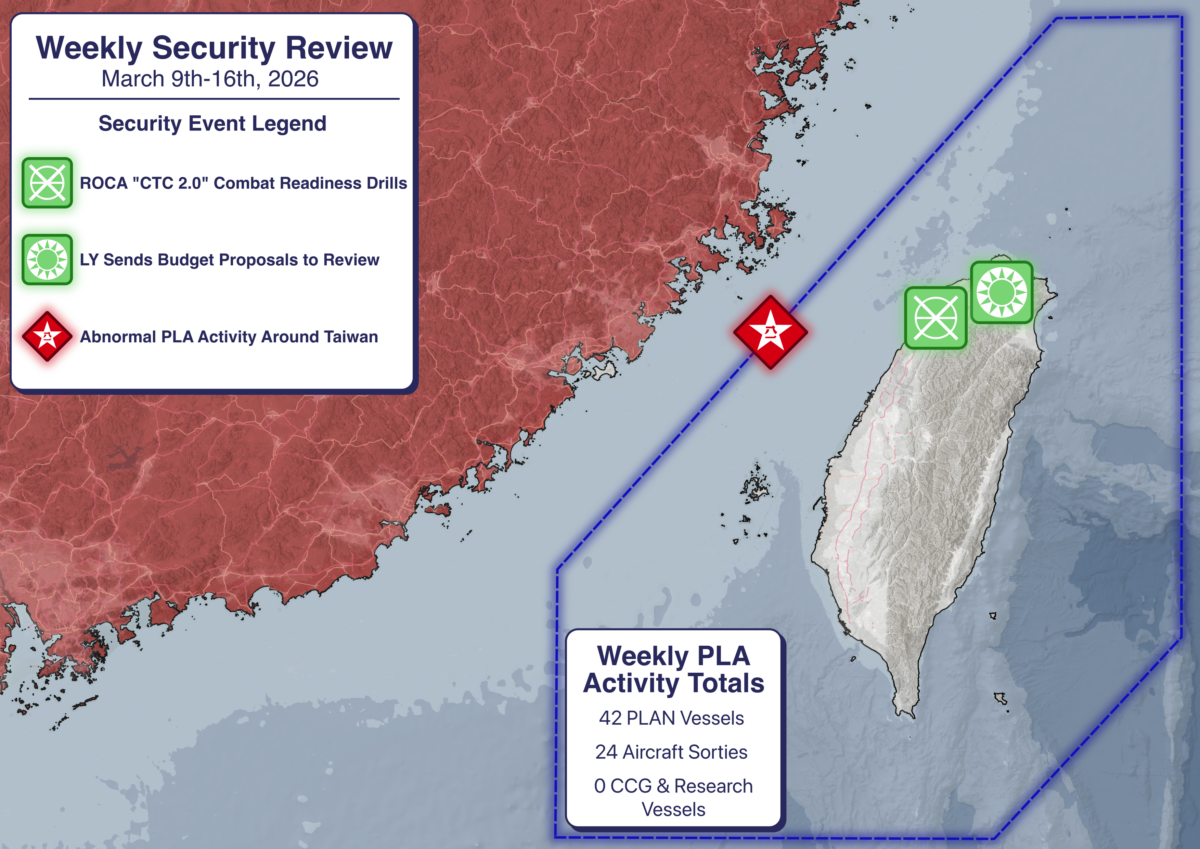
This week, Taiwanโ€™s army conducts a new kind of exercise, a lack of ADIZ activity around Taiwan raises suspicion, and a supplemental defense budget inches closer to being passed.

Army Wraps Up Inaugural CTC 2.0 Combat Readiness Drills

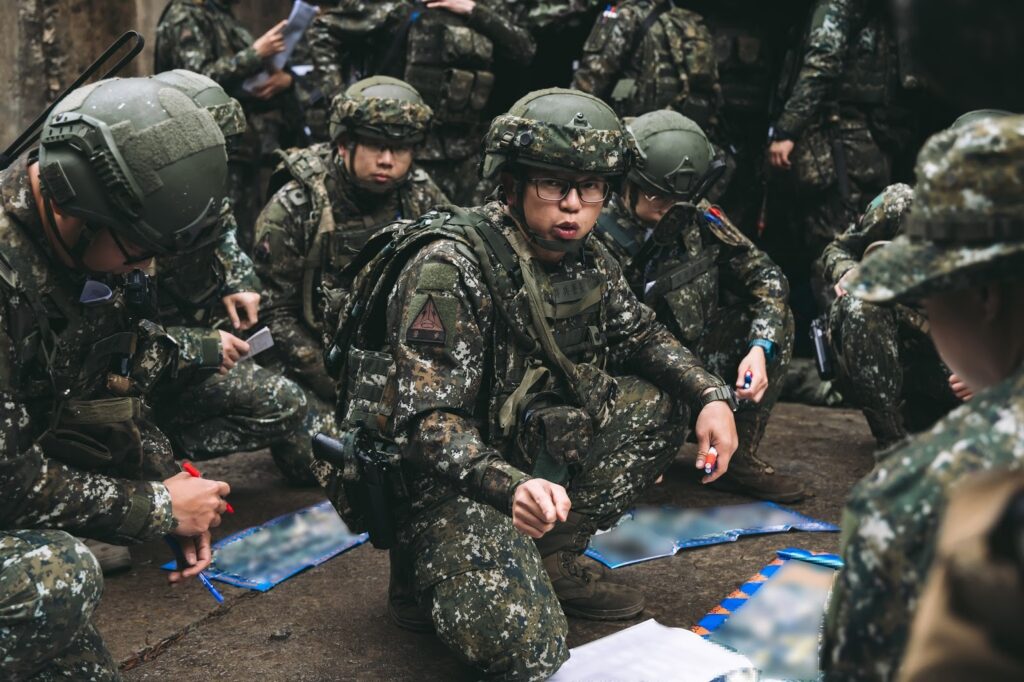
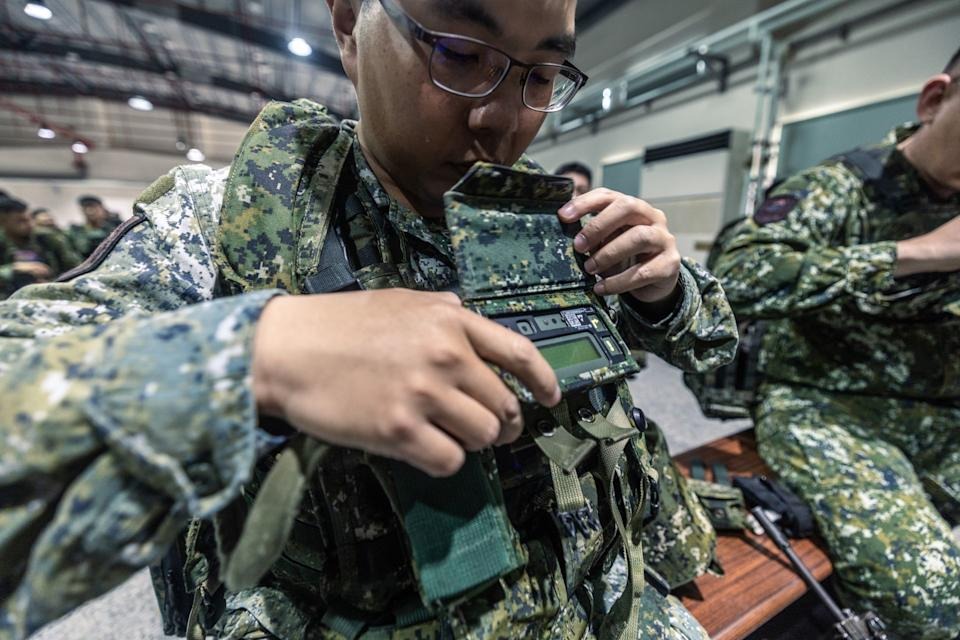
Taiwan’s Army has wrapped up a new kind of military exercise called “CTC 2.0” (Combat Training Center rotation 2.0). The Ministry of National Defense (MND) says the inaugural drills are a significant upgrade to its existing combat readiness exercise and are modeled after U.S. Army training. The first-ever rotation involved the 542nd, 584th, and 586th Combined Arms Brigades, along with the 39th Chemical Corps and 52nd Engineer Group. The goal of these exercises, per military officials, is to simulate uninterrupted high-intensity operations to improve the combat endurance of Taiwanโ€™s troops. The military simulated live-fire scenarios using an opposing force, creating mock fires within an integrated engagement system. These live-fire scenarios put pressure on units to coordinate combined arms tactics and forced officers to issue quick orders using the Military Decision Making Process (MDMP). Soldiers taking part in the drills were also tested on how they conducted logistics, with some units even performing maintenance and swapping engines on the fly. 

Since 2023, Taiwan has been making great strides to increase the realism of its military exercises, and the new CTC 2.0 is a continuation of those efforts. These drills were extended from 5 days/4 nights to 10 days/9 nights, and included one-year conscripts alongside the active volunteer force. Units that fail the drills must complete the entire exercise again. Engineers who took part in CTC 2.0 say this iteration helped them improve their ability to rapidly deploy mines, obstacles, and field fortifications under pressure across different terrains. A large number of armor crewmembers, however, say the drills are physically and mentally demanding, due to the 24-hour cycle having no predictable rest periods. Battalion commanders say the biggest challenge was issuing orders under pressure and under consistently changing battlefield conditions. 

Suspicious ADIZ Activity Around Taiwan Raises Eyebrows  

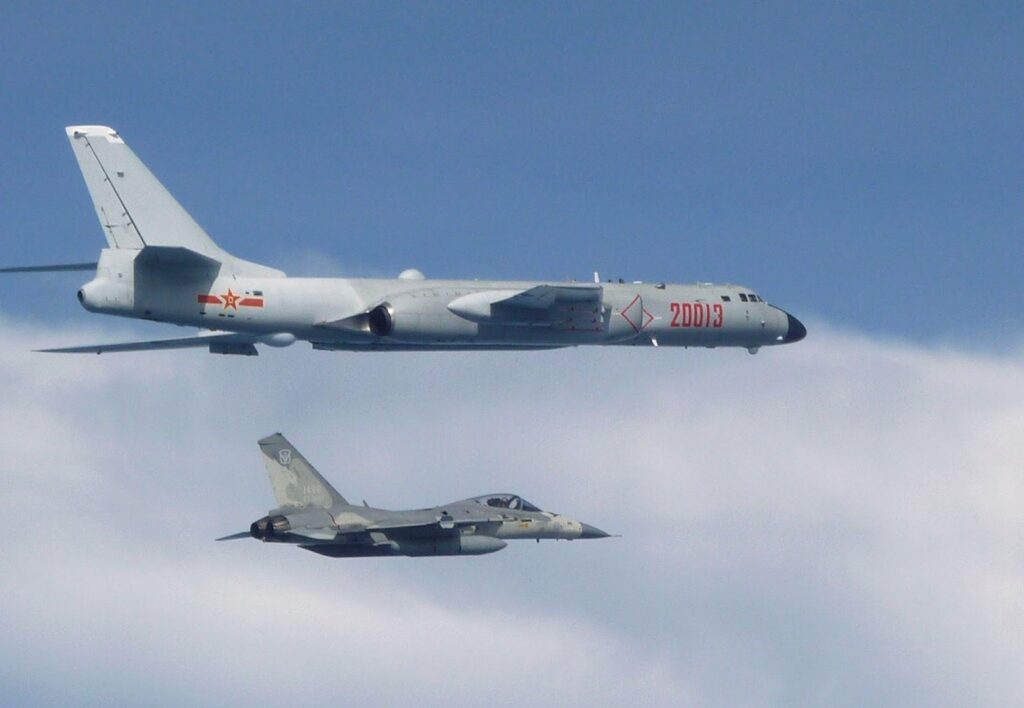
Itโ€™s been an interesting two weeks for Taiwan, which has since reported a sharp uptick in Chinese military activity around its airspace on Sunday, ending a rare 10-day lull in flights that have left analysts and observers around the world looking for answers. Regardless, Taiwanโ€™s MND says it spotted 26 PLA military aircraft operating in the region, with 16 crossing the median line of the Taiwan Strait or entering Taiwanโ€™s air-defense identification zone (ADIZ). Seven Chinese naval vessels were also observed maneuvering in the surrounding waters. 

From February 27 to March 11, the MND reported zero Peopleโ€™s Liberation Army Air Force (PLAAF) sorties on 11 of 13 days, being the longest pause since 2021. Beijing offered no public comment, and Taiwanโ€™s Minister of National Defense, Wellington Koo, has cautioned against reading too much into the โ€œde-escalation.โ€ Koo went on to tell reporters that Chinese naval patrols โ€œstill surround us daily.โ€ Analysts in Taipei and Washington have floated a variety of competing theories, ranging from internal leadership disruptions due to recent PLA purges to political calculations ahead of an anticipated U.S.โ€“China summit. Some analysts have highlighted possible fuel shortages and new training formats as another possibility, but one thing is for sure: no one knows exactly why. Some observers now say that the resurgence of flights suggests the lull was tactical rather than strategic, as with the Two Sessions finished, aircraft are now starting to return.

Taiwan Security Monitor put out its own explanation for the lull in activity on March 7. You can read the full article here: 

Taiwanโ€™s Legislature Sends All Supplemental Budget Proposals to Committee Review

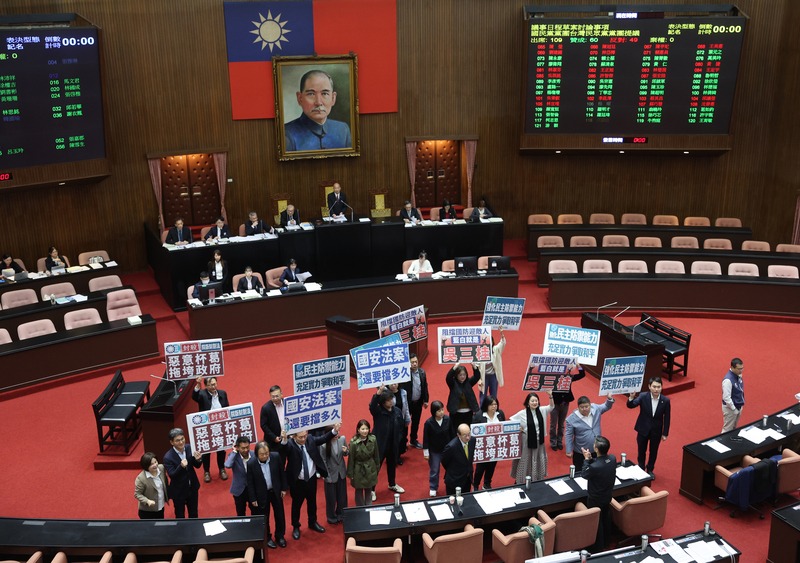
Taiwan’s Legislative Yuan (LY) has agreed to send all three versions of a supplemental defense budget draft to the various committees for review. The competing proposals includes the Lai administrationโ€™s NT$1.25 trillion (US$40 billion) request, a proposal by the Taiwan Peopleโ€™s Party (TPP) worth NT$400 billion (US$12.7 billion), and a third budget by the Kuomintang (KMT) worth NT$380 billion (US$11.93 billion)   Days later, the LY agreed to allow the Cabinet to sign Letters of Offer and Acceptance (LOA) for four U.S. weapons systems. Three of those systems, Paladin self-propelled howitzers, TOW-2B, and Javelin anti-armor missiles, had a deadline of March 15. A fourth LOA, to be signed for 82 High Mobility Artillery Rocket Systems (HIMARS) and munitions, has a March 26 deadline. The next step is for the Cabinet to inform the Legislature of the estimated procurement timelines for these systems. The decision to push the budget forward comes just days after the KMT said it could also support the TPPโ€™s special defense budget proposal. KMT legislator Lo Ting-wei said the plans are similar enough that the versions could be merged into a unified โ€œblue-whiteโ€ budget reflecting cooperation between the parties. 

The budget dispute has intensified after the U.S. announced a US$11 billion arms sale to Taiwan in December. Over 30 American lawmakers took to social media and sent a bipartisan letter to LY leaders, urging approval of a supplemental budget. The KMT and TPP both support increasing defense spending, but are more concerned about oversight mechanisms and specific funding details. The KMTโ€™s version requires receipt of LOAs before releasing funds and mandates delivery by 2028, while the TPP would fund only five of the eight U.S. arms sale items. The KMT and TPP oppose the idea of the DPP receiving a โ€œblank checkโ€ for President Laiโ€™s administration. The DPP has continued to release more information clarifying what they would purchase, including funds for a domestic air defense network (T-Dome) and indigenous missile production. 

Visualization: US Military Aircraft Training Incident


Author: Maxwell Hollingsworth


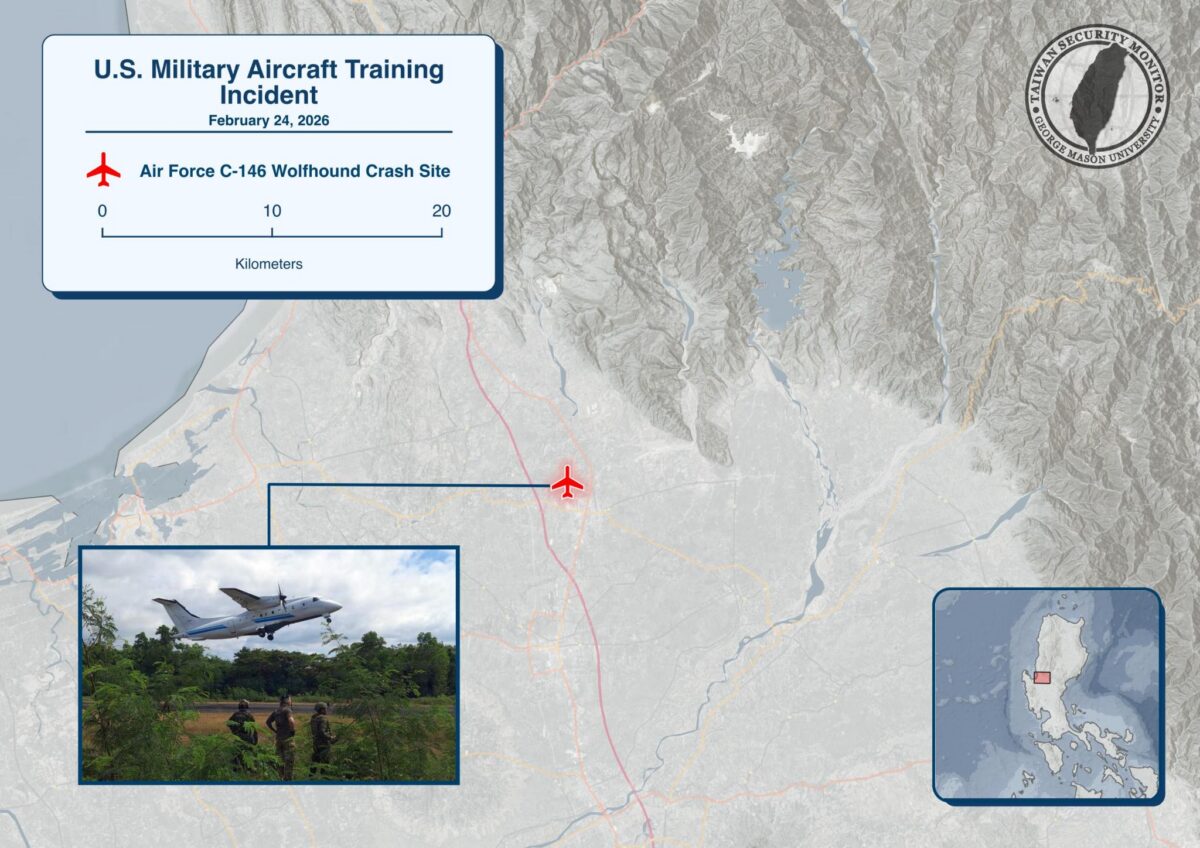
On Feb. 24, a U.S. Air Force C-146 Wolfhound struck a concrete road barrier while attempting to take off from a designated alternate landing zone on a bypass road in Laoac, Pangasinan, during contingency training with Philippine counterparts, injuring all five personnel onboard. 

This was the first such alternate roadway landing activity in the Philippines, tied to both contingency operations and humanitarian/disaster response scenarios. 

Above is TSM’s visualization of the incident’s location.

The Taiwan Affairs Office sharply denounces Lai Ching-teโ€™s fallacies: If he dares to take reckless risks, he will bring about his own destruction!

On March 14, State Council Taiwan Affairs Office (TAO) spokesperson Chen Binhua answered reportersโ€™ questions.

Lai Ching-te attended a so-called โ€œ30 Years of Direct Elections for the Taiwan Regional Leader and Democratic Resilience Symposiumโ€ today, where he openly claimed that the election demonstrated that โ€œTaiwan is a sovereign and independent country.โ€ He fabricated the fallacy that โ€œdemocracy equals sovereignty,โ€ played up the โ€œmainland threat,โ€ advocated โ€œseeking independence through force,โ€ and incited slogans such as โ€œresist China, protect Taiwanโ€ and โ€œdemocracy versus authoritarianism.โ€ A reporter asked for comment.

Chen Binhua said that Laiโ€™s remarks were yet another carefully cobbled-together and packaged โ€œTaiwan independence confession,โ€ once again brazenly challenging the one-China principle and fully exposing Laiโ€™s intransigent โ€œTaiwan independenceโ€ nature and clearly malicious intentions.

He said Lai was using so-called โ€œelectoral democracyโ€ to manufacture a basis for Taiwanโ€™s non-existent โ€œstatehood,โ€ fabricating a โ€œChinese threat to Taiwan,โ€ clamoring about โ€œdefending sovereignty,โ€ creating a false narrative of โ€œdemocracy confronting authoritarianism,โ€ and inciting cross-strait antagonism and confrontation. This, Chen said, completely distorts Taiwanโ€™s history and departs from basic facts. Its purpose is to mislead the public, confuse the issue, stir up โ€œresist China, protect Taiwan,โ€ and pursue โ€œindependence through forceโ€ and โ€œrejecting unification through force.โ€ In essence, it undermines peace and stability in the Taiwan Strait and pushes Taiwan toward war.

Chen said that both sides of the Taiwan Strait belong to one China and Taiwan is part of Chinaโ€”historically and legally clear. Although the two sides have not yet been fully reunified, Chinaโ€™s sovereignty and territorial integrity have never been divided. Taiwan has never been a country and cannot become one; there is fundamentally no such thing as โ€œsovereignty.โ€ No matter how elections are held in the Taiwan region, or who is elected, it cannot change Taiwanโ€™s status as part of China, cannot sever the unbreakable historical and legal ties across the Strait, and cannot overturn the iron rule that Taiwanโ€™s future can only be decided jointly by all Chinese people, including Taiwan compatriots. Differences in systems are not an obstacle to unification, still less an excuse for separation. โ€œWe will never allow anyone or any force to use democracy as a pretext to pursue a โ€˜Taiwan independenceโ€™ separatist agenda.โ€ Chen warned that people like Lai should not miscalculate: if they dare to take reckless risks, they will bring about their own destruction.

Chen added that no matter what Lai says or does, he cannot change the basic trajectory of cross-strait relations, nor can he stop the historical trend that the motherland will eventually be reunifiedโ€”and must be reunified. He said he hoped Taiwan compatriots would clearly recognize Lai and the โ€œTaiwan independenceโ€ separatist forcesโ€™ ambitions and selfish aims, uphold the greater national cause, stand on the right side of history, and join hands with them to oppose โ€œTaiwan independenceโ€ separatist acts, firmly safeguard peace and stability in the Taiwan Strait, and protect the shared homeland of the Chinese nation.

Weekly Arms Update: 3/11/26

Authors: Joe Oโ€™Connor & Shikhar Chaturvedi


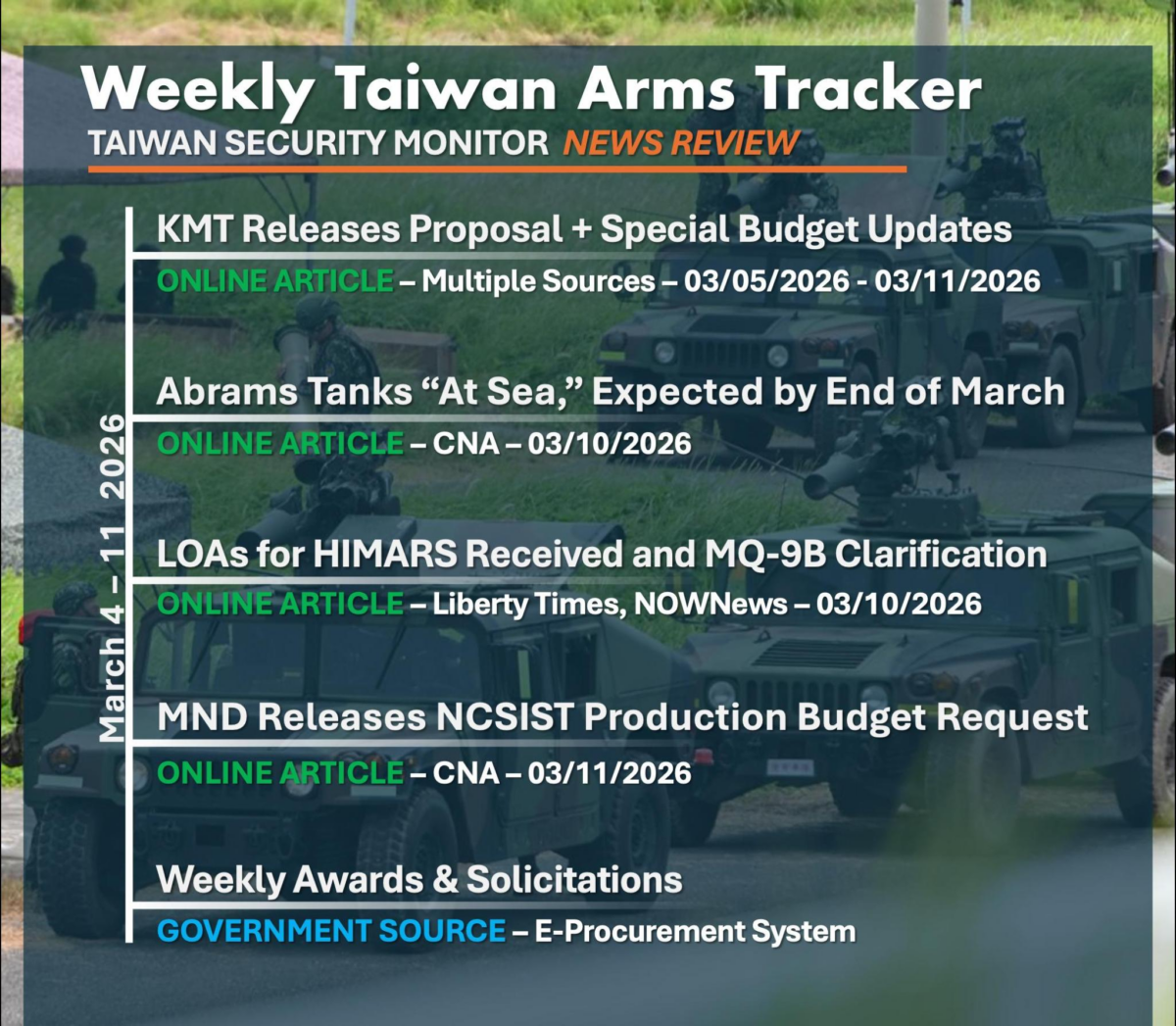
This week: the Kuomintang releases its budget proposal, leading to a flurry of statements about special budgets; the MND confirms Abrams tanks are en route to Taiwan; Minister Koo confirms an LOA for HIMARS was received; and the ministry releases budget details on NCSIST domestic production, alongside weekly bids and solicitations.

KMT Releases Proposal + Special Budget Updates

On Thursday, 5 March, the opposition Kuomintang (KMT) party released its special defense budget proposal, after weeks of internal debate as to the amount. The proposal allocates NT$380 billion (US$11.93 billion) specifically to fund the eight U.S. arms sale cases announced in December and would require additional special budget requests for future procurement to be submitted to the Legislative Yuan. Additional reporting on Friday revealed that the request was NT$30 billion (US$940 million) higher than party leadership had planned for; with the KMT also mandating that Letters of Offer and Acceptance, which outline payment and delivery schedules, be issued and signed before funds are appropriated.

Immediately after, the Lai administration began issuing statements opposing the proposal and clarifying their own. The same day, 5 March, the MND issued a statement clarifying that three sales from December (the Taiwan Tactical Network, AH-1W SuperCobra spare parts, and Harpoon missile refurbishment) were not included in the special budget and would be in annual defense budgets. The next day, 6 March, Minister of National Defense Wellington Koo spoke to the press, stating that the KMTโ€™s requirement that all sales be completed by December 2028 is unreasonable and impossible. On Saturday, 7 March, the MND issued a second statement, specifically discussing the KMT requirement of having LOAs before funding is approved, stating that cases follow a formal acquisition timeline and that public disclosure of budget items only occurs after U.S. congressional notification.

On Sunday, 8 March, President Lai visited Jieyun Temple in Banqiao District, New Taipei, giving a speech where he compared his special defense budget to installing a security system against a โ€œbad neighbor.โ€ Lai also argued for the reasonableness of his budget, comparing it to yearly defense spending by Japan and South Korea, both of which are more than his planned NT$1.25 trillion (US$40 billion) in spending over eight years. Also on Sunday, when asked by CNA if the U.S. would support the KMTโ€™s proposal, an unnamed State Department official stated that they โ€œencourage all parties in Taiwanโ€™s legislature to work through political differences and quickly pass a special defense budget,โ€ not taking a partisan side on the issue.

Today, the Legislative Yuan held elections for committee โ€œconvening members,โ€ legislators who serve as co-chairs and who control the agenda and legislative review, electing DPP legislator Chen Kuan-ting and KMT legislator Ma Wen-jun to the Foreign Affairs and National Defense Committee, which is tasked with review of the three special budget proposals. Chen, on Monday, met with former U.S. INDOPACOM commander Admiral John Aquilino, discussing Indo-Pacific security, domestic defense production, and advocating for the Lai administrationโ€™s budget to pass quickly.

Abrams Tanks “At Sea,โ€ Expected by End of March

An MND official told CNA on Tuesday that the final batch of 28 M1A2T Abrams tanks is โ€œat sea,โ€ en route to Taiwan, with delivery expected before the end of March. The first batch of 38 tanks arrived in December 2024 and was commissioned into the Armyโ€™s 584th Combined Arms Brigade in October. A second batch of 42 tanks, which arrived in July 2025, is still undergoing training and is expected to be commissioned by mid-year. This marks the last out of 108 total tanks that Taiwan began procuring in July 2019.

LOAs for HIMARS Received + MQ-9B Clarification

On Tuesday, Minister of National Defense Wellington Koo told the press that the MND had received a fourth Letter of Offer and Acceptance (LOA) from the U.S., for the sale of 82 High Mobility Artillery Rocket Systems (HIMARS) and associated munitions, worth NT$127.2 billion (US$4.05 billion), initially being notified in December.  This LOA, which has a deadline of 26 March to be signed, joins three prior LOAs, for Paladin self-propelled howitzers, Javelin anti-armor missiles, and TOW-2B anti-armor missiles, that have not been signed by the MND owing to ongoing special budget negotiations and are in danger of expiry. On Thursday, 5 March, however, it was reported that the Taiwan Peopleโ€™s Party (TPP), the KMTโ€™s fellow opposition party in the LY, will allow the three previous LOAs, which expire on March 15, to be signed if they are reported immediately to the LY. As of the time of writing, however, we are not aware of those three LOAs having been signed.

While speaking to the press on Tuesday, Minister Koo also clarified ongoing rumors about delays in the delivery of four MQ-9B SeaGuardian maritime surveillance drones to Taiwan, stating that the ongoing conflict in the Middle East has no effect on delivery timelines to Taiwan and that the MND continues to interface with U.S. partners if that were to change.

MND Releases NCSIST Production Budget Request

Taiwanโ€™s Ministry of National Defense has begun releasing additional budget details tied to the National Chung-Shan Institute of Science and Technology (NCSIST), offering a clearer picture of how Taipei intends to scale domestic weapons production under the proposed NT$1.25 trillion โ€œDefense Resilience and Asymmetric Capabilitiesโ€ special budget. Per Central News Agency reporting, the MND explained that NT$80.9 billion (US$2.55 billion) of the package will fund NCSIST mass production programs, including NT$36.1 billion (US$1.14 billion) for the Strong Bow missile system, NT$16.8 billion (US$529 million) for the Rui Yuan II surveillance drone program, and NT$28 billion (US$881.7 million) for production of โ€œsmall suicide unmanned surface vessels.โ€

The newly released figures reinforce a trend visible across Taiwan Security Monitorโ€™s backlog and acquisition analysis: Taiwan is increasingly pairing U.S. arms purchases with expanded domestic production capacity anchored by NCSIST. Previous special budgets (such as the Sea and Air Combat Power Improvement Plan) already used this model to accelerate missile and unmanned platform production while strengthening Taiwanโ€™s industrial supply chain. Taiwan Security Monitorโ€™s December 2025 update on the Arms Sales Backlog showed a growing shift in U.S. arms packages toward asymmetric capabilities that are cheaper and faster to produce. The new NCSIST allocations suggest Taiwan is now extending that logic domestically, using local production to scale asymmetric systems while relying on Foreign Military Sales (FMS) programs for higher-end platforms.

Weekly Awards/Solicitations

On Thursday, the Armaments Bureauโ€™s 209th Factory awarded an NT$480 million (US$15.09 million) contract to the Armaments Bureau’s 202nd Factory for base section maintenance of 40-mm remote-controlled turret systems, which feature on Clouded Leopard infantry fighting vehicles. The contract will be fulfilled in Jiji Township, Nantou County.

On Monday, the Naval Specialty Training Center, Naval Education and Training Command, awarded an NT$180 million (US$5.66 million) contract to NCSIST for the repair of โ€œSea Chain IVโ€ training simulators. We estimate this may be some sort of tactical data link. The contract will be fulfilled in the southern region of Taiwan.

On Wednesday, the 192nd Fleet, Naval Command, the ROCNโ€™s minesweeping force, awarded an NT$51.21 million (US$1.61 million) contract to NCSIST for comprehensive mine inspection and maintenance of various mines, including maintenance of MK 6 mine projectiles. The contract will be fulfilled in the southern region of Taiwan.

Taiwan Affairs Office on Cho Jung-taiโ€™s โ€˜sneak visitโ€™ to Japan: petty โ€˜chicken-and-dogโ€™ tricks, contemptible.โ€

A reporter asked: Recently, the head of Taiwanโ€™s administrative authorities, Cho Jung-tai, went to Japan to watch a ballgame, citing a so-called โ€œprivate itinerary.โ€ What is your comment?

TAO spokesperson Zhu Fenglian responded: The DPP authorities stubbornly adhere to a โ€œTaiwan independenceโ€ separatist position and will stop at nothing to โ€œseek independence by relying on external forces.โ€ They are, without question, โ€œdestroyers of cross-strait peaceโ€ and โ€œmakers of crises in the Taiwan Strait.โ€ Leading figures of the DPP authorities, under the pretext of a โ€œprivate itinerary,โ€ are in reality carrying out โ€œpro-independenceโ€ provocationsโ€”engaging in petty, underhanded tricks that are contemptible. We hope that Taiwan compatriots will clearly recognize the DPP authoritiesโ€™ malicious intent and the harm of their โ€œindependenceโ€ agenda, and join with us in firmly opposing โ€œTaiwan independenceโ€ separatist actions and external interference, effectively safeguarding peace and stability in the Taiwan Strait, and resolutely protecting the shared homeland of the Chinese nation.

The Taiwan issue is purely Chinaโ€™s internal affair and brooks no external interference. By allowing leading figures of the DPP authorities to make such a visit, Japan has violated the one-China principle and the spirit of the four Chinaโ€“Japan political documents, violated international law and the basic norms of international relations, and sent a serious wrong signal to โ€œTaiwan independenceโ€ separatist forces. We strongly oppose this. Japan should seriously reflect on history, draw lessons from it, genuinely correct its mistakes, and stop its maneuvering and reckless actions on the Taiwan issue.

All Quiet in the Taiwan Strait? Explaining the Recent Drop in PLA Aircraft Activity Around Taiwan

Authors: Noah Reed, Jonathan Walberg, Ethan Connell, & Joe Oโ€™Connor


From February 27th to March 5th, Taiwanโ€™s Ministry of National Defense (MND) reported no Peopleโ€™s Liberation Army aircraft operating in the airspace near Taiwanโ€™s Air Defense Identification Zone (ADIZ), an unusually long pause in activity that drew significant attention among regional observers. No supply flights, no repositioning of aircraft, and not even any training exercises.  While long pauses in ADIZ violations have occurred in the past, it has become extremely rare in recent years for Taiwanโ€™s military to detect no aircraft operating in the nearby airspace outside the ADIZ for a prolonged period. The reason for this is quite simple: ADIZ violations are almost always directed at Taiwan, while activity outside Taiwanโ€™s ADIZ could involve routine training flights or transits between coastal airbases. Thus, it is more common for the PRC to halt incursions into Taiwanโ€™s ADIZ than to reduce aviation activity in the Eastern Theater Command writ large over a long period of time.

This pause naturally sparked speculation, however many popular theories are as of yet unsupported by observable patterns and regional events. Observers have forwarded several possible explanations, to include the ongoing operations in Iran, the upcoming summit between President Trump and Xi, an inability to operate routinely following a series of major officer purges, and domestic politics in Taiwan. Below, we parse through the most prominent suggested theories and examine if they hold up to historical trends and further scrutiny. As our central argument suggests, it remains too early to make definitive judgments given the available data. Instead, we focus on understanding the factors behind several of the leading explanations for this break from pattern.

I: Domestic Explanations and Leadership Struggles

Two domestic events in the PRC could reasonably explain the dive in PLA activity in February. First, this week marked the beginning of the โ€œTwo Sessions,โ€ an annual meeting of the PRCโ€™s National Peopleโ€™s Congress (NPC).[i] Historically, this event coincided with lower ADIZ violations, with a notable exception of 2025.[ii] The heightened level of activity seen during 2025โ€™s NPC meeting relative to prior years could be explained by the higher cross-Strait tension at the time, with the PLA holding its Strait Thunder-2025Aย joint exercise around Taiwan less than a month later.

Second, the end of the Spring Festival and the beginning of the Lantern Festival in the PRC could play some part in the lower activity. The Spring Festival has empirically propelled lower reported ADIZ numbers from late January into February over the last couple of years.[iii] Still, it is difficult to discern if the holidays alone drive these trends, or if it is merely one element of a broader rationale.

Finally, it is worth addressing the rumors that the PLA is simply incapable of conducting aerial activity around Taiwan due to recent turmoil in its leadership. This appears to be a less convincing explanation. After all, PLAN activity around Taiwan remains somewhat consistent, and the PLA and China Coast Guard (CCG) remain active in the Senkaku Islands and the South China Sea. Moreover, it is not clear why the removal of senior leadership would cause the PLA to be incapable of flying aircraft around Taiwan, as such activity has become routine, even mundane, for several years. It also cannot explain why several waves of aerial activity occurred around Taiwan in February after the leadership investigations took place.

Overall, the National Peopleโ€™s Congress, as well as Spring/Lantern festivals, have historically contributed to lower numbers of ADIZ and airspace violations. However, it is rare for these events to coincide with total stoppages in incursions.

II: Trumpโ€“Xi Meeting and the โ€œBest Behaviorโ€ Hypothesis

Another explanation is that the pause reflects a temporary โ€œbest behaviorโ€ or truce period ahead of a pending meeting between Donald Trump and Xi Jinping later this spring.[iv] Under this interpretation, Beijing may be attempting to avoid incidents or tensions that could complicate or even cancel the meeting.[v] This suggests that China would reduce visible military pressure around Taiwan to create a more stable atmosphere prior to the meeting.

While plausible, the explanation doesnโ€™t fit the observed pattern of activity.

First, the lull extended beyond just a halt in ADIZ incursions, but rather to all aircraft activity in the area, where regular flights and movements occur with training flights and movements between coastal bases. If the goal were to signal intent to Washington regarding Taiwan, Beijing could easily continue routine training flights in these areas while avoiding breaching Taiwanโ€™s ADIZ. A complete halt of flights in the area goes beyond just signaling that Beijing doesnโ€™t want to โ€˜rock the boat.โ€™ It also assumes that Washington views the ADIZ as the principal outlet of PRC signaling over Taiwan, something that cannot necessarily be accepted at face value.

Second, the logic of a pre-summit truce, while plausible, would require a much longer pause in operations. This would become more plausible if the lull had continued. Further, it would commit the PLA to maintaining a break for a period following the summit, as a resumption of regular patrols would risk creating the impression that the summit had failed. In practice, maintaining the appearance of diplomatic restraint would likely require months of reduced activity, which is unlikely given the PLAโ€™s ongoing pressure campaign that has seen few pauses since 2022.

 Finally, the broader geopolitical context makes the argument less convincing. Some analysts frame ADIZ incursions as a signaling mechanism directed at Washington, meaning that temporarily halting them could itself be a signal, a tacit gesture of restraint ahead of a summit. But even under this logic, the timing is difficult to reconcile with current events. The United States is presently engaged in an escalating conflict with Iran involving large-scale strikes and the possibility of wider regional escalation.[vi] In that environment, it is not obvious why Beijing would view the suspension of routine PLA sorties near Taiwan as a necessary diplomatic signal. If Beijing is prepared to pursue high-level diplomacy with Washington while the United States is conducting major military operations elsewhere, it is difficult to see why the symbolic value of turning off routine Taiwan-related flights would suddenly become decisive.

Put simply, a snapshot of the rest of the world makes the idea that Beijing is shelving routine Taiwan-related air activity purely to preserve summit optics less convincing.

III: Signaling to Taiwan

Yet another explanation being advanced is that Beijing is signaling its lack of concern over Taiwanโ€™s ongoing special defense budget debate. However, the timeline of PLA activity does not support this interpretation. The debate has been ongoing for months, yet PLA air activity remained elevated throughout that period.[vii] For example, Taiwanโ€™s Ministry of National Defense reported 19 PLA aircraft operating around Taiwan on January 29, just days after the Taiwan Peopleโ€™s Party unveiled its alternative special budget proposal. Activity continued shortly afterward, with 32 PLA aircraft detected on February 12, two days after Lai publicly urged the Legislative Yuan to pass the proposal during a press conference. Similarly, 22 PLA aircraft were detected on February 26, the day after Taiwanโ€™s legislature agreed to send multiple budget proposals to committee review. These patterns suggest that PLA air activity has continued regardless of developments in Taiwanโ€™s defense budget debate.

The PRC is likely to react to developments in Taiwanโ€™s special defense budget proposals as they move through the Legislative Yuan. Beijing has repeatedly framed major Taiwanese defense initiatives as provocations, often responding with diplomatic pressure or military signaling. The PLAโ€™s most recent exercise, Justice-Mission 2025A, reflects this pattern.[viii] Much of the iconography and messaging released before and during the exercise framed the drills in punitive terms, portraying them as a warning to Taipei. In that sense, the exercise reinforced the perception that advances in Taiwanโ€™s defense budgeting process can trigger demonstrative military responses from Beijing.

Others advance this as rewarding Lai for his statements during a Spring Festival event where he referred to โ€œMainland Chinaโ€ instead of just โ€œChina,โ€ a term that the PRC prefers.[ix] This reference, while not necessarily insignificant in meaning, is unlikely to prompt Beijing to depart three years of policy and โ€œrewardโ€ the Lai administration by giving them time to breathe over a difference in terminology.

IV: Middle East and Fuel Hypothesis, Regional activity

One external explanation for the Eastern Theater Commandโ€™s pause in flight activity is that Beijing is temporarily conserving aviation fuel amid uncertainty about the ongoing conflict in the Middle East and potential supply disruptions. Sustained air operations require significant fuel resources, and the PLA may reduce nonessential sorties if leadership anticipates a prolonged price increase or broader market volatility.

However, the fuel-constraint explanation presents two significant challenges:

First, China has invested decades in developing strategic petroleum stockpiles to mitigate supply shocks. Public estimates indicate that Beijing maintains hundreds of millions of barrels in state strategic reserves, supplemented by commercial storage.[x] Recent planning documents and reports further suggest that China continues to expand these undisclosed strategic holdings, rather than signaling scarcity.[xi] Therefore, if the PLA were experiencing immediate operational constraints due to fuel availability, it would indicate a far more acute, system-wide stress than current stockpiling trends imply.

Second, if fuel conservation were the primary factor, a broader reduction in activity would be expected across all PLA operating areas, rather than a distinct, localized pause in aircraft activity detected around Taiwan. Chinese military activity in other regions, however, appeared to remain consistent with typical patterns.

For example, in the South China Sea, the PLAโ€™s Southern Theater Command publicly released footage of naval and air units conducting a readiness patrol around Scarborough Shoal on February 28.[xii] The patrol involved coordinated use of early warning aircraft, anti-submarine aircraft, fighters, and bombers, accompanied by messaging that forces remain โ€œon high alertโ€ and prepared to take countermeasures. A subsequent Weibo post by the Southern Theater Command highlighted a PLAAF unit undergoing โ€œrigorous combat training,โ€ with a follow-on Global Times report stating that these patrols and exercises have continued โ€œsince Februaryโ€ and are explicitly linked to responses to external โ€œjoint patrolโ€ activity.[xiii] This reinforces that PRC operational signaling in the south has not paused during this period.

Japanese public reporting over the past week indicates continued and routine activity around the Senkaku Islands. In its March 1, 2026, update, Japanโ€™s Ministry of Foreign Affairs notes that Chinese government vessels, mainly from the China Coast Guard, have continued to enter Japanโ€™s contiguous zone near the Senkakus almost daily.[xiv] On February 28th, Japanโ€™s Joint Staff reported that two Peopleโ€™s Liberation Army (PLA) Y-9 intelligence, surveillance, and reconnaissance (ISR) aircraft flew from the East China Sea, passed between Okinawa and Miyako, and continued into the Pacific as far as the Amami island chain, then reversed course and returned, prompting Japan Air Self-Defense Force (JASDF) scrambles.[xv] Overall, Japanโ€™s official statements and recent Joint Staff reports indicate that PRC operations in the East China Sea remain active, even as aviation patterns near Taiwan fluctuate.

V. Preparing for an Invasion or Major Exercise

A more dramatic explanation is that the pause reflects preparations for a major PLA exercise. Others have posited that it could possibly be the โ€˜calmโ€™ before an invasion or move on one of Taiwanโ€™s outlying islands. Under this interpretation, the halt in routine aviation activity signifies an operational pause while forces reposition, conduct planning, or prepare for a larger coordinated operation.

It is true that large exercises or operations are sometimes preceded by short-term changes in routine activity, particularly if units are redeploying, conducting maintenance, or consolidating forces in preparation for a larger event.

However, there was little evidence during the pause to support the idea that it reflected imminent large-scale operations. Even a preparation for a theater-level exercise would likely generate additional changes and disruptions in observable patterns, including major changes in naval deployments, unusual airbase activity, logistical movements, and more. Many of these indicators are regularly detected through open-source monitoring and satellite imagery. At present, there are no clear signs of these types of preparatory activities occurring on a scale that would suggest a major operation is imminent.

More broadly, if the PLA were preparing a large exercise around Taiwan, it is not obvious why routine aviation activity across the Eastern Theater Command would need to halt. Training flights and patrols would normally continue alongside preparations unless airspace was being cleared for a specific operation, something that would likely be accompanied by other visible signals.

For these reasons, while the possibility of future exercises should never be discounted given the PLAโ€™s recent pattern of demonstrations around Taiwan, the current pause alone is not strong evidence that a major operation is imminent.

Taken together, the available evidence suggests that the brief pause in PLA aviation activity around Taiwan was unlikely to be driven by any single factor. Domestic political events in China, including the NPC โ€œTwo Sessionsโ€ and the seasonal slowdown associated with the Spring Festival period, likely contributed to a temporary reduction in operational tempo. At the same time, explanations centered on diplomatic signaling, energy constraints, or preparations for major military operations remain less consistent with observed patterns of activity both around Taiwan and in other regions.

The resumption of PLA flights shortly after this lull reinforces a broader pattern that has characterized Chinese military pressure around Taiwan in recent years: cyclical activity. Periods of heightened sorties are often followed by short pauses before returning to baseline levels. Rather than indicating a change in Beijingโ€™s strategy, the episode likely reflects the routine variability inherent in sustained military operations.

The more important analytical question is not why the PLA paused for several days, but how Beijing calibrates these cycles of pressure. Short interruptions in activity can create the perception of sudden shifts in intent, even when the underlying strategy remains unchanged.


[i] https://asiasociety.org/policy-institute/what-watch-chinas-two-sessions-2026

[ii] PLA Tracker: https://docs.google.com/spreadsheets/d/1qbfYF0VgDBJoFZN5elpZwNTiKZ4nvCUcs5a7oYwm52g/edit?gid=905433190#gid=905433190

[iii] https://chinadrew.substack.com/p/the-pla-has-stopped-flying-aircraft?triedRedirect=true&_src_ref=t.co

[iv] https://www.reuters.com/business/aerospace-defense/chinese-military-flights-around-taiwan-fall-trump-xi-meeting-may-be-factor-2026-03-05/

[v] https://www.taipeitimes.com/News/taiwan/archives/2026/03/05/2003853320

[vi] https://www.war.gov/Spotlights/Operation-Epic-Fury/

[vii] PLA Tracker: https://docs.google.com/spreadsheets/d/1qbfYF0VgDBJoFZN5elpZwNTiKZ4nvCUcs5a7oYwm52g/edit?gid=905433190#gid=905433190

[viii] https://tsm.schar.gmu.edu/justice-mission-2025-the-narrative-battle-inside-chinas-latest-taiwan-exercise/

[ix] https://chinadrew.substack.com/p/the-pla-has-stopped-flying-aircraft?triedRedirect=true&_src_ref=t.co

[x] https://www.eia.gov/international/analysis/country/chn

[xi] https://www.reuters.com/business/energy/china-targets-steady-oil-output-more-gas-stockpiling-five-year-plan-2026-03-05

[xii] https://www.globaltimes.cn/page/202603/1355963.shtml

[xiii] https://weibo.com/7468777622?tabtype=album&uid=7468777622&index=0; https://www.globaltimes.cn/page/202603/1356043.shtml; https://www.globaltimes.cn/page/202603/1355963.shtml

[xiv] https://www.mofa.go.jp/files/100857530.pdf; https://www.mofa.go.jp/region/page23e_000021.html

[xv] https://www.mod.go.jp/js/pdf/2026/p20260302_01.pdf

Taiwan Affairs Office (TAO): We hope the broad community of Taiwan compatriotsโ€”including Taiwan youthโ€”will pay more attention to the National Two Sessions (NPC & CPPCC meetings).

At the March 4 State Council Taiwan Affairs Office (TAO) press briefing, a reporter asked: The National โ€œTwo Sessionsโ€ (NPC and CPPCC) are about to convene. Weโ€™ve noticed that more and more Taiwan compatriotsโ€”especially Taiwan youthโ€”say they are paying attention. What is your comment?

TAO spokesperson Zhang Han responded: The peopleโ€™s congress system is Chinaโ€™s fundamental political system, and the system of multiparty cooperation and political consultation under the leadership of the Communist Party of China is one of Chinaโ€™s basic political systems. The National Peopleโ€™s Congress and the Chinese Peopleโ€™s Political Consultative Conference are important platforms that centrally reflect and deeply practice whole-process peopleโ€™s democracy. Todayโ€™s opening of the 4th session of the 14th CPPCC National Committee, and tomorrowโ€™s opening of the 4th session of the 14th National Peopleโ€™s Congress, are important meetings convened in the opening year of the โ€œ15th Five-Year Planโ€ period. The agenda includes discussing and reviewing the government work report and the outline of the โ€œ15th Five-Year Plan,โ€ among other items; these meetings will sketch out the countryโ€™s development blueprint for the next five years and reveal the logic and direction of Chinaโ€™s future development.

Zhang added: By paying attention to and understanding the Two Sessions, Taiwan compatriots can better understand the mainlandโ€™s democratic political system and its economic and social development, experience the achievements of whole-process peopleโ€™s democracy and Chinese-style modernization, and learn the countryโ€™s future development directionโ€”thereby grasping opportunities for their own development. We hope Taiwan compatriots, including Taiwan youth, will actively participate in cross-strait exchanges and cooperation and in integrated development, jointly promote the peaceful development of cross-strait relations, and together create a bright future of national rejuvenation and the reunification of the motherland.

Taiwan Affairs Office (TAO): The DPP authorities, by obstructing Taiwan compatriots from receiving evacuation assistance from Chinese embassies and consulates abroad, have lost their conscience and extinguished their humanity.

At the March 4 State Council Taiwan Affairs Office (TAO) press briefing, a reporter asked: Recently, the United States and Israel launched military operations against Iran. Chinaโ€™s Ministry of Foreign Affairs and our relevant embassies and consulates issued notices reminding Chinese citizensโ€”including Taiwan compatriotsโ€”to evacuate as soon as possible, and said Taiwan compatriots who need to leave can register. However, the DPP authorities have falsely claimed that it is โ€œriskyโ€ for Taiwan compatriots to seek evacuation assistance from the mainland. What is your comment?

TAO spokesperson Zhang Han responded: Taiwan compatriots are Chinese citizens; they are our flesh and blood, our close kin. From evacuations from Libya, Yemen, and Sudan, to the outbreak of the Israelโ€“Palestine conflict, and when Taiwan compatriots overseas encountered dangers such as typhoons and earthquakes, we have maintained close contact with Taiwan compatriots on the ground and provided timely assistance. As always, we will take all necessary measures to protect the safety of Chinese citizens, including Taiwan compatriots. If Taiwan compatriots need assistance, they can contact Chinese embassies and consulates locally at any time, or call the 12308 consular protection hotline. No matter where they are or what difficulties they face, the great motherland is the strong backing of Taiwan compatriots.

Zhang added: At this critical moment, when the safety of Taiwan compatriots is at stake, the DPP authorities are still engaging in political manipulationโ€”losing their conscience and extinguishing their humanity. What they fear most is seeing โ€œcompatriots on both sides are one family, and true feelings show in hardship,โ€ and they are doing everything they can to place their political schemes above peopleโ€™s lives and safety. Their cold-bloodedness and selfishness are fully exposed, and they will inevitably face firm opposition from Taiwan compatriots.

Taiwan Affairs Office: The punitive measures targeting โ€˜Taiwan independenceโ€™ diehard separatistsโ€”and their affiliated companies and financial backersโ€”do not involve the vast majority of Taiwan compatriots or Taiwan businesspeople and enterprises.

At the March 4 State Council Taiwan Affairs Office (TAO) press briefing, a reporter asked: After the mainland disclosed that relatives of Liu Shifang hold positions in mainland enterprises and announced it would handle the matter in accordance with laws and regulations, Taiwanโ€™s Mainland Affairs Council (MAC) on the 28th issued its first โ€œ2026 Mainland China Economic Risk Warning.โ€ It reminded Taiwanese businesspeople to carefully assess investment, operations, and work on the mainland to avoid economic losses and personal safety risks, and called on the mainland to โ€œpull back from the brink.โ€ What is your comment?

TAO spokesperson Zhang Han responded: Media reporting has already drawn widespread attention across Taiwan. At present, the key issue is that the DPP authorities must directly answer whether Liu Shifangโ€™s relatives are seeking profits on the mainland, and whether there is โ€œdouble standardsโ€ within the Green campโ€”on the one hand suppressing and participating in the persecution of people involved in cross-strait exchanges, while on the other hand using relatives on the mainland to โ€œmake money from Chinaโ€ (โ€œearning red moneyโ€). Instead of shifting the focus and evading the question, they should address it head-on.

Zhang added: Our punitive measures target only a very small number of โ€œTaiwan independenceโ€ diehard separatists and their affiliated companies and financial backers; they do not involve the vast majority of Taiwan compatriots or Taiwanese businesspeople and enterprises. The DPP authorities are deliberately muddying the waters and fabricating so-called โ€œrisks,โ€ with the aim of intimidating Taiwanโ€™s public, creating a โ€œchilling effect,โ€ and obstructing and undermining cross-strait exchanges and cooperation. Their โ€œpro-independenceโ€ provocations have led to tension and turbulence in the Taiwan Strait; they have repeatedly cracked down on those who participate in cross-strait exchanges and cooperation; and they have a poor record of pushing โ€œdecouplingโ€ and โ€œcutting supply chainsโ€ across the Strait. The side that should โ€œpull back from the brinkโ€ is the DPP authorities themselves.