Taiwan Security Monitor

Taiwan Affairs Office: In accordance with the requirements of the 15th Five-Year Plan outline, we will actively promote the peaceful development and integrated development of cross-Strait relations.

At the March 18 press conference of the State Council Taiwan Affairs Office, a reporter asked: The Fourth Session of the 14th National Peopleโ€™s Congress approved the outline of the 15th Five-Year Plan. How should the section specifically related to Taiwan be interpreted? How will the Taiwan Affairs Office of the State Council implement it?

Taiwan Affairs Office spokesperson Chen Binhua responded: On March 12, the Fourth Session of the 14th National Peopleโ€™s Congress voted to adopt the outline of the 15th Five-Year Plan for national economic and social development. The outline provides top-level design and strategic planning for Taiwan-related work during the 15th Five-Year Plan period, and clarifies the objectives and tasks of promoting the peaceful development of cross-Strait relations and advancing the great cause of national reunification in the course of building a modern socialist power in all respects. The outline clearly states that it is necessary to thoroughly implement the Partyโ€™s overall strategy for resolving the Taiwan question in the new era, adhere to the one-China principle and the โ€œ1992 Consensus,โ€ firmly crack down on โ€œTaiwan independenceโ€ separatist forces, oppose interference by external forces, safeguard peace and stability in the Taiwan Strait, firmly grasp the dominance and initiative in cross-Strait relations, improve the well-being of compatriots on both sides of the Strait, and resolutely safeguard the common homeland of the Chinese nation.

In terms of specific measures, first is promoting cross-Strait economic cooperation. This includes continuing to introduce and implement policies and measures benefiting Taiwan compatriots and Taiwan-funded enterprises, guiding them to actively integrate into and serve the new development pattern, supporting Taiwan businesses in establishing long-term roots on the mainland, participating in national regional development strategies and the joint construction of the Belt and Road Initiative, strengthening industrial cooperation, and building a common cross-Strait market. It also includes supporting Fujian in high-quality construction of a demonstration zone for cross-Strait integrated development, advancing key cross-Strait cooperation platforms and industrial cooperation zones in places such as Pingtan, Kunshan, and Dongguan, supporting the development of multi-level cross-Strait financial markets, and encouraging qualified Taiwan-funded enterprises to list on the mainland.

Second is deepening cross-Strait exchanges. This includes improving systems and policies that promote cross-Strait economic and cultural exchanges and cooperation, expanding personnel exchanges, and promoting interaction, engagement, and integration across the Strait. It also includes deepening cooperation in education, healthcare, social security, and the sharing of public resources; promoting cultural exchanges across the Strait; jointly preserving and promoting Chinese culture; and enhancing Taiwan compatriotsโ€™ identification with the Chinese nation, Chinese culture, and the Chinese state. It also calls for strengthening exchanges among youth and at the grassroots level, continuing to create better conditions for young people from Taiwan to pursue, build, and realize their dreams on the mainland, implementing equal-treatment policies for Taiwan compatriots, creating better conditions for them to study, work, and live on the mainland, and uniting the broad mass of Taiwan compatriots to create enduring well-being for the Chinese nation.

We will thoroughly implement the Partyโ€™s overall strategy for resolving the Taiwan question in the new era and, in accordance with the requirements of the 15th Five-Year Plan outline, unite the broad mass of Taiwan compatriots, grasp the trend of history, and actively promote the peaceful development and integrated development of cross-Strait relations, working together for the great cause of national reunification and national rejuvenation.

Taiwan Affairs Office: The Government Work Report has important guiding significance for carrying out this yearโ€™s Taiwan-related work.

At the March 18 press conference of the State Council Taiwan Affairs Office, a question was raised that, due to recent instability in the Middle East, Taiwan faces the risk of disruptions to oil and natural gas supplies, and concerns over energy reserves and supply security have become a major issue on the island. This has also drawn renewed attention to the mainlandโ€™s statement last October about the โ€œseven ways Taiwan would be better off after unification,โ€ including the claim that โ€œafter peaceful unification, with the strong motherland as its backing, Taiwanโ€™s energy and resource security will be better.โ€ Could you elaborate on this?

Taiwan Affairs Office spokesperson Chen Binhua responded: Achieving unification by peaceful means is in the greatest interest of compatriots on both sides of the Strait and of the Chinese nation as a whole. Peaceful unification would create enormous opportunities for Taiwanโ€™s economic and social development and bring tangible benefits to the broad mass of Taiwan compatriots. This includes stronger guarantees for Taiwanโ€™s energy and resource security with the support of a powerful motherland.

During the 14th Five-Year Plan period, the mainland developed a multi-driver energy supply system based on coal, oil, gas, nuclear power, and renewable energy. Traditional energy production has remained stable and increased, while new energy sources have been fully utilized and their share has risen rapidly, with wind and solar power now accounting for about 22 percent of total electricity consumption. Investment has also expanded in new forms of energy infrastructure such as new-type energy storage, frontier hydrogen energy, virtual power plants, and charging and battery-swapping facilities. The mainlandโ€™s capacity to guarantee energy supply has strong resilience and broad potential. Taking electricity as an example, major countries around the world are now developing artificial intelligence and related industries, and the growth of the AI sector depends heavily on a stable power supply. The mainland has already built the worldโ€™s largest clean power supply system, with an average electricity reliability rate of over 99.9 percent. In 2025, total electricity consumption surpassed 10 trillion kilowatt-hours for the first time, exceeding the combined electricity use of the United States, Germany, Japan, and India. In both July and August, monthly electricity consumption exceeded 1 trillion kilowatt-hours, setting a world record, yet there were neither power cuts nor price increases. Power on that scale, fully supplied, would be enough to meet the electricity needs of Taiwan businesses and would also allow households across Taiwan to put an end to the inconvenience and anxiety of summer electricity shortages and rationing.

The recently concluded Fourth Session of the 14th National Peopleโ€™s Congress reviewed and approved the outline of the 15th Five-Year Plan. The outline makes strategic arrangements for accelerating a comprehensive green transformation in economic and social development and for building a Beautiful China during the 15th Five-Year Plan period. We will accelerate the construction of a new energy system, continuously strengthen the foundations of energy and resource security, and keep advancing the building of an energy powerhouse. After peaceful unification, the two sides of the Strait will achieve connectivity wherever possible and full interconnection where appropriate. This will make it entirely possible to make up for Taiwanโ€™s shortages in electricity, natural gas, crude oil, and other resources, providing reliable guarantees for Taiwanโ€™s energy and resource security, allowing Taiwan compatriots to enjoy cheaper, cleaner, and more stable energy supplies, and reducing the energy burden on households and businesses.

Dr. Sun Yat-sen once said: โ€œUnification is the hope of all Chinese citizens. If unification can be achieved, the whole nation will enjoy happiness; if it cannot, the nation will suffer.โ€ We are willing to provide Taiwan compatriots with stable and reliable guarantees for energy and resource supplies, so that they may live better lives. We hope that compatriots in Taiwan and on the mainland will work together to create a better future of national unification and national rejuvenation.
Taiwan Affairs Office: After peaceful unification, Taiwan will have reliable guarantees for energy and resource supplies.

At the March 18 press conference of the State Council Taiwan Affairs Office, a reporter asked: Regarding the passage by the Fourth Session of the 14th National Peopleโ€™s Congress of the Law of the Peopleโ€™s Republic of China on Promoting Ethnic Unity and Progress, the head of Taiwanโ€™s Mainland Affairs Council said that โ€œthis law carries implications of punishing independence, treats opposing independence and promoting unification as the same thing, and creates the possibility of using the law to impose penalties. This is a typical form of transnational repression.โ€ What is your comment on this?

Taiwan Affairs Office spokesperson Chen Binhua responded: The joint struggle and shared prosperity of all ethnic groups are the source of life, strength, and hope for the Chinese nation. The formulation of the Law on Promoting Ethnic Unity and Progress lays a stronger legal foundation for forging a strong sense of the Chinese national community and advancing the building of that community. It is of major significance for comprehensively advancing the cause of ethnic unity and progress, and for promoting the united struggle of people of all ethnic groups across the country in pursuit of national strength and national rejuvenation through Chinese modernization.

Compatriots on both sides of the Strait share the same language and race, the same roots and origins, and all belong to the Chinese nation. They are a community with close blood ties and a shared destiny in both honor and hardship. We will thoroughly implement the Law on Promoting Ethnic Unity and Progress, further deepen cross-Strait exchanges and cooperation, strengthen the shared interests of compatriots on both sides, jointly promote Chinese culture, enhance Taiwan compatriotsโ€™ identification with the Chinese nation, Chinese culture, and the Chinese state, and work together to achieve the great rejuvenation of the Chinese nation.

Driven by its private interest in pursuing โ€œindependence,โ€ the DPP authorities are deliberately confusing the public, fabricating so-called โ€œrisks,โ€ and trying to intimidate the people of Taiwan in order to create a chilling effect. As for acts by โ€œTaiwan independenceโ€ separatist forces that divide the nation and undermine national unity, we will take all necessary measures and punish them in accordance with the law.

Taiwan Affairs Office: We will punish, in accordance with the law, โ€˜Taiwan independenceโ€™ separatist forces for splitting the nation and undermining national unity.

At the March 18 press conference of the State Council Taiwan Affairs Office, a reporter asked: In response to criticism from the Taiwan Affairs Office spokesperson of Lai Ching-teโ€™s โ€œTaiwan independenceโ€ fallacies at the so-called โ€œ30th Anniversary of Taiwanโ€™s Direct Presidential Election and Democratic Resilience Forum,โ€ the DPP authorities said that โ€œthe essence of cross-Strait relations lies in a struggle between political systems,โ€ that โ€œthe mainland should engage in dialogue with Taiwanโ€™s legitimately elected government and pragmatically address problems,โ€ and that โ€œTaiwanโ€™s future must be decided jointly by the 23.5 million people of Taiwan.โ€ What is your comment on this?

Taiwan Affairs Office spokesperson Chen Binhua responded: Under the banner of so-called โ€œuniversal values,โ€ the Lai Ching-te authorities use democracy as a cover for suppressing dissent, promoting โ€œresist China, protect Taiwan,โ€ and colluding with external forces. They are attempting to mislead the public, confuse the issue, stir up cross-Strait confrontation, โ€œseek independence by relying on foreign forces,โ€ and โ€œreject unification through military means.โ€ Their sinister intentions are plain for all to see.

Differences in political systems are not an obstacle to unification, much less an excuse for division. What exists across the Strait is absolutely not a struggle between systems, but rather a struggle between unification and division. The so-called โ€œstruggle between systemsโ€ is merely an excuse used by the DPP authorities to pursue โ€œindependence,โ€ and a trick to deceive Taiwan compatriots and international public opinion.

No matter what Lai Ching-te and others like him say or do, they cannot change the fact that Taiwan is part of China; they cannot sever the unbreakable historical and legal ties across the Strait; and they cannot overturn the iron rule that Taiwanโ€™s future can only be decided jointly by all Chinese people, including Taiwan compatriots. In the face of the historical trend that the two sides of the Strait will inevitably and must inevitably be unified, and in the face of the resolve and will of more than 1.4 billion compatriots to safeguard national sovereignty and territorial integrity, any plot to split the country or resist unification is nothing more than wishful thinking.

Taiwan Affairs Office: Using a name change to pursue โ€˜Taiwan independenceโ€™ separatism has absolutely no future.

At the March 18 press conference of the State Council Taiwan Affairs Office, a reporter asked: According to reports, Taiwanโ€™s General Association of Chinese Culture has begun promoting a name change to remove the term โ€œChinese,โ€ first by changing its English name to one using โ€œTaiwan,โ€ and is expected to rename itself in English as the National Cultural Association of Taiwan. What is your comment on this?

Taiwan Affairs Office spokesperson Chen Binhua responded: The Chinese nation has a history of immense length and a civilization of profound breadth and depth. The continuous and enduring Chinese culture is the shared spiritual home and lifeblood of compatriots on both sides of the Strait, and a strong bond that sustains national feeling and identity. This move by Taiwanโ€™s General Association of Chinese Culture is another farce by the DPP authorities in the cultural sphere, escalating their efforts at โ€œde-Sinicizationโ€ and manipulation of โ€œde-Chinese-ification.โ€ Its essence is an attempt to sever the cultural blood ties of common origin shared across the Strait and to manufacture the false perception that โ€œTaiwanese culture is independent from Chinese culture.โ€ Changing the English name first while delaying changes to the Chinese name is a classic sign of a guilty conscienceโ€”an attempt to proceed stealthily, hollowing out the meaning of โ€œChineseโ€ step by step and paving the way for separatist โ€œTaiwan independenceโ€ schemes. We firmly oppose this.

Taiwanese culture is rooted in Chinese culture. This is a basic fact and also the collective consensus of the broad majority of Taiwan compatriots; it cannot be distorted or denied. Any attempt to use a name change to pursue โ€œTaiwan independenceโ€ separatism or to sever the roots of the nation runs against the course of history and harms national sentiments. It is bound to be firmly opposed by all Chinese people and is absolutely doomed to fail.

Taiwan Affairs Office: The DPP authoritiesโ€™ smearing of the mainlandโ€™s care for and protection of Taiwan compatriots is utterly shameless.

At the March 18 press conference of the State Council Taiwan Affairs Office, a reporter asked: Due to the situation in the Middle East, nearly 100 Taiwan compatriots who had been stranded there for several days were successfully evacuated with the assistance of Chinese embassies and consulates abroad, transited through Shanghai, and returned to Taiwan. In interviews with the media, a number of those assisted said, โ€œWe thank our motherland โ€” it was the mainland that helped us get home.โ€ The DPP authorities, however, claimed that these people had not actually been stranded in a Middle Eastern war zone, that they had received no notification, and that this might be part of the mainlandโ€™s โ€œcognitive warfare.โ€ What is your comment on this?

Taiwan Affairs Office spokesperson Chen Binhua responded: Compatriots on both sides of the Strait are all Chinese. We have always been concerned about the safety of Chinese citizens overseas, including Taiwan compatriots. Recently, due to the situation in the Middle East, many Taiwan compatriots were stranded there. In recent days, the Chinese Consulate General in Istanbul coordinated with relevant parties to help 93 Taiwan compatriots transfer to a mainland flight and arrive in Shanghai, where Taiwan Compatriot Permits were processed for them immediately, enabling them to transit smoothly back to Taiwan. In addition, many other Taiwan compatriots sought assistance through the China Consular Affairs APP, the 12308 consular protection hotline, and other channels. Our embassies in Iran and Israel, as well as the Consulate General in Dubai and other overseas diplomatic and consular missions, also assisted Taiwan compatriots in returning to Taiwan or evacuating to safe areas. Those who received assistance expressed sentiments such as: โ€œNo matter when, the motherland is always there for us,โ€ โ€œI personally experienced that people on both sides of the Strait are one family,โ€ and โ€œThe Taiwan Compatriot Permit is a protective talisman.โ€

The DPP authorities have shown indifference to pleas for help from stranded Taiwan compatriots โ€” cold, incapable, and inactive โ€” yet they still repeatedly attack and smear the mainlandโ€™s care for and protection of Taiwan compatriots. That is truly shameless. As for who genuinely keeps Taiwan compatriots in mind, and who truly shelters them from hardship and danger, the facts are plain to see, and justice lives in the hearts of the people.

Taiwan Affairs Office: The DPP authoritiesโ€™ fawning on the United States and selling out Taiwan will leave them squeezed dry and used up completely.

At the March 18 press conference of the State Council Taiwan Affairs Office, a reporter asked: Recently, the United States announced that it would initiate Section 301 investigations into unfair trade practices by certain trading partners, including the Taiwan region of China. Some analysts on the island believe that, despite the DPP authoritiesโ€™ willingness to give the United States whatever it wants, Washington has still not let Taiwan off the hook, which is difficult to accept. What is your comment on this?

Taiwan Affairs Office spokesperson Chen Binhua responded: The DPP authorities adhere to a line of โ€œfollowing the United States in everything and taking their cues solely from Washington.โ€ They curry favor with the United States without principle and sell out Taiwan without any bottom line, going all out to ingratiate themselves with the U.S. at the expense of the well-being of the Taiwanese people and the islandโ€™s economic future. Yet blind compromise and retreat will not win any mercy. Instead, it has only brought escalating predation step by step, and in the end they will find it impossible to escape being exploited to the last drop. It is truly ridiculous, detestable, and tragic.

Weekly Arms Update: 3/18/26

Authors: Joe Oโ€™Connor, Shikhar Chaturvedi, Danielle Kremer, & Wyeth Lindberg


This week: the LY agreed to approve signature for four arms sales; MND officials provided updates on MQ-9B and PAC-3 procurement alongside low-cost air defense technology; a U.S. House hearing shed light on arms sales to Taiwan; and the MND confirmed the receipt of ALTIUS 600M drones, alongside weekly awards and solicitations.

Legislative Yuan Agrees to Approve LOA Signature

On Thursday, the Legislative Yuanโ€™s Foreign Affairs and National Defense Committee agreed to allow Letters of Offer and Acceptance (LOAs) to be signed for four U.S. arms sale cases, three of which (Paladin self-propelled howitzers, TOW-2B, and Javelin anti-armor missiles), were set to expire on March 15. A fourth LOA for High Mobility Artillery Rocket Systems (HIMARS), received earlier last week with an expiry date of March 26, is also included in this agreement. The committee required that upon signing, however, the MND must immediately report delivery schedules to the LY and continue to engage in the ongoing legislative review process.

On March 18, DPP legislator Kuan-ting Chen stated to the press that the LY committee would schedule reviews of all three special defense budget proposals next week. Per Chen, the committee will have a Q&A session on March 23 (Monday) and undergo a clause-by-clause review on March 25-26 (Wednesday-Thursday). When asked, Chen also indicated heโ€™d prioritize the Lai administrationโ€™s proposal, but aspects are open to negotiation and discussion.

LY Hearing Provides Updates on MQ-9B, PAC-3

On Monday, the LYโ€™s Foreign Affairs and National Defense Committee then held a hearing on the status of Taiwanโ€™s air defense network amid conflict in the Middle East. ROCAF Chief of Staff, Lieutenant General Lee Ching-jan, stated that the first two MQ-9B SeaGuardian maritime surveillance drones will be delivered to Taiwan by the third quarter of this year. MND officials also reiterated that the ongoing delivery of 102 PAC-3 Missile Segment Enhancement (MSE) missiles should not be affected by conflict in the Middle East, a concern that was also expressed about MQ-9B delays.

Details on Taiwan Arms Sales from U.S. House Hearing

During a March 17 House Foreign Affairs Committee hearing on โ€œReforming Americaโ€™s Defense Sales,โ€ U.S. officials reaffirmed that security assistance for Taiwan remains the administrationโ€™s โ€œtop priority.โ€ Defense Security Cooperation Agency (DSCA) Director Michael F. Miller testified that his 2023 guidance prioritizing Taiwan over all other requirements remains active, specifically ensuring that if a โ€œcompetitionโ€ for production capacity arises, Taiwan will maintain priority for deliveries like the Harpoon Coastal Defense Systems over other buyers such as Saudi Arabia. This emphasis follows the notification of a record US$11.1 billion arms package in December 2025, which includes HIMARS rocket systems, howitzers, and ALTIUS loitering munition drones designed to rapidly build asymmetric warfare advantages. While witnesses at the hearing addressed a US$21 billion backlog of undelivered weapons, TSM identifies the total value at US$32 billion in a recent February Arms Sales Backlog Update, noting that roughly 20% (US$6.26 billion) represents cases like the M1A2T Abrams tanks and Harpoons that are currently in partial delivery.

The hearing also clarified the diplomatic and legislative frameworks governing these sales amidst concerns over President Trumpโ€™s recent summit diplomacy with Xi Jinping. Despite the Presidentโ€™s suggestions that future packages might be discussed with Beijing, witnesses from both the State and Defense Departments stated they were unaware of any changes to the Six Assurances or longstanding U.S. policy. To address delivery bottlenecks, the committee discussed the โ€œPorcupine Actโ€, which would categorize Taiwan as a โ€œNATO plusโ€ partner to raise notification thresholds, following the House passing a 2026 funding bill that includes US$2.3 billion in Foreign Military Financing (FMF) grants and loans. However, TSM analysis indicates that the strategic impact of these reforms is increasingly threatened by political gridlock in Taiwanโ€™s Legislative Yuan, where delays in passing the NT$1.25 trillion special budget have left several Letters of Offer and Acceptance (LOAs) for asymmetric systems at risk of expiration. Despite these internal delays, physical deliveries of higher-end platforms continue, with the final batch of 28 M1A2T Abrams tanks currently โ€œat seaโ€ and expected to reach Taiwan by the end of March 2026.

MND Confirms ALTIUS 600s Delivered

According to a recent report from the Ministry of National Defense, as of March 18, the Taiwanese military has officially received all 600M ALTIUS UAVs purchased from the United States and defense contractor Anduril. These drones are said to have a range of up to 40km, along with anti-armor warheads and infrared detection capabilities. With this last delivery, the Taiwanese military now has up to 291 ALTIUS systems, costing approximately NT$9.6 billion (US$300 million). A second sale, announced in December, of 1,554 ALTIUS 700M and 478 ALTIUS 600M ISR drones, is currently in progress, but it is expected will be completed quickly owing to the speed of the first case, having only taken 14 months between notification and delivery.

Weekly Awards/Solicitations

On Thursday, the Army Logistics Commandโ€™s Army Ordnance Maintenance and Development Center awarded the 209th Factory a NT$800.00 million (US$25.14 million) contract for CM-32/33 APC maintenance kits. The contract is to be fulfilled in Jiji Township, Nantou County.

Also on Thursday, the Armaments Bureau awarded a NT$2.82 billion (US$88.52 million) contract to Pan Asia Engineering Construction Co., Ltd for the Hanyang Camp new construction project. The contract is to be fulfilled in Taoyuan City.

On Friday, the Army Commandโ€™s Military Mission to the United States awarded the American Institute in Taiwan a NT$67.59 million (US$2.12 million) contract for flares. While this award is to the AIT, it is likely for a U.S. defense contractor. The contract is to be fulfilled in the Rende District of Tainan and Pingtung City in Pingtung.

Also on Friday, the Armaments Bureauโ€™s Production and Manufacturing Center made a repeat solicitation of bids for Night-vision detection equipment, worth NT$38.89 million (US$1.22 million).

On Monday, the Naval Command solicited bids for the purchase of new Hong Kong tugboats, worth NT$807.57 million (US$ 25.35 million).

On Wednesday, the Naval Command solicited bids for the procurement and installation of NBC protection training ground facilities, worth NT$1.51 billion (US$ 47.47 million).

U.S. Contracts Relating to Taiwan

On Tuesday, the Defense Logistics Agency awarded a US$470 million (NT$14.99 billion) contract to Pratt & Whitney, a division of RTX Corp., for the re-manufacturing of F100 engine modules. This contract uses Taiwan FMS funds alongside 12 other countries. F100 engines are used by F-16 Fighting Falcon fighter jets, as well as F-15s. Work is expected to be completed by March 2029.

From 16 Aircraft to Surrounded: Fear, Virality, and the Misinformation Cascade in ADIZ Discourse

Authors: Jonathan Walberg, Noah Reed, & Ethan Connell


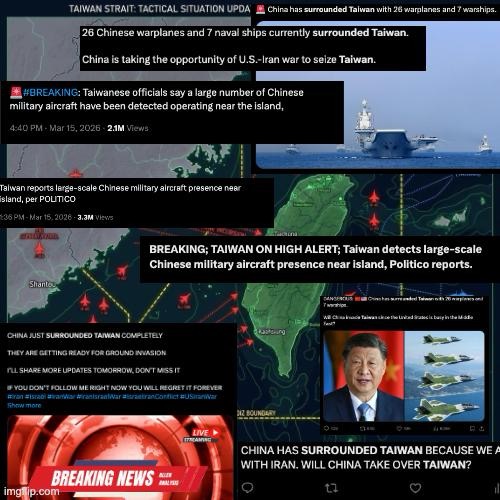
On March 15th, 2026, Politico published an article titled โ€œTaiwan reports large-scale Chinese military aircraft presence near island.โ€[i] This title exaggerated what was in actuality a relatively normal day of PLA activity around Taiwan. Nevertheless, the piece caught the eye of many observers on social media. Within hours, thousands of finance and Open-Source Intelligence (OSINT) accounts began to regurgitate the headline, without linking the article or explaining the nuance behind the report of โ€œlarge-scaleโ€ activity.[ii] These posts, which seemed to imply that China was preparing significant military action against Taiwan, accumulated tens of thousands of likes, and began trending on both Twitter/X and Bluesky. 

Essentially, we witnessed a game of telephone taking place on the internet. A single headline was rapidly shared, rephrased, and simplified across platforms, with each iteration shedding context and adding interpretation. Within hours, an observation about aircraft activity became a claim about encirclement, with accounts sharing posts that declared Taiwan as โ€œsurroundedโ€ by the Peopleโ€™s Liberation Army (PLA).

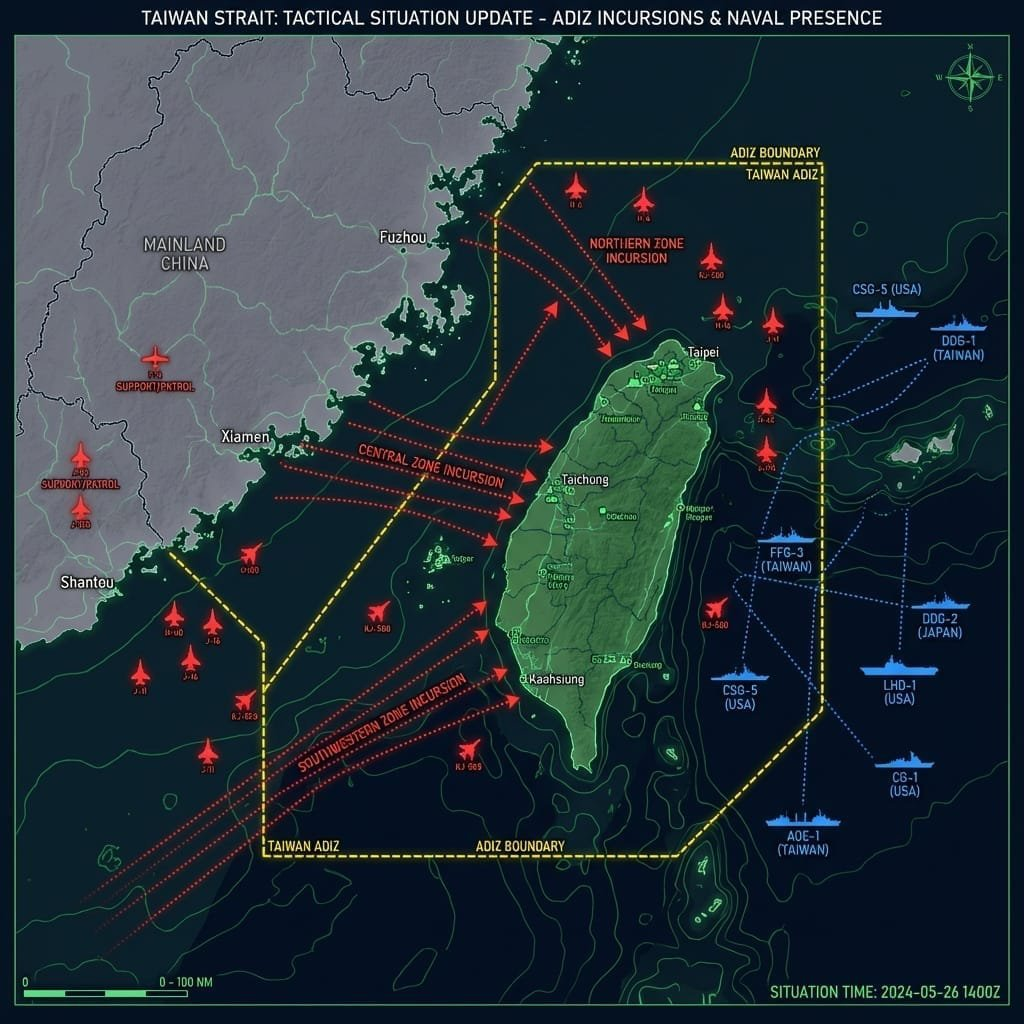
An AI-generated map that circulated on X/Bluesky during the wave of misinformation

This incident provides a useful window into how even relatively small actions by the PLA around Taiwan have the potential to significantly swing social media coverage of Taiwan by actors engaged in disinformation. In a crisis-prone environment such as Taiwanโ€™s, where China has carefully shaped the narrative environment for years through large exercises, even one article can cascade into a broader wave of false and misleading claims, using recycled visuals and improvised escalation narratives.[iii]

The Problem With ADIZ Reporting

Following two weeks of depressed PLA activity in and around Taiwanโ€™s Air Defense Identification Zone (ADIZ), Taiwanโ€™s MND reported that 26 Chinese aircraft were detected operating around Taiwan, with 16 aircraft entering its IZ[iv]. While this instance is indeed above 2026โ€™s daily average of 4.5, it is in fact only โ€œlarge-scaleโ€ if compared to the previous two weeks of little to no activity, something that the Politico article make[v] clear. However, when viewed holistically, March 14thโ€™s numbers are less significant, representing only the 8th largest ADIZ incursion of 2026. The eventโ€™s significance is further diminished due to the resumption of low aerial activity the following day, March 15th.[vi]

It is routine for news organizations outside Taiwan to report on PLA activity in Taiwanโ€™s ADIZ, especially when violation numbers seem to be abnormally high or low. During the recent period of lower activity, for example, many major news organizations published stories on the unusual lull.[vii]

Reporting on something as niche as Taiwanโ€™s ADIZ creates a structural vulnerability. Headlines often compress complex operational data into simplified, attention-grabbing phrases that lack important context. On social media, these headlines are frequently detached from the underlying reporting, leaving readers to infer meaning from incomplete signals.

This dynamic does not require deliberate manipulation. Headline framing can make routine activity appear more consequential than it is, creating openings for exaggerated interpretations. A similar pattern appears during PLA joint exercises, when maps of exercise zones or footage of missile launches circulate without context, prompting observers to interpret routine demonstrations as evidence of blockade preparations or imminent invasion.

The Misinformation Cascade Begins

The cascade began with a flurry of financial news accounts simply sharing the article title on social media, something they likely received from news wire services. The simplicity of the title, specifically the fact it could very easily be misconstrued as suggesting that China was preparing a military build-up, instantly attracted massive attention from OSINT accounts that simply aggregate the news headlines, usually in a way that exaggerates the severity of events.[viii]

What began as โ€œTaiwan reports large-scale Chinese military aircraft presence near islandโ€ became โ€œTAIWAN DETECTS MASSIVE CHINESE MILITARY PRESENCE SURROUNDING ISLANDโ€ and โ€œBREAKING; TAIWAN ON HIGH ALERT.โ€[ix] As these posts began to circulate, generating tens of thousands of likes and reposts, commentary accounts began to post uninformed analysis.[x] This fed into the algorithm and expanded the audience to circles outside of the โ€œOSINT communityโ€. Less than six hours after the publication of the original Politico article, the dominant discourse surrounding it became completely unrecognizable from its actual substance.

As the social media posts spread rapidly, some posts referencing the Politico report began to adopt the phrase โ€œTaiwan surrounded.โ€[xi]

This linguistic shift was not trivial. Describing aircraft and ships โ€œaround Taiwanโ€ conveys an operational snapshot: an observation about detected activity. Describing Taiwan as โ€œsurrounded,โ€ however, implies a fundamentally different military posture. The term suggests physical enclosure, coercive leverage, or even the early stages of blockade operations. The difference between these descriptions marks the point where an activity report becomes a strategic claim.

In many viral posts, the progression followed a familiar pattern: The original numbers were omitted, but the language of heightened military activity and encirclement remained. As the messaging grew stronger, the belief that we were seeing something larger beginning grew as a seemingly logical conclusion. At that moment, the misinformation cascade began.

The initial spread of the Politico headline was driven by rapid reposting across financial news and OSINT accounts, many of which likely received the story through news wire services. Each repost preserved the sense of urgency while shedding the context needed to interpret the underlying activity.

But repetition alone does not explain why the narrative gained traction. Ongoing global events, emotional responses such as fear, and the pressure to keep pace with breaking news all contributed to how the headline was interpreted. Together, these forces helped transform an activity report into something that appeared far more consequential.

Context Collapse and the Vulnerability of Breaking News

This transformation illustrates a recurring problem in the information environment surrounding security crises: context collapse.[xii] Technical military reporting often relies on specialized terminology, whose meaning depends heavily on operational context. As a result, phrases like โ€œlarge-scale activity,โ€ โ€œoperating near the island,โ€ or โ€œaround Taiwanโ€ can be easily misinterpreted when removed from the operational reporting framework used by defense institutions. This is especially relevant during the ongoing operations in the Middle East. With airstrikes, bombings, and naval fires filling up algorithms on social media, the public is hyper fixated on action, worried about the conflict spilling over with global consequences.

On media platforms that reward simplicity and emotional clarity, those phrases can quickly evolve into stronger claims. A surge becomes an escalation. Activity becomes encirclement. A snapshot becomes a strategic turning point.

Research on crisis communication shows that information environments characterized by uncertainty and urgency often degrade shared situational awareness.[xiii] In these environments, audiences rely increasingly on simplified narratives rather than technical explanations, making complex military developments easier to misinterpret or exaggerate.[xiv]

The Taiwan Strait is particularly vulnerable to this dynamic because even routine military movements carry geopolitical significance. For audiences with limited familiarity with PLA operational patterns, the difference between an activity spike and a strategic shift may not be obvious. As a result, ambiguity can easily be filled with worst-case interpretations.

Fear as a Carrier of Misinformation

One of the major factors fueling the spread of discussion around the activity was a sense of urgency and fear. What had begun as a description of aircraft counts was quickly processed as a signal of possible escalation. This shift mattered because it changed the role of the audience. Rather than evaluating a technical report, users were reacting to what appeared to be the early stages of a crisis.

Fear alters how individuals process information under uncertainty. Research on information diffusion shows that emotionally arousing content, particularly content that evokes anxiety, reduces the likelihood that individuals will pause to verify claims before sharing them.[xv] When the perceived stakes are high, the cost of inaction can feel greater than the risk of being wrong.[xvi] In this context, sharing becomes a precautionary behavior: a way of responding to a potential threat rather than confirming a verified fact.

This dynamic helps explain how the narrative evolved so quickly. As users encountered repeated claims that Taiwan was being โ€œsurrounded,โ€ the framing itself encouraged a particular interpretation of events, one in which time was limited and escalation plausible. Under those conditions, ambiguity is often resolved in the direction of worst-case assumptions.

The Taiwan Strait is especially susceptible to this process because it is already widely understood as a high-risk flashpoint.[xvii] Reports of increased military activity therefore do not enter a neutral information environment. They are received by audiences primed to expect crisis, making emotionally charged interpretations more intuitive and more difficult to dislodge.

Rather than distorting an already existing stable understanding of events, in this case, fear constructed a distorted understanding of events from first principles.

As the narrative spread, emotional reactions reinforced the interpretation that something larger was unfolding, even though the underlying data had not changed. By the time more precise context emerged, the initial framing had already taken hold.

The โ€œUse It or Lose Itโ€ Logic of Virality

The initial posts that circulated widely were not detailed analyses, but rapid reposts of the headline, often stripped of its original context. As the story began to trend, users encountered a familiar dilemma: whether to wait for additional information or to share immediately while the topic was gaining attention. In fast-moving situations, that window can close quickly. Waiting to verify information risks missing the moment when a story is most visible.

This dynamic creates what can be understood as a โ€œuse it or lose itโ€ logic. Information is most valuable when it is new and circulating widely. As a result, users are incentivized to share content as soon as they encounter it, even if the underlying details remain unclear. In the case of the Taiwan activity report, this pressure contributed to the rapid spread of simplified and, at times, misleading interpretations of the original article.

Research on information diffusion suggests that time pressure plays a significant role in reducing verification behavior. When individuals are required to make quick decisions about whether to share content, they rely more heavily on heuristic cues, such as the tone of a headline or the apparent urgency of a claim, rather than engaging in careful evaluation.[xviii] When the valence of the emotions is negative (fear or anger), and the arousal stronger, we see an even larger effect, effectively bypassing internal โ€™factcheckingโ€™ mechanisms.  In practice, this means that speed can substitute for accuracy in shaping what information circulates most widely.

In the hours following the Politico report, this mechanism was visible in how the story evolved. As more users shared increasingly simplified versions of the original claim, the narrative moved further away from the underlying data. Each iteration prioritized immediacy over precision, reinforcing a version of events that was easier to transmit but less accurate.

Importantly, this process does not require intentional deception. The users participating in the spread of the narrative are often responding rationally to platform incentives that reward speed, visibility, and engagement. The result, however, is an information environment in which early interpretations, rather than verified ones, play a disproportionate role in shaping collective understanding.

Visual Misinformation and the Power of the Map

The misinformation surge surrounding the Taiwan activity report was further amplified by the circulation of a misleading map.

Images carry a particular authority online. A map, diagram, or chart often appears more credible than text because it looks technical and objective. For many readers, visual representation functions as evidence rather than interpretation.[xix]

In this case, users circulated a map that purported to show Taiwan surrounded by Chinese forces. The image appeared to provide visual confirmation of the encirclement narrative.[xx] However, the map was not current, instead containing information from a Chinese exercise in May of 2024 (Joint Sword 2024A).

Despite this discrepancy, the image spread widely because it aligned with the narrative already circulating online. Once paired with the phrase โ€œTaiwan surrounded,โ€ the map helped transform a contested claim into something that looked authoritative.

This illustrates the powerful role visual content plays in misinformation ecosystems. Textual claims invite debate. Images often suppress it.

Why Taiwan Is Particularly Vulnerable

The Taiwan information environment is especially susceptible to rapid misinformation cascades due to several reinforcing factors.

First, Chinaโ€™s activity around Taiwan is both real and visible. The PLA regularly conducts air and naval exercises that simulate encirclement. Because these activities are genuine, reports about them carry immediate credibility and are easily incorporated into alarmist interpretations. Because these activities are genuine, reports about them easily gain traction.

Second, many audiences lack the context needed to interpret these developments. Without familiarity with PLA operational patterns, even routine activity can appear extraordinary.

Third, these factors combine with a media environment that rewards simplification. With the Taiwan Strait being a flashpoint that many fixate on, often viewed through the lens of great-power rivalry, social media platforms reward provocative messaging. Complex operational data rarely goes viral; emotionally resonant narratives do.

Together, these factors create what might be described as a fear market: where worst-case interpretations consistently attract attention and engagement.

The Anatomy of a Misinformation Cascade

The episode surrounding the โ€œTaiwan surroundedโ€ narrative illustrates a broader pattern in contemporary disinformation dynamics.

The process often follows a recognizable sequence:

  1. A real event occurs.
  2. Initial reporting frames the event in simplified terms.
  3. Emotionally charged interpretations amplify the story.
  4. Users rapidly repost the information without verification.
  5. Speculative narratives accumulate around the original claim.
  6. Visual content reinforces the narrativeโ€™s apparent credibility.
  7. The story stabilizes as a widely accepted, but inaccurate, account.

Importantly, this sequence does not require deliberate fabrication. The most effective misinformation often begins with something that is true. What changes is the interpretation.

Precision as Resilience

The lesson from this episode is not that analysts should dismiss reports of PLA activity or treat social-media reactions as irrelevant. Instead, it highlights the importance of maintaining precision in the way military developments are described and interpreted. In the Taiwan information environment, the difference between โ€œincreased PLA activityโ€ and โ€œTaiwan is surroundedโ€ is not a matter of rhetorical nuance. It represents the boundary between analysis and alarmism.

Once that boundary is crossed, the information environment becomes difficult to correct. Viral narratives spread faster than careful explanations, and emotionally compelling interpretations often outcompete technical accuracy.

Precision therefore becomes a form of resilience. Analysts, journalists, and policymakers who communicate clearly about military developments help prevent routine operational activity from being misinterpreted as strategic escalation.

The recent surge of misinformation surrounding the Taiwan activity report demonstrates how quickly ambiguity can be converted into certainty online. It also serves as a reminder that in crisis-prone environments, the first casualty is often not truth itself, but proportion.


[i] https://www.politico.com/news/2026/03/15/taiwan-reports-large-scale-chinese-military-aircraft-presence-near-island-00829219

[ii] https://x.com/unusual_whales/status/2033235867616383090?s=20

[iii] https://tsm.schar.gmu.edu/justice-mission-2025-the-narrative-battle-inside-chinas-latest-taiwan-exercise/

[iv] https://www.mnd.gov.tw/en/news/plaact/86327

[v] https://www.politico.com/news/2026/03/15/taiwan-reports-large-scale-chinese-military-aircraft-presence-near-island-00829219?utm_medium=twitter&utm_source=dlvr.it

[vi] https://www.mnd.gov.tw/en/news/plaact/86330

[vii] https://www.cnn.com/2026/03/12/asia/china-taiwan-buzzing-mystery-intl-hnk, https://www.bbc.com/zhongwen/articles/c2lr8ejq0w8o/simp

[viii] https://x.com/rawsalerts/status/2033282084282695857?s=20, https://x.com/Defence_Index/status/2033172908277891415?s=20, https://x.com/Globalsurv/status/2033265245582413860?s=20

[ix] https://x.com/SpencerHakimian/status/2033282256962208210?s=20, https://x.com/Globalsurv/status/2033257539291242981?s=20

[x] https://x.com/krassenstein/status/2033284541788324217?s=20, https://x.com/HotSotin/status/2033292605811798043?s=20

[xi] https://x.com/GlobalIJournal/status/2033362180351852786?s=20, https://x.com/drhossamsamy65/status/2033270501947081180?s=20 , https://x.com/PrimeH12995/status/2033572921365647430?s=20

[xii] Brandtzaeg, Petter Bae, and Marika Lรผders. “Time collapse in social media: Extending the context collapse.” Social Media+ Society 4, no. 1 (2018): 2056305118763349.

[xiii] Hilberts, Sonya, Mark Govers, Elena Petelos, and Silvia Evers. “The impact of misinformation on social media in the context of natural disasters: Narrative review.” JMIR infodemiology 5 (2025): e70413.

[xiv] Shahbazi, Maryam, and Deborah Bunker. “Social media trust: Fighting misinformation in the time of crisis.” International Journal of Information Management 77 (2024): 102780

[xv] Stieglitz, Stefan, and Linh Dang-Xuan. “Emotions and information diffusion in social mediaโ€”sentiment of microblogs and sharing behavior.” Journal of management information systems 29, no. 4 (2013): 217-248.

[xvi] Ecker, Ullrich KH, Stephan Lewandowsky, John Cook, Philipp Schmid, Lisa K. Fazio, Nadia Brashier, Panayiota Kendeou, Emily K. Vraga, and Michelle A. Amazeen. “The psychological drivers of misinformation belief and its resistance to correction.” Nature Reviews Psychology 1, no. 1 (2022): 13-29., Marcus, George E., W. Russell Neuman, and Michael MacKuen. Affective intelligence and political judgment. University of Chicago Press, 2000.

[xvii] https://www.bloomberg.com/news/articles/2026-02-10/the-10-trillion-fight-modeling-a-us-china-war-over-taiwan

[xviii] Talwar, Shalini, Amandeep Dhir, Dilraj Singh, Gurnam Singh Virk, and Jari Salo. “Sharing of fake news on social media: Application of the honeycomb framework and the third-person effect hypothesis.” Journal of Retailing and Consumer Services 57 (2020): 102197

[xix] Rama, Daniele, Tiziano Piccardi, Miriam Redi, and Rossano Schifanella. “A large scale study of reader interactions with images on Wikipedia.” EPJ Data Science 11, no. 1 (2022): 1.

[xx] https://x.com/WealthWatcherCo/status/2033280246254895138?s=20

Taiwan Arms Sale Backlog, February 2026 Update

Special Budget Complications Continue

Authors: Joseph Oโ€™Connor, Eric Gomez, & Shikhar Chaturvedi


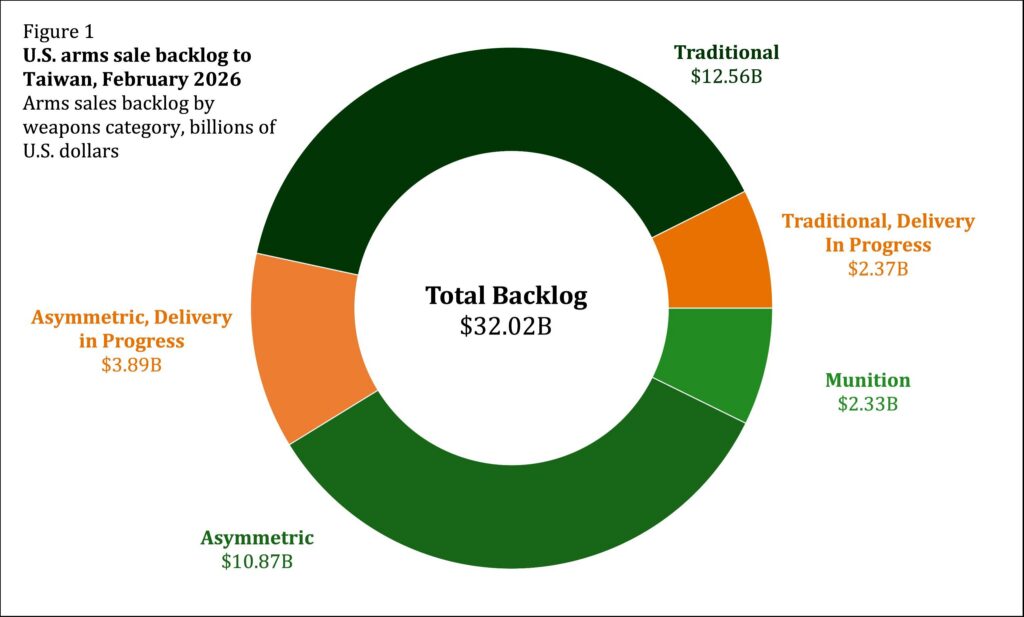
Political gridlock over the Lai administrationโ€™s special procurement budget continued in February 2026, leading to concerns about recently announced U.S. arms sales to Taiwan. No new Foreign Military Sales (FMS) cases were notified to Congress, and no existing sales were delivered in February. The total value of FMS cases notified to Congress but not delivered to Taiwan remains $32 billion.

Eagle-eyed readers will notice that there is a change in Figure 1. Arms sales cases are fully removed from our dataset once final delivery occurs, but we do not reduce the dollar value of the backlog for partial deliveries. We have explained our thinking in other articles.

We indicate partially delivered arms sales through color coding in our data visualizations, with the yellow-orange color representing cases that are partially delivered to the best of our knowledge. Previously, we have only done this for arms sales valued at $1 billion or more because these were the most militarily significant sales and because, given the quantities and types of capabilities involved, they tended to be the easiest to track.

However, we realize that a $1 billion threshold has its own problems. We have therefore decided to adjust our methodology for data visualizations, and from now on, any arms sale that we can verify as partially delivered will be visually indicated with the yellow-orange color. The dollar value of the backlog will only be reduced when a sale is fully delivered, but we think this new approach represents a reasonable way to show in-progress deliveries.

This methodology change moves five arms sales cases worth $1.89 billion into the partially delivered category. Combined with the two cases above, the $1 billion threshold that we were already tracking as partially deliveredโ€”M1A2T Abrams tanks and Harpoon Coastal Defense Cruise Missile systemsโ€”there are seven arms sales cases worth $6.26 billion that are partially delivered, just shy of 20 percent of the backlogโ€™s total dollar value.  

Special Budget Updates in February

Ongoing deliberations in the Legislative Yuan (LY) relating to a special defense budget slowed down in February, as the LY recessed for the Lunar New Year holiday. Prior to recess, the legislature voted to advance a proposal made by the opposition Taiwan Peopleโ€™s Party (TPP) to committee review, leaving the Lai administrationโ€™s NT$1.25 trillion (US$40 billion) proposal in limbo. During the recess, 37 U.S. senators and representatives, including senior members of the House and Senate foreign affairs committees and from both parties in Congress, sent a letter to LY Speaker Han Kuo-yu and party caucus leaders, expressing concern about โ€œongoing deliberations in the Legislative Yuan to only partially fund a supplemental budget request.โ€ Han, responding on February 16, stated that the budget would be one of the โ€œvery firstโ€ items to be debated, and upon re-convening on February 24, the LY voted to advance the governmentโ€™s proposal, ending the month with both proposals under review by the Foreign Affairs and National Defense Committee.

The differences between the competing proposals largely center on flexibility and holistic spending, as opposed to narrower and targeted procurements of established systems, as discussed in detail in our recent article comparing the two proposals. On the sidelines, the Kuomintang (KMT), the third and largest major party in the LY, announced in late February that they would be releasing their own special budget proposal, which they did in early March. As of the end of February, the proposal had ranged from NT$350 billion (US$11.19 billion) to NT$750 billion (US$23.97 billion) but turned out to be only NT$380 billion (US$12 billion) when announced on March 6.

Taiwan’s MND, on February 6, sounded the alarm about three Letters of Offer and Acceptance (LOAs) that are set to expire on March 15. The LOAs, which are for the December sales of Paladin self-propelled howitzers, TOW-2B anti-armor missiles, and Javelin anti-armor missiles, were not signed because of ongoing battles in the LY. MND officials stated they were seeking extensions to the LOAs if a deal was not reached soon. Signing a LOA quickly is an important milestone in the FMS process. A LOA has a payment schedule, whereby Taiwan would pay the U.S. government in installments for the capabilities it is purchasing. The U.S. government negotiates a contract with the defense industry and pays for the capabilities using the funds that Taiwan transfers per the LOA. Importantly, until a LOA is signed and a first payment is made, the Department of Defense cannot enter a contract to produce the weapons. If a LOA is not signed before it expires, then certain steps in the FMS process must be repeated or renegotiated due to potential changes in pricing.

Updates to Abrams, PAC-3 Sales

On February 2, MND officials reported that the final batch of 28 M1A2T Abrams tanks will arrive in Taiwan by the end of March. Delivery of the total 108 tanks has been ongoing since December 2024, when the first batch of 38 arrived in Taiwan.

On February 11, MND officials confirmed to the press that they would be procuring 102 PAC-3 Missile Segment Enhancement (MSE) missiles for Patriot air defense systems, which would be paid via surplus funds from a prior Patriot procurement program.  This is a positive development for the backlog, as the 102 PAC-3 MSEs are a 2022 modification to a 2010 Patriot case and can be funded through surplus from the earlier program. They are separate from and (additive to) the planned but not yet notified Patriot follow-on package (additional batteries and PAC-3 MSEs) expected to be financed through the Lai administrationโ€™s special defense budget.

Amidst these updates, reporting from the Financial Times, New York Times, and Taipei Times has revealed a future arms sale package to Taiwan, including PAC-3 MSE missiles, additional Patriot batteries, Integrated Battle Command Systems, and Lower Tier Air and Missile Defense Sensors radars, all designed to integrate into the Lai administrationโ€™s planned โ€œT-Domeโ€ air defense system. The timeline of this sale, however, is in flux owing to Trumpโ€™s summit with Xi in April.

Trump Administration Announces Arms Sale Reforms

On February 6, the Trump administration launched a new round of arms-transfer reforms through Executive Order 14383 and its accompanying White House fact sheet, establishing an โ€œAmerica First Arms Transfer Strategy.โ€ The order reframes arms transfers as a mechanism for expanding U.S. production capacity, strengthening supply chains, and prioritizing partners that invest in their own defense. The point was reinforced on February 10, when the Pentagon announced the realignment of the Defense Security Cooperation Agency (DSCA) and the Defense Technology Security Administration (DTSA) under the Under Secretary for Acquisition and Sustainment, explicitly tying security cooperation and export administration more closely to defense-industrial management and execution.

At the same time, Taiwan’s arms sales became more visibly entangled with summit diplomacy. Following the February 4 Trumpโ€“Xi call, Beijing publicly urged Washington to handle Taiwan arms sales with โ€œprudenceโ€ and again described Taiwan as theโ€œmost important issueโ€ in U.S.โ€“China relations. Trump then said he was โ€œtalkingโ€ with Xi about future arms sales to Taiwan and would decide โ€œpretty soon,โ€ before the White House promptly clarified that there had been no change in longstanding U.S. policy. Further reporting that a major new package could move only after a Trump trip to China further underscores that dynamic.

Conclusion

Taiwanโ€™s arms sales backlog remained steady at $32.0 billion through the end of February 2026. However, recent developments highlight the role of political factors in the backlog rather than defense industrial capacity.  

The Legislative Yuan has only just begun substantive review of competing special budget proposals, while the March 15 LOA expiration deadline is approaching for several cases notified in December.  Meanwhile, Washingtonโ€™s efforts to streamline arms transfers are occurring alongside high-level diplomacy, which may influence the timing of major new Taiwan FMS notifications to Congress. 

March will be a critical month to determine whether Taipei can turn budget discussions into signed agreements and funding, and whether U.S. process improvements will result in faster execution or be offset by political considerations on both sides.