After the Storm
Authors: Ethan Connell & Jonathan Walberg
KEY FINDINGS
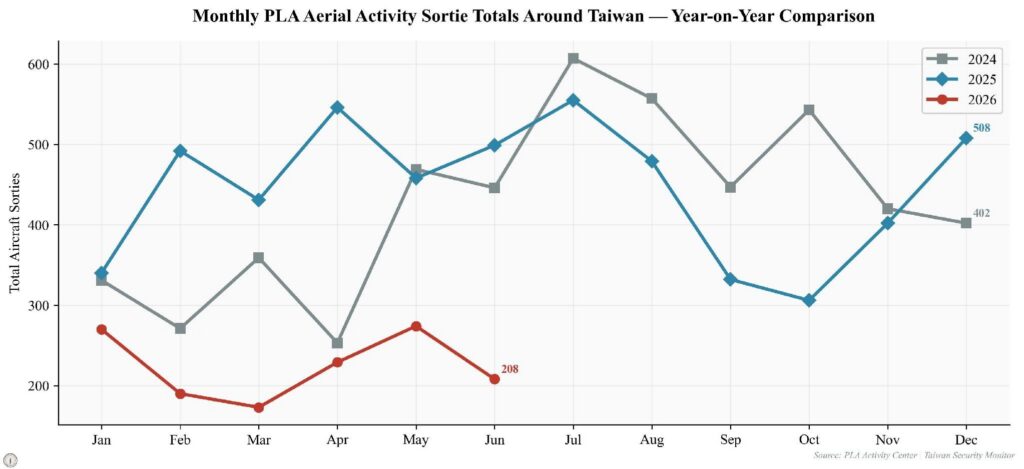
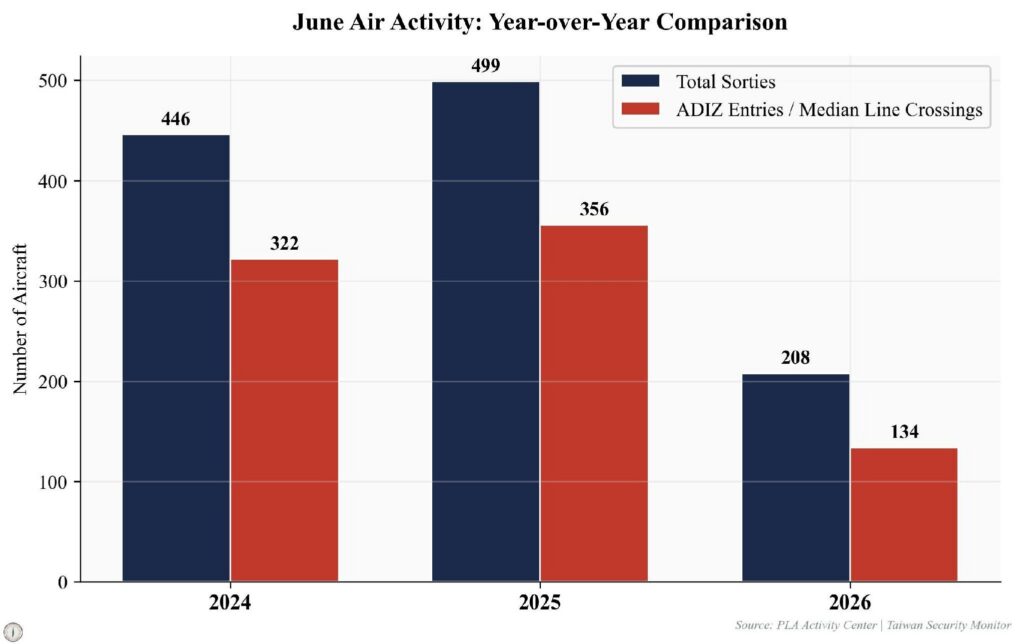
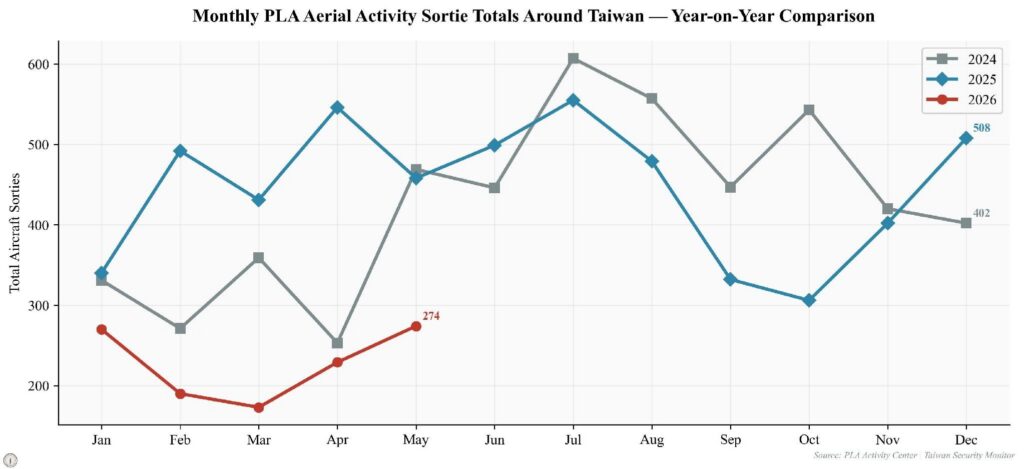
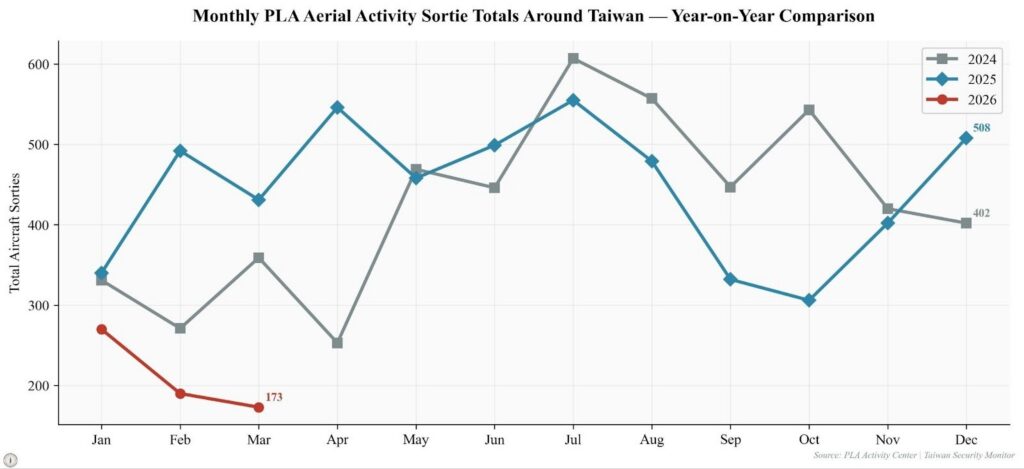
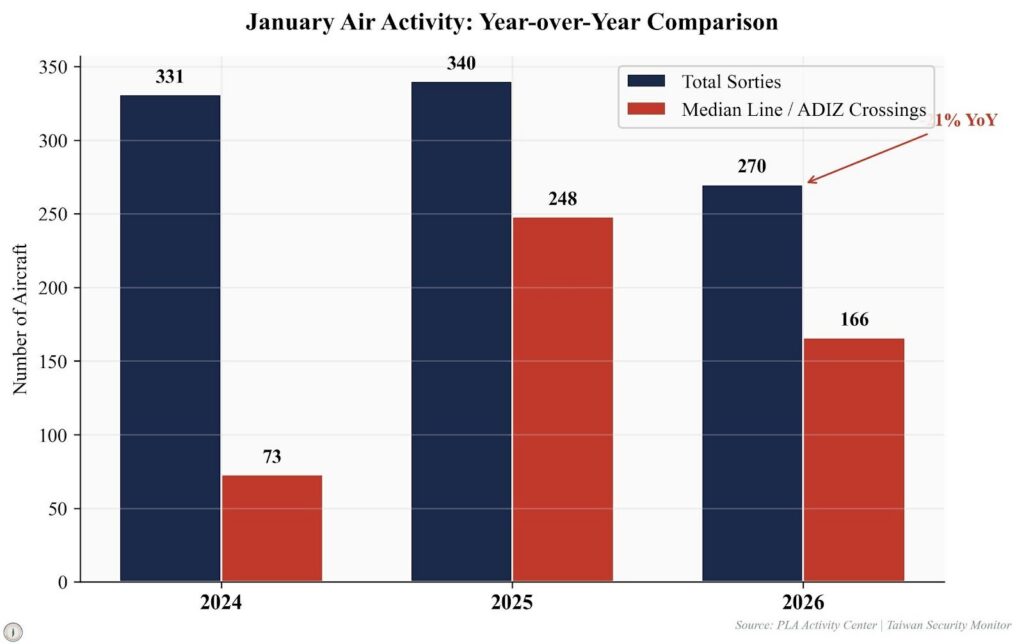
- Taiwan’s Ministry of National Defense documented 260 PLA aerial sorties around the island in July 2026, with 190 entering the Air Defense Identification Zone. The total rose 25 percent from June’s 208 to the second-highest month of the year, while remaining 53 percent below July 2025’s 555 sorties. The seven-month sequence reads 270, 190, 173, 229, 274, 208, 260.
- The PLA conducted three joint combat readiness patrols on July 8 (28 aircraft, 20 ADIZ entries), July 24 (29 aircraft, 17 ADIZ entries), and July 30 (27 aircraft, 22 ADIZ entries), restoring the patrol cadence that had dropped to a single operation in June. Typhoon Bavi suppressed activity from July 9 through 14, during which only 11 aircraft were detected, and PLAN vessel counts fell to one on consecutive days.
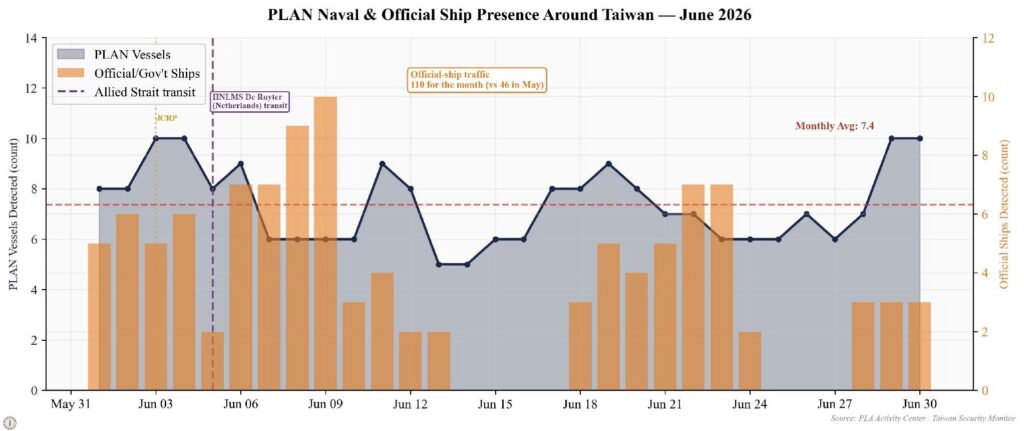
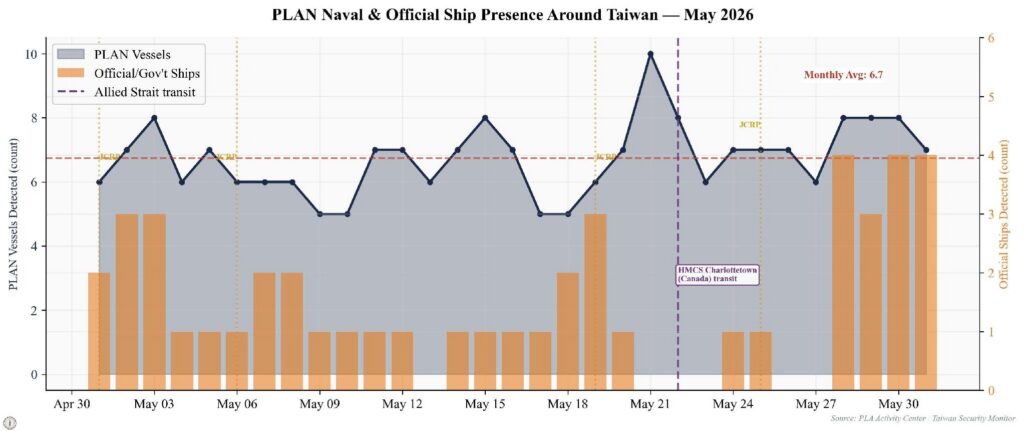
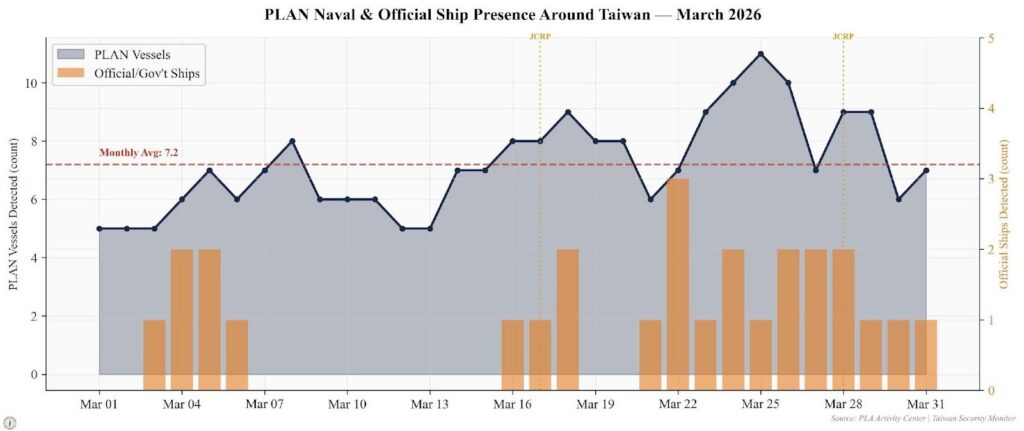
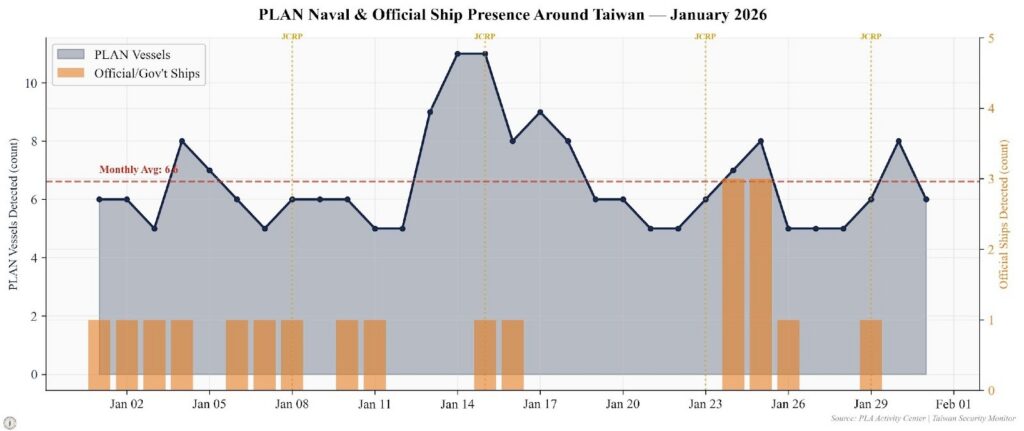
- PLAN vessel detections averaged 6.9 per day and peaked at 10, remaining within the five-to-nine baseline. Official and government-ship detections totaled 116 for the month, comparable to June’s 110 and well above the 46 recorded in May.
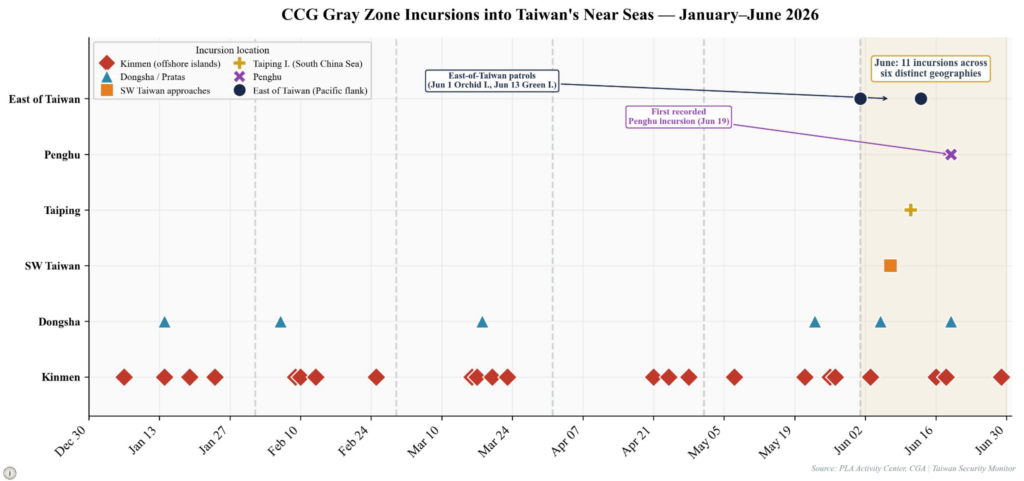
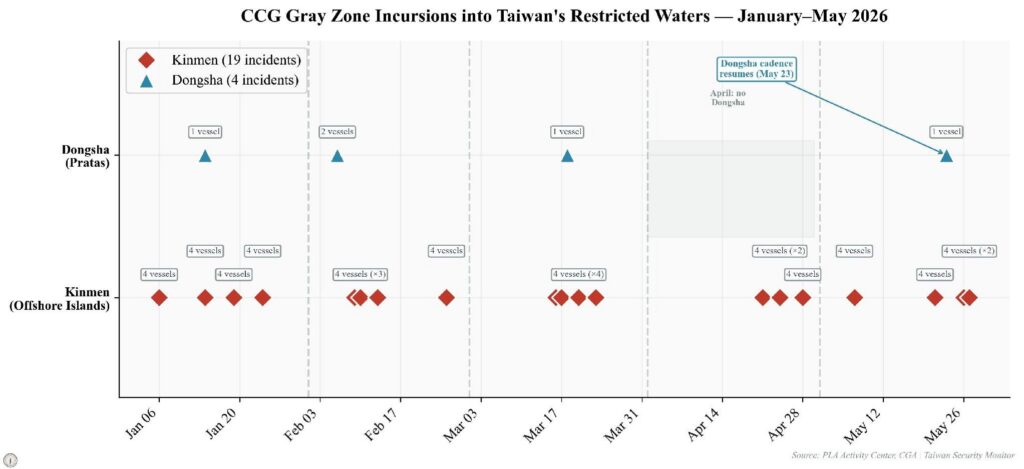
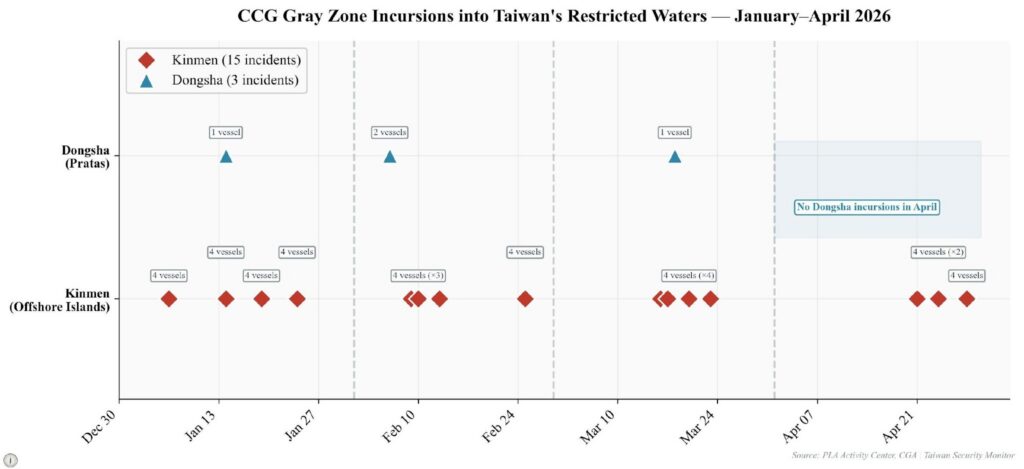
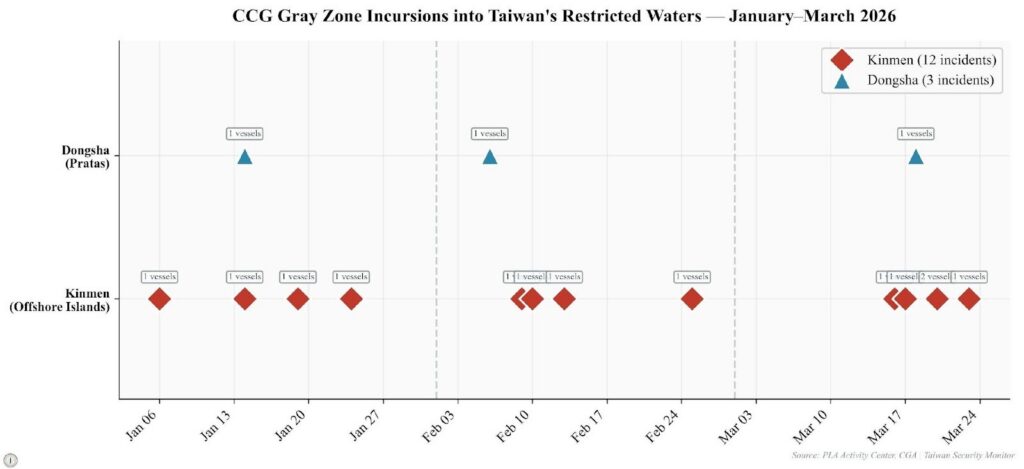
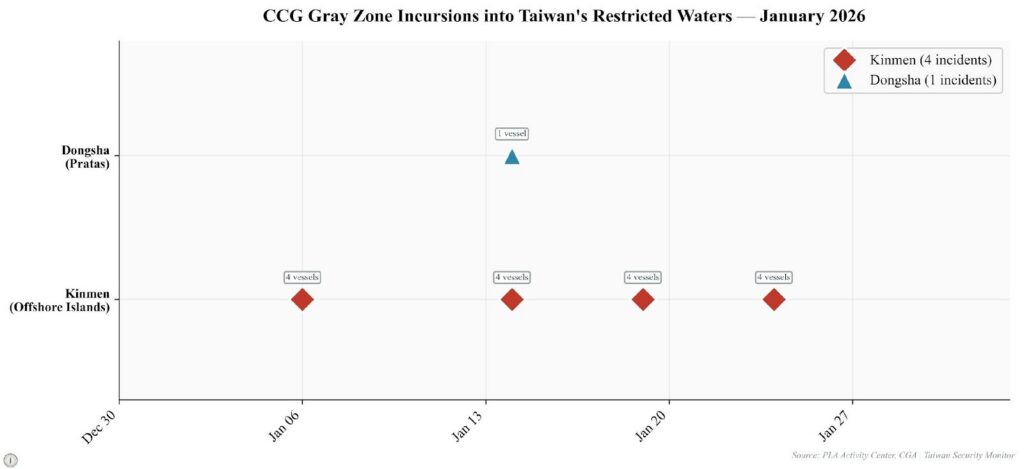
- The Coast Guard Administration documented seven PRC government-vessel incursions in July: five into Kinmen restricted waters (July 8, 14, 16, 21, and 29), including a nighttime transit by PRC Maritime Safety Administration vessel Haixun 1630 on July 16, the first non-CCG government ship recorded in the series; and two east-of-Taiwan patrol reports (July 4 and 31), confirming the Xiushan formation’s rotation into a standing presence east of the island. Cumulative 2026 incursions reached 42.
Air Activity: Rebound from the June Dip
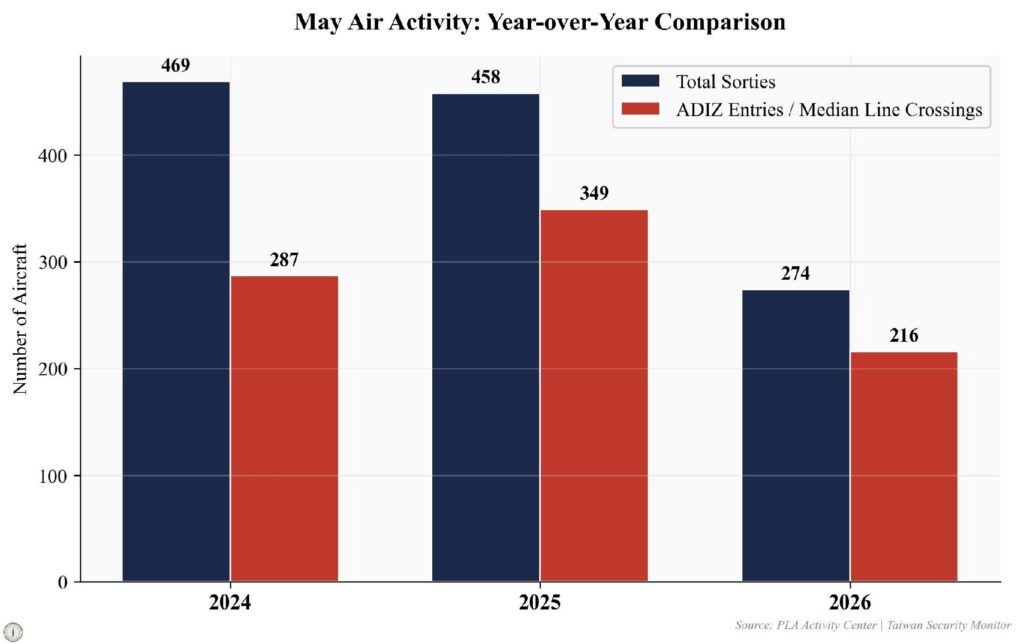
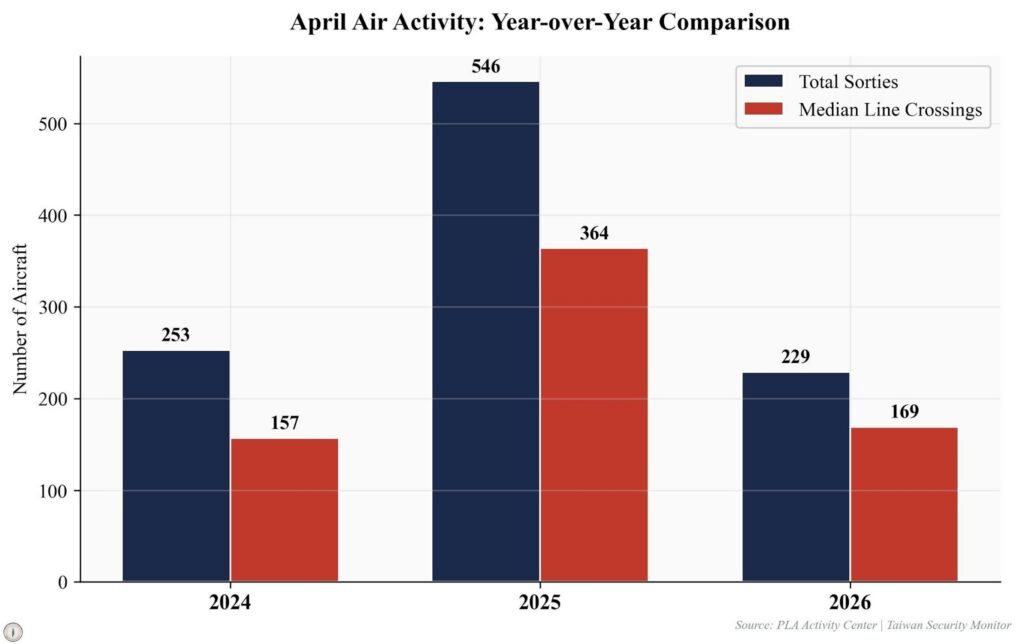
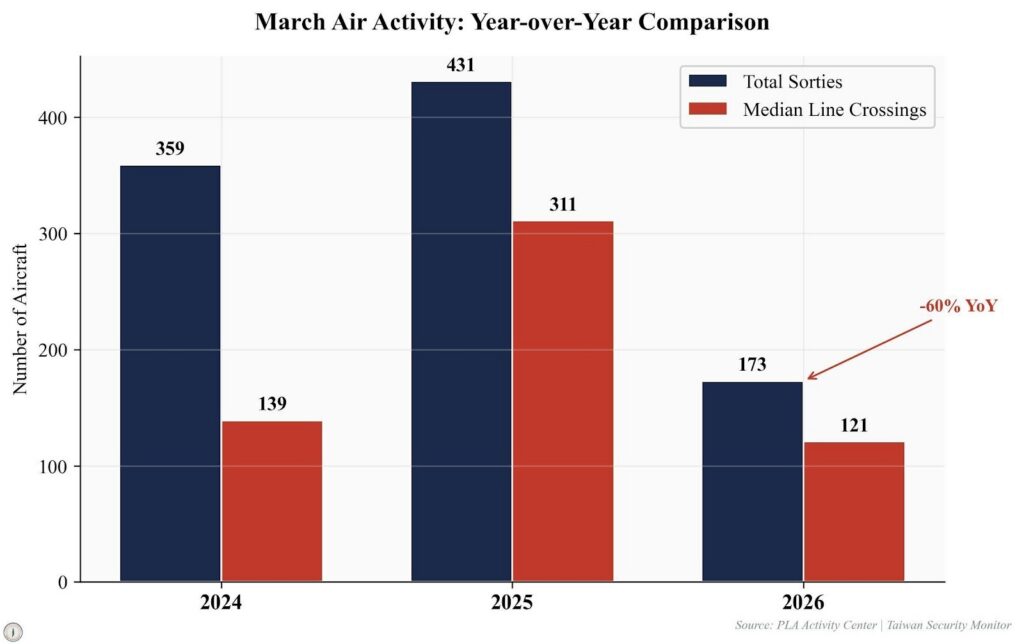
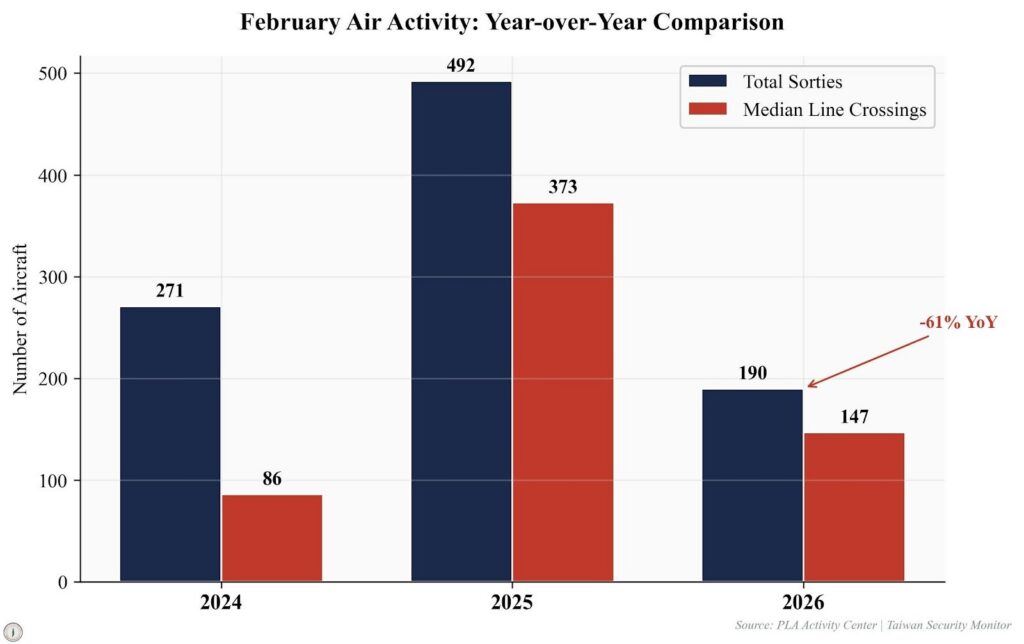
July’s 260 detected sorties reversed the pullback that had brought PLA air activity to its second-lowest month of the year in June. The 52-sortie increase returned the count above April’s 229 and close to January’s 270, though still well below the May peak of 274. Against July 2025’s 555 sorties, the shortfall was 53 percent, and against July 2024’s 607, it was 57 percent, consistent with the year-on-year suppression that has defined 2026.
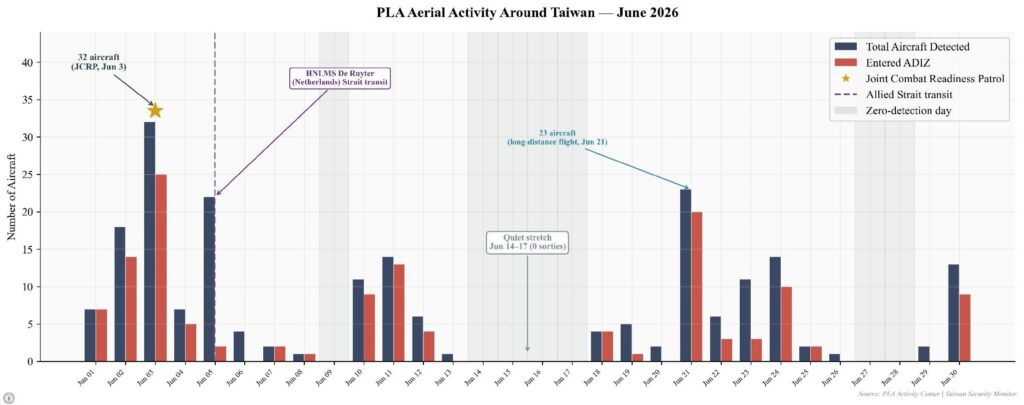
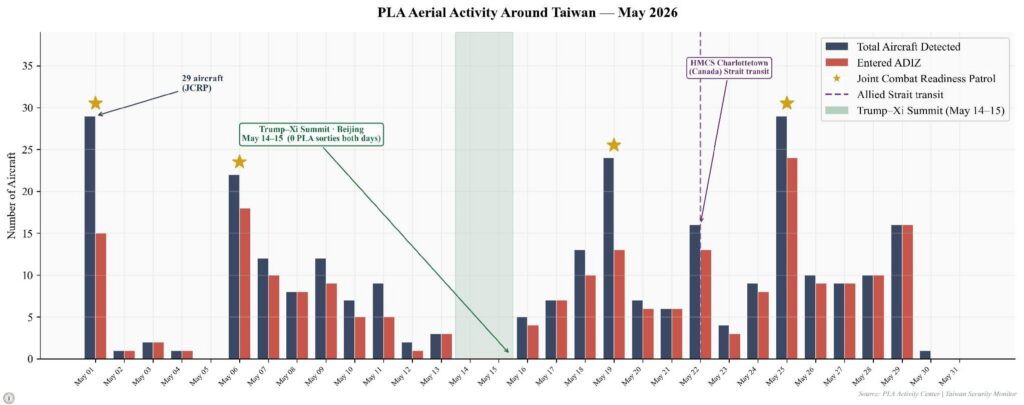
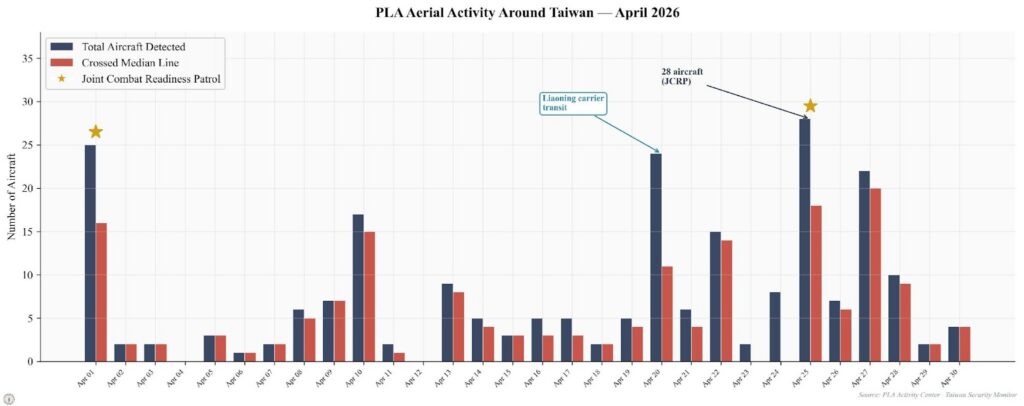
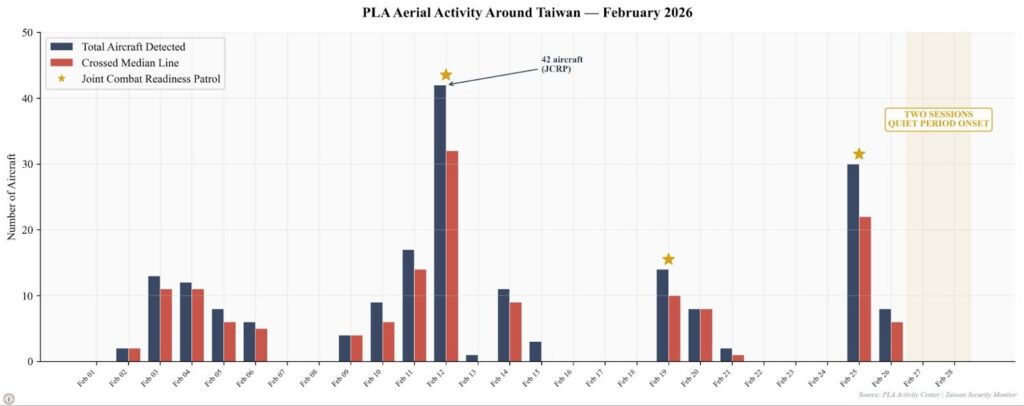
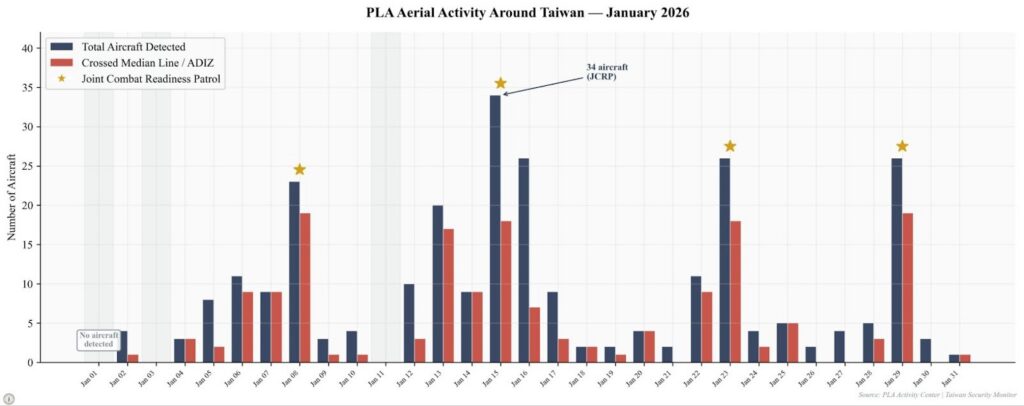
Three joint combat readiness patrols accounted for the month’s three largest single-day totals: 29 aircraft on July 24, 28 on July 8, and 27 on July 30. The July 2 long-distance flight of 30 aircraft was the month’s single busiest day but carried no patrol designation. Five days registered zero aircraft, four of them clustered in the Typhoon Bavi window between July 10 and 17.
Typhoon Bavi’s passage across the strait between July 9 and 14 produced the sharpest disruption to air activity recorded in 2026. Over six days, only 11 aircraft were detected, and PLAN vessel counts dropped to one on July 10 and 11, the lowest daily figures in the dataset. Activity resumed immediately: the July 14 post-storm CCG incursion into Kinmen waters and the 6-aircraft detection that day marked the start of a sustained late-month recovery that carried through the July 24 and 30 patrols.
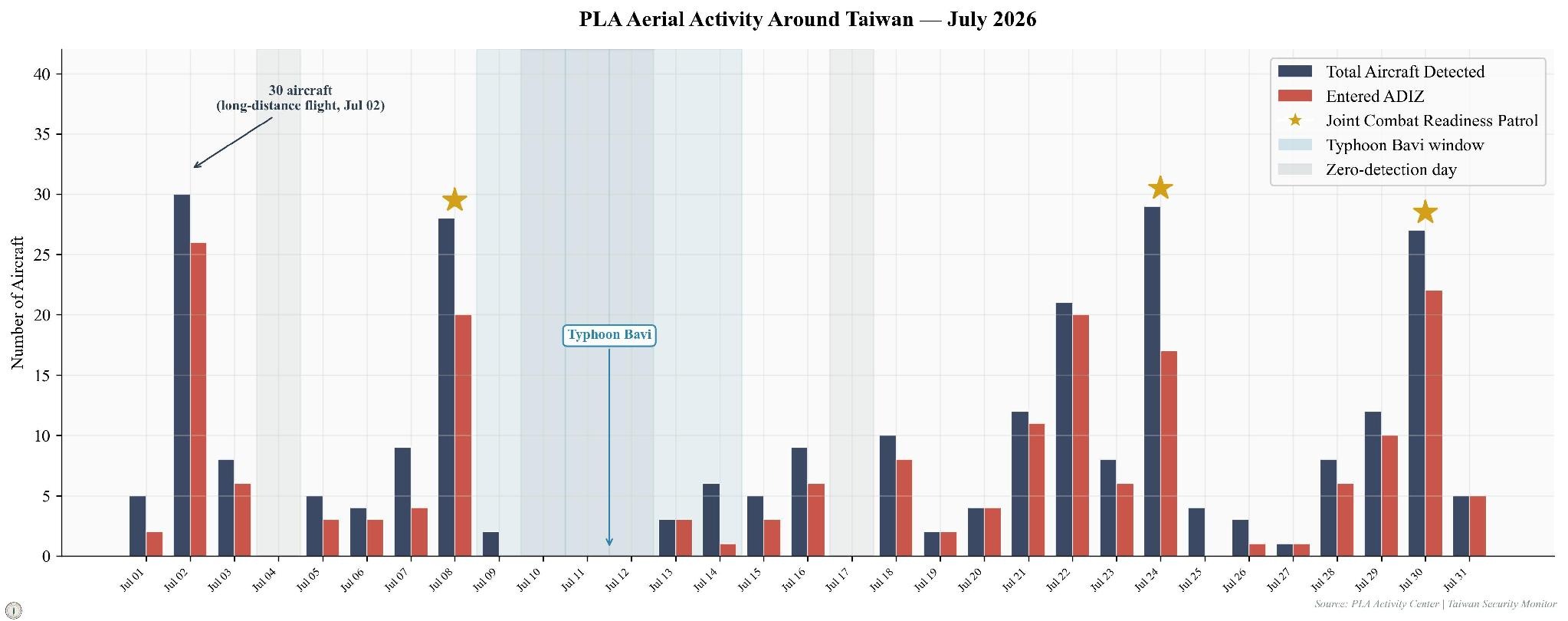
Figure 1. Daily PLA aerial activity around Taiwan, July 2026. Gold stars mark joint combat readiness patrols on July 8, 24, and 30; the shaded band denotes the Typhoon Bavi disruption window.
Monthly Trajectory: The Sawtooth Continues
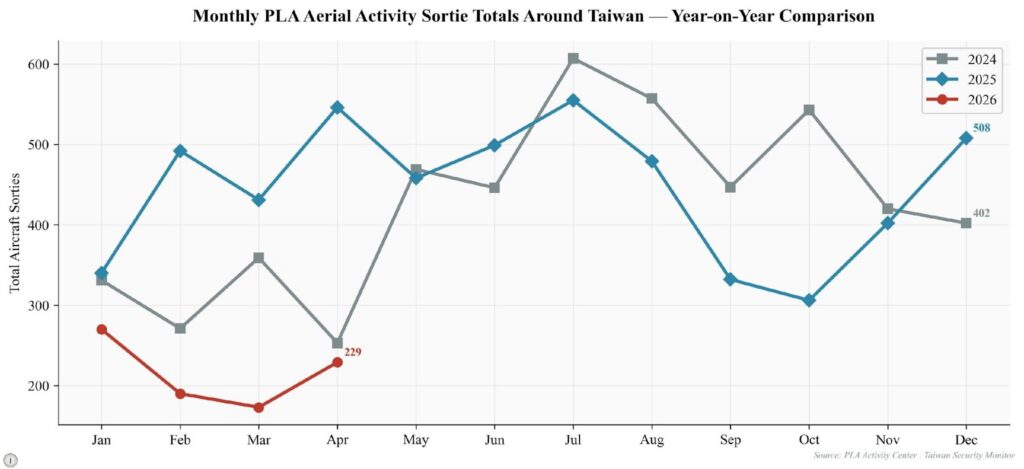
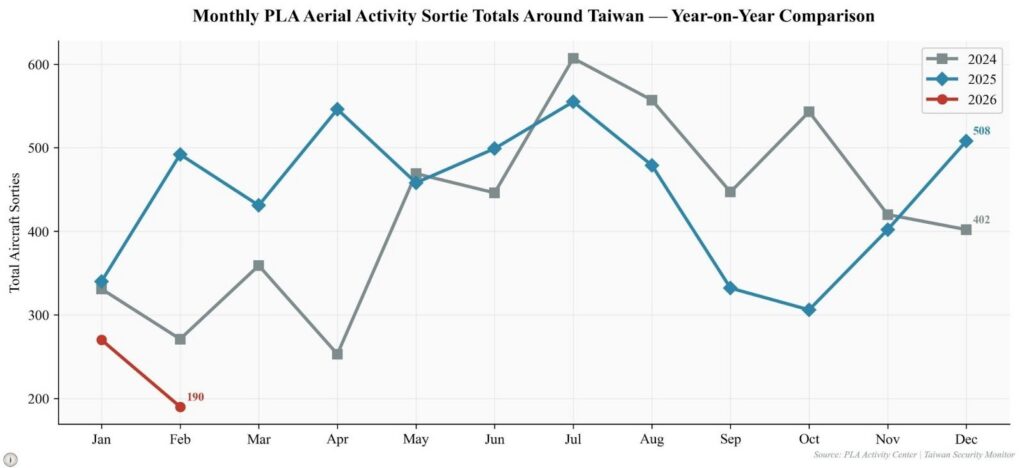
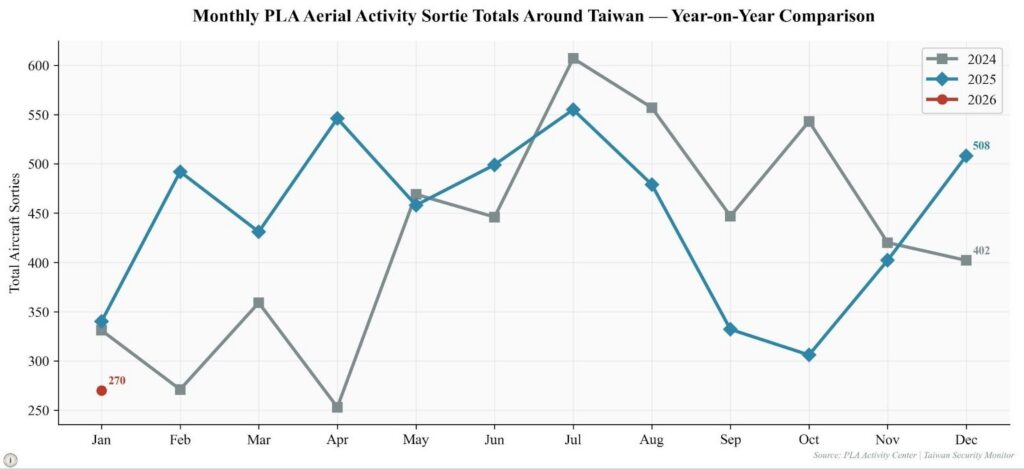
July’s rebound from June extended the sawtooth-like rhythm that has characterized 2026: 270, 190, 173, 229, 274, 208, 260. Each uptick (April, May, July) has been followed or preceded by a downtick, and no month has sustained the pace of either 2024 or 2025. The three JCRPs in July matched January’s four and May’s four as the months with the highest patrol frequency, while June’s single patrol remains the year’s low.
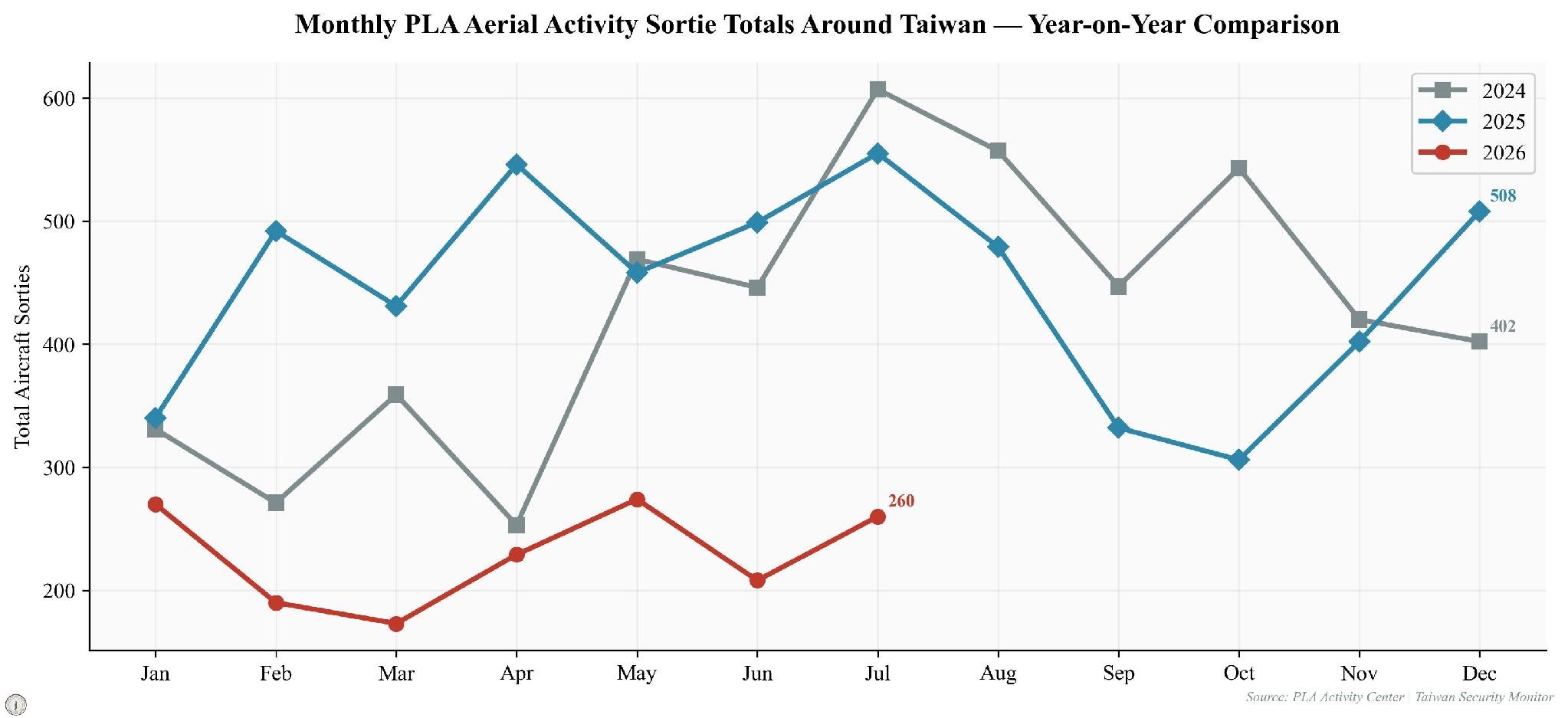
Figure 2. Monthly PLA aerial activity sortie totals, 2024–2026. July 2026 rebounds from June but remains far below the 2024 and 2025 comparables.
At Sea: Bavi Disrupts the Baseline
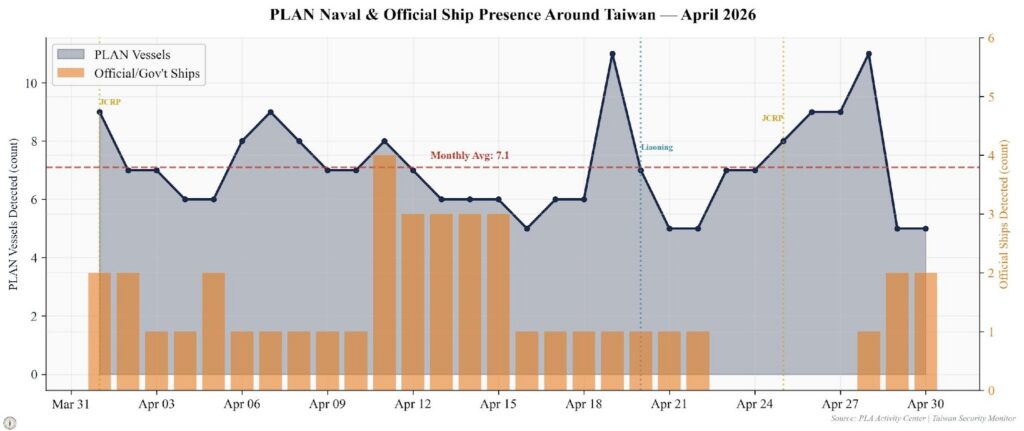
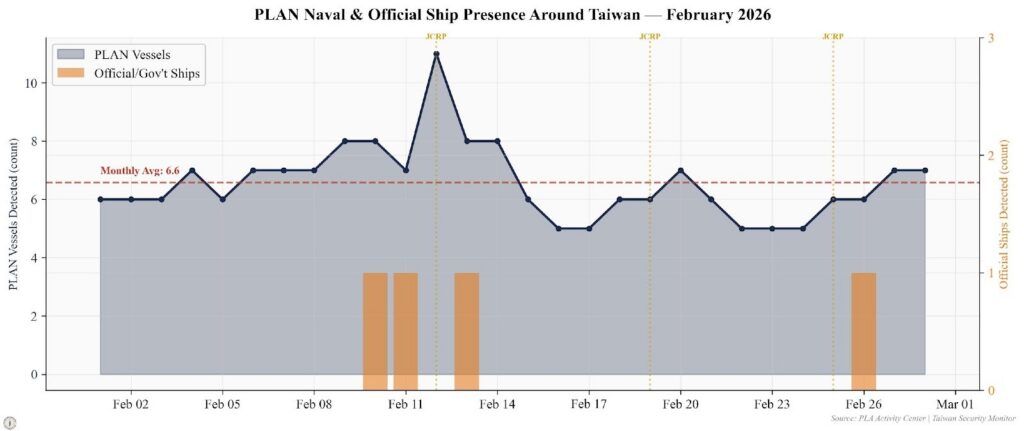
Naval presence held within the five-to-nine band for most of July, with a daily average of 6.9 PLAN vessels and a peak of 10, but the Typhoon Bavi window broke the pattern. PLAN detections dropped to one vessel on both July 10 and 11, the only single-digit-low readings in the 2026 dataset. By July 12, the count had recovered to five and by month’s end reached 10, restoring the baseline.
Official and government-ship detections totaled 116 for the month, roughly flat against June’s 110 and confirming that the step-change from May’s 46 has held. The highest single-day official-ship count was 10 on July 12, a day with zero aircraft. No allied Taiwan Strait transits were recorded in July; the last logged transit was the Netherlands frigate HNLMS De Ruyter on June 5.
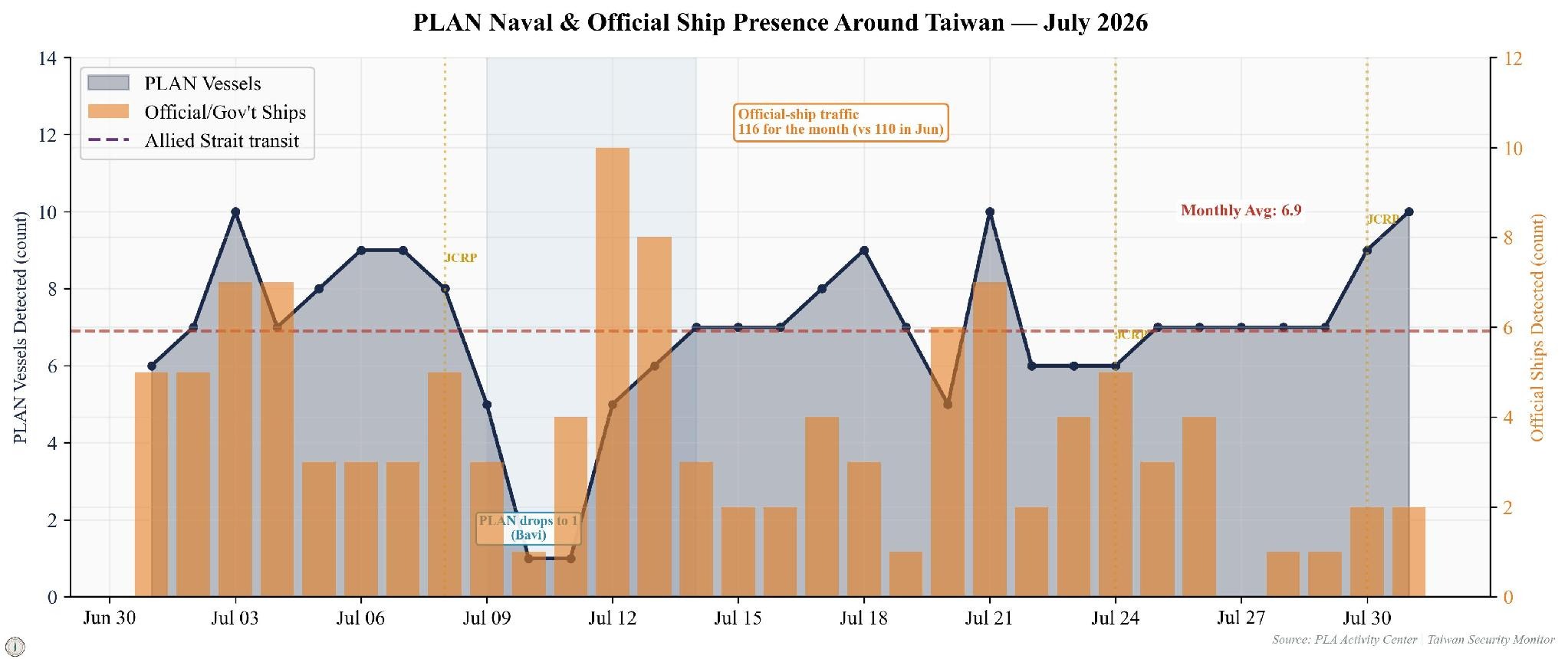
Figure 3. PLAN vessel and official-ship detections around Taiwan, July 2026. The shaded band marks the Typhoon Bavi disruption.
Coast Guard Gray Zone Operations
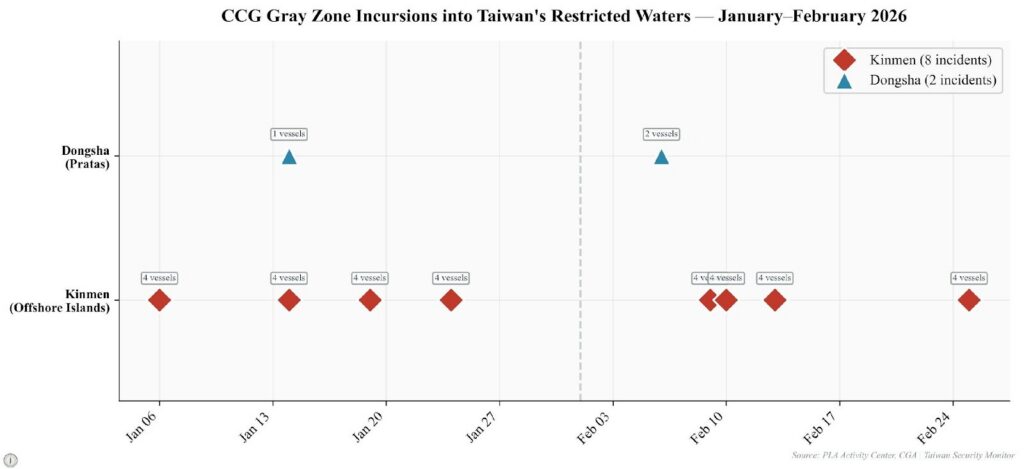
July’s seven PRC government-vessel incursions were fewer than June’s eleven and geographically narrower, but introduced a new actor. Five operations targeted Kinmen restricted waters, conducted on July 8, 14, 21, and 29 by standard four-ship CCG formations drawing on hulls 14530, 14532, 14533, 14602, 14605, 14606, and 14607, with the pre-storm July 8 and post-storm July 14 incursions sharing three of four hull numbers. The July 29 operation employed a two-axis pincer entry, with pairs approaching simultaneously from east of Liaoluo and southwest of Damaoshan.
The July 16 incursion was anomalous. Haixun 1630, a PRC Maritime Safety Administration vessel rather than a China Coast Guard cutter, transited Kinmen restricted waters at night, entering five nautical miles southeast of Liaoluo at 20:44 and exiting southwest of Shaxi Fort at 22:54. The CGA described it as an “edge-cutting transit” and noted it was the first recorded incursion by a non-CCG PRC government vessel. As of July 16, the CGA counted 24 CCG intrusions into Kinmen waters in 2026.
East of Taiwan, the Xiushan formation (CCG 2305 and CCG 1401 Chongming) relieved the Daishan formation on July 4, 54 nautical miles east of Hualien, and remained on station through July 31, when CCG 2305 was reported drifting 151 nautical miles east of Lanyu. The CGA deployed frigates Bali, Hualien, and Taipei for continuous monitoring across the month. The standing rotation confirms that the east-of-Taiwan patrol declared in June has become an institutionalized presence.
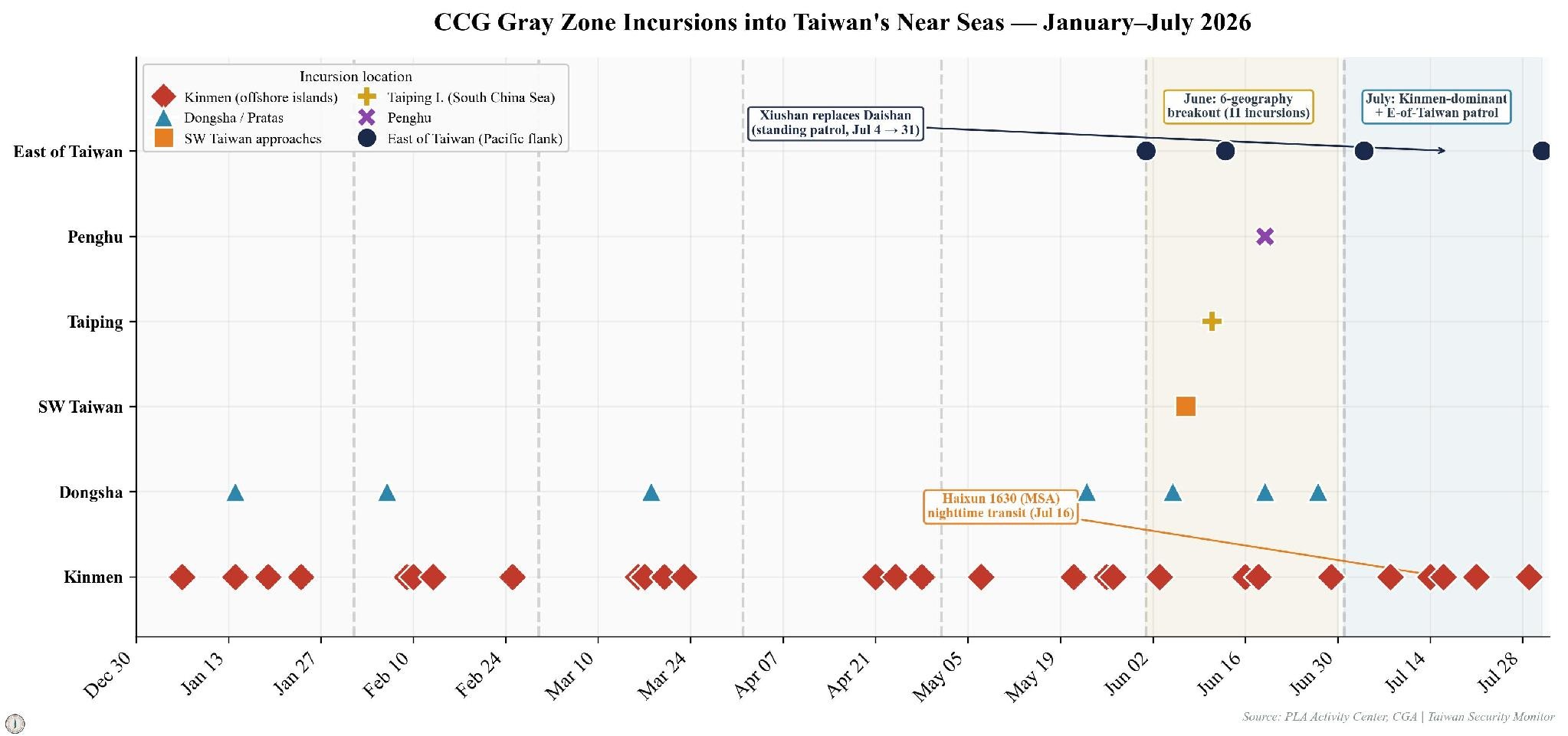
Figure 4. CCG incursions into Taiwan’s near seas, January–July 2026, by location. July reverts to a Kinmen-dominant pattern after June’s six-geography breakout, while the east-of-Taiwan patrol line continues.
The Full Picture: Multi-Domain Overview
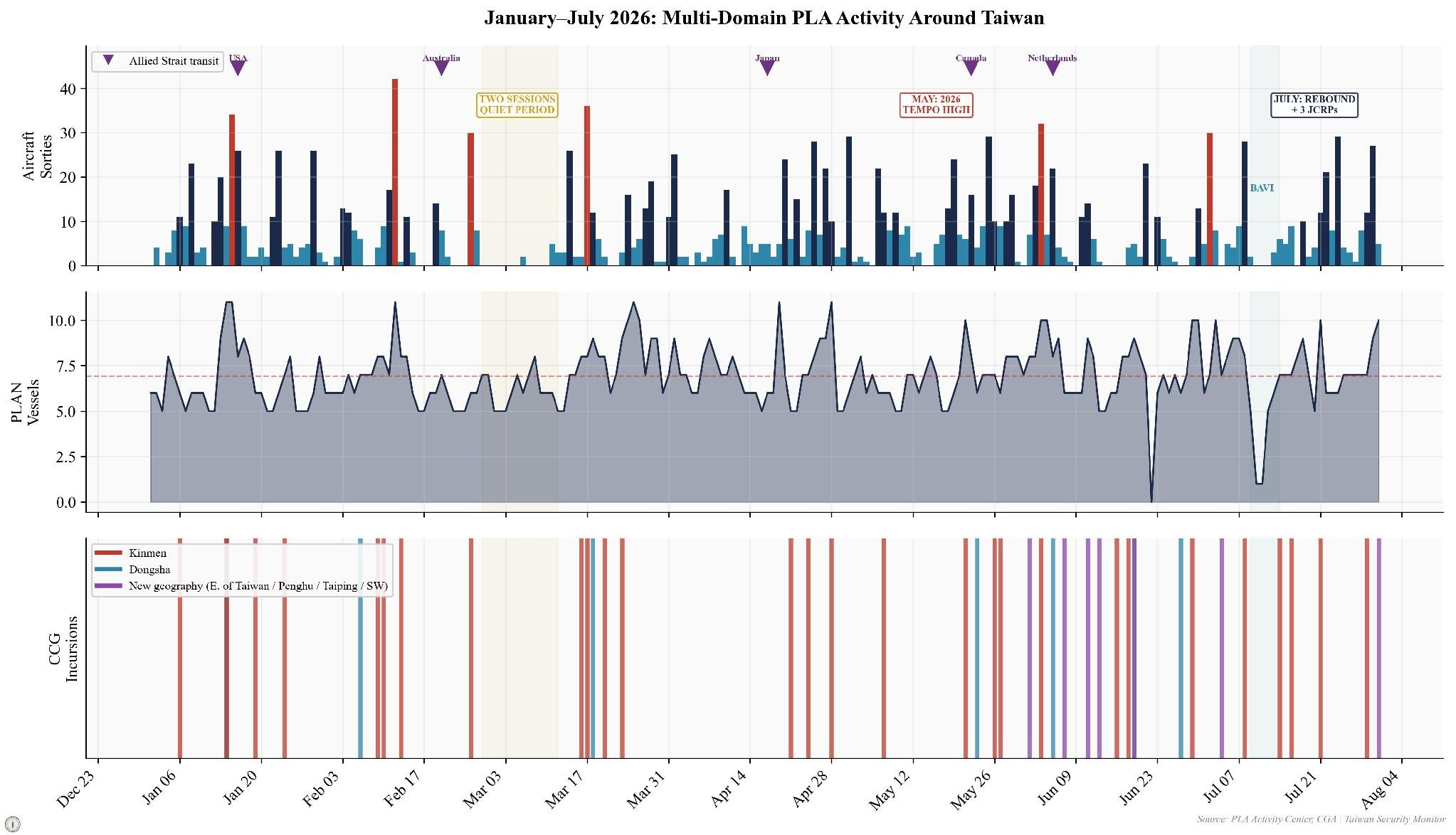
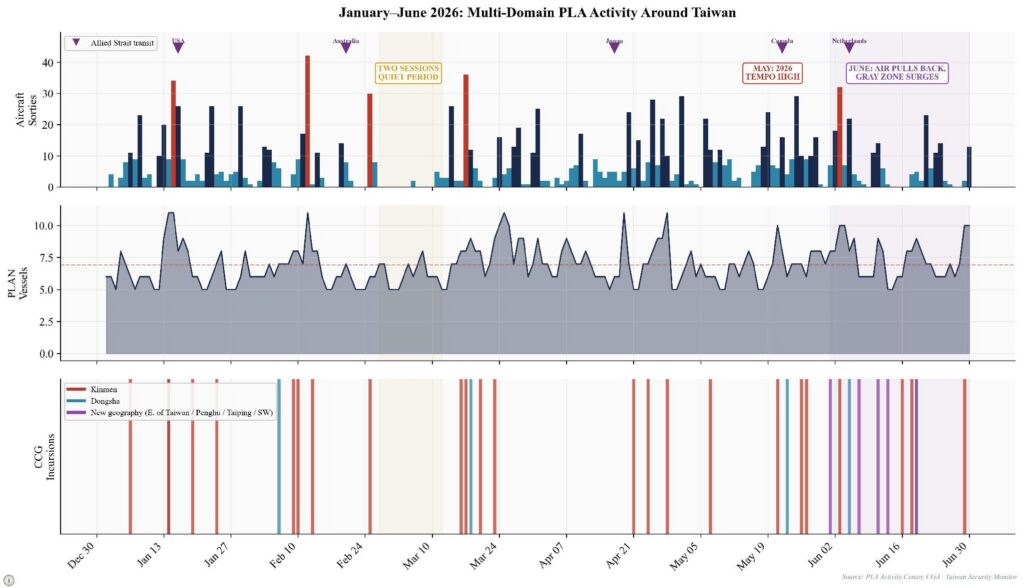
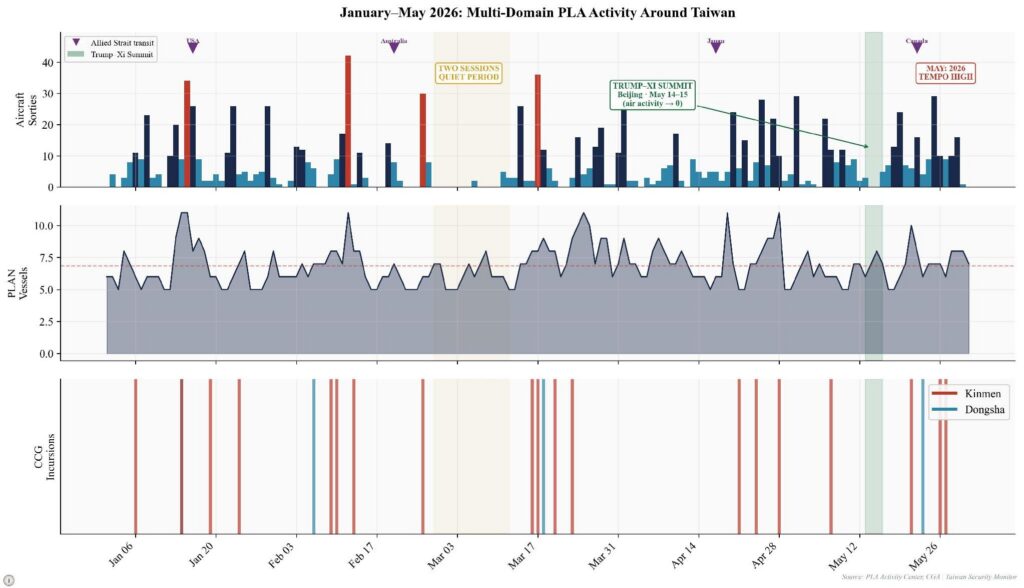
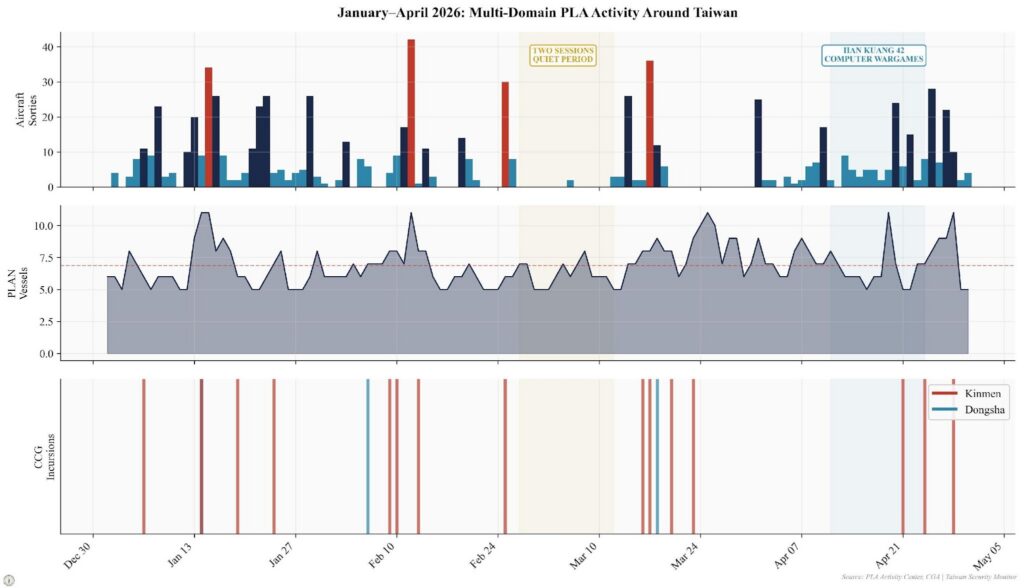
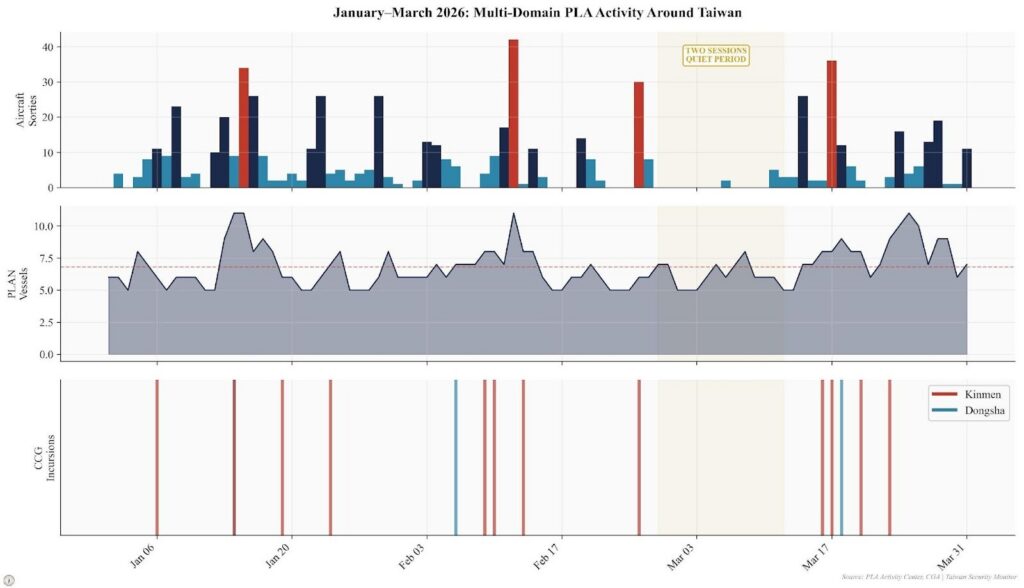
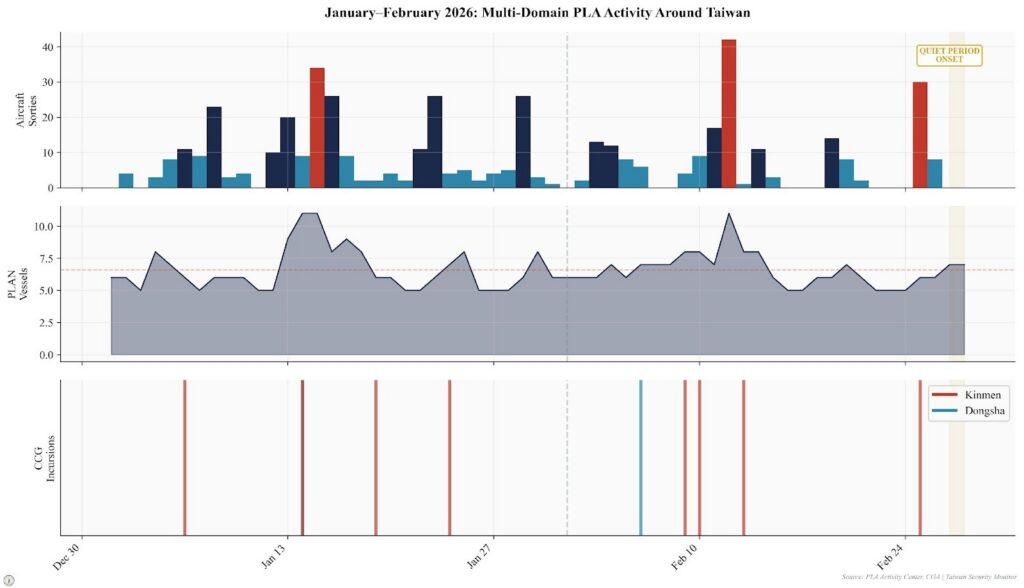
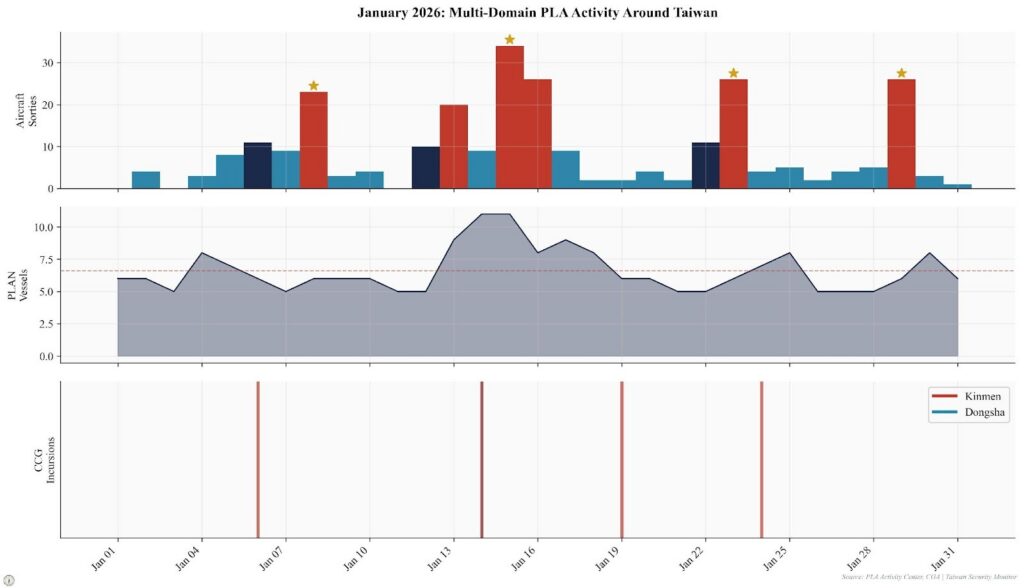
Figure 5. January–July 2026 multi-domain PLA activity: air sorties, naval presence, and CCG incursions. The shaded band in July marks the Typhoon Bavi disruption. Inverted triangles atop the air panel mark allied Taiwan Strait transits.
July’s data reinforces the observation that air activity fluctuates while naval presence holds a persistent baseline and coast-guard operations follow their own institutional rhythm. The Typhoon Bavi window is the starkest illustration: air sorties and PLAN detections both cratered, but the CCG conducted incursions on either side of the storm, and the east-of-Taiwan formation remained on station throughout. Across seven months, the overall multi-domain posture has not meaningfully decreased from the level sustained since August 2022.
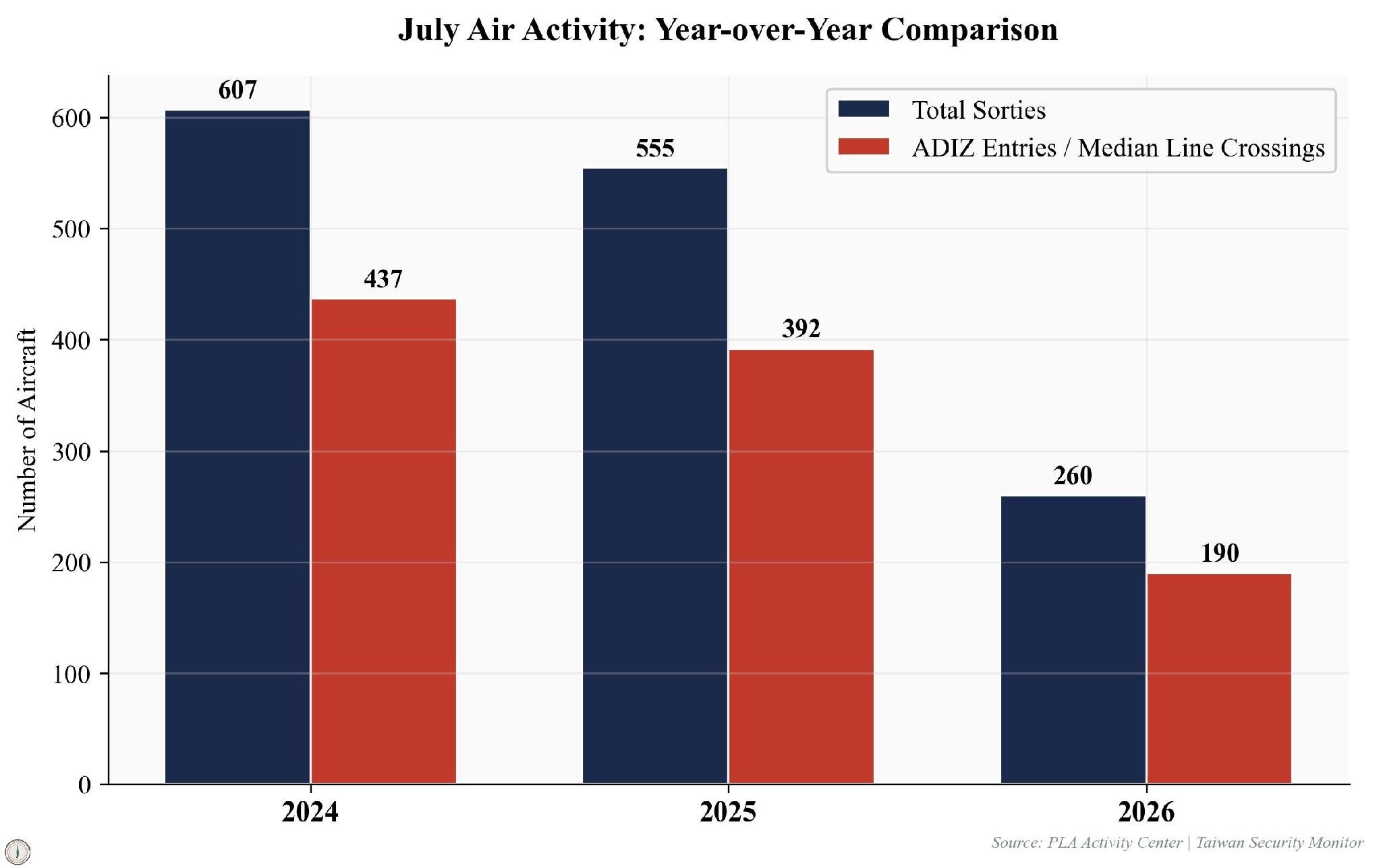
Figure 6. July air activity year-over-year: total sorties and ADIZ entries, 2024–2026.
Methodology & Sources
Air and naval detection data are drawn from the PLA Activity Center database maintained by the Taiwan Security Monitor, which compiles daily press releases issued by Taiwan’s Ministry of National Defense. The PLA Activity Center data are complete through July 31, 2026. Coast Guard incident data are compiled from Coast Guard Administration gray-zone press releases (cga.gov.tw) and verified against contemporaneous media reporting. Allied Taiwan Strait transit records are drawn from the Taiwan Strait Transit Tracker maintained by the Taiwan Security Monitor; no allied transits were recorded in July 2026. “ADIZ” denotes Taiwan’s Air Defense Identification Zone; “median line” refers to the informal centerline of the Taiwan Strait historically observed by both sides; “JCRP” denotes Joint Combat Readiness Patrols as designated by Taiwan’s MND. All analysis and commentary are by the Taiwan Security Monitor.