Taiwan Security Monitor

Weekly Arms Update:ย 5/6/26ย 

Author: Joe Oโ€™Connor, Shikhar Chaturvedi, Danielle Kremer, & Wyeth Lindbergย 


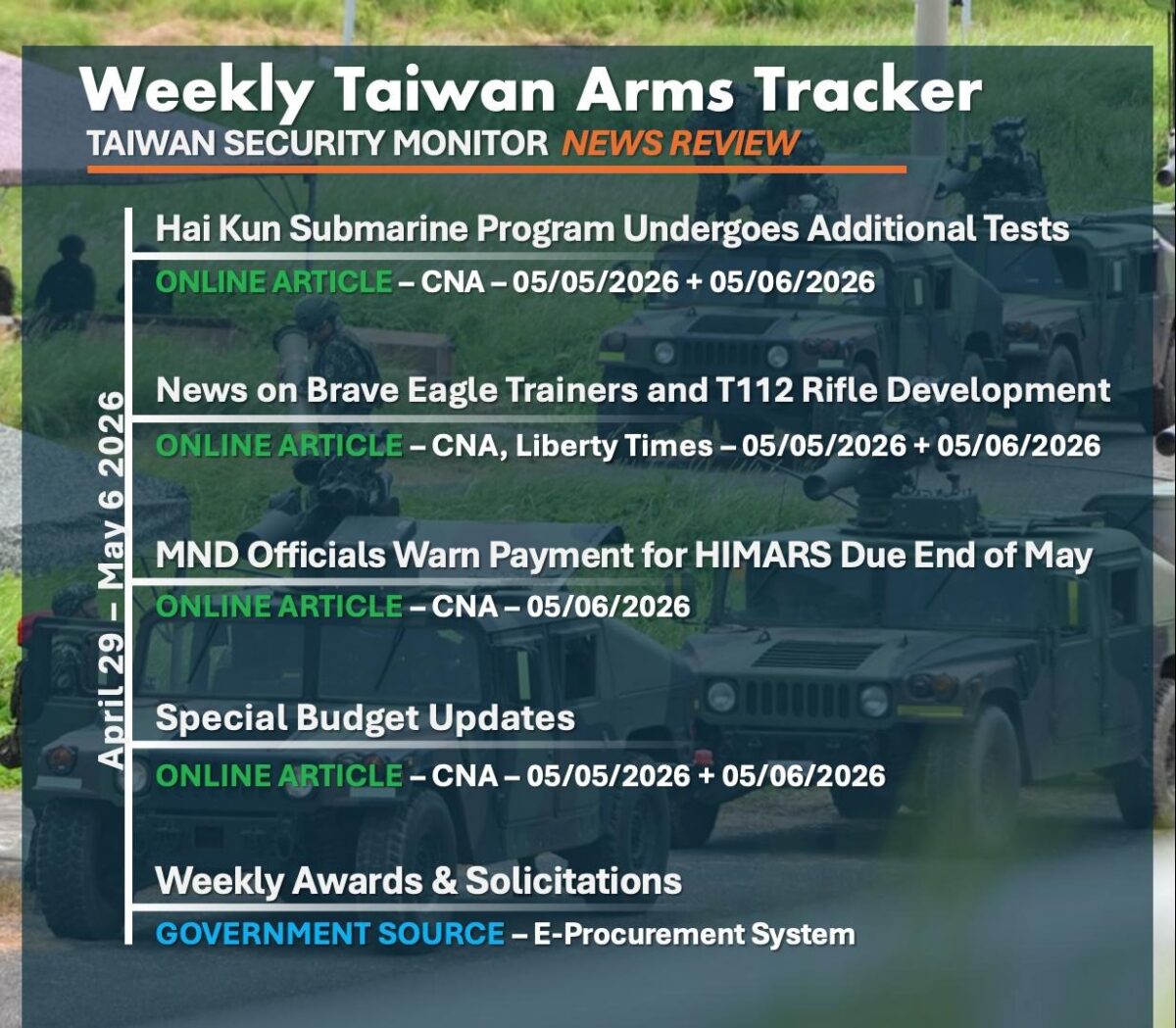
This week: Taiwanโ€™s indigenously-produced Hai Kun submarine completed two more submergence tests, progress reports emerged on delivery of Brave Eagle trainer aircraft and T112 battle rifles; Minister of National Defense Wellington Koo warned about payments for HIMARS being due soon; and special budget updates, alongside weekly awards and solicitations. 

Hai Kun Submarine Program Undergoes Additional Tests  

On Tuesday, the Hai Kun (SS-711), a prototype of Taiwanโ€™s indigenous submarine program, undertook its seventh submergence test off Kaohsiung. Marking its 13th sea trial and the first in over a month, analysts speculated that the submarineโ€™s crew did torpedo testing and handling, since certain equipment borrowed from the United States must be returned. 

On Wednesday, the Hai Kun departed again for an eighth test, and appeared to undertake a more comprehensive exercise, including navigation, diving maneuvers, and live-fire torpedo drills, per observers speaking to CNA. Much like the prior test, a large focus appears to be on torpedo testing and overnight testing of seaworthiness. 

News on Brave Eagle Trainers and T112 Rifle Development 

An MND report to the Legislative Yuan revealed on Monday that the Air Force has received 56 โ€œBrave Eagleโ€ advanced jet trainer aircraft so far this year and is expected to receive the remaining 10 by the end of the year. A variant of the Indigenous Defense Fighter jet, the Brave Eagle has been in production and procurement since 2017. 

The same MND report, and an ensuing hearing on Wednesday, revealed that failure rates of new T112 battle rifles will be investigated by the Armaments Bureau, who has also allocated funds for T112 red-dot sight production, to be completed and issued as standard equipment by 2029. The failures of some 500 T112s in ROC Military Police service, including claimed poor barrel quality, have not been reported to the Bureau, but an investigation will occur anyway, per Director Lt. Gen. Lin Wen-hsiang. 

MND Officials Warn Payment for HIMARS Due End of May 

In the same Legislative Yuan hearing as above on Wednesday, Minister of National Defense Wellington Koo and Director of the MNDโ€™s Department of Strategic Planning, Lt. Gen. Huang Wen-chi, warned that the final deadline is May 31 for initial payment of High Mobility Artillery Rocket Systems (HIMARS) from the U.S.; and that failure to pay would mean procurement cancellation and further delays if Taiwan wished to re-apply for sale of those systems. 

Huang further stated that the initial payment is valued at NT$800 million (US$25.49 million), and was originally due on March 30, but after coordination between the MND and U.S. authorities, the deadline was set back to late May. DPP legislators, hearing this, expressed concern regarding the deadline, particularly due to delays and lack of agreement in passing a supplemental defense budget, which will fund procurement of HIMARS, as well as Paladin self-propelled howitzers, Javelin anti-armor missiles, and TOW-2B anti-armor missiles. 

Special Budget Updates 

On Tuesday, Kuomintang members of the Legislative Yuan and party members met internally to achieve a compromise on the partyโ€™s topline ceiling for the special defense budget, particularly after last week, where divisions began to appear and KMT Vice Chairman Chi Lin-lien threatened to expel LY Speaker Han Kuo-yu from the party for his support of NT$800 billion in spending. At this weekโ€™s meeting, KMT legislator Lai Shih-bao made a compromise proposal, consisting of the present NT$380 billion (US$12 billion) ceiling, and amending it to NT$800 billion (US$25.49 billion) once additional Letters of Offer and Acceptance (LOAs) from the United States are received. Lai did note, however, that some KMT members, who are seeking re-election in local elections this year, favor a flat NT$800 billion ceiling to assist their electoral chances.  

On Wednesday, LY Speaker Han Kuo-yu convened the fourth round of caucus negotiations on the special defense budget, which like previous sessions, failed to achieve consensus on the topline budget ceiling, despite recessing to allow more private consultations. Per Han, the LYโ€™s standard 30-day โ€œfreezeโ€ policy has elapsed, allowing the three competing proposals (one by the Lai administration + DPP, one by the Kuomintang, and one by the Taiwan Peopleโ€™s Party) to advance to floor consideration. LY consideration of proposals could happen as early as Friday, May 8, per Han. 

Weekly Awards / Solicitations 

On Thursday, the Air Force Commandโ€™s Military Mission to the United States awarded the American Institute in Taiwan a NT$10.07 billion (US$319.42 million) contract for non-standard aircraft spare parts and accessories. The contract is to be fulfilled in Taichung (Daya District) Chiayi (Shuishang Township), Tainan (Rende District), Kaohsiung (Gangshan District), Pingtung (Pingtung), Taitung (Taitung), Hualien (Xincheng Township, Ji’an Township). 

Also on Thursday, the Military Police Command solicited bids for the purchase of unmanned aerial vehicles (UAVs) for diversified administrative applications, worth NT$247.20 million (US$7.83 million)

Weekly Arms Update:ย 4/29/26ย 

Authors: Joe Oโ€™Connor,ย Shikhar Chaturvedi, Danielle Kremer, & Wyeth Lindbergย 


This week: special budget negotiations remain stalled, as internal fractures emerge; a Lockheed earnings call gives details on delayed F-16s; the final batch of Abrams tanks are delivered to Taipei; and information comes out about ROCN plans to use V-BAT drones on ships, alongside weekly awards and solicitations. 

Special Budget: Negotiations Stall, KMT Fractures Emerge 

Negotiations on the budget this week continued, with two consultations in the Legislative Yuanโ€™s Foreign Affairs and National Defense Committee ending with little to no consensus reached. A hearing on Thursday elicited some agreement on execution provisions, including members agreeing on LY oversight of reallocation of funds and reporting requirements. The most recent hearing, on Monday, concluded after approximately an hour, with no resolution. LY Speaker Han Kuo-yu later told press that the next hearing would be scheduled for next week, on May 6. 

Separately, internal discussions in the opposition Kuomintang (KMT) and Taiwan Peopleโ€™s Party (TPP) over a unified spending proposal continued, with rumors emerging that both had agreed on a budget ceiling of NT$800 billion (US$25.3 billion). An internal KMT caucus meeting today, however, revealed greater divisions, with members being split between the current proposal for NT$380 billion (US$12 billion), or NT$800 billion. This tension within the party escalated to an extent that KMT Vice Chairman Chi Lin-lien threatened to expel LY Speaker Han Kuo-yu from the party for his support of NT$800 billion in spending. 

Lockheed Earnings Call Provides Updates on F-16  

On Thursday, Lockheed Martin chief financial officer Evan Scott told shareholders in a quarterly earnings call that “issues during the flight test” of F-16 Block 70 fighter jets for Taiwan and Morocco contributed to a decline in profits and resultant delays in delivery. Scott also stated that “we are back on track with a successful flight test and plan to begin deliveries of the first aircraft as soon as this week.” It is unclear whether Taiwan or Morocco will receive airframes first, although previously, Minister of National Defense Wellington Koo stated that he thought they would begin receiving F-16s by September 2026. 

Final Batch of Abrams Tanks Delivered to Taipei 

On April 27th, the third and final batch of M1A2T Abrams tanks, purchased from the United States and equipped with 120mm smoothbore guns and incorporating advanced fire control and hunter-killer systems arrived at Taipei Port, totaling 108 tanks. The first batch consisted of 38 tanks and arrived in December of 2025; the second batch of 42 tanks arriving that July. According to sources, these 28 tanks are split: 10 are to be used by the Equipment and Training Department, while 14 will be allocated to the 269th Brigade. As for the other four tanks, there have been no further details on their disposition. Now that all tanks are present, they will participate in transition training, quality evaluations, and combat readiness. According to MND sources, if training progresses well, the tanks may be ready for service by the end of this year. 

Representing 6.3% of the total US$31.72 billion backlog of U.S. arms sales to Taiwan, as tracked by Taiwan Security Monitor, the delivery of the Abrams represents completion of a US$2 billion sale, originally notified to the U.S. Congress in July 2019.  
 
Future ROCN Ships to Include Space for V-BAT UAVs 
 
Taiwanโ€™s Navy is reportedly planning a โ€œdual hangarโ€ design for its next-generation combatant, with space to support both an MH-60R anti-submarine helicopter and a vertical takeoff and landing (VTOL) unmanned aerial vehicle (UAV). According to Liberty Times, the design evaluation case is expected to move forward in May, and military sources said the Navy has identified Shield AIโ€™s V-BAT as the design reference for the unmanned aviation component. The requirement reportedly includes remote-control and guidance capabilities for the UAV. 
 
The V-BAT’s manufacturer, Shield AI, signed a February 2026 agreement with NCSIST to integrate its Hivemind autonomy platform into Taiwan-developed unmanned systems, and the company says V-BAT is designed for maritime ISR and targeting in GPS-denied and communications-contested environments. 
 
Weekly Awards/Solicitations  

On Friday, the Naval Command made a repeat solicitation of bids for the procurement and installation of nuclear, biological, and chemical (NBC) protection training ground facilities, worth NT$1.51 billion (US$47.9 million)

On Monday, the Information and Communications Command made a repeat solicitation of bids for the licensing of cloud information services, worth NT$36.03 billion (US$1.14 billion)

On Tuesday, the Tactical Control Wing of the Air Force Command awarded NCSIST a NT$162.49 million (US$5.14 million) contract for maintenance of the Anyu logistics maintenance system for 2026โ€“2030. 

On Wednesday, the Naval Command made a repeat solicitation of bids for 266 transport trucks and 221 5-ton transport vans, worth NT$1.35 billion (US$42.53 million)

U.S. Contracts Relating to Taiwan 

On Wednesday, the U.S. Army awarded Lockheed Martin an undefinitized contract action with a ceiling of US$1.13 billion (NT$35.75 billion) for production of High Mobility Artillery Rocket System (HIMARS) launchers, for U.S. forces and FMS customers, including Taiwan and four other countries. Work is expected to be completed by April 30, 2028. 

Weekly Arms Update:ย 4/22/26ย 

Authors: Joe Oโ€™Connor,ย Shikhar Chaturvedi, Danielle Kremer & Wyeth Lindbergย 


This week: special budget negotiations continued, featuring statements from key stakeholders; two U.S. Senators introduced an act to expand reporting on the Taiwan Relations Act; the MND released statistics on future ammunition purchases; and the MND released seven major contract awards to American contractors; alongside weekly contracts and solicitations. 

Special Budget: MND Issues Redacted Budget Proposal 

Statements from stakeholders involved in or observing special budget negotiations proliferated this week, beginning with a letter from four U.S. Senators, including Senate Foreign Relations Committee Ranking Member Jeanne Shaheen, expressing to Legislative Yuan leaders the need to โ€œapprove a supplementary defense budgetโ€ that addresses ongoing U.S. sales to Taiwan, as well as โ€œspeedier domestic production.โ€ At a military inspection in Kaohsiung on Friday, President Lai also called for passage, reiterating the need for โ€œconstant preparedness.โ€ At a forum in Taipei on the same day, retired U.S. Navy Adm. Mark Montgomery urged the LY to pass a special budget before a Trump-Xi summit in May, warning that not doing so would weaken Taiwanโ€™s relations with the U.S. 

On Sunday, Kuomintang (KMT) media personality, Jaw Shaw-kong, stated that he would support a proposal worth NT$810 billion (US$25.64 billion), tying approximately NT$350 billion of that to existing U.S. arms sales, and holding the remaining NT$460 billion for future U.S. sales. Jaw stated that he came to this number after subtracting budget items for domestic procurement from the Lai administrationโ€™s proposal. 

On Monday, the LYโ€™s Foreign Affairs and National Defense Committee held a closed-door hearing, where Minister of National Defense Wellington Koo laid out a new, partially redacted version of the Lai administrationโ€™s NT$1.25 trillion (US$40 billion) spending proposal. In the hearing, Koo continued to play defense, responding to Jawโ€™s comments by urging the MNDโ€™s need to plan around operational needs.  

On Tuesday, in a Senate Armed Services Committee hearing, U.S. Indo-Pacific Command commander, Admiral Samuel Paparo, stated that progress on the special budget would reflect โ€œhow committedโ€ Taiwan is to its own defense, among other comments. A Reuters report on the hearing also revealed that KMT officials had assured Democratic aides visiting Taiwan in March that a defense proposal would eventually be passed. 

U.S. Senators Introduces Act Expanding TRA Reporting  

A bipartisan group of senators introduced the โ€œTaiwan Relations Reinforcement Actโ€ (S.4294) on April 14, which would require the Department of Defense to submit an annual report assessing the United Statesโ€™ capacity to fully implement the Taiwan Relations Act (TRA). The bill mandates a detailed evaluation of U.S. ability to deter and respond to a range of Taiwan contingency scenarios, including amphibious invasion, blockade, and large-scale missile strikes, while also assessing gray zone coercion across cyber, economic, and information domains. It further requires analysis of U.S. force posture in the Indo-Pacific and the sustainability of operations in a prolonged conflict, alongside the role of allied contributions. Notably, the report must identify capability gaps, estimate future shortfalls over a ten-year horizon, and outline budgetary and force structure changes needed to meet TRA obligations. The legislation also calls for an assessment of U.S. capacity to respond to a Taiwan contingency in the context of managing other global conflicts, underscoring growing congressional concern over resource constraints and multi-theater readiness


MND Releases Information on Future Commercial Purchases 

On April 21st, Taiwanโ€™s Ministry of National Defense announced a list of weapons systems it intends to acquire through direct commercial sales (DCS) and domestic manufacturing, many of them being unmanned systems and ammunition. The MND stated that this process would involve working with the National Chung-Shan Institute of Science and Technology (NCSIST) and the Armaments Bureau to achieve the expected results. This would all be part of the US$40 billion (NT$1.25 trillion) special budget plan the DPP and Lai administration proposed in November of 2025. Approximately a quarter of the budget proposal will go to domestic procurement and indigenous production capabilities, with the remaining 76% going to purchases of United States weapons systems.  

MND Issues Seven Major Contract Awards to AIT 

This past week, the Ministry of National Defense awarded 7 major contracts to the American Institute in Taiwan; one Air Force award on Tuesday and six today. 

According to information published yesterday on Taiwanโ€™s government e-procurement website, the Air Force Command awarded the American Institute in Taiwan (AIT) a NT$572.60 million (US$18.19 million) contract for โ€œother support services,” with Liberty Times reporting a performance period of five years. On Wednesday, the Army Command awarded contracts for โ€œMissile combat reserve replenishment,โ€ “Long-range precision strike systems,” and โ€œSelf-propelled artilleryโ€, for various amounts noted below. The Naval Command awarded a contract for “Anti-armor missiles.” The Armaments Bureauโ€™s Production and Manufacturing Center awarded a contract for the โ€œCo-production of large-caliber ammunition.โ€ These awards come as the fate of the special budget, funding from which would likely pay for these tranches, remains undecided as Legislative Yuan leaders debate the scope of approved spending. 

Weekly Awards/Solicitations  

On Thursday, the Naval Command awarded RH Marine a NT$33.32 million (US$1.06 million) contract for 11 items, including oscillators. RH Marine is a Dutch company that designs and integrates advanced electrical and automation systems for both civilian and military naval vessels. The contract is to be fulfilled throughout the southern region of Taiwan. 

On Friday, the Army Command awarded seven companies a NT$1.80 billion (US$57.27 million) contract for frozen meat products. The contract is to be fulfilled nationwide. 

Also on Friday, the Army Logistics Command awarded a NT$339.11 million (US$10.77 million) contract to NCSIST for the outsourced maintenance of the Armyโ€™s “Phase II Mobile Digital Microwave System” for FY2026โ€“2030. The contract is to be fulfilled in the Zhongli District of Taoyuan. 

On Tuesday, the Air Force Command awarded American Institute in Taiwan a NT$572.60 million (US$18.19 million) contract for โ€œother support servicesโ€. 

Also on Tuesday, the Armaments Bureau made a repeat solicitation of bids for the purchase of engineering services for dry dock construction, as part of the Weihai project. The solicitation is valued at NT$6.10 billion (US$193.50 million)

On Wednesday, several awards were announced: 

  • Theย Army Commandย awardedย the American Institute in Taiwanย aย NT$5.32ย billionย (US$168.98ย million)ย contractย forย โ€œMissile combat reserve replenishmentโ€.ย The contract is to be fulfilled inย Taichung (Houli and Daya Districts), Kaohsiung (Alian District), Pingtung (Wanluanย Township)ย andย Hualien (Hualienย County).ย 
  • Theย Army Commandย awardedย the American Institute in Taiwanย a NT$123.50ย billionย (US$3.92 billion) contractย forย “Long-range precision strike systems”. The contract is to be fulfilled inย Taoyuan (Zhongli District), Taichung (New Community), Tainan (Guanmiaoย District)ย andย Kaohsiung (Qishan District).ย 
  • Theย Army Commandย awardedย the American Institute in Taiwanย aย NT$73.89ย billion (US$2.35ย billion)ย contractย forย “Self-propelled artillery”. The contract is to be fulfilled inย Taoyuan (Zhongliย andย Pingzhenย Districts)ย andย Tainan (Guanmiaoย District).ย 
  • Theย Naval Commandย awardedย the American Institute in Taiwanย aย NT$5.13ย billionย (US$162.75ย million) contractย forย “Anti-armor missiles”. The contract is to be fulfilled inย Taoyuanโ€™sย Guishanย District andย Kaohsiungโ€™sย Linyuanย District.ย 
  • Theย Armaments Bureauโ€™s Production and Manufacturing Centerย awardedย the American Institute in Taiwanย aย NT$910.45 million (US$28.91ย million)ย contractย forย the โ€œCo-production of large-caliber ammunitionโ€.ย The contract is to be fulfilled inย the Zhongshan andย Nagangย Districts of Taipei.ย 
  • Theย General Staffย awardedย the American Institute in Taiwanย a NT$22.88ย million (US$0.73ย million)ย contractย forย โ€œIntegrated air defense servicesโ€.ย Integrated air defense services likelyย refersย to Taiwanโ€™s air and missile defense system,ย the T-Dome.ย The contract is to be fulfilled inย theย Zhongshanย districtย ofย Taipei.ย 

Weekly Arms Update:ย 4/15/26ย 

Authors: Joe Oโ€™Connor,ย Shikhar Chaturvedi, Danielle Kremer, and Wyeth Lindbergย 


This week: special budget negotiations continued to stall without consensus, the ROCN awarded another maintenance contract to a French company; NCSIST leaked the range of its Strong Bow missile system, as well as upgrades to M60A3 main battle tanks; and former U.S. military officers observed an annual civil defense drill in Taiwan, alongside weekly awards and solicitations. 

Special Budget Negotiations Continue to Stall 

On Thursday, scheduled negotiations on the special defense budget in the Legislative Yuan stalled as Kuomintang legislators were not present, having asked DPP convener Chen Kuan-ting to postpone any hearings on the budget until chairwoman Cheng Li-wun returned from her trip to the PRC, which she did on Saturday. This led to condemnation by DPP officials, who accused the KMT of obstructing legislative business. 

DPP press conference on Tuesday confirmed that cross-party negotiations would be held today and convened by Legislative Yuan President Han Kuo-yu. Per CNA and Military News Agency, those negotiations also resulted in no consensus, but legislators from all three LY caucuses attended. Reportedly, convener Chen Kuan-ting will organize a special report from the MND on procurement issues on Monday, April 20, and additional negotiations will continue thereafter.  

ROCN Signs Second Deal for Continuing Naval Support 

On Thursday, the Republic of China Navy (ROCN) awarded Defense Conseil International (DCI) as NT$1.98 billion (US$62.26 million) contract for repairable parts and servicing as they begin upgrading their fleet of six Kang Ding-class frigates. This contract comes two weeks after the Navy signed a NT$1.81 billion (US$56.73 million) deal with DCI for technical support of the frigates. DCI, which is Franceโ€™s state-owned military export agency has received awards for these due to the frigatesโ€™ systems having French patents. Both contracts are to run for 5 years and 6 months, with an expected completion date of 2031. 

NCSIST Leaks Range of Strong Bow Missile, M60 Tank Upgrades 

The website of the National Chung-Shan Institute of Science and Technology (NCSIST) and an industry presentation revealed new details about two Taiwanese defense programs. On April 10, Liberty Times reported that NCSIST had updated its website to include the M60A3 main battle tank upgrade program, describing a package that replaces legacy components with digital fire control, all-electric gun control, and high-resolution sights. The report also said the first upgraded vehicle is undergoing system tests and is scheduled for a live-fire operational evaluation on May 19. Separately, NCSISTโ€™s official product page now publicly describes the M60A3 upgrade as intended to improve firing accuracy, shorten engagement time, and mitigate obsolescence issues, underscoring Taipeiโ€™s continued effort to extract more utility from legacy armor while it pursues broader force modernization. 

A second Liberty Times report suggested the range of the new Strong Bow missile may have been inadvertently disclosed during an earnings presentation by Taiwanese microwave component firm Allis. According to the report, the company described Sky Bow IV/Strong Bow as having a 1,500-kilometer range, a speed of more than Mach 10, and a 70-kilometer intercept altitude, while also noting that NCSIST has publicly described the system as part of a layered missile defense architecture with an AESA radar and tactical center vehicle. Because the reported range figure came from an industry presentation rather than a formal Ministry of National Defense (or NCSIST specification sheet), it should be treated cautiously. Still, if accurate, the disclosure offers insight into the scale of Taiwanโ€™s T-Dome defense ambitions and the indigenous programs tied to the proposed special budget. 

U.S., Allied Former Officers Attend Annual Civil Defense Drill 

From April 11โ€“13th, the Fuhe Association held a joint civil defense training exercise in Nantou, Taiwan. This training was attended by multiple retired generals from Taiwan’s allies, including the United States, Japan, the Republic of Korea, and the Philippines. These retired generals closely observed the civilian training activities, while exchanging anecdotes and discussing the comparative systems of compulsory military service. Many of them found the enthusiasm from the Taiwanese people impressive, with retired U.S. Navy Rear Admiral Montgomery saying that more Taiwanese citizens should regularly participate in public service. He noted that Taiwan should strengthen its reserve forces to better integrate military and civilian resources, arguing that this would strengthen Taiwanโ€™s ability to respond to both military threats and natural disasters. However, he added that this integration requires significant effort from both the government and its people. 

Weekly Awards/Solicitations  

On Thursday, several bid solicitations were made: 

  • Theย Armaments Bureauย solicitedย separateย bids for the purchase ofย engineeringย servicesย forย dryย dockย construction, as partย of theย Weihai project. Theย Wehaiย Projectย isย the MNDโ€™sย years-long projectย toย renovate and upgradeย Zuoyingย Navalย Base.ย Theย solicitationย is valued atย NT$6.10ย billionย (US$192.02ย million).ย 
  • Theย Naval Commandย made a repeat solicitation of bids forย theย procurement and installation of equipment and facilities forย nuclear, biological, and chemicalย (NBC)ย warfareย protection training. The solicitation isย valuedย atย NT$1.51 billionย (US$47.63ย million).ย 

Also on Thursday,ย theย Naval Commandย awardedย Defense Conseil International aย NT$1.98ย billionย (US$62.26ย million)ย contractย forย repairable parts and their servicing.ย The contract is to be fulfilled throughout the southern region of Taiwan.ย 

On Friday, the Army Command solicited bids for the purchase of broadband radios, worth NT$9.61 billion (US$302.85 million)

On Monday, the Information and Communications Command made a repeat solicitation of bids for the hardware and software required for virtual workspaces. The solicitation is worth NT$2.30 billion (US$72.96 million)

On Tuesday, the Naval Commandโ€™s military mission to the United States solicited bids for the purchase of sonobuoys, worth NT$389.63 million (US$12.33 million)

U.S. Contracts 

Today, the U.S. Air Force awarded a US$234.76 million undefinitized contract action to Raytheon for production of Advanced Medium-Range Air-to-Air Missile (AMRAAM) Extended Range (ER) missiles. This contract uses Taiwan FMS funds alongside 5 other countries in the total amount of US$61.57 million. Work is expected to be completed by April 2030. 

The Air Force also awarded a US$13.72 million contract to Chromalloy Gas Turbine, LLC, for the re-manufacture of F-100-PW-220 engine stators and shrouds. This contract involves FMS sales to Taiwan alongside 14 other countries, and represents components for F-16 Fighting Falcon fighter jets. Work is expected to be completed by April 2027. 

Taiwan Arms Sale Backlog,ย Marchย 2026 Updateย 

Abrams and ALTIUS Delivered, But Further Delays Emerge

Authors: Joe Oโ€™ConnorEric Gomez, Shikhar ChaturvediDanielle Kremer, and Wyeth Lindberg 


Taiwanโ€™s legislature failed to reach an agreement on a special procurement budget to fund U.S. arms sales in March, which is already delaying Foreign Military Sales (FMS) cases worth over $10 billion.  

But March had good news for the U.S. arms sale backlog as well. A June 2024 FMS case for ALTIUS drones was fully delivered, reducing the backlogโ€™s dollar value by $300 million. The final tranche of Abrams tanks is also on its way to Taiwan by ship. Once these tanks arrive the backlog will come down by $2 billion, but we were not able to verify their delivery before the end of March so that FMS case is still coded as delivery in progress for this month. No new FMS cases were notified to Congress this month. 

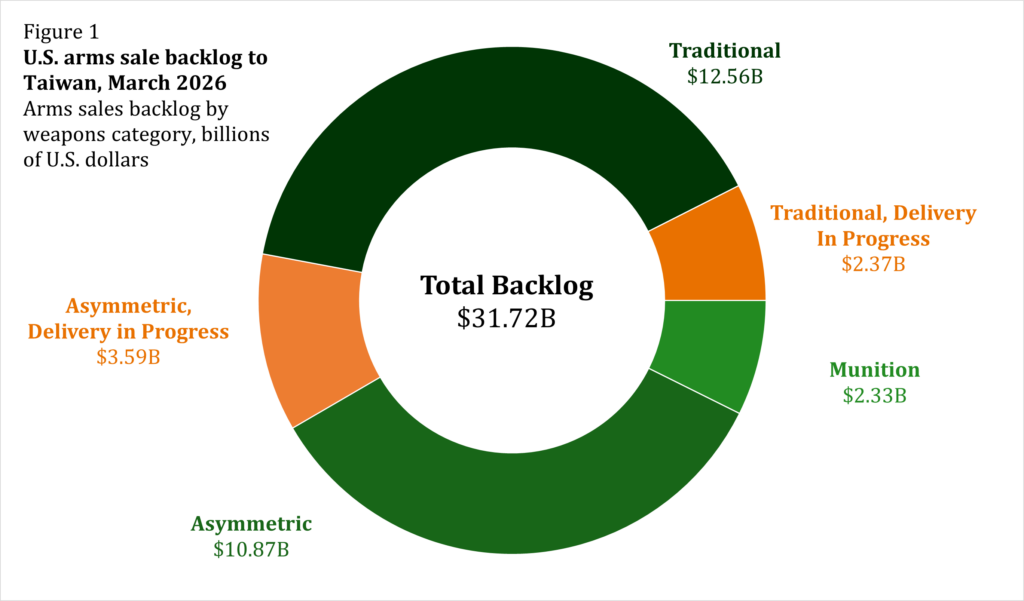
The delivery of ALTIUS drones brings the backlogโ€™s total value down slightly to $31.72 billion.  

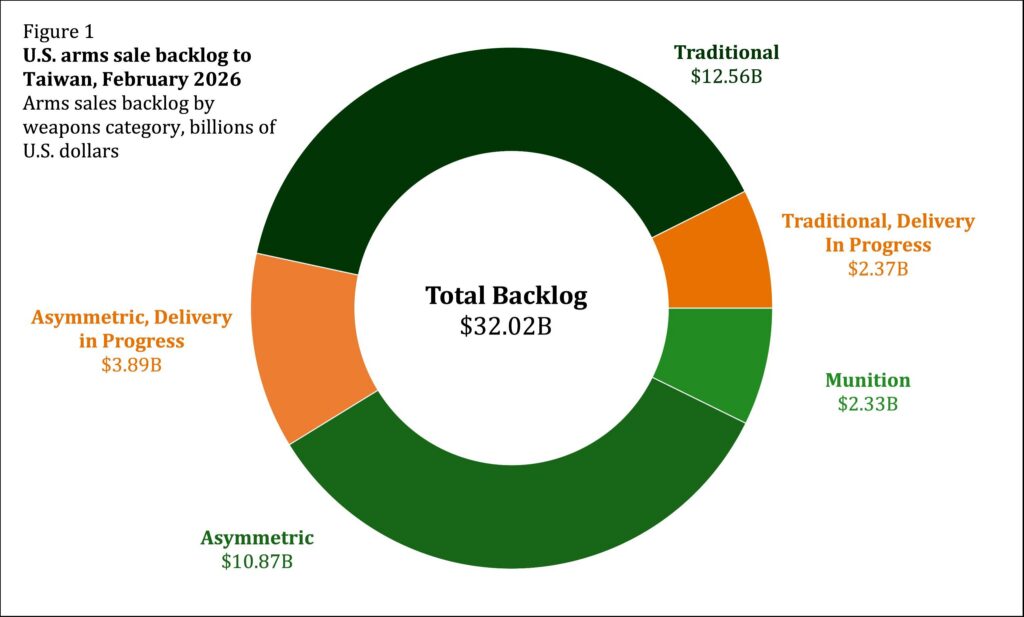
Figure 1 illustrates the breakdown of the backlog between asymmetric weapons, traditional weapons, and munitions. Table 1 provides an itemized list of all arms sales in the backlog, including the most up-to-date information on their status. In that table, arms sales that have been partially but not fully delivered are indicated in italics. New and completed arms sales are indicated with bolding and underlining.  

Special Budget Updates in March 

On March 5, the Kuomintang (KMT) released their proposal for US$12.02 billion (NT$380 billion) in spending, to fund only the arms approved in December 2025. This proposal required that Letters of Offer and Acceptance (LOAs) be approved before funds are appropriated, instead of having funds in advance. The KMTโ€™s proposal also required that funds for future arms sales from the US be approved as a second bill, instead of the Lai administration or Taiwan Peopleโ€™s Party (TPP) proposals, which allocate funds for future arms purchases. 

Following its release, Minister of National Defense Wellington Koo and statements carried by the Military News Agency (MNA) pushed back against the proposal, arguing that its sunset provision of December 2028 is incompatible with current delivery timelines and unrealistic. The MND also clarified in a statement that three sales announced in December, including the Taiwan Tactical Network, as well as AH-1W spare parts and Harpoon missile refurbishment, were not included within the administrationโ€™s NT$1.25 trillion special budget request, instead being folded under annual defense spending. 

Table 1
Itemized list of backlogged capabilities by weapons category, March 2026
Capability SoldDollar Value (In Millions)Share of total backlog, March 2026Current Status as of March 2026
Traditional$14,92747.06%
F-16C/D Block 70$8,00025.22%March 2026: Taiwanese officials attended an Acceptance Check Flight in the U.S. for the first F-16 airframe. Minister Koo also stated to press that the first F-16 could arrive as early as September 2026.
Paladin Self-Propelled Howitzer$4,03012.71%March 2026: MND officials warned that Letter of Offer and Acceptance for Paladins, as well as three other sales, would expire at end of month if not signed. LY agreed to allow signature of LOAs before special defense budget is approved.
M1A2T Abrams Tanks$2,0006.31%March 2026: MND officials stated that the final batch of 28 Abrams are โ€œat seaโ€ enroute to Taiwan. Further statements indicated delivery either at the end of March or in April. As of the end of March, TSM cannot independently verify delivery.
F-16 IRST Systems$5001.58%December 2025: US DoD awarded an undefinitized contract action to Lockheed Martin for targeting pods, including 55 IRST pods for Taiwan. Work is expected to complete by June 2031.
MS-110 Recce Pods$3671.16%February 2026: Three MS-110 pods expected to arrive by the end of 2026. This may fulfill the FMS case, but getting accurate, consistent numbers on MS-110 delivery has been challenging.
MK 75 76mm Gun Mounts$300.09%No information since posting of Congressional notification.
Asymmetric$14,76345.60%
HIMARS (Announced December 2025)$4,05012.77%March 2026: MND officials warned that Letter of Offer and Acceptance for HIMARS, as well as three other sales, would expire at end of month if not signed. LY agreed to allow signature of LOAs before special defense budget is approved. MND officials also warned that initial payment for HIMARS would be due, but agreements with U.S. officials resulted in an extension.
Harpoon Coastal Defense System$2,3707.47%March 2026: U.S. DSCA Director Michael Miller confirmed in a House hearing that Taiwan has priority for delivery of HCDS over Saudi Arabia.
National Advanced Surface-to-Surface Air Missile System (NASAMS)$1,1603.66%February 2026: Press reports citing MND sources repeated earlier reporting that Taiwan plans on purchasing 9 additional NASAMS systems and associated missiles. This appears to be one of the arms sales cases being held up by special procurement budget deadlock in the LY.
ALTIUS (Announced December 2025)$1,1003.47%January 2026: MND reported that it would purchase 1,554 ALTIUS-700M loitering munitions and 478 ALTIUS-600M ISR drones. The FMS notification did not specify the number of drones being purchased.
Tactical Mission Network$1,0103.18%January 2026: LY votes to move a special procurement budget proposed by the TPP to committee for consideration. The bill would not fund the Tactical Mission Network, but would fund almost all other FMS cases notified to Congress in December 2025.
PAC-3 MSE Interceptors$8822.78%March 2026: MND officials stated that ongoing delivery of 102 MSE missiles should not be affected by conflict in the Middle East.
AN/TPS-77 and AN/TPS-78 Radar Systems$8282.61%September 2025: Taiwanese press report citing 2026 budget request says that all radar systems will be delivered by the end of 2028. TPS-77s scheduled to begin arriving in 2026; TPS-78s to begin arriving in 2027.
MQ-9B Unmanned Aircraft$6001.89%March 2026: Taiwanese officials attended a โ€œhandoverโ€ ceremony in the U.S. for two of the expected four drones, clarifying that they expect to remain for further testing. LY testimony from MND officials also clarified that delivery is expected by the third quarter of 2026 and should not be delayed by ongoing conflict in the Middle East.
HIMARS (Announced December 2022)$5201.64%February 2026: Press reports citing MND sources indicate that 18 launchers, 20 ATACMS, and 864 GMLRS are expected to arrive before the fourth quarter of 2026. This is consistent with previously reported delivery timelines.
Javelin Missiles$3751.18%March 2026: MND officials warned that Letter of Offer and Acceptance for Javelins, as well as three other sales, would expire at end of month if not signed. LY agreed to allow signature of LOAs before special defense budget is approved.
Air-Launched Harpoon Missiles$3551.12%January 2023: Press report indicates that missiles will be delivered by 2030.
TOW Missiles$3531.11%March 2026: MND officials warned that Letter of Offer and Acceptance for TOWs, as well as three other sales, would expire at end of month if not signed. LY agrees to allow signature of LOAs before special defense budget is approved.
ALTIUS (Announced June 2024)$3000.90%March 2026: MND confirms receipt of all 291 ALTIUS-600M UAVs.
Field Information Communications System$2800.88%May 2025: Budget unfreezing report by MND indicates that testing of the system concluded in early 2025. The first batch of equipment is expected in the fourth quarter of 2025.
C4 Modernization$2650.84%No information since posting of Congressional notification.
Volcano Anti-Tank Mining System$1800.57%February 2026: Press reports citing MND sources indicate delivery of 14 Volcano systems will occur “soon.” This is consistent with previously reported delivery timelines.
Taiwan Advanced Tactical Data Link System Upgrade$750.24%August 2024: Taiwan’s E-Procurement System announced the award of a contract for the Link-16 system with completion date in 2026.
Switchblade 300 Loitering Missile System$600.19%September 2025: Taiwanese press reported details of delivery schedule: 66 drones already delivered to Military Police Command; 150 drones expected to be delivered to ROC Army by end of 2025, 469 drones by the end of 2026.
Munitions$2,3297.34%
AGM-84H SLAM-ER Missile$1,0083.18%December 2025: Taiwanese press report citing a publication by the LY’s budget office indicates a multi-year delay in finalizing details on cost and delivery schedule for AGM-84 missiles. Press report suggests that there is no finalized Letter of Offer and Acceptance (LOA) for this case, which would lay out a payment and delivery schedule.
F-16 Munitions$6191.95%July 2025: US DoD awarded Raytheon a $3.5 billion contract for Lots 39 and 40 of AMRAAM production, to be completed in 2031. Taiwan is one of many FMS customers and specific delivery timeline is not clear.
Mk 48 Heavyweight Torpedoes (Announced June 2017)$2500.79%December 2025: MND report to LY on arms sale delivery status reiterates that Mk-48 is one of three delayed arms sales cases.
AGM-154C Joint Standoff Weapon$1860.58%December 2025: MND report to LY on arms sale delivery status reiterates that AGM-154C is one of three delayed arms sales cases.
Mk 48 Heavyweight Torpedoes (Announced May 2020)$1800.57%December 2025: MND report to LY on arms sale delivery status reiterates that Mk-48 is one of three delayed arms sales cases.
AIM-9X Block II Missiles$860.27%March 2024: SIPRI annual update indicates delivery is expected to occur by 2030.

On March 25, the Legislative Yuanโ€™s Foreign Affairs and National Defense Committee began a two-day markup period of the three budget proposals, aiming to combine them into one bill. Committee members reached consensus on several provisions, including those relating to procurement planning, taken from the KMT proposal, as well as legal authorities, but crucially failed to reach consensus on provisions relating to the topline budget amount and specific procurement items. In the hearing, opposition legislators questioned the governmentโ€™s proposed spending categories, concerned that they were vague or classified. By law, the special budget entered a โ€œfreezeโ€ to allow for further negotiation, which is expected to go into April. Discussed below, these repeated delays and lack of consensus, while somewhat productive in challenging Lai administration policy, have also had negative knock-on effects, resulting in delayed or extended payments for several arms sales. 

March also featured several statements from Taiwanese officials on the status of the special budget. On March 8, President Lai, speaking at a temple in New Taipei, stated his administrationโ€™s budget was reasonable and compared it to a security system against a โ€œbad neighbor.โ€ On March 28, Premier Cho Jung-tai urged opposition parties to perceive the need for national defense and the nationโ€™s requirements, after a markup hearing in which General Huang Wen-chi, head of the MNDโ€™s Strategic Planning Department, was visibly upset. The same day, Vice President Hsiao Bi-khim echoed the same sentiments, speaking at the 2026 Taiwan Civil Defense Annual Conference and noting that the administrationโ€™s budget seeks to improve โ€œwhole-of-society resilience.โ€ 

American officials also weighed in. On March 9, a State Department spokesperson stated that Washington โ€œencourage[s] all parties in Taiwanโ€™s legislature to work through political differences and quickly pass a special defense budget,โ€ specifically addressing whether the United States would support a KMT proposal. On March 26, Director of the American Institute in Taiwan, Raymond Greene, also urged the LY to pass a budget, calling U.S. support for it โ€œrock solid.โ€ 

December Cases Face LOA and Payment Extensions, Possible Delays  

Taipei spent most of March trying to prevent a procedural problem from becoming a delivery problem. In early February, the Ministry of National Defense warned that the LOAs for TOW anti-armor missiles, Javelin anti-armor missiles, and M109A7 self-propelled howitzers would expire on March 15 unless the Legislative Yuan acted. Following this, the LY moved on March 12โ€“13 to authorize the Executive Yuan to sign four U.S. LOAs, adding HIMARS to the original three cases.  While a crucial step, as it prevented the deals from stalling at the signature stage, it did not fully solve the larger problem. In the FMS process, an LOA must be signed and an initial payment made before the U.S. procurement agency can enter into an agreement with the defense industry to build the weapons. Clearing the LOA signature step is a move in the right direction, but Taiwanโ€™s special procurement budget impasse means that it cannot make an initial payment, which means delays in finalizing production contracts.   

On March 26, Liberty Times reported that the initial payment deadline for HIMARS was approaching and that U.S. officials had indicated there was little room for delay, with Taiwanese officials warning that missing the current deadline could push negotiations for a new LOA back to the end of the year. Four days later, CNA reported that the United States had agreed to extend the HIMARS first-payment deadline with a revised timeline tied to the U.S. Department of Defenseโ€™s contract negotiations with Lockheed Martin, the systemโ€™s manufacturer. Taiwan is still seeking similar flexibility for the TOW, Javelin, and M109A7 cases.  

Updates to Abrams, ALTIUS Deliveries 

On March 10, MND officials reported that the final tranche of 28 M1A2T Abrams tanks is โ€œat sea,โ€ en route to Taiwan, however we were unable to verify delivery of the tanks before the end of March.. 80 of the 108 tanks have already arrived, including 38 delivered in December 2024 and 42 delivered in July 2025. Once delivered, this tranche will mark the last of 108 Abrams that Taiwan began procuring in July 2019. From a procurement perspective, the Abrams case is a useful execution benchmark inside the broader U.S.โ€“Taiwan pipeline. Taiwan Security Monitorโ€™s backlog tracker has identified Abrams as one of the smoother Foreign Military Sales deliveries. Final delivery of the Abrams would reduce the backlog by $2 billion, a sizable decrease.  

As of March 18, the Taiwanese military has officially received all ALTIUS-600M UAVs purchased from the United States and defense contractor Anduril. Announced on June 18, 2024, the first batch of ALTIUS-600M drones was delivered to Taiwan on August 4, 2025, a turn-around time between approval and initial delivery of less than 14 months. With this last delivery, the Taiwanese military now has up to 291 ALTIUS systems, costing approximately NT$9.6 billion (US$300 million). A second sale, announced in December, of 1,554 ALTIUS 700M and 478 ALTIUS 600M ISR drones, is currently in progress, and is also expected to be completed quickly. 

F-16 Block 70 and MQ-9B Production Updates 

As of March 21, the first Taiwanese F-16 Block 70 has completed its Acceptance Check Flight at Lockheed Martin facilities in Greenville, South Carolina. These tests were attended by several Taiwanese officials, including Deputy Minister of National Defense Hsu Szu-chien, Deputy Air Force Chief of Staff General Tian Zhongyi, and the Taiwanese Representative to the United States, Alexander Yui. An MND press release after the visit stated that this success means Lockheed will begin its deliveries to Taiwan. On the same day, the MND also confirmed that several Taiwanese officials attended a handover ceremony in the United States for two of the four MQ-9B SeaGuardian maritime surveillance drones purchased for NT$21.7 billion (US$674.02 million). However, the MND clarified that the two drones would stay in the United States for continued testingwith delivery to Taiwan expected in the third quarter of this year. 

Minister of National Defense Wellington Koo also stated in a recent press conference that the first two MQ-9B SeaGuardians are expected to be delivered by the third quarter of the year and that the first F-16 Block 70 could arrive as early as September 2026. He has also clarified that the United States’ ongoing conflict in the Middle East has no effect on delivery timelines to Taiwan. 

Conclusion

Taken together, Marchโ€™s developments show a backlog that is still slowly moving in the right direction, but with growing signs that Taiwanโ€™s main bottleneck is no longer only United Statesโ€™  production capacity. The completion of ALTIUS deliveries, the near-finish of the Abrams case, and visible progress on the F-16 Block 70 and MQ-9B programs are welcome developments. At the same time, repeated delays in passing a special defense budget, uncertainty over LOA follow-through and initial payments, and the need to seek deadline extensions from Washington indicate that domestic political and procedural friction in Taiwan are increasingly shaping the pace of FMS execution.  

Errata: Percentages in Table 1 inaccurately reflected sale value and have been appropriately updated.

Weekly Arms Update:ย 4/8/26ย 

Author: Joe Oโ€™Connor,ย Shikhar Chaturvedi, Danielle Kremer, and Wyeth Lindbergย 


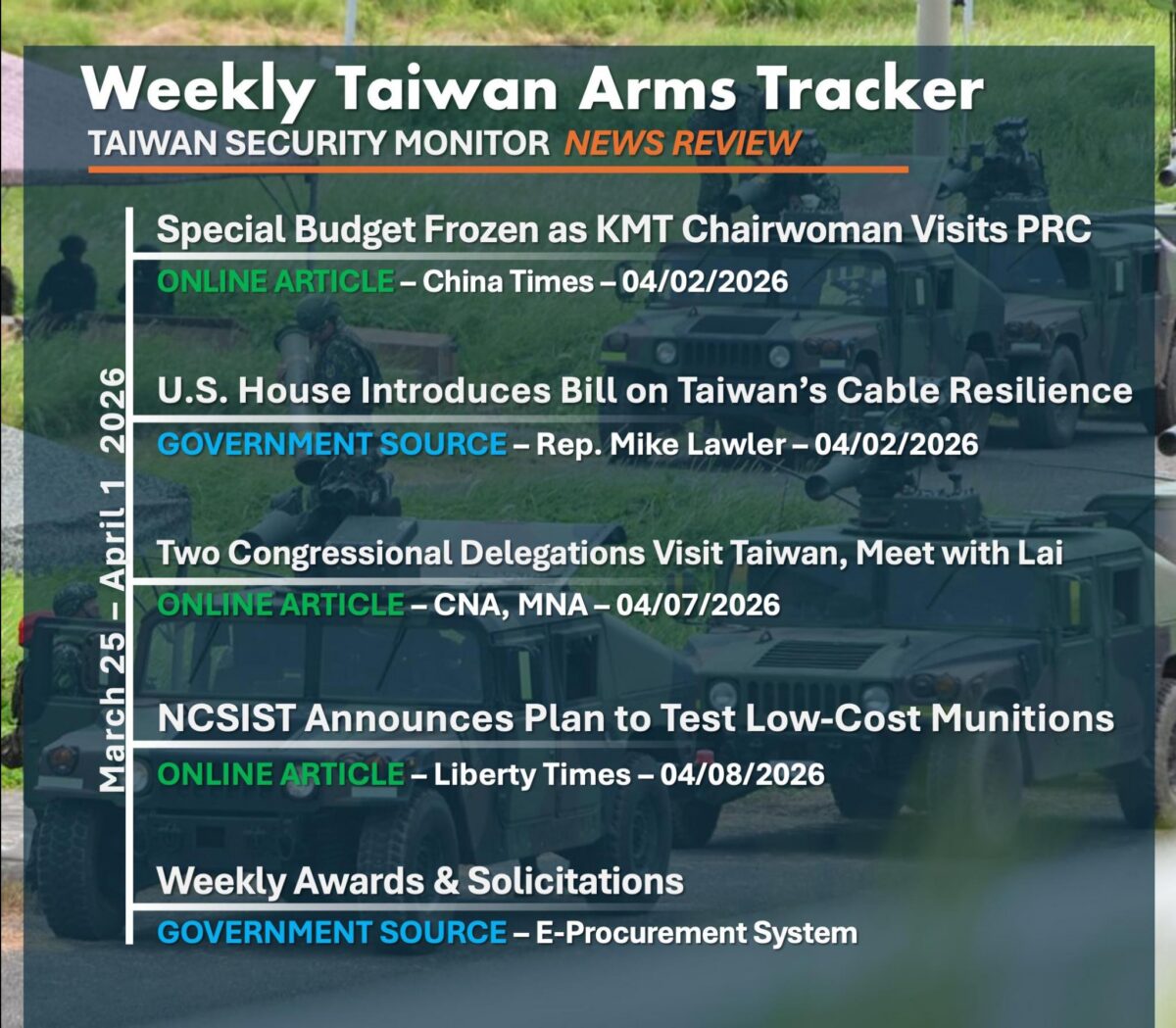
This week: the special budget remained frozen as the Kuomintangโ€™s chairwoman visits the PRC; the U.S. House introduced a bill on Taiwanโ€™s undersea cable resilience; two congressional delegations arrived in Taiwan for visits with officials; and NCSIST announced a plan to test low-cost ammunition prototypes, alongside weekly awards and solicitations. 

Special Budget Frozen as KMT Chairwoman Visits PRC 

Progress on special budget negotiations continued to be frozen this week, as KMT Chairwoman Cheng Li-wun began leading a delegation to the PRC. On April 2, the Legislative Yuanโ€™s Foreign Affairs and National Defense Committee convener, DPP legislator Chen Kuan-ting, reported that KMT members had requested negotiations be delayed until April 15-16. Chen, who had already delayed negotiations until April 9, stated that the DPP caucus does not intend to change its current schedule and will continue with negotiations on the planned date.  

DPP legislators criticized KMT counterparts upon hearing of this, with one member, Lin Chu-yin, accusing them of deliberately waiting until after Chengโ€™s visit and accusing them of trying to delay. Chen, however, attempted to appeal to younger KMT members, who have generally been more supportive of the Lai administrationโ€™s proposal than some of their other party members. As of the time of writing, it is assumed that negotiations will continue Thursday. 

U.S. House Introduces Bill on Taiwanโ€™s Cable Resilience  

 
On April 2, U.S. Representatives Mike Lawler (R-NY), Dave Min (D-CA), and Greg Stanton (D-AZ) introduced the House version of the Critical Undersea Infrastructure Resilience Initiative Act. Designed to address many of the concerns in the South China Sea, this bill prioritizes establishing advanced monitoring to detect disruptions in real time, strengthening early warning through global intelligence sharing, establishing rapid-response protocols, and expanding coordination to boost resilience. The legislation would also support joint patrols with the U.S. and Taiwanese Coast Guard in the area, as well as the creation of a Cross-Strait Contingency Planning Group to identify vulnerabilities and develop contingency plans. The bill would require the U.S. to pressure China to follow international norms and impose sanctions on those responsible for sabotaging critical undersea systems affecting Taiwan and allies. It is currently in its second stage, waiting to be passed by the United States Senate.  

Two U.S. Congressional Delegations Visit Taiwan, Meet with Lai 

Following a bipartisan congressional delegation that visited Taiwan at the end of March, two more U.S. legislative delegations arrived in Taiwan this week to meet with government officials. A group of four House members from the Republican Study Committee, consisting of Reps. Zach Nunn (R-IA), Scott Fitzgerald (R-WI), Julie Fedorchak (R-ND), and Jefferson Shreve (R-IN), arrived in Taipei on Sunday, April 5, and are expected to remain until Saturday, April 11. On Tuesday, the delegation attended a Taiwan-U.S. forum on economics and trade, alongside Maryland Secretary of State Susan C. Lee, where the representatives discussed tariffs, trade policy, and investment. On Tuesday, the delegation also met President Lai, who they presented with a congressional record of recognition; and met Minister of National Defense Wellington Koo at MND headquarters, discussing โ€œgray-zoneโ€ issues with Taiwan. 

A separate, simultaneous visit by U.S. Senator Jim Banks (R-IN), also began Tuesday, where the lawmaker met with President Lai, Legislative Yuan President Han Kuo-yu, and Minister of National Defense Wellington Koo. Banksโ€™ meeting with Lai centered around support for Taiwan and ongoing special budget negotiations, with the senator expressing hope that a budget will be passed soon and comparing Taiwanโ€™s special spending to President Trumpโ€™s plans for a US$1.5 trillion defense budget. At the LY, Banks met with President Han Kuo-yu, as well as members from all three political parties in the legislature, and further discussed ways to build consensus in passing the special defense budget. A later meeting with Minister of National Defense Wellington Koo at MND headquarters also reinforced this point, also discussing the U.S. congressional notification procedure for arms sales. In the evening, Banksโ€™ delegation attended a banquet at the Ministry of Foreign Affairs, hosted by Deputy Minister Chen Ming-chi, where the delegation reiterated earlier remarks made, and noted that this visit corresponds with the 47th anniversary of the Taiwan Relations Act, marking an auspicious moment for U.S.-Taiwan affairs. 

NCSIST Announces Plan to Test Low-Cost Munitions 

According to Liberty Times, the National Chung-Shan Institute of Science and Technology (NCSIST) has developed several types of “low-cost air defense munitions.โ€ One type is made to counter drone swarm attacks, and a second one is designed to defend against enemy missiles and long-range rocket attacks. So far, there has been no further information has been provided on either of the munitions.  Both are said to start planned combat testing later in the first half of next year. In addition to the two independently developed defense munitions, NCSIST has signed a contract with a Canadian manufacturer, AirShare, to develop “ribbon rocket systems.โ€ These systems use ribbons that catch enemy drones’ propellers, causing them to lose flight capability, then use a parachute to slow the droneโ€™s descent. The parachute reduces impact damage, specifically so the drone can be recovered intact for reverse engineering. This defense munition is also said to begin testing in the first half of next year. 

Weekly Awards/Solicitations  

On Thursday, the Armaments Bureau solicited bids for the purchase of road and electrical/mechanical engineering services in support of the Weihai project. The Wehai Project refers to the MNDโ€™s years-long project to renovate and upgrade Zuoying Naval Base. The contract is worth NT$5.30 billion (US$165.98 million)

Also on Thursday, the Army Command made a repeat solicitation of bids for official staff vehicles, worth NT$203.32 million (US$6.37 million)

On Wednesday, the Air Force Commandโ€™s Military Mission to the United States awarded a NT$88.76 million (US$2.79 million) contract to Integrated Procurement Technologies for the open-ended supply of aviation spare parts. Available evidence suggests that this contractor is providing spare parts for the F-CK-1 Ching-Kuo (otherwise known as the Indigenous Defense Fighter or IDF). 

Weekly Arms Update: 4/1/26

Author: Joe Oโ€™Connor, Shikhar Chaturvedi, Danielle Kremer, and Wyeth Lindberg


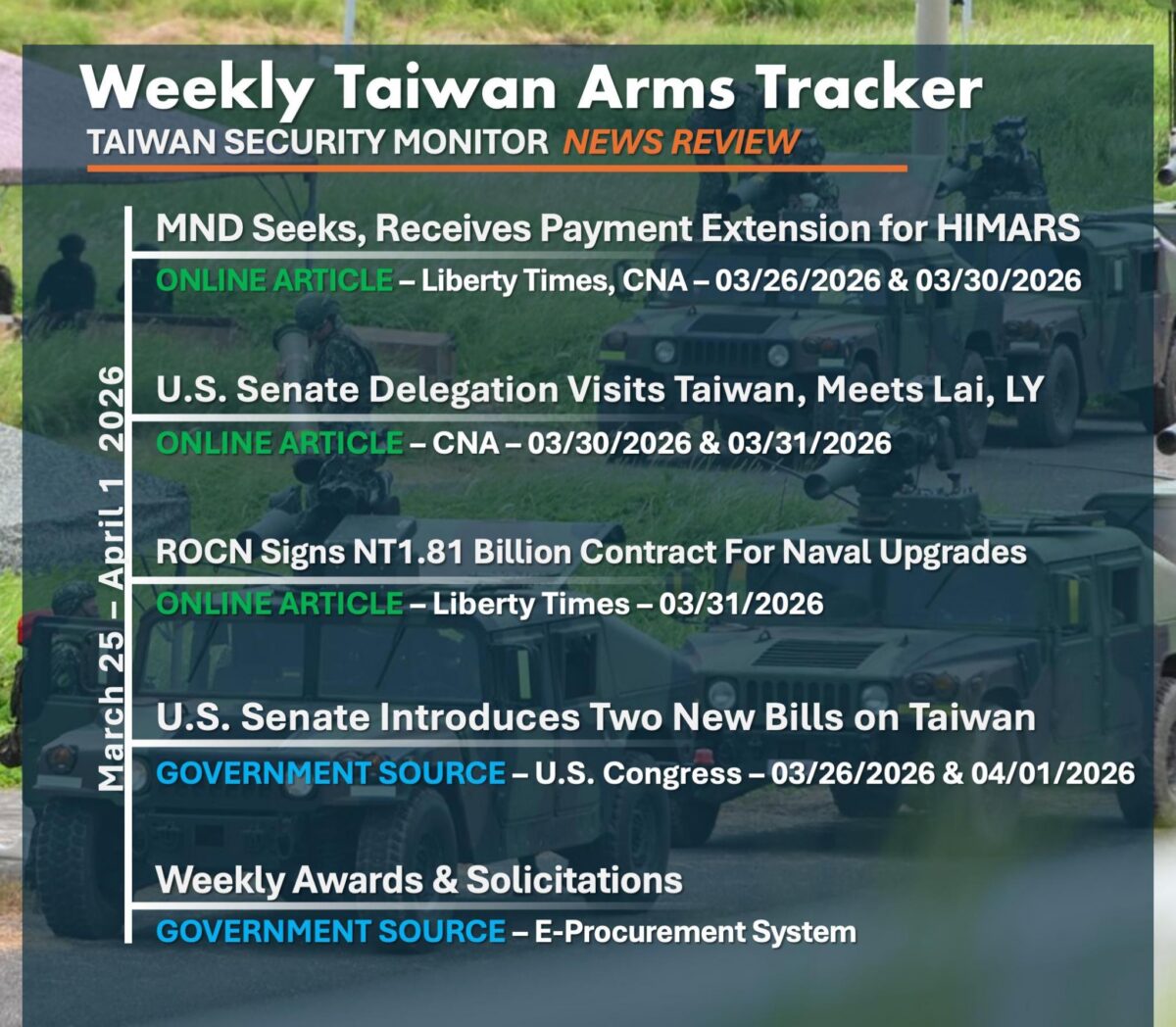
This week: the MND received a payment extension for the sale of HIMARS, a U.S. congressional delegation visited Taiwan to support ongoing budget negotiations, the ROCN signed a major upgrade contract with a French firm, and two Taiwan-related defense bills were introduced in the U.S. Senate, alongside weekly awards and solicitations.

MND Seeks, Receives Payment Extension for HIMARS

Taiwanโ€™s Ministry of National Defense said this week that the United States has agreed to defer the first payment deadline for 82 HIMARS launchers, giving Taipei temporary relief as the Legislative Yuan continues to debate the Lai administrationโ€™s NT$1.25 trillion special defense budget. According to Defense Minister Wellington Koo and MND officials, the HIMARS payment can now be pushed to around May, when Washington expects to complete contract negotiations with the supplier (Lockheed Martin), rather than the original March 30 deadline. Taiwan had already secured legislative authorization on March 13 to sign Letters of Offer and Acceptance for four U.S. arms sales packages worth roughly US$9 billion, but still lacked appropriated funds for the required down payments.

The HIMARS case nevertheless underscores how legislative delays are now affecting backlog management. Liberty Times reported on March 26 that MND officials had warned missing the HIMARS payment window could force Taiwan to wait until the end of the year for another contracting opportunity, and CNA now reports that MND is still trying to secure similar payment extensions for three additional systems: TOW missiles, Javelins, and M109A7 self-propelled howitzers. Together, the four initial payments total about US$79 million. For now, Taiwan has avoided a near-term disruption on HIMARS, but the episode shows how domestic budget gridlock can still complicate contracting timelines and add friction to efforts of moving delayed U.S. arms cases through the pipeline.

U.S. Senate Delegation Visits Taiwan, Meets Lai, LY

On Monday and Tuesday, a delegation of four U.S. Senators, led by Ranking Member of the Senate Foreign Relations Committee Jeanne Shaheen (D-NH), visited Taiwan on one leg of a trip around the Indo-Pacific. Shaheen, accompanied by Sens. Thom Tillis (R-NC), John Curtis (R-UT), and Jacky Rosen (D-NV), met with President Lai Ching-te and Minister of Foreign Affairs Lin Chia-lung, reaffirming support for Taiwanโ€™s defense and relations with the U.S. Before arriving, Sen. Curtis told the Financial Times that the visitโ€™s timing was linked to efforts in Taiwanโ€™s Legislative Yuan to pass a special defense budget, which has largely stalled in negotiations.

On Monday, the delegation also visited the National Chung-Shan Institute of Science and Technology (NCSIST), Taiwanโ€™s state-owned indigenous defense manufacturer, and viewed results of live-fire testing of the Mighty Hornet IV, a new attack drone jointly produced by NCSIST and US company Kratos that is a variant of the MQM-178 Firejet target drone.

On Tuesday, the delegation met with a bipartisan group of DPP and KMT Legislative Yuan members in a closed-door evening session. Per legislators Niu Hsu-ting (KMT) and Chen Kuan-ting (DPP), the delegations discussed ongoing arms procurement between the United States and Taiwan, as well as the current legislative process for the special defense budgets and how to build consensus among all parties. After this, the delegation departed Taipei, enroute to Japan.

ROCN Signs NT$1.81 Billion Contract for Naval Upgrades

On Tuesday, the Republic of China Navy (ROCN) signed a deal with Defense Conseil International (DCI) worth NT$1.81 billion (US$56.73 million) for technical support services as it begins upgrading its fleet of six Kang Ding-class frigates. DCI is Franceโ€™s state-owned operator for the exporting of military assistance to international partners, under the Ministry for the Armed Forces. Since the Kang Ding-class frigates are export models of Franceโ€™s own La Fayette-class frigates, their structural designs and parameters are protected by French patents.

Modifications include the installation of BAE Systemsโ€™ Type 997 Artisan radar and Safran S.A.โ€™s PASEO NS electro-optical fire control system, as well as installation of the indigenously produced Hua Yang vertical launch system (VLS), equipped with 32 TC-2N (Tien Chien II or Sky Sword II) air-to-air missiles, to replace older U.S. naval Sea Chaparral surface-to-air missiles. With the first upgraded ship being completed in February of this year, the contract will run for 5 years and 6 months and is expected to be completed by the end of 2031. This contract will ensure effective integration of Taiwanโ€™s domestically developed weapons with foreign-built platforms, avoiding any impact on shipsโ€™ operational or stealth performance.

U.S. Senate Introduces Two New Bills on Taiwan

On Thursday, Senators Michael Bennet (D-CO) and Pete Ricketts (R-NE) introduced the First Island Chain Deterrence Act, a measure requiring the U.S. Government Accountability Office (GAO) to issue a report to Congress on the status of major arms sales and if there are any delays affecting Japan, Taiwan, and the Philippines. The same report would assess the impacts of such delays, their effects on readiness in the region, and would be due within 18 months of the bill becoming law.

Today, Senators Jeff Merkley (D-OR), Ted Cruz (R-TX), Andy Kim (D-NJ), and John Curtis (R-UT), introduced the Blue Skies for Taiwan Act, which aims to support Taiwanโ€™s indigenous drone production industry. The measure specifically would establish a โ€œBlue UAS Working Group,โ€ which would assess Taiwanese industry and begin adding Taiwanese systems to the DODโ€™s secure โ€œBlue UASโ€ program, ensuring capabilities and components are โ€œPRC-independent.โ€ The bill, if passed, also directs the Pentagon and State Department to begin expedited certification processes for Taiwanese drone manufacturers.  

Weekly Awards/Solicitations

On Thursday, the Naval Command made a repeat solicitation of bids for transport trucks, worth NT$1.35 billion (US$42.13 million).

On Friday, the Military Medical Bureau solicited bids for the construction of the Radiation Oncology and Nuclear Medicine Center, worth NT$216.39 million (US$6.77 million).

On Tuesday, the Naval Command awarded Defense Conseil International a NT$1.81 billion (US$56.73 million) contract for naval technical support services. DCI is Franceโ€™s Ministry for the Armed Forces operator for the exporting of military assistance to international partners. The contract is to be fulfilled throughout the southern region of Taiwan.

On Wednesday, the Information and Communications Command made a repeat solicitation of bids for the licensing of cloud information services, worth NT$36.03 billion (US$1.13 billion).

Also on Wednesday, the Armaments Bureauโ€™s Production and Manufacturing Center, made a repeat solicitation of bids for night-vision detection equipment, worth NT$38.89 million (US$1.22 million).

Weekly Arms Update: 3/25/26

Author: Joseph Oโ€™Connor, Shikhar Chaturvedi, Danielle Kremer, & Wyeth Lindberg


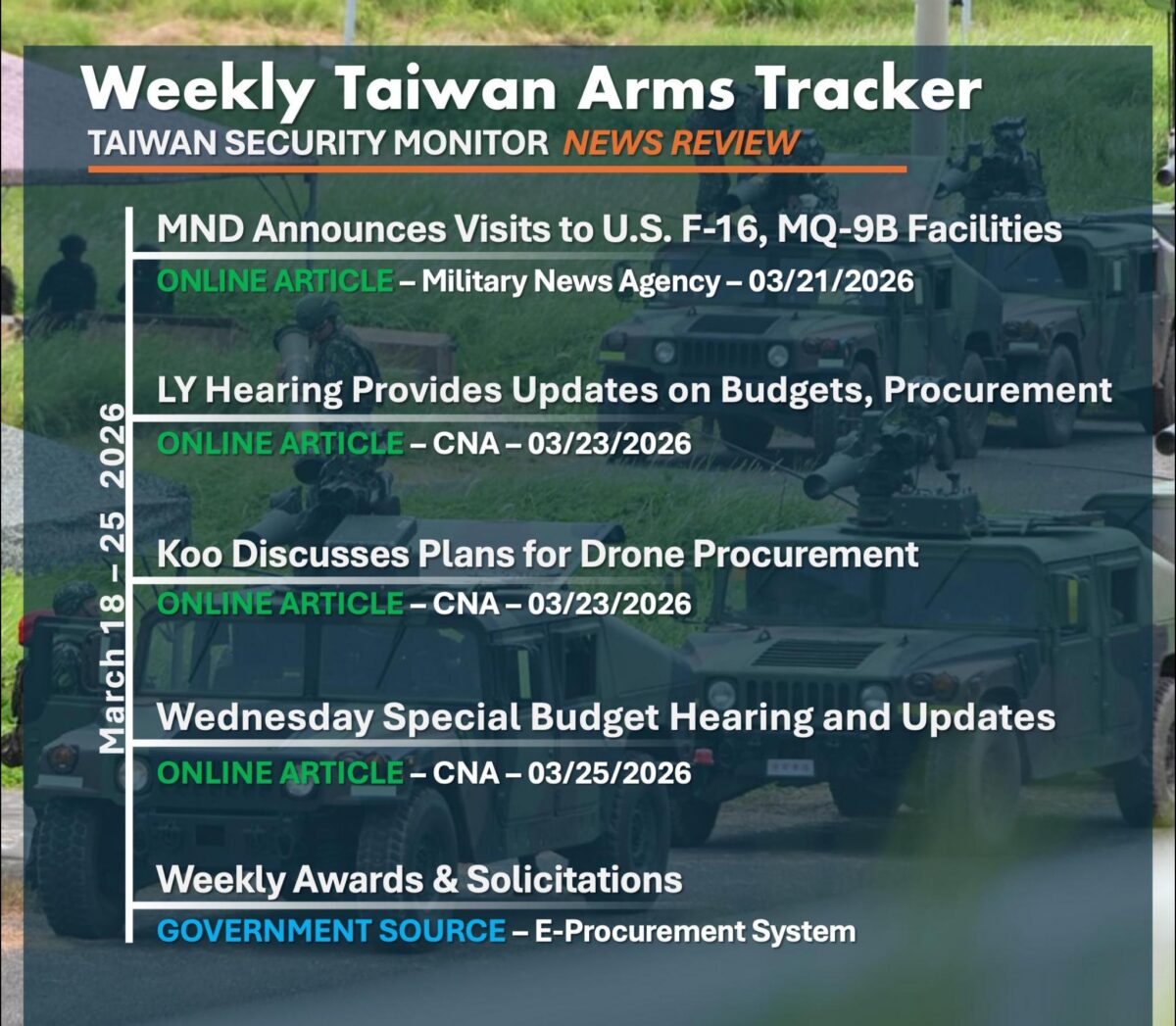
This week: the MND disclosed official visits to F-16 and MQ-9B production facilities, the Legislative Yuan began multiple days of hearings to consider the special defense budgets, and Minister Koo discussed plans for drone procurement, alongside weekly awards and solicitations.

MND Announces Visits to U.S. F-16, MQ-9B Facilities

As of March 21, the first Taiwanese F-16 Block 70 has completed its Acceptance Check Flight at Lockheed Martin facilities in Greenville, South Carolina. These tests were attended by several Taiwanese officials, including, Deputy Minister of National Defense Hsu Szu-chien, Deputy Air Force Chief of Staff General Tian Zhongyi, and the Taiwanese Representative to the U.S., Alexander Yui. In an MND press release, they stated that this success means Lockheed will begin their deliveries to Taiwan.

On March 21, the MND also confirmed that several Taiwanese officials attended a handover ceremony in the United States for two of the four MQ-9B SeaGuardian maritime surveillance drones purchased for NT$21.7 billion (US$674.02 million). However, the MND clarified that the two drones would stay in the United States for continued testing, with delivery expected in the third quarter of this year.

Monday LY Hearing Provides Updates on Budgets

On Monday, the Legislative Yuanโ€™s Foreign Affairs and National Defense Committee began formal consideration of three competing proposals for special defense budgets, submitted by the Lai administration, the Taiwan Peopleโ€™s Party (TPP), and the Kuomintang (KMT). Minister of National Defense Wellington Koo, alongside other officials, attended Mondayโ€™s question-and-answer session, reiterating that the administrationโ€™s budget is the most comprehensive. Koo also clarified that the first two MQ-9B SeaGuardians are expected to be delivered by the third quarter of the year and that the first F-16 Block 70 could arrive as early as September 2026.

Koo Discusses Plans for Drone Procurement


During a March 23 review in the Legislative Yuanโ€™s Foreign Affairs and National Defense Committee,the MND proposed procurement of more than 200,000 drones and 1,000-plus unmanned surface vessels. The proposal is best understood as an attempt to lock in a multi-year domestic unmanned systems production base. Minister Wellington Kooโ€™s main defense of the plan is that annual budgeting cannot generate the steady demand needed for firms to build production lines, lower costs, and incorporate iterative upgrades, whereas the Executive Yuanโ€™s eight-year special budget would allow procurement in batches as technology evolves. Koo and other Taiwanese officials are also tying the drone tranche to the creation of a โ€œnon-redโ€ supply chain, arguing that reliance on PRC-linked components creates cyber and operational risks. That logic aligns with the Executive Yuanโ€™s broader 2025-2030 drone industry plan, which seeks to expand and improve public-sector procurement, while deepening cooperation with U.S., European, and Japanese partners. Kooโ€™s proposed plan aims to build the domestic industrial base that Taiwan will need for longer-term drone cooperation with the U.S. and other partners.

Wednesday Special Budget Hearing and Updates

Today, March 25, the LYโ€™s Foreign Affairs and National Defense Committee re-convened for a markup session of special defense budget proposals, expected to continue into tomorrow, March 26. During this morningโ€™s meeting, the committee achieved consensus and passed several provisions, including those relating to procurement planning (taken from the KMT proposal) and authorities, but failed to reach consensus on provisions relating to legislative purpose, specific procurement items, and the topline budget amount.

Opposition legislators, including KMT Legislator Hsu Chiao-hsin, took issue specifically with the governmentโ€™s proposed budget items. Hsu accused some spending categories of being too vague or sometimes classified, arguing instead that opposition proposals such as from the KMT, already list known capabilities that Taiwan intends to purchase. DPP Legislator Puma Shen, backing the proposal, argued that less clear budget items provide flexibility in case of changes in price or schedule, which competing proposals would require an amendment for.

Weekly Awards/Solicitations

On Thursday, several bid solicitations and awards were announced:

The Army Command solicited bids for the purchase of one-day assault bags, personal carrying bags and multifunctional combat belts, worth NT$422.95 million (US$13.20 million).

The Army Logistics Command made a repeat solicitation of bids for Zero-annex specification editing and review equipment, worth NT$41.90 million (US$1.31 million).

The Naval Command and ROC Military Mission to the United States awarded the American Institute in Taiwan a NT$1.49 billion (US$46.65 million) contract for a second order of โ€œnaval spare parts.โ€ The contract is to be fulfilled in the Zuoying District of Kaohsiung City.

Additionally, the Naval Command and ROC Military Mission to the United States awarded the American Institute in Taiwan another NT$1.49 billion (US$46.65 million) contract for a second batch of โ€œaviation spare parts.โ€ The contract will also be fulfilled in the Zuoying District of Kaohsiung City.

On Tuesday, the Army Command solicited bids for the purchase of full-band handheld radios, worth NT$1.80 billion (US$56.38 million).

Weekly Arms Update: 3/18/26

Authors: Joe Oโ€™Connor, Shikhar Chaturvedi, Danielle Kremer, & Wyeth Lindberg


This week: the LY agreed to approve signature for four arms sales; MND officials provided updates on MQ-9B and PAC-3 procurement alongside low-cost air defense technology; a U.S. House hearing shed light on arms sales to Taiwan; and the MND confirmed the receipt of ALTIUS 600M drones, alongside weekly awards and solicitations.

Legislative Yuan Agrees to Approve LOA Signature

On Thursday, the Legislative Yuanโ€™s Foreign Affairs and National Defense Committee agreed to allow Letters of Offer and Acceptance (LOAs) to be signed for four U.S. arms sale cases, three of which (Paladin self-propelled howitzers, TOW-2B, and Javelin anti-armor missiles), were set to expire on March 15. A fourth LOA for High Mobility Artillery Rocket Systems (HIMARS), received earlier last week with an expiry date of March 26, is also included in this agreement. The committee required that upon signing, however, the MND must immediately report delivery schedules to the LY and continue to engage in the ongoing legislative review process.

On March 18, DPP legislator Kuan-ting Chen stated to the press that the LY committee would schedule reviews of all three special defense budget proposals next week. Per Chen, the committee will have a Q&A session on March 23 (Monday) and undergo a clause-by-clause review on March 25-26 (Wednesday-Thursday). When asked, Chen also indicated heโ€™d prioritize the Lai administrationโ€™s proposal, but aspects are open to negotiation and discussion.

LY Hearing Provides Updates on MQ-9B, PAC-3

On Monday, the LYโ€™s Foreign Affairs and National Defense Committee then held a hearing on the status of Taiwanโ€™s air defense network amid conflict in the Middle East. ROCAF Chief of Staff, Lieutenant General Lee Ching-jan, stated that the first two MQ-9B SeaGuardian maritime surveillance drones will be delivered to Taiwan by the third quarter of this year. MND officials also reiterated that the ongoing delivery of 102 PAC-3 Missile Segment Enhancement (MSE) missiles should not be affected by conflict in the Middle East, a concern that was also expressed about MQ-9B delays.

Details on Taiwan Arms Sales from U.S. House Hearing

During a March 17 House Foreign Affairs Committee hearing on โ€œReforming Americaโ€™s Defense Sales,โ€ U.S. officials reaffirmed that security assistance for Taiwan remains the administrationโ€™s โ€œtop priority.โ€ Defense Security Cooperation Agency (DSCA) Director Michael F. Miller testified that his 2023 guidance prioritizing Taiwan over all other requirements remains active, specifically ensuring that if a โ€œcompetitionโ€ for production capacity arises, Taiwan will maintain priority for deliveries like the Harpoon Coastal Defense Systems over other buyers such as Saudi Arabia. This emphasis follows the notification of a record US$11.1 billion arms package in December 2025, which includes HIMARS rocket systems, howitzers, and ALTIUS loitering munition drones designed to rapidly build asymmetric warfare advantages. While witnesses at the hearing addressed a US$21 billion backlog of undelivered weapons, TSM identifies the total value at US$32 billion in a recent February Arms Sales Backlog Update, noting that roughly 20% (US$6.26 billion) represents cases like the M1A2T Abrams tanks and Harpoons that are currently in partial delivery.

The hearing also clarified the diplomatic and legislative frameworks governing these sales amidst concerns over President Trumpโ€™s recent summit diplomacy with Xi Jinping. Despite the Presidentโ€™s suggestions that future packages might be discussed with Beijing, witnesses from both the State and Defense Departments stated they were unaware of any changes to the Six Assurances or longstanding U.S. policy. To address delivery bottlenecks, the committee discussed the โ€œPorcupine Actโ€, which would categorize Taiwan as a โ€œNATO plusโ€ partner to raise notification thresholds, following the House passing a 2026 funding bill that includes US$2.3 billion in Foreign Military Financing (FMF) grants and loans. However, TSM analysis indicates that the strategic impact of these reforms is increasingly threatened by political gridlock in Taiwanโ€™s Legislative Yuan, where delays in passing the NT$1.25 trillion special budget have left several Letters of Offer and Acceptance (LOAs) for asymmetric systems at risk of expiration. Despite these internal delays, physical deliveries of higher-end platforms continue, with the final batch of 28 M1A2T Abrams tanks currently โ€œat seaโ€ and expected to reach Taiwan by the end of March 2026.

MND Confirms ALTIUS 600s Delivered

According to a recent report from the Ministry of National Defense, as of March 18, the Taiwanese military has officially received all 600M ALTIUS UAVs purchased from the United States and defense contractor Anduril. These drones are said to have a range of up to 40km, along with anti-armor warheads and infrared detection capabilities. With this last delivery, the Taiwanese military now has up to 291 ALTIUS systems, costing approximately NT$9.6 billion (US$300 million). A second sale, announced in December, of 1,554 ALTIUS 700M and 478 ALTIUS 600M ISR drones, is currently in progress, but it is expected will be completed quickly owing to the speed of the first case, having only taken 14 months between notification and delivery.

Weekly Awards/Solicitations

On Thursday, the Army Logistics Commandโ€™s Army Ordnance Maintenance and Development Center awarded the 209th Factory a NT$800.00 million (US$25.14 million) contract for CM-32/33 APC maintenance kits. The contract is to be fulfilled in Jiji Township, Nantou County.

Also on Thursday, the Armaments Bureau awarded a NT$2.82 billion (US$88.52 million) contract to Pan Asia Engineering Construction Co., Ltd for the Hanyang Camp new construction project. The contract is to be fulfilled in Taoyuan City.

On Friday, the Army Commandโ€™s Military Mission to the United States awarded the American Institute in Taiwan a NT$67.59 million (US$2.12 million) contract for flares. While this award is to the AIT, it is likely for a U.S. defense contractor. The contract is to be fulfilled in the Rende District of Tainan and Pingtung City in Pingtung.

Also on Friday, the Armaments Bureauโ€™s Production and Manufacturing Center made a repeat solicitation of bids for Night-vision detection equipment, worth NT$38.89 million (US$1.22 million).

On Monday, the Naval Command solicited bids for the purchase of new Hong Kong tugboats, worth NT$807.57 million (US$ 25.35 million).

On Wednesday, the Naval Command solicited bids for the procurement and installation of NBC protection training ground facilities, worth NT$1.51 billion (US$ 47.47 million).

U.S. Contracts Relating to Taiwan

On Tuesday, the Defense Logistics Agency awarded a US$470 million (NT$14.99 billion) contract to Pratt & Whitney, a division of RTX Corp., for the re-manufacturing of F100 engine modules. This contract uses Taiwan FMS funds alongside 12 other countries. F100 engines are used by F-16 Fighting Falcon fighter jets, as well as F-15s. Work is expected to be completed by March 2029.

Taiwan Arms Sale Backlog, February 2026 Update

Special Budget Complications Continue

Authors: Joseph Oโ€™Connor, Eric Gomez, & Shikhar Chaturvedi


Political gridlock over the Lai administrationโ€™s special procurement budget continued in February 2026, leading to concerns about recently announced U.S. arms sales to Taiwan. No new Foreign Military Sales (FMS) cases were notified to Congress, and no existing sales were delivered in February. The total value of FMS cases notified to Congress but not delivered to Taiwan remains $32 billion.

Eagle-eyed readers will notice that there is a change in Figure 1. Arms sales cases are fully removed from our dataset once final delivery occurs, but we do not reduce the dollar value of the backlog for partial deliveries. We have explained our thinking in other articles.

We indicate partially delivered arms sales through color coding in our data visualizations, with the yellow-orange color representing cases that are partially delivered to the best of our knowledge. Previously, we have only done this for arms sales valued at $1 billion or more because these were the most militarily significant sales and because, given the quantities and types of capabilities involved, they tended to be the easiest to track.

However, we realize that a $1 billion threshold has its own problems. We have therefore decided to adjust our methodology for data visualizations, and from now on, any arms sale that we can verify as partially delivered will be visually indicated with the yellow-orange color. The dollar value of the backlog will only be reduced when a sale is fully delivered, but we think this new approach represents a reasonable way to show in-progress deliveries.

This methodology change moves five arms sales cases worth $1.89 billion into the partially delivered category. Combined with the two cases above, the $1 billion threshold that we were already tracking as partially deliveredโ€”M1A2T Abrams tanks and Harpoon Coastal Defense Cruise Missile systemsโ€”there are seven arms sales cases worth $6.26 billion that are partially delivered, just shy of 20 percent of the backlogโ€™s total dollar value.  

Special Budget Updates in February

Ongoing deliberations in the Legislative Yuan (LY) relating to a special defense budget slowed down in February, as the LY recessed for the Lunar New Year holiday. Prior to recess, the legislature voted to advance a proposal made by the opposition Taiwan Peopleโ€™s Party (TPP) to committee review, leaving the Lai administrationโ€™s NT$1.25 trillion (US$40 billion) proposal in limbo. During the recess, 37 U.S. senators and representatives, including senior members of the House and Senate foreign affairs committees and from both parties in Congress, sent a letter to LY Speaker Han Kuo-yu and party caucus leaders, expressing concern about โ€œongoing deliberations in the Legislative Yuan to only partially fund a supplemental budget request.โ€ Han, responding on February 16, stated that the budget would be one of the โ€œvery firstโ€ items to be debated, and upon re-convening on February 24, the LY voted to advance the governmentโ€™s proposal, ending the month with both proposals under review by the Foreign Affairs and National Defense Committee.

The differences between the competing proposals largely center on flexibility and holistic spending, as opposed to narrower and targeted procurements of established systems, as discussed in detail in our recent article comparing the two proposals. On the sidelines, the Kuomintang (KMT), the third and largest major party in the LY, announced in late February that they would be releasing their own special budget proposal, which they did in early March. As of the end of February, the proposal had ranged from NT$350 billion (US$11.19 billion) to NT$750 billion (US$23.97 billion) but turned out to be only NT$380 billion (US$12 billion) when announced on March 6.

Taiwan’s MND, on February 6, sounded the alarm about three Letters of Offer and Acceptance (LOAs) that are set to expire on March 15. The LOAs, which are for the December sales of Paladin self-propelled howitzers, TOW-2B anti-armor missiles, and Javelin anti-armor missiles, were not signed because of ongoing battles in the LY. MND officials stated they were seeking extensions to the LOAs if a deal was not reached soon. Signing a LOA quickly is an important milestone in the FMS process. A LOA has a payment schedule, whereby Taiwan would pay the U.S. government in installments for the capabilities it is purchasing. The U.S. government negotiates a contract with the defense industry and pays for the capabilities using the funds that Taiwan transfers per the LOA. Importantly, until a LOA is signed and a first payment is made, the Department of Defense cannot enter a contract to produce the weapons. If a LOA is not signed before it expires, then certain steps in the FMS process must be repeated or renegotiated due to potential changes in pricing.

Updates to Abrams, PAC-3 Sales

On February 2, MND officials reported that the final batch of 28 M1A2T Abrams tanks will arrive in Taiwan by the end of March. Delivery of the total 108 tanks has been ongoing since December 2024, when the first batch of 38 arrived in Taiwan.

On February 11, MND officials confirmed to the press that they would be procuring 102 PAC-3 Missile Segment Enhancement (MSE) missiles for Patriot air defense systems, which would be paid via surplus funds from a prior Patriot procurement program.  This is a positive development for the backlog, as the 102 PAC-3 MSEs are a 2022 modification to a 2010 Patriot case and can be funded through surplus from the earlier program. They are separate from and (additive to) the planned but not yet notified Patriot follow-on package (additional batteries and PAC-3 MSEs) expected to be financed through the Lai administrationโ€™s special defense budget.

Amidst these updates, reporting from the Financial Times, New York Times, and Taipei Times has revealed a future arms sale package to Taiwan, including PAC-3 MSE missiles, additional Patriot batteries, Integrated Battle Command Systems, and Lower Tier Air and Missile Defense Sensors radars, all designed to integrate into the Lai administrationโ€™s planned โ€œT-Domeโ€ air defense system. The timeline of this sale, however, is in flux owing to Trumpโ€™s summit with Xi in April.

Trump Administration Announces Arms Sale Reforms

On February 6, the Trump administration launched a new round of arms-transfer reforms through Executive Order 14383 and its accompanying White House fact sheet, establishing an โ€œAmerica First Arms Transfer Strategy.โ€ The order reframes arms transfers as a mechanism for expanding U.S. production capacity, strengthening supply chains, and prioritizing partners that invest in their own defense. The point was reinforced on February 10, when the Pentagon announced the realignment of the Defense Security Cooperation Agency (DSCA) and the Defense Technology Security Administration (DTSA) under the Under Secretary for Acquisition and Sustainment, explicitly tying security cooperation and export administration more closely to defense-industrial management and execution.

At the same time, Taiwan’s arms sales became more visibly entangled with summit diplomacy. Following the February 4 Trumpโ€“Xi call, Beijing publicly urged Washington to handle Taiwan arms sales with โ€œprudenceโ€ and again described Taiwan as theโ€œmost important issueโ€ in U.S.โ€“China relations. Trump then said he was โ€œtalkingโ€ with Xi about future arms sales to Taiwan and would decide โ€œpretty soon,โ€ before the White House promptly clarified that there had been no change in longstanding U.S. policy. Further reporting that a major new package could move only after a Trump trip to China further underscores that dynamic.

Conclusion

Taiwanโ€™s arms sales backlog remained steady at $32.0 billion through the end of February 2026. However, recent developments highlight the role of political factors in the backlog rather than defense industrial capacity.  

The Legislative Yuan has only just begun substantive review of competing special budget proposals, while the March 15 LOA expiration deadline is approaching for several cases notified in December.  Meanwhile, Washingtonโ€™s efforts to streamline arms transfers are occurring alongside high-level diplomacy, which may influence the timing of major new Taiwan FMS notifications to Congress. 

March will be a critical month to determine whether Taipei can turn budget discussions into signed agreements and funding, and whether U.S. process improvements will result in faster execution or be offset by political considerations on both sides.