Authors: Jaime Ocon & Danielle Kremer
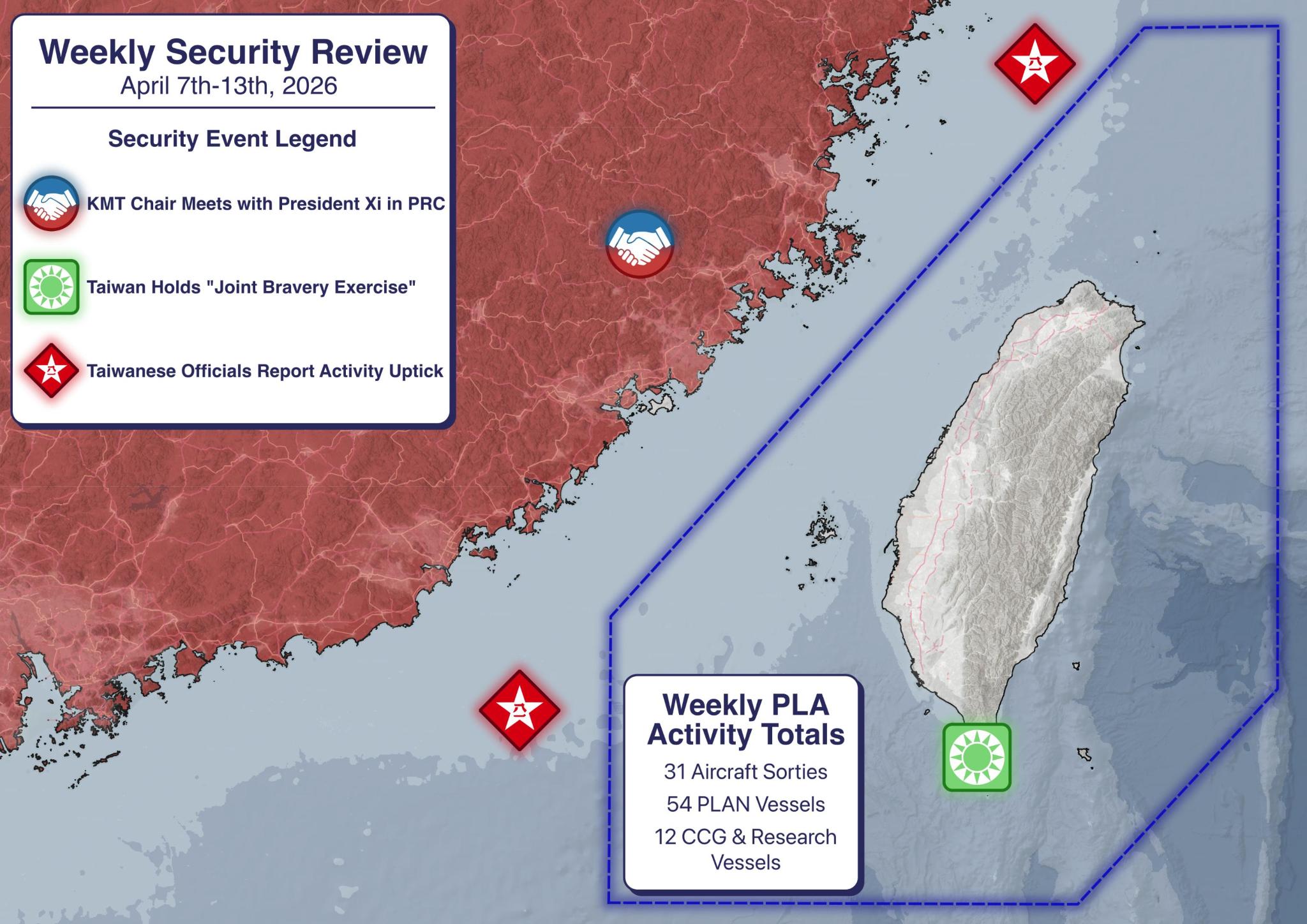
Welcome to the Weekly Security Review, where we highlight key military, security, and political developments around Taiwan in one straightforward summary!
This week, Taiwan’s opposition leader lays out a path for more cooperation with China, Taiwanese intelligence points to a surge in Chinese ships in the region, and Taiwan’s Army conducts live fire drills with special forces.
Taiwan’s Opposition Chairwoman Meets with Chinese President Xi, Pledges Closer Cooperation
Opposition Kuomintang (KMT) Chairwoman, Cheng Li-wun, wrapped up a visit to China, where she met with Chinese President Xi Jinping and called for expanded exchanges between Taiwan and the mainland. Cheng later announced a set of 10 proposals she said were aimed at strengthening ties. Some of those proposals include resuming individual travel by residents of Shanghai and Fujian Province to Taiwan, gradually moving towards “full normalization” of direct cross-strait passenger flights.
Chinese state media says the meeting highlighted Beijing’s efforts to maintain cross-strait communication despite rising tensions. While the meeting was brief, Xi used Cheng’s visit to repeat China’s position that any improvement in relations must be tied to opposition for Taiwan independence. Cheng told the media that she presented dialogue and practical exchanges as the best way to reduce friction and avoid further escalation.
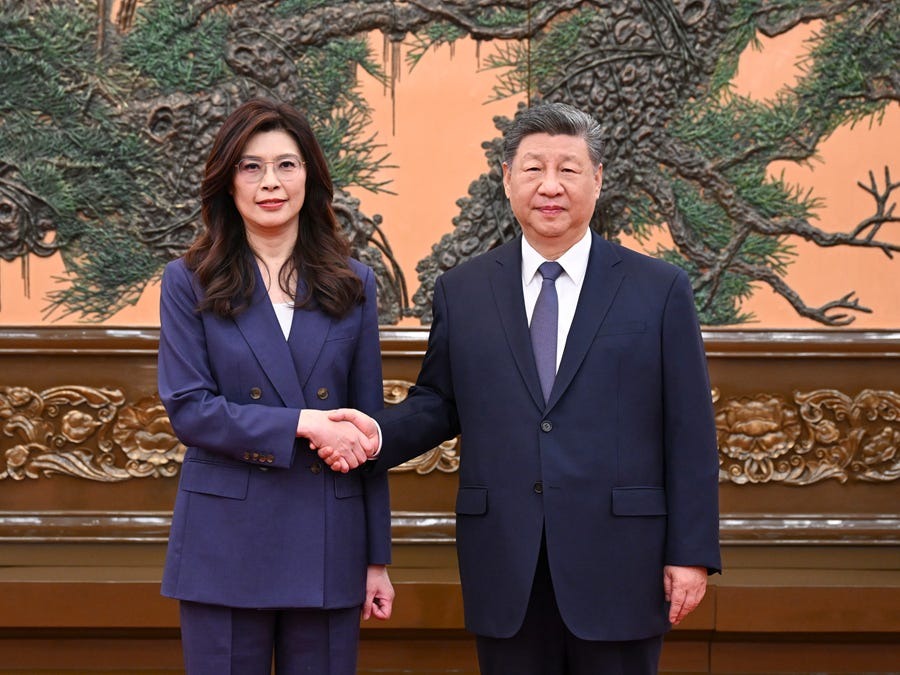
This visit was notable because it underscored the KMT’s willingness to engage Beijing directly at a time when official cross-strait channels remain strained. The last time a sitting KMT chair visited China was back in 2016, when Hung Hsiu-chu made the trip. The recent trip also gave China an opportunity to showcase a Taiwanese opposition leader willing to speak publicly about expanding ties. Initial polling showed the majority of the Taiwanese public thought the trip would do “more harm than good,” but it is yet to be seen how the trip will affect the upcoming local election in the fall.
Taiwan’s Army, Special Forces Conduct Annual Live-fire Drills in Pingtung
On April 6th, Taiwan’s 602nd Army Aviation and Special Forces Command Brigade conducted their annual “Joint Bravery Exercise” in Pingtung alongside the Taiwanese Army’s 234th Combined Arms Brigade. Said exercises are meant to adhere to the principle of “combat-oriented” training, allowing officers and soldiers to hone their combat skills in real battlefield conditions through intensive drills. Air Force helicopter exercises began early in the morning on the 6th, with maintenance and equipment checks alongside ammunition retrievals of 20mm ammunition and 2.75-inch Poseidon rockets, from weapons crews. Once the preparation was complete, the pilots received orders to start their helicopters and took off to commence said live-fire exercises.
Alongside these helicopter tests, the joint forces conducted live-fire drills on the ground in coordination with infantry and armored units. In this exercise, units focused on firepower coordination and capturing positions. To do this, they deployed with multiple heavy artillery pieces, including but not limited to 105mm tank guns and 120mm mortars. With the success of the first stage, the drill intensified. Attack helicopters were deployed to provide air support by executing low-altitude strikes simulating assaults on enemy positions. In doing so, the joint forces created a three-dimensional combat network, which they claim is a fully integrated air-ground battlefield system capable of coordinated multi-domain operations.
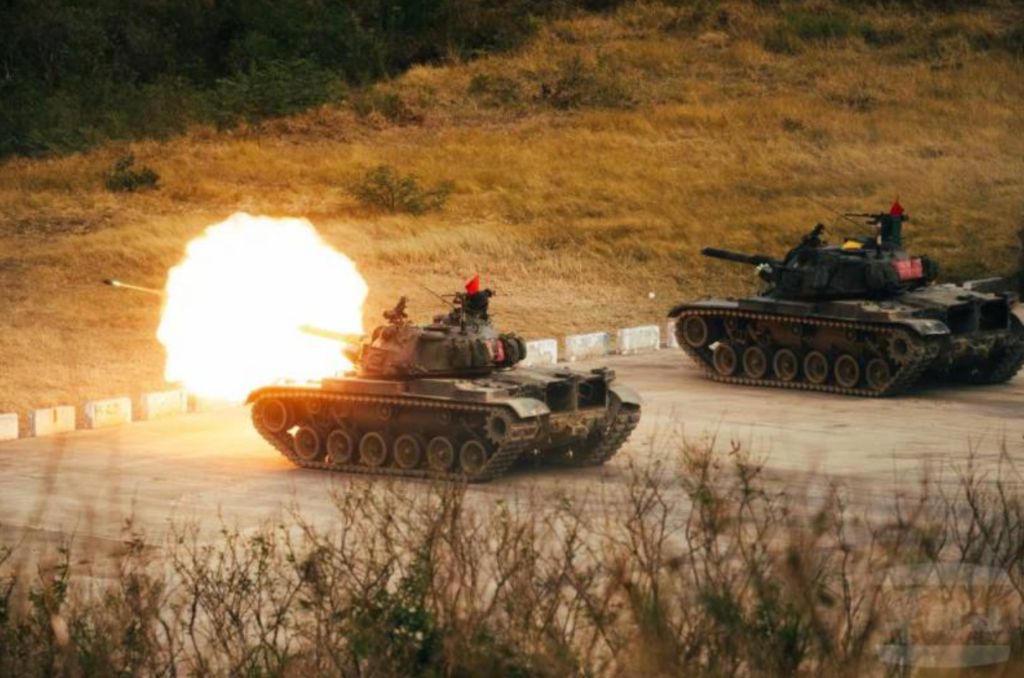
While these exercises were on a 24-hour schedule, a representative of the Army stated that the exercise was designed to begin with night combat, simulating how enemy defenses weaken, and outer positions are destroyed, allowing the main force to launch a daytime counterattack with ease. According to multiple reports, the Taiwanese military and MNDofficials called the exercise a success and plan to expand similar joint training exercises to further enhance combat readiness. The exercise ended on April 8th.
Taiwanese Intelligence Officials Concerned Over Uptick in Chinese Military Activity
As of April 10th, Taiwanese officials are monitoring naval and military activity in the strait. According to Reuters, “China has deployed nearly 100 naval and coast guard vessels in and around the South and East China Seas this week.” This raises security concerns for Taiwan, as China typically deploys only 50-60 vessels in that region, and heightened naval activity at this time of year is quite rare. They also reported seven Chinese military aircraft operating in Taiwanese airspace. Taiwanese officials are still monitoring this increase in military activity in the South and East China Seas.
In a Facebook post by Minister of the Ocean Affairs Council Kuan Bi-ling, a “sea situation map” was shared, sparking debate over the possible disclosure of classified information. The image clearly shows the locations of six Chinese warships and two coast guard vessels around Taiwan. They also mention that the Taiwanese Coast Guard can determine and track PLA naval vessels by type and hull number. Off the western coast of Taiwan, it was reported that they have identified a Type 052D multi-functional destroyer equipped with phased-array radar and missile systems, a Type 815 electronic reconnaissance ship designed to intercept Taiwanese signals at close range, and a Type 054A guided missile frigate with balanced air defense, anti-ship, and anti-submarine capabilities. On the cross-strait, two People’s Liberation Army (PLA) Coast Guard ships have been detected and confirmed to be Type 818 coast guard cutters. They have also found a Type 054A guided missile frigate, which is said to be specifically designed for anti-submarine warfare.
The use of naval vessels to intimidate and encircle Taiwan is Beijing’s “dual-track approach of military pressure and political exchanges.” The use of this tactic aims to maintain sustained coercive pressure on Taiwan while signaling openness to political engagement, thereby weakening Taiwan’s deterrence and influencing decision-making. According to sources, Beijing does not plan to withdraw the air and sea blockade.
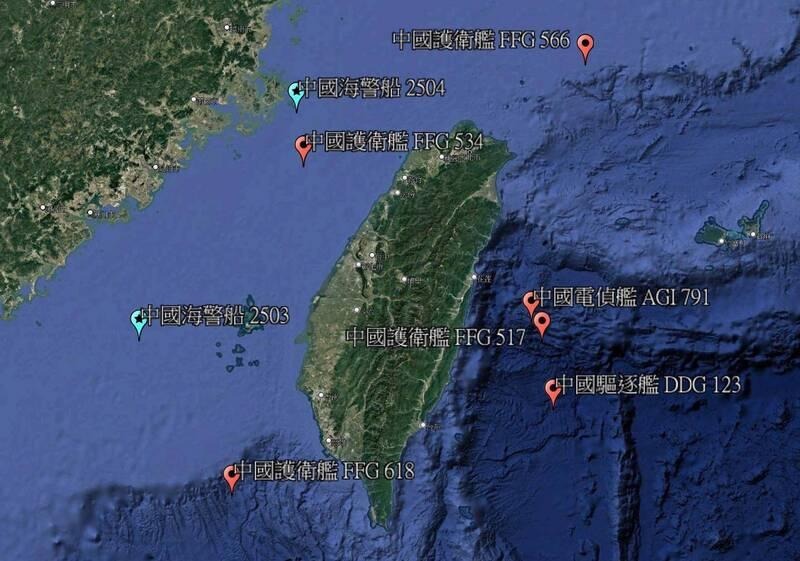
Ling’s Facebook post added that “Because the leader of the main opposition party is planning to meet with Chinese leadership … it is necessary to appropriately disclose to the public and the international community the situation of China’s harassment in our waters, so that our people are informed and understand the serious implications.”.