Author: Jaime Ocon
Welcome to the Weekly Security Review, where we highlight key military, security, and political developments around Taiwan in one straightforward summary!
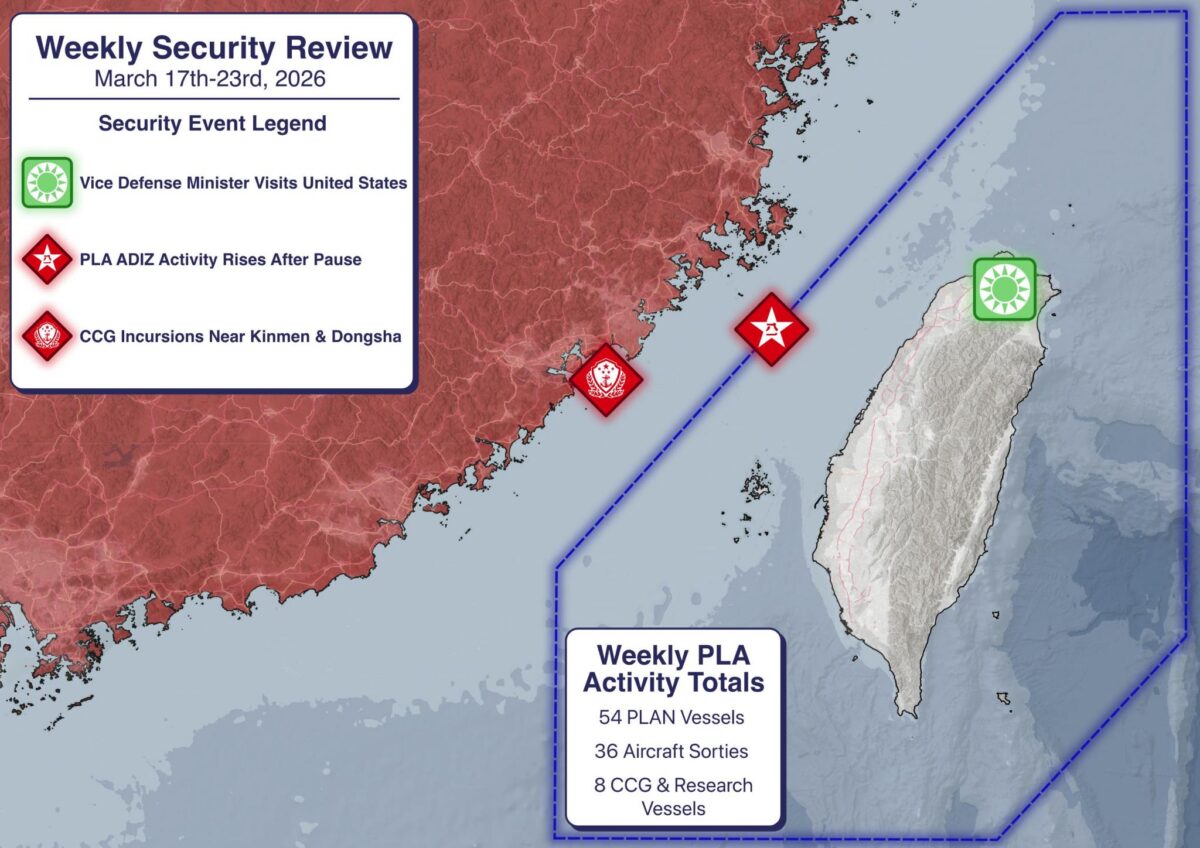
This week, senior members of Taiwan’s defense ministry traveled to the U.S. to inspect military aircraft, ADIZ activity in the Taiwan Strait continues to spark public discourse, and China’s Coast Guard steps up pressure near Kinmen and Dongsha Island.
Vice Defense Minister Makes U.S. Trip, Showcases Updates on U.S. Systems.
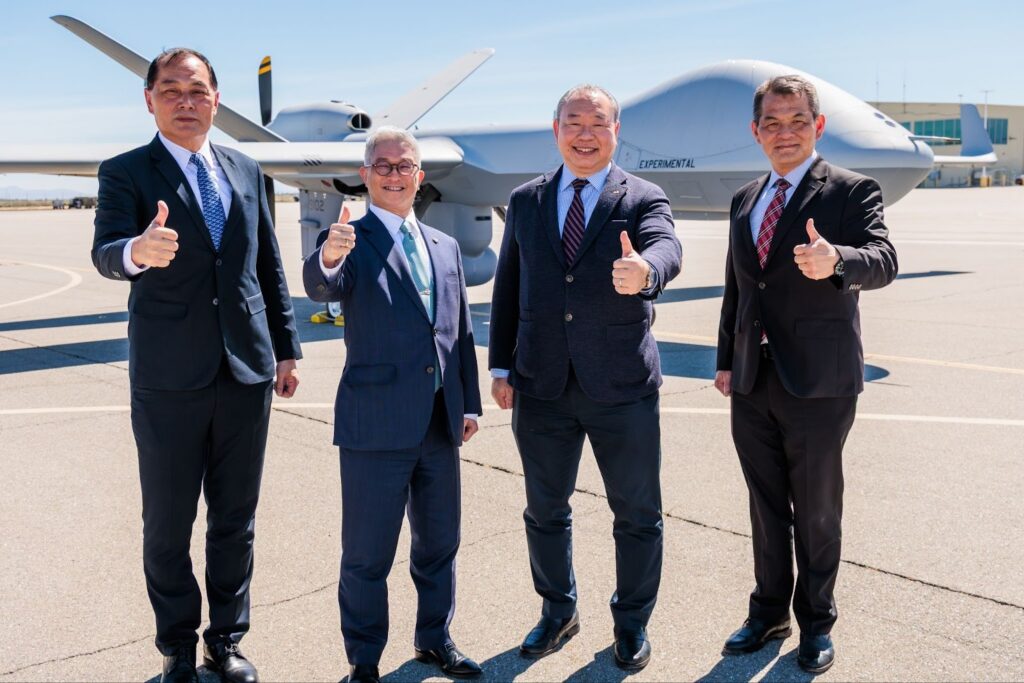
Taiwan’s Ministry of National Defense (MND) announced on March 21 that Vice Minister of Defense Hsu Shih-chien led a delegation to the United States to inspect key procurement projects that are close to delivery. In a press release, the MND delegation says they witnessed the completion of testing for Taiwan’s first F-16 Block 70 fighter jet at Lockheed Martin’s production facility in Greenville, South Carolina. The testing took place on March 16, and alongside Vice Minister Hsu were Taiwan’s Representative to the United States, Alexander Yui Tah-ray; Air Force Deputy Chief of Staff, Major General Tian Chung-yi; and Taiwan’s Defense Mission Chief, Major General Wei Chung-hsing. The MND specified that the group observed the first Acceptance Check Flight (ACF) and that Lockheed Martin briefed the delegation on production progress. Officials at Lockheed say that the F-16 Block 70 production line is at full capacity and has assigned hundreds of staff to the program to ensure delivery remains on track. The MND says that after Taiwan’s Block 70 aircraft receive factory acceptance, they will undergo final inspections by the U.S. government before delivery to Taiwan later this year.

The U.S. approved an $8 billion sale of F-16 fighter jets to Taiwan in 2019, a deal that would expand the country’s F-16 fleet to more than 200 aircraft, the largest in Asia. The deal, however, has continued to face delays due to production and software issues. As part of a broader modernization effort, Taiwan has already upgraded 141 of its older F-16A/B models to the advanced F-16V variant and is now awaiting delivery of 66 brand-new F-16Vs. Taiwanese officials say all aircraft will be delivered by 2028. The MND says it will continue to use existing Taiwan–U.S. security cooperation mechanisms to accelerate the delivery of the fighter jets, which it says are important to Taiwan’s air defense and deterrence capabilities.
During the same trip, the MND delegation also attended the handover ceremony for the first batch of MQ-9B SeaGuardian maritime surveillance drones. Taiwan purchased four MQ-9Bs from General Atomics Aeronautical Systems, Inc. in 2022, of which the U.S. is scheduled to deliver two aircraft in 2026 and two more in 2027. During the ceremony, Vice Minister Hsu observed a flight demonstration and also hopped into the driver’s seat to test the UAV’s capabilities.

Taiwan ADIZ Activity Continues to Fluctuate After Lull
Taiwan’s Ministry of National Defense reported 28 People’s Liberation Army (PLA) aircraft, including J-10, J-16 fighter jets, and KJ-500 command and control planes operating around the region on Tuesday (March 17). 21 of the aircraft crossed the median line of the Taiwan Strait and entered Taiwan’s air defense identification zone (ADIZ). The MND says these aircraft were conducting joint air-sea training along PLAN vessels. The spike in activity comes as Taiwan’s MND reported a small uptick in Chinese military activity around the island last Sunday (March 15), ending a lull that had analysts looking for answers.
Interestingly enough, Sunday’s ADIZ report sent shockwaves across social media after multiple media outlets began reporting that there was “Large Scale Chinese Military Activity Surrounding Taiwan”. Despite the MND reporting nothing indicating that it was surrounded, multiple accounts on X and Bluesky had a field day, reposting this false narrative. AI-generated maps based on previous military exercises in 2024 began to circulate, and within 12-24 hours, some posts had reached nearly 5 million engagements. A dangerous and concerning look into how misinformation around Taiwan can spread like wildfire.
Our analysis and leadership team at TSM wrote a great article that goes into detail about what happened, which can be found here: https://tsm.schar.gmu.edu/from-16-aircraft-to-surrounded-fear-virality-and-the-misinformation-cascade-in-adiz-discourse/
Despite that, Minister of National Defense Wellington Koo acknowledged the recent lull in activity but cautioned against reading too much into it, emphasizing that Taiwan’s armed forces need to remain on alert regardless. Koo told the Wall Street Journal that “we cannot rely on a single indicator like the absence of aircraft,” pointing to daily Chinese naval patrols around the island as a sign of continued pressure. Some analysts believe the lull was linked either to the annual meeting of the PRC’s National People’s Congress or to a broader diplomatic strategy ahead of a planned meeting between U.S. President Donald Trump and President Xi Jinping in late March.
Coast Guard Activity Surges in Kinmen and Dongsha
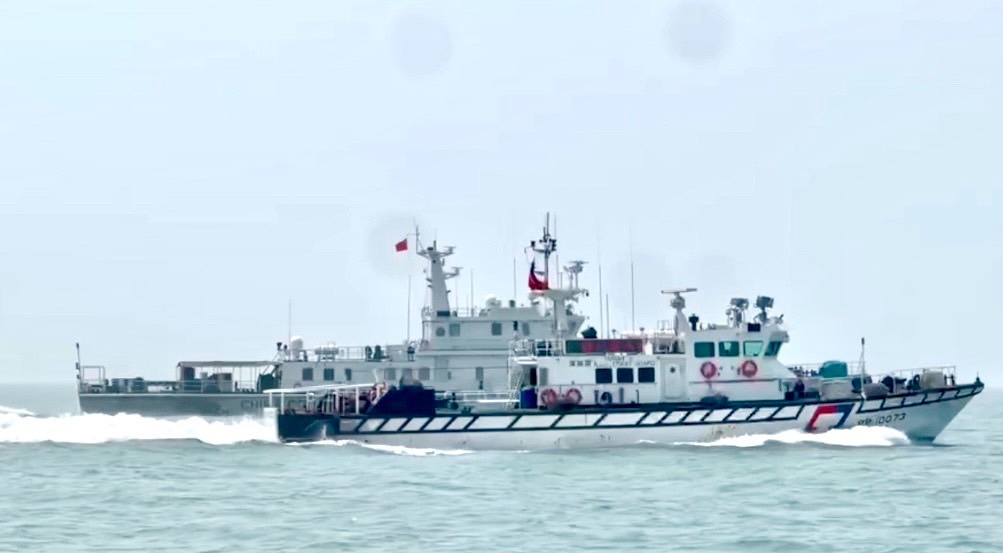
Taiwan’s Coast Guard Administration (CGA) has reported a surge in China Coast Guard (CCG) ships entering restricted waters around Kinmen and Dongsha Island. On March 16th, 17th, 20th, and 23rd, multiple CCG vessels breached restricted waters off Kinmen in coordinated formations, prompting Taiwan’s CGA to dispatch its own patrol boats. Taiwan says it conducted one-to-one shadowing of each Chinese vessel and issued repeated radio warnings in Chinese and English.
A similar situation unfolded near Dongsha Island on March 18, when a China Coast Guard ship (hull number 3102) entered Taiwan’s restricted waters after first being detected loitering just outside this area. Taiwan’s CGA is accusing Beijing of deliberately switching off the AIS signal and using small but frequent probes to test Taiwan’s detection and reaction capabilities. CGA officials say they will use high-tech surveillance and robust forward deployments to safeguard national sovereignty and maintain maritime security amid mounting gray-zone pressure.
For more information about the CCG’s activity around Taiwan, check out the China Coast Guard Incident Tracker on our website.