
Author: Jaime Ocon
Welcome to the Weekly Security Review, where we highlight key military, security, and political developments around Taiwan in one straightforward summary!
This week, Taiwan’s military conducted nationwide combat readiness drills ahead of the Lunar New Year, military police sharpened urban-warfare and close-quarters combat skills, and opposition lawmakers moved to cut supplementary defense funding.
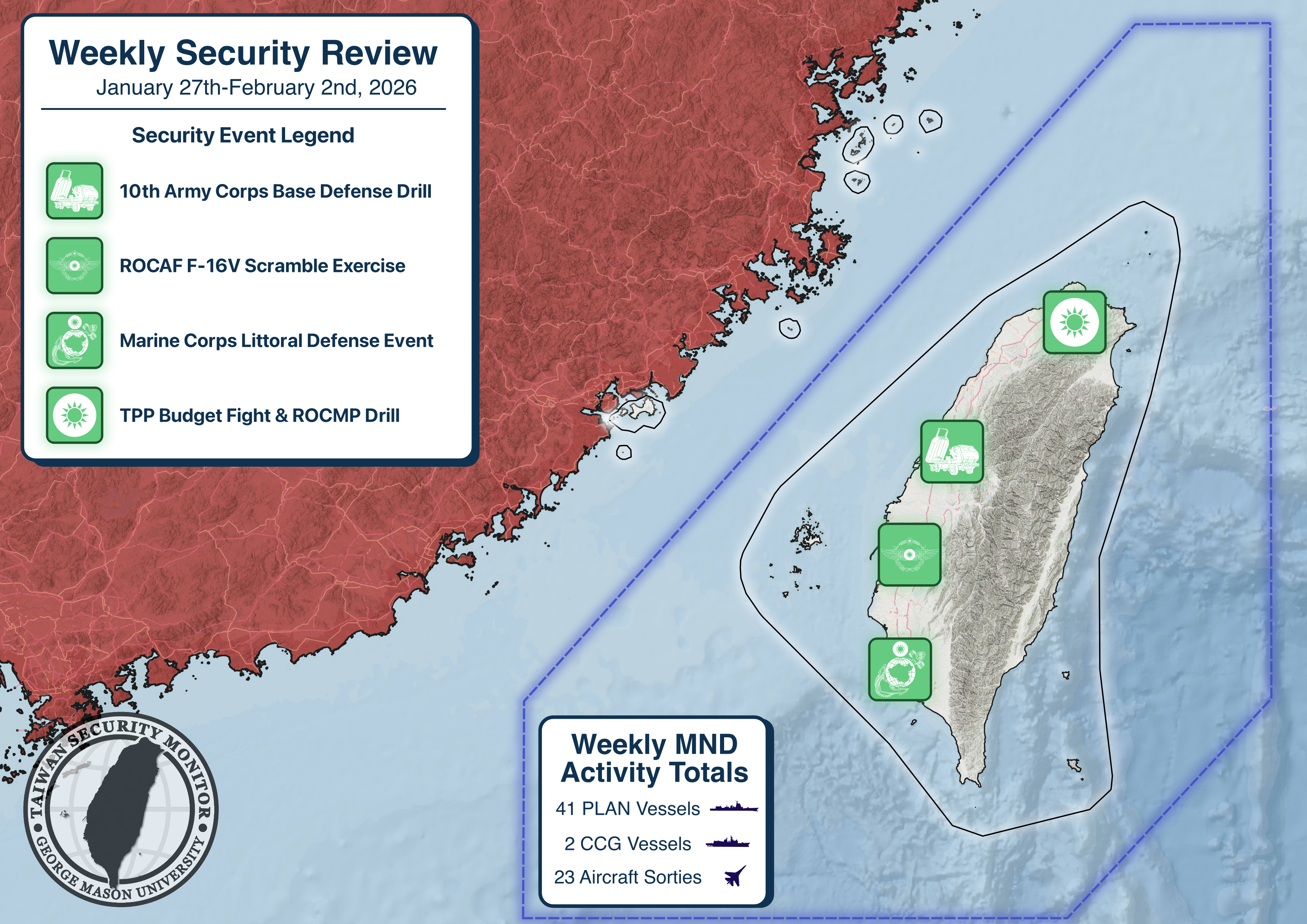
Military Conducts Lunar New Year Exercises
Ahead of the Lunar New Year, Taiwan’s military is conducting its annual combat readiness exercises to demonstrate that the armed forces will maintain vigilance and operational preparedness throughout the holiday period. For this iteration, the military held air, land, and sea media demonstrations over three days. It’s important to mention that there were other LNY exercises conducted away from the cameras in other parts of the country.
Army Deploys HIMARS, UAVs in Base Defense Drill
On Tuesday, 27 January, the 10th Army Corps conducted a “rapid combat readiness” scenario in which an opposing force, mostly fifth column operatives, attacked a small military base. The force was equipped with machine guns and used technical-style pickup trucks to launch an assault, with additional forces arriving by helicopter to support the broader attack. Taiwan’s army responded to this scenario by deploying troops from the 586th Armored Brigade, 58th Artillery Command, supported by the 602nd Army Aviation Brigade. Assets used included M60A3 tanks, CM33/34 Clouded Leopard infantry fighting vehicles, Humvees equipped with TOW-2B anti-tank missiles, Land Sword-2 SAM systems, UH-60M Black Hawk helicopters, AH-1W Super Cobra attack helicopters, and, for the first time, HIMARS and small-scale first-person-view (FPV) drones.
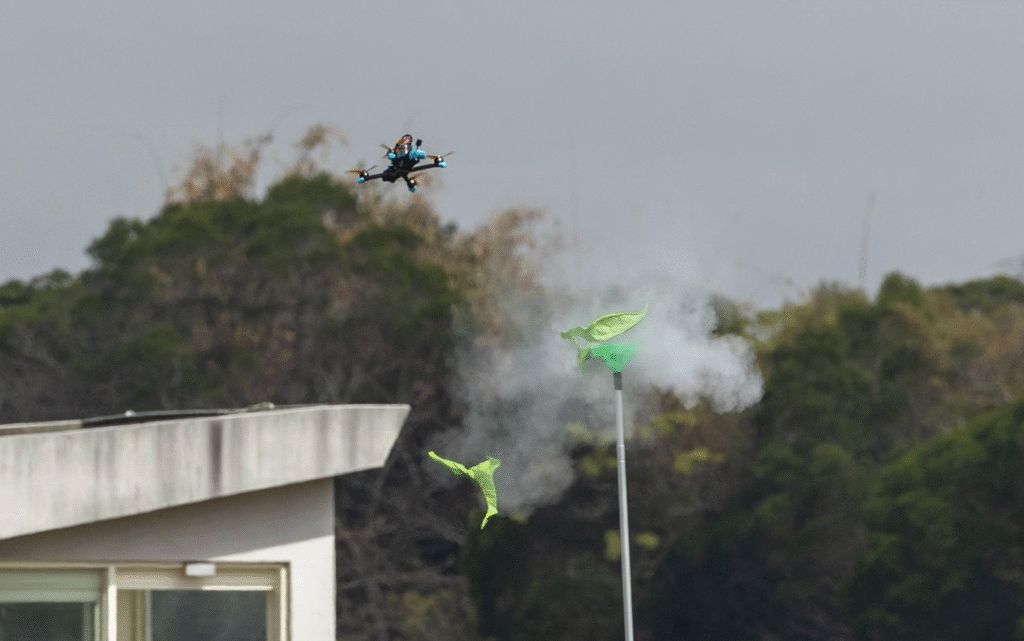
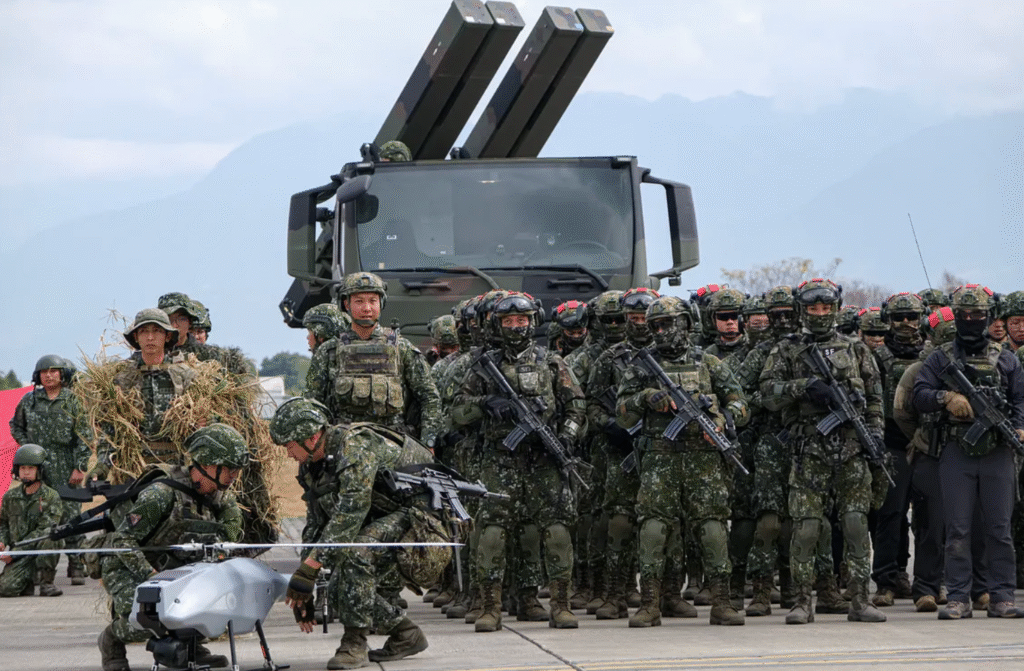
The exercises demonstrated small-scale counterinsurgency operations. Further, the MND said the drills were an opportunity for the 58th Artillery Command to test the effectiveness of new equipment. Most notable was the use of new HIMARS systems and FPV drones to provide additional firepower against potential enemy attacks. FPV drones were used to target balloons simulating enemy targets, while HIMARS demonstrated mobile “scoot-and-shoot” tactics, coordinating fire with troops on the ground. The tactic involves friendly forces practicing target engagement before relocating to avoid detection from the enemy.
It’s important to remember that late last year, the U.S. approved the sale of 82 HIMARS systems and 420 ATACMS worth more than $4 billion. Taiwan’s military considers these systems crucial to the island’s defense, and recent reports indicate the Army could deploy them to the outlying islands, closer to China. You can see our own visualization of that deployment here:
Air Force Demonstrates F-16V Scramble, Air Defense Operations
For two consecutive days (27-28 January), the media demonstrations moved south to Chiayi Air Base, home to the 4th Tactical Fighter Wing’s F-16V fighter jets. The exercises began with a demonstration of how pilots scramble to intercept enemy aircraft flying close to the country’s airspace. From the moment the alarm sounded to take off, the entire procedure reportedly took place in under six minutes. The Air Force also demonstrated various daily maintenance operations, including weapons‑loading teams mounting different types of missiles, such as AIM‑120 AMRAAMs and AIM‑9 Sidewinders. Officers told the media that “through integrated combat turnaround procedures, the aircraft can swiftly transition between air‑to‑air, air‑to‑sea and air‑to‑ground missions, enabling it to respond effectively to the rapidly changing conditions of the battlefield”.
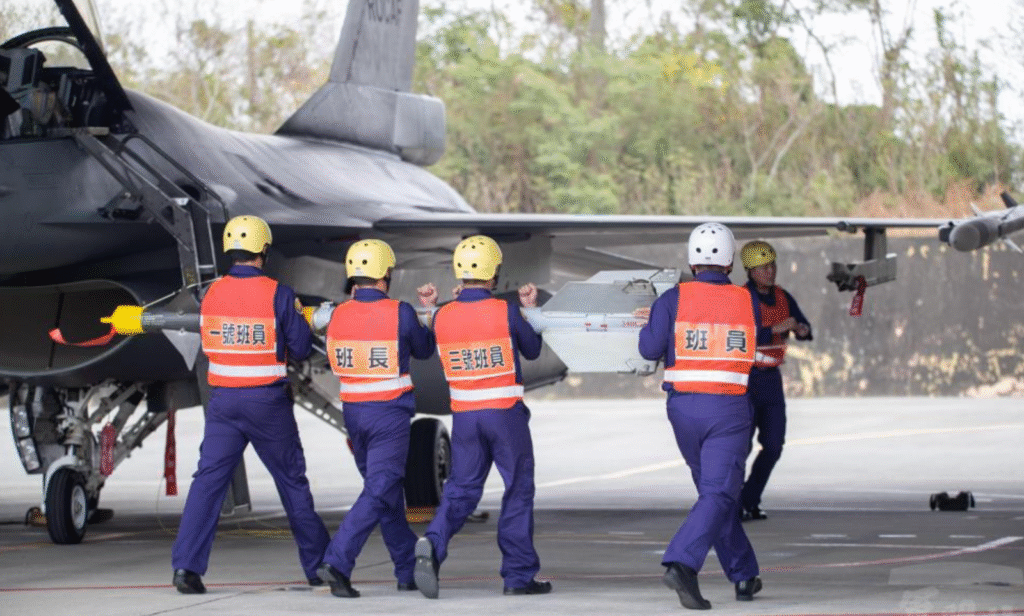
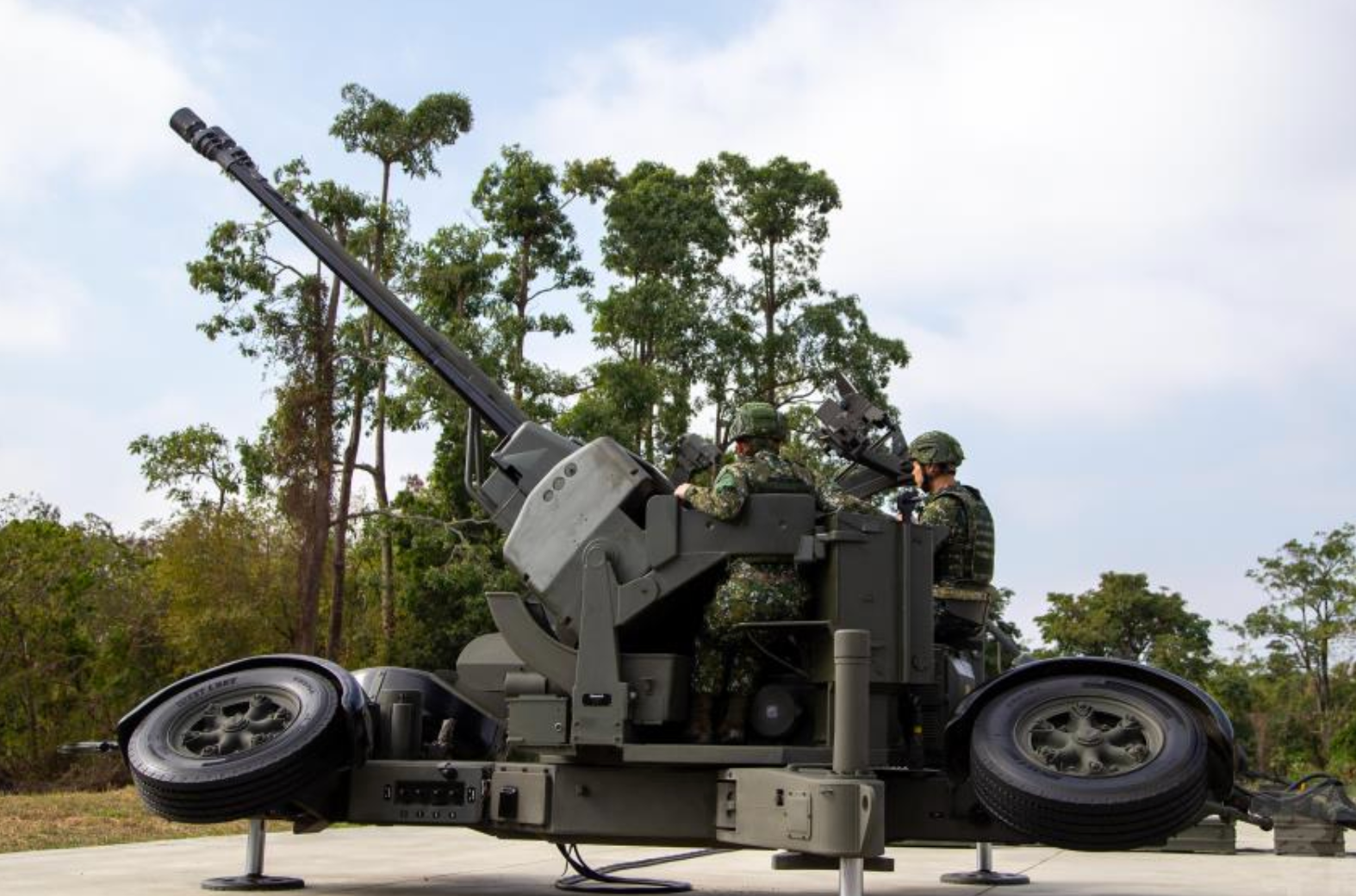
Along with the scramble exercises, units from the Air Force’s 301st Air Defense and Missile Battalion were also deployed to practice defending the surrounding airspace. Assets deployed included Skyguard GDF‑006 anti‑aircraft guns, Skyguard radar systems, and AIM-7 Sparrow SAM systems.
Navy, Marines Showcase Coastal Strike and Littoral Defense Capabilities
On the last day of the exercises (29 January), the Navy and Marine Corps hosted members of the media to demonstrate how they would defend against enemy vessels attempting to make it ashore. During the demonstration, ROCMC units held the first public live-fire test of the Chien Feng I attack UAV. This is a tube-launched drone that is similar to the American Switchblade system. One drone crashed shortly after takeoff, but the second backup drone launched successfully and struck a maritime target.
One component of the drill also featured enemy vessels rushing to shore, as Marine units aboard M109 speedboats and Kuang Hua-class missile boats raced to intercept and defend against the attack. In the background and along the shore, Haifeng Brigade mobile anti-ship missile launchers were deployed alongside snipers hidden in the tall grass. The MND says the overall goal of the drill was to demonstrate “integrated reconnaissance UAVs, mobile radar, and missile units…executing coordinated ISR, strike, and battle damage assessment operations”.
After the exercise, the National Chung-Shan Institute of Science and Technology (NCSIST), which produces the Chin Feng I drone, said the initial crash was due to wing control failure and that reliability improvements are underway.
Military Police Conducts Urban Defense Drills in Taipei
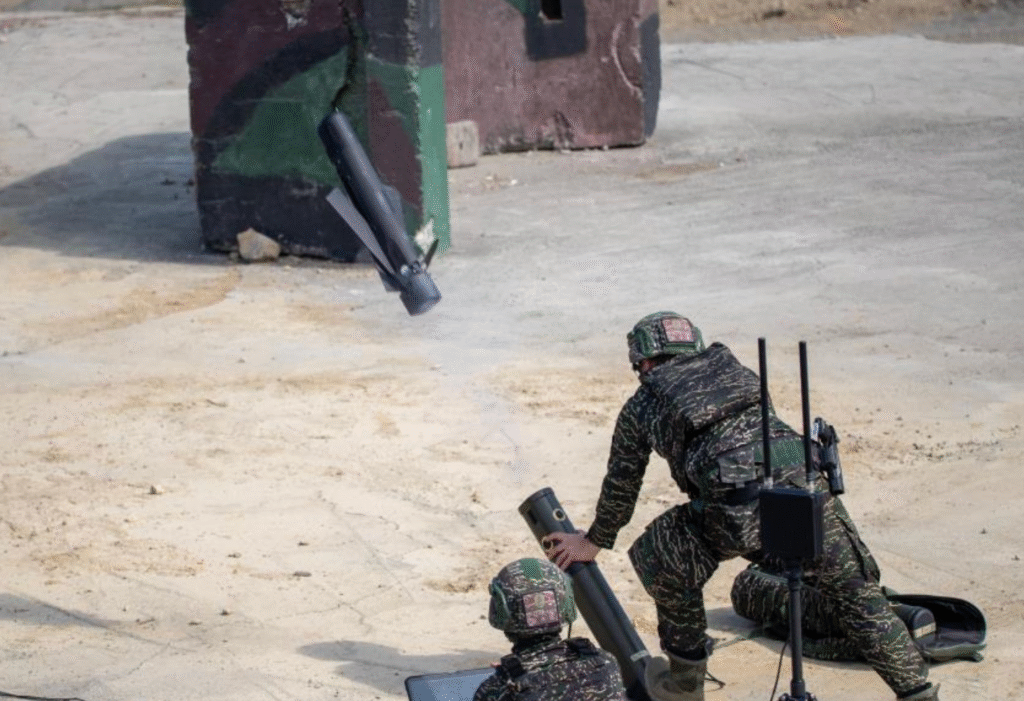
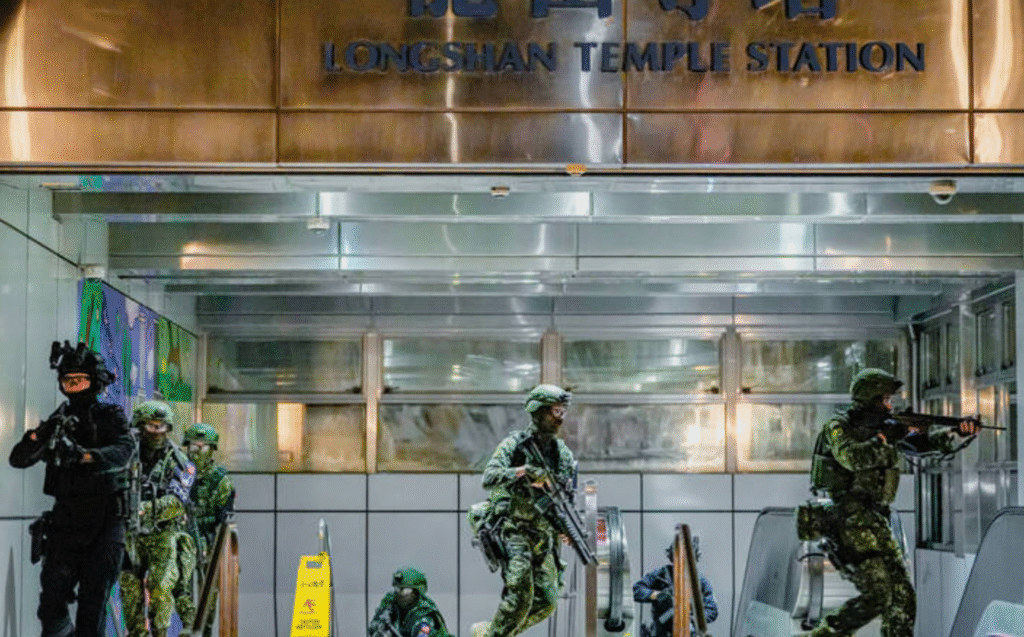
Taiwan’s military police were also busy this week as some units completed a four-day, three-night training exercise in the capital, Taipei. The drills tested defenses in both urban and mountainous environments, close-quarters battle (CQB), and counter-drone tactics.
Units from the 211th, 229th, and 332nd Battalions operated under the Military Police’s 202nd Command. The 211th Battalion, or “Iron Guard Battalion,” is responsible for guarding the Presidential Office and other key heads of state in downtown Taipei. Images show military personnel conducting CQB and seizing key positions as they exit Taiwan’s subway system. Other scenarios also included simulated artillery, gas, and drone attacks, forcing troops to shift constantly between underground and surface operations.
During last year’s annual Han Kuang military exercises, ROCMP troops made headlines as they were filmed using the subway system to transport Stinger and Javelin missiles across the city. The MND says the Military Police play an important role in the country’s defense, as they would be responsible for protecting key infrastructure from sabotage, terrorism, and other internal attacks.
TPP Agrees on Initial Passing of Supplemental Budget
After weeks of back and forth, Taiwan’s Legislative Yuan (LY) has voted to send the Taiwan People’s Party’s (TPP) proposed “national security and asymmetric warfare procurement bill” to committee review.
Originally, the ruling Democratic Progressive Party (DPP) proposed a special supplementary defense budget of roughly US$40 billion, comprising eight major categories of spending. You can find a complete breakdown here.
The TPP’s alternative proposal lists five line items and caps annual spending at US$12.6 billion, approximately one-third of the MND’s original request. The TPP’s proposal keeps 5 cases, including additional HIMARS, 60 Paladin self-propelled howitzers, Javelin anti-armor missiles, TOW anti-armor missiles, and ALTIUS loitering munitions. However, the proposal omits Tactical Mission Network software, AH-1W helicopter parts, and Harpoon missile support. Additional funding for production agreements with local arms industries, including the procurement of 200,000 drones and the T-Dome multilayered air defense system, has also been cut.
Taiwan’s MND says the TPP’s proposal lacks supporting measures, and without proper funding, weapon systems and defense procurement would be harder to implement and may have serious long-term repercussions.