Author: Jaime Ocon
Welcome to the Weekly Security Review, where we highlight key military, security, and political developments around Taiwan in one straightforward summary!
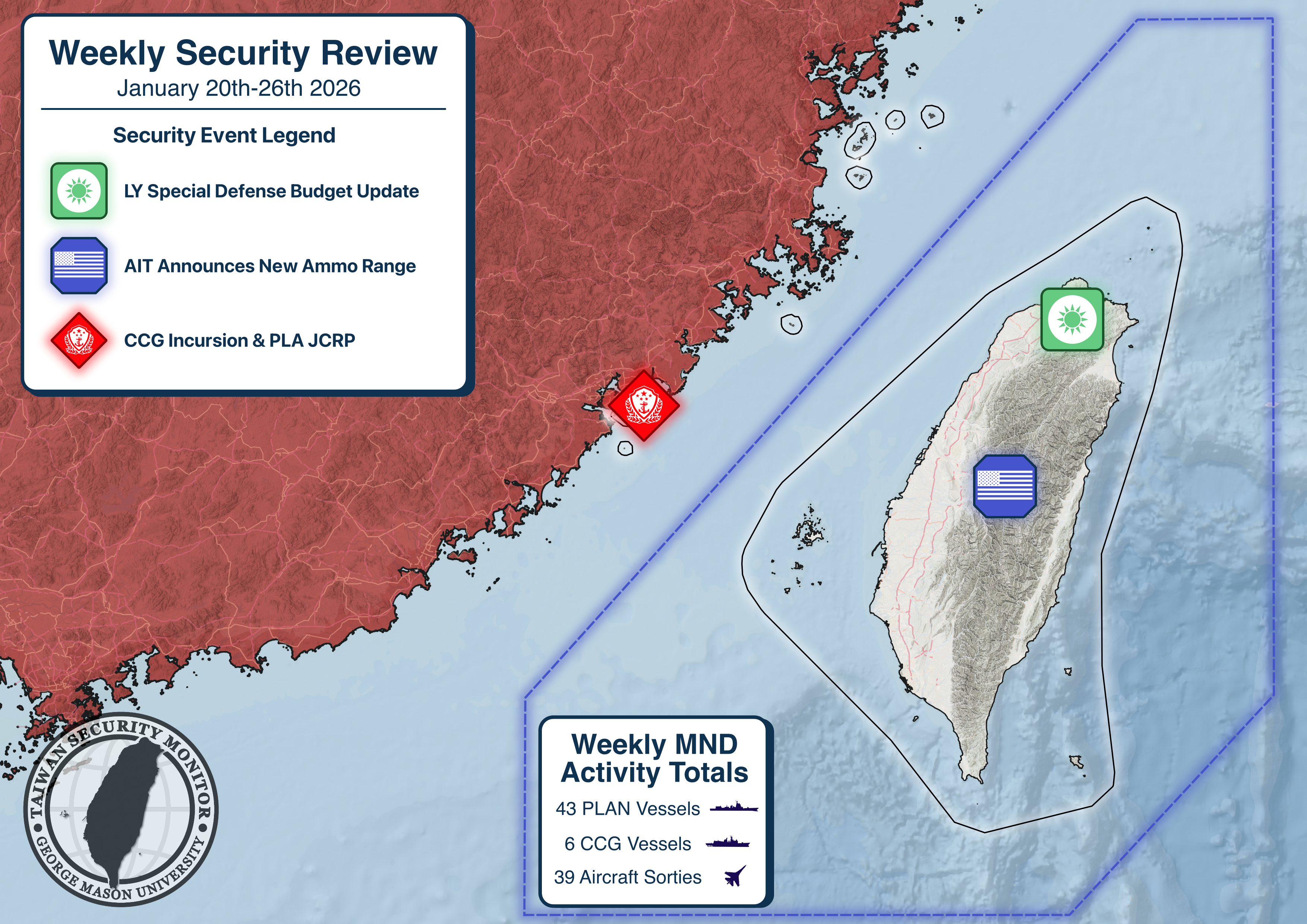
This week, Taiwan unveils details of its record-breaking supplemental defense budget, Washington and Taipei deepen industrial cooperation with a new joint ammunition-testing site, and Chinese forces intensify grey-zone patrols around the country.
Taiwan’s Defense Ministry Discloses Details of Record Supplemental Budget
Taiwan’s Ministry of National Defense (MND) delivered a classified special briefing on the NT$1.25 trillion (US$40 billion) special defense budget to the LY’s Foreign Affairs and National Defense Committee on 19 January. After that briefing, Minister of National Defense Wellington Koo revealed that Taiwan’s military is planning to procure seven categories of weapons systems: precision artillery, long-range strike missiles, air defense and anti-armor missiles, AI-assisted systems, and C5ISR capabilities.
Here is a complete list:
- Artillery
- M109A7 Paladin Self-Propelled Howitzers: 60 units
- Precision Guidance Ammunition Kits: 4,080 rounds
- M992A3 Carrier Ammunition Tracked Vehicles: 60 units
- M88A2 Recovery Vehicles: 13 units
- Howitzer and Associated Equipment
- Long-Range Precision Strike Systems
- High Mobility Artillery Rocket Systems (HIMARS): 82 launchers
- Guided Multiple Launch Rocket System Rocket Pods: 1,203 (756 unitary pods, 447 alternative cluster pods)
- Army Tactical Missile System (ATACMS) Missiles: 420
- Unmanned Platforms and Counter-UAS Systems
- ALTIUS-700M Loitering Munitions: 1,554 units
- ALTIUS-600 ISR Systems: 478 units
- Various drones: ~200,000 units, including littoral surveillance and littoral attack (submersible, bombing, and loitering) types
- Unmanned Surface Vessels (USVs): Over 1,000 vessels
- Counter-UAS Systems: Various types
- Air Defense and Anti-Armor Capabilities
- Javelin Anti-Tank missiles: 70 launchers, 1,050 missiles
- TOW-2B missiles: 24 launchers, 1,545 missiles
- Various Air Defense Missile Systems (including ammunition)
- AI Support and C5ISR
- AI-Enabled Decision Support Systems
- Tactical Network and Rapid Intelligence Sharing Applications
- Enhancing Combat Sustainability
- Wartime High-Consumption Armament Production Expansion: Establishment or expansion of production lines for ammunition, propellant charges, small-arms primers, new armored vehicle assembly, high-explosives, protective chemical masks, and night-vision devices.
- Related Mobile Obstruction Equipment: To enhance battlefield denial capabilities.
- Critical Ammunition Procurement: 120mm tank rounds, 105mm tank rounds, 30mm autocannon rounds, 155mm propellant charges, and high-explosives.
- Taiwan–U.S. Joint Development and Procurement Cooperation
- Acquisition of emerging technology systems to enhance operational resilience and strengthen asymmetric warfare capabilities.
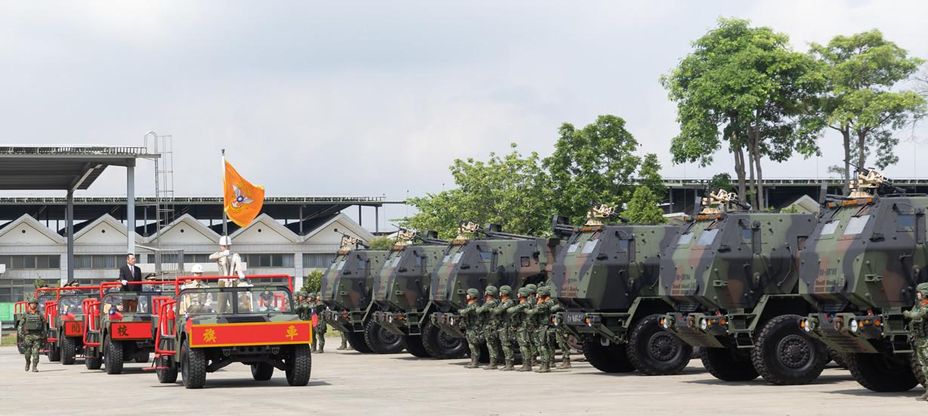
Defense Minister Wellington Koo oversees the first ROCA HIMARS battalion.
The special budget, officially referred to as the Special Act for the Procurement Program to Strengthen Defense Resilience and Asymmetric Capabilities, provides appropriations worth NT$1.25 trillion (US$40 billion) to fund various U.S. weapon systems and equipment. Back in November, Taiwan’s MND and the ruling Democratic Progressive Party (DPP) managed to pass this bill, separate from the general budget, through the Executive Yuan. However, there have been six attempts to pass the finalized act in the LY, all shut down by the opposition Kuomintang (KMT) and Taiwan People’s Party (TPP) due to a lack of oversight and demands that President Lai Ching-te provide more information on the budget’s content. Opposition lawmakers have been quite stern with their demands, declaring that they will not vote on the spending plans until Lai briefs the LY and responds to questions. President Lai continues to label these requests as unconstitutional, citing a 2024 Constitutional Court ruling that declared an opposition-backed legal revision, which would have mandated the President provide real-time responses to lawmakers’ questions, as unlawful.
Minister of National Defense Wellington Koo has already answered questions from the LY, and the MND says the spending plan would help construct a comprehensive defense system to build a “Taiwan Shield.” While a significant portion would be used to pay for U.S. weapon systems, another part of the special budget would introduce advanced technology and AI to accelerate Taiwan’s kill chain. MND officials also stated that it needs those funds to strengthen the domestic defense industry and develop a “non-red” (non-China-dependent) supply chain.
On top of that, in December, more than $11 billion in U.S. arms and equipment was approved for sale, and it is still unclear whether Taiwan needs these funds to start paying for that package.
If you’re interested in the status of U.S. arms sales to Taiwan, check out our Taiwan Arms Sales Backlog for a complete overview of publicly available data.
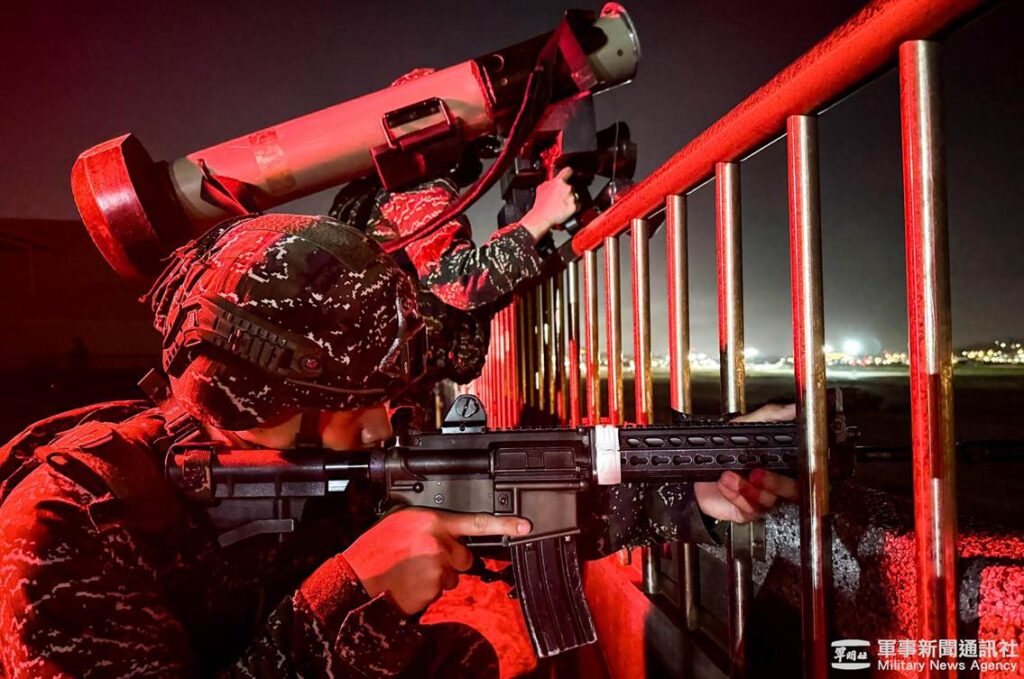
ROCMC units use a Javelin system during the Han Kuang exercises in 2025.
AIT, INDSR Announce Joint Medium-Caliber Ammunition Testing and Production Site
The Director of the American Institute in Taiwan (AIT), Raymond Greene, revealed that U.S. defense contractor Northrop Grumman has established a “medium-caliber ammunition test range” in Taiwan. AIT is the de facto embassy in Taiwan and manages all unofficial relationships between the two sides. Director Greene made the announcement at a forum with the Institute for National Defense and Security Research (INDSR), Taiwan’s top security think-tank, on 22 January. The facility would allow Taiwan’s MND to test ammunition in accordance with global industry standards and, through technology transfer and expert training, advance the country’s indigenous defense research and development projects.
The complete speech is here: https://www.ait.org.tw/speech-by-ait-dir-greene-at-indsr-seminar/

AIT Director, Raymond Greene, speaks at a forum in Taipei.
The announcement is the latest sign of stronger U.S.-Taiwan defense cooperation, as both actors work with Taiwan’s private sector to expand the island’s domestic defense industrial base. Just last week, the head of the MND’s Armaments Bureau said Taiwan’s military has already started working with the U.S. to co-produce 155mm howitzer shells. The MND has stated, “If successful, this will then be expanded to other weapons and munitions.” Other companies, like Anduril, have also announced plans to co-produce low-cost cruise missiles on the island, potentially providing a cheaper, faster way for Taiwan to arm itself.

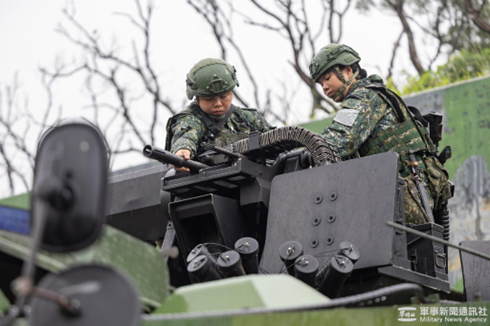
Various ROC units load ammunition into vehicles and aircraft.
This isn’t the first time Northrop Grumman has invested in Taiwan’s domestic production capabilities; in 2024, it committed to investing US$100 million annually in opportunities for Taiwan to become part of its global supply chain. Northrop Grumman, along with Lockheed Martin and Raytheon, has a long history of supplying Taiwan with weapons and equipment. E-2K Hawkeye early-warning aircraft, APG-83 radar systems for the F-16V fighter jets, and ammunition for 30 mm chain guns mounted on Clouded Leopard armored vehicles are just a few of those systems.
China Sustains Gray-Zone Military and Law Enforcement Operations Around Taiwan
For the 4th time this month, Taiwan’s Coast Guard reported that multiple China Coast Guard vessels entered the restricted waters around Kinmen.
In the morning of 24 January, four Chinese vessels (hull no. 14529, 14605, 14603, and 14533) entered Kinmen’s restricted waters in two-ship formations, one group approaching from the southeast of Liaoluo, the other from south of Lieyu. Taiwan dispatched its own ships and broadcast radio warnings in both Mandarin Chinese and English. Roughly three hours later, the Chinese vessels left the area.
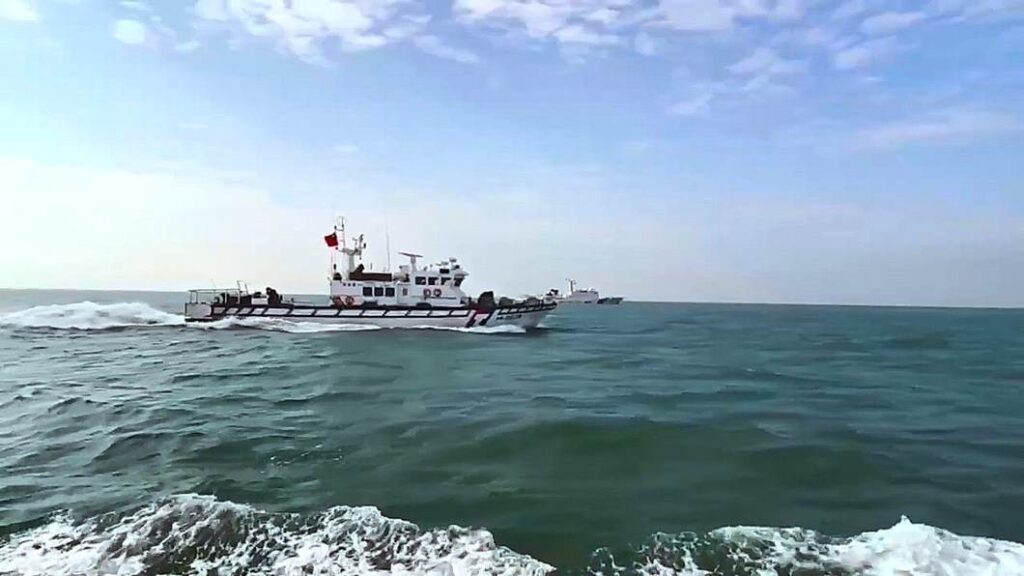
A Taiwanese patrol boat shadows a Chinese Coast Guard ship in the distance near Kinmen.
In an official statement, Taiwan’s Coast Guard Administration (CGA) accused Beijing of repeatedly exploiting false “law enforcement patrols” to justify incursions into Kinmen’s restricted waters. Taiwan’s CGA says China’s maneuvers are “routine harassment” that erodes cross-strait stability and threatens regional peace.
Earlier this week, the PLA Air Force (PLAAF) and PLA Navy (PLAN) also stepped up their presence around Taiwan, sending 23 sorties of various types to conduct a Joint Combat Readiness Patrol. The group of planes, which included PLAAF J-10 fighter jets, H-6K bombers, and KJ-500 Early Warning and Command aircraft, was detected breaching Taiwan’s air defense identification zone (ADIZ) at 1040 on 23 January. 17 out of 23 sorties crossed the median line of the Taiwan Strait and entered the northern, central, and southwestern ADIZ.
Taiwan Security Monitor operates a number of real-time trackers. For more information on PLA and CCG movements, you can find them here.