
Author: Jaime Ocon
Welcome to the Weekly Security Review, where we highlight key military, security, and political developments around Taiwan in one straightforward summary!
This week, a Chinese drone breaches Taiwan’s airspace for the first time, the Marine Corps brings back a long-dormant unit, an opposition party challenges the government’s record defense budget, and investigators scramble to retrieve an F-16’s black box.
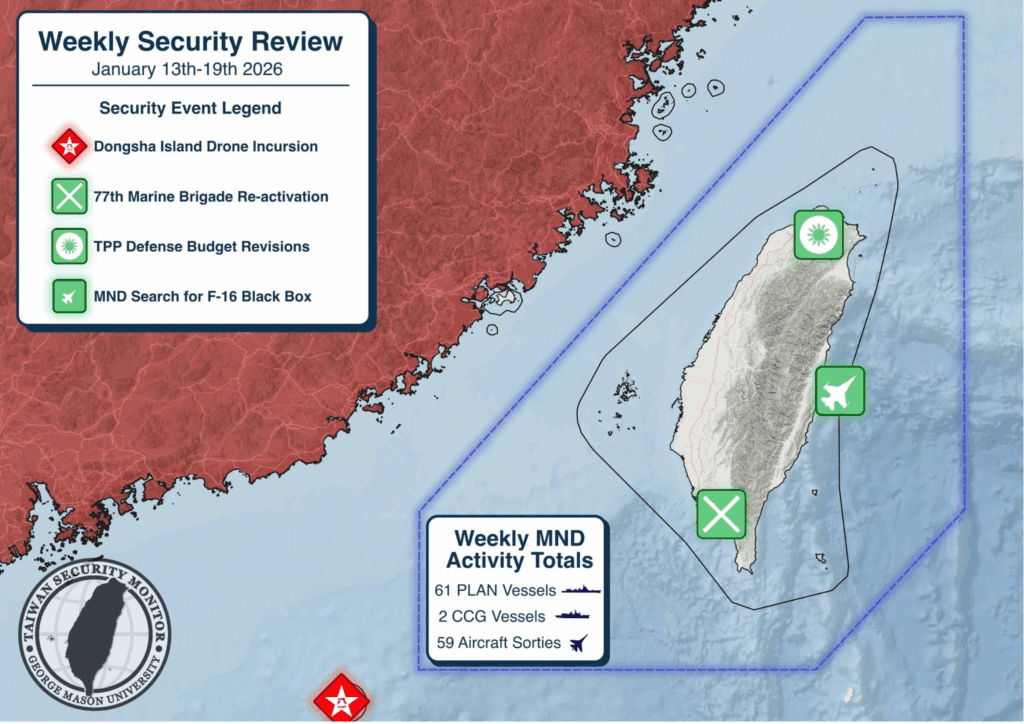
PLA Reconnaissance Drone Breaches Taiwan’s Airspace Near Dongsha Island
We start this week with some concerning news from Taiwan’s Ministry of National Defense (MND), which reported that a Chinese People’s Liberation Army (PLA) reconnaissance drone breached airspace over Dongsha Island on Saturday, 17 January. This is the first publicly disclosed instance of a PLA air asset breaching Taiwan’s airspace, though notably, Dongsha is an outlying island and farther away in the South China Sea. Taiwan’s military said it issued radio warnings at 0541 when the drone was first detected, but by 0544 the aircraft had already entered the island’s airspace. By 0548, the drone had left the area after continued radio warnings on international channels. In a statement, Taiwan’s MND says that the PLA’s behavior was “highly provocative and irresponsible,” adding that it undermined regional peace and violated international law. The PLA Southern Theater Command responded and said the drone was conducting “normal flight training in the airspace near China’s Dongsha Island,” and that the operation was “entirely justified and lawful.” China and Taiwan both claim Dongsha Island, also known as Pratas Island, as their own, but Taiwan administers the island, where it has built a runway and hosts a small garrison of some 500 marines.
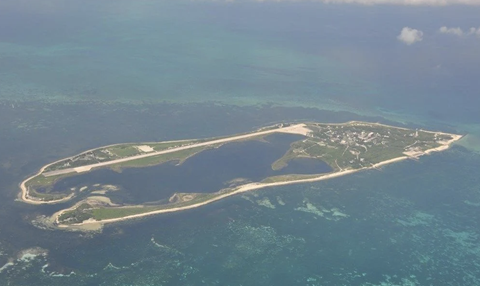
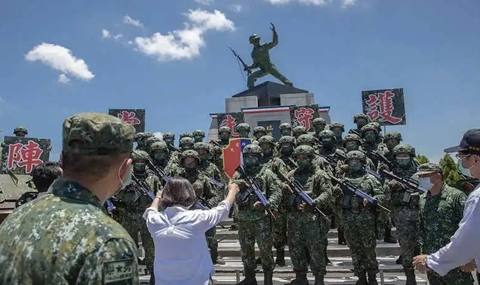
Left: Aerial image of Dongsha Island, Right: Former President Tsai Ing-wen visits marines based in Dongsha
In the same statement mentioned above, the MND said the drone was flying outside the range of the garrison’s air-defense weapons. This is concerning, but publicly available information shows that these Marines from the 99th Brigade are not heavily armed. These Marines are equipped with 120mm mortars, 40mm anti-air autocannons, dual-mounted Stinger missiles, and Kestrel anti-armor rocket launchers. Commanders are authorized to fire back at potential enemy troops if communications are cut off from the main island.
However, harassment of Taiwan’s outlying islands, especially Dongsha, is not new. Chinese maritime law enforcement and PLAN vessels are frequently spotted operating in the waters near Taiwan’s claims. Just this past week, on 14 January, Taiwan’s Coast Guard Administration spotted a Chinese Coast Guard ship operating just outside Dongsha Island’s restricted waters. It was on track to breach restricted waters until Taiwan dispatched two patrol ships, Yunlin and Kaohsiung, to intercept and drive the ships away. Saturday’s report of a drone breaching Taiwanese airspace, paired with the military’s acknowledgment that it lacked the capability to shoot it down, is concerning, to put it mildly. It suggests we may see more incidents like this as Beijing probes for gaps in Taiwan’s defenses and expands its gray-zone playbook.
Taiwan Re-Activates Marine Brigade for Extra Infrastructure Security
Taiwan’s military is mulling reactivating the 77th Marine Brigade, a unit downgraded in 2014 to the current Air Defense and Base Guard Group, with military officials saying it will be modeled on US forces tasked with coastal defense and rapid deployment. The unit’s planned equipment package includes U.S.-standard M4A1 rifles, M4 recoilless rifles for anti‑armor tasks, and man‑portable Stinger missiles. The MND says the emphasis for this group of soldiers is mobility and precision rather than heavy armor capabilities. The brigade is also expected to incorporate layered counter‑drone capabilities, employing both “soft‑kill” electronic warfare and “hard‑kill” kinetic defenses. Officials say this decision was made after recognizing the variety of unmanned threats posed by the PLA and as Taiwan continues to modernize its amphibious warfare tactics.
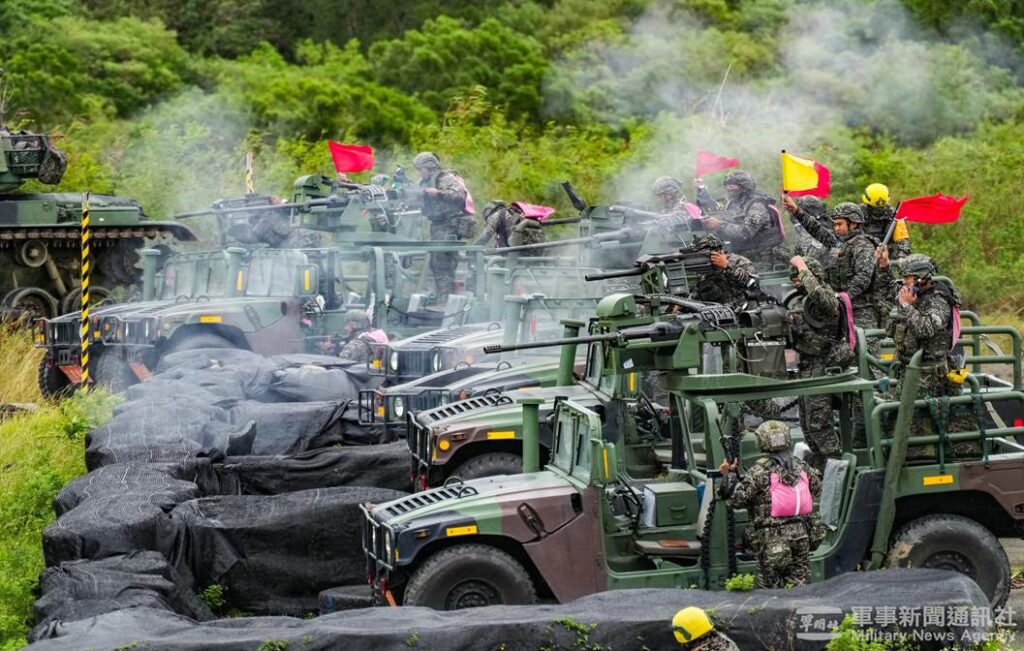
Taiwan’s 99th Marine Brigade conducts combined arms training
Currently, Taiwan has two Marine brigades: the 66th Brigade in the north and the 99th Brigade in the south. According to the MND, the 77th Brigade will oversee the defense of Taiwan’s four principal naval hubs (Zuoying, Su’ao, Keelung, and Magong), along with several coastal missile bases. Officials say the new brigade creates a more flexible, regionally distributed force capable of rapid response and sustained littoral defense against potential PLA incursions.
Recently, the 66th Marine Brigade underwent comprehensive changes, the first being a major transfer from its original base near Tamsui District, New Taipei, to Songshan Airport in Taipei. MND officials said that this redeployment was meant to bolster the security of critical infrastructure within the capital and protect key sites like the MND HQ, Presidential Office, and Legislative Yuan. The brigade is now a strategic reserve force directly under the General Staff Headquarters and will conduct operations alongside the 202nd Military Police Command, also headquartered in Taipei. Additionally, the Marines’ M60A3 tank battalion and M109A2 self-propelled artillery battalion are also being gradually phased out and converted into a “drone firepower unit” to establish more sophisticated intelligence, surveillance, and reconnaissance capabilities to supplement long-range strike operations.
I mention these changes to the 66th because Taiwanese defense planners have really tried to figure out what to do with their force of roughly 10,000. I believe more changes are coming as 2026 introduces the “Littoral Command” for the Navy and as more Haifeng anti-ship missile brigades come online. Let’s see how things go for the 77th.
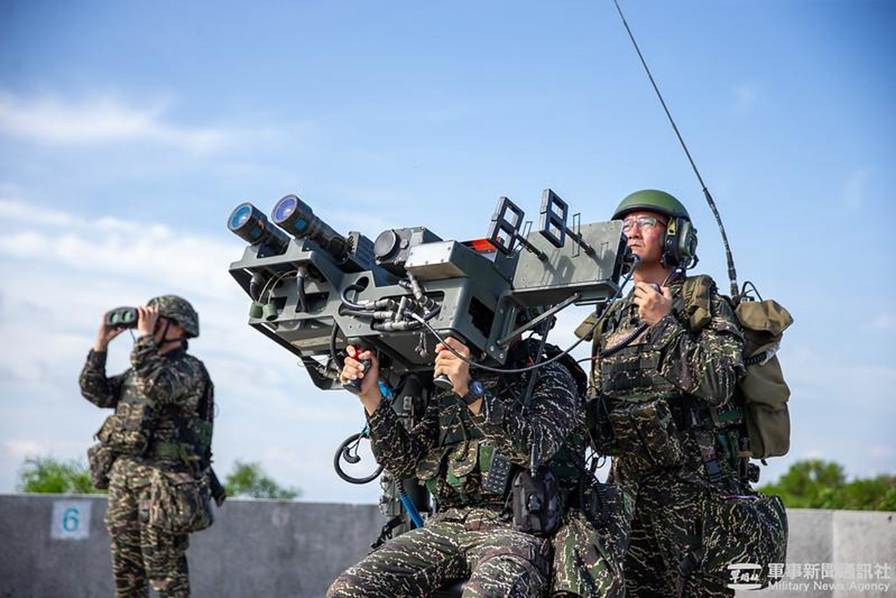
Soldiers from the 66th Marine Brigade operate a dual-mounted Stinger in Taipei
TPP Proposes Revised Defense Budget (link to original story)
On 15 January, the chairman of the opposition Taiwan People’s Party (TPP), Huang Kuo-chang, said the TPP will propose an alternative special defense budget compared to the one currently drafted by the ruling Democratic Progressive Party (DPP). The announcement comes after Huang returned from a one-day trip to Washington, where he reportedly met with State Department, AIT, and NSC officials.
According to Huang, the TPP is concerned about the lack of clarity in the government’s proposed NT$1.25 trillion (US$39.5 billion) special defense budget, especially given the size of the most recent defense package. He claims that U.S. officials “agreed” with him and added that in his proposed bill, a large proportion of the funds would not go toward U.S. arms purchases. Huang says this trip has hardened his stance on the budget, and the TPP will wait for a closed-door briefing from the Ministry of National Defense next week before submitting its own proposal.

Taiwan People’s Party (TPP), Huang Kuo-chang gives a briefing in Taipei on a possible U.S. arms sale.
This comes as the TPP and Kuomintang (KMT) have worked to block the special budget at least six times. The DPP says their budget would be used to finance the next wave of military modernization and help pay for a series of recent U.S. arms packages worth more than $11 billion. The MND says that “at least four” U.S. arms packages will be notified to Congress in the near future, which puts even more pressure on the Lai administration to find a way to pay for these systems and equipment.
Military Deploys Retrieval Team to Recover Black Box from Crashed F-16
The Air Force says it has pinpointed the location of the black box from an F-16 that crashed last week during a routine nighttime training exercise. Search and rescue operations are still ongoing for the pilot, and the aircraft has yet to be located.
Earlier this week, Air Force personnel detected small, intermittent signals coming from the flight recorder near the crash site. The MND is now seeking assistance from Singaporean and Japanese salvage companies for the retrieval mission, as Taiwan lacks the capacity to conduct deep-sea salvage operations.
In response to the crash, Taiwan grounded its entire fleet of F-16s for inspection as part of the overall investigation into the crash. The aircraft have since returned to service, and the MND posted these photos of the first flight operations after the incident.
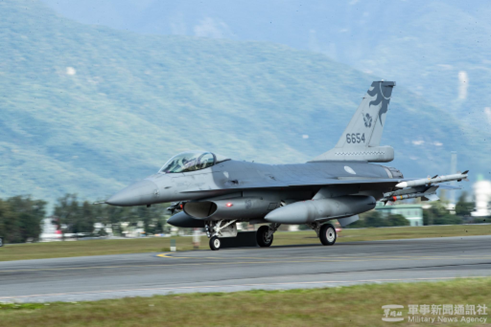
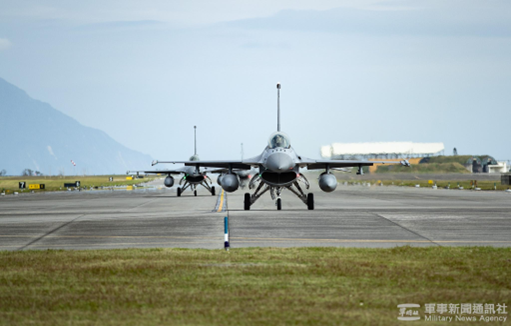
ROCAF F-16’s prepare for takeoff at Hualien Air Force Base.