
Author: Joe O’Connor, Shikhar Chaturvedi, Danielle Kremer, and Wyeth Lindberg
This week: the Army pushes back on reports that testing of new ALTIUS drones was not effective; a bipartisan US letter is sent to Taiwanese legislators worried about defense spending; reports show that a potential US arms sale could include radars and counter-drone systems alongside PAC-3 missiles, and Trump announces that he will make a decision “pretty soon” on additional sales to Taiwan,
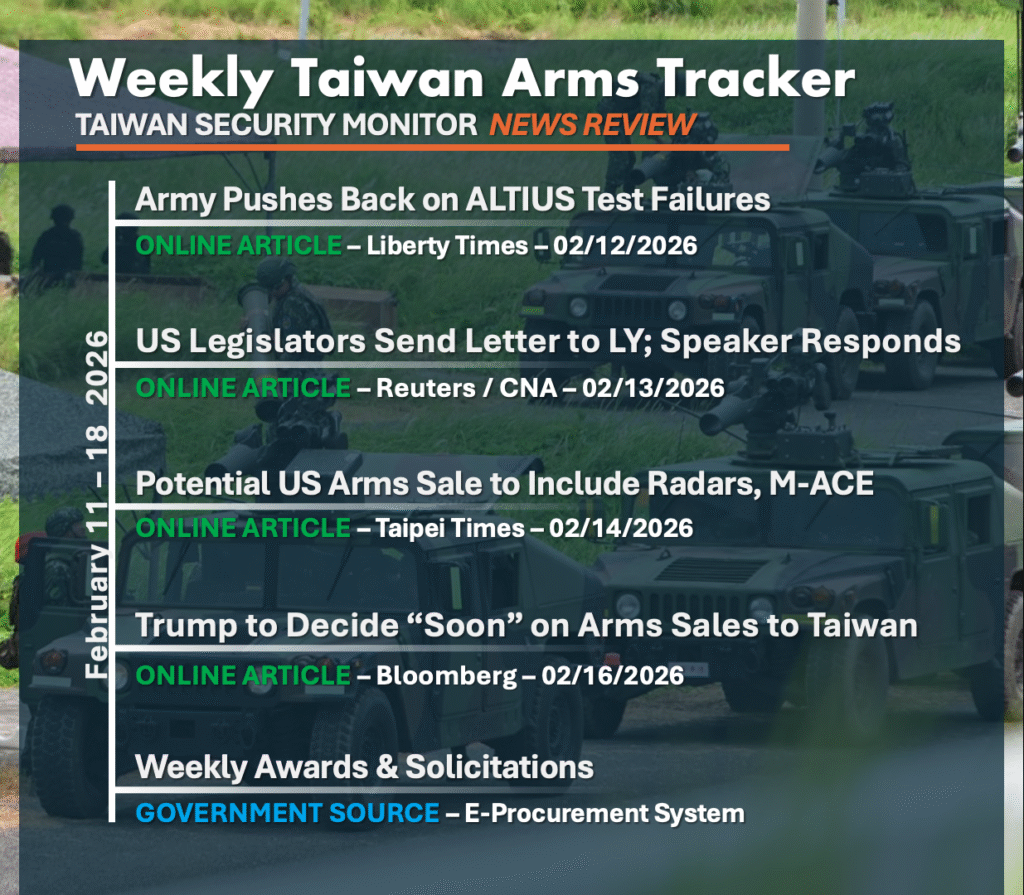
Army Pushes Back on ALTIUS Test Failures
In August 2025, Taiwan received its first batch of “Hunter Owl” ALTIUS-600M UAV attack drones from the United States. As such, Taiwan began using its Army Artillery Testing Center to conduct the drones’ first live-fire exercises. However, reporters claimed the results were less than ideal, this week, with only two out of five drones successfully completing the tests. In response to media reports, Taiwan’s army stated that the drones were performing normally and emphasized that they planned to incorporate the new weapons and equipment into these exercises soon. In December, an additional sale of 1,554 ALTIUS-700M loitering munitions and 478 ALTIUS-600 ISR drones was announced, indicating that more will be arriving soon.
US Legislators Send Letter to LY; Speaker Responds
On Thursday, 37 US senators and representatives, including senior members of the House and Senate Foreign Affairs Committees and representing both parties in Congress, sent a letter to the speaker of the Legislative Yuan (LY) and party leaders, expressing concern about “ongoing deliberations in the Legislative Yuan to only partially fund a supplemental budget request.” After noting that “the US must address the massive backlog in weapons deliveries,” the letter noted that “we need Taiwan to step up with us,” urging the LY to pass the special defense budget advanced by the Lai administration. On Monday, LY Speaker Han Kuo-yu responded in a joint statement, saying that they will prioritize the review of the special defense budget when the LY reconvenes on February 24.
Potential US Arms Sale to Include Radars, M-ACE
MND sources told the Taipei Times on Friday that the next potential arms sale to Taiwan could include much more than PAC-3 MSE interceptor missiles, including improved radars and counter-drone equipment. Per sources, the sale could include Integrated Battle Command Systems, which coordinate Patriot and other AD systems, as well as Lower Tier Air and Missile Defense Sensors (LTAMDS) radars, which would replace currently installed radars on Patriots. Additionally, a separate sale may include Mobile-Acquisition, Cueing and Effector (M-ACE) counter-drone systems, which consist of sensors, jammers, and autocannons mounted on pickup trucks and produced by Northrop Grumman.
Trump to Decide “Soon” on Arms Sales to Taiwan
On Monday, President Donald Trump said he is “talking” with Xi Jinping about potential additional U.S. arms sales to Taiwan and that a decision will be made “pretty soon,” prompting a rapid White House clarification that there has been no change in U.S. policy. Beijing, for its part, has elevated arms sales as the “most important” issue in U.S.–China relations ahead of a possible April summit, urging Washington to act prudently. The U.S.–Taiwan arms-sale backlog remains roughly US$32 billion, with no new cases notified since December. Meanwhile, Taiwan’s stalled special defense budget continues to shape how quickly notified systems can move into execution. At a February 11 Presidential Office press conference, President Lai warned that U.S. and other major suppliers’ production lines are already “排滿” (fully booked) and cautioned that delays in passing the special defense budget could push Taiwan out of priority queues, further slowing delivery of key systems. Taken together, Trump’s pending decision should be viewed less as a standalone political headline and more as a potential inflection point in the backlog queue. While current White House communications may signal commitment, deterrent value will ultimately hinge on whether weapons are actually contracted, funded, and delivered on time.
Weekly Awards/Solicitations
There were no significant awards or bid solicitations this week.