
Author: Jaime Ocon
Taiwan’s response to China’s “Justice Mission-2025” was less about matching PLA moves and more about controlling the narrative and information environment. Taiwan’s Ministry of National Defense (MND), Coast Guard Administration (CGA), and Presidential Office moved quickly to reassure the public by framing the drills as coercive and to signal readiness through press conferences and real-time activity updates. Taiwan also tried to preempt Beijing’s psychological operations by debunking blockade claims, clarifying live-fire and warning-system protocols, and pushing back on rumors of territorial air/sea space intrusions, drones, reservist mobilization, and air and maritime safety.
Initial Responses from the Defense Ministry
On December 29, after the PLA Eastern Theater Command had announced live-fire drills, and as PLAN assets had already begun moving into position, Taiwan’s MND reported at 0950 that the ETC was conducting live-fire exercises in the waters and airspace around the Taiwan Strait.
The MND stated that in the days leading up to the drills announcement, the PLA was continuously carrying out military harassment and cognitive operations around Taiwan and the Indo‑Pacific, heightening regional tensions. These operations included China Coast Guard (CCG) ships breaching restricted waters in the outlying islands of Kinmen and PLA UAVs wrapping around the southern portion of Taiwan’s mainland.
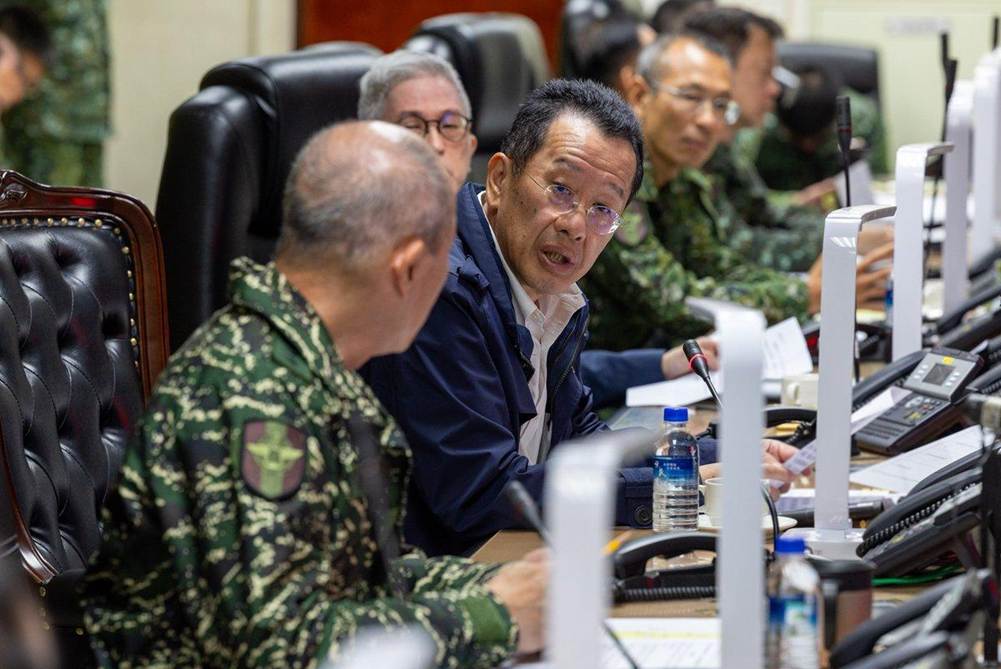
Defense Minister Wellington Koo speaks with members of the Joint Chiefs of Staff
In response to the exercises, Taiwan’s military raised its alert level, directing all personnel to maintain a “high level of vigilance,” remain fully prepared, and “act to safeguard national sovereignty and the security of the homeland.” The MND established an emergency operations center to implement rules of engagement and authorization procedures at strategic, operational, and tactical levels to monitor and, if necessary, intercept PLA activity. It was also announced that Taiwan’s armed forces would conduct “immediate combat exercises” across the country for an unspecified period.
Local media reported that Mirage-2000 fighter jets had scrambled from Hsinchu Air Base shortly thereafter, and that the MND repositioned additional assets, including F-CK-1s, F-16s, and P-3C aircraft, to Hualien Air Base. A portion of Taiwan’s F-16s were ordered to maintain a high state of readiness and were equipped with AGM-84 Harpoon anti-ship missiles.
Taiwan’s Coast Guard
Shortly after the ETC announced Justice Mission-2025, Taiwan’s CGA detected four Chinese Coast Guard (CCG) vessels approaching Taiwan’s northern and eastern waters. PLA Navy (PLAN) surface combatants were also dispatched to maritime exercise zones announced by the PLA. In response, the CGA deployed its own patrol vessels and established an emergency response center to work jointly with the MND on information sharing and countermeasures.
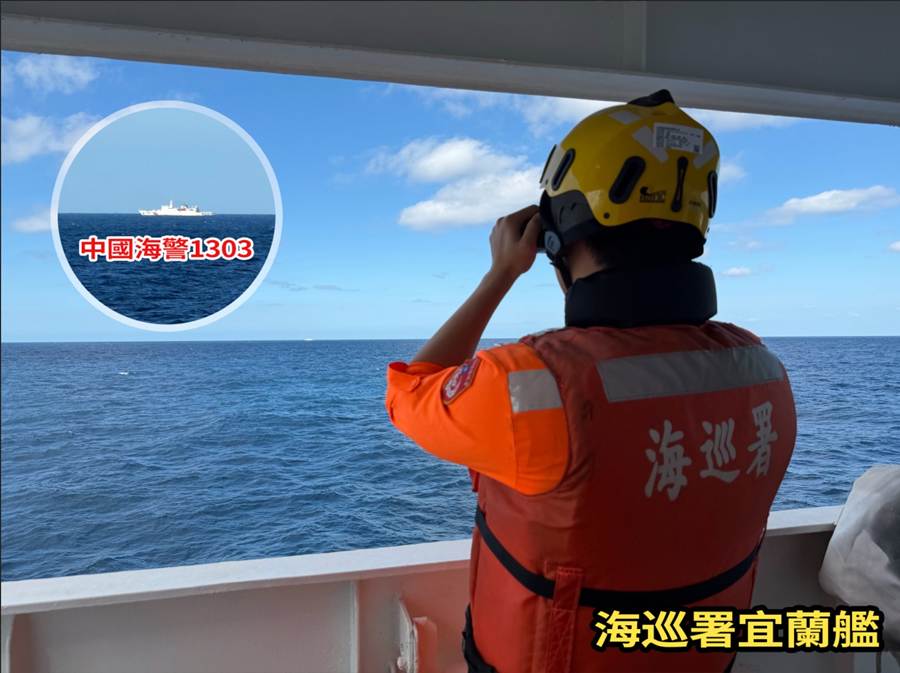
Taiwan CG ship “Yilan” shadows Chinese Coast Guard Vessel 1303 in the distance.
Presidential Office
While the MND and CGA mobilized their operational response, Taiwan’s Presidential Office condemned the drills, calling them a “direct challenge to international law and order and a violation of international norms”.
In the statement, Taiwan’s Presidential Office said Beijing is using military intimidation to threaten neighboring countries and risks becoming a troublemaker that undermines regional peace. Taiwan continued urging China to act rationally, exercise self‑restraint, avoid misjudgment, and immediately halt irresponsible provocations.
First Images
The first images of CCG vessels came from Taiwan’s CGA, as CGA vessel Yilan intercepted CCG vessel 1303 approximately 23 nautical miles northwest of the Pengjia Islets. Another CGA vessel, the Taoyuan, trailed CCG 1306 just 30 nautical miles from Hualien, off Taiwan’s east coast. Linked here is a video of the reported activity and radio warnings from Taiwan.
Taiwanese F-16s also captured images of various PLA aircraft operating around Taiwan.
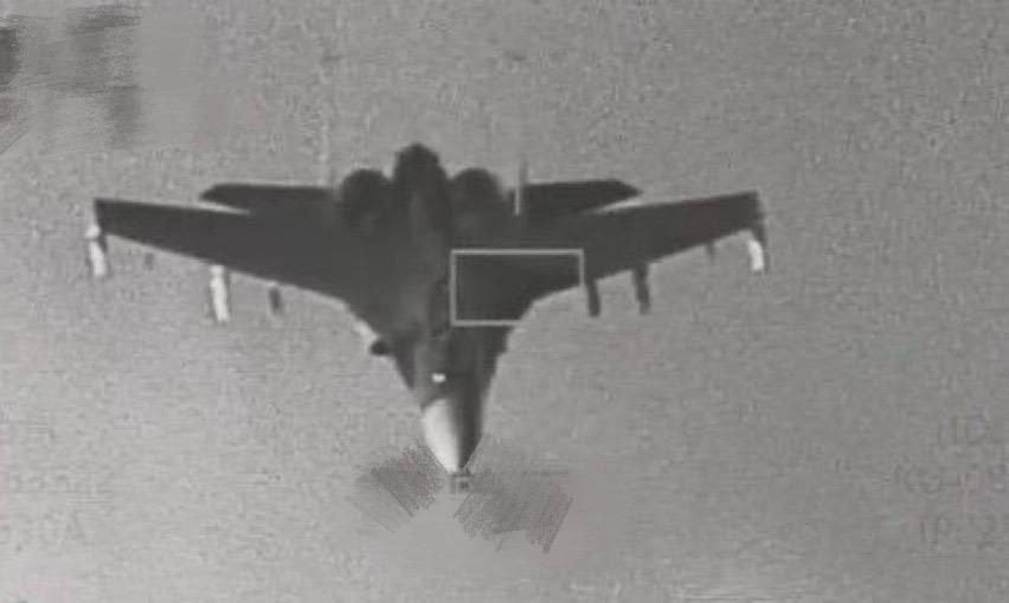
Taiwan’s MND Holds Day 1 Press Conference
At 1630 on December 29, Taiwan’s MND held an emergency press conference to provide more information on the scale and specifics of China’s large-scale exercise. The MND reported that it identified 89 PLAAF military aircraft and drones operating in the area, 67 of which entered Taiwan’s Air Defense Identification Zone (ADIZ), during the first seven and a half hours of the exercise. It had also tracked 18 PLAN and 14 CCG surface ships operating around Taiwan, along with a Type 075 Amphibious Assault ship and three escort vessels sailing 160 nautical miles southeast of Taiwan.
Taiwan’s MND noted that the announced exercise zones in the south, east near Taitung, west near Penghu, and north all overlapped into Taiwan’s restricted territorial waters. That said, it clarified that no PLAN or CCG vessels had entered the restricted 12 nautical mile barrier. Finally, the MND reported that although the PLA had not conducted live-fire exercises on the first day of Justice Mission-2025, it was tracking the PLA’s Rocket Forces for signs that it might conduct such drills in the coming days.
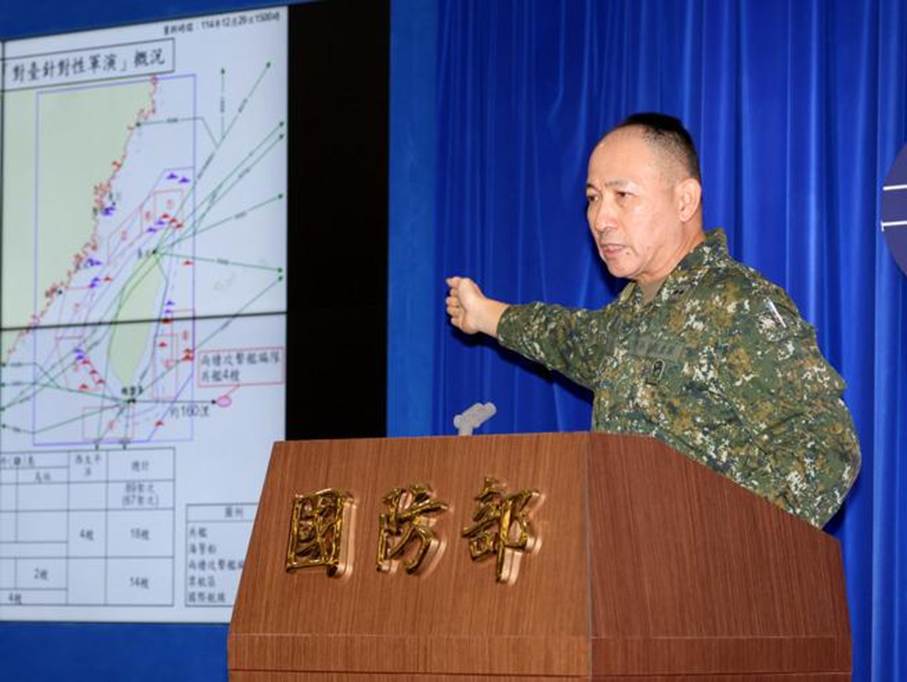
Taiwanese intelligence officers explain Chinese military movements in a press conference.
Aviation authorities reported that 857 flights and more than 100,000 travelers were affected by China’s exercises. Roughly 74 domestic flights to Kinmen and Matsu were cancelled, affecting about 6,000 passengers. Media questions prompted Taiwan’s military to admit that the transition time between China’s routine training and large-scale exercises has shortened, increasing pressure on the country.
Day 2
Taiwan’s CGA released a statement early on the second day of “Justice Mission-2025” confirming that 14 CCG vessels were still operating near Taiwan and in the restricted maritime zones near Matsu, Kinmen, Wuqiu, and Dongsha (Pratas). The CGA responded by dispatching 14 of its own vessels to designated sectors, pairing each Chinese vessel with a “one-to-one shadowing formation” to monitor and attempt to repel CCG ships.
Total PLA activity from the MND’s daily ADIZ report showed that from 0900 on December 29 to 0900 on December 30, 130 PLA aircraft and 22 naval and coast guard vessels had operated in the region. 90 of these aircraft breached the ADIZ median line, the 2nd most since China conducted its Joint Sword-2024 B exercises in October 2024.
At 1130, the MND reported that approximately two and a half hours earlier, PLA rocket artillery units in Fujian Province conducted live-fire exercises targeting the northernmost exercise zone, with impact zones scattered around Taiwan’s 24-nautical-mile line. Taiwan’s CGA later clarified that 7 PCH-191 rockets were fired into Zones 1 and 2.
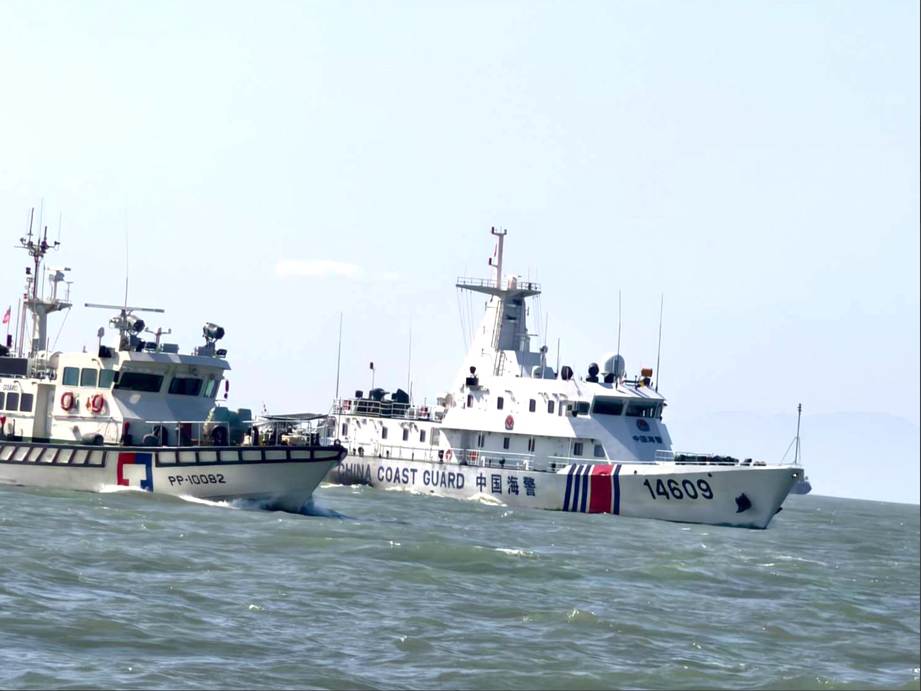
Taiwan and Chinese Coast Guard ships sailing side by side in waters near Matsu.
Taiwanese Minister of National Defense Wellington Koo (Gu Lixiong) reported that the military, under the President’s directive of “no escalation, no provocation,” would stay on standby and continue to monitor and intercept Chinese assets approaching Taiwan’s maritime and air domain. In a press release, Koo also stated he would remain at the Joint Operations Command Center in Taipei with senior officers to maintain full situational awareness and monitor the readiness of reconnaissance, radar, and air defense units. Taiwan’s CGA also released a statement denouncing China’s state media’s claim of a blockade of four Taiwanese ports. The CGA flagged this reporting as false information intended to mislead public opinion. It further said that all ships heading towards Taiwanese waters would be intercepted to ensure the border is protected. All normal maritime operations continued as usual.
Taiwan’s President Lai Ching-te released a statement condemning the live-fire drills, stating that “the country continues to face various forms of harassment and influence operations, emphasizing that Taiwan will not escalate tensions or provoke confrontation but will act responsibly to maintain stability”. Lai criticized the Chinese Communist Party for its efforts to amplify military pressure, remarking that such behavior is unworthy of a responsible major power.
Taiwan’s MND Holds Day 2 Press Conference
Taiwan’s MND held a second-day press conference on the exercises, reporting that it had detected 27 rocket impacts in zones 1 and 3, 71 PLA aircraft (35 entering Taiwan’s ADIZ), 15 CCG ships, 13 PLA Navy ships, and one amphibious assault group consisting of a Type 075 and three additional vessels as of December 30 at 1500. The MND also stressed that it had not observed the PLA launching Dongfeng missiles; that no PLA or CCG ships entered Taiwan’s territorial waters; and that Chinese operations in the “Zone 8” off of Taiwan’s east coast had concluded by noon.
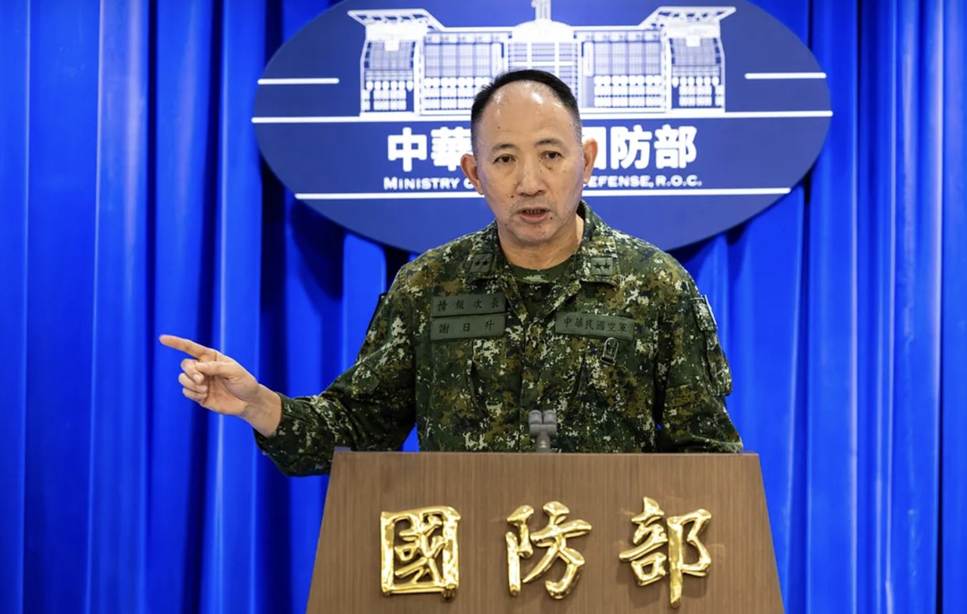
Taiwanese intel officers answer questions from the media on Day 2 of “Justice Mission-2025”
The MND also issued clarifying information regarding the two waves of live-fire rocket launches. The first salvo at 0900 comprised 17 rockets launched from Pingtan, Fujian, which landed about 70 nautical miles northeast of Keelung, outside 24 nautical miles and without overflying Taiwan. PLA units fired a second salvo of 10 rockets from Shishi, Quanzhou at approximately 0100. These rockets splashed down about 50 nautical miles southwest of Tainan. Taiwan’s military also took advantage of the press conference to clarify some grey-zone and psychological warfare concerns. It stated that reports that a Chinese drone breached territorial airspace to photograph Taipei 101 were false, noting that all drones remained outside the 24-nautical-mile limit. The clarification came after Chinese outlets circulated a detailed photo of Taipei’s urban landscape and claimed it was taken by a PLA TB-001 drone, prompting online discussion. The military said that, in addition to kinetic activity, Beijing was pairing its exercises with cognitive warfare and invited people interested in photography and video editing to help analyze imagery and counter Chinese disinformation.

An alleged image captured from a Chinese TB-001 showing Taipei 101, claiming to breach Taiwan’s territorial airspace.
Taiwanese reporters also pressed the MND as to whether rocket or missile launches might trigger activation of the national emergency warning system. The MND emphasized that established protocols govern both air alerts and live-fire contingencies: if rockets or missiles pass through Taiwan’s territorial airspace, the JAOC would issue mobile alerts through the Airborne Threat Warning System. If assessments indicate that projected impact areas could endanger Taiwan or Penghu, commanders are authorized to sound air-raid sirens, issue public warnings, and order appropriate countermeasures.
Regarding reports that the MND was activating reservists, the military clarified that immediate combat readiness drills automatically activate air and naval combat units. Only ground units tasked with securing key infrastructure as well as command posts, response centers, and support elements recalled personnel, and only those needed based on preplanned structures and mission needs.
The MND emphasized that since 2022, PLA exercises have integrated cognitive warfare by combining military and non-military means to shape perceptions in Taiwan, among allies, PRC domestic audiences, and third countries with minimal cost. Examples include distributing pre-packaged and heavily edited media alongside military drills to create the illusion that certain exercises are larger than they are. Taiwan’s military reiterated that its joint Intelligence, Surveillance, and Reconnaissance systems had already detected abnormal PLA movements ahead of this drill, allowing preparations before the public announcement. Even after Beijing declares an end to the exercises, Taiwan’s forces would continue monitoring deployments, training patterns, and overall posture to avoid readiness gaps. China’s ‘Justice-Mission 2025’ would conclude later that day.
National Security Bureau Conducts Review
On 1/8, about a week after China’s drills, Taiwan’s National Security Bureau (NSB) was called to submit a report to the Legislative Yuan.
Taiwan’s NSB said that China’s exercises around Taiwan were part of a campaign to counter growing international support for the island. NSB officials added that the drills could also have been an attempt to divert attention from Beijing’s economic situation. NSB officials said the drills have a clear political intent: to push back in the international arena against democratic partners’ support for Taiwan. The report also confirmed that the exercises were the most expansive to date in terms of geographic scope. The drills are part of a broader “hybrid” pressure campaign combining military intimidation and economic coercion against Taiwan,
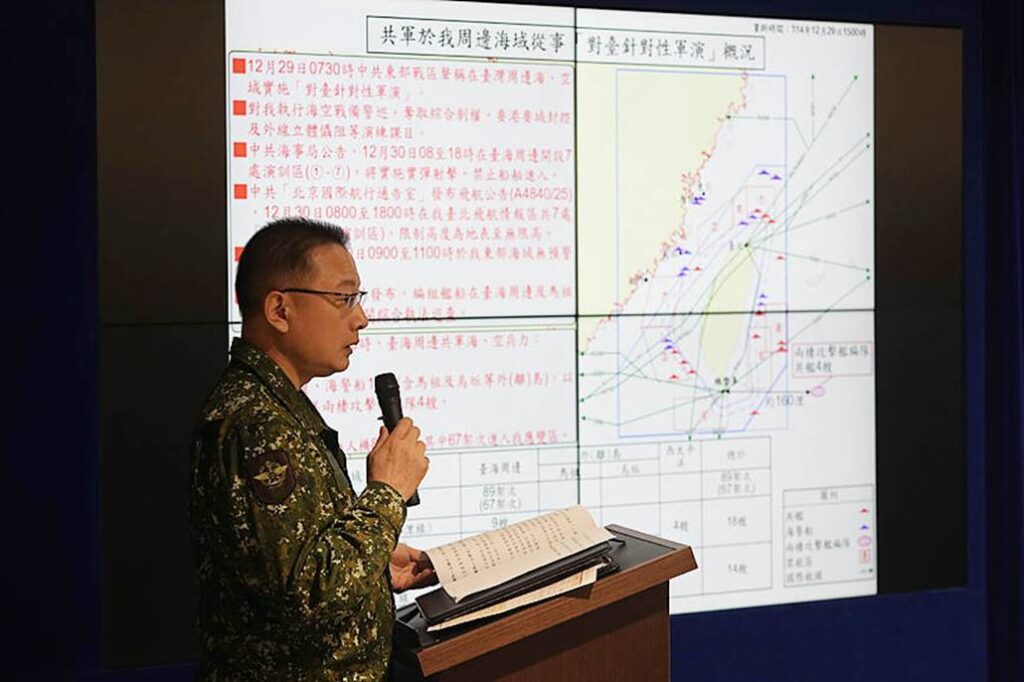
Taiwan’s military shows a map of “Justice Mission-2025” military activity
Sentiment Among the Political Parties
Taiwan’s ruling Democratic Progressive Party (DPP) condemned China’s exercises and used the moment to criticize KMT chairwoman Cheng Li-wun (鄭麗文), accusing her of prioritizing cross-strait political engagement, specifically the prospect of meeting Chinese President Xi Jinping in Beijing, over Taiwan’s security. Cheng argued such a meeting would be “strategically significant,” but the DPP countered that the KMT’s approach puts relations with Beijing ahead of deterrence and defense readiness.
In a separate statement, Cheng blamed China’s military pressure on what she called the Lai administration’s “wrong cross-strait policies.” She said the DPP’s confrontational posture was raising security risks while failing to deliver tangible improvements for Taiwan’s forces, including better troop conditions and compensation.
The Taiwan People’s Party (TPP) also condemned the drills, arguing they do nothing to promote regional stability and instead deepen cross-strait tensions. Echoing the DPP and the Presidential Office, TPP officials urged Beijing to halt military activities they said undermine stability in the Taiwan Strait.
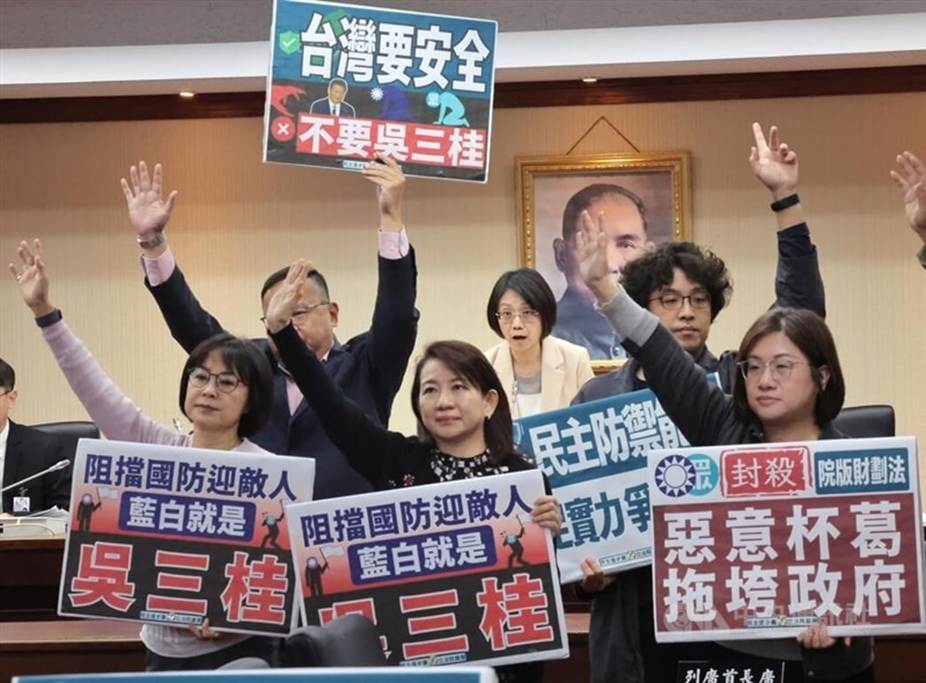
Members of Taiwan’s DPP protest the exclusion of a defense budget bill during a Legislative Session.
These exchanges are unfolding amid heightened domestic polarization, especially over defense spending. For the fifth time, and during the second day of “Justice Mission 2025,” opposition lawmakers blocked a proposed special defense budget of US$39.8 billion. The DPP argues the package is needed to fund new U.S. weapons, equipment, and training, while the KMT insists President Lai must brief the legislature in person before lawmakers consider the plan, arguing that a short summary is insufficient. The KMT and TPP have also advanced a motion to initiate impeachment proceedings, while the DPP accuses the opposition of using fiscal procedures in an unconstitutional way.
China’s “Justice Mission 2025” drills intensified pressure in an already fraught Taiwan security environment. The exercise, Beijing’s sixth large-scale drill of this kind since 2022, saw dozens of PLAN and PLAAF assets rapidly converge around the island and showcased an increasingly sophisticated rehearsal of Taiwan-focused operations. The key question now is whether these developments will galvanize support for passing Taiwan’s defense budget, or instead strengthen calls to dial back steps seen as likely to provoke Beijing.