New Report to LY, Special Budget, and NASAMS Contracts
By Joseph O’Connor and Eric Gomez
While November 2025 did not see any major topline activity in the backlog itself, the second Trump administration made its first maintenance sale of aircraft parts to Taiwan, valued at $330 million. Additionally, many valuable status updates emerged from a new MND report to the Legislative Yuan on arms sales, alongside regular hearings. Taiwanese President Lai Ching-te also publicly announced Taiwan’s special budget for the first time, which will not directly affect the backlog but signals additional purchases in the future.
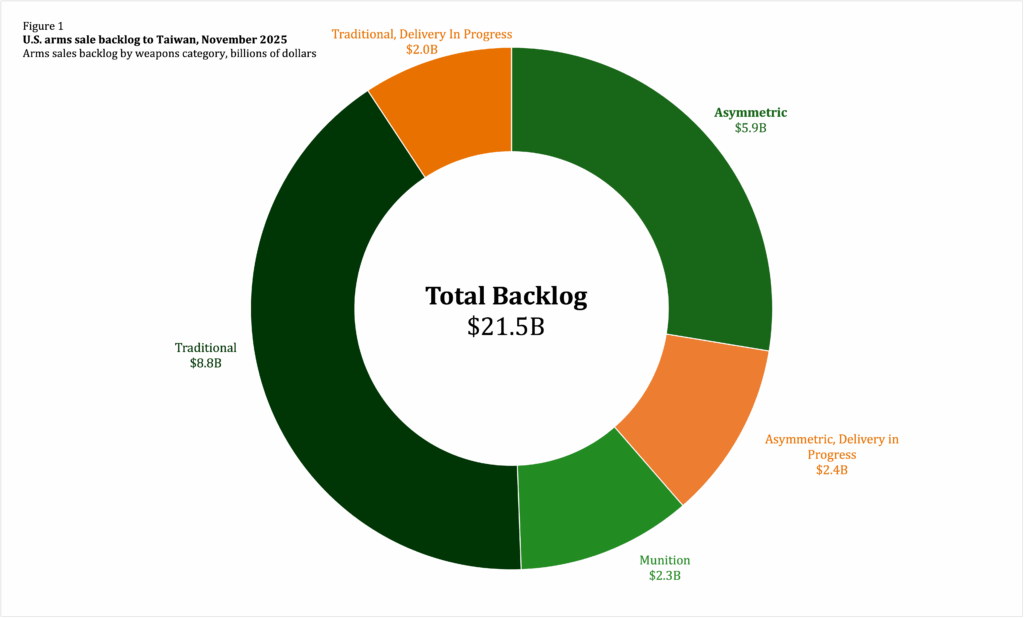
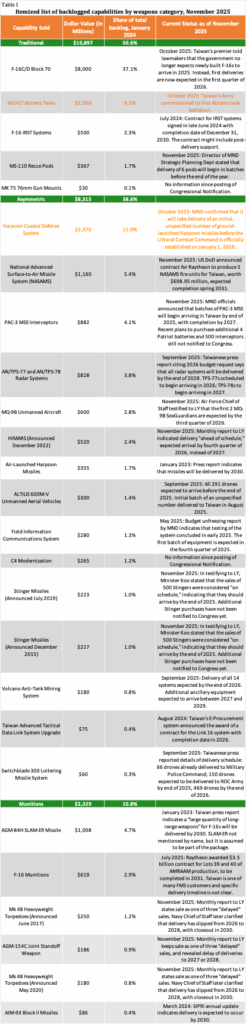
The U.S. arms sale backlog to Taiwan as of November 30, 2025, remains $21.54 billion. For arms sales valued at over $1 billion, deliveries in progress are marked in yellow-orange in our visualizations, meaning that the true dollar value is lower than the topline. Figure 1 illustrates the breakdown of the backlog between asymmetric weapons, traditional weapons, and munitions. Table 1 provides an itemized list of all arms sales in the backlog, including the most up-to-date information on their status.
November’s Report to LY and Other Status Updates
On November 3rd, the MND submitted a report to the Legislative Yuan on the status of US arms sales, noting a total of 25 FMS cases that are ongoing, up from 18 in June 2025. The report classified three major sales as “delayed,” namely, F-16 Block 70/72 aircraft, AGM-154C Joint Standoff Weapons (JSOWs), and MK 48 torpedoes, corresponding with earlier statements in October from Minister of National Defense Wellington Koo about delays associated with those sales.
On AGM-154C JSOWs: The report indicates they will continue to be delayed, with delivery not expected until 2027 or 2028, instead of 2026; in line with Premier Cho Jung-tai’s statements in October to that same effect. The AGM-154C has been categorized as a delayed sale by the MND since March 2024, and a contract to produce them was not signed until February 2024.
On MK 48 torpedoes: November’s report categorizes them as delayed for the first time, slipping from 2026 to 2028 and a closeout of 2030, per statements made by the Navy’s Chief of Staff, Vice Adm. Chiu Chun-jung, after the LY report was submitted.
Though known for a while, the November report categorized the sale of 18 HIMARS launchers, 20 ATACMS missiles, and 864 GMLRS rockets as “ahead of schedule,” expected by the fourth quarter of 2026, instead of the projected timeline of 2027. This is likely owing to significant production increases on the US side. Koo, while testifying to the LY concerning the monthly report, also stated that sales of Stinger and Harpoon missiles were on schedule.
A few other status updates appeared in November, from various MND announcements and statements by officials. First, Air Force Chief of Staff Lt. Gen. Lee Ching-jan informed the LY on November 6th that the first two MQ-9B SeaGuardian maritime surveillance drones will be delivered to Taiwan by the third quarter of 2026, continuing on a normal timeline. The MND announced on November 11th that as a part of the “T-Dome” air defense concept, batches of the 100 total PAC-3 MSE interceptors will begin arriving by the end of 2025, with expected completion by 2027. Lastly, Director of the MND Strategic Planning Department Maj. Gen. Huang Wen-chi stated that delivery of the 6 total MS-110 reconnaissance pods will begin in batches before the end of 2025.
The inclusion of these monthly reports by the MND to the LY is a useful and transparent step in determining the status of all sales, but, in particular, those that the MND considers “delayed.”
Lai Announces Special Budget Publicly
On November 25, President Lai Ching-te publicly announced, via a speech and an opinion piece in the Washington Post, a special defense budget worth NT$1.25 trillion (US$40 billion) for “strengthening defense resilience and asymmetric capabilities.” This also included additional statements echoing Lai’s earlier calls to raise defense spending to 3.3% of GDP by 2026 and 5% by 2030.
What this means for the current backlog is unknown, but as of December 2025, significant new arms sales appear to be associated with the special budget funding announced here. Our analysis of the new sales is already published, but additional information about those sales and their relationship to the special budget will be included in the December 2025 backlog update.
NASAMS Update and FMS Sale
Two other major updates regarding backlogged sales also merit consideration. First, on November 17th, the U.S. Department of Defense announced a new contract award to Raytheon for the production of three National Advanced Surface-to-Air Missile System (NASAMS) fire units for Taiwan, worth $698.95 million (NT$21.8 billion). Expected to finish in spring 2031, this is part of a $1.16 billion sale of NASAMS approved in October 2024. Owing to this contract’s timeline, it is expected that NASAMS will be an extremely delayed sale in the future.
On November 13th, the Defense Security Cooperation Agency notified Congress of a new sale to Taiwan of non-standard spare parts for use in F-16, C-130 and Indigenous Defense Fighter (IDF) aircraft, worth US$330 million (NT$10.28 billion). This marks the first sale during the second Trump administration (and as of the time of writing, certainly not the most recent), the last being approved in December 2024, 329 days prior. Maintenance sales are not counted toward the backlog because they support weapons already in Taiwan’s possession, unlike weapons that have not been delivered, and tracking the delivery status of maintenance equipment is difficult given publicly available information.
Conclusion
The more frequent publication of reports on arms sale timelines to the LY is an encouraging and transparent step from Taiwanese officials. It is worth noting that there are many more than three sales that are delayed, but the MND only appears to categorize “delayed” sales as those that Taiwan has paid for. TSM is working on a complete translation of Koo’s testimony before the LY that we will publish in the new year; and will also have a more in-depth response to the issue of Taiwanese perception between “delayed” and “backlogged” sales.
As of the time of writing, there are many new developments in Taiwanese arms sales, in particular, the addition of a US$11 billion arms package. We at TSM will provide more detail on what that means for the backlog next month.