Author: Ethan Connell & Jonathan Walberg
Key Findings
- Taiwan’s Ministry of National Defense recorded 190 PLA aerial sorties around the island in February 2026, a 30 percent decline from January’s 270 and a continuation of the downward trajectory that began after the December 2025 Justice Mission exercise. Year-over-year, February’s figure represents a 61 percent decline from 492 sorties in February 2025.
- Three joint combat readiness patrols occurred during the month: February 12 (42 aircraft), February 19 (14 aircraft), and February 25 (30 aircraft). These operations demonstrate that the PLA’s capacity for large-scale multi-domain demonstrations remains intact, despite a contraction in routine sortie volume.
- No aircraft were detected around Taiwan on February 27 and 28, marking the onset of a quiet period that extended through the first half of March in anticipation of the National People’s Congress and Chinese People’s Political Consultative Conference (the ‘Two Sessions’).
- PLAN vessel detections averaged approximately seven per day in February, with a peak of eleven, consistent with the five-to-nine vessel baseline observed throughout 2025. The persistence of naval presence during a month of declining air activity demonstrates the operational decoupling between the air and maritime domains.
- Coast Guard Administration data indicate ten documented China Coast Guard (CCG) incursions into Taiwan’s restricted waters from January through February, concentrated around Kinmen (eight incidents) and Dongsha Island (two incidents).
February 2026 Air Activity
In February 2026, 190 aircraft sorties were detected around Taiwan, with 147 entering the southwestern portion of Taiwan’s Air Defense Identification Zone. This total represents a significant reduction from January’s 270 sorties and continues a downward trajectory that began after the PLA’s Justice Mission-2025 exercise on December 29, 2025. That exercise involved 130 aircraft in a single day, marking the largest single-day operation around Taiwan since comprehensive daily reporting began. The post-exercise period has been characterized by a gradual normalization of activity levels, although the pace of this decline is not unprecedented in the historical record.
February exhibited a familiar pattern of quiet periods punctuated by activity surges. The peak occurred on February 12, when 42 aircraft were detected as part of a Joint Combat Readiness Patrol (JCRP), representing the largest single-day figure since the Justice Mission exercise. Two additional JCRPs followed on February 19 (14 aircraft) and February 25 (30 aircraft). Outside these exercises, daily sortie counts typically ranged from two to thirteen aircraft, with several days recording zero detections. The final two days of the month, February 27 and 28, both recorded zero aircraft, indicating the onset of the quiet period associated with China’s annual Two Sessions legislative meetings, which extended through mid-March. The Chinese Military Commission (CMC) leadership purges that began in January 2026, including the dismissal of two senior vice-chairmen, may have reinforced this pattern of restraint by introducing additional institutional caution among theater-level commanders.
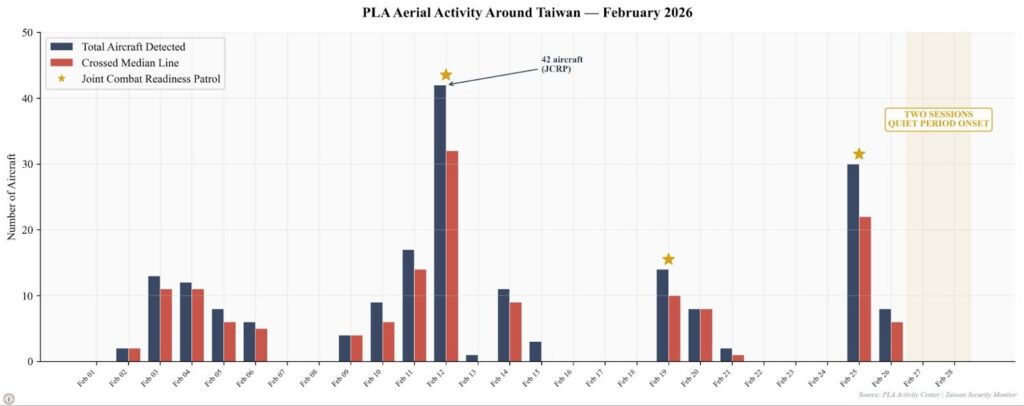
Figure 1. Daily PLA activity around Taiwan, February 2026. Gold stars denote JCRP days; shaded region marks the onset of the Two Sessions quiet period.
Monthly Trajectory: Post–Justice Mission Cooling
The decline from 270 sorties in January to 190 in February aligns with the broader pattern of post-exercise normalization observed after major PLA operations around Taiwan in recent years. The December 2025 Justice Mission exercise caused a significant spike in both single-day and monthly activity. The first two months of 2026 appear to reflect a return to a lower operational baseline rather than a strategic decision to permanently de-escalate. January 2026 remained elevated relative to the monthly averages of mid-2025, and February’s figure, while lower, falls within the range of monthly totals observed during non-exercise periods.
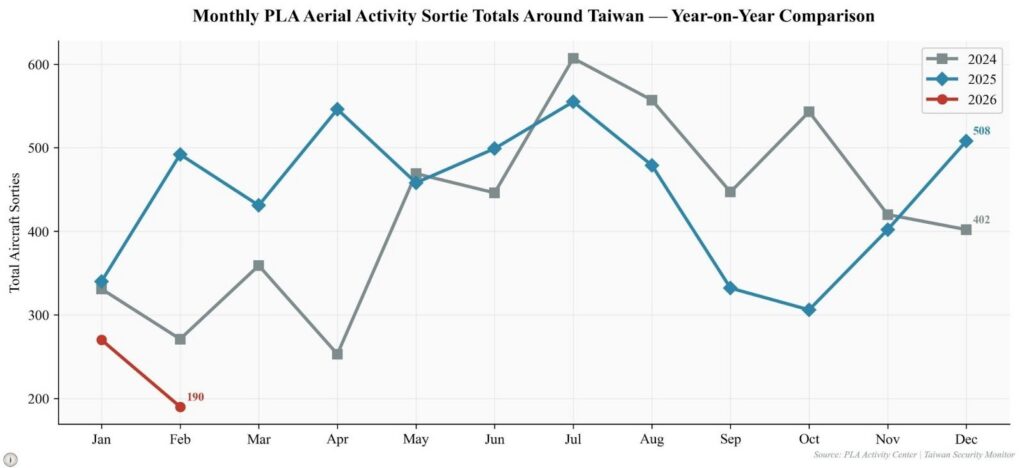
Figure 2. Monthly PLA sortie totals, 2024–2026. For 2026, January and February data are shown.
The frequency of joint combat readiness patrols offers a counterpoint to the overall decline in sortie numbers. February’s three JCRPs are comparable to January’s four, indicating that the PLA’s exercise tempo has not significantly slowed, even as routine patrol activity has contracted. This distinction between routine and surge operations is analytically important: reductions in daily sortie volume do not necessarily indicate a diminished PLA capacity or willingness to conduct large-scale operations on short notice.
At Sea: Naval Presence
PLAN vessel detections in the waters around Taiwan averaged 6.6 per day in February, with a peak of eleven vessels on a single day. These figures are broadly consistent with the range of 5-9 vessels that has characterized PLAN presence throughout 2025 and into 2026. The stability of naval posture during a month when air activity declined by nearly 30 percent from January highlights a structural feature of cross-strait military dynamics: the air and maritime components of PLA activity around Taiwan appear to operate under distinct operational logics and respond to different drivers.
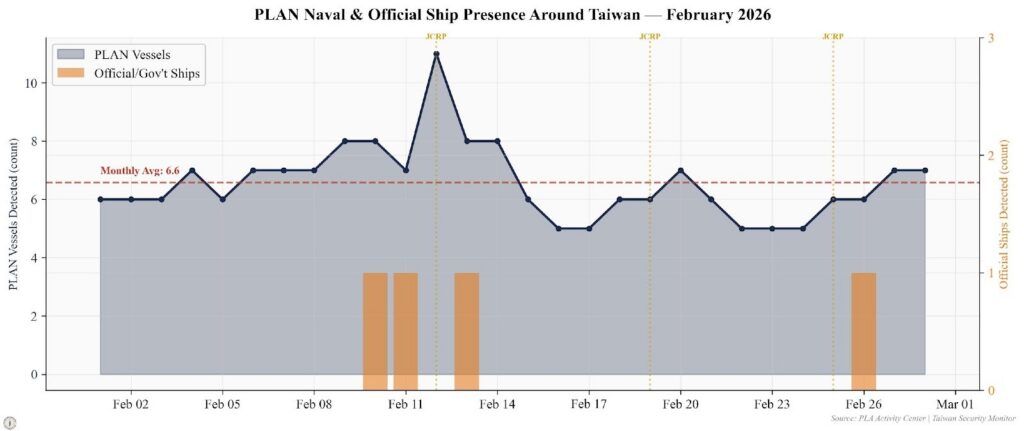
Figure 3. PLAN vessel and official ship detections around Taiwan, February 2026.
This decoupling is analytically significant. Observers who track sortie counts as a proxy for cross-strait tension may interpret the January-to-February decline as evidence of easing pressure. However, naval data present a different perspective: the PLAN’s sustained presence at sea indicates that the military’s overall posture in the Taiwan Strait has not meaningfully contracted, even as the air component adjusts to post-exercise and politically sensitive rhythms.
Coast Guard Gray Zone Operations
China Coast Guard activity in Taiwan’s restricted waters constitutes a third, and often underreported, dimension of cross-strait pressure. From January through February 2026, the CCG conducted at least ten documented incursions: eight around Kinmen and two near Dongsha Island (Pratas). The Kinmen operations have developed into a recognizable pattern, typically involving two to four CCG cutters entering restricted waters for two to three hours before withdrawing. This approach appears designed to normalize a regular CCG presence in waters that Taiwan’s Coast Guard Administration considers under its jurisdiction.
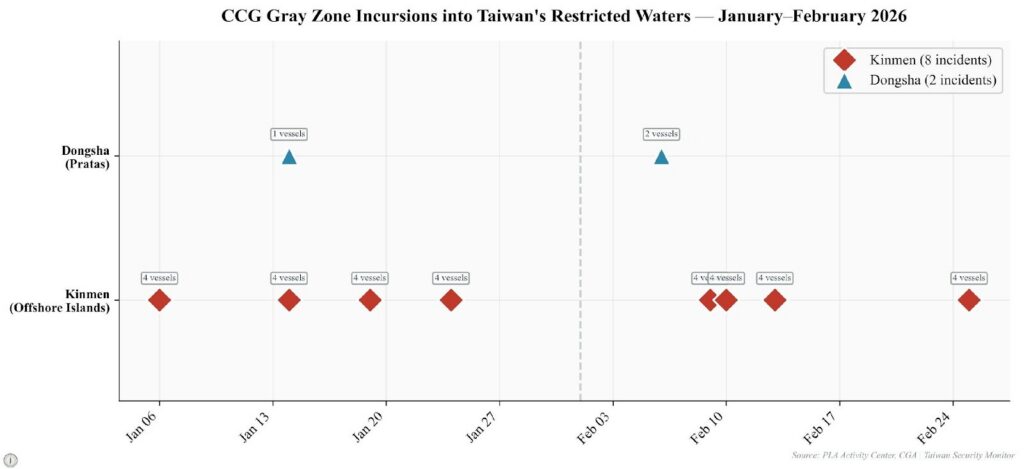
Figure 4. CCG incursions into Taiwan’s restricted waters, January–February 2026, by location and vessel count.
The Kinmen incursions have involved a recurring set of CCG cutters, including hull numbers 14529, 14603, 14609, and 14530, suggesting a dedicated patrol rotation rather than ad hoc deployments. The Dongsha operations are qualitatively different. The February 6 incursion near Dongsha involved vessels 3501 and 3107, with the CCG presence lasting approximately eight hours. Although shorter than the extended dwell times observed in later months, the Dongsha deployments represent a more logistically demanding operation due to the island’s distance from Chinese territorial waters. Their continuation into February suggests an established rather than exploratory program.
Multi-Domain Overview
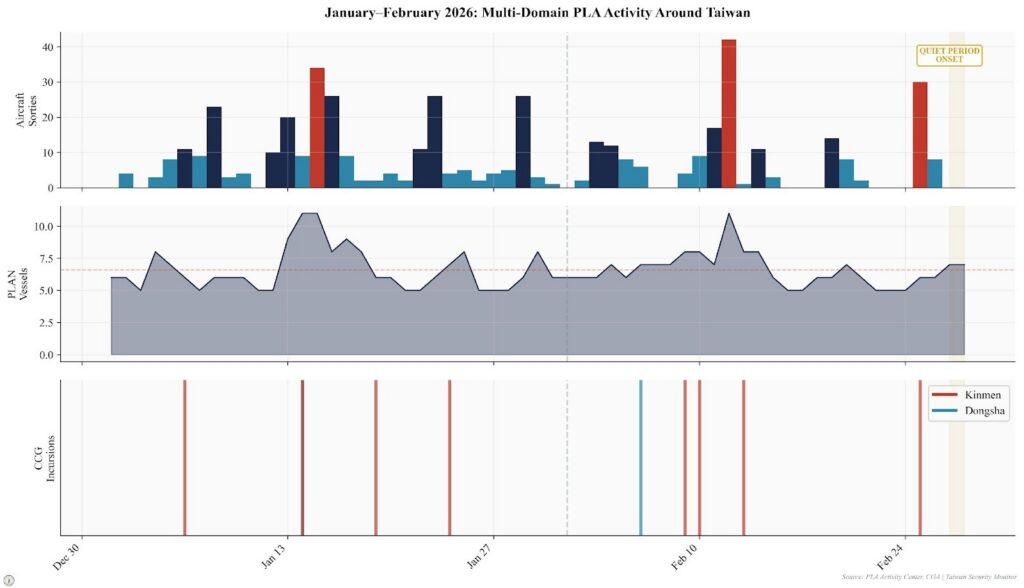
Figure 5. January–February 2026 multi-domain PLA activity: air sorties, naval presence, and CCG incursions.
An integrated view of all three domains during the first two months of 2026 reveals a more complex picture than any single metric suggests. Air activity has declined sequentially, reflecting sensitivity to both post-exercise normalization and political calendars. Naval presence has remained steady and largely unaffected by fluctuations in the air domain. Coast Guard incursions have continued at a pace consistent with an institutionalized patrol program. Analysts and policymakers assessing cross-strait dynamics should examine all three domains collectively, rather than relying solely on sortie counts as a barometer of PLA intent.
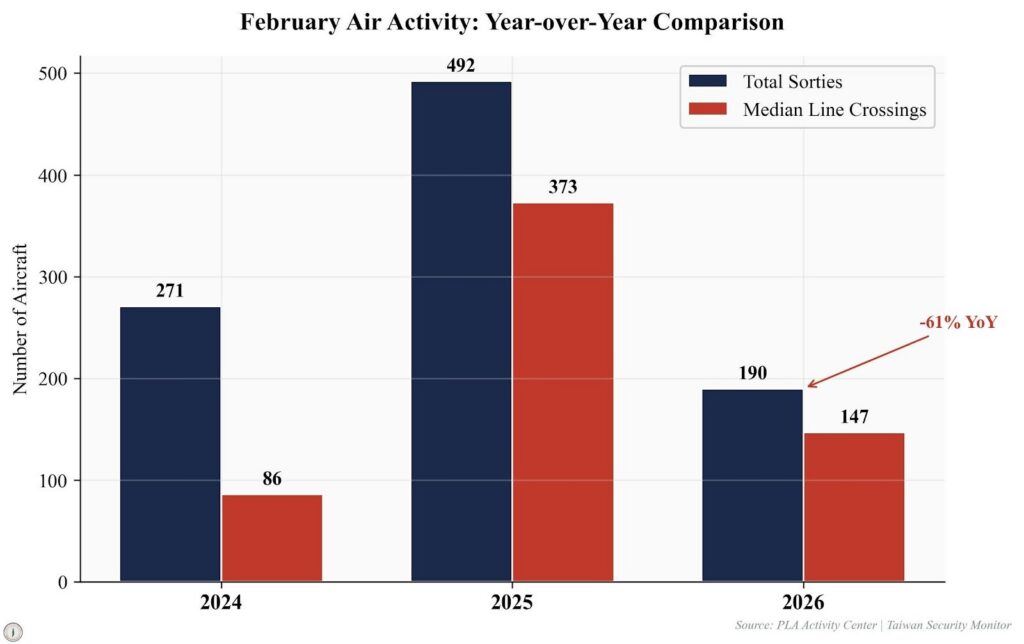
Figure 6. February air activity year-over-year: total sorties and median line crossings, 2024–2026.
Methodology & Sources
Air and naval detection data are drawn from daily press releases issued by Taiwan’s Ministry of National Defense and compiled in the PLA Activity Center database maintained by Taiwan Security Monitor. Coast Guard incident data are compiled from Coast Guard Administration press releases and verified against contemporaneous media reporting. “Median line” refers to the informal centerline of the Taiwan Strait historically observed by both sides. “JCRP” denotes Joint Combat Readiness Patrols as designated by Taiwan’s MND. All analysis and commentary are by Taiwan Security Monitor.
© 2026 Taiwan Security Monitor. All rights reserved.