Author: Jonathan Walberg
When the People’s Liberation Army’s Eastern Theater Command launched its Justice Mission–2025 exercises around Taiwan on December 29th, the visible indicators were familiar: joint air and naval maneuvers,[1] expanded operating zones, and calibrated signaling toward Taipei and external actors.[2] What distinguished this iteration was not just the scale or geometry of the activity, but the depth and coherence of the narrative campaign that unfolded alongside it.
Rather than treating messaging as post hoc propaganda, Beijing used Justice Mission–2025 to actively storyboard a theory of coercion in real time. A coordinated series of posters released through PLA and affiliated channels visually depicted how Beijing intends to punish pro-independence forces; why such punishment is legitimate, and why resistance is futile. In the days immediately following the exercise, Taiwan Affairs Office (TAO) press conferences reinforced and formalized those same narrative frames through authoritative political language.
Taken together, the posters and follow-on statements show how China increasingly integrates narrative warfare with military signaling to shape Taiwanese and American expectations about legitimacy, inevitability, escalation, and identity.
Justice as the Organizing Frame of the Exercise
The narrative architecture of Justice Mission–2025 begins with the exercise name itself: “Justice Mission–2025” (正义使命–2025). The term zhengyi (justice or righteousness) is used to morally pre-legitimize the operation. The exercise is framed not as discretionary pressure or political signaling, but as enforcement of an already rightful order. Beijing’s message is that the mission is “justice,” and resistance is implicitly illegitimate.
The narrative architecture of Justice Mission–2025 begins with the exercise name itself: “Justice Mission–2025” (正义使命–2025). The term zhengyi (justice or righteousness) is used to morally pre-legitimize the operation. The exercise is framed not as discretionary pressure or political signaling, but as enforcement of an already rightful order. Beijing’s message is that the mission is “justice,” and resistance is implicitly illegitimate.
This framing was reinforced with a reiteration of messaging on “How to Curb ‘Independence.” The phrasing is revealing. Instead of depicting a political dispute between two actors, the problem is framed as a technical control challenge: how to suppress or restrain a condition. “Independence” becomes something mechanical to be constrained rather than a societal preference or political identity. Taiwan itself is rendered visually as an object—cut by cables, fractured into segments, encircled by forces—reinforcing a systems-control worldview rather than a political one.
The TAO immediately echoed this framing after the exercise. Responding directly to Justice Mission–2025, a spokesperson described the PLA’s actions as “a necessary and just measure to safeguard national sovereignty and territorial integrity” and “a stern warning” to “Taiwan independence” and “external interference.”[4] The political language locks in the moral logic embedded in the posters: coercion is corrective, not escalatory.
Shield and Sword: Encoding Enforcement Logic
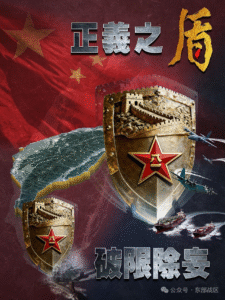
Several of the exercise posters establish a clear moral dualism between protection and punishment. “Shield of Justice” (正义之盾) depicts PLA symbolism forming a protective barrier over Taiwan, visually communicating that China is acting as a stabilizing force safeguarding rightful order.[5] This poster also features a shield bearing the Great Wall of China forcing American C-130s to turn away from Taiwan. The messaging here is clear: To the people of Taiwan, America won’t be able to come to your aid. To Washington, your efforts to intervene in a contingency will be futile compared to the ‘great power’ of China, as shown through the symbolism of the Great Wall.
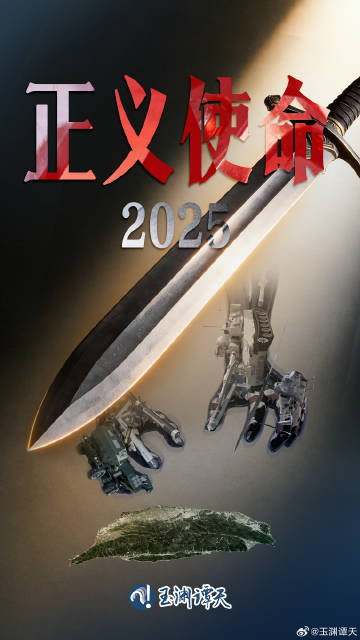
Building off of this messaging is another poster titled “Sword of Justice” (正义之剑), which depicts a blade striking downward into the island.[6] Justice is not passive; it enforces compliance. Punishment is portrayed as morally righteous rather than coercive. Together, the shield-and-sword motif communicates a simple conditional logic: alignment brings protection, resistance brings righteous force.
This same logic surfaced in TAO messaging tied to the exercise. Officials accused the Lai administration of “recklessly colluding with external forces,” “selling out Taiwan,” and pushing the island toward confrontation, while warning that such actions “will be firmly struck down.”[7] The sword imagery becomes political language: punishment is framed as an unavoidable consequence rather than a choice. Another TAO briefing extended the sword narrative outward toward external actors, warning that any country or force that “plays with fire on the Taiwan question will inevitably pay a price,” reinforcing deterrence signaling that accompanied the exercise’s expanded operational footprint.[8]
Systemic Isolation: Ports, Cables, and Everyday Vulnerability
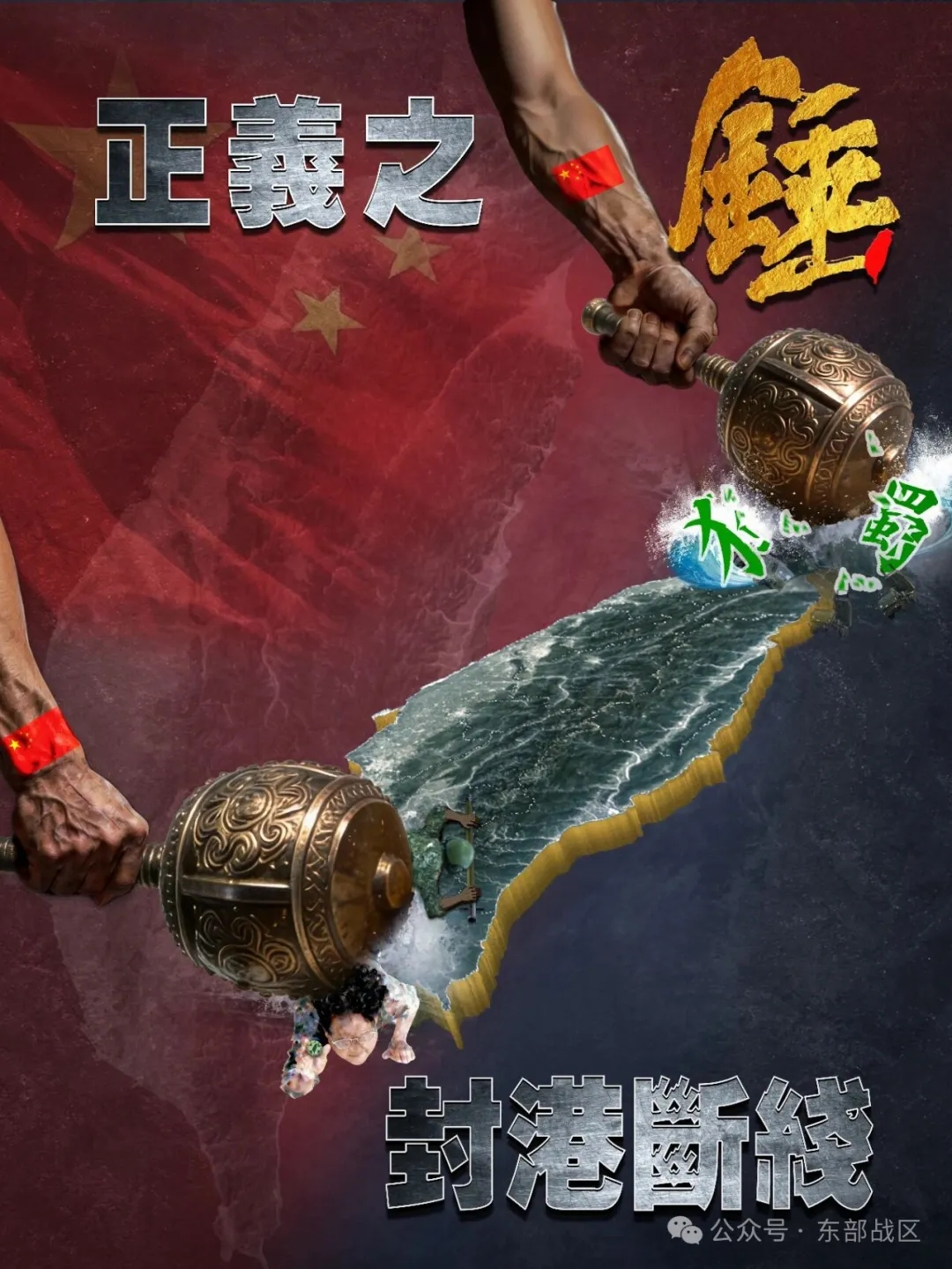
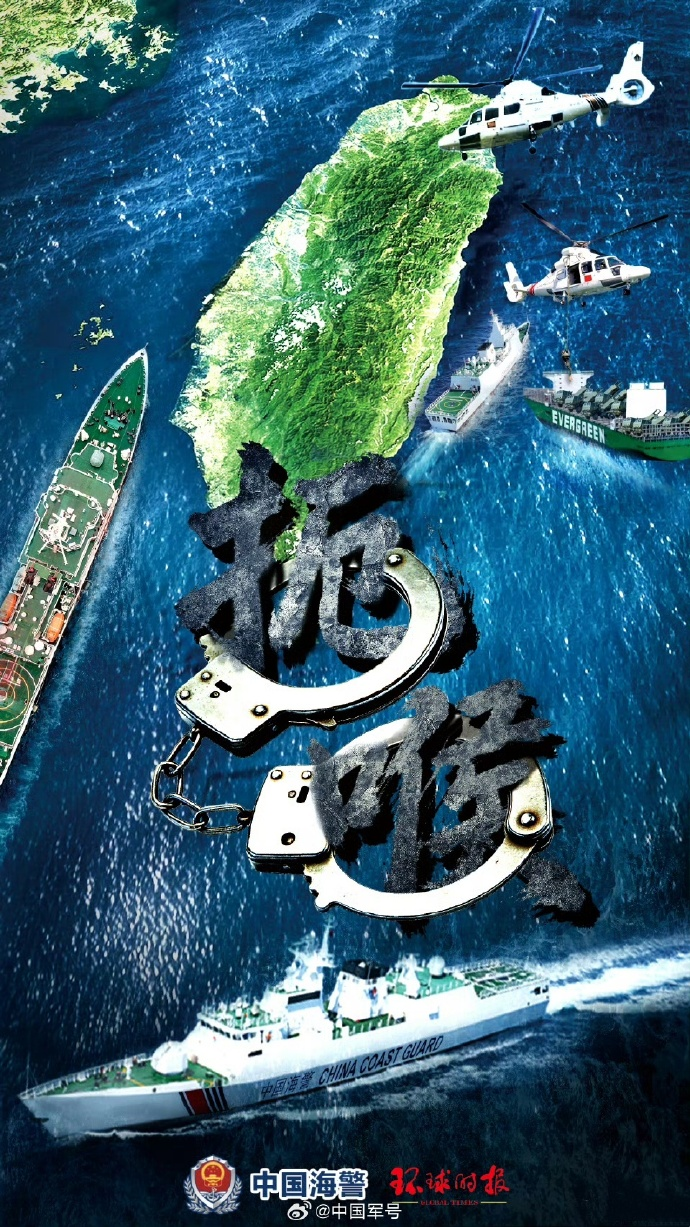
One of the most analytically important themes of the Justice Mission–2025 posters is the emphasis on systemic isolation rather than battlefield confrontation. “Seal Ports, Cut Lines” (封港断线) depicts hammers crushing Taiwan in the North and South, and maritime access constrained.[9] Another poster shows handcuffs on the island, and Chinese Coast Guard vessels “choking off” Taiwan’s ports.[10] In this messaging, Taiwan’s vulnerability is framed not primarily in terms of military defeat, but in terms of disrupted connectivity: data flows, trade routes, energy supply, logistics, and digital lifelines.
This logic is paired with a carefully calibrated assurance. The posters and TAO statements consistently distinguish between “Taiwan independence forces” and the broader population, framing coercion as corrective rather than collective. This is a classic coercive move: threats are made credible by being conditional, while reassurance is offered to those willing to disengage from the targeted behavior. The message is not that Taiwan as a society must be destroyed, but that normalcy will return once pro-independence leadership is rejected.
This imagery subtly shifts the imagined battlespace away from amphibious invasion toward persistent, incremental coercion applied against civilian infrastructure and economic normalcy. The message is that pressure can be sustained below traditional thresholds of war while still imposing cumulative strategic effects.
Post-exercise TAO messaging reinforced this normalization logic through law-enforcement framing. In a briefing addressing mainland China Coast Guard activity near Kinmen, the spokesperson asserted that there are “fundamentally no such things as so-called ‘restricted waters’” and that patrols are conducted “in accordance with the law” to maintain navigation order and protect fishermen.[11] Maritime pressure is reframed as routine governance rather than escalation.
This political framing directly complements posters featuring handcuffs and Coast Guard imagery. Together, they normalize gray-zone pressure as administrative control rather than crisis behavior, as well as push the norm of Chinese ships being able to interdict vessels heading to Taiwan’s ports.[12]
Deter Externally, Contain Internally: Managing Escalation
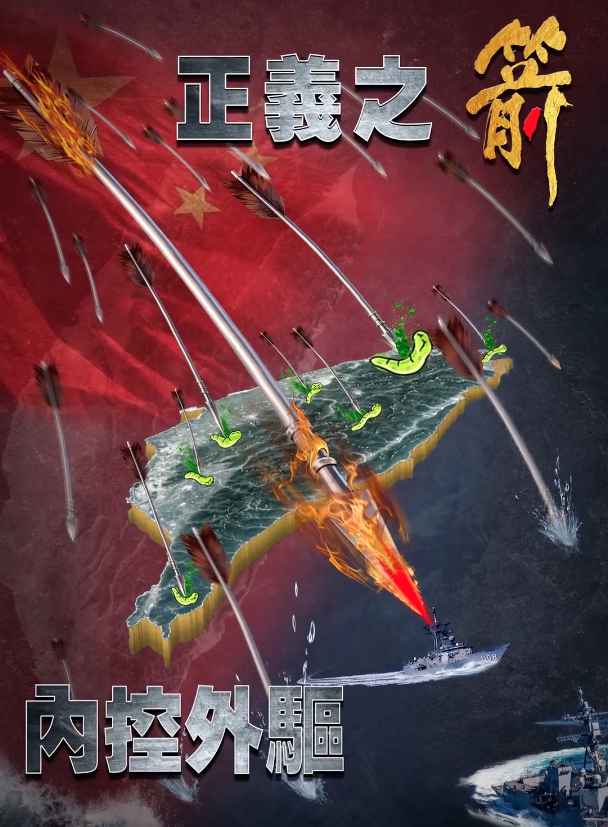
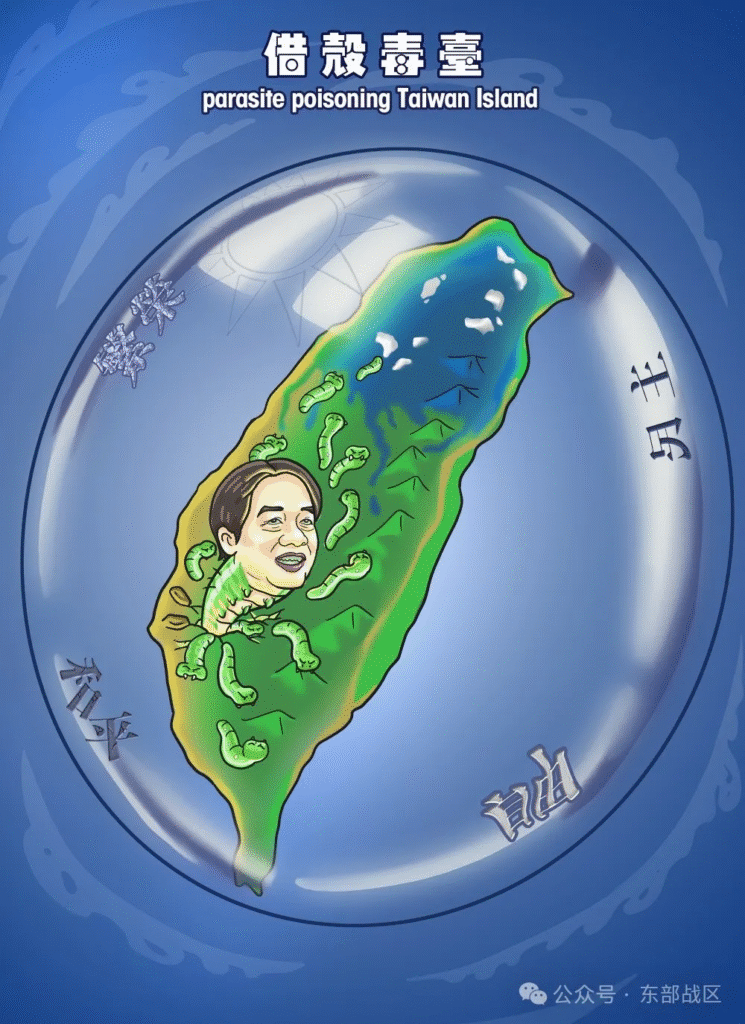
Another poster cluster encodes escalation management logic. “Counter External Influence” (反控外调) sits above a set of arrows in flight at Taiwan, implicitly threatening the Taiwanese people.[13] The arrows are piercing green worms, a reference to an earlier 2025 poster displaying Taiwan President Lai Ching-te as a green worm.[14] The imagery reflects not operational anti-access in the narrow military sense, but a narrative adaptation of anti-access logic. Rather than depicting missiles denying airspace or sinking ships, the posters show arrows striking Taiwan itself, signaling that foreign involvement will translate into intensified pressure on the island. The intended audience is therefore not primarily external militaries, but Taiwanese observers being warned that outside intervention will not insulate them from coercion. In this sense, the messaging exploits both Taiwanese vulnerability and U.S. preoccupation with anti-access scenarios, emphasizing political consequences over operational mechanisms.
Language from the TAO tied directly to Justice Mission–2025 reinforced this precise logic. Officials emphasized that the PLA’s actions target “separatist activities and external interference—not the people of Taiwan,” while urging Taiwanese citizens to recognize the danger of their leadership’s course and oppose independence.[15] The narrative pressures Taiwan internally while attempting to reduce reputational costs externally.
Precision and Exposure: Targeting Critical Nodes
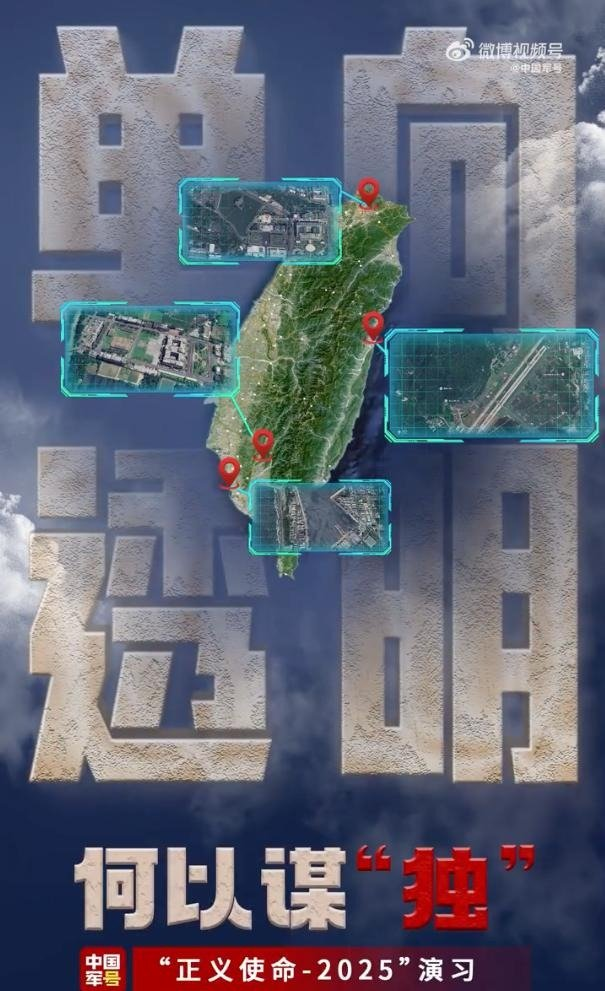
Several posters emphasize surveillance and precision dominance. “Lock the island” (锁岛) overlays Taiwan with targeting graphics and highlighted infrastructure nodes. Below it, the message of “How could you possibly pursue ‘independence’?” (何以谋“独” )[16]. The narrative message is omniscience: critical systems are known, mapped, and vulnerable. Coercion is framed as precise and technologically controlled rather than indiscriminate. Beijing intentionally couples its supposed revelation of Taiwanese capabilities in an attempt to puncture the hope the Taiwanese have in their own military.
This reinforces deterrence through perceived exposure rather than sheer destructive threat. Psychologically, it compresses uncertainty and signals that escalation pathways are already mapped.
Narrative Warfare as Operational Preparation
Justice Mission–2025 demonstrates that China increasingly treats exercises as integrated narrative operations rather than isolated military demonstrations. The posters storyboarded a coercive pathway: justice and legitimacy; suppression of independence; protection and punishment; systemic isolation; escalation control; precision targeting; and administrative normalization. The TAO then formalized that storyboard into authoritative political language.
The objective is not merely intimidation. It is expectation management: normalizing coercion, relocating blame, compressing escalation timelines, and psychologically conditioning audiences toward acceptance of pressure as lawful and inevitable through calibrated threats and assurances that deliberately play to existing fears: Taiwanese fears of isolation and cutoff, accommodationist hopes that restraint will restore normalcy, and external concerns that China can exploit anti-access dynamics to keep interveners out.
For analysts and policymakers, the implication is methodological as well as strategic. Monitoring aircraft counts and maritime tracks alone no longer captures the full signaling environment. Visual messaging, slogan sequencing, and political language now provide early indicators of how Beijing conceptualizes coercive pathways and escalation control.
Justice Mission–2025 illustrates how narrative warfare is being embedded directly into China’s military signaling toolkit, shaping how future coercion will be interpreted long before a crisis unfolds.
[1] https://x.com/TaiwanMonitor/status/2005636702183039129?s=20
[2] https://tsm.schar.gmu.edu/visualization-historical-pla-exercise-zones-2022-2025/
[3] https://x.com/TaiwanMonitor/status/2005431801721094379?s=20
[4] https://tsm.schar.gmu.edu/taiwan-affairs-office-the-plas-military-operations-are-a-solemn-warning-to-taiwan-independence-separatist-forces-and-external-interference-forces/
[5] https://x.com/TaiwanMonitor/status/2005453180860084427?s=20
[6] https://x.com/TaiwanMonitor/status/2005456163249192993?s=20
[7] https://tsm.schar.gmu.edu/taiwan-affairs-office-any-taiwan-independence-separatist-actions-will-never-be-tolerated-and-will-be-met-with-severe-punishment/
[8] https://tsm.schar.gmu.edu/taiwan-affairs-office-any-country-or-force-that-plays-with-fire-on-the-taiwan-question-will-inevitably-pay-a-price/
[9] https://x.com/TaiwanMonitor/status/2005807062735790564?s=20
[10] https://x.com/TaiwanMonitor/status/2005837836851855481?s=20
[11] https://tsm.schar.gmu.edu/taiwan-affairs-office-the-coast-guard-is-conducting-law-enforcement-patrols-in-the-relevant-waters-to-safeguard-the-lives-and-property-of-fishermen-on-both-sides-of-the-taiwan-strait/
[12] https://x.com/TaiwanMonitor/status/2005837836851855481?s=20
[13] https://x.com/TaiwanMonitor/status/2005456163249192993?s=20
[14] https://www.globaltimes.cn/page/202504/1331297.shtml
[15] https://tsm.schar.gmu.edu/taiwan-affairs-office-the-plas-military-operations-are-a-solemn-warning-to-taiwan-independence-separatist-forces-and-external-interference-forces/
[16] https://x.com/TaiwanMonitor/status/2005473337783492633?s=20