Taiwan Security Monitor

Taiwan Arms Sale Backlog,ย Marchย 2026 Updateย 

Abrams and ALTIUS Delivered, But Further Delays Emerge

Authors: Joe Oโ€™ConnorEric Gomez, Shikhar ChaturvediDanielle Kremer, and Wyeth Lindberg 


Taiwanโ€™s legislature failed to reach an agreement on a special procurement budget to fund U.S. arms sales in March, which is already delaying Foreign Military Sales (FMS) cases worth over $10 billion.  

But March had good news for the U.S. arms sale backlog as well. A June 2024 FMS case for ALTIUS drones was fully delivered, reducing the backlogโ€™s dollar value by $300 million. The final tranche of Abrams tanks is also on its way to Taiwan by ship. Once these tanks arrive the backlog will come down by $2 billion, but we were not able to verify their delivery before the end of March so that FMS case is still coded as delivery in progress for this month. No new FMS cases were notified to Congress this month. 

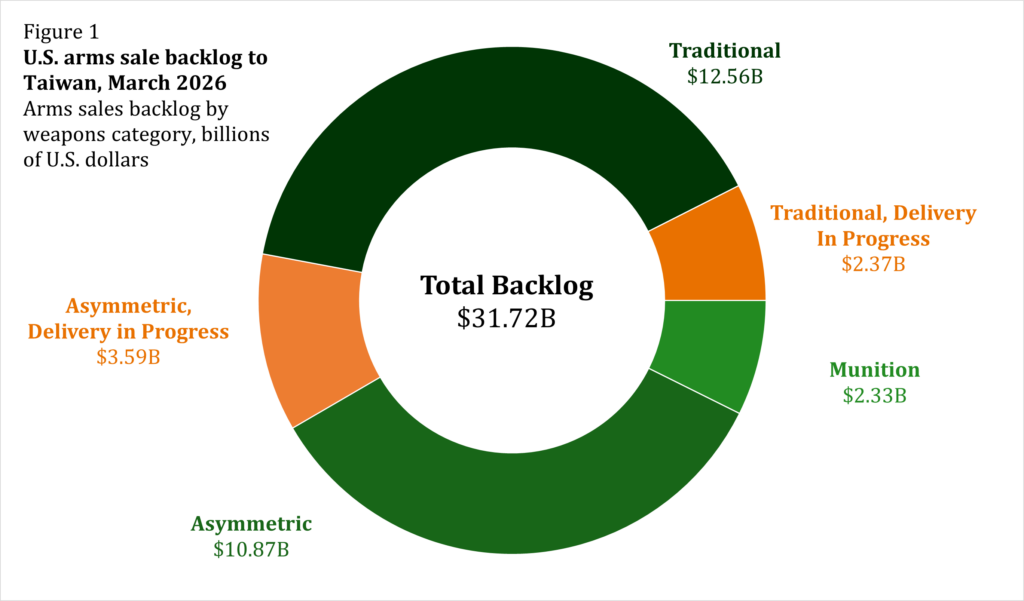
The delivery of ALTIUS drones brings the backlogโ€™s total value down slightly to $31.72 billion.  

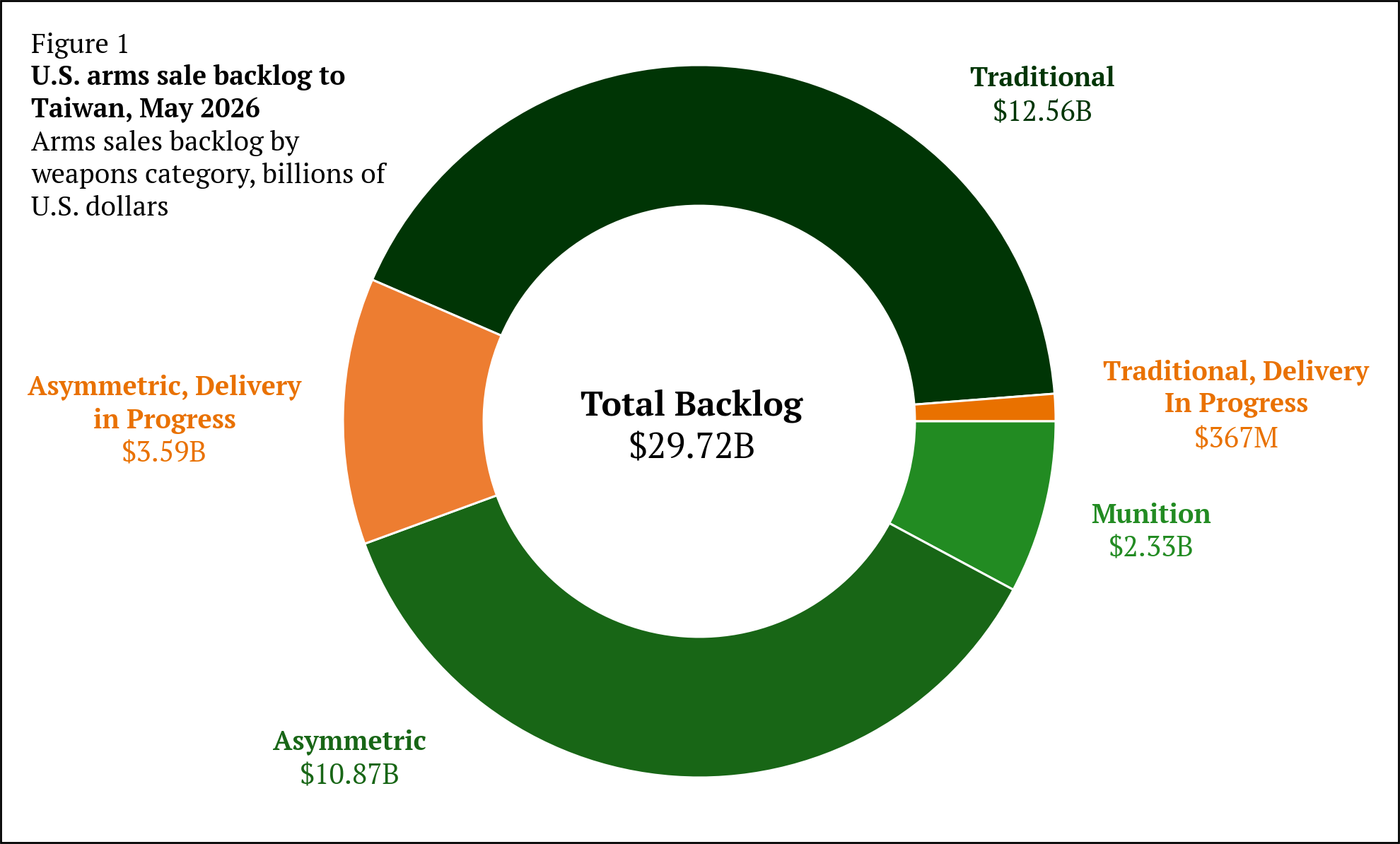
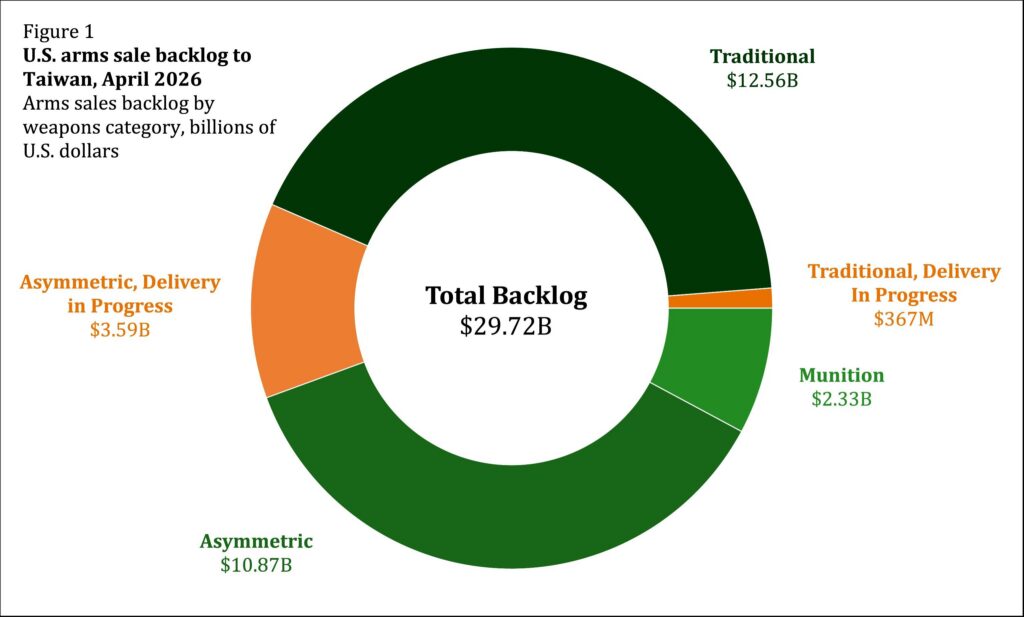
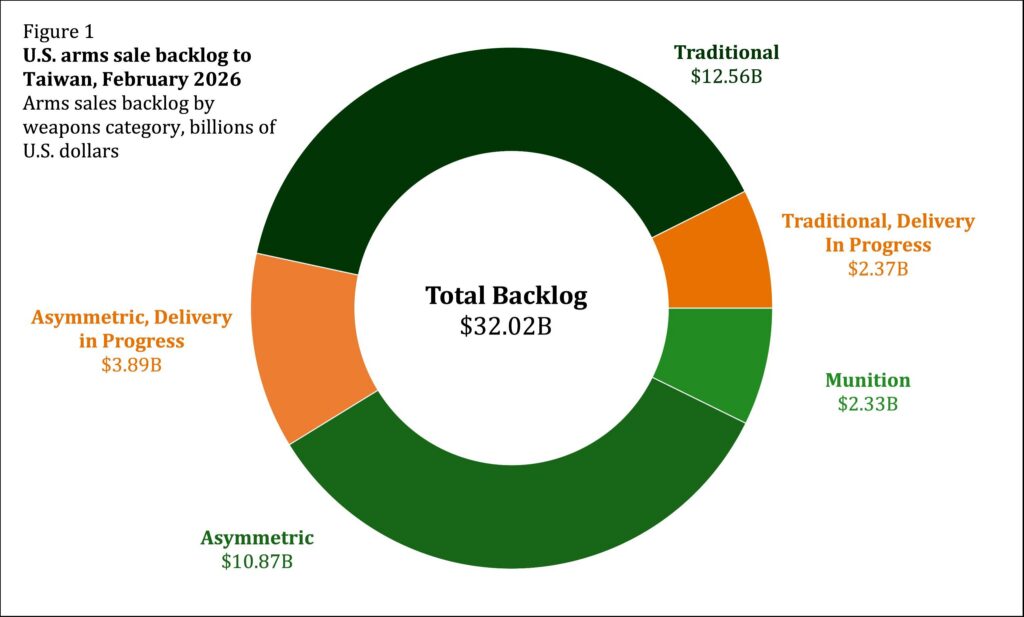
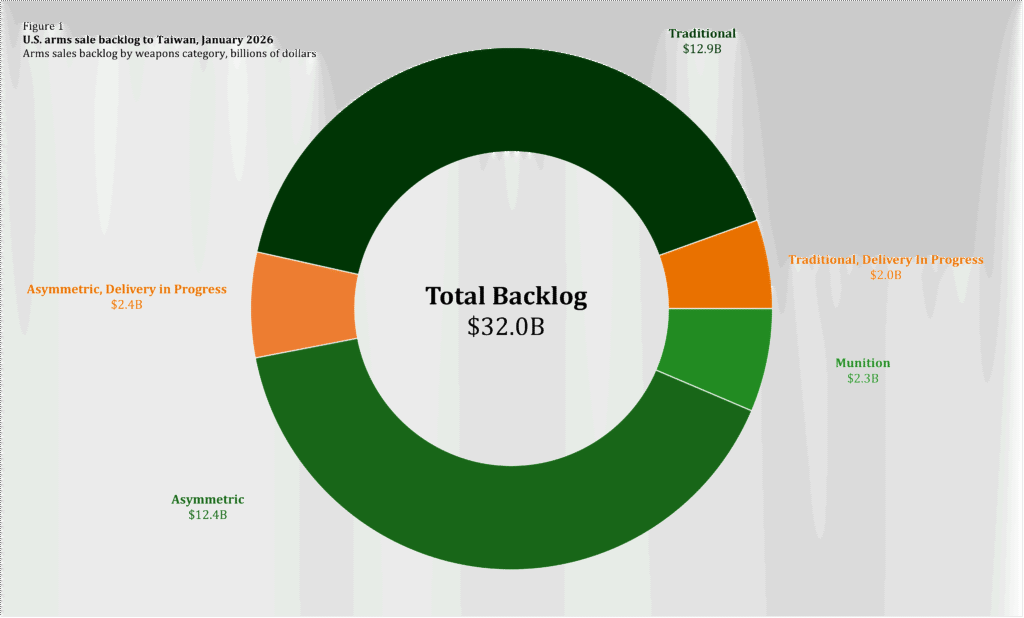
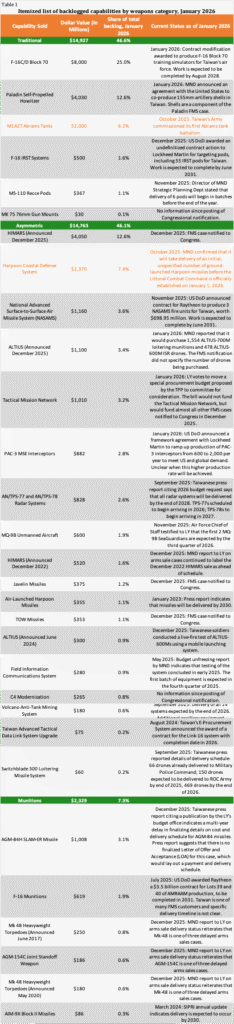
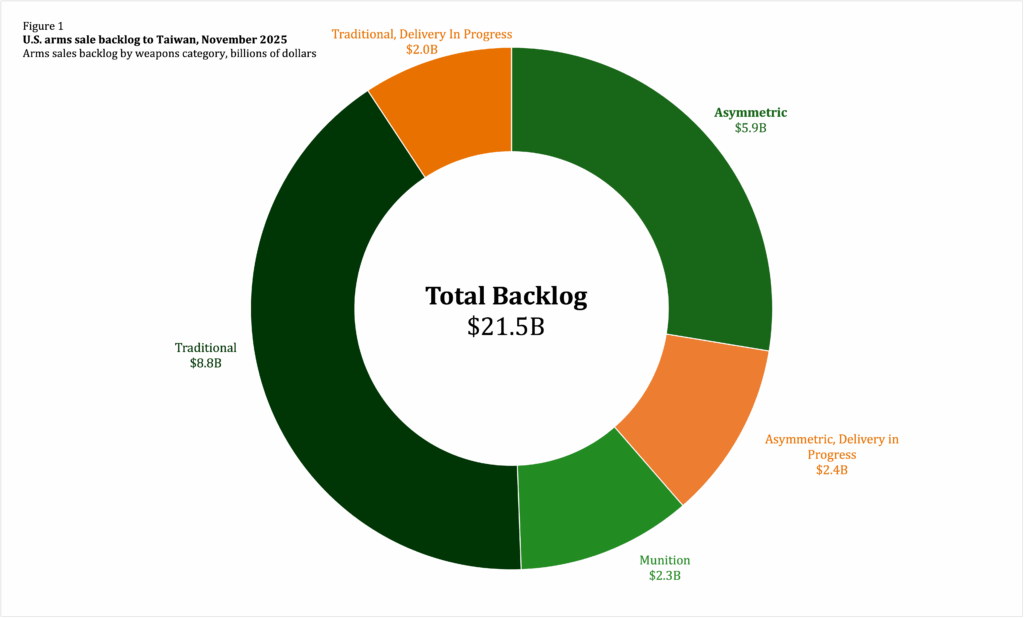
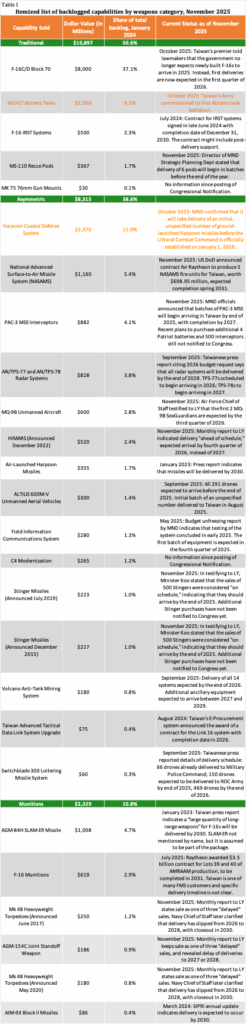
Figure 1 illustrates the breakdown of the backlog between asymmetric weapons, traditional weapons, and munitions. Table 1 provides an itemized list of all arms sales in the backlog, including the most up-to-date information on their status. In that table, arms sales that have been partially but not fully delivered are indicated in italics. New and completed arms sales are indicated with bolding and underlining.  

Special Budget Updates in March 

On March 5, the Kuomintang (KMT) released their proposal for US$12.02 billion (NT$380 billion) in spending, to fund only the arms approved in December 2025. This proposal required that Letters of Offer and Acceptance (LOAs) be approved before funds are appropriated, instead of having funds in advance. The KMTโ€™s proposal also required that funds for future arms sales from the US be approved as a second bill, instead of the Lai administration or Taiwan Peopleโ€™s Party (TPP) proposals, which allocate funds for future arms purchases. 

Following its release, Minister of National Defense Wellington Koo and statements carried by the Military News Agency (MNA) pushed back against the proposal, arguing that its sunset provision of December 2028 is incompatible with current delivery timelines and unrealistic. The MND also clarified in a statement that three sales announced in December, including the Taiwan Tactical Network, as well as AH-1W spare parts and Harpoon missile refurbishment, were not included within the administrationโ€™s NT$1.25 trillion special budget request, instead being folded under annual defense spending. 

Table 1
Itemized list of backlogged capabilities by weapons category, March 2026
Capability SoldDollar Value (In Millions)Share of total backlog, March 2026Current Status as of March 2026
Traditional$14,92747.06%
F-16C/D Block 70$8,00025.22%March 2026: Taiwanese officials attended an Acceptance Check Flight in the U.S. for the first F-16 airframe. Minister Koo also stated to press that the first F-16 could arrive as early as September 2026.
Paladin Self-Propelled Howitzer$4,03012.71%March 2026: MND officials warned that Letter of Offer and Acceptance for Paladins, as well as three other sales, would expire at end of month if not signed. LY agreed to allow signature of LOAs before special defense budget is approved.
M1A2T Abrams Tanks$2,0006.31%March 2026: MND officials stated that the final batch of 28 Abrams are โ€œat seaโ€ enroute to Taiwan. Further statements indicated delivery either at the end of March or in April. As of the end of March, TSM cannot independently verify delivery.
F-16 IRST Systems$5001.58%December 2025: US DoD awarded an undefinitized contract action to Lockheed Martin for targeting pods, including 55 IRST pods for Taiwan. Work is expected to complete by June 2031.
MS-110 Recce Pods$3671.16%February 2026: Three MS-110 pods expected to arrive by the end of 2026. This may fulfill the FMS case, but getting accurate, consistent numbers on MS-110 delivery has been challenging.
MK 75 76mm Gun Mounts$300.09%No information since posting of Congressional notification.
Asymmetric$14,76345.60%
HIMARS (Announced December 2025)$4,05012.77%March 2026: MND officials warned that Letter of Offer and Acceptance for HIMARS, as well as three other sales, would expire at end of month if not signed. LY agreed to allow signature of LOAs before special defense budget is approved. MND officials also warned that initial payment for HIMARS would be due, but agreements with U.S. officials resulted in an extension.
Harpoon Coastal Defense System$2,3707.47%March 2026: U.S. DSCA Director Michael Miller confirmed in a House hearing that Taiwan has priority for delivery of HCDS over Saudi Arabia.
National Advanced Surface-to-Surface Air Missile System (NASAMS)$1,1603.66%February 2026: Press reports citing MND sources repeated earlier reporting that Taiwan plans on purchasing 9 additional NASAMS systems and associated missiles. This appears to be one of the arms sales cases being held up by special procurement budget deadlock in the LY.
ALTIUS (Announced December 2025)$1,1003.47%January 2026: MND reported that it would purchase 1,554 ALTIUS-700M loitering munitions and 478 ALTIUS-600M ISR drones. The FMS notification did not specify the number of drones being purchased.
Tactical Mission Network$1,0103.18%January 2026: LY votes to move a special procurement budget proposed by the TPP to committee for consideration. The bill would not fund the Tactical Mission Network, but would fund almost all other FMS cases notified to Congress in December 2025.
PAC-3 MSE Interceptors$8822.78%March 2026: MND officials stated that ongoing delivery of 102 MSE missiles should not be affected by conflict in the Middle East.
AN/TPS-77 and AN/TPS-78 Radar Systems$8282.61%September 2025: Taiwanese press report citing 2026 budget request says that all radar systems will be delivered by the end of 2028. TPS-77s scheduled to begin arriving in 2026; TPS-78s to begin arriving in 2027.
MQ-9B Unmanned Aircraft$6001.89%March 2026: Taiwanese officials attended a โ€œhandoverโ€ ceremony in the U.S. for two of the expected four drones, clarifying that they expect to remain for further testing. LY testimony from MND officials also clarified that delivery is expected by the third quarter of 2026 and should not be delayed by ongoing conflict in the Middle East.
HIMARS (Announced December 2022)$5201.64%February 2026: Press reports citing MND sources indicate that 18 launchers, 20 ATACMS, and 864 GMLRS are expected to arrive before the fourth quarter of 2026. This is consistent with previously reported delivery timelines.
Javelin Missiles$3751.18%March 2026: MND officials warned that Letter of Offer and Acceptance for Javelins, as well as three other sales, would expire at end of month if not signed. LY agreed to allow signature of LOAs before special defense budget is approved.
Air-Launched Harpoon Missiles$3551.12%January 2023: Press report indicates that missiles will be delivered by 2030.
TOW Missiles$3531.11%March 2026: MND officials warned that Letter of Offer and Acceptance for TOWs, as well as three other sales, would expire at end of month if not signed. LY agrees to allow signature of LOAs before special defense budget is approved.
ALTIUS (Announced June 2024)$3000.90%March 2026: MND confirms receipt of all 291 ALTIUS-600M UAVs.
Field Information Communications System$2800.88%May 2025: Budget unfreezing report by MND indicates that testing of the system concluded in early 2025. The first batch of equipment is expected in the fourth quarter of 2025.
C4 Modernization$2650.84%No information since posting of Congressional notification.
Volcano Anti-Tank Mining System$1800.57%February 2026: Press reports citing MND sources indicate delivery of 14 Volcano systems will occur “soon.” This is consistent with previously reported delivery timelines.
Taiwan Advanced Tactical Data Link System Upgrade$750.24%August 2024: Taiwan’s E-Procurement System announced the award of a contract for the Link-16 system with completion date in 2026.
Switchblade 300 Loitering Missile System$600.19%September 2025: Taiwanese press reported details of delivery schedule: 66 drones already delivered to Military Police Command; 150 drones expected to be delivered to ROC Army by end of 2025, 469 drones by the end of 2026.
Munitions$2,3297.34%
AGM-84H SLAM-ER Missile$1,0083.18%December 2025: Taiwanese press report citing a publication by the LY’s budget office indicates a multi-year delay in finalizing details on cost and delivery schedule for AGM-84 missiles. Press report suggests that there is no finalized Letter of Offer and Acceptance (LOA) for this case, which would lay out a payment and delivery schedule.
F-16 Munitions$6191.95%July 2025: US DoD awarded Raytheon a $3.5 billion contract for Lots 39 and 40 of AMRAAM production, to be completed in 2031. Taiwan is one of many FMS customers and specific delivery timeline is not clear.
Mk 48 Heavyweight Torpedoes (Announced June 2017)$2500.79%December 2025: MND report to LY on arms sale delivery status reiterates that Mk-48 is one of three delayed arms sales cases.
AGM-154C Joint Standoff Weapon$1860.58%December 2025: MND report to LY on arms sale delivery status reiterates that AGM-154C is one of three delayed arms sales cases.
Mk 48 Heavyweight Torpedoes (Announced May 2020)$1800.57%December 2025: MND report to LY on arms sale delivery status reiterates that Mk-48 is one of three delayed arms sales cases.
AIM-9X Block II Missiles$860.27%March 2024: SIPRI annual update indicates delivery is expected to occur by 2030.

On March 25, the Legislative Yuanโ€™s Foreign Affairs and National Defense Committee began a two-day markup period of the three budget proposals, aiming to combine them into one bill. Committee members reached consensus on several provisions, including those relating to procurement planning, taken from the KMT proposal, as well as legal authorities, but crucially failed to reach consensus on provisions relating to the topline budget amount and specific procurement items. In the hearing, opposition legislators questioned the governmentโ€™s proposed spending categories, concerned that they were vague or classified. By law, the special budget entered a โ€œfreezeโ€ to allow for further negotiation, which is expected to go into April. Discussed below, these repeated delays and lack of consensus, while somewhat productive in challenging Lai administration policy, have also had negative knock-on effects, resulting in delayed or extended payments for several arms sales. 

March also featured several statements from Taiwanese officials on the status of the special budget. On March 8, President Lai, speaking at a temple in New Taipei, stated his administrationโ€™s budget was reasonable and compared it to a security system against a โ€œbad neighbor.โ€ On March 28, Premier Cho Jung-tai urged opposition parties to perceive the need for national defense and the nationโ€™s requirements, after a markup hearing in which General Huang Wen-chi, head of the MNDโ€™s Strategic Planning Department, was visibly upset. The same day, Vice President Hsiao Bi-khim echoed the same sentiments, speaking at the 2026 Taiwan Civil Defense Annual Conference and noting that the administrationโ€™s budget seeks to improve โ€œwhole-of-society resilience.โ€ 

American officials also weighed in. On March 9, a State Department spokesperson stated that Washington โ€œencourage[s] all parties in Taiwanโ€™s legislature to work through political differences and quickly pass a special defense budget,โ€ specifically addressing whether the United States would support a KMT proposal. On March 26, Director of the American Institute in Taiwan, Raymond Greene, also urged the LY to pass a budget, calling U.S. support for it โ€œrock solid.โ€ 

December Cases Face LOA and Payment Extensions, Possible Delays  

Taipei spent most of March trying to prevent a procedural problem from becoming a delivery problem. In early February, the Ministry of National Defense warned that the LOAs for TOW anti-armor missiles, Javelin anti-armor missiles, and M109A7 self-propelled howitzers would expire on March 15 unless the Legislative Yuan acted. Following this, the LY moved on March 12โ€“13 to authorize the Executive Yuan to sign four U.S. LOAs, adding HIMARS to the original three cases.  While a crucial step, as it prevented the deals from stalling at the signature stage, it did not fully solve the larger problem. In the FMS process, an LOA must be signed and an initial payment made before the U.S. procurement agency can enter into an agreement with the defense industry to build the weapons. Clearing the LOA signature step is a move in the right direction, but Taiwanโ€™s special procurement budget impasse means that it cannot make an initial payment, which means delays in finalizing production contracts.   

On March 26, Liberty Times reported that the initial payment deadline for HIMARS was approaching and that U.S. officials had indicated there was little room for delay, with Taiwanese officials warning that missing the current deadline could push negotiations for a new LOA back to the end of the year. Four days later, CNA reported that the United States had agreed to extend the HIMARS first-payment deadline with a revised timeline tied to the U.S. Department of Defenseโ€™s contract negotiations with Lockheed Martin, the systemโ€™s manufacturer. Taiwan is still seeking similar flexibility for the TOW, Javelin, and M109A7 cases.  

Updates to Abrams, ALTIUS Deliveries 

On March 10, MND officials reported that the final tranche of 28 M1A2T Abrams tanks is โ€œat sea,โ€ en route to Taiwan, however we were unable to verify delivery of the tanks before the end of March.. 80 of the 108 tanks have already arrived, including 38 delivered in December 2024 and 42 delivered in July 2025. Once delivered, this tranche will mark the last of 108 Abrams that Taiwan began procuring in July 2019. From a procurement perspective, the Abrams case is a useful execution benchmark inside the broader U.S.โ€“Taiwan pipeline. Taiwan Security Monitorโ€™s backlog tracker has identified Abrams as one of the smoother Foreign Military Sales deliveries. Final delivery of the Abrams would reduce the backlog by $2 billion, a sizable decrease.  

As of March 18, the Taiwanese military has officially received all ALTIUS-600M UAVs purchased from the United States and defense contractor Anduril. Announced on June 18, 2024, the first batch of ALTIUS-600M drones was delivered to Taiwan on August 4, 2025, a turn-around time between approval and initial delivery of less than 14 months. With this last delivery, the Taiwanese military now has up to 291 ALTIUS systems, costing approximately NT$9.6 billion (US$300 million). A second sale, announced in December, of 1,554 ALTIUS 700M and 478 ALTIUS 600M ISR drones, is currently in progress, and is also expected to be completed quickly. 

F-16 Block 70 and MQ-9B Production Updates 

As of March 21, the first Taiwanese F-16 Block 70 has completed its Acceptance Check Flight at Lockheed Martin facilities in Greenville, South Carolina. These tests were attended by several Taiwanese officials, including Deputy Minister of National Defense Hsu Szu-chien, Deputy Air Force Chief of Staff General Tian Zhongyi, and the Taiwanese Representative to the United States, Alexander Yui. An MND press release after the visit stated that this success means Lockheed will begin its deliveries to Taiwan. On the same day, the MND also confirmed that several Taiwanese officials attended a handover ceremony in the United States for two of the four MQ-9B SeaGuardian maritime surveillance drones purchased for NT$21.7 billion (US$674.02 million). However, the MND clarified that the two drones would stay in the United States for continued testingwith delivery to Taiwan expected in the third quarter of this year. 

Minister of National Defense Wellington Koo also stated in a recent press conference that the first two MQ-9B SeaGuardians are expected to be delivered by the third quarter of the year and that the first F-16 Block 70 could arrive as early as September 2026. He has also clarified that the United States’ ongoing conflict in the Middle East has no effect on delivery timelines to Taiwan. 

Conclusion

Taken together, Marchโ€™s developments show a backlog that is still slowly moving in the right direction, but with growing signs that Taiwanโ€™s main bottleneck is no longer only United Statesโ€™  production capacity. The completion of ALTIUS deliveries, the near-finish of the Abrams case, and visible progress on the F-16 Block 70 and MQ-9B programs are welcome developments. At the same time, repeated delays in passing a special defense budget, uncertainty over LOA follow-through and initial payments, and the need to seek deadline extensions from Washington indicate that domestic political and procedural friction in Taiwan are increasingly shaping the pace of FMS execution.  

Errata: Percentages in Table 1 inaccurately reflected sale value and have been appropriately updated.

Taiwan Arms Sale Backlog, February 2026 Update

Special Budget Complications Continue

Authors: Joseph Oโ€™Connor, Eric Gomez, & Shikhar Chaturvedi


Political gridlock over the Lai administrationโ€™s special procurement budget continued in February 2026, leading to concerns about recently announced U.S. arms sales to Taiwan. No new Foreign Military Sales (FMS) cases were notified to Congress, and no existing sales were delivered in February. The total value of FMS cases notified to Congress but not delivered to Taiwan remains $32 billion.

Eagle-eyed readers will notice that there is a change in Figure 1. Arms sales cases are fully removed from our dataset once final delivery occurs, but we do not reduce the dollar value of the backlog for partial deliveries. We have explained our thinking in other articles.

We indicate partially delivered arms sales through color coding in our data visualizations, with the yellow-orange color representing cases that are partially delivered to the best of our knowledge. Previously, we have only done this for arms sales valued at $1 billion or more because these were the most militarily significant sales and because, given the quantities and types of capabilities involved, they tended to be the easiest to track.

However, we realize that a $1 billion threshold has its own problems. We have therefore decided to adjust our methodology for data visualizations, and from now on, any arms sale that we can verify as partially delivered will be visually indicated with the yellow-orange color. The dollar value of the backlog will only be reduced when a sale is fully delivered, but we think this new approach represents a reasonable way to show in-progress deliveries.

This methodology change moves five arms sales cases worth $1.89 billion into the partially delivered category. Combined with the two cases above, the $1 billion threshold that we were already tracking as partially deliveredโ€”M1A2T Abrams tanks and Harpoon Coastal Defense Cruise Missile systemsโ€”there are seven arms sales cases worth $6.26 billion that are partially delivered, just shy of 20 percent of the backlogโ€™s total dollar value.  

Special Budget Updates in February

Ongoing deliberations in the Legislative Yuan (LY) relating to a special defense budget slowed down in February, as the LY recessed for the Lunar New Year holiday. Prior to recess, the legislature voted to advance a proposal made by the opposition Taiwan Peopleโ€™s Party (TPP) to committee review, leaving the Lai administrationโ€™s NT$1.25 trillion (US$40 billion) proposal in limbo. During the recess, 37 U.S. senators and representatives, including senior members of the House and Senate foreign affairs committees and from both parties in Congress, sent a letter to LY Speaker Han Kuo-yu and party caucus leaders, expressing concern about โ€œongoing deliberations in the Legislative Yuan to only partially fund a supplemental budget request.โ€ Han, responding on February 16, stated that the budget would be one of the โ€œvery firstโ€ items to be debated, and upon re-convening on February 24, the LY voted to advance the governmentโ€™s proposal, ending the month with both proposals under review by the Foreign Affairs and National Defense Committee.

The differences between the competing proposals largely center on flexibility and holistic spending, as opposed to narrower and targeted procurements of established systems, as discussed in detail in our recent article comparing the two proposals. On the sidelines, the Kuomintang (KMT), the third and largest major party in the LY, announced in late February that they would be releasing their own special budget proposal, which they did in early March. As of the end of February, the proposal had ranged from NT$350 billion (US$11.19 billion) to NT$750 billion (US$23.97 billion) but turned out to be only NT$380 billion (US$12 billion) when announced on March 6.

Taiwan’s MND, on February 6, sounded the alarm about three Letters of Offer and Acceptance (LOAs) that are set to expire on March 15. The LOAs, which are for the December sales of Paladin self-propelled howitzers, TOW-2B anti-armor missiles, and Javelin anti-armor missiles, were not signed because of ongoing battles in the LY. MND officials stated they were seeking extensions to the LOAs if a deal was not reached soon. Signing a LOA quickly is an important milestone in the FMS process. A LOA has a payment schedule, whereby Taiwan would pay the U.S. government in installments for the capabilities it is purchasing. The U.S. government negotiates a contract with the defense industry and pays for the capabilities using the funds that Taiwan transfers per the LOA. Importantly, until a LOA is signed and a first payment is made, the Department of Defense cannot enter a contract to produce the weapons. If a LOA is not signed before it expires, then certain steps in the FMS process must be repeated or renegotiated due to potential changes in pricing.

Updates to Abrams, PAC-3 Sales

On February 2, MND officials reported that the final batch of 28 M1A2T Abrams tanks will arrive in Taiwan by the end of March. Delivery of the total 108 tanks has been ongoing since December 2024, when the first batch of 38 arrived in Taiwan.

On February 11, MND officials confirmed to the press that they would be procuring 102 PAC-3 Missile Segment Enhancement (MSE) missiles for Patriot air defense systems, which would be paid via surplus funds from a prior Patriot procurement program.  This is a positive development for the backlog, as the 102 PAC-3 MSEs are a 2022 modification to a 2010 Patriot case and can be funded through surplus from the earlier program. They are separate from and (additive to) the planned but not yet notified Patriot follow-on package (additional batteries and PAC-3 MSEs) expected to be financed through the Lai administrationโ€™s special defense budget.

Amidst these updates, reporting from the Financial Times, New York Times, and Taipei Times has revealed a future arms sale package to Taiwan, including PAC-3 MSE missiles, additional Patriot batteries, Integrated Battle Command Systems, and Lower Tier Air and Missile Defense Sensors radars, all designed to integrate into the Lai administrationโ€™s planned โ€œT-Domeโ€ air defense system. The timeline of this sale, however, is in flux owing to Trumpโ€™s summit with Xi in April.

Trump Administration Announces Arms Sale Reforms

On February 6, the Trump administration launched a new round of arms-transfer reforms through Executive Order 14383 and its accompanying White House fact sheet, establishing an โ€œAmerica First Arms Transfer Strategy.โ€ The order reframes arms transfers as a mechanism for expanding U.S. production capacity, strengthening supply chains, and prioritizing partners that invest in their own defense. The point was reinforced on February 10, when the Pentagon announced the realignment of the Defense Security Cooperation Agency (DSCA) and the Defense Technology Security Administration (DTSA) under the Under Secretary for Acquisition and Sustainment, explicitly tying security cooperation and export administration more closely to defense-industrial management and execution.

At the same time, Taiwan’s arms sales became more visibly entangled with summit diplomacy. Following the February 4 Trumpโ€“Xi call, Beijing publicly urged Washington to handle Taiwan arms sales with โ€œprudenceโ€ and again described Taiwan as theโ€œmost important issueโ€ in U.S.โ€“China relations. Trump then said he was โ€œtalkingโ€ with Xi about future arms sales to Taiwan and would decide โ€œpretty soon,โ€ before the White House promptly clarified that there had been no change in longstanding U.S. policy. Further reporting that a major new package could move only after a Trump trip to China further underscores that dynamic.

Conclusion

Taiwanโ€™s arms sales backlog remained steady at $32.0 billion through the end of February 2026. However, recent developments highlight the role of political factors in the backlog rather than defense industrial capacity.  

The Legislative Yuan has only just begun substantive review of competing special budget proposals, while the March 15 LOA expiration deadline is approaching for several cases notified in December.  Meanwhile, Washingtonโ€™s efforts to streamline arms transfers are occurring alongside high-level diplomacy, which may influence the timing of major new Taiwan FMS notifications to Congress. 

March will be a critical month to determine whether Taipei can turn budget discussions into signed agreements and funding, and whether U.S. process improvements will result in faster execution or be offset by political considerations on both sides.

Taiwan Arms Sale Backlog, January 2026 Update

Special Budget Complications Continue

By Joseph Oโ€™Connor and Eric Gomez

The first month of 2026 was relatively slow for the US arms sale backlog to Taiwan. No new Foreign Military Sales (FMS) were notified to Congress or fully delivered; the topline value of the backlog saw no change since December. Deadlock on the special defense budget in the Legislative Yuan (LY) continued, with the opposition Taiwan Peopleโ€™s Party (TPP) submitting its own, reduced proposal. Additionally, the Department of Defense awarded a contract for the production of F-16 simulators being purchased by Taiwan.

The arms sale backlog as of January 31, 2026, remains $32.0 billion. For arms sales valued at over $1 billion, deliveries in progress are marked in yellow-orange in our visualizations, meaning that the true dollar value is lower than the topline. Figure 1 illustrates the breakdown of the backlog between asymmetric weapons, traditional weapons, and munitions. Table 1 provides an itemized list of all arms sales in the backlog, including the most up-to-date information on their status.

Special Defense Budget Complications

The MNDโ€™s special defense budget, initially announced by President Lai in November 2025, continued its tumultuous journey through the LY in January. The administrationโ€™s proposal, a budget of NT$1.25 trillion (US$40 billion) to be spent over eight years, remained in the LYโ€™s Foreign Affairs and National Defense Committee. Legislators in the Kuomintang (KMT) and Taiwan Peopleโ€™s Party (TPP) โ€” which hold a combined 62 seats to the Democratic Progressive Partyโ€™s (DPP) 51โ€”have prevented Laiโ€™s budget from advancing to the full LY. On January 19, Minister of National Defense Wellington Koo delivered a closed-door, confidential briefing to the Foreign Affairs and National Defense Committee, but little concrete information about the budget was released.

Meanwhile, the TPP announced a counter proposal for the special defense budget, worth NT$400 billion (US$12.69 billion) on January 26 in a press conference, sending it to the LY Foreign Affairs and National Defense Committee for review on January 30. This reduced budget proposal contains funding for five of the eight cases announced in December, including Paladin self-propelled howitzers, HIMARS launchers and munitions, Javelin and TOW anti-tank missiles, and ALTIUS loitering munitions, for a total of NT$311.9 billion (US$9.90 billion). The December FMS cases not funded in the TPPโ€™s proposed budget are tactical mission networks, and spare parts for attack helicopters and Harpoon anti-ship missiles.  The proposal also omitted funding for local partnerships with the Taiwanese defense industrial base, including the procurement of some 200,000 drones. The NT$400 billion represents a spending ceiling, with the LY needing to vote on new funding each year until the total amount is reached. This gives the LY much more oversight power over arms sale spending, giving them multiple opportunities to pause or redirect funding if cases fall behind schedule.

Interestingly, the inclusion of the five most significant cases from December indicates an implicit desire to continue procurement of mostly asymmetric systems. The TPP proposal also includes oversight provisions, including โ€œcomprehensive special reportsโ€ on case statuses over the last five years, how said procurement cases improve joint operational effectiveness, acquisition timelines, and delivery dates, and fiscal impacts. An MND press conference on 26 January refuted these oversight provisions as being time-prohibitive and having effects on the progress of backlogged cases. If passed, however, this level of oversight would provide more effective monitoring of the backlog.

MND Hints at Further Sales

After a Cabinet meeting on 15 January, Vice Minister of National Defense Hsu Szu-chien stated that four more arms sales from the US were in the pipeline, but had yet to be notified to Congress, without giving more details. As of the end of January, it is thought that additional Patriot air defense missile batteries and PAC-3 MSE missiles are one of those sales, but no details have been confirmed by the MND. This, of course, presents more opportunities for the backlog to only grow, but only after these sales have been notified to the U.S. Congress.

F-16 Simulator Contract Awarded

On 29 January, the U.S. Air Force awarded a contract definitization modification valued at US$69.88 million (using US$59.42 million of Taiwan FMS funds) for the procurement of F-16 Block 70 training simulators for the ROC Air Force. This is an extension of a contract originally awarded in January 2023 and appears to be the sixth such extension. Work under the contract is expected to be completed by August 2028, pending further contract extensions. This contract award is part of the US$8 billion F-16 Block 70 sale approved in August 2019.

Other Updates

A few other updates on backlogged cases emerged this month. First, after the 19 January confidential hearing, Minister Koo revealed that from the December sale, 1,554 ALTIUS-700M loitering munitions and 478 ALTIUS-600ISR drones would be procured. This case is worth US$1.1 billion, and previously, the quantity of drones was not specified. Owing to the speed of the first sale of ALTIUS being delivered to Taiwan, we expect this December case to also be fulfilled quickly.

During the month, the MND released details about production line enhancement projects set to be funded under their special defense budget proposal. Among other projects, the 202nd Factory of the MNDโ€™s Armaments Bureau is set to increase 155mm artillery shell production. This affects the recent December sale of Paladin self-propelled howitzers, as those are the only systems in Taiwanโ€™s inventory that would use that caliber of shell. MND sources also stated that surplus 155mm shells would be sold via a partnership with the United States.

On 21 January, the U.S. Army awarded a contract extension worth US$202.78 million (using US$52.38 million in Taiwan FMS funds) to Lockheed Martin for inspection, recertification, and repair of PAC-3 missiles, presumably including missiles in Taiwanโ€™s possession or to be delivered to Taiwan. Similar to the above F-16 contract, this is an extension of a contract originally awarded in June 2022, and work is expected to be completed by June 2028.

Conclusion

January marked the continuation of ongoing budgetary battles in the LY, which have no intention of ending soon, particularly with an opposition alternative being proposed. The special defense budget debate is now the central variable: if the LY cannot reach a workable compromise soon, Taiwan risks procurement delays in the earliest phases of an FMS case. The budget drama also sends mixed signals to allies and adversaries of Taiwan on its willingness to provide for its own defense.  However, the TPPโ€™s emphasis on greater transparency and oversight would be welcome for providing more information about how arms sale cases are progressingโ€”or stalling.

Taiwan Arms Sale Backlog, December 2025 Update

Trump Administration Notifies Congress of $11 Billion in New Taiwan Arms Sales

By Eric Gomez and Joseph Oโ€™Connor

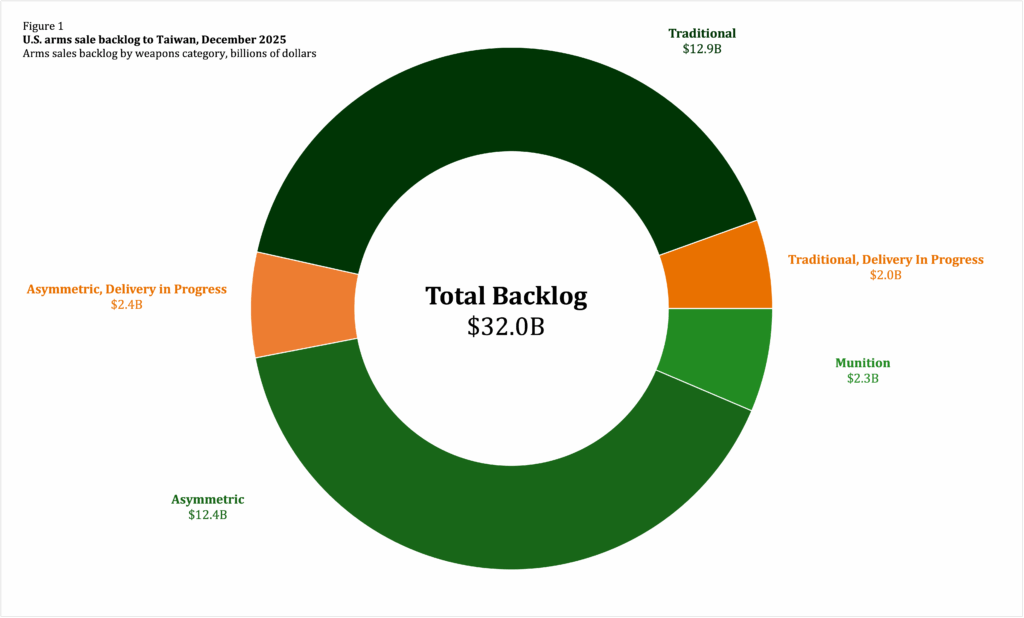
On December 17, 2025, the Trump administration notified Congress of over $11 billion worth of new Foreign Military Sales (FMS) cases to Taiwan, the largest ever package of US arms sales to Taiwan by dollar value. This new package raises the total dollar value of the US arms sale backlog to Taiwan to approximately $32 billion. At least $4.4 billion of this amount has been partially delivered to Taiwan.

Seeing such a steep growth in the total dollar value of the backlog seems alarming at first glance, but overall, the December 2025 FMS cases are a good thing for Taiwan. The new arms sales are heavily weighted in favor of asymmetric systems that will likely be produced and delivered rapidly.

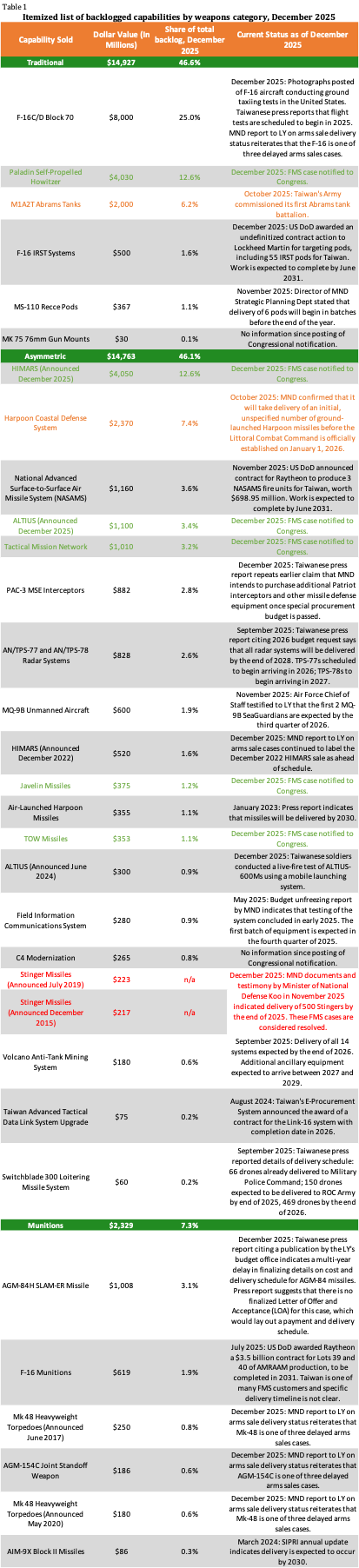
As always, Figure 1 shows how the backlog is divided between traditional systems, asymmetric systems, and munitions. Table 1 is an itemized list of the FMS cases that Taiwan is waiting to receive, with the latest information on delivery schedules. In Table 1, items in green text are new additions to the backlog; those in red text are newly delivered items that have been removed from the backlog, and yellow/orange text represents arms sales worth at least $1 billion that are partially delivered.

Breaking Down the December Package

The Arms Export Control Act requires that Congress receive notification of new FMS cases above a certain dollar threshold before those cases can advance. After notification, Congress has a specified period, depending on the recipient country (30 days in Taiwanโ€™s case), during which it can block the sale by passing a joint resolution of disapproval. If Congress does not pass such a resolution, then the FMS sale goes ahead. Congressional notifications are how Taiwan Security Monitor establishes its universe of arms sales for the backlog.

The $11 billion package contains eight unique FMS cases. The new cases are heavily weighted in favor of asymmetric capabilities, which represent five cases worth approximately $6.9 billion. The other three sales are for one traditional capability (Paladin self-propelled howitzers) and two maintenance sales (spare and repair parts for Harpoon missiles and attack helicopters).

The distinction between asymmetric capabilities, traditional capabilities, and munitions is explained in a November 2023 article by Eric Gomez, published with the Cato Institute, during the nascency of the backlog dataset. Additionally, the two maintenance sales have not been added to the backlog because they support capabilities that Taiwan already possesses, and tracking the delivery of spare parts is not possible with the available data.

Asymmetric Capabilities: 5 Cases, $6.9 Billion

The most heartening aspect of the December 2025 FMS package to Taiwan is its heavy emphasis on asymmetric weapons systems. Taiwan has historically under-invested in asymmetric capabilities, which are less flexible, but tend to be less expensive, more mobile, and harder for Chinaโ€™s military to counter in a high-intensity conflict.

When Gomez published the first version of the Taiwan arms backlog dataset in late 2023, asymmetric capabilities were $4.2 billion out of $19.17 billion, or 22 percent. With the December 2025 arms sales, these numbers are now $14.7 billion out of $32 billion, or 46 percent. This growing emphasis on asymmetric capabilities is a step in the right direction for Taiwan.

The five December 2025 asymmetric capabilities arms sales are:

  1. HIMARS launchers and munitions, $4.05 billion
  2. ALTIUS loitering munitions/drones, $1.1 billion
  3. Tactical Mission Network, $1.01 billion
  4. Javelin Missiles, $375 million
  5. TOW Missiles, $353 million

There are several things to note with this mix of capabilities:

Firstly, the two largest arms sales in this categoryโ€”HIMARS rocket artillery launchers and ALTIUS dronesโ€”are on efficient production lines, which means they will likely be delivered to Taiwan relatively quickly. According to Taiwanโ€™s Ministry of National Defense, a December 2022 sale of HIMARS launchers and munitions that should arrive in 2026 is the only FMS case out of 14 that is considered ahead of schedule. ALTIUS drones likewise have arrived in Taiwan rapidly, with an initial tranche arriving in Taiwan (August 2025) only a little over one year after Congress was notified of the sale (June 2024).

Secondly, our dataset codes Javelin and TOW missiles as asymmetric weapons and not munitions because both FMS cases include other systems besides the missiles themselves that make it more appropriate to see them as an asymmetric capability rather than just munition reloads. The Javelin sale includes additional launcher units, while the TOW sale includes kits to mount launchers to Humvee vehicles.

Finally, once Taiwan receives the 82 HIMARS launchers from the December sale on top of the 29 from previous arms sales, it will have the second-largest inventory of HIMARS in the world after the United States. HIMARS has demonstrated its value as an asymmetric, long-range precise rocket artillery system in the ongoing war in Ukraine, and it is in high demand in Taiwan, alongside many frontline NATO countries. The range and mobility of HIMARS make it an excellent choice for an asymmetric defense strategy.

Traditional Capabilities: 1 Case, $4.03 Billion

The only traditional capability in the December 2025 arms sale package is the sale of 60 M109A7 Paladin self-propelled howitzers plus support equipment such as ammunition carriers and armored recovery vehicles. Taiwan previously attempted to purchase 40 M109A6 Paladins in 2021, but shortly after the Ukraine war began, the sale was cancelled, and Taiwan instead focused on buying additional HIMARS.

Taiwan could have probably found better ways to spend $4 billion, but in the world of traditional capabilities, self-propelled howitzers are not that bad an investment. Artillery pieces are still important in modern battlefields, and while it may not be as mobile as a HIMARS launcher, a Paladin can still use mobility to improve its survivability. Taiwan also already operates earlier variants of the Paladin, which should help with the quick absorption of the new systems. Finally, the defense industrial base has improved its production rates of 155mm artillery shells and Paladin howitzers because of the Ukraine war, which will hopefully mean a shorter gap between Congressional notification and delivery to Taiwan.

Stinger Delivery Completed

While the massive recent arms sale package has understandably received most of the attention this month, there were two arms sales that were removed from the backlog. Taiwan was waiting on the delivery of 500 Stinger man-portable air defense missiles that were sold across two FMS cases (December 2015 and July 2019) worth a combined $440 million.

Though Taiwan originally planned on purchasing just 250 for the Navy, and got relatively close to finalizing a contract a few years after the 2015 notification to Congress, the Taiwanese Army desired Stingers of its own, halting progress on the sale to allow for renegotiations. A 2024 MND document further mentions that supply chain issues and material shortages exacerbated by the COVID-19 pandemic contributed to sluggish progress on Stinger production, and that since 2021, there have been two official letters of protest submitted about the project.

A budget unfreezing report from earlier in 2025 and testimony by Defense Minister Wellington Koo to the Legislative Yuan in November indicated that Taiwan would finally receive a delivery of 500 Stingers, which would satisfy the two FMS cases, by the end of 2025. Taiwan has reportedly developed plans to purchase approximately 2,000 additional Stingers from the United States, but such a sale has not yet received Congressional notification.

Other Case Updates: F-16 Testing and IRST Production

News emerged about the status of F-16V production this month, as the first Taiwanese airframe, #6831, underwent taxiing tests on December 20 and a flight test on December 30, both at Lockheed Martinโ€™s production facility in Greenville, South Carolina. Delivery of the aircraft and additional testing of more airframes are expected to begin early this year. Once the first airframe arrives in Taiwan, we will mark the F-16 case as being a delivery in progress.

On December 31, the U.S. Air Force awarded a $328.5 million undefinitized contract action (UCA) to Lockheed Martin for production of three types of targeting pods, including Sniper, IRST, and LANTIRN pods. Of this, 55 IRST pods are to be produced for the ROCAF, using $157.3 million worth of FMS funds for Taiwan, and work is expected to be completed by June 2031. It is worth noting that a UCA is expressly not final in terms of cost and quantity, but authorizes production of those systems. The last update for the IRST case was in June 2024, when a contract was signed for production.

Conclusion

The December 2025 arms sale package significantly increases the size of the backlog while also improving its underlying composition. Unlike previous FMS cases that added slow-to-deliver, traditional capabilities like F-16s and Abrams tanks, the new cases prioritize asymmetric systems, which will likely have faster production times and have a lower per-unit cost. A Taiwanese military that is better prepared to implement an asymmetric defense strategy should be able to impose costs on China through dispersed fires, expendable unmanned systems, and mobile air defense.

This update also highlights the main challenge for 2026: closing the gap between FMS notification to Congress and weapons in the hands of Taiwanโ€™s soldiers. The recently completed Stinger cases show how even sales of asymmetric capabilities can be slowed down by bureaucratic inefficiencies, supply chain disruption, and defense industry bottlenecks. Maintaining progress on HIMARS, ALTIUS, and other asymmetric programs will require ongoing prioritization by both governments, transparent delivery timelines, and consistent follow-through on training, basing, and sustainment.

Taiwan Arms Sale Backlog, November 2025 Update

New Report to LY, Special Budget, and NASAMS Contracts

By Joseph Oโ€™Connor and Eric Gomez

While November 2025 did not see any major topline activity in the backlog itself, the second Trump administration made its first maintenance sale of aircraft parts to Taiwan, valued at $330 million. Additionally, many valuable status updates emerged from a new MND report to the Legislative Yuan on arms sales, alongside regular hearings. Taiwanese President Lai Ching-te also publicly announced Taiwanโ€™s special budget for the first time, which will not directly affect the backlog but signals additional purchases in the future.

The U.S. arms sale backlog to Taiwan as of November 30, 2025, remains $21.54 billion. For arms sales valued at over $1 billion, deliveries in progress are marked in yellow-orange in our visualizations, meaning that the true dollar value is lower than the topline. Figure 1 illustrates the breakdown of the backlog between asymmetric weapons, traditional weapons, and munitions. Table 1 provides an itemized list of all arms sales in the backlog, including the most up-to-date information on their status.

Novemberโ€™s Report to LY and Other Status Updates

On November 3rd, the MND submitted a report to the Legislative Yuan on the status of US arms sales, noting a total of 25 FMS cases that are ongoing, up from 18 in June 2025. The report classified three major sales as โ€œdelayed,โ€ namely, F-16 Block 70/72 aircraft, AGM-154C Joint Standoff Weapons (JSOWs), and MK 48 torpedoes, corresponding with earlier statements in October from Minister of National Defense Wellington Koo about delays associated with those sales.

On AGM-154C JSOWs: The report indicates they will continue to be delayed, with delivery not expected until 2027 or 2028, instead of 2026; in line with Premier Cho Jung-taiโ€™s statements in October to that same effect. The AGM-154C has been categorized as a delayed sale by the MND since March 2024, and a contract to produce them was not signed until February 2024.

On MK 48 torpedoes: Novemberโ€™s report categorizes them as delayed for the first time, slipping from 2026 to 2028 and a closeout of 2030, per statements made by the Navyโ€™s Chief of Staff, Vice Adm. Chiu Chun-jung, after the LY report was submitted.

Though known for a while, the November report categorized the sale of 18 HIMARS launchers, 20 ATACMS missiles, and 864 GMLRS rockets as โ€œahead of schedule,โ€ expected by the fourth quarter of 2026, instead of the projected timeline of 2027. This is likely owing to significant production increases on the US side. Koo, while testifying to the LY concerning the monthly report, also stated that sales of Stinger and Harpoon missiles were on schedule.

A few other status updates appeared in November, from various MND announcements and statements by officials. First, Air Force Chief of Staff Lt. Gen. Lee Ching-jan informed the LY on November 6th that the first two MQ-9B SeaGuardian maritime surveillance drones will be delivered to Taiwan by the third quarter of 2026, continuing on a normal timeline. The MND announced on November 11th that as a part of the โ€œT-Domeโ€ air defense concept, batches of the 100 total PAC-3 MSE interceptors will begin arriving by the end of 2025, with expected completion by 2027. Lastly, Director of the MND Strategic Planning Department Maj. Gen. Huang Wen-chi stated that delivery of the 6 total MS-110 reconnaissance pods will begin in batches before the end of 2025.

The inclusion of these monthly reports by the MND to the LY is a useful and transparent step in determining the status of all sales, but, in particular, those that the MND considers โ€œdelayed.โ€

Lai Announces Special Budget Publicly

On November 25, President Lai Ching-te publicly announced, via a speech and an opinion piece in the Washington Post, a special defense budget worth NT$1.25 trillion (US$40 billion) for โ€œstrengthening defense resilience and asymmetric capabilities.โ€ This also included additional statements echoing Lai’s earlier calls to raise defense spending to 3.3% of GDP by 2026 and 5% by 2030.

What this means for the current backlog is unknown, but as of December 2025, significant new arms sales appear to be associated with the special budget funding announced here. Our analysis of the new sales is already published, but additional information about those sales and their relationship to the special budget will be included in the December 2025 backlog update.

NASAMS Update and FMS Sale

Two other major updates regarding backlogged sales also merit consideration. First, on November 17th, the U.S. Department of Defense announced a new contract award to Raytheon for the production of three National Advanced Surface-to-Air Missile System (NASAMS) fire units for Taiwan, worth $698.95 million (NT$21.8 billion). Expected to finish in spring 2031, this is part of a $1.16 billion sale of NASAMS approved in October 2024. Owing to this contractโ€™s timeline, it is expected that NASAMS will be an extremely delayed sale in the future.

On November 13th, the Defense Security Cooperation Agency notified Congress of a new sale to Taiwan of non-standard spare parts for use in F-16, C-130 and Indigenous Defense Fighter (IDF) aircraft, worth US$330 million (NT$10.28 billion). This marks the first sale during the second Trump administration (and as of the time of writing, certainly not the most recent), the last being approved in December 2024, 329 days prior. Maintenance sales are not counted toward the backlog because they support weapons already in Taiwanโ€™s possession, unlike weapons that have not been delivered, and tracking the delivery status of maintenance equipment is difficult given publicly available information.

Conclusion

The more frequent publication of reports on arms sale timelines to the LY is an encouraging and transparent step from Taiwanese officials. It is worth noting that there are many more than three sales that are delayed, but the MND only appears to categorize โ€œdelayedโ€ sales as those that Taiwan has paid for. TSM is working on a complete translation of Kooโ€™s testimony before the LY that we will publish in the new year; and will also have a more in-depth response to the issue of Taiwanese perception between โ€œdelayedโ€ and โ€œbackloggedโ€ sales.

As of the time of writing, there are many new developments in Taiwanese arms sales, in particular, the addition of a US$11 billion arms package. We at TSM will provide more detail on what that means for the backlog next month.

Taiwan Arms Sale Backlog, October 2025 Update

Delays Mount for F-16s, Torpedoes

By Eric Gomez

The backlog of US arms sales notified to Congress slightly worsened in October 2025, as senior Lai administration officials admitted to new delays while under questioning by lawmakers in the Legislative Yuan (LY). A summit between Donald Trump and Xi Jinping did not result in any significant changes to US policy toward Taiwan, which suggests that future arms sales remain on the table. A new โ€œT-Domeโ€ initiative for air and missile defense, announced by President Lai, offers hints as to what Taiwan wants to prioritize; however, no new arms sales were notified to Congress in October.

We assess the Taiwan arms sale backlog to be unchanged from September 2025. The topline dollar value of the backlog remains $21.54 billion, though in-progress deliveries of Abrams tanks and Harpoon Coastal Defense Systems mean the true dollar value is lower than the topline. Figure 1 illustrates the breakdown of the backlog between asymmetric weapons, traditional weapons, and munitions. Table 1 provides an itemized list of all arms sales in the backlog, including the most up-to-date information on their status.

New Information about Delayed Arms Sales

Senior Lai administration officials revealed new information about several delayed arms sales after being questioned by members of the LY this month.

As Taiwan Security Monitor has previously reported, Taiwan has yet to receive its first newly built F-16 Block 70/72 fighter aircraft, despite the first one rolling off the assembly line in March 2025. The delivery timeline for the first aircraft has been nudged back several times, but until October, press reports consistently said that deliveries were expected to begin before the end of the year. In June 2025, the Air Force Chief of Staff told the LY that he was โ€œoptimisticโ€ that at least 10 F-16s would arrive in Taiwan by the end of 2025.

This month, Premier Cho Jung-tai informed lawmakers that 10 F-16s will be assembled by the end of the year; however, they will not begin arriving in Taiwan until sometime in 2026. Moreover, Cho did not specify when full delivery would take place. To put this new timeline in context, in June 2024 Minister of National Defense Wellington Koo testified to lawmakers that he anticipated taking delivery of the first aircraft in the fourth quarter of 2024, with full delivery of 66 aircraft occurring by the end of 2026.

The same press report on Choโ€™s comments to lawmakers mentioned two other delayed arms sales: the AGM-154C glide bomb and Mk-48 heavyweight torpedoes. The AGM-154C has long been one of the most egregious delayed arms sales in the backlog. Congress received notification of the sale of 50 AGM-154Cs in June 2017. However, a contract to produce the weapons was not finalized until February 2024, almost seven years later. The MND releases periodic updates to the LY on the status of arms sales, and the AGM-154C has been considered a delayed sale in those reports since at least March 2024.

Mk-48 heavyweight torpedoes, however, are a new addition to the category of delayed arms sales. MND has been very tight-lipped about the Mk-48s, which are intended to arm Taiwanโ€™s new, indigenously produced submarine, which is also experiencing mounting delays in undergoing sea trials. The first Mk-48 sale was notified to Congress simultaneously with the AGM-154C sale, and a second notification for torpedoes was issued in May 2020. Prior to October 2025, the last update on the torpedoes came in September 2025, when press reports said that Taiwan would receive 14 torpedoes in 2027 and 10 in 2028 (this falls short of the 46 torpedoes notified to Congress).

In early November, the most recent version of the MND report to the LY on arms sale delivery status was publicly released; however, Taiwan Security Monitor has not yet finished translating it. Based on previous versions of this report, the most recent version should have more detailed delivery timelines for the three arms sales that MND considers delayed. We will post a full translation of this report once it is available and include more information about delivery delays in the November 2025 monthly update. 

โ€œT-Domeโ€ Shines Spotlight on Air and Missile Defense

Another significant development in October 2025 was President Laiโ€™s announcement in his National Day speech that Taiwan would begin work on a โ€œT-Domeโ€ system to improve its air and missile defense capabilities.

While details about โ€œT-Domeโ€ are still scarce, its name references Israelโ€™s โ€œIron Domeโ€ systemโ€”a layered missile defense system that utilizes a variety of sensors and interceptors to intercept threats ranging from simple, unguided rockets to medium-range ballistic missiles. The air and missile threat facing Taiwan has important differences from that facing Israel, but that is a discussion for another time. For arms sales, Taiwan will likely lean more heavily on the United States to bolster its air defense capabilities.

There are already indications that Taiwan is considering significant purchases of US air defense systems. The MND has requested funding to purchase nearly 2,000 additional Stinger missiles on top of 500 that are supposed to arrive in Taiwan by the end of this year. The 2026 defense budget submitted to the LY a few months ago included a phase two of NASAMS procurement that would add nine more batteries and over 300 missiles to the three batteries and 123 missiles notified to Congress last year. Finally, in October 2025, press reports indicated that Taiwan is considering a large purchase of four additional Patriot batteries and up to 500 interceptors.

To be clear, none of the above arms sales have been notified to Congress yet, and until they are, they should be considered hypothetical rather than real. However, it is positive that Taiwan is willing to make significant investments in asymmetric air defense capabilities. The key variable in this discussion is what happens to the special five-year procurement budget that is up for consideration in the LY. Taiwan and the United States are likely waiting for the special budget issue to work itself out before any new arms sales move further down the process of being notified to Congress, as Taiwan needs to have funding lined up for an arms sale before it can move ahead with signing a Letter of Offer and Acceptance (LOA), which details a payment and delivery schedule. Congressional notification precedes LOA signature.

Conclusion

The October 2025 data reinforces a now-familiar pattern: Taiwanโ€™s arms sale backlog is not growing, but existing delays are becoming more severe and visible. The slippage of major programs, such as the F-16s, AGM-154C glide bombs, and now the Mk-48 torpedoes, highlights persistent bottlenecks in U.S. production capacity and the long timelines required to move weapons from notification to delivery. At the same time, emerging initiatives such as President Laiโ€™s โ€œT-Domeโ€ concept signal where Taiwan intends to invest next, particularly in layered air and missile defense.

Whether these potential purchases meaningfully reshape the backlog will depend on the fate of Taiwanโ€™s five-year special procurement budget and the ability of both Washington and Taipei to align funding, contracting, and delivery schedules. Novemberโ€™s release of updated MND reporting should clarify how far timelines have slipped, and whether progress toward new air defense systems offsets mounting delays in legacy programs.

Taiwan Arms Sale Backlog, September 2025 Update

Partial Deliveries, Future Schedules and Co-Production News

By Eric Gomez and Joseph Oโ€™Connor

There were many updates to US arms sale cases to Taiwan, but no new Foreign Military Sales (FMS) cases were announced, and no deliveries were completed, so our dataset has not changed from last month. We assess the current backlog to be $21.54 billion.

See Figure 1 for a breakdown of this total by category and Table 1 for an itemized list of the FMS cases in the backlog with the latest available information on their status.

Before getting into updates from September 2025, we wanted to explain why our dataset has remained fixed at $21.54 billion despite more information coming out about partial deliveries.

A Note on Methodology
Our dataset retains the full dollar value of an arms sale case as notified to Congress until the arms package is fully delivered. However, as 2025 has progressed, many packages have been partially delivered. This means that the datasetโ€™s top-line backlog dollar value of $21.54 billion is inaccurate.
While we are aware of this accuracy issue, we are not changing the datasetโ€™s methodology at this time and wanted to explain why.


First, FMS cases typically include many more pieces of equipment than the headline item. The sale of 108 Abrams tanks, for example, includes tank recovery vehicles, munitions, machine guns, and spare parts. Reducing the backlogโ€™s dollar value by a fraction of the number of tanks delivered would therefore also produce an inaccurate number.


Second, while it may be easy to track partial deliveries of weapons systems with a bigger media following, like tanks and aircraft, most of the backlog consists of platforms that are smaller in both size and level of attention, making it harder to determine when partial delivery has occurred.


Third, it is not always possible to determine the scale of a partial delivery. For larger capabilities like HIMARS, F-16s, and Abrams tanks, it is easy to keep track of what is in Taiwan and what is not, but for many other cases, precise numbers are not available. The partial delivery of Altius drones from August 2025 is an instructive recent example of this. As of the end of September, no specific number of drones has been mentioned as being delivered, only a โ€œfirst batch.โ€


While our current methodology is imperfect, due to data availability constraints, we are concerned that attempting to adjust the backlogโ€™s dollar value based on partial deliveries would also produce an inaccurate number. Therefore, we will stick with our existing methodology despite its flaws.


Additionally, we have made two changes to the Excel file that accompanies these blog posts. First, we deleted the sheet that tracked US arms transfers to Ukraine and their overlap with arms sales to Taiwan because of changes in the overall level of US military aid to Ukraine and a general lack of new information from the State Department. Second, the sheet tracking all FMS cases since the beginning of the Ukraine war had become very long, so we disaggregated it. The new sheets are now labeled โ€œGlobal FMS Cases 2022,โ€ โ€œGlobal FMS Cases 2023,โ€ etc.

New Information on Partial Delivery of Switchblade Drones
A press report from Taiwanโ€™s Liberty Times, citing the Ministry of National Defense (MND) 2026 budget request, indicates that, in addition to the partial delivery of Altius-600M drones last month, Taiwan has also started receiving Switchblade 300 drones. The Military Police Command has already received 66 Switchblade drones. The army is receiving 619 Switchblades, with 150 expected by the end of 2025 and 469 by the end of 2026. The original Congressional notification for the Switchblade sale had 720 drones, but from the press report and other sources, this number has evidently been reduced to 685.

The same press report also indicated that a second batch of Altius-600M drones should arrive in Taiwan by the end of 2025, which would complete the FMS case. If the defense industry can stick to these delivery schedules, it will be a significant achievement in the speedy delivery of FMS cases. Both cases were notified to Congress in mid-June 2024, meaning that it took just slightly over a year to go from notification to initial delivery. In the world of arms sales, this is a breakneck pace. Given Taiwanโ€™s urgent need for large numbers of unmanned systems to offset Chinaโ€™s military advantages, the rapid pace of Switchblade and Altius deliveries is a heartening development.

Updated Delivery Timelines for Multiple Arms Sales
We were able to find new information about delivery timelines for five arms sale cases in the backlog. These are covered in alphabetical order.


AN/TPS-77/78 Radar Systems
In October 2024, Congress was notified of an FMS case for an unspecified number of AN/TPS-77 and AN/TPS-78 mobile air defense radar systems valued at $828 million. A press report in September 2025 provided more information about the number of radar systems being procured and their delivery timeline. Taiwan is purchasing four TPS-77s and five TPS-78s. The TPS-77s will begin arriving in 2026, while the TPS-78s will begin arriving in 2027. Both radar systems should be completely delivered by the end of 2028.


F-16 Block 70s
Taiwanโ€™s first F-16 Block 70 aircraft rolled off the production line in March 2025, but the jets have not been flown to Taiwan yet. Taiwanese news sources reported that the first two aircraft would arrive in early October, around the time of the National Day holiday on October 10. The ROCAF has denied the press reports, but the Air Force Chief of Staff testified to the Legislative Yuan (LY) that he expects 10 aircraft to arrive before the end of the year.


Harpoon Coastal Defense System
The $2.37 billion sale of 100 ground-based Harpoon launchers, 25 radar vehicles, and 400 missiles is the largest asymmetric arms sale by dollar value in the backlog. In May 2025, the MND informed the LY that 5 launch vehicles and 1 radar vehicle had already been delivered. A press report from September 2025 indicates that Taiwan will take delivery of the first batch of ground-launched Harpoon missiles before the end of 2025. Assuming that there will be enough missiles to fully arm the five launchers, with four tubes apiece, this would be 20 total missiles.


MK-48 Heavyweight Torpedoes
Taiwan News, citing the MNDโ€™s budget request for 2026, reported in September that Taiwan will receive four training Mk-48 heavyweight torpedoes next year, with 14 additional torpedoes arriving in 2027 and 10 in 2028. There was a 2017 Congressional notification for 46 Mk-48s for $250 million, and it is not clear if these 28 total torpedoes represent a reduction in the original arms sale or if deliveries will continue past 2028. These torpedoes will arm Taiwanโ€™s new class of indigenously produced submarines, which have run into delays.


MQ-9B Drones
Last month, we shared information from the 2026 MND budget request saying that two MQ-9B drones are expected to be delivered next year. Additional reporting from September clarifies that the two remaining drones will be delivered in 2028, and that all four will be the SeaGuardian variant of the MQ-9B, optimized for maritime reconnaissance.

Barracuda Missile Co-Production
The final major update from September 2025 was an announcement by Taiwanโ€™s National Chung-Shan Institute of Science and Technology (NCSIST) that it will co-produce with Anduril Industries the Barracuda, a low-cost anti-ship missile. NCSIST claims that each missile will cost approximately $216,000 and be made in Taiwan. Little else is known about the Barracuda or the details of the co-production agreement, but if NCSIST and Anduril can indeed join forces to manufacture such missiles in Taiwan at scale, it would be a major positive development for Taiwan moving toward a sustainable asymmetric defense posture.

Co-production means that Taiwanese companies would produce American-designed weapons in Taiwan. Such agreements would require export licensing of sensitive US technology, which undergoes a complex and lengthy review and approval process. This may mean a slower up-front process, but successful co-production agreements between the United States and Taiwan would take pressure off an overburdened US defense industrial base while also giving the Taiwanese defense industry experience building more weapons. The Barracuda missile is not part of the backlog because it does not have an FMS case notified to Congress.

Conclusion
Although the dollar value of Taiwanโ€™s arms sale backlog has not changed, 2025 has been a busy year for US-Taiwan arms sales. There is considerably more information available about delivery schedules and partial deliveries than last year, including much-faster-than-expected timelines for critical asymmetric capabilities like man-portable drones. We hope our methodological note explains our reasoning for not adjusting the backlogโ€™s dollar value yet despite the partial delivery developments.

Taiwan Arms Sale Backlog, August 2025 Update

Altius Deliveries and 2026 Delivery Schedules

By Joseph Oโ€™Connor and Eric Gomez

August featured a major development in arms sales to Taiwan, as US manufacturer Anduril announced the delivery of the first set of Altius drones to the MND, just six months after the initial contract was announced. In late August, the 2026 defense budget request was submitted to the Legislative Yuan, and included a schedule of incoming deliveries, including MQ-9B drones and Mk 48 heavyweight torpedoes.

The overall size of the U.S. arms sale backlog to Taiwan remains $21.54 billion. For arms sales valued at over $1 billion, deliveries in progress are marked in yellow-orange in our visualizations. Figure 1 shows the current composition of the arms sale backlog by weapon category. Table 1 shows an itemized list of arms sales in the backlog with the most recently available information about their status.

Altius UAV Delivery

On August 4, Anduril founder Palmer Luckey visited MND officials, presenting them with the first delivery of Altius-600M drones. This is especially significant as this sale was only notified to Congress in June 2024, just over a year ago, and as Liberty Times reported, likely set a record for the fastest delivery of weapons in the last twenty years. The Congressional notification gives a dollar value of $300 million for 291 drones.

However, the number in the first batch was reported as unspecified. Thus, we regard the Altius-600M sale as being partially but not fully delivered. Because the sale is under the $1 billion threshold, we have not adjusted the visualizations. The dollar value of the arms sale backlog will decrease once all the drones are in Taiwan. Regardless, the rapid speed of the initial Altius delivery to Taiwan is a positive development given the importance of these types of asymmetric capabilities in fending off a Chinese invasion.

2026 Defense Budget Request and Schedule of Delivery

On August 29, the 2026 defense budget was submitted to the Legislative Yuan (LY) by the Executive Yuan (EY) for review and debate. As United Daily News reported, the budget request also contained specifics about scheduled arms deliveries in the next year.

First, two MQ-9B drones (of four) for the ROCAF are expected next year. Backlog followers will recall that in May, an MND budget unfreezing report indicated that all four would be delivered in 2026 due to concerns about where they would be based.

Next, the remaining batch of five MS-110 reconnaissance pods (of six total) are scheduled to be delivered. The last update to this was in June, when a press report indicated that the pods would begin arriving in 2025, contradicting SIPRIโ€™s claim that five had already been delivered.

Additionally, the report indicated that four Mark 48 heavyweight torpedoes of 46 will be delivered. Our last update to this sale was also in June, when we reported that delays to Taiwanโ€™s indigenous submarine program may affect torpedo deliveries. We suspect that the 2026 torpedoes may be practice or training torpedoes.

Lastly, the budget report stated that all 14 Volcano anti-tank mining systems would be delivered by the end of next year. The last update to this was in September 2024, when a press report indicated delivery by 2026.

Another note from the budget report: Liberty Times reported that the budget also includes a request for 9 NASAMS launchers and 339 missiles for the ROCAF, worth $3.63 billion or NTD $110 billion. This was moved from the 2025 confidential budget to next yearโ€™s public budget.

Conclusion

The Altius delivery is extremely significant and a potential sign of things to come for future arms sales deliveries, especially lower-cost, asymmetric items. The updated schedules for 2026 deliveries are mixed, but completion of MS-110 pods and Volcano systems are welcome in reducing the $21 billion backlog.

Taiwan Arms Sale Backlog, July 2025 Update

Second Batch of Abrams Tanks Arrives

By Eric Gomez and Joseph Oโ€™Connor

A second batch of Abrams tanks arrived in Taiwan in late July, but besides this development, July was quiet in terms of arms sales updates. From July 9-18, Taiwanโ€™s military conducted its annual Han Kuang series of exercises, which featured several developments of note.

The Taiwan Security Monitor (TSM) dataset only removes an arms sale from the backlog when it is fully delivered. Therefore, the overall size of the U.S. arms sale backlog to Taiwan remains $21.54 billion. However, for arms sales valued at over $1 billion, deliveries in progress are marked in yellow-orange in our visualizations.. Figure 1 shows the current composition of the arms sale backlog by weapon category. Table 1 shows an itemized list of arms sales in the backlog with the most recently available information about their status.

Han Kuang Exercise

The biggest development in Taiwan security news in July was the annual Han Kuang exercise. Han Kuang is Taiwanโ€™s largest and most highly publicized exercise. The 2025 iteration featured several notable changes from previous years. The TSM team conducted real-time open-source analysis of the Han Kuang exercise that can be found on our X account.

One of the most widely covered new aspects of the Han Kuang exercise was increased realism in engineering and logistics aspects of the exercise to better simulate wartime conditions. For example, military police troops practiced moving shoulder-fired Stinger missiles on Taipeiโ€™s underground metro system. Other aspects of improved realism in Han Kuang 2025 were the calling up of more reservistsโ€” 22,000 participated, a record highโ€” and the integration of two civil defense drills that occur concurrently with Han Kuang but were previously kept separate.

Abrams Tank Delivery and Other Arms Sale Updates

The biggest piece of arms sales backlog news in July was the arrival of a second batch of 42 M1A2T Abrams tanks. Taiwan has now taken delivery of 80 Abrams tanks. The final batch of 28 tanks is expected to arrive in the first quarter of 2026, which seems likely given the successful on-time deliveries of the first two batches. The Abrams sale, valued at $2 billion, was originally notified to Congress in July 2019.

As a reminder, the TSM dataset does not reduce the overall dollar value of the backlog for partial deliveries, which is why there is no change in the backlogโ€™s overall composition or dollar value from June 2025. The Abrams case, the third largest case by dollar value, has been a relatively smooth arms sale compared to other large cases in the backlog. Final delivery in early 2026 will bring the backlogโ€™s overall value below the $20 billion threshold, assuming there are no new arms sales announced between now and then.

There were two other small developments in July worth mentioning:

First, at the end of the month, Raytheon was awarded a $3.5 billion contract to produce Lots 39 and 40 of AIM-120 Advanced Medium-Range Air-to-Air Missiles (AMRAAM), with a completion date in the third quarter of fiscal year 2031. The AMRAAM is one of the most popular U.S. arms sale items, as shown by the 19 foreign country customers mentioned in the contract award announcement. It is unclear when Taiwan will receive the missiles and how many missiles are being produced. Taiwan is currently waiting for delivery of 123 AMRAAM-ER missiles from a 2024 sale of National Advanced Surface-to-Air Missile Systems and 200 AIM-120C-8 missiles from a 2023 sale of various F-16 munitions.

Second, Taiwanโ€™s Ministry of National Defense (MND) announced plans to purchase five types of commercial, off-the-shelf drones, with almost 50,000 to be purchased in 2026. Commercial drones have played a significant role in helping Ukraine stymie Russia and would be an important fixture of an asymmetric defense strategy for Taiwan. The MND has made welcome investments and efforts to expand its use of drones of various sizes and capabilities across the military, including purchasing approximately 1,000 small drones via U.S. arms sales (720 Switchblades and 291 ALTIUS drones).

While the overall value of the U.S. arms sales backlog to Taiwan did not change in July, the on-time delivery of a second batch of Abrams tanks is a good sign and a harbinger of a very large decrease in the backlog early next year.

Taiwan Arms Sale Backlog, June 2025 Update

New MND Document Sheds Light on Arms Sale Status

By Eric Gomez

Taiwanโ€™s Ministry of National Defense (MND) released a document in June 2025 that reports on the status of several US arms sales to the Legislative Yuan (LY). This is the third such document that I have found in my work on the arms sale backlog, with previous iterations released in June and October of last year. These MND reports are very valuable sources of information about the status of US arms sales to Taiwan. The June 2025 report does not contain any major surprises, but it does offer some additional bits of information.

There were no new arms sales to Taiwan notified to Congress in June 2025 and no reports of weapons deliveries either. The backlog remains valued at $21.54 billion, with just shy of $4.5 billion of this figure covering deliveries that have begun but are not finished. Figure 1 shows how the backlog is broken down between traditional capabilities, asymmetric capabilities, and munitions. Table 1 shows an itemized list of what arms sales are in the backlog, with information about their most recently known status.

Before delving into the MND report, I did want to highlight two other developments in June 2025.

Early in the month, Raytheon was awarded a $1.1 billion contract modification to produce several variants of approximately 2,000 AIM-9X air-to-air missiles, with over half earmarked for Foreign Military Sales (FMS) customers. The contract has a completion date of October 2028. The contract award announcement does not list specific FMS customers, but Taiwan is waiting for delivery of 100 AIM-9X Block IIs from an FMS case notified to Congress in September 2022. Updates on the AIM-9X case have been hard to find, but the contract award announcement is a good sign for Taiwan and many other countries.

The other backlogged arms sale that received an update in June 2025 is an FMS case for six MS-110 reconnaissance pods, which was notified to Congress in October 2020. SIPRIโ€™s arms transfer dataset reports that almost all these pods were already delivered to Taiwan. However, a report by Taiwanโ€™s Central News Agency in June 2025 that cites an MND source says that delivery of the MS-110s should begin 2025, though CNA did not provide an end date for delivery. This would suggest that SIPRIโ€™s information is incorrect or out of date.

MNDโ€™s Arms Sale Report to the LY The three MND reports to the LY on US arms sales to Taiwan that I have translated follow a similar pattern. All the reports give a total number of active arms sales cases and mention how many of those cases are considered on time, delayed, or ahead of schedule. Most of the arms sale cases are on schedule, but there is no additional information on these cases. The overall number of cases mentioned in the MND report are slightly different from the overall number in our TSM dataset. I suspect, but cannot definitively prove with current data, that the MND does not include an arms sale on its list unless the sale has a signed Letter of Offer and Acceptance (LOA). A LOA contains a detailed payment schedule and expected delivery timeline for an FMS case and must be signed before the US military can enter a contract with the defense industry to produce new weapons systems.

There can sometimes be delays of one or two years between an FMS case being notified to Congress and a LOA being signed. So, it is possible that many recent arms sales to Taiwan (there were seven notified to Congress in 2024) are not included in MNDโ€™s list because their LOAs are being negotiated.

The June 2025 edition of the MND arms sales implementation report indicates that there are 18 arms sales currently in progress, with 15 on schedule, 2 delayed, and 1 ahead of schedule. The two delayed arms sales are AGM-154C Joint Standoff Weapon (JSOW) guided glide bombs and F-16 Block 70 fighter aircraft.

The JSOW sale was notified to Congress in 2017 and is one of the oldest arms sales in the backlog. The MND report says the bombs were supposed to be delivered in 2023 but limited production capacity and delays in testing pushed this back by three years to 2026. The JSOWs are supposed to arm Taiwanโ€™s older F-16A/B fighter jets, which completed a major upgrade in late 2023. The three-year delay would mean a total gap of nine years between congressional notification and final delivery for the JSOWs. Taiwan is only purchasing around 50 bombs.

Delays in the new production F-16 Block 70 aircraft are less severe, but still noteworthy. I have previously written about the F-16 Block 70 delays for Taiwan Security Monitor. The June 2025 MND report does not contain any new information on the timeline for delivery. The MND is confident that all 66 aircraft will arrive in Taiwan before the end of 2026, despite the first aircraft only rolling off the assembly line in March 2025. In other words, the MND claims that final delivery of the F-16s will not be delayed despite delivery of the first aircraft occurring over a year behind schedule.

Finally, the June 2025 MND report echoes reporting from other sources on early delivery of the second batch of 18 HIMARS launchers, which are now expected in Taiwan before the end of next yearโ€”one year ahead of schedule. The 18 HIMARS were notified to Congress at the end of 2022, which would mean a little less than a four-year gap between notification and final delivery. By comparison, Taiwanโ€™s first batch of 11 HIMARS took four years from notification (October 2020) to final delivery (November 2024), so Taiwan has a slightly shorter wait time for a larger order. It will probably take until 2027 for Taiwan to receive all the HIMARS munitions it is purchasing, but for the purpose of the backlog dataset once all launchers are in Taiwan I will consider the case to be delivered.