Taiwan Security Monitor

Taiwan Arms Sale Backlog,ย Marchย 2026 Updateย 

Abrams and ALTIUS Delivered, But Further Delays Emerge

Authors: Joe Oโ€™ConnorEric Gomez, Shikhar ChaturvediDanielle Kremer, and Wyeth Lindberg 


Taiwanโ€™s legislature failed to reach an agreement on a special procurement budget to fund U.S. arms sales in March, which is already delaying Foreign Military Sales (FMS) cases worth over $10 billion.  

But March had good news for the U.S. arms sale backlog as well. A June 2024 FMS case for ALTIUS drones was fully delivered, reducing the backlogโ€™s dollar value by $300 million. The final tranche of Abrams tanks is also on its way to Taiwan by ship. Once these tanks arrive the backlog will come down by $2 billion, but we were not able to verify their delivery before the end of March so that FMS case is still coded as delivery in progress for this month. No new FMS cases were notified to Congress this month. 

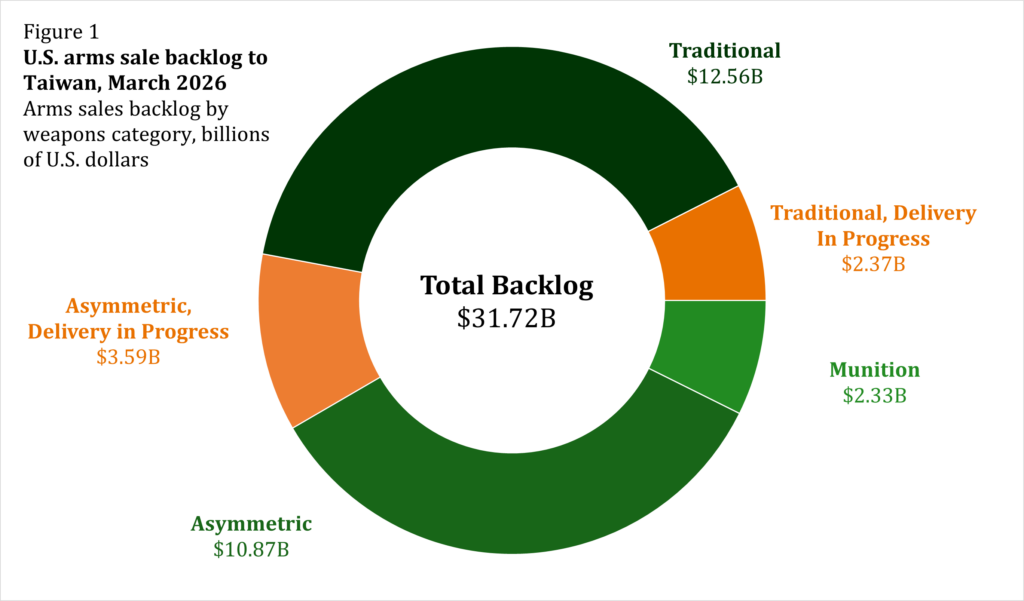
The delivery of ALTIUS drones brings the backlogโ€™s total value down slightly to $31.72 billion.  

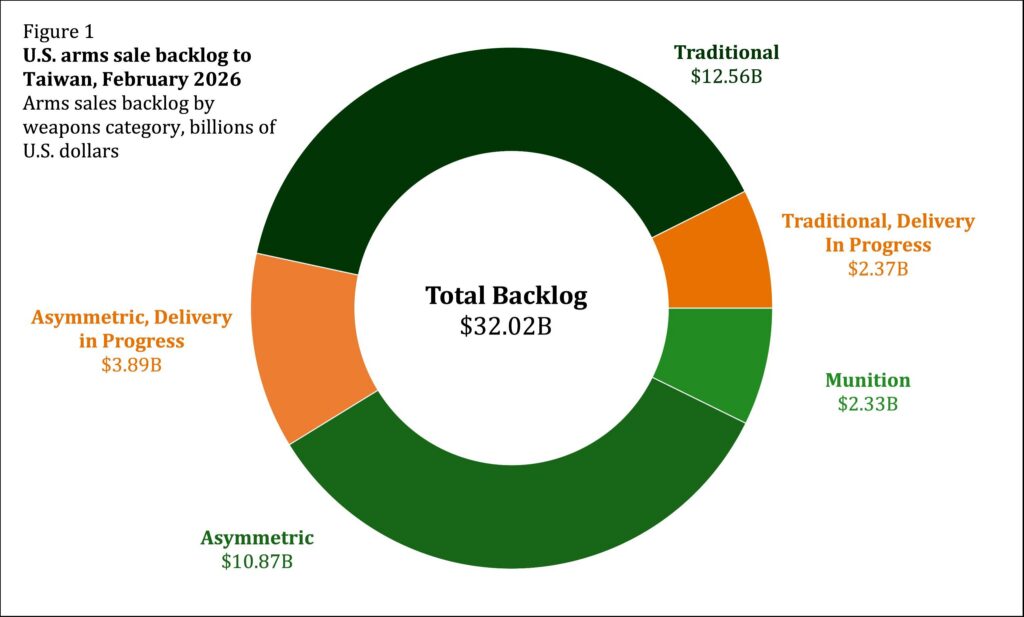
Figure 1 illustrates the breakdown of the backlog between asymmetric weapons, traditional weapons, and munitions. Table 1 provides an itemized list of all arms sales in the backlog, including the most up-to-date information on their status.ย In that table, arms sales that have been partially but not fully delivered are indicated in italics. New and completed arms sales are indicated with bolding and underlining.ย ย 

Special Budget Updates in March 

On March 5, the Kuomintang (KMT) released their proposal for US$12.02 billion (NT$380 billion) in spending, to fund only the arms approved in December 2025. This proposal required that Letters of Offer and Acceptance (LOAs) be approved before funds are appropriated, instead of having funds in advance. The KMTโ€™s proposal also required that funds for future arms sales from the US be approved as a second bill, instead of the Lai administration or Taiwan Peopleโ€™s Party (TPP) proposals, which allocate funds for future arms purchases. 

Following its release, Minister of National Defense Wellington Koo and statements carried by the Military News Agency (MNA) pushed back against the proposal, arguing that its sunset provision of December 2028 is incompatible with current delivery timelines and unrealistic. The MND also clarified in a statement that three sales announced in December, including the Taiwan Tactical Network, as well as AH-1W spare parts and Harpoon missile refurbishment, were not included within the administrationโ€™s NT$1.25 trillion special budget request, instead being folded under annual defense spending. 

Table 1
Itemized list of backlogged capabilities by weapons category, March 2026
Capability SoldDollar Value (In Millions)Share of total backlog, March 2026Current Status as of March 2026
Traditional$14,92746.60%
F-16C/D Block 70$8,00025.00%March 2026: Taiwanese officials attended an Acceptance Check Flight in the U.S. for the first F-16 airframe. Minister Koo also stated to press that the first F-16 could arrive as early as September 2026.
Paladin Self-Propelled Howitzer$4,03012.60%March 2026: MND officials warned that Letter of Offer and Acceptance for Paladins, as well as three other sales, would expire at end of month if not signed. LY agreed to allow signature of LOAs before special defense budget is approved.
M1A2T Abrams Tanks$2,0006.20%March 2026: MND officials stated that the final batch of 28 Abrams are โ€œat seaโ€ enroute to Taiwan. Further statements indicated delivery either at the end of March or in April. As of the end of March, TSM cannot independently verify delivery.
F-16 IRST Systems$5001.60%December 2025: US DoD awarded an undefinitized contract action to Lockheed Martin for targeting pods, including 55 IRST pods for Taiwan. Work is expected to complete by June 2031.
MS-110 Recce Pods$3671.10%February 2026: Three MS-110 pods expected to arrive by the end of 2026. This may fulfill the FMS case, but getting accurate, consistent numbers on MS-110 delivery has been challenging.
MK 75 76mm Gun Mounts$300.10%No information since posting of Congressional notification.
Asymmetric$14,76346.10%
HIMARS (Announced December 2025)$4,05012.60%March 2026: MND officials warned that Letter of Offer and Acceptance for HIMARS, as well as three other sales, would expire at end of month if not signed. LY agreed to allow signature of LOAs before special defense budget is approved. MND officials also warned that initial payment for HIMARS would be due, but agreements with U.S. officials resulted in an extension.
Harpoon Coastal Defense System$2,3707.40%March 2026: U.S. DSCA Director Michael Miller confirmed in a House hearing that Taiwan has priority for delivery of HCDS over Saudi Arabia.
National Advanced Surface-to-Surface Air Missile System (NASAMS)$1,1603.60%February 2026: Press reports citing MND sources repeated earlier reporting that Taiwan plans on purchasing 9 additional NASAMS systems and associated missiles. This appears to be one of the arms sales cases being held up by special procurement budget deadlock in the LY.
ALTIUS (Announced December 2025)$1,1003.40%January 2026: MND reported that it would purchase 1,554 ALTIUS-700M loitering munitions and 478 ALTIUS-600M ISR drones. The FMS notification did not specify the number of drones being purchased.
Tactical Mission Network$1,0103.20%January 2026: LY votes to move a special procurement budget proposed by the TPP to committee for consideration. The bill would not fund the Tactical Mission Network, but would fund almost all other FMS cases notified to Congress in December 2025.
PAC-3 MSE Interceptors$8822.80%March 2026: MND officials stated that ongoing delivery of 102 MSE missiles should not be affected by conflict in the Middle East.
AN/TPS-77 and AN/TPS-78 Radar Systems$8282.60%September 2025: Taiwanese press report citing 2026 budget request says that all radar systems will be delivered by the end of 2028. TPS-77s scheduled to begin arriving in 2026; TPS-78s to begin arriving in 2027.
MQ-9B Unmanned Aircraft$6001.90%March 2026: Taiwanese officials attended a โ€œhandoverโ€ ceremony in the U.S. for two of the expected four drones, clarifying that they expect to remain for further testing. LY testimony from MND officials also clarified that delivery is expected by the third quarter of 2026 and should not be delayed by ongoing conflict in the Middle East.
HIMARS (Announced December 2022)$5201.60%February 2026: Press reports citing MND sources indicate that 18 launchers, 20 ATACMS, and 864 GMLRS are expected to arrive before the fourth quarter of 2026. This is consistent with previously reported delivery timelines.
Javelin Missiles$3751.20%March 2026: MND officials warned that Letter of Offer and Acceptance for Javelins, as well as three other sales, would expire at end of month if not signed. LY agreed to allow signature of LOAs before special defense budget is approved.
Air-Launched Harpoon Missiles$3551.10%January 2023: Press report indicates that missiles will be delivered by 2030.
TOW Missiles$3531.10%March 2026: MND officials warned that Letter of Offer and Acceptance for TOWs, as well as three other sales, would expire at end of month if not signed. LY agrees to allow signature of LOAs before special defense budget is approved.
ALTIUS (Announced June 2024)$3000.90%March 2026: MND confirms receipt of all 291 ALTIUS-600M UAVs.
Field Information Communications System$2800.90%May 2025: Budget unfreezing report by MND indicates that testing of the system concluded in early 2025. The first batch of equipment is expected in the fourth quarter of 2025.
C4 Modernization$2650.80%No information since posting of Congressional notification.
Volcano Anti-Tank Mining System$1800.60%February 2026: Press reports citing MND sources indicate delivery of 14 Volcano systems will occur “soon.” This is consistent with previously reported delivery timelines.
Taiwan Advanced Tactical Data Link System Upgrade$750.20%August 2024: Taiwan’s E-Procurement System announced the award of a contract for the Link-16 system with completion date in 2026.
Switchblade 300 Loitering Missile System$600.20%September 2025: Taiwanese press reported details of delivery schedule: 66 drones already delivered to Military Police Command; 150 drones expected to be delivered to ROC Army by end of 2025, 469 drones by the end of 2026.
Munitions$2,3297.30%
AGM-84H SLAM-ER Missile$1,0083.10%December 2025: Taiwanese press report citing a publication by the LY’s budget office indicates a multi-year delay in finalizing details on cost and delivery schedule for AGM-84 missiles. Press report suggests that there is no finalized Letter of Offer and Acceptance (LOA) for this case, which would lay out a payment and delivery schedule.
F-16 Munitions$6191.90%July 2025: US DoD awarded Raytheon a $3.5 billion contract for Lots 39 and 40 of AMRAAM production, to be completed in 2031. Taiwan is one of many FMS customers and specific delivery timeline is not clear.
Mk 48 Heavyweight Torpedoes (Announced June 2017)$2500.80%December 2025: MND report to LY on arms sale delivery status reiterates that Mk-48 is one of three delayed arms sales cases.
AGM-154C Joint Standoff Weapon$1860.60%December 2025: MND report to LY on arms sale delivery status reiterates that AGM-154C is one of three delayed arms sales cases.
Mk 48 Heavyweight Torpedoes (Announced May 2020)$1800.60%December 2025: MND report to LY on arms sale delivery status reiterates that Mk-48 is one of three delayed arms sales cases.
AIM-9X Block II Missiles$860.30%March 2024: SIPRI annual update indicates delivery is expected to occur by 2030.

On March 25, the Legislative Yuanโ€™s Foreign Affairs and National Defense Committee began a two-day markup period of the three budget proposals, aiming to combine them into one bill. Committee members reached consensus on several provisions, including those relating to procurement planning, taken from the KMT proposal, as well as legal authorities, but crucially failed to reach consensus on provisions relating to the topline budget amount and specific procurement items. In the hearing, opposition legislators questioned the governmentโ€™s proposed spending categories, concerned that they were vague or classified. By law, the special budget entered a โ€œfreezeโ€ to allow for further negotiation, which is expected to go into April. Discussed below, these repeated delays and lack of consensus, while somewhat productive in challenging Lai administration policy, have also had negative knock-on effects, resulting in delayed or extended payments for several arms sales. 

March also featured several statements from Taiwanese officials on the status of the special budget. On March 8, President Lai, speaking at a temple in New Taipei, stated his administrationโ€™s budget was reasonable and compared it to a security system against a โ€œbad neighbor.โ€ On March 28, Premier Cho Jung-tai urged opposition parties to perceive the need for national defense and the nationโ€™s requirements, after a markup hearing in which General Huang Wen-chi, head of the MNDโ€™s Strategic Planning Department, was visibly upset. The same day, Vice President Hsiao Bi-khim echoed the same sentiments, speaking at the 2026 Taiwan Civil Defense Annual Conference and noting that the administrationโ€™s budget seeks to improve โ€œwhole-of-society resilience.โ€ 

American officials also weighed in. On March 9, a State Department spokesperson stated that Washington โ€œencourage[s] all parties in Taiwanโ€™s legislature to work through political differences and quickly pass a special defense budget,โ€ specifically addressing whether the United States would support a KMT proposal. On March 26, Director of the American Institute in Taiwan, Raymond Greene, also urged the LY to pass a budget, calling U.S. support for it โ€œrock solid.โ€ 

December Cases Face LOA and Payment Extensions, Possible Delays  

Taipei spent most of March trying to prevent a procedural problem from becoming a delivery problem. In early February, the Ministry of National Defense warned that the LOAs for TOW anti-armor missiles, Javelin anti-armor missiles, and M109A7 self-propelled howitzers would expire on March 15 unless the Legislative Yuan acted. Following this, the LY moved on March 12โ€“13 to authorize the Executive Yuan to sign four U.S. LOAs, adding HIMARS to the original three cases.  While a crucial step, as it prevented the deals from stalling at the signature stage, it did not fully solve the larger problem. In the FMS process, an LOA must be signed and an initial payment made before the U.S. procurement agency can enter into an agreement with the defense industry to build the weapons. Clearing the LOA signature step is a move in the right direction, but Taiwanโ€™s special procurement budget impasse means that it cannot make an initial payment, which means delays in finalizing production contracts.   

On March 26, Liberty Times reported that the initial payment deadline for HIMARS was approaching and that U.S. officials had indicated there was little room for delay, with Taiwanese officials warning that missing the current deadline could push negotiations for a new LOA back to the end of the year. Four days later, CNA reported that the United States had agreed to extend the HIMARS first-payment deadline with a revised timeline tied to the U.S. Department of Defenseโ€™s contract negotiations with Lockheed Martin, the systemโ€™s manufacturer. Taiwan is still seeking similar flexibility for the TOW, Javelin, and M109A7 cases.  

Updates to Abrams, ALTIUS Deliveries 

On March 10, MND officials reported that the final tranche of 28 M1A2T Abrams tanks is โ€œat sea,โ€ en route to Taiwan, however we were unable to verify delivery of the tanks before the end of March.. 80 of the 108 tanks have already arrived, including 38 delivered in December 2024 and 42 delivered in July 2025. Once delivered, this tranche will mark the last of 108 Abrams that Taiwan began procuring in July 2019. From a procurement perspective, the Abrams case is a useful execution benchmark inside the broader U.S.โ€“Taiwan pipeline. Taiwan Security Monitorโ€™s backlog tracker has identified Abrams as one of the smoother Foreign Military Sales deliveries. Final delivery of the Abrams would reduce the backlog by $2 billion, a sizable decrease.  

As of March 18, the Taiwanese military has officially received all ALTIUS-600M UAVs purchased from the United States and defense contractor Anduril. Announced on June 18, 2024, the first batch of ALTIUS-600M drones was delivered to Taiwan on August 4, 2025, a turn-around time between approval and initial delivery of less than 14 months. With this last delivery, the Taiwanese military now has up to 291 ALTIUS systems, costing approximately NT$9.6 billion (US$300 million). A second sale, announced in December, of 1,554 ALTIUS 700M and 478 ALTIUS 600M ISR drones, is currently in progress, and is also expected to be completed quickly. 

F-16 Block 70 and MQ-9B Production Updates 

As of March 21, the first Taiwanese F-16 Block 70 has completed its Acceptance Check Flight at Lockheed Martin facilities in Greenville, South Carolina. These tests were attended by several Taiwanese officials, including Deputy Minister of National Defense Hsu Szu-chien, Deputy Air Force Chief of Staff General Tian Zhongyi, and the Taiwanese Representative to the United States, Alexander Yui. An MND press release after the visit stated that this success means Lockheed will begin its deliveries to Taiwan. On the same day, the MND also confirmed that several Taiwanese officials attended a handover ceremony in the United States for two of the four MQ-9B SeaGuardian maritime surveillance drones purchased for NT$21.7 billion (US$674.02 million). However, the MND clarified that the two drones would stay in the United States for continued testingwith delivery to Taiwan expected in the third quarter of this year. 

Minister of National Defense Wellington Koo also stated in a recent press conference that the first two MQ-9B SeaGuardians are expected to be delivered by the third quarter of the year and that the first F-16 Block 70 could arrive as early as September 2026. He has also clarified that the United States’ ongoing conflict in the Middle East has no effect on delivery timelines to Taiwan. 

Conclusion

Taken together, Marchโ€™s developments show a backlog that is still slowly moving in the right direction, but with growing signs that Taiwanโ€™s main bottleneck is no longer only United Statesโ€™  production capacity. The completion of ALTIUS deliveries, the near-finish of the Abrams case, and visible progress on the F-16 Block 70 and MQ-9B programs are welcome developments. At the same time, repeated delays in passing a special defense budget, uncertainty over LOA follow-through and initial payments, and the need to seek deadline extensions from Washington indicate that domestic political and procedural friction in Taiwan are increasingly shaping the pace of FMS execution.  
Architecture Over Arsenal: What Link-22 Would Mean for Taiwanโ€™s Defenseย 

Author: Shikhar Chaturvedi & Kiran Khalifaย 

Testing the Network: Taiwanโ€™s Command-and-Control Challengeย 

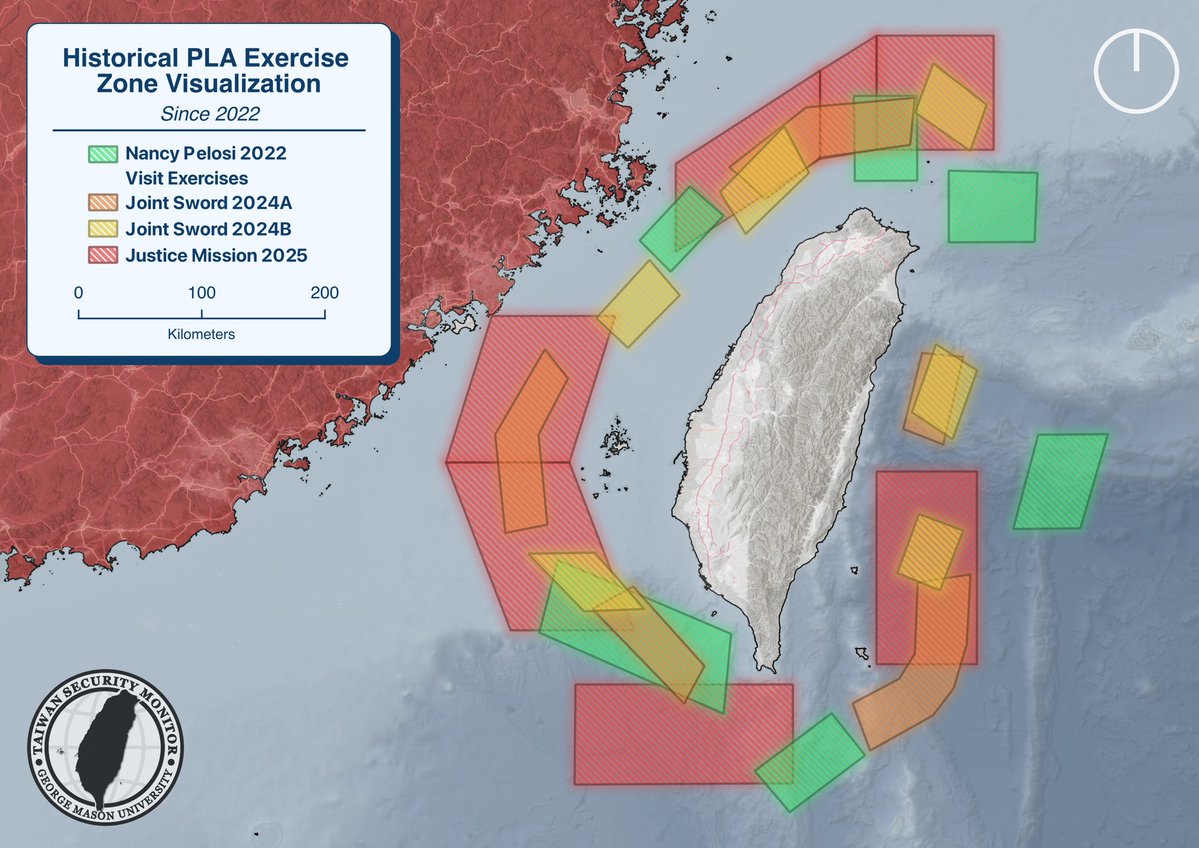
During the โ€œJoint Swordโ€ exercises in late 2024, the Peopleโ€™s Liberation Army (PLA) tested Taiwanโ€™s ability to maintain command and control (C2) under a total blockade. Modern Militariesโ€™ C2 architecture relies on Tactical Data Links (TDLs) to allow radars, aircraft, ships, and missile units to share information and coordinate action in real time. The drills highlighted a key weakness in Taiwanโ€™s aging C2 architecture and current TDLs. Taiwanโ€™s Syun An Link-16 & Link-11 remain largely horizon-limited in a battlespace that would not be. Since then, amid continued pressure such as โ€œJustice Mission-2025โ€ and the ever-present risk of communications paralysis in a crisis, Taiwan has begun a quiet but consequential shift in how it approaches defense. 

(Source: TSM, Exercise zones from the post-2022 Pelosi visit to Justice Mission 2025) 

At the center of that shift is Link-22, a NATO-developed tactical data link (TDL) designed to function as the connective tissue of a modern force. It allows ships, aircraft, and ground units to exchange information across greater distances and under degraded conditions. While the procurement of fighter jets and tanks dominates headlines, their effectiveness is determined by whether those platforms can see, talk, and coordinate under stress. Link-22โ€™s secure, Beyond Line-of-Sight (BLOS) architecture is meant to keep that network alive, linking the โ€œbrainโ€ of Taiwanโ€™s C6ISR (Command, Control, Communications, Computers, Cyber, Combat Systems, Intelligence, Surveillance, and Reconnaissance) with the missile batteries and naval assets that would execute a response. As Taiwan advances its US$40 billion special defense proposal, stands on the cusp of a new U.S. security package, and continues work on projects like โ€œT-Dome,โ€ the potential inclusion of Link-22 underscores a broader shift toward decentralized, multi-domain defense.  

While Taiwan has not formally adopted Link-22, recent U.S. planning support for tactical data link upgrades suggests that Washington and Taipei may be laying the groundwork for a future transition. If eventually funded and fielded, Link-22 will complement Taiwanโ€™s broader T-Dome defense initiative, blunt Chinaโ€™s ability to disrupt command-and-control, and signal deeper U.S.โ€“Taiwan and coalition-oriented interoperability. 

The Architecture of Resilience: The Link-22 Edgeย 

Tactical data links (TDLs) are a key enabler for modern military organizations/operations. They create a secure, high-speed network that allows warships, aircraft, and ground units to automatically exchange real-time radar data, targeting coordinates, and identification information. By feeding sensor data from every participant into a unified network, TDLs create a Common Operational Picture. This shared operational picture can significantly improve situational awareness across the battlespace, but in practice, it remains complex, bandwidth-constrained, and dependent on operator training and system integration. 

Link-22 represents the latest evolution of this technology, developed under the NATO Improved Link Eleven program. Formed by a consortium of seven nations (the U.S., UK, France, Germany, Italy, Canada, and Spain), the system was engineered to overcome the obsolescence of the 1950s-era Link-11 while complementing the widely used Link-16. Its operational maturity was underscored during 2024โ€™s Rim of the Pacific (RIMPAC) naval exercise, where it successfully connected ten diverse platforms from seven nations; today, 26 countries have adopted the technology.  

(Source: NATO Improved Link Eleven Project Management Office) 

Beyond the Horizon: The Three Strategic Breakthroughs of Link-22ย 

For Taiwan, the transition to Link-22 provides three operational / tactical advances:  

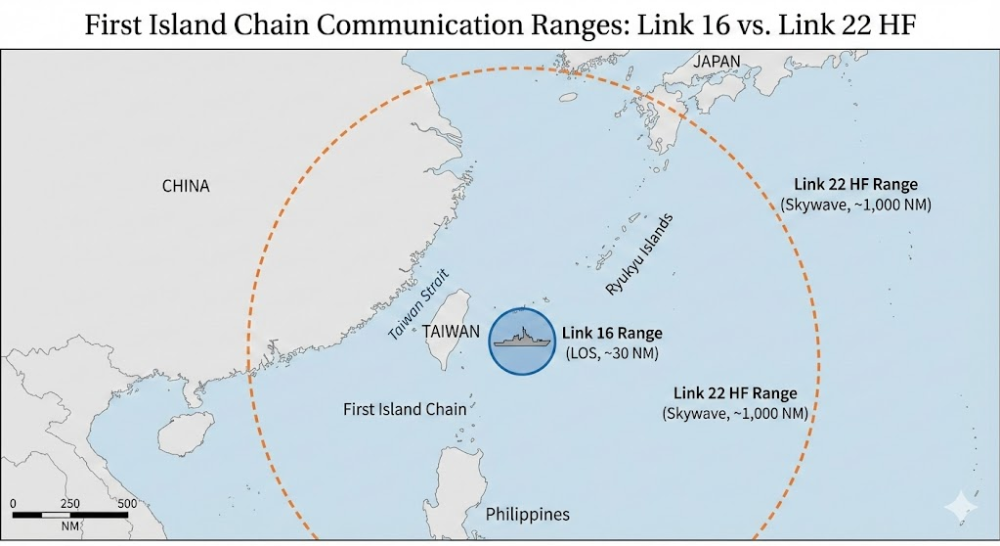
(1.) โ€œBeyond-Horizon Connectivityโ€ Without Satellites: Standard Link-16 systems rely on Ultra High Frequency (UHF) radio bands, which transmit primarily along line-of-sight paths. Because UHF signals travel in straight lines and are limited by the curvature of the Earth, ship-to-ship communication is typically restricted to roughly 25 to 35 nautical miles without relays. Link-22 adds a powerful High Frequency (HF) band, which reflects off the ionosphere and enables secure data transfers across distances exceeding 1,000 nautical miles. Crucially, this provides Beyond Line-of-Sight (BLOS) coordination without relying on satellites. In a conflict where space-based communications are jammed or disabled, Link-22 helps ensure that Taiwanโ€™s forces remain connected across the Strait and the wider Western Pacific. 

(Source: TSM, Kiran Khalifa & Shikhar Chaturvedi) 

 
Link-22 Comparison with Legacy Architecture 

Feature Link 11 Link 16 Link 22 
Frequency UF / UHF UHF (960-1215 MHz)  HF and UHF 
Range 300-1000 NM (HF) 25-35 NM (ship to ship)  Up to 1,000 NM 
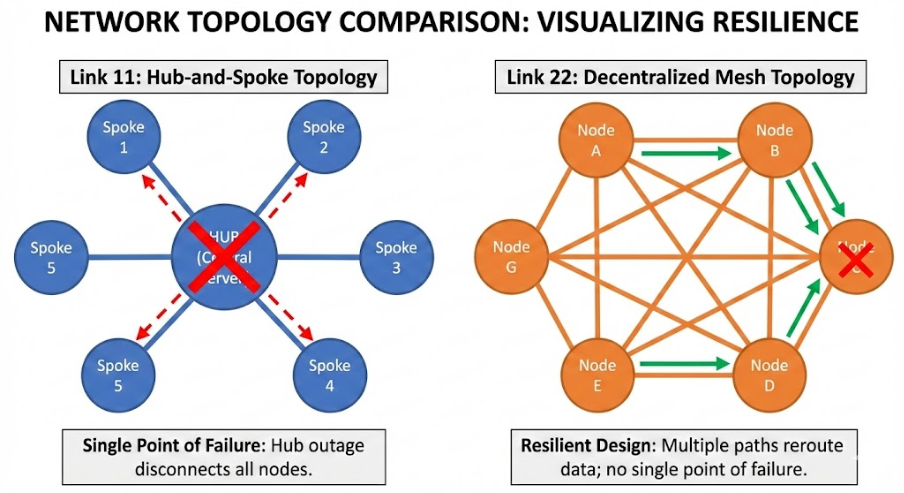
Single point of failure Yes No No 
Data rate 1,090 bps (HF) Up to 107,520 bps 4,053 bps (HF) / 12,666 (UHF)  
Jam resistance Poor Strong Strong (dual-band hopping, ECCM)  
Max participants 61 125+ 125 per Super Network 
Link 16 compatibility  None  Full  

Source: Comparison adapted from ROC Naval Academic Bimonthly; Northrop Grumman Link 22 System Guidebook, 4th Edition. 

(2.) Decentralized Survivability: The legacy Link-11 architecture relied on a controlling station which, if disabled or destroyed, would cause the entire network to collapse. Link-22 replaces this structure with a decentralized architecture built around Dynamic Time Division Multiple Access (DTDMA). The DTDMA system allows communication across the network without relying on a single controller, eliminating a central point of failure. If a participant of the DTDMA system is lost to a strike, the network automatically reconfigures through the remaining participants, allowing information to continue flowing even under sustained attack. 

(Source: TSM, Shikhar Chaturvedi & Kiran Khalifa) 

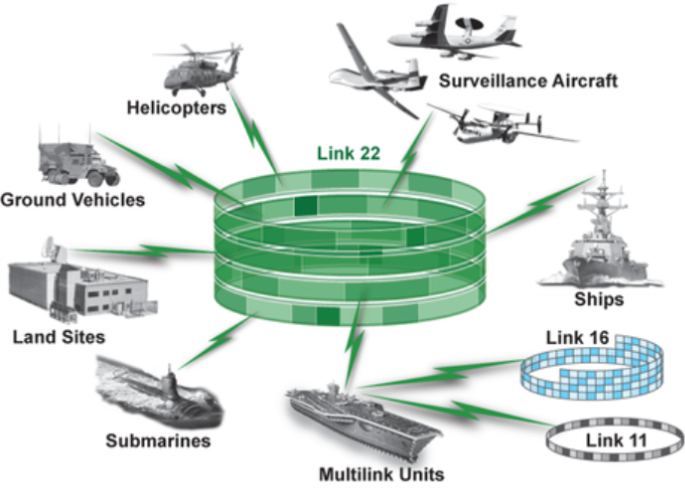
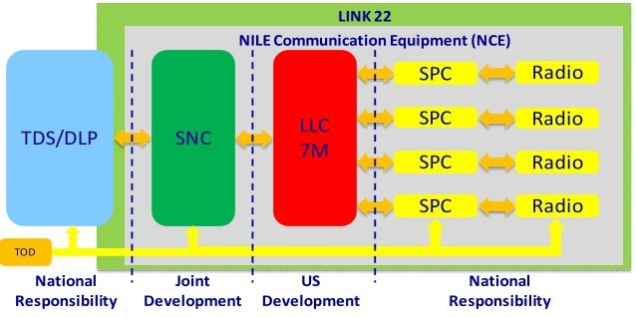
(3.) Seamless Architectural Integration: Link-22 was designed to function as an extension of existing networks rather than a total replacement. It shares compatible message standards with Link-16, creating what operators describe as a โ€œnetwork of networks.โ€ For Taiwanโ€™s military, this allows Link-22 to plug directly into the Link-11’s legacy architecture. Its integration enhances battlefield intelligence sharing without requiring a wholesale replacement of Taiwanโ€™s existing hardware infrastructure. 

(Source: NILE, Link 22 System with NILE Communication Equipment) 

ย 

Understanding these Strategic Breakthroughs

ย ย 
Onย February 2024ย the State Department approved a US$75 million sale for โ€œAdvanced Tactical Data Link System Upgrade Planningโ€ย to Taiwan, providing the essentialย frameworkย required to bridge critical gaps in Taiwanโ€™s aging Syun An (Link-16) system. This structural groundwork was accelerated inย December 2024 by a US$265 million saleย of 309 Multifunctional Information Distribution System Joint Tactical Radio System (MIDS JTRS) Variant 5 terminals.ย These high-assurance hardware components ensure theย secure flow of tactical informationย across Taiwanโ€™s Patriot batteries, F-16 Block 20 jets, and E-2K platforms.ย ย 

A future Link-22 transfer would also carry political significance. More than a routine sustainment package, it would suggest deeper U.S. support for Taiwanโ€™s transition toward a more resilient and interoperable command-and-control architecture. Because Link-22 is a NATO-exclusive technology, U.S. assistance in its transfer effectively solidifies Taiwanโ€™s status as a โ€œquasi-major non-NATO allyโ€ extending Taiwan’s defense beyond a bilateral U.S. agreement. 

Yet the strategic value of Link-22 should not be overstated. Its benefits depend on the survival of the platforms and nodes carrying it, including ships,ย aircraft, and air-defense systems that wouldย likely beย priority targets in the opening phase of a cross-Strait conflict. In that sense, Link-22 does notย eliminateย Taiwanโ€™s vulnerability so much as reduce the risk of communications collapse among the forces thatย remain. It also raises a broader strategic tradeoff: strengthening a network built around high-end platforms improves resilience and coalition interoperability, but it does not by itself resolve the larger debate over whether Taiwan should continue investing in systems tied to conventional naval and air operations rather than pushing further toward a more asymmetric force design.ย 
ย 

Networking and Deterrence:ย Link-22 in PLA Calculusย 

Chinaโ€™s reaction to Taiwanโ€™s data link modernization has differed noticeably from its routine objections to conventional arms sales. When PLA-affiliated commentators and Chinese officials responded to reporting on a potential Link-22 transfer, the focus was not on individual hardware platforms but on โ€œstructural integrationโ€. Chinese military expert Song Zhongping argued in the Global Times that while sales of 76 mm autocannons and Link-11 upgrades only serve to “sustain” existing combat capabilities, acquiring Link-22 crosses a strategic threshold by placing Taiwan โ€œunder the U.S. combat command structure.โ€ A March 2024 Tencent News analysis went further, labeling it โ€œthe most dangerous arms sale to Taiwan to date.โ€ The consistent theme across Chinese commentary is that Link-22 enables encrypted, real-time coordination that effectively embeds the islandโ€™s defense within a broader, U.S.-led operational network. 

Chinese analysis draws a clear distinction between Link-16 sustainment and Link-22 acquisition and ultimately reflects Beijingโ€™s concern of the “remote control” effect. Chinese experts warn that Link-22’s integration allows the U.S. to monitor Taiwanโ€™s front-line intelligence from 1,800 kilometers away and potentially directly control Taiwanese missile launchers and air defense platforms during a conflict. From Beijingโ€™s perspective, Link-22 acts as a “nerve center” that connects the islandโ€™s “flesh and bones” (like HIMARS and PAC-3 MSE missiles) to a U.S.-controlled “brain.”  

Beijingโ€™s concern also stems from its own priorities in information dominance. The PLA has invested heavily in electronic warfare and link systems like the XS-3 and DTS-03 to maintain a tactical edge. The 2024 restructuring of the PLAโ€™s Strategic Support Force into the Information Support Force underscored a recognition that network resilience is the center of gravity in high-intensity conflict. The coalition dimension further amplifies Beijing’s calculus. As a NATO-exclusive standard, Link-22 extends Taiwan’s defense beyond a bilateral U.S. agreement. From Beijingโ€™s perspective, the risk is a networked defense perimeter across the First Island Chain.  

Conclusionย 

Link-22 can strengthen the network architecture needed to better connect Taiwanโ€™s emerging missile, air-defense, and unmanned capabilities, improving coordination and enabling them to function more effectively as part of an integrated warfighting system. Still, it is best understood as a force multiplier, not a silver bullet. Its benefits depend on the survival of ships, aircraft, and air-defense nodes carrying it, many of which would likely be priority targets in the opening phase of a conflict. 

If funded and fielded, Link-22 will complement Taiwanโ€™s broader T-Dome initiative, complicate Chinaโ€™s ability to disrupt command-and-control through communication paralysis and potentially signal deeper U.S.โ€“Taiwan and coalition-oriented interoperability across the First Island Chain. But that same signal is precisely what makes the system politically sensitive: Beijing will almost certainly view it not as a routine technical upgrade, but as a step toward tighter wartime alignment between Taiwan and a broader U.S.-led regional network. 

Weekly Arms Update:ย 4/8/26ย 

Author: Joe Oโ€™Connor,ย Shikhar Chaturvedi, Danielle Kremer, and Wyeth Lindbergย 


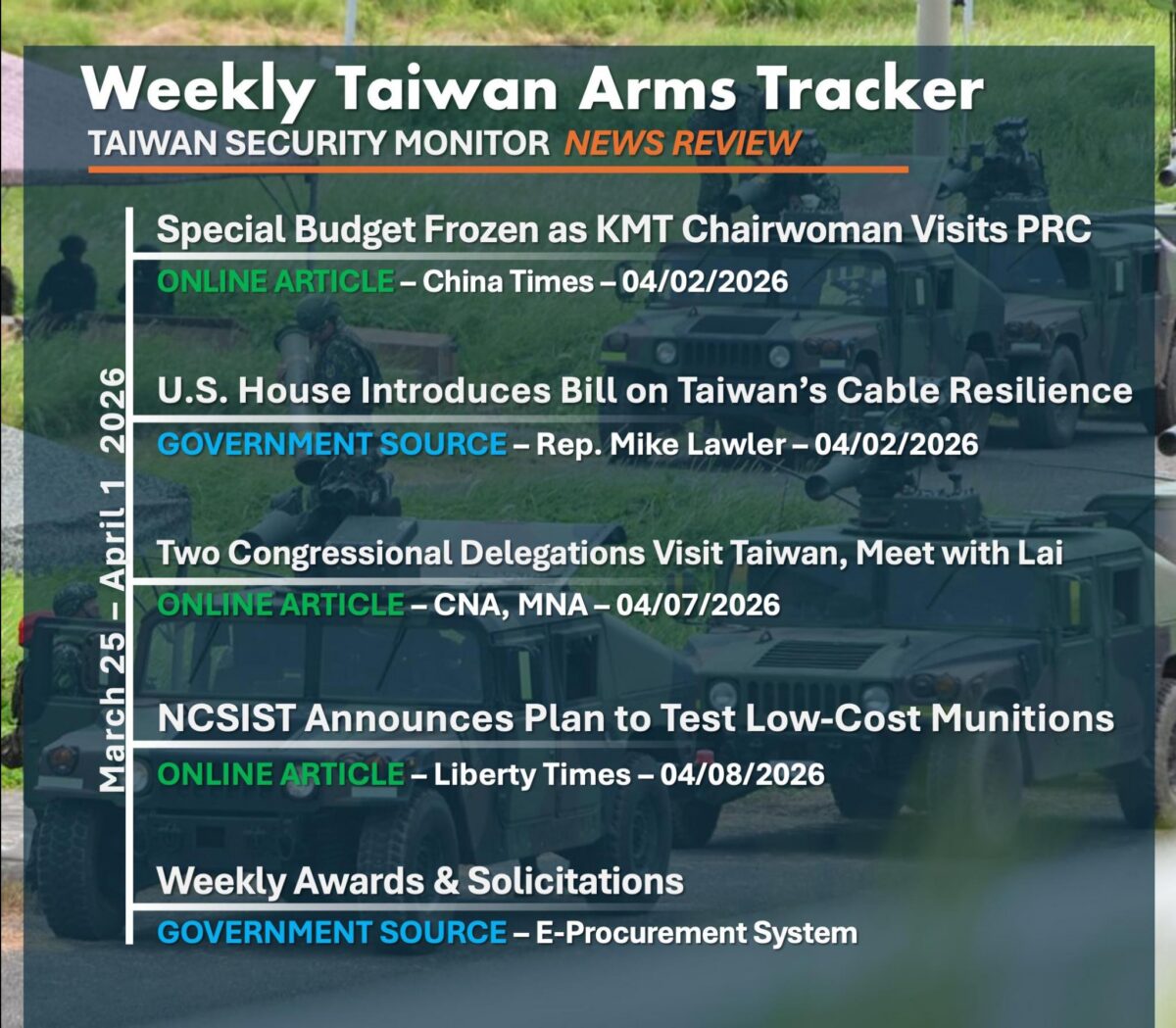
This week: the special budget remained frozen as the Kuomintangโ€™s chairwoman visits the PRC; the U.S. House introduced a bill on Taiwanโ€™s undersea cable resilience; two congressional delegations arrived in Taiwan for visits with officials; and NCSIST announced a plan to test low-cost ammunition prototypes, alongside weekly awards and solicitations. 

Special Budget Frozen as KMT Chairwoman Visits PRC 

Progress on special budget negotiations continued to be frozen this week, as KMT Chairwoman Cheng Li-wun began leading a delegation to the PRC. On April 2, the Legislative Yuanโ€™s Foreign Affairs and National Defense Committee convener, DPP legislator Chen Kuan-ting, reported that KMT members had requested negotiations be delayed until April 15-16. Chen, who had already delayed negotiations until April 9, stated that the DPP caucus does not intend to change its current schedule and will continue with negotiations on the planned date.  

DPP legislators criticized KMT counterparts upon hearing of this, with one member, Lin Chu-yin, accusing them of deliberately waiting until after Chengโ€™s visit and accusing them of trying to delay. Chen, however, attempted to appeal to younger KMT members, who have generally been more supportive of the Lai administrationโ€™s proposal than some of their other party members. As of the time of writing, it is assumed that negotiations will continue Thursday. 

U.S. House Introduces Bill on Taiwanโ€™s Cable Resilience  

 
On April 2, U.S. Representatives Mike Lawler (R-NY), Dave Min (D-CA), and Greg Stanton (D-AZ) introduced the House version of the Critical Undersea Infrastructure Resilience Initiative Act. Designed to address many of the concerns in the South China Sea, this bill prioritizes establishing advanced monitoring to detect disruptions in real time, strengthening early warning through global intelligence sharing, establishing rapid-response protocols, and expanding coordination to boost resilience. The legislation would also support joint patrols with the U.S. and Taiwanese Coast Guard in the area, as well as the creation of a Cross-Strait Contingency Planning Group to identify vulnerabilities and develop contingency plans. The bill would require the U.S. to pressure China to follow international norms and impose sanctions on those responsible for sabotaging critical undersea systems affecting Taiwan and allies. It is currently in its second stage, waiting to be passed by the United States Senate.  

Two U.S. Congressional Delegations Visit Taiwan, Meet with Lai 

Following a bipartisan congressional delegation that visited Taiwan at the end of March, two more U.S. legislative delegations arrived in Taiwan this week to meet with government officials. A group of four House members from the Republican Study Committee, consisting of Reps. Zach Nunn (R-IA), Scott Fitzgerald (R-WI), Julie Fedorchak (R-ND), and Jefferson Shreve (R-IN), arrived in Taipei on Sunday, April 5, and are expected to remain until Saturday, April 11. On Tuesday, the delegation attended a Taiwan-U.S. forum on economics and trade, alongside Maryland Secretary of State Susan C. Lee, where the representatives discussed tariffs, trade policy, and investment. On Tuesday, the delegation also met President Lai, who they presented with a congressional record of recognition; and met Minister of National Defense Wellington Koo at MND headquarters, discussing โ€œgray-zoneโ€ issues with Taiwan. 

A separate, simultaneous visit by U.S. Senator Jim Banks (R-IN), also began Tuesday, where the lawmaker met with President Lai, Legislative Yuan President Han Kuo-yu, and Minister of National Defense Wellington Koo. Banksโ€™ meeting with Lai centered around support for Taiwan and ongoing special budget negotiations, with the senator expressing hope that a budget will be passed soon and comparing Taiwanโ€™s special spending to President Trumpโ€™s plans for a US$1.5 trillion defense budget. At the LY, Banks met with President Han Kuo-yu, as well as members from all three political parties in the legislature, and further discussed ways to build consensus in passing the special defense budget. A later meeting with Minister of National Defense Wellington Koo at MND headquarters also reinforced this point, also discussing the U.S. congressional notification procedure for arms sales. In the evening, Banksโ€™ delegation attended a banquet at the Ministry of Foreign Affairs, hosted by Deputy Minister Chen Ming-chi, where the delegation reiterated earlier remarks made, and noted that this visit corresponds with the 47th anniversary of the Taiwan Relations Act, marking an auspicious moment for U.S.-Taiwan affairs. 

NCSIST Announces Plan to Test Low-Cost Munitions 

According to Liberty Times, the National Chung-Shan Institute of Science and Technology (NCSIST) has developed several types of “low-cost air defense munitions.โ€ One type is made to counter drone swarm attacks, and a second one is designed to defend against enemy missiles and long-range rocket attacks. So far, there has been no further information has been provided on either of the munitions.  Both are said to start planned combat testing later in the first half of next year. In addition to the two independently developed defense munitions, NCSIST has signed a contract with a Canadian manufacturer, AirShare, to develop “ribbon rocket systems.โ€ These systems use ribbons that catch enemy drones’ propellers, causing them to lose flight capability, then use a parachute to slow the droneโ€™s descent. The parachute reduces impact damage, specifically so the drone can be recovered intact for reverse engineering. This defense munition is also said to begin testing in the first half of next year. 

Weekly Awards/Solicitations  

On Thursday, the Armaments Bureau solicited bids for the purchase of road and electrical/mechanical engineering services in support of the Weihai project. The Wehai Project refers to the MNDโ€™s years-long project to renovate and upgrade Zuoying Naval Base. The contract is worth NT$5.30 billion (US$165.98 million)

Also on Thursday, the Army Command made a repeat solicitation of bids for official staff vehicles, worth NT$203.32 million (US$6.37 million)

On Wednesday, the Air Force Commandโ€™s Military Mission to the United States awarded a NT$88.76 million (US$2.79 million) contract to Integrated Procurement Technologies for the open-ended supply of aviation spare parts. Available evidence suggests that this contractor is providing spare parts for the F-CK-1 Ching-Kuo (otherwise known as the Indigenous Defense Fighter or IDF). 

Weekly Arms Update: 4/1/26

Author: Joe Oโ€™Connor, Shikhar Chaturvedi, Danielle Kremer, and Wyeth Lindberg


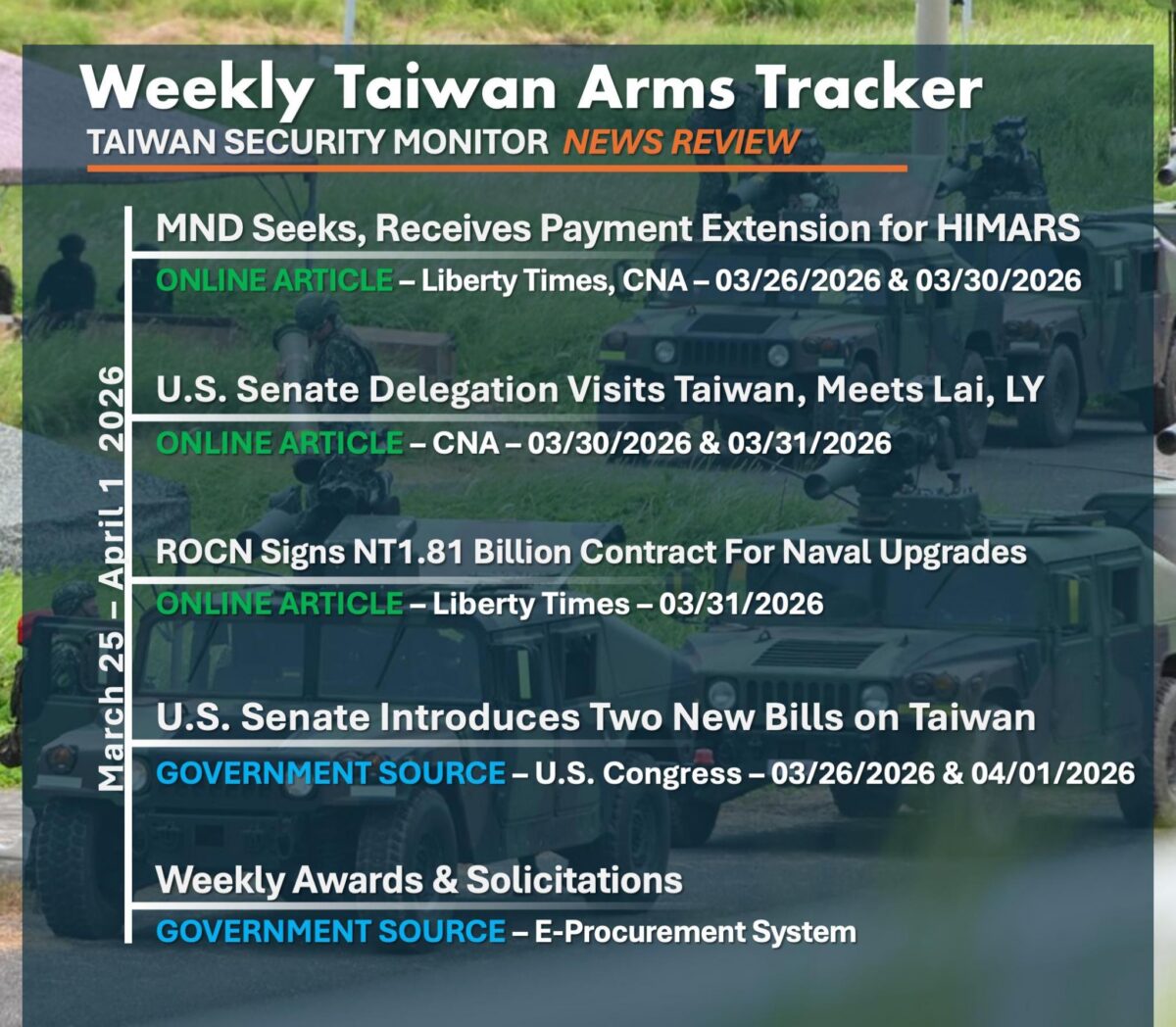
This week: the MND received a payment extension for the sale of HIMARS, a U.S. congressional delegation visited Taiwan to support ongoing budget negotiations, the ROCN signed a major upgrade contract with a French firm, and two Taiwan-related defense bills were introduced in the U.S. Senate, alongside weekly awards and solicitations.

MND Seeks, Receives Payment Extension for HIMARS

Taiwanโ€™s Ministry of National Defense said this week that the United States has agreed to defer the first payment deadline for 82 HIMARS launchers, giving Taipei temporary relief as the Legislative Yuan continues to debate the Lai administrationโ€™s NT$1.25 trillion special defense budget. According to Defense Minister Wellington Koo and MND officials, the HIMARS payment can now be pushed to around May, when Washington expects to complete contract negotiations with the supplier (Lockheed Martin), rather than the original March 30 deadline. Taiwan had already secured legislative authorization on March 13 to sign Letters of Offer and Acceptance for four U.S. arms sales packages worth roughly US$9 billion, but still lacked appropriated funds for the required down payments.

The HIMARS case nevertheless underscores how legislative delays are now affecting backlog management. Liberty Times reported on March 26 that MND officials had warned missing the HIMARS payment window could force Taiwan to wait until the end of the year for another contracting opportunity, and CNA now reports that MND is still trying to secure similar payment extensions for three additional systems: TOW missiles, Javelins, and M109A7 self-propelled howitzers. Together, the four initial payments total about US$79 million. For now, Taiwan has avoided a near-term disruption on HIMARS, but the episode shows how domestic budget gridlock can still complicate contracting timelines and add friction to efforts of moving delayed U.S. arms cases through the pipeline.

U.S. Senate Delegation Visits Taiwan, Meets Lai, LY

On Monday and Tuesday, a delegation of four U.S. Senators, led by Ranking Member of the Senate Foreign Relations Committee Jeanne Shaheen (D-NH), visited Taiwan on one leg of a trip around the Indo-Pacific. Shaheen, accompanied by Sens. Thom Tillis (R-NC), John Curtis (R-UT), and Jacky Rosen (D-NV), met with President Lai Ching-te and Minister of Foreign Affairs Lin Chia-lung, reaffirming support for Taiwanโ€™s defense and relations with the U.S. Before arriving, Sen. Curtis told the Financial Times that the visitโ€™s timing was linked to efforts in Taiwanโ€™s Legislative Yuan to pass a special defense budget, which has largely stalled in negotiations.

On Monday, the delegation also visited the National Chung-Shan Institute of Science and Technology (NCSIST), Taiwanโ€™s state-owned indigenous defense manufacturer, and viewed results of live-fire testing of the Mighty Hornet IV, a new attack drone jointly produced by NCSIST and US company Kratos that is a variant of the MQM-178 Firejet target drone.

On Tuesday, the delegation met with a bipartisan group of DPP and KMT Legislative Yuan members in a closed-door evening session. Per legislators Niu Hsu-ting (KMT) and Chen Kuan-ting (DPP), the delegations discussed ongoing arms procurement between the United States and Taiwan, as well as the current legislative process for the special defense budgets and how to build consensus among all parties. After this, the delegation departed Taipei, enroute to Japan.

ROCN Signs NT$1.81 Billion Contract for Naval Upgrades

On Tuesday, the Republic of China Navy (ROCN) signed a deal with Defense Conseil International (DCI) worth NT$1.81 billion (US$56.73 million) for technical support services as it begins upgrading its fleet of six Kang Ding-class frigates. DCI is Franceโ€™s state-owned operator for the exporting of military assistance to international partners, under the Ministry for the Armed Forces. Since the Kang Ding-class frigates are export models of Franceโ€™s own La Fayette-class frigates, their structural designs and parameters are protected by French patents.

Modifications include the installation of BAE Systemsโ€™ Type 997 Artisan radar and Safran S.A.โ€™s PASEO NS electro-optical fire control system, as well as installation of the indigenously produced Hua Yang vertical launch system (VLS), equipped with 32 TC-2N (Tien Chien II or Sky Sword II) air-to-air missiles, to replace older U.S. naval Sea Chaparral surface-to-air missiles. With the first upgraded ship being completed in February of this year, the contract will run for 5 years and 6 months and is expected to be completed by the end of 2031. This contract will ensure effective integration of Taiwanโ€™s domestically developed weapons with foreign-built platforms, avoiding any impact on shipsโ€™ operational or stealth performance.

U.S. Senate Introduces Two New Bills on Taiwan

On Thursday, Senators Michael Bennet (D-CO) and Pete Ricketts (R-NE) introduced the First Island Chain Deterrence Act, a measure requiring the U.S. Government Accountability Office (GAO) to issue a report to Congress on the status of major arms sales and if there are any delays affecting Japan, Taiwan, and the Philippines. The same report would assess the impacts of such delays, their effects on readiness in the region, and would be due within 18 months of the bill becoming law.

Today, Senators Jeff Merkley (D-OR), Ted Cruz (R-TX), Andy Kim (D-NJ), and John Curtis (R-UT), introduced the Blue Skies for Taiwan Act, which aims to support Taiwanโ€™s indigenous drone production industry. The measure specifically would establish a โ€œBlue UAS Working Group,โ€ which would assess Taiwanese industry and begin adding Taiwanese systems to the DODโ€™s secure โ€œBlue UASโ€ program, ensuring capabilities and components are โ€œPRC-independent.โ€ The bill, if passed, also directs the Pentagon and State Department to begin expedited certification processes for Taiwanese drone manufacturers.  

Weekly Awards/Solicitations

On Thursday, the Naval Command made a repeat solicitation of bids for transport trucks, worth NT$1.35 billion (US$42.13 million).

On Friday, the Military Medical Bureau solicited bids for the construction of the Radiation Oncology and Nuclear Medicine Center, worth NT$216.39 million (US$6.77 million).

On Tuesday, the Naval Command awarded Defense Conseil International a NT$1.81 billion (US$56.73 million) contract for naval technical support services. DCI is Franceโ€™s Ministry for the Armed Forces operator for the exporting of military assistance to international partners. The contract is to be fulfilled throughout the southern region of Taiwan.

On Wednesday, the Information and Communications Command made a repeat solicitation of bids for the licensing of cloud information services, worth NT$36.03 billion (US$1.13 billion).

Also on Wednesday, the Armaments Bureauโ€™s Production and Manufacturing Center, made a repeat solicitation of bids for night-vision detection equipment, worth NT$38.89 million (US$1.22 million).

Weekly Arms Update: 3/25/26

Author: Joseph Oโ€™Connor, Shikhar Chaturvedi, Danielle Kremer, & Wyeth Lindberg


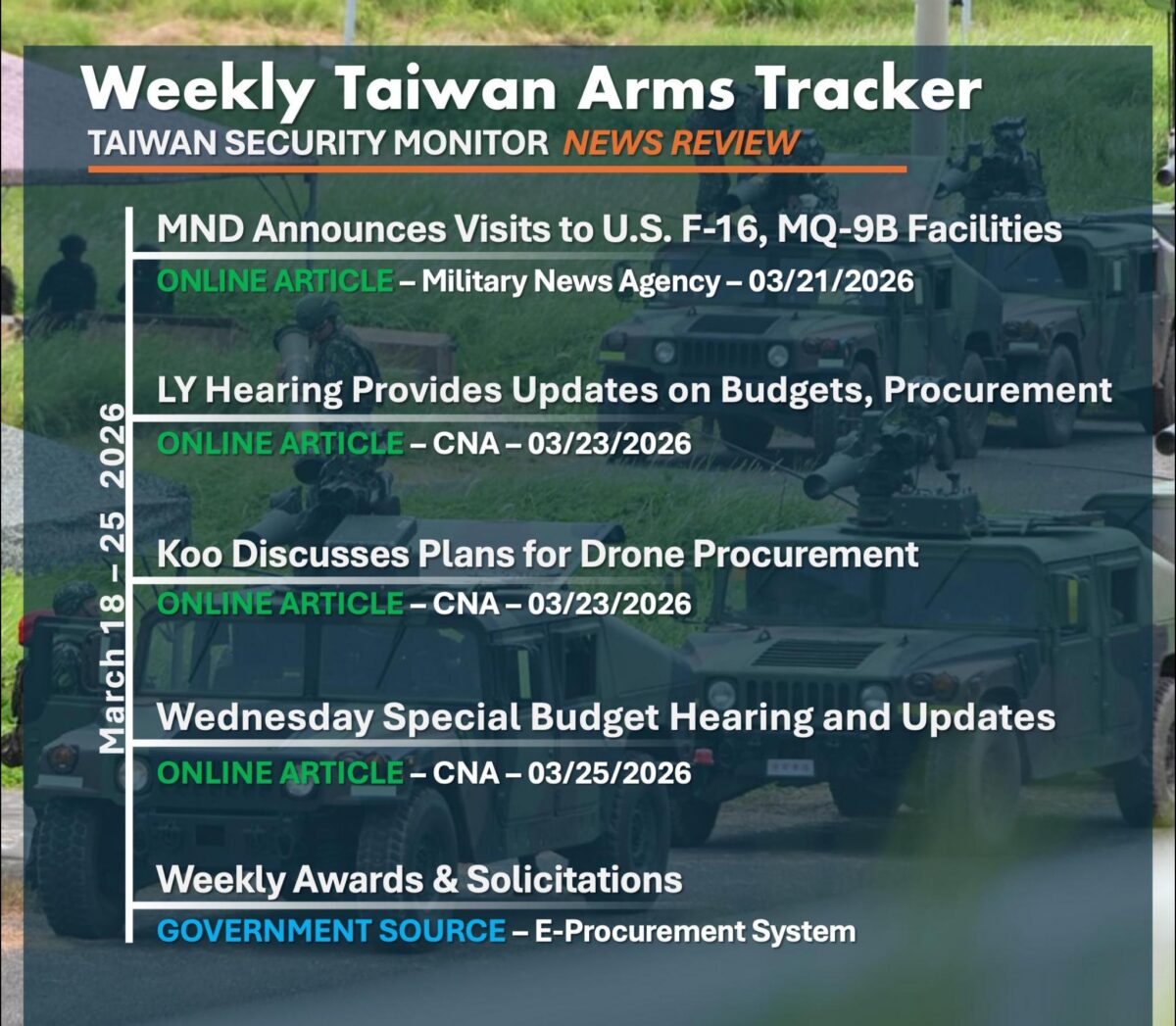
This week: the MND disclosed official visits to F-16 and MQ-9B production facilities, the Legislative Yuan began multiple days of hearings to consider the special defense budgets, and Minister Koo discussed plans for drone procurement, alongside weekly awards and solicitations.

MND Announces Visits to U.S. F-16, MQ-9B Facilities

As of March 21, the first Taiwanese F-16 Block 70 has completed its Acceptance Check Flight at Lockheed Martin facilities in Greenville, South Carolina. These tests were attended by several Taiwanese officials, including, Deputy Minister of National Defense Hsu Szu-chien, Deputy Air Force Chief of Staff General Tian Zhongyi, and the Taiwanese Representative to the U.S., Alexander Yui. In an MND press release, they stated that this success means Lockheed will begin their deliveries to Taiwan.

On March 21, the MND also confirmed that several Taiwanese officials attended a handover ceremony in the United States for two of the four MQ-9B SeaGuardian maritime surveillance drones purchased for NT$21.7 billion (US$674.02 million). However, the MND clarified that the two drones would stay in the United States for continued testing, with delivery expected in the third quarter of this year.

Monday LY Hearing Provides Updates on Budgets

On Monday, the Legislative Yuanโ€™s Foreign Affairs and National Defense Committee began formal consideration of three competing proposals for special defense budgets, submitted by the Lai administration, the Taiwan Peopleโ€™s Party (TPP), and the Kuomintang (KMT). Minister of National Defense Wellington Koo, alongside other officials, attended Mondayโ€™s question-and-answer session, reiterating that the administrationโ€™s budget is the most comprehensive. Koo also clarified that the first two MQ-9B SeaGuardians are expected to be delivered by the third quarter of the year and that the first F-16 Block 70 could arrive as early as September 2026.

Koo Discusses Plans for Drone Procurement


During a March 23 review in the Legislative Yuanโ€™s Foreign Affairs and National Defense Committee,the MND proposed procurement of more than 200,000 drones and 1,000-plus unmanned surface vessels. The proposal is best understood as an attempt to lock in a multi-year domestic unmanned systems production base. Minister Wellington Kooโ€™s main defense of the plan is that annual budgeting cannot generate the steady demand needed for firms to build production lines, lower costs, and incorporate iterative upgrades, whereas the Executive Yuanโ€™s eight-year special budget would allow procurement in batches as technology evolves. Koo and other Taiwanese officials are also tying the drone tranche to the creation of a โ€œnon-redโ€ supply chain, arguing that reliance on PRC-linked components creates cyber and operational risks. That logic aligns with the Executive Yuanโ€™s broader 2025-2030 drone industry plan, which seeks to expand and improve public-sector procurement, while deepening cooperation with U.S., European, and Japanese partners. Kooโ€™s proposed plan aims to build the domestic industrial base that Taiwan will need for longer-term drone cooperation with the U.S. and other partners.

Wednesday Special Budget Hearing and Updates

Today, March 25, the LYโ€™s Foreign Affairs and National Defense Committee re-convened for a markup session of special defense budget proposals, expected to continue into tomorrow, March 26. During this morningโ€™s meeting, the committee achieved consensus and passed several provisions, including those relating to procurement planning (taken from the KMT proposal) and authorities, but failed to reach consensus on provisions relating to legislative purpose, specific procurement items, and the topline budget amount.

Opposition legislators, including KMT Legislator Hsu Chiao-hsin, took issue specifically with the governmentโ€™s proposed budget items. Hsu accused some spending categories of being too vague or sometimes classified, arguing instead that opposition proposals such as from the KMT, already list known capabilities that Taiwan intends to purchase. DPP Legislator Puma Shen, backing the proposal, argued that less clear budget items provide flexibility in case of changes in price or schedule, which competing proposals would require an amendment for.

Weekly Awards/Solicitations

On Thursday, several bid solicitations and awards were announced:

The Army Command solicited bids for the purchase of one-day assault bags, personal carrying bags and multifunctional combat belts, worth NT$422.95 million (US$13.20 million).

The Army Logistics Command made a repeat solicitation of bids for Zero-annex specification editing and review equipment, worth NT$41.90 million (US$1.31 million).

The Naval Command and ROC Military Mission to the United States awarded the American Institute in Taiwan a NT$1.49 billion (US$46.65 million) contract for a second order of โ€œnaval spare parts.โ€ The contract is to be fulfilled in the Zuoying District of Kaohsiung City.

Additionally, the Naval Command and ROC Military Mission to the United States awarded the American Institute in Taiwan another NT$1.49 billion (US$46.65 million) contract for a second batch of โ€œaviation spare parts.โ€ The contract will also be fulfilled in the Zuoying District of Kaohsiung City.

On Tuesday, the Army Command solicited bids for the purchase of full-band handheld radios, worth NT$1.80 billion (US$56.38 million).

Weekly Arms Update: 3/18/26

Authors: Joe Oโ€™Connor, Shikhar Chaturvedi, Danielle Kremer, & Wyeth Lindberg


This week: the LY agreed to approve signature for four arms sales; MND officials provided updates on MQ-9B and PAC-3 procurement alongside low-cost air defense technology; a U.S. House hearing shed light on arms sales to Taiwan; and the MND confirmed the receipt of ALTIUS 600M drones, alongside weekly awards and solicitations.

Legislative Yuan Agrees to Approve LOA Signature

On Thursday, the Legislative Yuanโ€™s Foreign Affairs and National Defense Committee agreed to allow Letters of Offer and Acceptance (LOAs) to be signed for four U.S. arms sale cases, three of which (Paladin self-propelled howitzers, TOW-2B, and Javelin anti-armor missiles), were set to expire on March 15. A fourth LOA for High Mobility Artillery Rocket Systems (HIMARS), received earlier last week with an expiry date of March 26, is also included in this agreement. The committee required that upon signing, however, the MND must immediately report delivery schedules to the LY and continue to engage in the ongoing legislative review process.

On March 18, DPP legislator Kuan-ting Chen stated to the press that the LY committee would schedule reviews of all three special defense budget proposals next week. Per Chen, the committee will have a Q&A session on March 23 (Monday) and undergo a clause-by-clause review on March 25-26 (Wednesday-Thursday). When asked, Chen also indicated heโ€™d prioritize the Lai administrationโ€™s proposal, but aspects are open to negotiation and discussion.

LY Hearing Provides Updates on MQ-9B, PAC-3

On Monday, the LYโ€™s Foreign Affairs and National Defense Committee then held a hearing on the status of Taiwanโ€™s air defense network amid conflict in the Middle East. ROCAF Chief of Staff, Lieutenant General Lee Ching-jan, stated that the first two MQ-9B SeaGuardian maritime surveillance drones will be delivered to Taiwan by the third quarter of this year. MND officials also reiterated that the ongoing delivery of 102 PAC-3 Missile Segment Enhancement (MSE) missiles should not be affected by conflict in the Middle East, a concern that was also expressed about MQ-9B delays.

Details on Taiwan Arms Sales from U.S. House Hearing

During a March 17 House Foreign Affairs Committee hearing on โ€œReforming Americaโ€™s Defense Sales,โ€ U.S. officials reaffirmed that security assistance for Taiwan remains the administrationโ€™s โ€œtop priority.โ€ Defense Security Cooperation Agency (DSCA) Director Michael F. Miller testified that his 2023 guidance prioritizing Taiwan over all other requirements remains active, specifically ensuring that if a โ€œcompetitionโ€ for production capacity arises, Taiwan will maintain priority for deliveries like the Harpoon Coastal Defense Systems over other buyers such as Saudi Arabia. This emphasis follows the notification of a record US$11.1 billion arms package in December 2025, which includes HIMARS rocket systems, howitzers, and ALTIUS loitering munition drones designed to rapidly build asymmetric warfare advantages. While witnesses at the hearing addressed a US$21 billion backlog of undelivered weapons, TSM identifies the total value at US$32 billion in a recent February Arms Sales Backlog Update, noting that roughly 20% (US$6.26 billion) represents cases like the M1A2T Abrams tanks and Harpoons that are currently in partial delivery.

The hearing also clarified the diplomatic and legislative frameworks governing these sales amidst concerns over President Trumpโ€™s recent summit diplomacy with Xi Jinping. Despite the Presidentโ€™s suggestions that future packages might be discussed with Beijing, witnesses from both the State and Defense Departments stated they were unaware of any changes to the Six Assurances or longstanding U.S. policy. To address delivery bottlenecks, the committee discussed the โ€œPorcupine Actโ€, which would categorize Taiwan as a โ€œNATO plusโ€ partner to raise notification thresholds, following the House passing a 2026 funding bill that includes US$2.3 billion in Foreign Military Financing (FMF) grants and loans. However, TSM analysis indicates that the strategic impact of these reforms is increasingly threatened by political gridlock in Taiwanโ€™s Legislative Yuan, where delays in passing the NT$1.25 trillion special budget have left several Letters of Offer and Acceptance (LOAs) for asymmetric systems at risk of expiration. Despite these internal delays, physical deliveries of higher-end platforms continue, with the final batch of 28 M1A2T Abrams tanks currently โ€œat seaโ€ and expected to reach Taiwan by the end of March 2026.

MND Confirms ALTIUS 600s Delivered

According to a recent report from the Ministry of National Defense, as of March 18, the Taiwanese military has officially received all 600M ALTIUS UAVs purchased from the United States and defense contractor Anduril. These drones are said to have a range of up to 40km, along with anti-armor warheads and infrared detection capabilities. With this last delivery, the Taiwanese military now has up to 291 ALTIUS systems, costing approximately NT$9.6 billion (US$300 million). A second sale, announced in December, of 1,554 ALTIUS 700M and 478 ALTIUS 600M ISR drones, is currently in progress, but it is expected will be completed quickly owing to the speed of the first case, having only taken 14 months between notification and delivery.

Weekly Awards/Solicitations

On Thursday, the Army Logistics Commandโ€™s Army Ordnance Maintenance and Development Center awarded the 209th Factory a NT$800.00 million (US$25.14 million) contract for CM-32/33 APC maintenance kits. The contract is to be fulfilled in Jiji Township, Nantou County.

Also on Thursday, the Armaments Bureau awarded a NT$2.82 billion (US$88.52 million) contract to Pan Asia Engineering Construction Co., Ltd for the Hanyang Camp new construction project. The contract is to be fulfilled in Taoyuan City.

On Friday, the Army Commandโ€™s Military Mission to the United States awarded the American Institute in Taiwan a NT$67.59 million (US$2.12 million) contract for flares. While this award is to the AIT, it is likely for a U.S. defense contractor. The contract is to be fulfilled in the Rende District of Tainan and Pingtung City in Pingtung.

Also on Friday, the Armaments Bureauโ€™s Production and Manufacturing Center made a repeat solicitation of bids for Night-vision detection equipment, worth NT$38.89 million (US$1.22 million).

On Monday, the Naval Command solicited bids for the purchase of new Hong Kong tugboats, worth NT$807.57 million (US$ 25.35 million).

On Wednesday, the Naval Command solicited bids for the procurement and installation of NBC protection training ground facilities, worth NT$1.51 billion (US$ 47.47 million).

U.S. Contracts Relating to Taiwan

On Tuesday, the Defense Logistics Agency awarded a US$470 million (NT$14.99 billion) contract to Pratt & Whitney, a division of RTX Corp., for the re-manufacturing of F100 engine modules. This contract uses Taiwan FMS funds alongside 12 other countries. F100 engines are used by F-16 Fighting Falcon fighter jets, as well as F-15s. Work is expected to be completed by March 2029.

Taiwan Arms Sale Backlog, February 2026 Update

Special Budget Complications Continue

Authors: Joseph Oโ€™Connor, Eric Gomez, & Shikhar Chaturvedi


Political gridlock over the Lai administrationโ€™s special procurement budget continued in February 2026, leading to concerns about recently announced U.S. arms sales to Taiwan. No new Foreign Military Sales (FMS) cases were notified to Congress, and no existing sales were delivered in February. The total value of FMS cases notified to Congress but not delivered to Taiwan remains $32 billion.

Eagle-eyed readers will notice that there is a change in Figure 1. Arms sales cases are fully removed from our dataset once final delivery occurs, but we do not reduce the dollar value of the backlog for partial deliveries. We have explained our thinking in other articles.

We indicate partially delivered arms sales through color coding in our data visualizations, with the yellow-orange color representing cases that are partially delivered to the best of our knowledge. Previously, we have only done this for arms sales valued at $1 billion or more because these were the most militarily significant sales and because, given the quantities and types of capabilities involved, they tended to be the easiest to track.

However, we realize that a $1 billion threshold has its own problems. We have therefore decided to adjust our methodology for data visualizations, and from now on, any arms sale that we can verify as partially delivered will be visually indicated with the yellow-orange color. The dollar value of the backlog will only be reduced when a sale is fully delivered, but we think this new approach represents a reasonable way to show in-progress deliveries.

This methodology change moves five arms sales cases worth $1.89 billion into the partially delivered category. Combined with the two cases above, the $1 billion threshold that we were already tracking as partially deliveredโ€”M1A2T Abrams tanks and Harpoon Coastal Defense Cruise Missile systemsโ€”there are seven arms sales cases worth $6.26 billion that are partially delivered, just shy of 20 percent of the backlogโ€™s total dollar value.  

Special Budget Updates in February

Ongoing deliberations in the Legislative Yuan (LY) relating to a special defense budget slowed down in February, as the LY recessed for the Lunar New Year holiday. Prior to recess, the legislature voted to advance a proposal made by the opposition Taiwan Peopleโ€™s Party (TPP) to committee review, leaving the Lai administrationโ€™s NT$1.25 trillion (US$40 billion) proposal in limbo. During the recess, 37 U.S. senators and representatives, including senior members of the House and Senate foreign affairs committees and from both parties in Congress, sent a letter to LY Speaker Han Kuo-yu and party caucus leaders, expressing concern about โ€œongoing deliberations in the Legislative Yuan to only partially fund a supplemental budget request.โ€ Han, responding on February 16, stated that the budget would be one of the โ€œvery firstโ€ items to be debated, and upon re-convening on February 24, the LY voted to advance the governmentโ€™s proposal, ending the month with both proposals under review by the Foreign Affairs and National Defense Committee.

The differences between the competing proposals largely center on flexibility and holistic spending, as opposed to narrower and targeted procurements of established systems, as discussed in detail in our recent article comparing the two proposals. On the sidelines, the Kuomintang (KMT), the third and largest major party in the LY, announced in late February that they would be releasing their own special budget proposal, which they did in early March. As of the end of February, the proposal had ranged from NT$350 billion (US$11.19 billion) to NT$750 billion (US$23.97 billion) but turned out to be only NT$380 billion (US$12 billion) when announced on March 6.

Taiwan’s MND, on February 6, sounded the alarm about three Letters of Offer and Acceptance (LOAs) that are set to expire on March 15. The LOAs, which are for the December sales of Paladin self-propelled howitzers, TOW-2B anti-armor missiles, and Javelin anti-armor missiles, were not signed because of ongoing battles in the LY. MND officials stated they were seeking extensions to the LOAs if a deal was not reached soon. Signing a LOA quickly is an important milestone in the FMS process. A LOA has a payment schedule, whereby Taiwan would pay the U.S. government in installments for the capabilities it is purchasing. The U.S. government negotiates a contract with the defense industry and pays for the capabilities using the funds that Taiwan transfers per the LOA. Importantly, until a LOA is signed and a first payment is made, the Department of Defense cannot enter a contract to produce the weapons. If a LOA is not signed before it expires, then certain steps in the FMS process must be repeated or renegotiated due to potential changes in pricing.

Updates to Abrams, PAC-3 Sales

On February 2, MND officials reported that the final batch of 28 M1A2T Abrams tanks will arrive in Taiwan by the end of March. Delivery of the total 108 tanks has been ongoing since December 2024, when the first batch of 38 arrived in Taiwan.

On February 11, MND officials confirmed to the press that they would be procuring 102 PAC-3 Missile Segment Enhancement (MSE) missiles for Patriot air defense systems, which would be paid via surplus funds from a prior Patriot procurement program.  This is a positive development for the backlog, as the 102 PAC-3 MSEs are a 2022 modification to a 2010 Patriot case and can be funded through surplus from the earlier program. They are separate from and (additive to) the planned but not yet notified Patriot follow-on package (additional batteries and PAC-3 MSEs) expected to be financed through the Lai administrationโ€™s special defense budget.

Amidst these updates, reporting from the Financial Times, New York Times, and Taipei Times has revealed a future arms sale package to Taiwan, including PAC-3 MSE missiles, additional Patriot batteries, Integrated Battle Command Systems, and Lower Tier Air and Missile Defense Sensors radars, all designed to integrate into the Lai administrationโ€™s planned โ€œT-Domeโ€ air defense system. The timeline of this sale, however, is in flux owing to Trumpโ€™s summit with Xi in April.

Trump Administration Announces Arms Sale Reforms

On February 6, the Trump administration launched a new round of arms-transfer reforms through Executive Order 14383 and its accompanying White House fact sheet, establishing an โ€œAmerica First Arms Transfer Strategy.โ€ The order reframes arms transfers as a mechanism for expanding U.S. production capacity, strengthening supply chains, and prioritizing partners that invest in their own defense. The point was reinforced on February 10, when the Pentagon announced the realignment of the Defense Security Cooperation Agency (DSCA) and the Defense Technology Security Administration (DTSA) under the Under Secretary for Acquisition and Sustainment, explicitly tying security cooperation and export administration more closely to defense-industrial management and execution.

At the same time, Taiwan’s arms sales became more visibly entangled with summit diplomacy. Following the February 4 Trumpโ€“Xi call, Beijing publicly urged Washington to handle Taiwan arms sales with โ€œprudenceโ€ and again described Taiwan as theโ€œmost important issueโ€ in U.S.โ€“China relations. Trump then said he was โ€œtalkingโ€ with Xi about future arms sales to Taiwan and would decide โ€œpretty soon,โ€ before the White House promptly clarified that there had been no change in longstanding U.S. policy. Further reporting that a major new package could move only after a Trump trip to China further underscores that dynamic.

Conclusion

Taiwanโ€™s arms sales backlog remained steady at $32.0 billion through the end of February 2026. However, recent developments highlight the role of political factors in the backlog rather than defense industrial capacity.  

The Legislative Yuan has only just begun substantive review of competing special budget proposals, while the March 15 LOA expiration deadline is approaching for several cases notified in December.  Meanwhile, Washingtonโ€™s efforts to streamline arms transfers are occurring alongside high-level diplomacy, which may influence the timing of major new Taiwan FMS notifications to Congress. 

March will be a critical month to determine whether Taipei can turn budget discussions into signed agreements and funding, and whether U.S. process improvements will result in faster execution or be offset by political considerations on both sides.

Weekly Arms Update: 3/11/26

Authors: Joe Oโ€™Connor & Shikhar Chaturvedi


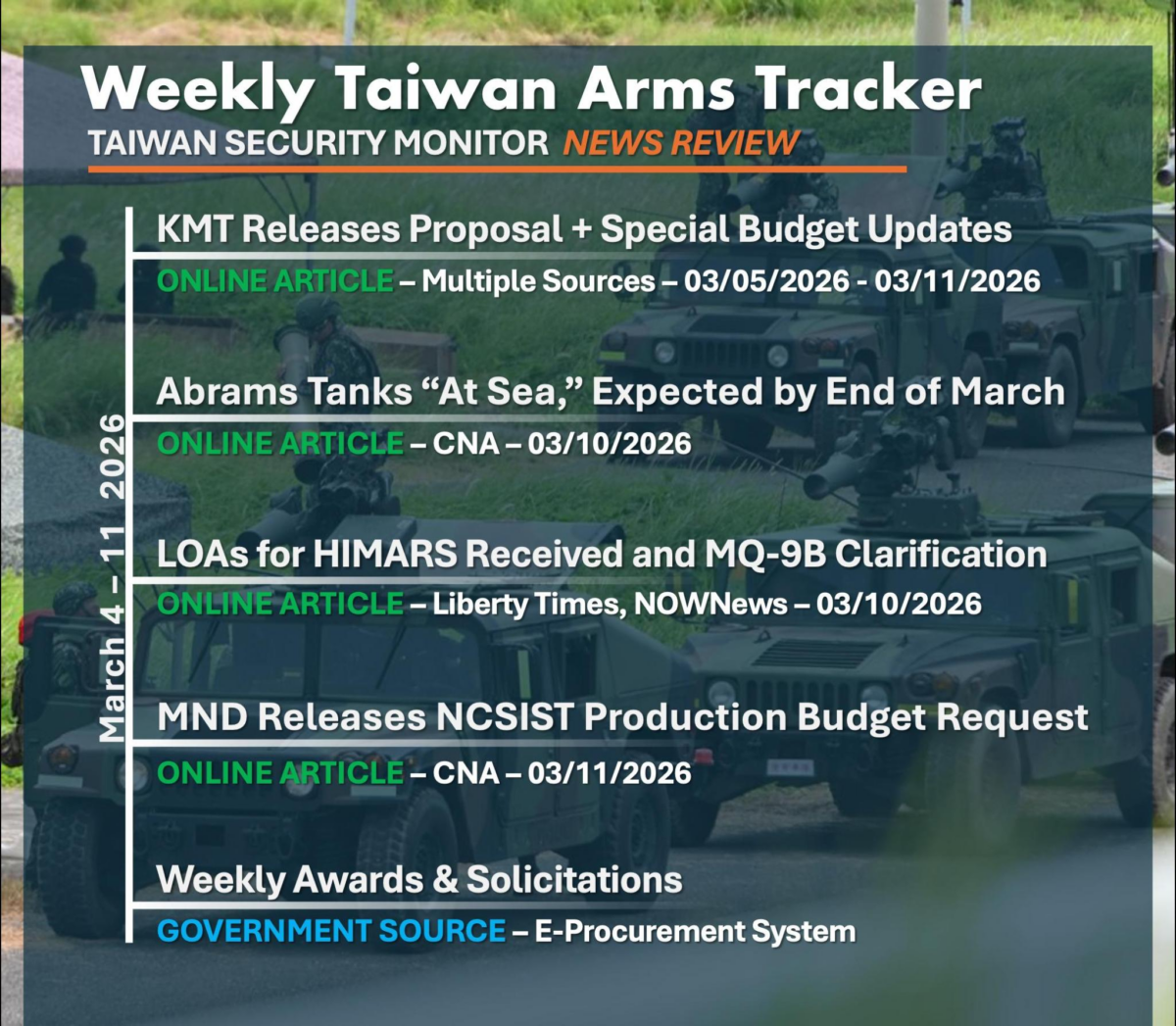
This week: the Kuomintang releases its budget proposal, leading to a flurry of statements about special budgets; the MND confirms Abrams tanks are en route to Taiwan; Minister Koo confirms an LOA for HIMARS was received; and the ministry releases budget details on NCSIST domestic production, alongside weekly bids and solicitations.

KMT Releases Proposal + Special Budget Updates

On Thursday, 5 March, the opposition Kuomintang (KMT) party released its special defense budget proposal, after weeks of internal debate as to the amount. The proposal allocates NT$380 billion (US$11.93 billion) specifically to fund the eight U.S. arms sale cases announced in December and would require additional special budget requests for future procurement to be submitted to the Legislative Yuan. Additional reporting on Friday revealed that the request was NT$30 billion (US$940 million) higher than party leadership had planned for; with the KMT also mandating that Letters of Offer and Acceptance, which outline payment and delivery schedules, be issued and signed before funds are appropriated.

Immediately after, the Lai administration began issuing statements opposing the proposal and clarifying their own. The same day, 5 March, the MND issued a statement clarifying that three sales from December (the Taiwan Tactical Network, AH-1W SuperCobra spare parts, and Harpoon missile refurbishment) were not included in the special budget and would be in annual defense budgets. The next day, 6 March, Minister of National Defense Wellington Koo spoke to the press, stating that the KMTโ€™s requirement that all sales be completed by December 2028 is unreasonable and impossible. On Saturday, 7 March, the MND issued a second statement, specifically discussing the KMT requirement of having LOAs before funding is approved, stating that cases follow a formal acquisition timeline and that public disclosure of budget items only occurs after U.S. congressional notification.

On Sunday, 8 March, President Lai visited Jieyun Temple in Banqiao District, New Taipei, giving a speech where he compared his special defense budget to installing a security system against a โ€œbad neighbor.โ€ Lai also argued for the reasonableness of his budget, comparing it to yearly defense spending by Japan and South Korea, both of which are more than his planned NT$1.25 trillion (US$40 billion) in spending over eight years. Also on Sunday, when asked by CNA if the U.S. would support the KMTโ€™s proposal, an unnamed State Department official stated that they โ€œencourage all parties in Taiwanโ€™s legislature to work through political differences and quickly pass a special defense budget,โ€ not taking a partisan side on the issue.

Today, the Legislative Yuan held elections for committee โ€œconvening members,โ€ legislators who serve as co-chairs and who control the agenda and legislative review, electing DPP legislator Chen Kuan-ting and KMT legislator Ma Wen-jun to the Foreign Affairs and National Defense Committee, which is tasked with review of the three special budget proposals. Chen, on Monday, met with former U.S. INDOPACOM commander Admiral John Aquilino, discussing Indo-Pacific security, domestic defense production, and advocating for the Lai administrationโ€™s budget to pass quickly.

Abrams Tanks “At Sea,โ€ Expected by End of March

An MND official told CNA on Tuesday that the final batch of 28 M1A2T Abrams tanks is โ€œat sea,โ€ en route to Taiwan, with delivery expected before the end of March. The first batch of 38 tanks arrived in December 2024 and was commissioned into the Armyโ€™s 584th Combined Arms Brigade in October. A second batch of 42 tanks, which arrived in July 2025, is still undergoing training and is expected to be commissioned by mid-year. This marks the last out of 108 total tanks that Taiwan began procuring in July 2019.

LOAs for HIMARS Received + MQ-9B Clarification

On Tuesday, Minister of National Defense Wellington Koo told the press that the MND had received a fourth Letter of Offer and Acceptance (LOA) from the U.S., for the sale of 82 High Mobility Artillery Rocket Systems (HIMARS) and associated munitions, worth NT$127.2 billion (US$4.05 billion), initially being notified in December.  This LOA, which has a deadline of 26 March to be signed, joins three prior LOAs, for Paladin self-propelled howitzers, Javelin anti-armor missiles, and TOW-2B anti-armor missiles, that have not been signed by the MND owing to ongoing special budget negotiations and are in danger of expiry. On Thursday, 5 March, however, it was reported that the Taiwan Peopleโ€™s Party (TPP), the KMTโ€™s fellow opposition party in the LY, will allow the three previous LOAs, which expire on March 15, to be signed if they are reported immediately to the LY. As of the time of writing, however, we are not aware of those three LOAs having been signed.

While speaking to the press on Tuesday, Minister Koo also clarified ongoing rumors about delays in the delivery of four MQ-9B SeaGuardian maritime surveillance drones to Taiwan, stating that the ongoing conflict in the Middle East has no effect on delivery timelines to Taiwan and that the MND continues to interface with U.S. partners if that were to change.

MND Releases NCSIST Production Budget Request

Taiwanโ€™s Ministry of National Defense has begun releasing additional budget details tied to the National Chung-Shan Institute of Science and Technology (NCSIST), offering a clearer picture of how Taipei intends to scale domestic weapons production under the proposed NT$1.25 trillion โ€œDefense Resilience and Asymmetric Capabilitiesโ€ special budget. Per Central News Agency reporting, the MND explained that NT$80.9 billion (US$2.55 billion) of the package will fund NCSIST mass production programs, including NT$36.1 billion (US$1.14 billion) for the Strong Bow missile system, NT$16.8 billion (US$529 million) for the Rui Yuan II surveillance drone program, and NT$28 billion (US$881.7 million) for production of โ€œsmall suicide unmanned surface vessels.โ€

The newly released figures reinforce a trend visible across Taiwan Security Monitorโ€™s backlog and acquisition analysis: Taiwan is increasingly pairing U.S. arms purchases with expanded domestic production capacity anchored by NCSIST. Previous special budgets (such as the Sea and Air Combat Power Improvement Plan) already used this model to accelerate missile and unmanned platform production while strengthening Taiwanโ€™s industrial supply chain. Taiwan Security Monitorโ€™s December 2025 update on the Arms Sales Backlog showed a growing shift in U.S. arms packages toward asymmetric capabilities that are cheaper and faster to produce. The new NCSIST allocations suggest Taiwan is now extending that logic domestically, using local production to scale asymmetric systems while relying on Foreign Military Sales (FMS) programs for higher-end platforms.

Weekly Awards/Solicitations

On Thursday, the Armaments Bureauโ€™s 209th Factory awarded an NT$480 million (US$15.09 million) contract to the Armaments Bureau’s 202nd Factory for base section maintenance of 40-mm remote-controlled turret systems, which feature on Clouded Leopard infantry fighting vehicles. The contract will be fulfilled in Jiji Township, Nantou County.

On Monday, the Naval Specialty Training Center, Naval Education and Training Command, awarded an NT$180 million (US$5.66 million) contract to NCSIST for the repair of โ€œSea Chain IVโ€ training simulators. We estimate this may be some sort of tactical data link. The contract will be fulfilled in the southern region of Taiwan.

On Wednesday, the 192nd Fleet, Naval Command, the ROCNโ€™s minesweeping force, awarded an NT$51.21 million (US$1.61 million) contract to NCSIST for comprehensive mine inspection and maintenance of various mines, including maintenance of MK 6 mine projectiles. The contract will be fulfilled in the southern region of Taiwan.

Weekly Arms Update: 3/4/26

Authors: Joe Oโ€™Connor, Shikhar Chaturvedi, Danielle Kremer, and Wyeth Lindberg


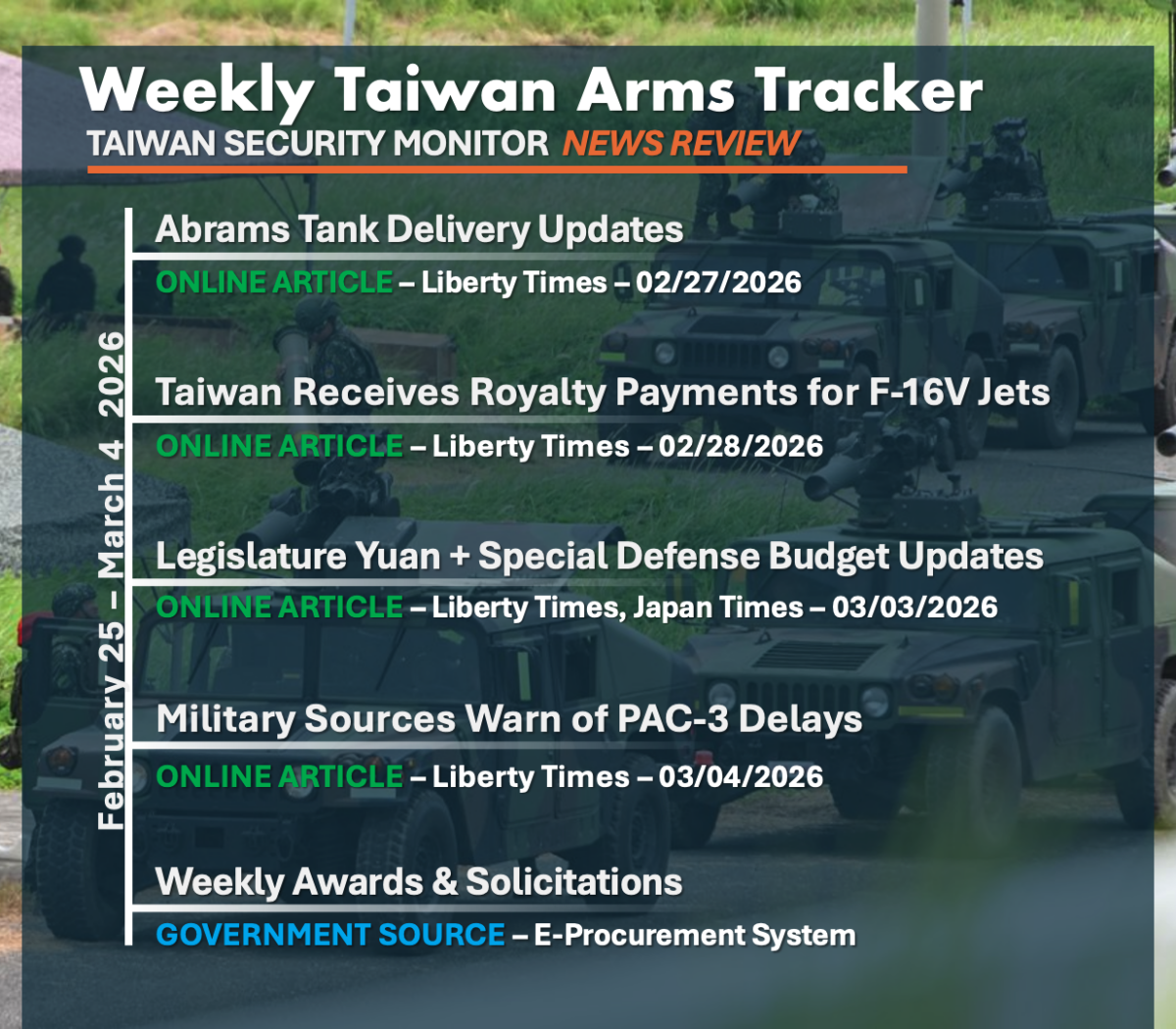
This week: MND officials provide an update on the delivery of the last batch of Abrams tanks, Taiwan reportedly receives $70 million in royalty payments from F-16V development, both KMT and TPP officials speak about special defense budget proposals, and the military warns of delays to PAC-3 missile production owing to conflict in the Middle East, alongside weekly awards and solicitations.

Abrams Tank Delivery Updates

Taiwanโ€™s M1A2T Abrams program is approaching delivery completion, with reporting confirming that 80 of 108 tanks have already arrived, including 38 delivered in December 2024 and 42 delivered in July 2025, while the final tranche of 28 is projected to be shipped in March, with arrival in April (a timeline that Taiwan Security Monitorโ€™s July 2025 Arms Sale Backlog Update previously assessed as on schedule). Operationally, the Army has paired deliveries with a visible training and validation rhythm. Reporting notes the first tranche completed conversion training and live-fire events before transitioning toward fielded status, and the broader deployment plan aligns the tanks with Sixth Corpsโ€™ northern defense posture, centered on the 584th Brigade with a smaller allocation to the 269th Brigade, reflecting an infrastructure protection logic tied to approaches to key nodes such as Taipei Port. From a procurement perspective, the Abrams case is a useful execution benchmark inside the broader U.S.โ€“Taiwan pipeline. Taiwan Security Monitorโ€™s backlog tracking has flagged Abrams as one of the smoother Foreign Military Sales deliveries, and notes that completion of the final tranche would shift topline backlog optics even as higher friction programs remain constrained by contracting timelines and industrial capacity.

Taiwan Receives Royalty Payments for F-16V Jets

MND officials revealed on Saturday that as of the end of 2025, Taiwan had received approximately US$70 million (NT$2.197 billion) in royalty payments from buyers of F-16V Fighting Falcon fighter jets. A new configuration of the F-16 with advanced AESA radars, avionics, and Auto Ground Collision Avoidance System (Auto GCAS), the Taiwanese government originally worked with the United States and Egypt, who both withdrew, leaving Taiwan as the sole developer and eligible to receive rebate payments from other countries who procure F-16Vs. Per officials, Taiwan is expected to earn hundreds of millions of dollars more from rebate payments in the next five years, as global purchases of the aircraft increase.

Legislative Yuan + Special Defense Budget Updates

On Tuesday, Kuomintang (KMT) legislator Lo Ting-wei confirmed in a radio interview that at a recent dinner attended by KMT lawmakers ahead of Taichung Mayor Lu Shiow-yen’s trip to the US this week, it was mentioned that the United States had apparently demanded the KMTโ€™s special defense budget be approximately NT$900 billion (US$28.6 billion). As we reported last week, the proposed amount of the KMTโ€™s special budget has been highly variable, with Lo confirming this week that it could be between NT$350 billion (US$11.19 billion) and NT$810 billion (US$25.63 billion), not including the USโ€™s suggestion of NT$900 billion. Per other sources, the KMTโ€™s proposal is being personally managed by caucus whip Fu Kun-chi and is still set to be released by the end of this week.

Also on Tuesday, Taiwan Peopleโ€™s Party chairman Huang Kuo-chang held an exclusive interview with The Japan Times, stating that the TPP would agree to pass the Lai administrationโ€™s NT$1.25 trillion (US$40 billion) special budget proposal if the U.S. State Department notified a new, second package of arms sales that would be included under that budget. Huang stated that โ€œwe see no reason to write a blank checkโ€ for the governmentโ€™s budget until more information on specific capability-based spending is released. Per our recent analysis of the Lai administration and TPP budget proposals, the TPPโ€™s focus is specifically on funding sales that have already been approved, including HIMARS, Paladins, and anti-armor missiles. Prior reporting by the Financial Times and New York Times, however, indicate that the Trump administration is delaying approval of a new package of sales until after Xi and Trump meet in April.

On Monday, February 23, an unclassified Department of Defense spending plan was delivered to the U.S. Congress. This spending plan included allocating NT$26.9 billion (US$850 million) as part of a reconciliation bill passed last year. According to the Taipei Times, these funds will be used to replenish US weapons stockpiles, some of which were given to Taiwan. Additionally, this allocation serves to strengthen the alliance between Taiwan and the United States of America in accordance with the Taiwan Enhanced Resilience Act (TERA), passed in 2022. This spending is in addition to approximately US$150 million allocated in the FY26 Department of Defense Appropriations Act, passed in January, backfilling $850 million that was cut by appropriators.

Military Sources Warn of PAC-3 Delays

Military officials stated to Liberty Times today that plans to purchase a battalion worth of Patriot launchers and air defense missiles may be delayed owing to โ€œproduction crowding,โ€ as well as conflicts in Ukraine and the Middle East. Since Taiwanโ€™s Patriot purchase is still in the planning phase, per the officials, it is possible that the United States prioritizes production of missiles to be used in the Middle East or to replenish its own stockpiles before fulfilling Taiwanโ€™s case. To this end, LTN reported that the military would continue monitoring via military exchange channels and also urged that a special budget be passed to avoid disruptions.

Weekly Awards/Solicitations

On Thursday, several bid solicitations were made:

Also on Thursday, the Air Force Command awarded a NT$1.08 billion (US$34.23 million) contract to Air Asia Co. Ltd for the civilian outsourcing of repair and supply services at the Air Force’s Songshan Air Base. Air Asia Co. Ltd, an aircraft maintenance company now owned by Taiwanโ€™s Aerospace Industrial Development Corporation (AIDC), was previously owned and operated covertly by the Central Intelligence Agency. The contract is to be fulfilled at the Songshan Air Base, in the Songshan district of Taipei.

On Monday, the Military Medical Bureau awarded Ningliren Medical Equipment Co., Ltd., a NT$52.75 million (US$1.66 million) contract for interventional angiography X-ray machines. The contract is to be fulfilled in the northern region of Taiwan.

On Wednesday, the Information and Communications Command solicited bids for the integrated construction of field information equipment, translation and voice systems, worth NT$558.18 million (US$17.65 million).

Weekly Arms Update: 2/25/26

Author: Joe Oโ€™Connor, Shikhar Chaturvedi, Danielle Kremer, & Wyeth Lindberg


This week: Military sources reveal plans to purchase nine more NASAMS fire units, the Navy releases their unmanned surface vessel acquisition plan, the Strong Bow missile system passes operational test and evaluation, and the Legislative Yuan reconvenes to debate special defense budgets, alongside weekly awards and solicitations.

MND Reveals Nine NASAMS Fire Units to be Bought

As part of President Laiโ€™s Taiwan Shield project, the Taiwanese military announced the possible purchase of nine additional National Advanced Surface-to-Air Missile System (NASAMS) fire units, funded by a budget of NT$1.25 trillion (US$39.8 billion).  With this purchase, and a previous purchase in 2024, Taiwan will have procured 12 fire units, roughly four batteriesโ€™ worth. This missile system will allow Taiwan to defend against aircraft, cruise missiles, and other aerial threats.

Navy Releases USV Acquisition Plan

The Navyโ€™s unmanned surface vessel (USV) program convened an industry briefing meeting before the Lunar New Year, per Liberty Times, to discuss procurement timelines. Navy officials stated on Monday that the acquisition of approximately 1,000 USVs will begin in three phases, with iterative batch tenders of various types being solicited in 2028. Further phases between 2029 and 2033 would enhance 3D recognition and build upon AI technologies to enhance โ€œswarm-controlโ€ capabilities. However, the Navy also pointed out that progress on this would increase if the National Chung-Shan Institute of Science and Technology (NCSIST), Taiwanโ€™s state-owned weapons development center, were entrusted with program execution.  

Strong Bow System Passes Operational Tests

Taiwanโ€™s domestically developed “Strong Bowโ€ (ๅผทๅผ“) air and missile defense system appears to have crossed a critical readiness threshold, with recent reporting indicating that the program has completed operational evaluation and is prepared to transition into mass production pending Legislative Yuan approval of the Lai administrationโ€™s NT$1.25 trillion special defense budget, tied to the broader โ€œTaiwan Shield / T Domeโ€ framework. Strong Bow is intended to expand Taiwanโ€™s engagement envelope upward, pairing a new Active Electronically Scanned Array (AESA) radar claimed to exceed 500 km in surveillance range, with an interceptor layer in the 70 km band, while integrating decision support tools designed to manage saturation conditions alongside existing Sky Bow and Patriot systems. Minister of National Defense Wellington Koo has consistently framed โ€œTaiwan Shieldโ€ as a โ€œsensor-to-shooter integrationโ€ challenge, stressing that AI-assisted fusion and fire control coordination are essential to raising interception probability rather than simply increasing interceptor counts.

From a procurement perspective, our weekly arms update from early February highlights an MND policy document outlining plans for two launchers and 128 missiles, while the regulated products list also reflects adjacent support equipment tied to the mid-layer anti-tactical ballistic missile architecture. Taken together, Strong Bowโ€™s operational test milestone should be viewed as an important potential inflection point in the โ€œT-Domeโ€ acquisition pipeline.

Legislative Yuan + Special Defense Budget Updates

On Tuesday, the Legislative Yuan (LY) returned from a short Lunar New Year recess. After stating last week that the two rival special defense budget proposals would be among the โ€œvery firstโ€ to be considered, the chamber voted to advance the Lai administrationโ€™s NT$1.25 trillion (US$40 billion) special budget proposal to a joint review by the LYโ€™s Finance Committee and the Foreign Affairs and National Defense Committee. This leaves both proposals in the committee review stage, after the TPPโ€™s proposal was advanced on 30 January, prior to the recess.

MND officials, including Minister Wellington Koo, continue to express concern over the timing of budget proposals, pointing to Letters of Offer and Acceptance (LOAs) for three U.S. arms sales approved in December that expire if not signed by March 15. The sales, which include TOW and Javelin anti-armor missiles, as well as Paladin self-propelled howitzers, totaling approximately NT$149.0 billion (US$4.76 billion), would be subject to renegotiation or cancellation if the LOAs are not signed. Koo, expressing worry about this possibility, said that he hoped the LY would pass the administrationโ€™s proposal to avert this from happening.

On the sidelines of the LY: the Kuomintang (KMT) announced that they would be releasing their own special budget proposal soon, with plans to submit for review by 6 March. Per KMT sources, the proposal could range from a cap of NT$350 billion (US$11.19 billion) to NT$750 billion (US$23.97 billion) and would likely include significant pay raises for military personnel.

Weekly Awards/Solicitations

On Monday, the Production and Manufacturing Center, Armaments Bureau, made a repeat solicitation of bids for FED #215 primers for rifle cartridges, worth NT$38.00 million (US$1.21 million).

On Tuesday, the Ministry of National Defense solicited bids for procurement of frozen meat products, worth NT$1.96 billion (US$62.60 million).

On Wednesday, the Information, Communications, and Electronic Force Command solicited bids for the licensing of cloud information services, worth NT$36.03 billion (US$1.15 billion).

U.S. Contracts Relating to Taiwan

On Friday, the U.S. Air Force awarded BAE Systems Information and Electronic Systems Integration a US$98.87 million indefinite-delivery/indefinite-quantity (IDIQ) contract for F-16 commodities sustainment, likely covering spare and other consumable parts. The contract supports Foreign Military Sales (FMS) for Taiwanโ€™s 66 F-16C/D Block 70 aircraft, along with at least 20 other countries. No Taiwan FMS funds were obligated at the time of award. Contract work is expected to continue through February 2037.

On Wednesday, the U.S. Army awarded a contract modification worth US$18.99 million to Iron Mountain Solutions, Inc., for technical support to the Utility Helicopters Project Office. This extension uses Taiwan FMS funds alongside 20 other countries. Work is expected to be completed by September 2026 and is an extension of a contract originally awarded in February 2021.