Taiwan Security Monitor

All Quiet in the Taiwan Strait? Explaining the Recent Drop in PLA Aircraft Activity Around Taiwan

Authors: Noah Reed, Jonathan Walberg, Ethan Connell, & Joe Oโ€™Connor


From February 27th to March 5th, Taiwanโ€™s Ministry of National Defense (MND) reported no Peopleโ€™s Liberation Army aircraft operating in the airspace near Taiwanโ€™s Air Defense Identification Zone (ADIZ), an unusually long pause in activity that drew significant attention among regional observers. No supply flights, no repositioning of aircraft, and not even any training exercises.  While long pauses in ADIZ violations have occurred in the past, it has become extremely rare in recent years for Taiwanโ€™s military to detect no aircraft operating in the nearby airspace outside the ADIZ for a prolonged period. The reason for this is quite simple: ADIZ violations are almost always directed at Taiwan, while activity outside Taiwanโ€™s ADIZ could involve routine training flights or transits between coastal airbases. Thus, it is more common for the PRC to halt incursions into Taiwanโ€™s ADIZ than to reduce aviation activity in the Eastern Theater Command writ large over a long period of time.

This pause naturally sparked speculation, however many popular theories are as of yet unsupported by observable patterns and regional events. Observers have forwarded several possible explanations, to include the ongoing operations in Iran, the upcoming summit between President Trump and Xi, an inability to operate routinely following a series of major officer purges, and domestic politics in Taiwan. Below, we parse through the most prominent suggested theories and examine if they hold up to historical trends and further scrutiny. As our central argument suggests, it remains too early to make definitive judgments given the available data. Instead, we focus on understanding the factors behind several of the leading explanations for this break from pattern.

I: Domestic Explanations and Leadership Struggles

Two domestic events in the PRC could reasonably explain the dive in PLA activity in February. First, this week marked the beginning of the โ€œTwo Sessions,โ€ an annual meeting of the PRCโ€™s National Peopleโ€™s Congress (NPC).[i] Historically, this event coincided with lower ADIZ violations, with a notable exception of 2025.[ii] The heightened level of activity seen during 2025โ€™s NPC meeting relative to prior years could be explained by the higher cross-Strait tension at the time, with the PLA holding its Strait Thunder-2025Aย joint exercise around Taiwan less than a month later.

Second, the end of the Spring Festival and the beginning of the Lantern Festival in the PRC could play some part in the lower activity. The Spring Festival has empirically propelled lower reported ADIZ numbers from late January into February over the last couple of years.[iii] Still, it is difficult to discern if the holidays alone drive these trends, or if it is merely one element of a broader rationale.

Finally, it is worth addressing the rumors that the PLA is simply incapable of conducting aerial activity around Taiwan due to recent turmoil in its leadership. This appears to be a less convincing explanation. After all, PLAN activity around Taiwan remains somewhat consistent, and the PLA and China Coast Guard (CCG) remain active in the Senkaku Islands and the South China Sea. Moreover, it is not clear why the removal of senior leadership would cause the PLA to be incapable of flying aircraft around Taiwan, as such activity has become routine, even mundane, for several years. It also cannot explain why several waves of aerial activity occurred around Taiwan in February after the leadership investigations took place.

Overall, the National Peopleโ€™s Congress, as well as Spring/Lantern festivals, have historically contributed to lower numbers of ADIZ and airspace violations. However, it is rare for these events to coincide with total stoppages in incursions.

II: Trumpโ€“Xi Meeting and the โ€œBest Behaviorโ€ Hypothesis

Another explanation is that the pause reflects a temporary โ€œbest behaviorโ€ or truce period ahead of a pending meeting between Donald Trump and Xi Jinping later this spring.[iv] Under this interpretation, Beijing may be attempting to avoid incidents or tensions that could complicate or even cancel the meeting.[v] This suggests that China would reduce visible military pressure around Taiwan to create a more stable atmosphere prior to the meeting.

While plausible, the explanation doesnโ€™t fit the observed pattern of activity.

First, the lull extended beyond just a halt in ADIZ incursions, but rather to all aircraft activity in the area, where regular flights and movements occur with training flights and movements between coastal bases. If the goal were to signal intent to Washington regarding Taiwan, Beijing could easily continue routine training flights in these areas while avoiding breaching Taiwanโ€™s ADIZ. A complete halt of flights in the area goes beyond just signaling that Beijing doesnโ€™t want to โ€˜rock the boat.โ€™ It also assumes that Washington views the ADIZ as the principal outlet of PRC signaling over Taiwan, something that cannot necessarily be accepted at face value.

Second, the logic of a pre-summit truce, while plausible, would require a much longer pause in operations. This would become more plausible if the lull had continued. Further, it would commit the PLA to maintaining a break for a period following the summit, as a resumption of regular patrols would risk creating the impression that the summit had failed. In practice, maintaining the appearance of diplomatic restraint would likely require months of reduced activity, which is unlikely given the PLAโ€™s ongoing pressure campaign that has seen few pauses since 2022.

 Finally, the broader geopolitical context makes the argument less convincing. Some analysts frame ADIZ incursions as a signaling mechanism directed at Washington, meaning that temporarily halting them could itself be a signal, a tacit gesture of restraint ahead of a summit. But even under this logic, the timing is difficult to reconcile with current events. The United States is presently engaged in an escalating conflict with Iran involving large-scale strikes and the possibility of wider regional escalation.[vi] In that environment, it is not obvious why Beijing would view the suspension of routine PLA sorties near Taiwan as a necessary diplomatic signal. If Beijing is prepared to pursue high-level diplomacy with Washington while the United States is conducting major military operations elsewhere, it is difficult to see why the symbolic value of turning off routine Taiwan-related flights would suddenly become decisive.

Put simply, a snapshot of the rest of the world makes the idea that Beijing is shelving routine Taiwan-related air activity purely to preserve summit optics less convincing.

III: Signaling to Taiwan

Yet another explanation being advanced is that Beijing is signaling its lack of concern over Taiwanโ€™s ongoing special defense budget debate. However, the timeline of PLA activity does not support this interpretation. The debate has been ongoing for months, yet PLA air activity remained elevated throughout that period.[vii] For example, Taiwanโ€™s Ministry of National Defense reported 19 PLA aircraft operating around Taiwan on January 29, just days after the Taiwan Peopleโ€™s Party unveiled its alternative special budget proposal. Activity continued shortly afterward, with 32 PLA aircraft detected on February 12, two days after Lai publicly urged the Legislative Yuan to pass the proposal during a press conference. Similarly, 22 PLA aircraft were detected on February 26, the day after Taiwanโ€™s legislature agreed to send multiple budget proposals to committee review. These patterns suggest that PLA air activity has continued regardless of developments in Taiwanโ€™s defense budget debate.

The PRC is likely to react to developments in Taiwanโ€™s special defense budget proposals as they move through the Legislative Yuan. Beijing has repeatedly framed major Taiwanese defense initiatives as provocations, often responding with diplomatic pressure or military signaling. The PLAโ€™s most recent exercise, Justice-Mission 2025A, reflects this pattern.[viii] Much of the iconography and messaging released before and during the exercise framed the drills in punitive terms, portraying them as a warning to Taipei. In that sense, the exercise reinforced the perception that advances in Taiwanโ€™s defense budgeting process can trigger demonstrative military responses from Beijing.

Others advance this as rewarding Lai for his statements during a Spring Festival event where he referred to โ€œMainland Chinaโ€ instead of just โ€œChina,โ€ a term that the PRC prefers.[ix] This reference, while not necessarily insignificant in meaning, is unlikely to prompt Beijing to depart three years of policy and โ€œrewardโ€ the Lai administration by giving them time to breathe over a difference in terminology.

IV: Middle East and Fuel Hypothesis, Regional activity

One external explanation for the Eastern Theater Commandโ€™s pause in flight activity is that Beijing is temporarily conserving aviation fuel amid uncertainty about the ongoing conflict in the Middle East and potential supply disruptions. Sustained air operations require significant fuel resources, and the PLA may reduce nonessential sorties if leadership anticipates a prolonged price increase or broader market volatility.

However, the fuel-constraint explanation presents two significant challenges:

First, China has invested decades in developing strategic petroleum stockpiles to mitigate supply shocks. Public estimates indicate that Beijing maintains hundreds of millions of barrels in state strategic reserves, supplemented by commercial storage.[x] Recent planning documents and reports further suggest that China continues to expand these undisclosed strategic holdings, rather than signaling scarcity.[xi] Therefore, if the PLA were experiencing immediate operational constraints due to fuel availability, it would indicate a far more acute, system-wide stress than current stockpiling trends imply.

Second, if fuel conservation were the primary factor, a broader reduction in activity would be expected across all PLA operating areas, rather than a distinct, localized pause in aircraft activity detected around Taiwan. Chinese military activity in other regions, however, appeared to remain consistent with typical patterns.

For example, in the South China Sea, the PLAโ€™s Southern Theater Command publicly released footage of naval and air units conducting a readiness patrol around Scarborough Shoal on February 28.[xii] The patrol involved coordinated use of early warning aircraft, anti-submarine aircraft, fighters, and bombers, accompanied by messaging that forces remain โ€œon high alertโ€ and prepared to take countermeasures. A subsequent Weibo post by the Southern Theater Command highlighted a PLAAF unit undergoing โ€œrigorous combat training,โ€ with a follow-on Global Times report stating that these patrols and exercises have continued โ€œsince Februaryโ€ and are explicitly linked to responses to external โ€œjoint patrolโ€ activity.[xiii] This reinforces that PRC operational signaling in the south has not paused during this period.

Japanese public reporting over the past week indicates continued and routine activity around the Senkaku Islands. In its March 1, 2026, update, Japanโ€™s Ministry of Foreign Affairs notes that Chinese government vessels, mainly from the China Coast Guard, have continued to enter Japanโ€™s contiguous zone near the Senkakus almost daily.[xiv] On February 28th, Japanโ€™s Joint Staff reported that two Peopleโ€™s Liberation Army (PLA) Y-9 intelligence, surveillance, and reconnaissance (ISR) aircraft flew from the East China Sea, passed between Okinawa and Miyako, and continued into the Pacific as far as the Amami island chain, then reversed course and returned, prompting Japan Air Self-Defense Force (JASDF) scrambles.[xv] Overall, Japanโ€™s official statements and recent Joint Staff reports indicate that PRC operations in the East China Sea remain active, even as aviation patterns near Taiwan fluctuate.

V. Preparing for an Invasion or Major Exercise

A more dramatic explanation is that the pause reflects preparations for a major PLA exercise. Others have posited that it could possibly be the โ€˜calmโ€™ before an invasion or move on one of Taiwanโ€™s outlying islands. Under this interpretation, the halt in routine aviation activity signifies an operational pause while forces reposition, conduct planning, or prepare for a larger coordinated operation.

It is true that large exercises or operations are sometimes preceded by short-term changes in routine activity, particularly if units are redeploying, conducting maintenance, or consolidating forces in preparation for a larger event.

However, there was little evidence during the pause to support the idea that it reflected imminent large-scale operations. Even a preparation for a theater-level exercise would likely generate additional changes and disruptions in observable patterns, including major changes in naval deployments, unusual airbase activity, logistical movements, and more. Many of these indicators are regularly detected through open-source monitoring and satellite imagery. At present, there are no clear signs of these types of preparatory activities occurring on a scale that would suggest a major operation is imminent.

More broadly, if the PLA were preparing a large exercise around Taiwan, it is not obvious why routine aviation activity across the Eastern Theater Command would need to halt. Training flights and patrols would normally continue alongside preparations unless airspace was being cleared for a specific operation, something that would likely be accompanied by other visible signals.

For these reasons, while the possibility of future exercises should never be discounted given the PLAโ€™s recent pattern of demonstrations around Taiwan, the current pause alone is not strong evidence that a major operation is imminent.

Taken together, the available evidence suggests that the brief pause in PLA aviation activity around Taiwan was unlikely to be driven by any single factor. Domestic political events in China, including the NPC โ€œTwo Sessionsโ€ and the seasonal slowdown associated with the Spring Festival period, likely contributed to a temporary reduction in operational tempo. At the same time, explanations centered on diplomatic signaling, energy constraints, or preparations for major military operations remain less consistent with observed patterns of activity both around Taiwan and in other regions.

The resumption of PLA flights shortly after this lull reinforces a broader pattern that has characterized Chinese military pressure around Taiwan in recent years: cyclical activity. Periods of heightened sorties are often followed by short pauses before returning to baseline levels. Rather than indicating a change in Beijingโ€™s strategy, the episode likely reflects the routine variability inherent in sustained military operations.

The more important analytical question is not why the PLA paused for several days, but how Beijing calibrates these cycles of pressure. Short interruptions in activity can create the perception of sudden shifts in intent, even when the underlying strategy remains unchanged.


[i] https://asiasociety.org/policy-institute/what-watch-chinas-two-sessions-2026

[ii] PLA Tracker: https://docs.google.com/spreadsheets/d/1qbfYF0VgDBJoFZN5elpZwNTiKZ4nvCUcs5a7oYwm52g/edit?gid=905433190#gid=905433190

[iii] https://chinadrew.substack.com/p/the-pla-has-stopped-flying-aircraft?triedRedirect=true&_src_ref=t.co

[iv] https://www.reuters.com/business/aerospace-defense/chinese-military-flights-around-taiwan-fall-trump-xi-meeting-may-be-factor-2026-03-05/

[v] https://www.taipeitimes.com/News/taiwan/archives/2026/03/05/2003853320

[vi] https://www.war.gov/Spotlights/Operation-Epic-Fury/

[vii] PLA Tracker: https://docs.google.com/spreadsheets/d/1qbfYF0VgDBJoFZN5elpZwNTiKZ4nvCUcs5a7oYwm52g/edit?gid=905433190#gid=905433190

[viii] https://tsm.schar.gmu.edu/justice-mission-2025-the-narrative-battle-inside-chinas-latest-taiwan-exercise/

[ix] https://chinadrew.substack.com/p/the-pla-has-stopped-flying-aircraft?triedRedirect=true&_src_ref=t.co

[x] https://www.eia.gov/international/analysis/country/chn

[xi] https://www.reuters.com/business/energy/china-targets-steady-oil-output-more-gas-stockpiling-five-year-plan-2026-03-05

[xii] https://www.globaltimes.cn/page/202603/1355963.shtml

[xiii] https://weibo.com/7468777622?tabtype=album&uid=7468777622&index=0; https://www.globaltimes.cn/page/202603/1356043.shtml; https://www.globaltimes.cn/page/202603/1355963.shtml

[xiv] https://www.mofa.go.jp/files/100857530.pdf; https://www.mofa.go.jp/region/page23e_000021.html
[xv] https://www.mod.go.jp/js/pdf/2026/p20260302_01.pdf

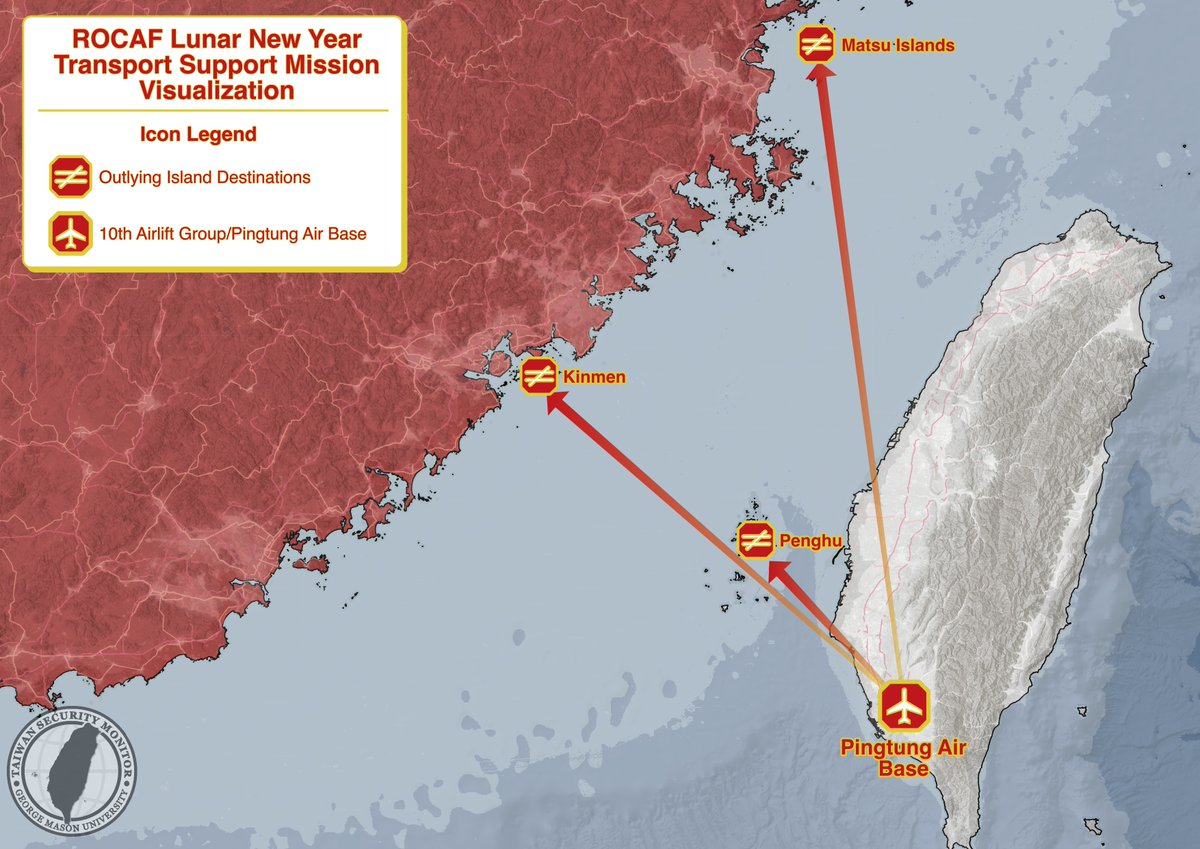
Visualization: ROCAF Lunar New Year Transport Support Mission

Author: Noah Reed

Happy Lunar New Year from Taiwan Security Monitor! Over the next several weeks, C-130H transport aircraft of the ROCAF’s 10th Airlift Group will undertake civilian transport support operations, helping people travel to their families in the outlying islands during the holiday. To support this mission, crews have reconfigured the interior cabins on the C-130 aircraft, and pilots have trained for smooth takeoffs and landings.

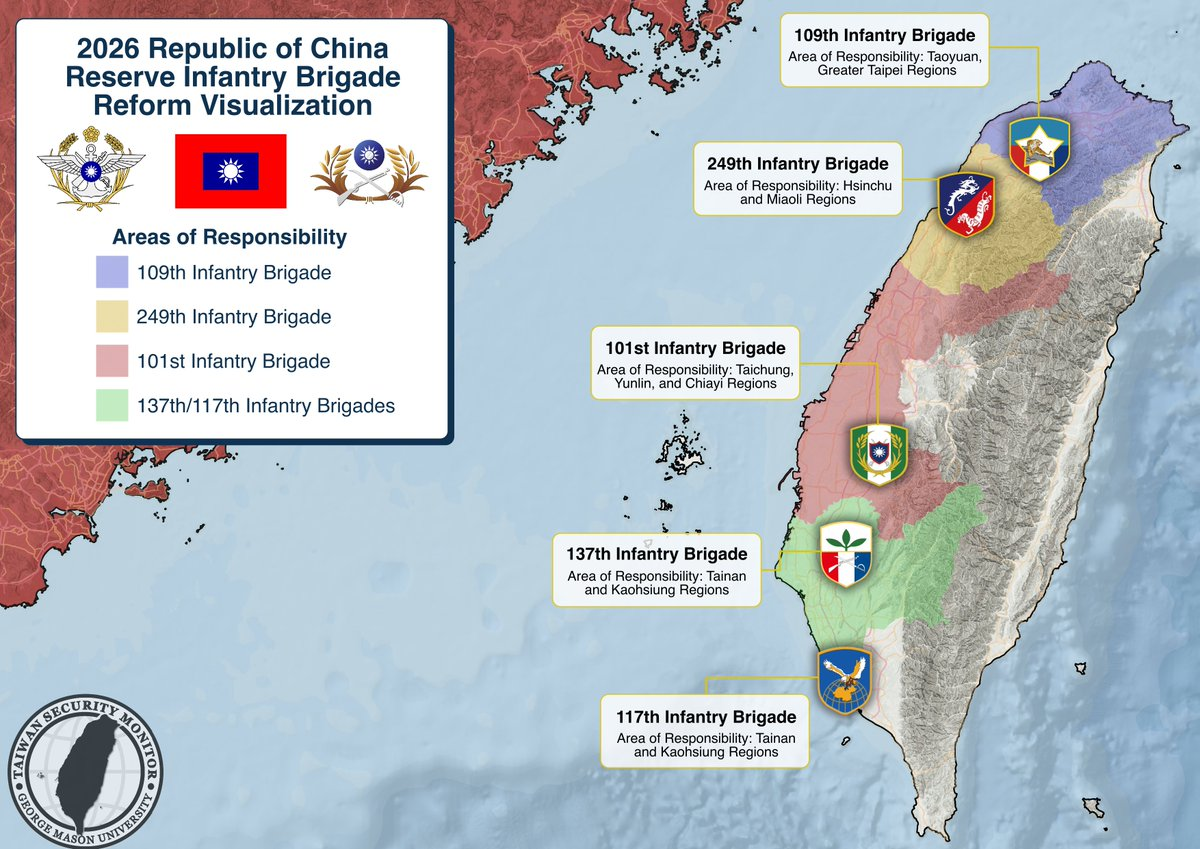
Visualization: 2026 ROC Reserve Infantry Brigade Reform


Author: Noah Reed


Taiwan’s military, as part of efforts to improve the training and strength of its conscript force, will reportedly organize training alongside volunteer combined arms brigades within five of its reserve infantry brigades. These five brigades will transition from primarily training units to being tasked with defending critical areas, allowing for greater movement by volunteer-based combined arms brigades during wartime.

Visualization: Taiwan’s Varied Aircraft Protection


Authors: Chris Dayton & Noah Reed


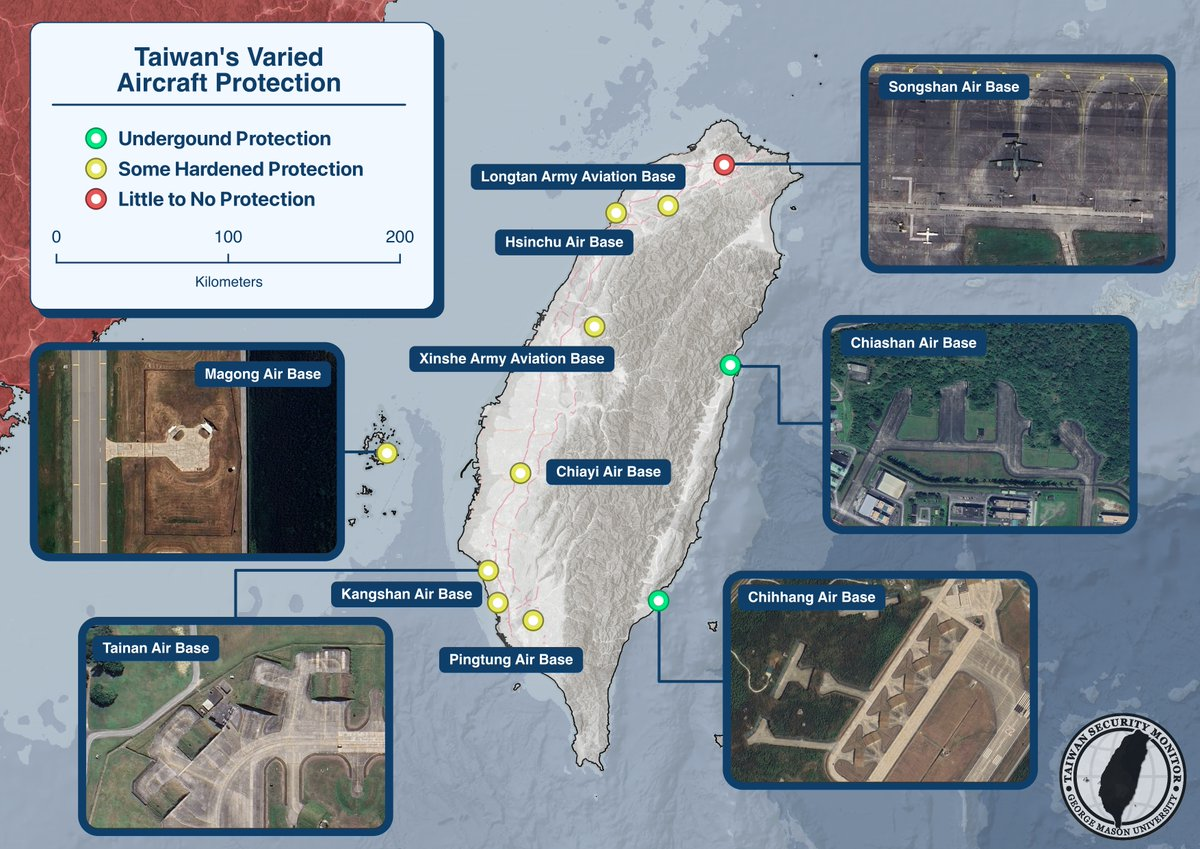
Recent drone attacks on airfields in global conflicts have placed a heightened focus on aircraft protection at Taiwanโ€™s major military bases. Improving ROCAF survivability is now a priority for the MND, with plans to significantly expand hardened shelters at Chihhang AFB by 2028 to protect future F-16C/D Block 70 fighters. Above is our visualization of the level of hardened protection at each of Taiwanโ€™s airbases.

Visualization: 2026 ROC Mechanized and Armored Brigade Reclassification

Author: Noah Reed


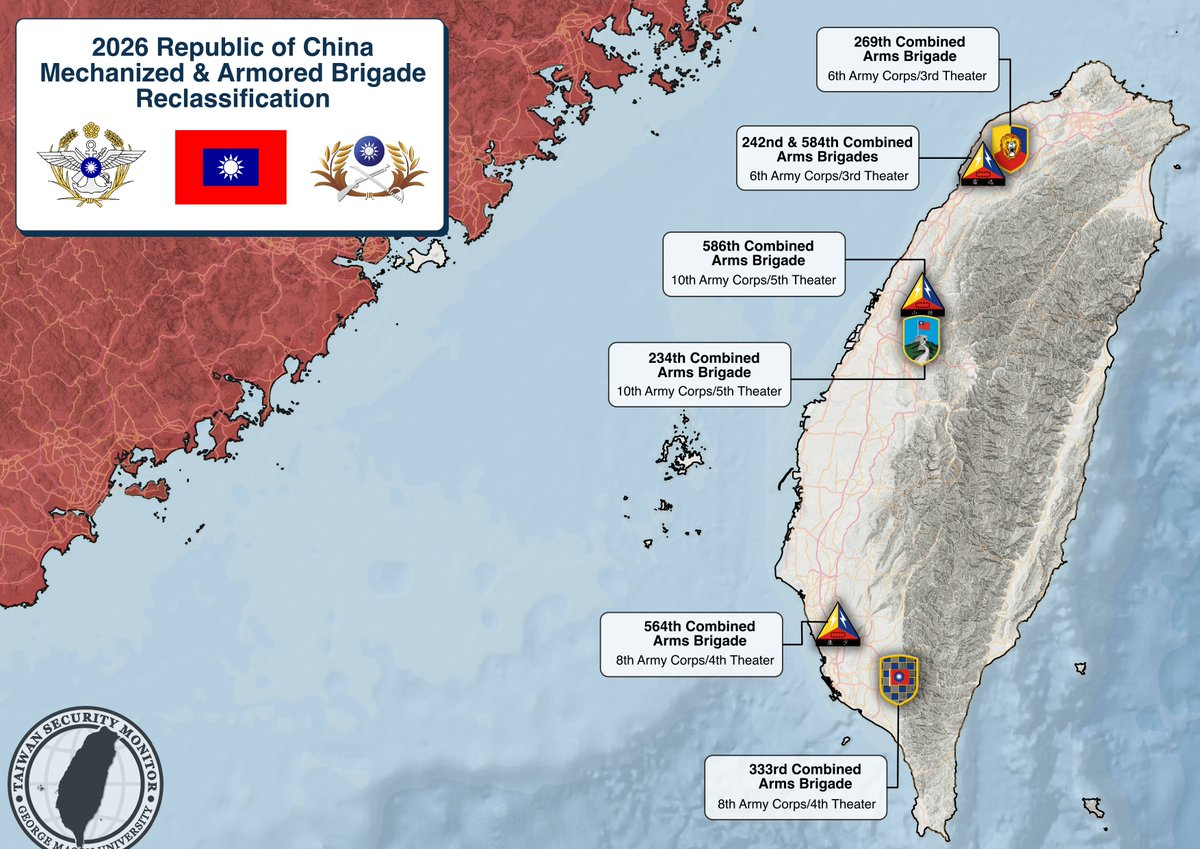
Taiwan’s military recently reclassified its 7 mechanized and armored brigades as combined arms brigades to better align its force structure reform efforts. Our visualization highlights the distribution of those brigades, along with their new titles and unit patches.

Creeping Closer: Timeline and Analysis of the Justice Mission-2025 Joint Exercise

Authors: Noah Reed, Ethan Connell, & Jonathan Walberg


From December 29th to 31st, the Eastern Theater Command (ETC) of the Peopleโ€™s Liberation Army (PLA) held exercise โ€œJustice Mission-2025โ€ (ๆญฃไน‰ไฝฟๅ‘ฝ-2025) in the waters and airspace surrounding Taiwan. The drills, described by Chinese state media as a response in part to the United Statesโ€™ US$11.1 billion arms package to Taiwan announced two weeks prior,[i] were the 5th and most significant round of joint exercises around Taiwan since Nancy Pelosiโ€™s 2022 visit to Taiwan.[ii]

While following the overall thematic and operational rhythm established in prior exercises following 2022, Justice Mission-2025 also produced several firsts. These include the closest live-fire exercise to date, and the first use of a Type 075 amphibious assault ship in a joint-exercise. The exercise also featured a notable increase in attention devoted to psychological warfare and political messaging elements.

As has been the case in all past joint exercises, Justice Mission-2025 was described first and foremost as a โ€œSerious warning to โ€˜Taiwan Independenceโ€™ separatist forces and external interferenceโ€ by the Peopleโ€™s Republic of Chinaโ€™s (PRC) Ministry of National Defense (MND). (ๅฏนโ€œๅฐ็‹ฌโ€ๅˆ†่ฃ‚ๅŠฟๅŠ›ไธŽๅค–้ƒจๅŠฟๅŠ›ๅนฒๆถ‰็š„ไธฅ้‡่ญฆๅ‘Š.)[iii]

Overall, Justice Mission-2025 fulfilled a dual mandate. First, it provided relevant operational experience for the PLA and China Coast Guard (CCG), something represented in the growing scale of joint-exercises since 2022 as the PLA expands in reach and scale. Second, it sent a signal of frustration over the state of cross-Strait relations to Washington, while also attempting to place the blame for the deterioration of those relations on the incumbent Democratic Progressive Party and President Lai Ching-te.

Operational Sequencing of the Exercise

Day 1 Overview: Overall, Taiwanโ€™s MND detected 89 aircraft and 28 naval vessels, split into 15 PLAN vessels and 13 CCG vessels, operating around Taiwan during day one of the Justice Mission-2025 exercise. The day was marked by several operational themes, including:

  1. A focus on airpower, including long-range air superiority, airspace encirclement, and airborne early warning.
  2. A focus on sea-air coordination, especially as it relates to the detection and destruction of surface and sub-surface vessels.
  3. A focus on the airspace and waters east of Taiwan, consistent with an overall focus on deterring โ€œexternal interference.โ€

29 December (All Times Local)

0730-0800: Spokesperson of the ETC of the Peopleโ€™s Liberation Army, Senior Colonel Shi Yi, announced that it had dispatched its Army, Navy, Air Force, and Rocket Force troops to conduct joint military drills codenamed โ€œJustice Mission 2025โ€ in the airspace and waters surrounding Taiwan.[iv]

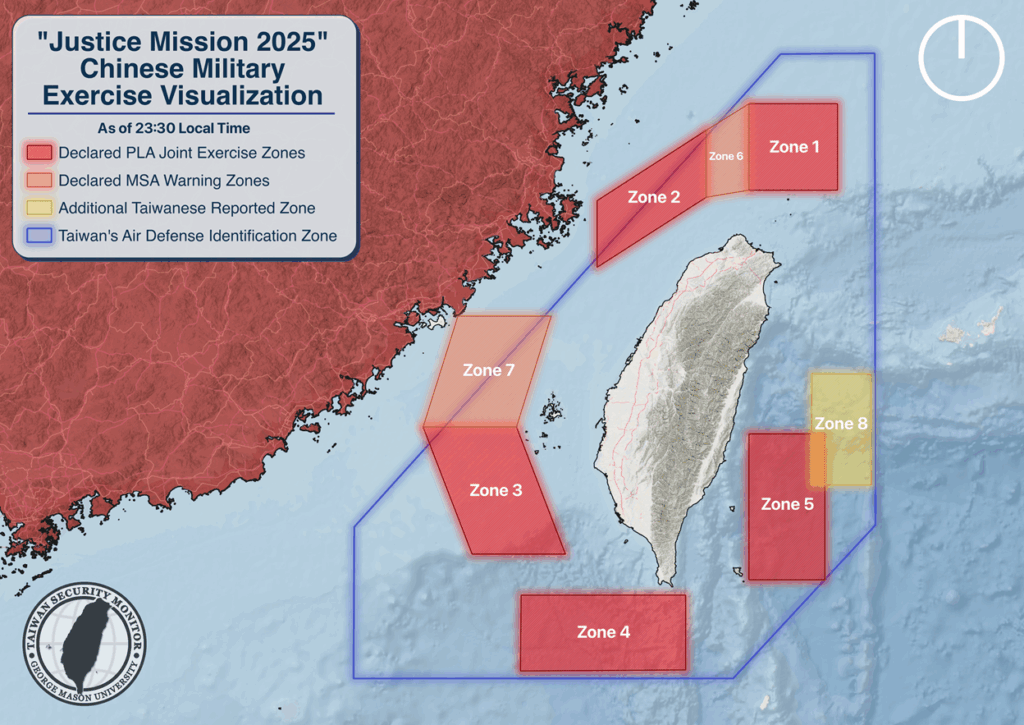
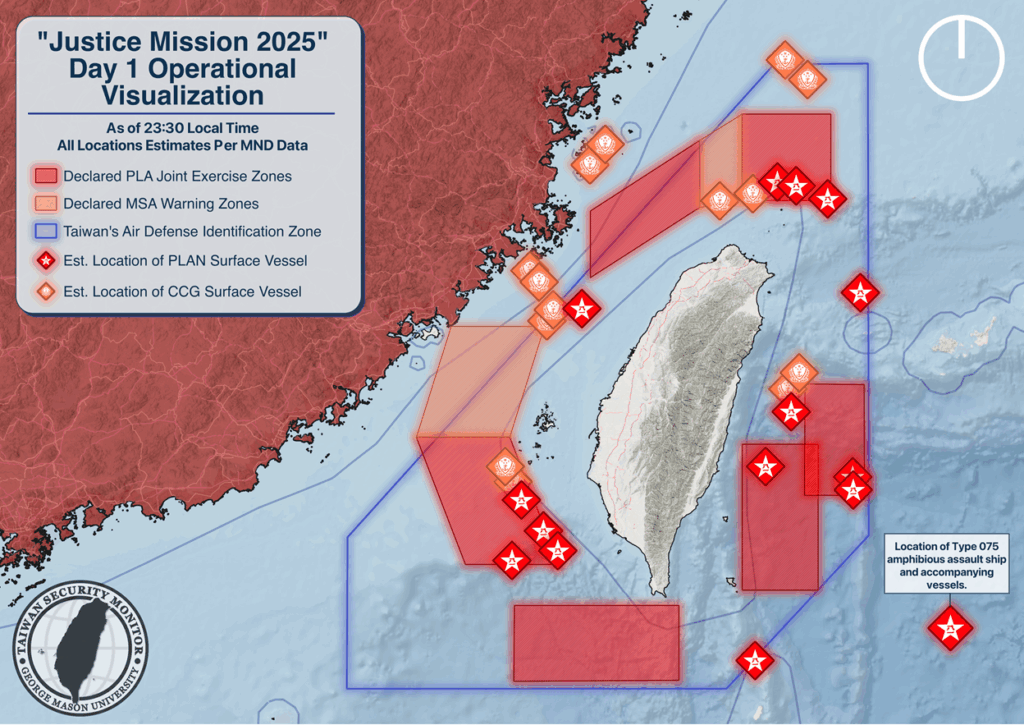
Alongside this announcement was the release of a navigation warning with five prohibited entry zones within which live-fire exercises would take place the following day. Later in the day, the PRCโ€™s Maritime Safety Administration (MSA) published two additional warning zones. The ETC later added an eighth zone to the east of Taiwan over radio, although they never announced it publicly via navigational warning.

Five of the eight declared zones violated Taiwanโ€™s territorial waters. Zone fourโ€™s boundary ran less than five nautical miles from Taiwanโ€™s southern coast. However, at no point did Chinese vessels cross into Taiwanโ€™s territorial waters. All Chinese vessels operated in the area between Taiwanโ€™s contiguous and territorial waters.

Notably, Taiwanโ€™s Ministry of National Defense (MND) disclosed that its intelligence agencies had noticed irregular activity and possible preparation several days prior to the start of โ€œJustice Mission,โ€ which contrasts with a claim by Chinese state media that the operation represented a โ€œcold startโ€ or โ€œsnap exercise.โ€[v]

0800-0930: Approximately one hour after announcing the exercise, the PLAโ€™s ETC claimed that it had mobilized fighters, bombers, unmanned aerial vehicles, and long-range rocket units to strikes on simulated mobile ground targets in the โ€œmiddle areasโ€ of the Taiwan Strait.[vi] Taiwanโ€™s MND did not report any rocket impacts in the Taiwan Strait during this time, and the ETC did not release footage of these strikes as it did on the next day.

0930-1130: At 1000, Taiwanโ€™s MND released a statement condemning the exercise and announced the beginning of rapid response exercises and a state of high alert.[vii] One hour later, the ETC announced maritime live-fire training to the north and southwest of Taiwan, employing destroyers, frigates, fighters, bombers, and unmanned aerial vehicles. The training focused on hunting and neutralizing targets, simulated ground strikes, and live firing against targets.[viii]

An article in the PLA Daily newspaper published on the morning of the 30th identified several of the ships involved in this portion of the exercise, including the Baoyi, Quzhou, and Taiyuan ship formations.[ix]

1130-1230: At 1200, the ETC announced that it had dispatched destroyers, frigates, fighters, and bombers to conduct anti-submarine and sea-air coordination exercises to the east of the Taiwan Strait.[x] The ETC released initial footage from the exercise, showcasing elements of all involved services at around this time.

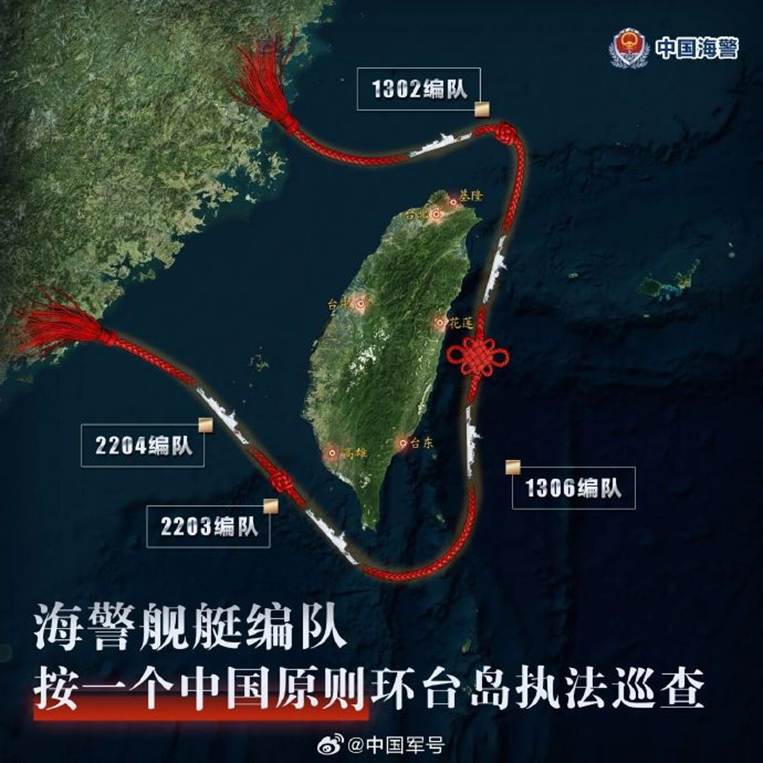
On the heels of this announcement, the CCG announced that it was carrying out โ€œcomprehensive law-enforcement patrolsโ€ in waters surrounding Taiwan and the areas near the Matsu and Wuqiu islands. Taiwanโ€™s Coast Guard Administration (CGA) claimed that it had detected increased CCG activity several hours prior to the CCGโ€™s official announcement.[xi]

MarineTraffic Automatic Identification System (AIS) data, which shows the last pinged location of certain vessels, confirmed this claim, as several CCG vessels, including CCG 1303 and 1302, were already observed operating north of Taiwan by 12:00.[xii] TSM researchers subsequently confirmed that CCG vessels 14609, 14606, 1302, 1306, 2203, 2204, 1303, 1303, 1302 also participated in these patrols on the 29th.[xiii]

Poster showcasing involved CCG vessels published by Chinaโ€™s Coast Guard Weibo Account

1230-1630: At 1500, the ETC conducted regional patrol, information support, and aerial confrontation drills using airborne early warning aircraft, fighters, and electronic warfare aircraft to the southwest of Taiwan.[xiv] An hour later, the ETC dispatched bomber task forces to conduct far-seas combat readiness patrols east of Taiwan, focusing on long-distance joint precision strikes in remote areas.[xv]

1600-0000: At 1700, the ETC reported that a Type 075 amphibious assault ship and several accompanying vessels were operating Southeast of Taiwan. According to state media, this represented the first time the PLA had deployed a Type 075 around Taiwan during a joint exercise.[xvi]

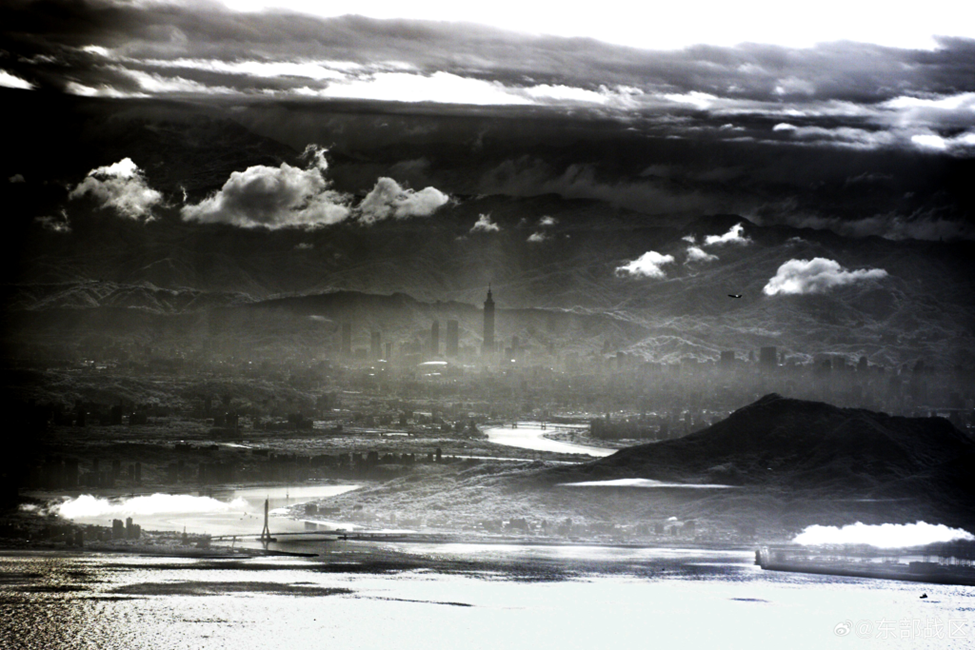
Finally, at 2000, the ETC released footage claiming to show a TB-001 UAV from the PLA Rocket Forceโ€™s 61st Base operating close to Taipei City near the Tamsui River outlet.[xvii] Taiwanโ€™s MND has disputed the authenticity of the footage, reporting that no drone entered Taiwanโ€™s airspace during the exercise.

Image circulated by PRC State Media claiming to show a UAVโ€™s photo capture of New Taipei

30 December (All Times Local)

Day 2 Summary: Taiwanโ€™s MND reported 71 aircraft, 17 PLAN vessels, and 15 CCG vessels around Taiwan by 1500 on day 2 of Justice Mission-2025. In addition, Taiwan detected a total of 27 rocket impacts in the waters north and south of Taiwan over this period.

The second day of the drills focused on blockade operations and targeted strikes, marking the closest live-fire drills around Taiwan on record.

0730-0800: The second day of Justice Mission-2025 began at 0800, when the ETC announced that fighters, bombers, frigates, and destroyers were conducting integrated blockade and control operations, to include identification, warning, and anti-air and submarine operations, to the north and south of Taiwan.[xviii]

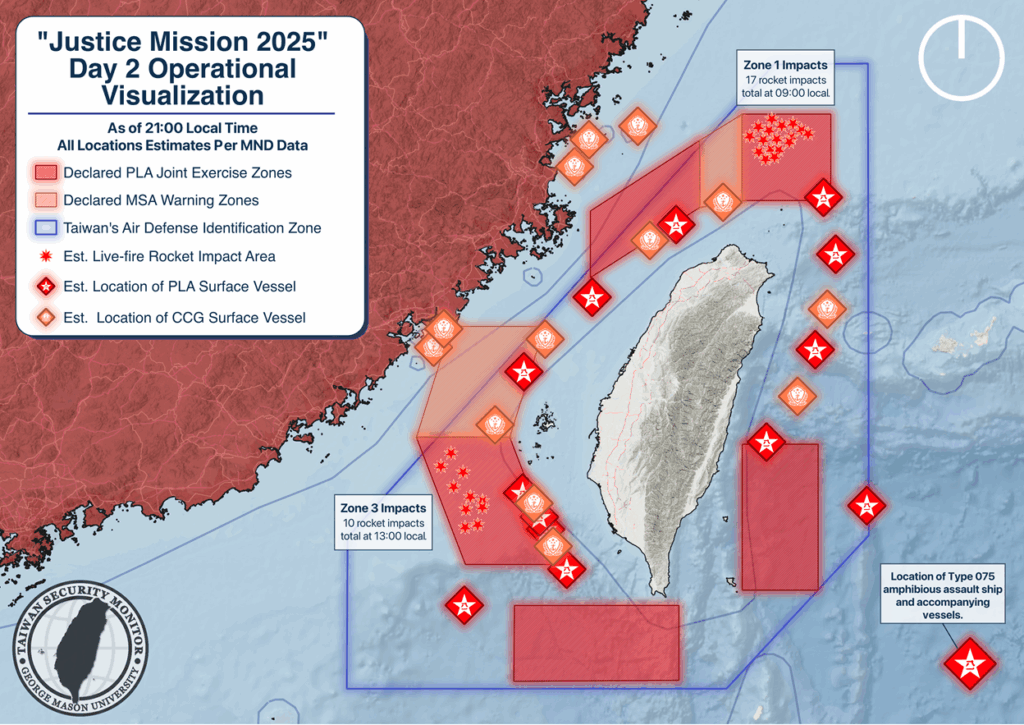
0800-1200: At 0900, the ETC initiated the first of two rounds of live-fire long-range rocket drills in exercise zone 1. According to Taiwanโ€™s MND, PHL-16 self-propelled Multiple Rocket Launcher Systems (MLRS) from the 72nd Group Armyโ€™s Rocket Artillery Brigade in Pingtan County, Fujian, fired at least 17 rockets into this zone.[xix]

1200-0000: At approximately 1300, PHL-16 MLRS from the 73rd Group Armyโ€™s Rocket Artillery Brigade in Shishi, Fujian, initiated a second round of live-fire long-range rocket drills. [xx] These launches targeted Zone 3 to the south of Taiwan. Taiwanโ€™s MND reported 10 rocket impacts in the exercise. [xxi]Taiwanese media outlets reported that ten rockets from the two sets of launches landed within Taiwanโ€™s contiguous waters zone, marking the closest ever recorded impacts during a live-fire exercise.[xxii]

The remainder of Day 2 was mostly devoted to a series of poster and video releases by the Eastern Theater Command and China Coast Guard, who continued their โ€œcomprehensive law enforcement patrolsโ€ into the second day.

31 December (All Times Local)

The ETC announced the end of the exercise at 16:00 on December 31. It is not clear why the ETC delayed announcing the end of the exercise until 31 December, as all exercise warning zones had already expired the day prior. Furthermore, MarineTraffic AIS data showed that China Coast Guard vessels had begun pulling back from the waters around Taiwan earlier in the day.[xxiii] In prior exercises, the ETC usually announced the end of exercises on the last day of heavy activity.

Notably, the ETC had released no prior exercise updates on the 31st, and Taiwanโ€™s MND reported only 1 aircraft violating the Air Defense Identification Zone (ADIZ) over this period.[xxiv]

Justice Mission-2025โ€™s Propaganda Dimensions

Beijing deliberately crafted the messaging and reporting surrounding Justice Mission to frame the exercise as a โ€œstern warningโ€ to Taipei and its international supporters. Official statements and state media reports consistently emphasized the operation as a โ€œlegitimate and necessary actionโ€ to defend the PRCโ€™s sovereignty and promote unification.[xxv] PRC spokespeople explicitly connected the drills to Washingtonโ€™s mid-December approval of a record US$11.1 billion arms package for Taiwan, framing the exercise as a direct โ€œpunitive and deterrent actionโ€ in response.[xxvi] Foreign Ministry officials accused Taiwanโ€™s ruling party of transforming the island into a โ€œpowder kegโ€ through military expansion and arms acquisitions, cautioning that U.S. efforts to โ€œarm Taiwan to contain Chinaโ€ would โ€œonly embolden the separatists and push the Taiwan Strait closer to the peril of armed conflict.โ€[xxvii] This external context was central to PRC rhetoric, enabling Beijing to justify the drills as compelled by hostile provocations and reinforcing its narrative that Democratic Progressive Party (DPP) leaders are โ€œprovocateursโ€ responsible for escalating tensions.

Official posters and slogans likewise adopted an overtly threatening tone, emphasizing the PLAโ€™s capacity to isolate and strike Taiwan. PLA media accounts disseminated a series of dramatic infographics and posters suggesting that Taiwan would be defenseless in a military confrontation. For instance, one poster depicted PLA forces severing Taiwanโ€™s supply lines, accompanied by the caption โ€œSupply cut off โ€“ how can [you] pursue โ€˜independenceโ€™?โ€ while another highlighted the โ€œoverwhelming power gapโ€ between the PRC and Taiwan, with the challenge, โ€œHow can you seek โ€˜independenceโ€™ [against such odds]?โ€[xxviii]ย These visuals, often given titles like โ€œHammer of Justiceโ€ or โ€œArrow of Justice,โ€ portrayed missiles targeting the island and blockade operations restricting access to Taiwanโ€™s ports.[xxix]

The central message was that Beijingโ€™s military strength serves as a tool of righteous punishment, capable of simultaneously defeating โ€œTaiwan independenceโ€ forces and deterring external intervention from the United States. One โ€œArrow of Justiceโ€ poster went further by depicting a missile and volleys of arrows plunging into Taiwan itself, with lurid green โ€œwormโ€ figures, a common stand-in for the DPP/โ€œGreen camp,โ€ splattered across the island, visually signaling not just blockade or deterrence but the targeted eradication of โ€œinternalโ€ pro-independence actors. Paired with the slogan โ€œๅ…งๆŽงๅค–้ฆณโ€ (โ€œcontrol internally, charge outwardโ€), the imagery suggested Beijing could simultaneously suppress โ€œTaiwan independenceโ€ forces on the island while striking outward to deter or punish external intervention.

 PRC civilian agencies also contributed to the propaganda campaign. For example, the China Coast Guard promoted its involvement in the drills through graphics of patrol ships encircling Taiwan and slogans such as โ€œTaiwan is Chinaโ€™s inherent territory,โ€ thereby reinforcing the exerciseโ€™s dual military and law-enforcement objectives in asserting sovereignty.[xxx]

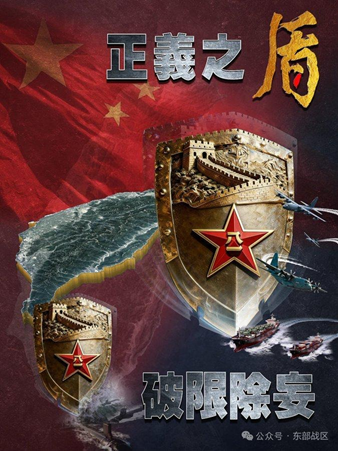
Initial announcement poster for Justice Mission 2025. The poster depicts the PRC as two shields emblazoned with the Great Wall, defending Taiwan from the external influence of American arms sales and military platforms.

Official statements from Beijingโ€™s civilian and military representatives reinforced these themes. The State Councilโ€™s Taiwan Affairs Office (TAO) described the Justice Mission maneuvers as a โ€œsolemn warningโ€ to separatists and foreign actors, calling them a โ€œnecessary and just measureโ€ to protect Chinaโ€™s territorial integrity.[xxxi] TAO spokespersons accused the DPP administration of โ€œrecklessly colluding with external forcesโ€ and pursuing โ€œindependenceโ€ at the expense of Taiwanโ€™s security and welfare. They cited President Lai Ching-teโ€™s governmentโ€™s acceptance of U.S. arms and support, claiming this โ€œmilitarizationโ€ was leading the island down a โ€œdangerous path.โ€[xxxii] Beijing repeatedly stated that its actions targeted โ€œTaiwan independenceโ€ elements and their supporters, not the general population. TAO officials emphasized that โ€œpeople on both sides of the Strait are one family,โ€ and that PLA operations were directed only at separatist provocations and were โ€œnot [aimed] at the Taiwan compatriots.โ€[xxxiii] By combining explicit threats with appeals to โ€œTaiwanese compatriots,โ€ the PRCโ€™s narrative sought to weaken support for the DPP by portraying Beijingโ€™s actions as protective and just. At the same time, severe rhetoric toward external actors, warning that any foreign interference would โ€œdash itself to pieces against the steel Great Wall of the PLA,โ€ highlighted the exercisesโ€™ additional audience: the United States and other regional observers.[xxxiv] Through coordinated statements and vivid propaganda, the PRC presented Justice Mission-2025 as a lawful and necessary operation to punish separatism, deter U.S. โ€œmeddling,โ€ and position itself as the purported defender of national sovereignty and guarantor of peace in the Taiwan Strait.

Regional and US Responses

While US President Donald Trump said that he โ€œwasnโ€™t worriedโ€ about Justice Mission-2025,[xxxv] and that his relationship with President Xi remains strong, the State Department called for China to โ€œcease military pressure,โ€ and that Beijingโ€™s actions spiked tensions. Trumpโ€™s comment was widely interpreted in divergent ways: by critics as dismissive or inattentive, and by supporters as a signal of confidence meant to convey U.S. military and political dominance. In this sense, the remark functioned less as an assessment of the exercises themselves than as a performative signal aimed at preserving maneuver space and projecting toughness. Following the conclusion of the exercises, on January 1, State Department spokesperson Tommy Pigott reaffirmed the United Statesโ€™ policy of supporting peace and stability across the Strait, opposing unilateral changes to the status quo.[xxxvi]

On December 30th, South Koreaโ€™s Foreign Ministry released a similar statement, calling for โ€œdialogue and cooperation.โ€[xxxvii] On December 31st, Japan expressed concern over the exercises, with Foreign Ministry press Secretary Kitamura emphasizing that โ€œpeace and stability across the Taiwan Strait are important for the international community as a whole.โ€[xxxviii] The same day in Manila, Philippine Defense Secretary Teodoro expressed deep concern, adding that Chinaโ€™s coercion against Taiwan has implications โ€œbeyond the regionโ€ and risks stability across the continent.[xxxix] Also making statements expressing concern on New Yearโ€™s Eve were Australia and New Zealand,[xl] with Germany,[xli] the United Kingdom,[xlii] and France making announcements the day before.[xliii] Notably, Taiwanโ€™s Foreign Ministry thanked each of these countries for their statements condemning the exercises, including Japan, but left off the United States from the message.[xliv]

Conclusion

Justice Missionโ€“2025 underscored that Beijing is trying to institutionalize a coercive โ€œdealโ€ around Taiwan: headline joint exercises are increasingly treated as a conditional punishment for specific U.S. and Taiwanese actions, while day-to-day gray-zone pressure continues regardless. The exercise showed ongoing improvements in joint fires, seaโ€“air coordination, and geographically dispersed operations, especially east of Taiwan to deter external intervention from the US. The ambiguous third day of the exercise and subdued final phase created uncertainty surrounding the intentions and overall sequence of the exercise.

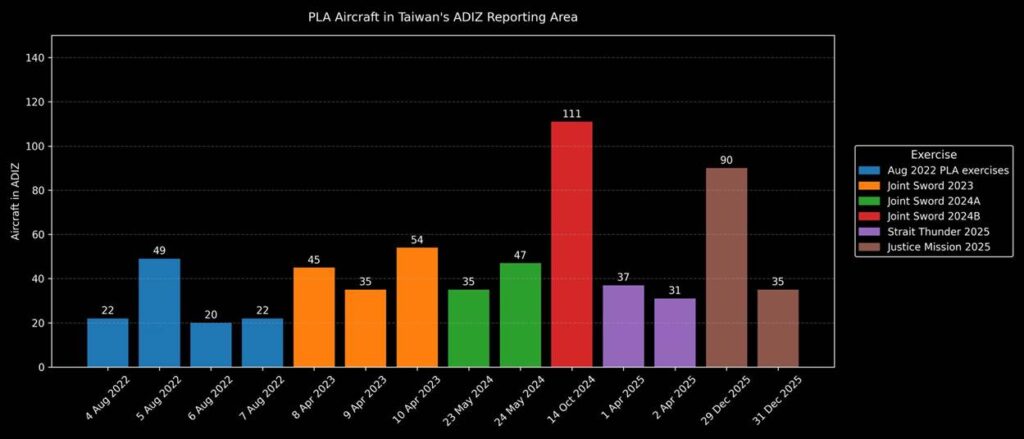
The number of aircraft and naval vessels involved during the exercise naturally grew from prior iterations, as should be expected with an increasingly large and coordinated force. December 29 saw the second-largest single-day ADIZ violation by PLA aircraft on record, with the period from December 29-30 representing the largest overall violation period. Notably, the exercise did not feature an aircraft carrier, instead opting to involve a Type 075 amphibious assault vessel for the first time.

Visualization of ADIZ violations during a major exercise, via Ben Lewis and PLATracker

The exercises featured Beijingโ€™s increasing use of coordinated propaganda, law enforcement involvement, and symbolic imagery alongside military pressure. By linking the drills to U.S. arms sales and rationalizing them as โ€œjustโ€ and โ€œdefensive,โ€ the PRC aimed to shift blame for escalation to Taipei and Washington while normalizing the PLAโ€™s presence near Taiwan. Regional reactions, which were mostly expressions of concern, underscore the gap between Beijingโ€™s claims of legitimacy and the international communityโ€™s view of destabilization. Overall, the exercise suggests that future PLA operations around Taiwan will be frequent, multi-domain, and information-driven, focusing on eroding confidence and complicating decision-making rather than preparing for immediate invasion.


[i] Global Times. โ€˜Justice Mission 2025โ€™ drills serious warning to โ€˜Taiwan independenceโ€™ separatist forces and foreign interference, MND on comment drills target US arms sale to Taiwan. December 29th, 2025. https://www.globaltimes.cn/page/202512/1351803.shtml

[ii] Prior joint-exercises include: 2023 โ€Joint Swordโ€, Joint Sword 2024-A, Joint Sword 2024-B, and Strait Thunder 2025-A.

[iii] PRC Ministry of National Defense. ๅ›ฝ้˜ฒ้ƒจๆ–ฐ้—ปๅ‘่จ€ไบบๅผ ๆ™“ๅˆšๅฐฑไธœ้ƒจๆˆ˜ๅŒบโ€œๆญฃไน‰ไฝฟๅ‘ฝ-2025โ€ๆผ”ไน ็ญ”่ฎฐ่€…้—ฎ. December 29th,2025.

[iv] PRC Ministry of National Defense. ไธœ้ƒจๆˆ˜ๅŒบๆตท็ฉบๅ…ตๅŠ›ๅฎžๆ–ฝ็Žฏๅฐๅฒ›ๆˆ˜ๅค‡่ญฆๅทก. December 29th, 2025.

[v] Guo Yuandan and Liu Xuanzun. Expert interprets PLA’s ‘Justice Mission 2025’ drill areas as media on Taiwan island describes exercises as ‘sudden’. Global Times. December 29th, 2025. https://www.globaltimes.cn/page/202512/1351721.shtml, Taiwan Military News Agency. ไธญๅ…ฑ็‰‡้ขๅฎฃๅธƒ่ปๆผ”ใ€€ๅœ‹้˜ฒ้ƒจ๏ผš็ถฟๅฏ†ๆŽŒๆก็ขบไฟๅœ‹ๅฎถๅฎ‰ๅ…จ. December 29th, 2025. https://www.mnd.gov.tw/news/mnd/85591

[vi] PRC Ministry of National Defense. ไธœ้ƒจๆˆ˜ๅŒบไฝๅฐๆนพๆตทๅณกไธญ้ƒจๆตท็ฉบๅŸŸๅผ€ๅฑ•ๅฏน้™†ๆœบๅŠจ็›ฎๆ ‡ๆ‰“ๅ‡ปๆผ”็ปƒ. December 29th, 2025.

[vii] ROC Ministry of National Defense. https://x.com/MoNDefense/status/2005460859901051243. December 29th, 2025.

[viii] PRC Ministry of National Defense.  ไธœ้ƒจๆˆ˜ๅŒบไฝๅฐๅฒ›ๅŒ—้ƒจใ€่ฅฟๅ—ๆตท็ฉบๅŸŸๅผ€ๅฑ•ๅฏนๆตทๅฎžๅผนๅฐ„ๅ‡ป็ญ‰็ง‘็›ฎ่ฎญ็ปƒ. December 29th, 2025.

[ix] Songโ€™s Defense Watch. https://x.com/songs349/status/2005953998604623997. December 30th, 2025., PLA Daily. ไธœ้ƒจๆˆ˜ๅŒบไฝๅฐๅฒ›ๅ‘จ่พนๅผ€ๅฑ•โ€œๆญฃไน‰ไฝฟๅ‘ฝ-2025โ€ๆผ”ไน . Pg 1. December 30th, 2025.

[x] PRC Ministry of National Defense. ไธœ้ƒจๆˆ˜ๅŒบไฝๅฐๅฒ›ไปฅไธœๆตท็ฉบๅŸŸๅผ€ๅฑ•ๅฏนๆตท็ชๅ‡ปใ€ๅŒบๅŸŸๅˆถ็ฉบใ€ๆœๆฝœๅๆฝœ็ญ‰็ง‘็›ฎๆผ”็ปƒ. December 29th, 2025.

[xi] Jaime Ocon. https://x.com/JaimeOcon1/status/2005475439108833748.December 29th, 2025.

[xii] Taiwan Security Monitor. https://x.com/TaiwanMonitor/status/2005499477323374881.December 29th, 2025.

[xiii] Taiwan Security Monitor. https://x.com/TaiwanMonitor/status/2005569169895366874. December 29th, 2025.

[xiv] PLA Eastern Theater Command Weibo. ไธœ้ƒจๆˆ˜ๅŒบไฝๅฐๅฒ›่ฅฟๅ—็ฉบๅŸŸๅผ€ๅฑ•ๅŒบๅŸŸๅทก้€ปใ€็ฉบไธญๅฏนๆŠ—ใ€ไฟกๆฏๆ”ฏๆด็ญ‰็ง‘็›ฎๆผ”็ปƒ. December 29th, 2025.

[xv] PLA Eastern Theater Command Weibo. ไธœ้ƒจๆˆ˜ๅŒบ็ป„็ป‡่ฝฐ็‚ธๆœบ็ผ–้˜Ÿ่ตดๅฐๅฒ›ไปฅไธœๅผ€ๅฑ•่ฟœๆตทๆˆ˜ๅค‡ๅทก่ˆช. December 29th, 2025.

[xvi] Guo Yuandan and Liu Xuanzun. Type 075 amphibious assault ship joins drills surrounding Taiwan for first time. Global Times. December 29th, 2025.

[xvii] Joseph Wen. https://x.com/JosephWen___/status/2005729323593224444. December 29th, 2025., PLA Eastern Theater Command Weibo. ไธœ้ƒจๆˆ˜ๅŒบๅ‘ๅธƒ#ๅพฎ่ง†้ข‘่ฟ™ไนˆ่ฟ‘้‚ฃไนˆ็พŽ้šๆ—ถๅˆฐๅฐๅŒ—#. December 29th, 2025.

[xviii] PLA Eastern Theater Command Weibo. ไธœ้ƒจๆˆ˜ๅŒบไฝๅฐๅฒ›ๅ—ๅŒ—ไธค็ซฏๅผ€ๅฑ•ๅฏนๆตท็ชๅ‡ปใ€้˜ฒ็ฉบๅๆฝœ็ญ‰็ง‘็›ฎๆผ”็ปƒ. December 30th, 2025.

[xix] Joseph Wen & Taiwan Defense Studies Initiative. https://x.com/JosephWen___/status/2005661342691398111. December 29th, 2025.

[xx] Joseph Wen & Taiwan Defense Studies Initiative. https://x.com/JosephWen___/status/2005661342691398111. December 29th, 2025.

[xxi] Joseph Wen & Taiwan Defense Studies Initiative. https://x.com/JosephWen___/status/2005661342691398111. December 29th, 2025.

[xxii] Joseph Yeh. PLA rockets land inside Taiwan’s 24 nautical mile contiguous zone: MND.ย  Focus Taiwan/CNA. December 30th, 2025.

[xxiii] Taiwan Security Monitor. https://x.com/TaiwanMonitor/status/2006216815442116690. December 30th, 2025.

[xxiv] ROC Military News Agency. ไธญๅ…ฑๆฉŸ่‰ฆ่‡บๆตทๅ‘จ้‚Šๆดปๅ‹•ใ€€ๅœ‹่ปๅšดๅฏ†็›ฃๆŽงๆ‡‰่™•. January 1st, 2026.https://mna.mnd.gov.tw/news/detail/?UserKey=a7500bc9-1570-4fc9-8818-8998d9b695cf

[xxv] Taiwan Security Monitor TAO Statement Tracker https://tsm.schar.gmu.edu/taiwan-affairs-office-the-plas-military-operations-are-a-solemn-warning-to-taiwan-independence-separatist-forces-and-external-interference-forces/

[xxvi] Taiwan Security Monitor on X/Twitter:   https://tsm.schar.gmu.edu/new-arms-sales-for-taiwan-details-and-reactions/

[xxvii] Taiwan Security Monitor on X/Twitter:   https://www.fmprc.gov.cn/fyrbt_673021/jzhsl_673025/202512/t20251229_11789718.shtml

[xxviii]  Taiwan Security Monitor on X/Twitter:   https://x.com/TaiwanMonitor/status/2005869817232867426?s=20

[xxix] Taiwan Security Monitor on X/Twitter:   https://x.com/TaiwanMonitor/status/2005807062735790564?s=20; https://x.com/TaiwanMonitor/status/2005456163249192993?s=20

[xxx] Taiwan Security Monitor on X/Twitter:  https://x.com/TaiwanMonitor/status/2005521133496623314?s=20; https://x.com/TaiwanMonitor/status/2005837836851855481?s=20; https://x.com/TaiwanMonitor/status/2005569169895366874?s=20

[xxxi] Taiwan Security Monitor TAO Statement Tracker https://tsm.schar.gmu.edu/taiwan-affairs-office-the-plas-military-operations-are-a-solemn-warning-to-taiwan-independence-separatist-forces-and-external-interference-forces/

[xxxii] Taiwan Security Monitor TAO Statement Tracker https://tsm.schar.gmu.edu/taiwan-affairs-office-any-country-or-force-that-plays-with-fire-on-the-taiwan-question-will-inevitably-pay-a-price/; https://tsm.schar.gmu.edu/taiwan-affairs-office-any-taiwan-independence-separatist-actions-will-never-be-tolerated-and-will-be-met-with-severe-punishment/

[xxxiii] Taiwan Security Monitor TAO Statement Tracker https://tsm.schar.gmu.edu/taiwan-affairs-office-any-taiwan-independence-separatist-actions-will-never-be-tolerated-and-will-be-met-with-severe-punishment/

[xxxiv] Taiwan Security Monitor TAO Statement Tracker https://tsm.schar.gmu.edu/taiwan-affairs-office-any-taiwan-independence-separatist-actions-will-never-be-tolerated-and-will-be-met-with-severe-punishment/

[xxxv] Ng and Ewe, โ€œTrump Downplays Chinese Military Drills Around Taiwanโ€ BBC, https://www.bbc.com/news/articles/cdxwxkeg9w6o

[xxxvi]US State Department on Justice Mission 2025 from CBS News: โ€œU.S. says China’s military activities near Taiwan “increase tensions unnecessarily” https://www.cbsnews.com/news/china-military-activities-near-taiwan-unnecessarily-raise-tensions-us-says

[xxxvii] https://www.cna.com.tw/news/aopl/202512303004.aspx

[xxxviii] Japan Times: https://www.japantimes.co.jp/news/2025/12/31/japan/china-military-exercises-taiwan-japan-europe/

[xxxix] Philippines Government Announcement: https://www.bworldonline.com/the-nation/2026/01/01/721925/philippines-concerned-over-chinas-drills-near-taiwan-says-they-undermine-regional-stability

[xl] Taiwan Ministry of Foreign Affairs Announcement: https://en.mofa.gov.tw/News_Content.aspx?n=1329&s=121415

[xli] German Government Announcement: https://www.auswaertiges-amt.de/en/newsroom/news/military-exercises-china-taiwan-2750712

[xlii] United Kingdom Government Announcement: https://www.gov.uk/government/news/statement-on-chinas-military-drills-december-2025

[xliii] French Government Announcement: https://www.diplomatie.gouv.fr/en/country-files/china/news/article/justice-mission-2025-exercises-around-taiwan-december-30-2025

[xliv]Taiwan Ministry of Foreign Affairs Announcement: https://x.com/MOFA_Taiwan/status/2006273783192297963?s=20

Visualization: Japan’s First Island Chain Military Infrastructure

Authors: Noah Reed and Joe O’Connor


Recently, comments by Japanese PM Sanae Takaichi regarding China and the announcement of surface-to-air missiles being deployed at Yonaguni Island have attracted attention and discussion about Japanese military infrastructure in the First Island Chain.

Above is our visualization of JSDF facilities in the First Island Chain, including Okinawa.

Visualization: Yonaguni Missile System Deployment

Authors: Noah Reed, Joe O’Connor


Today, Japanese Minister of Defense Shinjiro Koizumi visited Yonaguni, the westernmost Japanese island in the Senkakus. After inspecting a JGSDF garrison, Koizumi announced that the JSDF will deploy a Type 03 Chลซ-SAM missile battery on the island, to โ€œreduce the likelihood of an armed attack against our country.โ€ The Type 03 has an effective range of approximately 50 km, while Yonaguni itself is approximately 105 km from Taiwan.

Above is our visualization of the Type 03’s future deployment on Yonaguni.

Visualization: Taiwan Military Theatre Command

Authors: Chris Dayton, Noah Reed


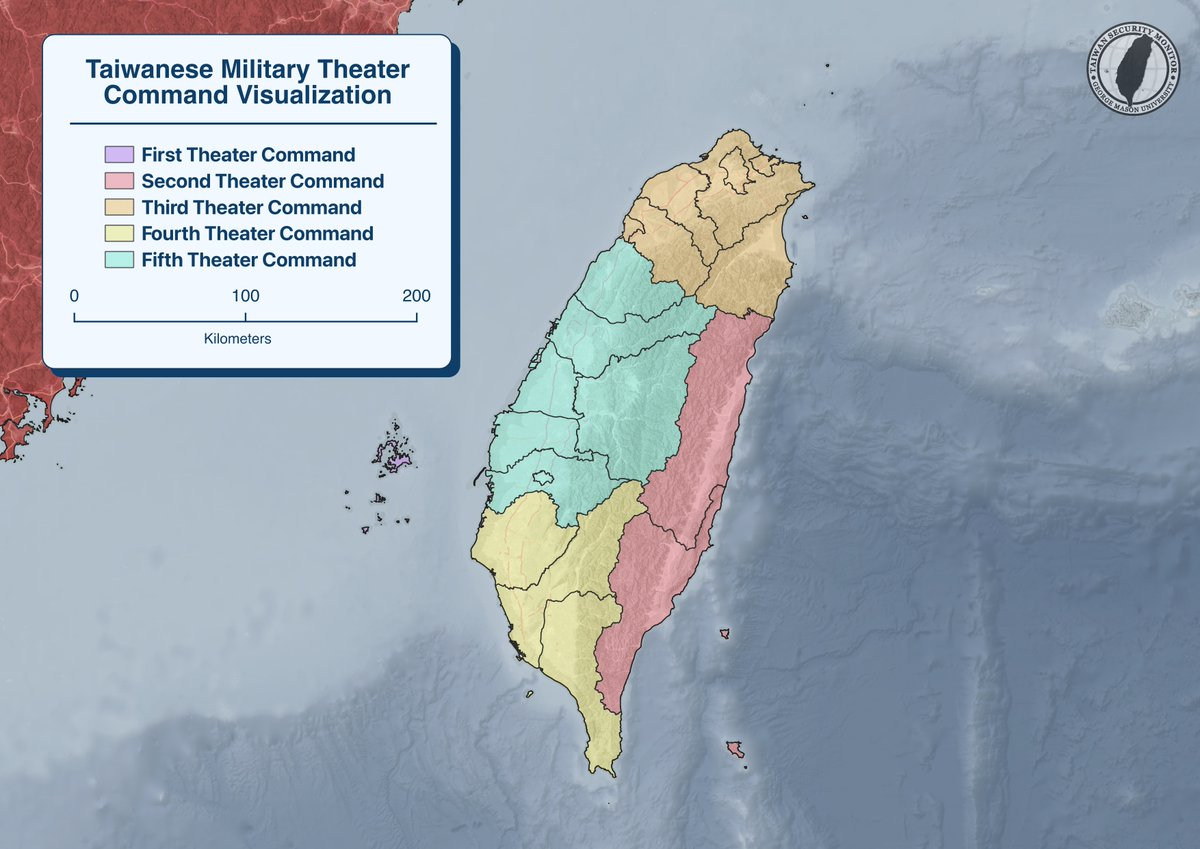
In 2021, Taiwan’s military reorganized its command structure into several “operational zones” (ไฝœๆˆฐๅ€), also often called “operational theaters” . These zones represent the integrated command of Taiwan’s different armed services.

Recently, Taiwan’s MND announced each command will have an integrated UAV battalion by 2026. Our visualization shows the breakdown of each command’s territorial jurisdiction.

Visualization: U.S. Taiwan Defense Command Force Distribution, 1973

Author: Noah Reed


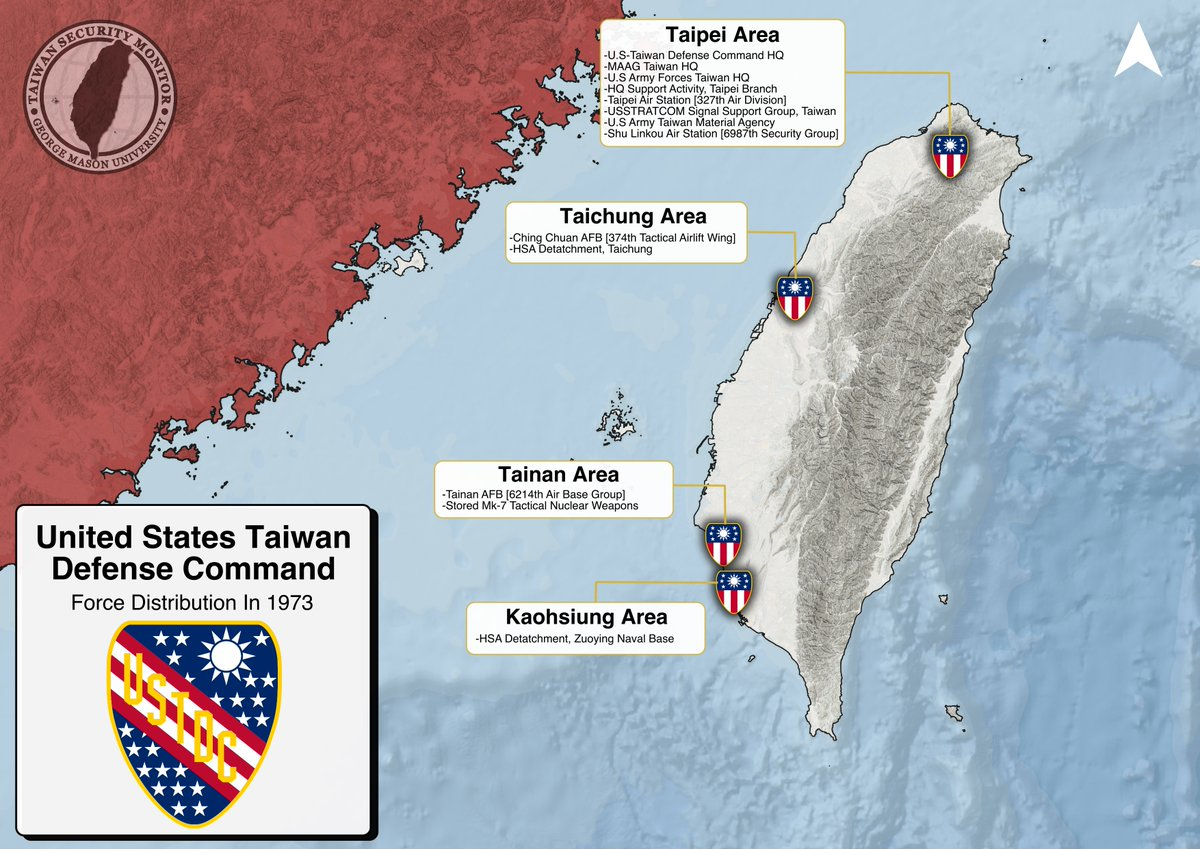
From 1955 to 1979, the United States stationed thousands of military personnel and even deployed several nuclear weapons to Taiwan under the U.S.โ€“ROC Mutual Defense Treaty. These forces were organized under the United States Taiwan Defense Command (USTDC), which operated as part of the U.S. Pacific Command (USPACOM), now known as USINDOPACOM. The USTDC was disbanded in 1979, following the recognition of the PRC.

Our visualization illustrates the distribution of USTDC combat and administrative units in 1973, shortly before the removal of nuclear weapons and drawdown of personnel. The visualization is based on declassified Cold Warโ€“era documents.