Taiwan Security Monitor

Justice Mission–2025: The Narrative Battle Inside China’s Latest Taiwan Exercise

Author: Jonathan Walberg


When the People’s Liberation Army’s Eastern Theater Command launched its Justice Mission–2025 exercises around Taiwan on December 29th, the visible indicators were familiar: joint air and naval maneuvers,[1] expanded operating zones, and calibrated signaling toward Taipei and external actors.[2] What distinguished this iteration was not just the scale or geometry of the activity, but the depth and coherence of the narrative campaign that unfolded alongside it.

Rather than treating messaging as post hoc propaganda, Beijing used Justice Mission–2025 to actively storyboard a theory of coercion in real time. A coordinated series of posters released through PLA and affiliated channels visually depicted how Beijing intends to punish pro-independence forces; why such punishment is legitimate, and why resistance is futile. In the days immediately following the exercise, Taiwan Affairs Office (TAO) press conferences reinforced and formalized those same narrative frames through authoritative political language.

Taken together, the posters and follow-on statements show how China increasingly integrates narrative warfare with military signaling to shape Taiwanese and American expectations about legitimacy, inevitability, escalation, and identity.

Justice as the Organizing Frame of the Exercise

The narrative architecture of Justice Mission–2025 begins with the exercise name itself: “Justice Mission–2025” (正义使命–2025). The term zhengyi (justice or righteousness) is used to morally pre-legitimize the operation. The exercise is framed not as discretionary pressure or political signaling, but as enforcement of an already rightful order. Beijing’s message is that the mission is “justice,” and resistance is implicitly illegitimate.

The narrative architecture of Justice Mission–2025 begins with the exercise name itself: “Justice Mission–2025” (正义使命–2025). The term zhengyi (justice or righteousness) is used to morally pre-legitimize the operation. The exercise is framed not as discretionary pressure or political signaling, but as enforcement of an already rightful order. Beijing’s message is that the mission is “justice,” and resistance is implicitly illegitimate.

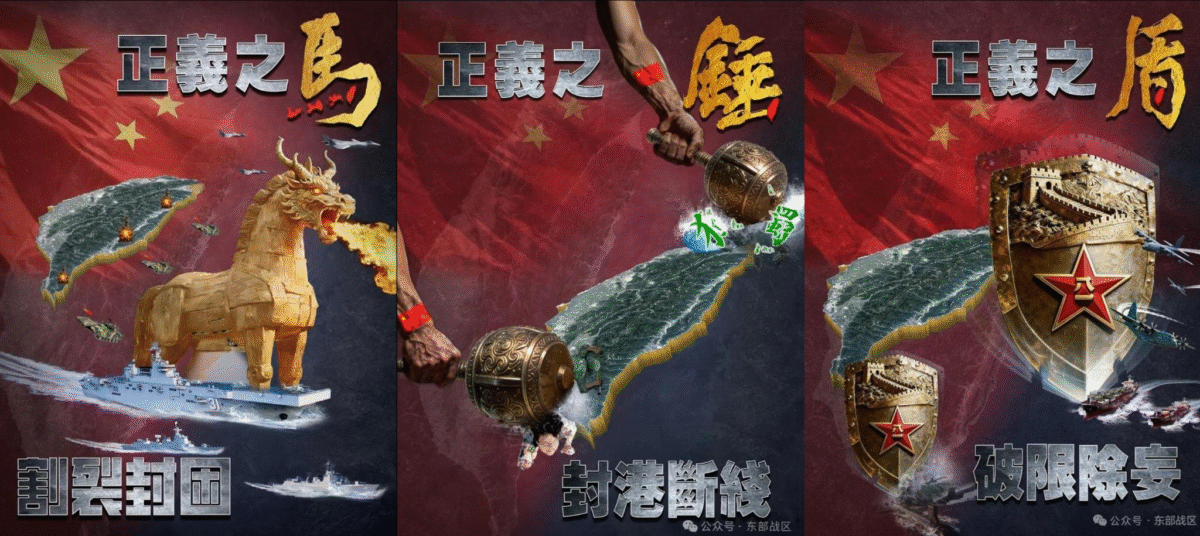
This framing was reinforced with a reiteration of messaging on “How to Curb ‘Independence.” The phrasing is revealing. Instead of depicting a political dispute between two actors, the problem is framed as a technical control challenge: how to suppress or restrain a condition. “Independence” becomes something mechanical to be constrained rather than a societal preference or political identity. Taiwan itself is rendered visually as an object—cut by cables, fractured into segments, encircled by forces—reinforcing a systems-control worldview rather than a political one.

The TAO immediately echoed this framing after the exercise. Responding directly to Justice Mission–2025, a spokesperson described the PLA’s actions as “a necessary and just measure to safeguard national sovereignty and territorial integrity” and “a stern warning” to “Taiwan independence” and “external interference.”[4] The political language locks in the moral logic embedded in the posters: coercion is corrective, not escalatory.

Shield and Sword: Encoding Enforcement Logic

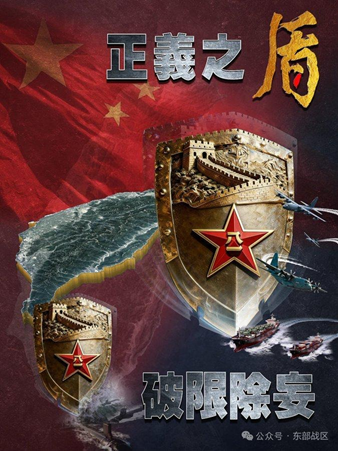
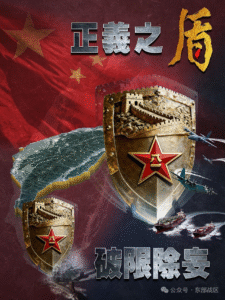
Several of the exercise posters establish a clear moral dualism between protection and punishment. “Shield of Justice” (正义之盾) depicts PLA symbolism forming a protective barrier over Taiwan, visually communicating that China is acting as a stabilizing force safeguarding rightful order.[5] This poster also features a shield bearing the Great Wall of China forcing American C-130s to turn away from Taiwan. The messaging here is clear: To the people of Taiwan, America won’t be able to come to your aid. To Washington, your efforts to intervene in a contingency will be futile compared to the ‘great power’ of China, as shown through the symbolism of the Great Wall.

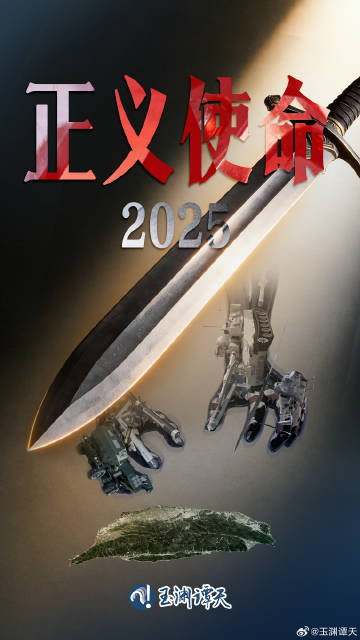
Building off of this messaging is another poster titled “Sword of Justice” (正义之剑), which depicts a blade striking downward into the island.[6] Justice is not passive; it enforces compliance. Punishment is portrayed as morally righteous rather than coercive. Together, the shield-and-sword motif communicates a simple conditional logic: alignment brings protection, resistance brings righteous force.

This same logic surfaced in TAO messaging tied to the exercise. Officials accused the Lai administration of “recklessly colluding with external forces,” “selling out Taiwan,” and pushing the island toward confrontation, while warning that such actions “will be firmly struck down.”[7] The sword imagery becomes political language: punishment is framed as an unavoidable consequence rather than a choice. Another TAO briefing extended the sword narrative outward toward external actors, warning that any country or force that “plays with fire on the Taiwan question will inevitably pay a price,” reinforcing deterrence signaling that accompanied the exercise’s expanded operational footprint.[8]
Systemic Isolation: Ports, Cables, and Everyday Vulnerability

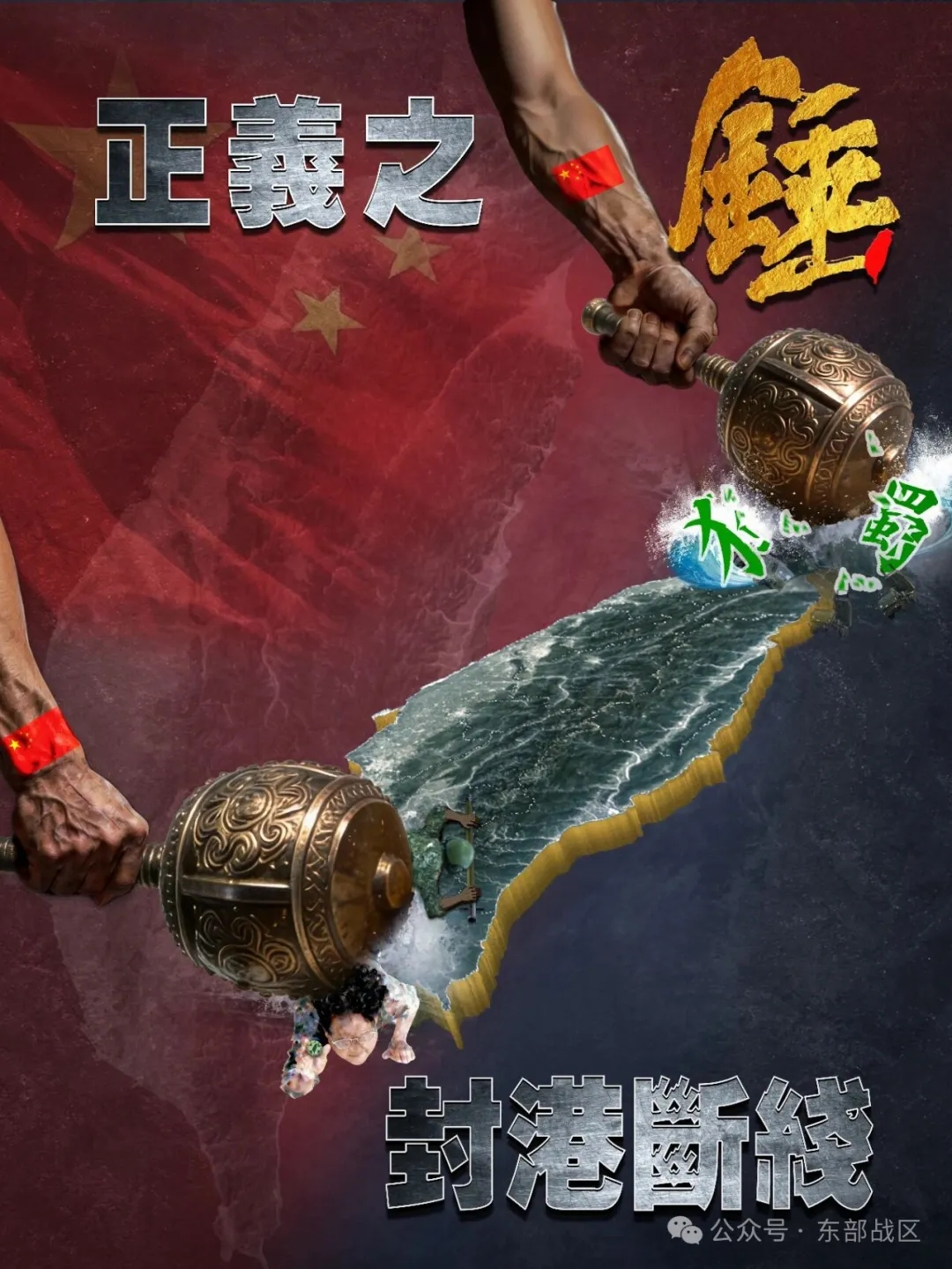
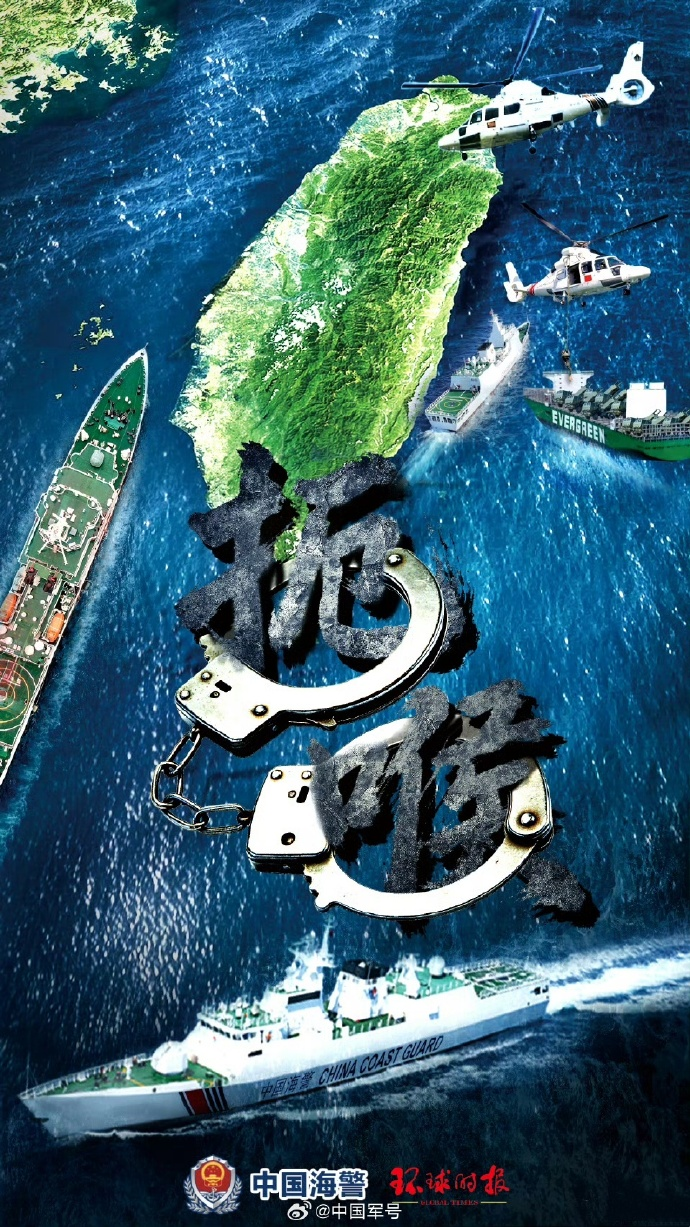
One of the most analytically important themes of the Justice Mission–2025 posters is the emphasis on systemic isolation rather than battlefield confrontation. “Seal Ports, Cut Lines” (封港断线) depicts hammers crushing Taiwan in the North and South, and maritime access constrained.[9] Another poster shows handcuffs on the island, and Chinese Coast Guard vessels “choking off” Taiwan’s ports.[10] In this messaging, Taiwan’s vulnerability is framed not primarily in terms of military defeat, but in terms of disrupted connectivity: data flows, trade routes, energy supply, logistics, and digital lifelines.

This logic is paired with a carefully calibrated assurance. The posters and TAO statements consistently distinguish between “Taiwan independence forces” and the broader population, framing coercion as corrective rather than collective. This is a classic coercive move: threats are made credible by being conditional, while reassurance is offered to those willing to disengage from the targeted behavior. The message is not that Taiwan as a society must be destroyed, but that normalcy will return once pro-independence leadership is rejected.

This imagery subtly shifts the imagined battlespace away from amphibious invasion toward persistent, incremental coercion applied against civilian infrastructure and economic normalcy. The message is that pressure can be sustained below traditional thresholds of war while still imposing cumulative strategic effects.

Post-exercise TAO messaging reinforced this normalization logic through law-enforcement framing. In a briefing addressing mainland China Coast Guard activity near Kinmen, the spokesperson asserted that there are “fundamentally no such things as so-called ‘restricted waters’” and that patrols are conducted “in accordance with the law” to maintain navigation order and protect fishermen.[11] Maritime pressure is reframed as routine governance rather than escalation.

This political framing directly complements posters featuring handcuffs and Coast Guard imagery. Together, they normalize gray-zone pressure as administrative control rather than crisis behavior, as well as push the norm of Chinese ships being able to interdict vessels heading to Taiwan’s ports.[12]

Deter Externally, Contain Internally: Managing Escalation

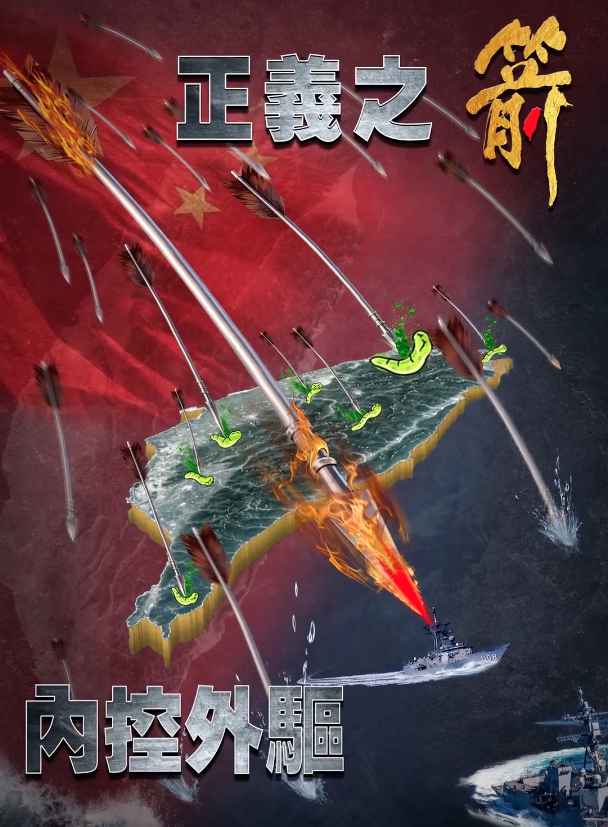
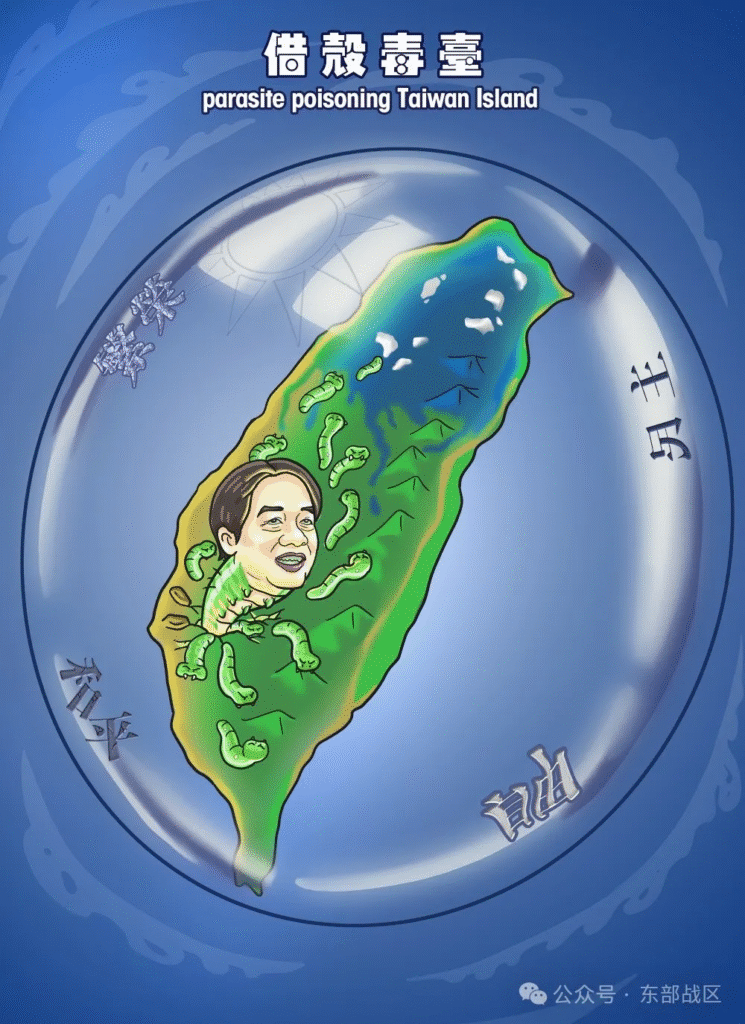
Another poster cluster encodes escalation management logic. “Counter External Influence” (反控外调) sits above a set of arrows in flight at Taiwan, implicitly threatening the Taiwanese people.[13] The arrows are piercing green worms, a reference to an earlier 2025 poster displaying Taiwan President Lai Ching-te as a green worm.[14] The imagery reflects not operational anti-access in the narrow military sense, but a narrative adaptation of anti-access logic. Rather than depicting missiles denying airspace or sinking ships, the posters show arrows striking Taiwan itself, signaling that foreign involvement will translate into intensified pressure on the island. The intended audience is therefore not primarily external militaries, but Taiwanese observers being warned that outside intervention will not insulate them from coercion. In this sense, the messaging exploits both Taiwanese vulnerability and U.S. preoccupation with anti-access scenarios, emphasizing political consequences over operational mechanisms.

Language from the TAO tied directly to Justice Mission–2025 reinforced this precise logic. Officials emphasized that the PLA’s actions target “separatist activities and external interference—not the people of Taiwan,” while urging Taiwanese citizens to recognize the danger of their leadership’s course and oppose independence.[15] The narrative pressures Taiwan internally while attempting to reduce reputational costs externally.
Precision and Exposure: Targeting Critical Nodes

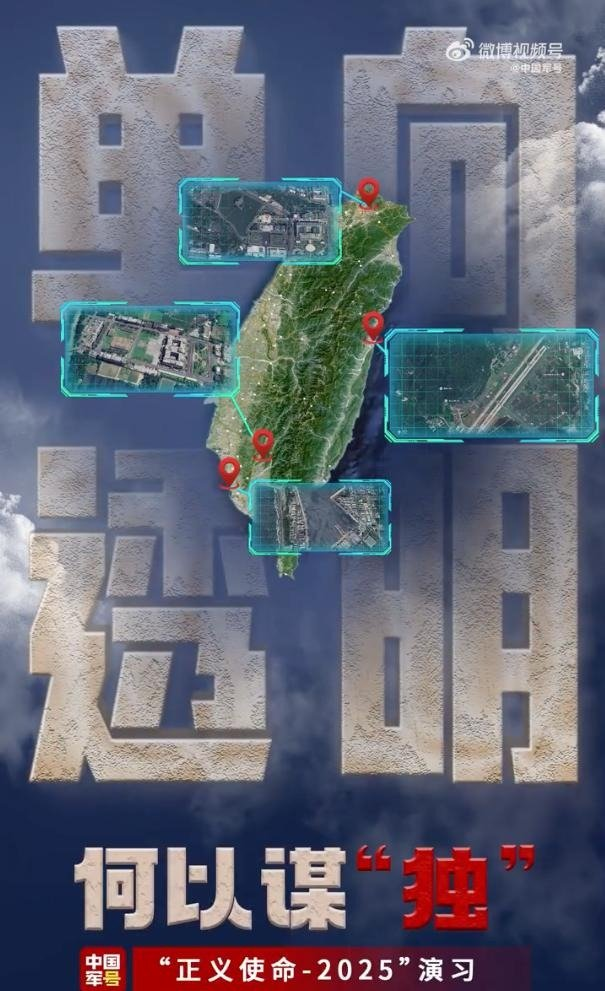
Several posters emphasize surveillance and precision dominance. “Lock the island” (锁岛) overlays Taiwan with targeting graphics and highlighted infrastructure nodes. Below it, the message of “How could you possibly pursue ‘independence’?” (何以谋“独” )[16]. The narrative message is omniscience: critical systems are known, mapped, and vulnerable. Coercion is framed as precise and technologically controlled rather than indiscriminate. Beijing intentionally couples its supposed revelation of Taiwanese capabilities in an attempt to puncture the hope the Taiwanese have in their own military. 

This reinforces deterrence through perceived exposure rather than sheer destructive threat. Psychologically, it compresses uncertainty and signals that escalation pathways are already mapped.

Narrative Warfare as Operational Preparation

Justice Mission–2025 demonstrates that China increasingly treats exercises as integrated narrative operations rather than isolated military demonstrations. The posters storyboarded a coercive pathway: justice and legitimacy; suppression of independence; protection and punishment; systemic isolation; escalation control; precision targeting; and administrative normalization. The TAO then formalized that storyboard into authoritative political language.

The objective is not merely intimidation. It is expectation management: normalizing coercion, relocating blame, compressing escalation timelines, and psychologically conditioning audiences toward acceptance of pressure as lawful and inevitable through calibrated threats and assurances that deliberately play to existing fears: Taiwanese fears of isolation and cutoff, accommodationist hopes that restraint will restore normalcy, and external concerns that China can exploit anti-access dynamics to keep interveners out.

For analysts and policymakers, the implication is methodological as well as strategic. Monitoring aircraft counts and maritime tracks alone no longer captures the full signaling environment. Visual messaging, slogan sequencing, and political language now provide early indicators of how Beijing conceptualizes coercive pathways and escalation control.

Justice Mission–2025 illustrates how narrative warfare is being embedded directly into China’s military signaling toolkit, shaping how future coercion will be interpreted long before a crisis unfolds.


[1] https://x.com/TaiwanMonitor/status/2005636702183039129?s=20

[2] https://tsm.schar.gmu.edu/visualization-historical-pla-exercise-zones-2022-2025/

[3] https://x.com/TaiwanMonitor/status/2005431801721094379?s=20

[4] https://tsm.schar.gmu.edu/taiwan-affairs-office-the-plas-military-operations-are-a-solemn-warning-to-taiwan-independence-separatist-forces-and-external-interference-forces/

[5] https://x.com/TaiwanMonitor/status/2005453180860084427?s=20

[6] https://x.com/TaiwanMonitor/status/2005456163249192993?s=20

[7] https://tsm.schar.gmu.edu/taiwan-affairs-office-any-taiwan-independence-separatist-actions-will-never-be-tolerated-and-will-be-met-with-severe-punishment/

[8] https://tsm.schar.gmu.edu/taiwan-affairs-office-any-country-or-force-that-plays-with-fire-on-the-taiwan-question-will-inevitably-pay-a-price/

[9] https://x.com/TaiwanMonitor/status/2005807062735790564?s=20

[10] https://x.com/TaiwanMonitor/status/2005837836851855481?s=20

[11] https://tsm.schar.gmu.edu/taiwan-affairs-office-the-coast-guard-is-conducting-law-enforcement-patrols-in-the-relevant-waters-to-safeguard-the-lives-and-property-of-fishermen-on-both-sides-of-the-taiwan-strait/

[12] https://x.com/TaiwanMonitor/status/2005837836851855481?s=20

[13] https://x.com/TaiwanMonitor/status/2005456163249192993?s=20

[14] https://www.globaltimes.cn/page/202504/1331297.shtml

[15] https://tsm.schar.gmu.edu/taiwan-affairs-office-the-plas-military-operations-are-a-solemn-warning-to-taiwan-independence-separatist-forces-and-external-interference-forces/

[16] https://x.com/TaiwanMonitor/status/2005473337783492633?s=20
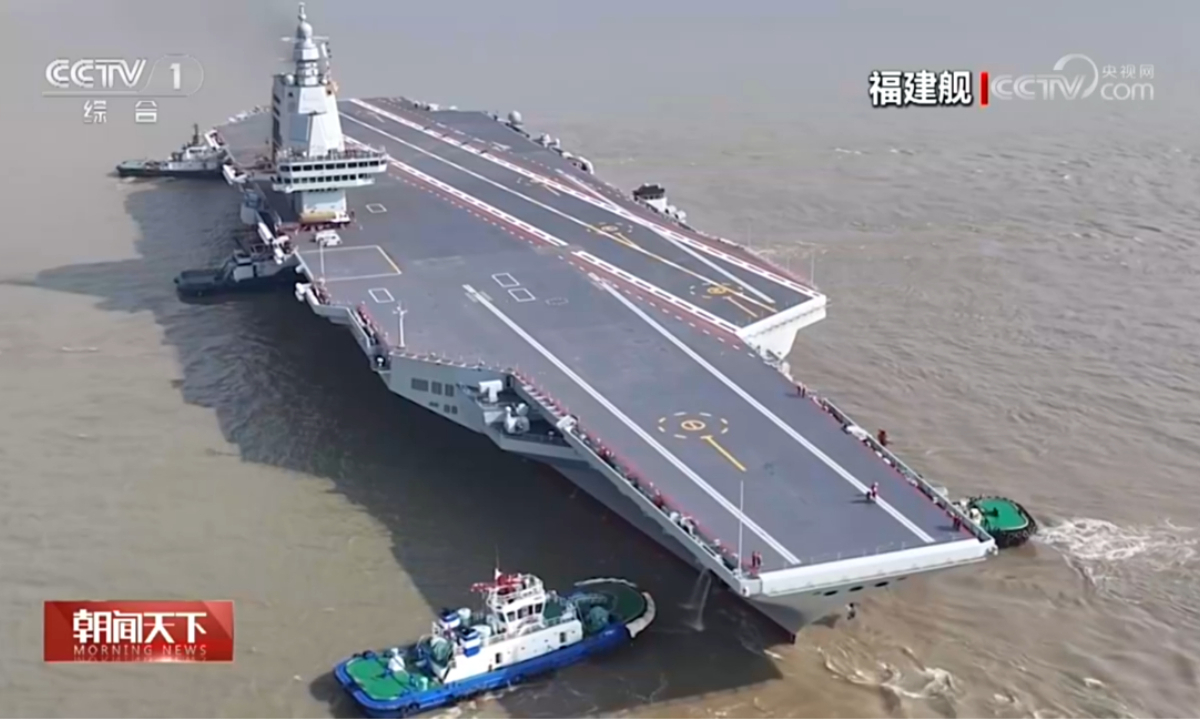
Failure to Launch: How Political Backpedaling Could Hand China the Carrier Edge​

Authors: Ethan Connell & Jonathan Walberg


TSM Research Lead Ethan Connell and Associate Director Jonathan Walberg write about the necessity of electromagnetic launch systems (EMALS) on modern aircraft carriers, and on why a U.S. shift back to steam-powered launch systems could be catastrophic.

Read the full piece here.

Taiwan Announced Billions More for Defense. Here’s How It Can Deliver.

Author: Jonathan Walberg


TSM Associate Director Jonathan Walberg writes about the necessity of a new Taiwanese annual strategy document.

Read the full piece here.

Creeping Closer: Timeline and Analysis of the Justice Mission-2025 Joint Exercise

Authors: Noah Reed, Ethan Connell, & Jonathan Walberg


From December 29th to 31st, the Eastern Theater Command (ETC) of the People’s Liberation Army (PLA) held exercise “Justice Mission-2025” (正义使命-2025) in the waters and airspace surrounding Taiwan. The drills, described by Chinese state media as a response in part to the United States’ US$11.1 billion arms package to Taiwan announced two weeks prior,[i] were the 5th and most significant round of joint exercises around Taiwan since Nancy Pelosi’s 2022 visit to Taiwan.[ii]

While following the overall thematic and operational rhythm established in prior exercises following 2022, Justice Mission-2025 also produced several firsts. These include the closest live-fire exercise to date, and the first use of a Type 075 amphibious assault ship in a joint-exercise. The exercise also featured a notable increase in attention devoted to psychological warfare and political messaging elements.

As has been the case in all past joint exercises, Justice Mission-2025 was described first and foremost as a “Serious warning to ‘Taiwan Independence’ separatist forces and external interference” by the People’s Republic of China’s (PRC) Ministry of National Defense (MND). (对“台独”分裂势力与外部势力干涉的严重警告.)[iii]

Overall, Justice Mission-2025 fulfilled a dual mandate. First, it provided relevant operational experience for the PLA and China Coast Guard (CCG), something represented in the growing scale of joint-exercises since 2022 as the PLA expands in reach and scale. Second, it sent a signal of frustration over the state of cross-Strait relations to Washington, while also attempting to place the blame for the deterioration of those relations on the incumbent Democratic Progressive Party and President Lai Ching-te.

Operational Sequencing of the Exercise

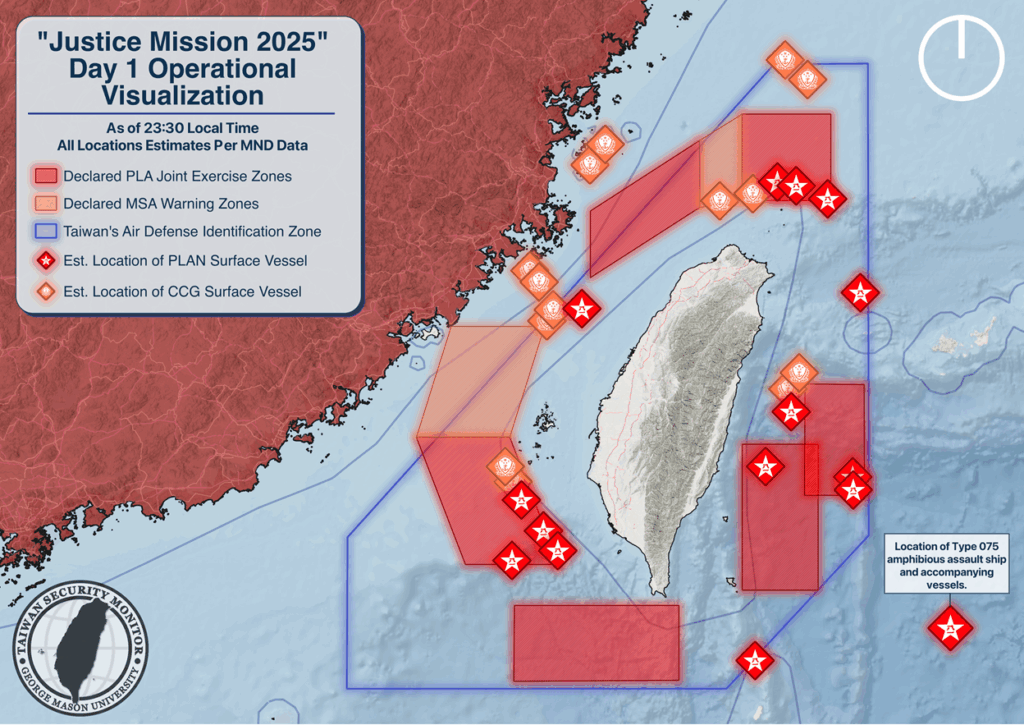
Day 1 Overview: Overall, Taiwan’s MND detected 89 aircraft and 28 naval vessels, split into 15 PLAN vessels and 13 CCG vessels, operating around Taiwan during day one of the Justice Mission-2025 exercise. The day was marked by several operational themes, including:

  1. A focus on airpower, including long-range air superiority, airspace encirclement, and airborne early warning.
  2. A focus on sea-air coordination, especially as it relates to the detection and destruction of surface and sub-surface vessels.
  3. A focus on the airspace and waters east of Taiwan, consistent with an overall focus on deterring “external interference.”

29 December (All Times Local)

0730-0800: Spokesperson of the ETC of the People’s Liberation Army, Senior Colonel Shi Yi, announced that it had dispatched its Army, Navy, Air Force, and Rocket Force troops to conduct joint military drills codenamed “Justice Mission 2025” in the airspace and waters surrounding Taiwan.[iv]

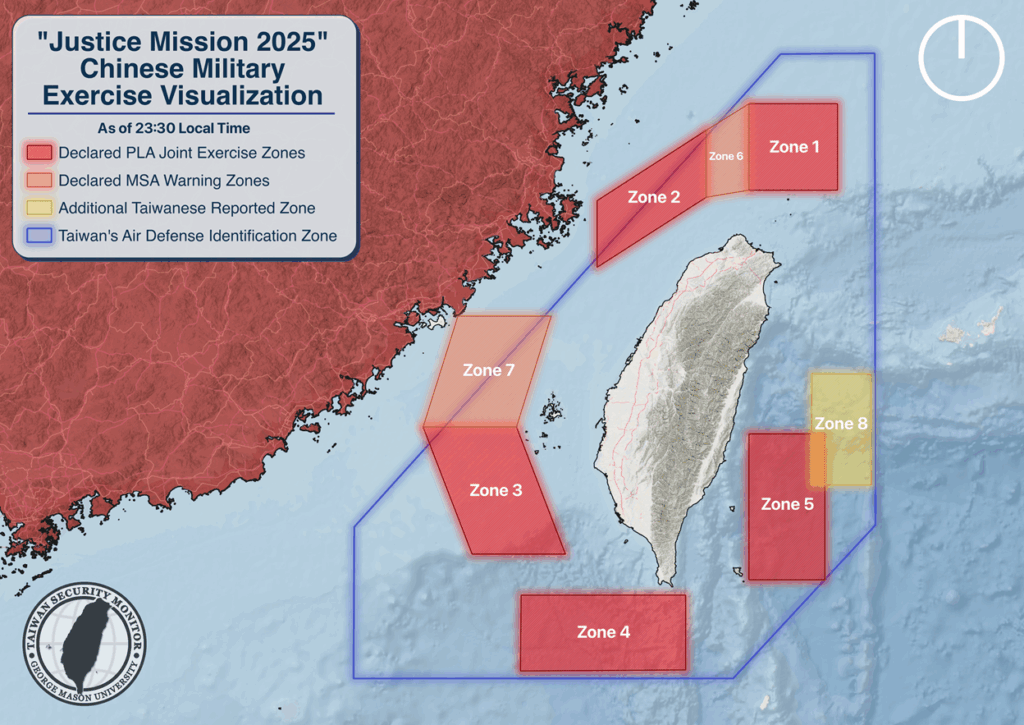
Alongside this announcement was the release of a navigation warning with five prohibited entry zones within which live-fire exercises would take place the following day. Later in the day, the PRC’s Maritime Safety Administration (MSA) published two additional warning zones. The ETC later added an eighth zone to the east of Taiwan over radio, although they never announced it publicly via navigational warning.

Five of the eight declared zones violated Taiwan’s territorial waters. Zone four’s boundary ran less than five nautical miles from Taiwan’s southern coast. However, at no point did Chinese vessels cross into Taiwan’s territorial waters. All Chinese vessels operated in the area between Taiwan’s contiguous and territorial waters.

Notably, Taiwan’s Ministry of National Defense (MND) disclosed that its intelligence agencies had noticed irregular activity and possible preparation several days prior to the start of “Justice Mission,” which contrasts with a claim by Chinese state media that the operation represented a “cold start” or “snap exercise.”[v]

0800-0930: Approximately one hour after announcing the exercise, the PLA’s ETC claimed that it had mobilized fighters, bombers, unmanned aerial vehicles, and long-range rocket units to strikes on simulated mobile ground targets in the “middle areas” of the Taiwan Strait.[vi] Taiwan’s MND did not report any rocket impacts in the Taiwan Strait during this time, and the ETC did not release footage of these strikes as it did on the next day.

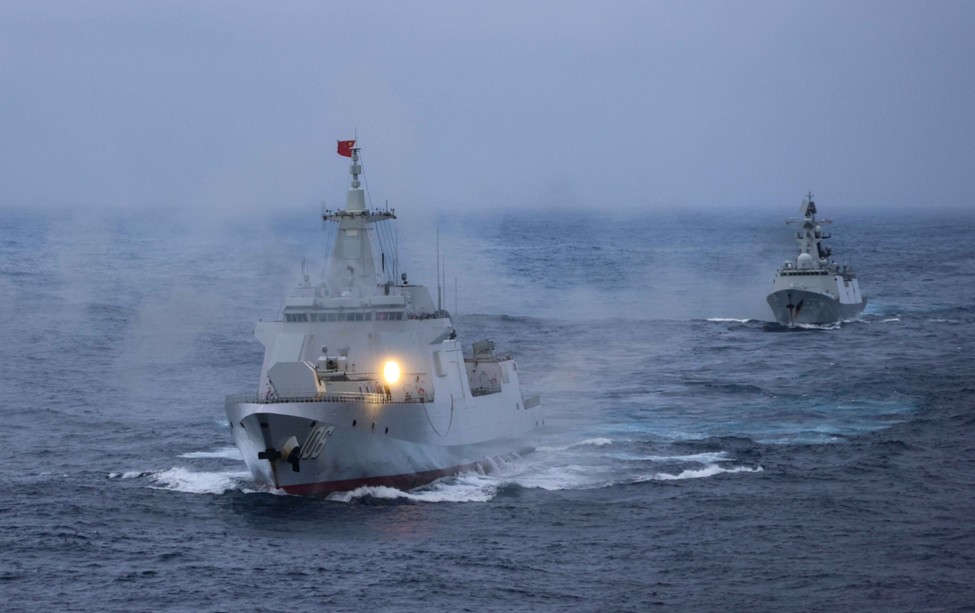
0930-1130: At 1000, Taiwan’s MND released a statement condemning the exercise and announced the beginning of rapid response exercises and a state of high alert.[vii] One hour later, the ETC announced maritime live-fire training to the north and southwest of Taiwan, employing destroyers, frigates, fighters, bombers, and unmanned aerial vehicles. The training focused on hunting and neutralizing targets, simulated ground strikes, and live firing against targets.[viii]

An article in the PLA Daily newspaper published on the morning of the 30th identified several of the ships involved in this portion of the exercise, including the Baoyi, Quzhou, and Taiyuan ship formations.[ix]

1130-1230: At 1200, the ETC announced that it had dispatched destroyers, frigates, fighters, and bombers to conduct anti-submarine and sea-air coordination exercises to the east of the Taiwan Strait.[x] The ETC released initial footage from the exercise, showcasing elements of all involved services at around this time.

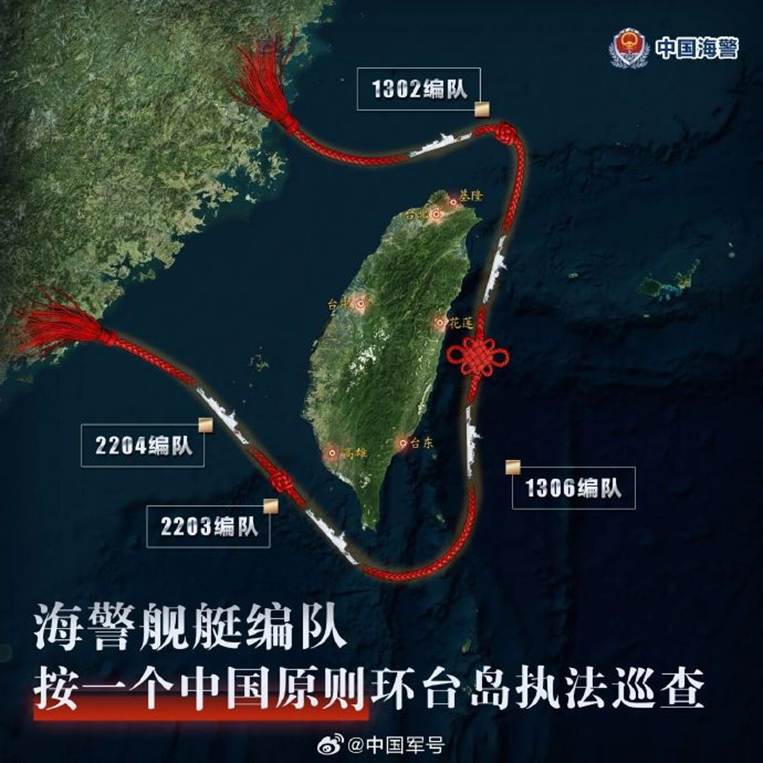
On the heels of this announcement, the CCG announced that it was carrying out “comprehensive law-enforcement patrols” in waters surrounding Taiwan and the areas near the Matsu and Wuqiu islands. Taiwan’s Coast Guard Administration (CGA) claimed that it had detected increased CCG activity several hours prior to the CCG’s official announcement.[xi]

MarineTraffic Automatic Identification System (AIS) data, which shows the last pinged location of certain vessels, confirmed this claim, as several CCG vessels, including CCG 1303 and 1302, were already observed operating north of Taiwan by 12:00.[xii] TSM researchers subsequently confirmed that CCG vessels 14609, 14606, 1302, 1306, 2203, 2204, 1303, 1303, 1302 also participated in these patrols on the 29th.[xiii]

Poster showcasing involved CCG vessels published by China’s Coast Guard Weibo Account

1230-1630: At 1500, the ETC conducted regional patrol, information support, and aerial confrontation drills using airborne early warning aircraft, fighters, and electronic warfare aircraft to the southwest of Taiwan.[xiv] An hour later, the ETC dispatched bomber task forces to conduct far-seas combat readiness patrols east of Taiwan, focusing on long-distance joint precision strikes in remote areas.[xv]

1600-0000: At 1700, the ETC reported that a Type 075 amphibious assault ship and several accompanying vessels were operating Southeast of Taiwan. According to state media, this represented the first time the PLA had deployed a Type 075 around Taiwan during a joint exercise.[xvi]

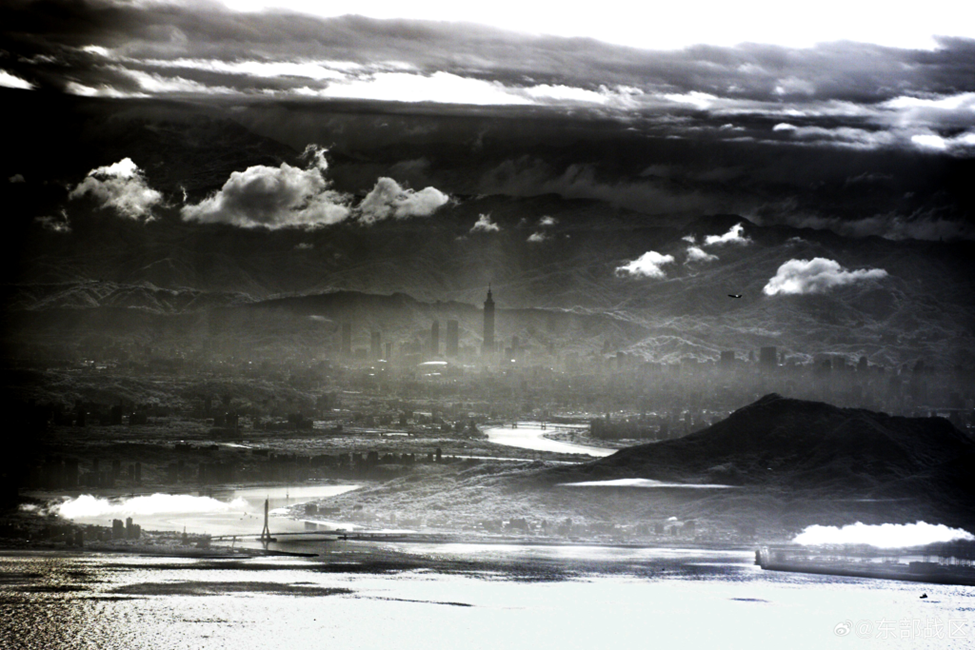
Finally, at 2000, the ETC released footage claiming to show a TB-001 UAV from the PLA Rocket Force’s 61st Base operating close to Taipei City near the Tamsui River outlet.[xvii] Taiwan’s MND has disputed the authenticity of the footage, reporting that no drone entered Taiwan’s airspace during the exercise.

Image circulated by PRC State Media claiming to show a UAV’s photo capture of New Taipei

30 December (All Times Local)

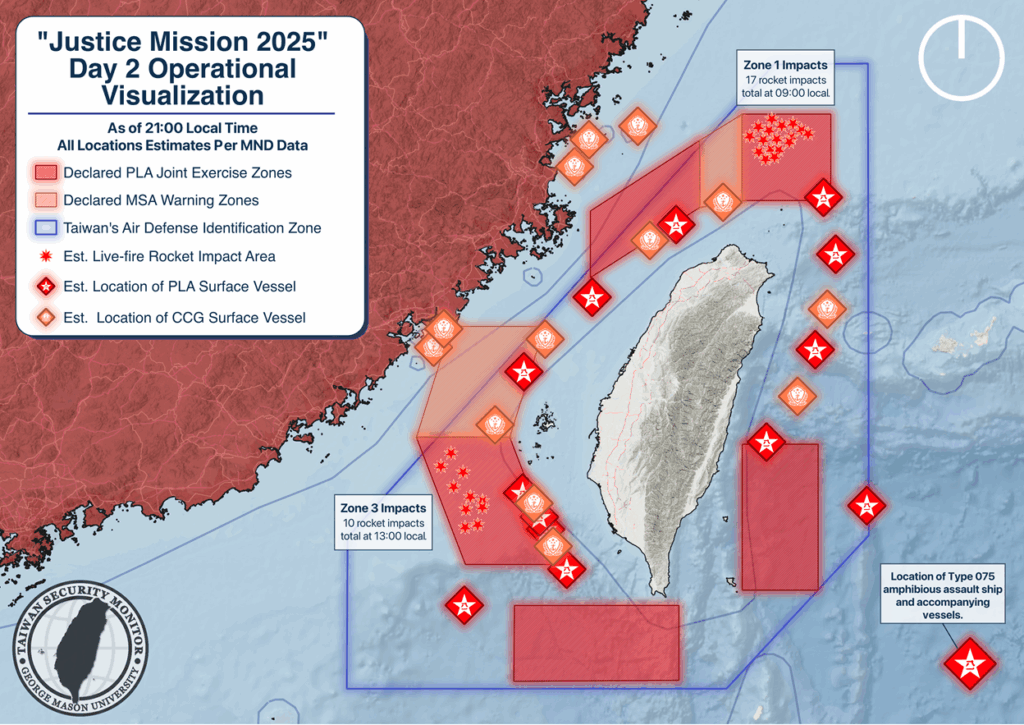
Day 2 Summary: Taiwan’s MND reported 71 aircraft, 17 PLAN vessels, and 15 CCG vessels around Taiwan by 1500 on day 2 of Justice Mission-2025. In addition, Taiwan detected a total of 27 rocket impacts in the waters north and south of Taiwan over this period.

The second day of the drills focused on blockade operations and targeted strikes, marking the closest live-fire drills around Taiwan on record.

0730-0800: The second day of Justice Mission-2025 began at 0800, when the ETC announced that fighters, bombers, frigates, and destroyers were conducting integrated blockade and control operations, to include identification, warning, and anti-air and submarine operations, to the north and south of Taiwan.[xviii]

0800-1200: At 0900, the ETC initiated the first of two rounds of live-fire long-range rocket drills in exercise zone 1. According to Taiwan’s MND, PHL-16 self-propelled Multiple Rocket Launcher Systems (MLRS) from the 72nd Group Army’s Rocket Artillery Brigade in Pingtan County, Fujian, fired at least 17 rockets into this zone.[xix]

1200-0000: At approximately 1300, PHL-16 MLRS from the 73rd Group Army’s Rocket Artillery Brigade in Shishi, Fujian, initiated a second round of live-fire long-range rocket drills. [xx] These launches targeted Zone 3 to the south of Taiwan. Taiwan’s MND reported 10 rocket impacts in the exercise. [xxi]Taiwanese media outlets reported that ten rockets from the two sets of launches landed within Taiwan’s contiguous waters zone, marking the closest ever recorded impacts during a live-fire exercise.[xxii]

The remainder of Day 2 was mostly devoted to a series of poster and video releases by the Eastern Theater Command and China Coast Guard, who continued their “comprehensive law enforcement patrols” into the second day.

31 December (All Times Local)

The ETC announced the end of the exercise at 16:00 on December 31. It is not clear why the ETC delayed announcing the end of the exercise until 31 December, as all exercise warning zones had already expired the day prior. Furthermore, MarineTraffic AIS data showed that China Coast Guard vessels had begun pulling back from the waters around Taiwan earlier in the day.[xxiii] In prior exercises, the ETC usually announced the end of exercises on the last day of heavy activity.

Notably, the ETC had released no prior exercise updates on the 31st, and Taiwan’s MND reported only 1 aircraft violating the Air Defense Identification Zone (ADIZ) over this period.[xxiv]

Justice Mission-2025’s Propaganda Dimensions

Beijing deliberately crafted the messaging and reporting surrounding Justice Mission to frame the exercise as a “stern warning” to Taipei and its international supporters. Official statements and state media reports consistently emphasized the operation as a “legitimate and necessary action” to defend the PRC’s sovereignty and promote unification.[xxv] PRC spokespeople explicitly connected the drills to Washington’s mid-December approval of a record US$11.1 billion arms package for Taiwan, framing the exercise as a direct “punitive and deterrent action” in response.[xxvi] Foreign Ministry officials accused Taiwan’s ruling party of transforming the island into a “powder keg” through military expansion and arms acquisitions, cautioning that U.S. efforts to “arm Taiwan to contain China” would “only embolden the separatists and push the Taiwan Strait closer to the peril of armed conflict.”[xxvii] This external context was central to PRC rhetoric, enabling Beijing to justify the drills as compelled by hostile provocations and reinforcing its narrative that Democratic Progressive Party (DPP) leaders are “provocateurs” responsible for escalating tensions.

Official posters and slogans likewise adopted an overtly threatening tone, emphasizing the PLA’s capacity to isolate and strike Taiwan. PLA media accounts disseminated a series of dramatic infographics and posters suggesting that Taiwan would be defenseless in a military confrontation. For instance, one poster depicted PLA forces severing Taiwan’s supply lines, accompanied by the caption “Supply cut off – how can [you] pursue ‘independence’?” while another highlighted the “overwhelming power gap” between the PRC and Taiwan, with the challenge, “How can you seek ‘independence’ [against such odds]?”[xxviii] These visuals, often given titles like “Hammer of Justice” or “Arrow of Justice,” portrayed missiles targeting the island and blockade operations restricting access to Taiwan’s ports.[xxix]

The central message was that Beijing’s military strength serves as a tool of righteous punishment, capable of simultaneously defeating “Taiwan independence” forces and deterring external intervention from the United States. One “Arrow of Justice” poster went further by depicting a missile and volleys of arrows plunging into Taiwan itself, with lurid green “worm” figures, a common stand-in for the DPP/“Green camp,” splattered across the island, visually signaling not just blockade or deterrence but the targeted eradication of “internal” pro-independence actors. Paired with the slogan “內控外馳” (“control internally, charge outward”), the imagery suggested Beijing could simultaneously suppress “Taiwan independence” forces on the island while striking outward to deter or punish external intervention.

 PRC civilian agencies also contributed to the propaganda campaign. For example, the China Coast Guard promoted its involvement in the drills through graphics of patrol ships encircling Taiwan and slogans such as “Taiwan is China’s inherent territory,” thereby reinforcing the exercise’s dual military and law-enforcement objectives in asserting sovereignty.[xxx]

Initial announcement poster for Justice Mission 2025. The poster depicts the PRC as two shields emblazoned with the Great Wall, defending Taiwan from the external influence of American arms sales and military platforms.

Official statements from Beijing’s civilian and military representatives reinforced these themes. The State Council’s Taiwan Affairs Office (TAO) described the Justice Mission maneuvers as a “solemn warning” to separatists and foreign actors, calling them a “necessary and just measure” to protect China’s territorial integrity.[xxxi] TAO spokespersons accused the DPP administration of “recklessly colluding with external forces” and pursuing “independence” at the expense of Taiwan’s security and welfare. They cited President Lai Ching-te’s government’s acceptance of U.S. arms and support, claiming this militarization was leading the island down a “dangerous path.”[xxxii] Beijing repeatedly stated that its actions targeted “Taiwan independence” elements and their supporters, not the general population. TAO officials emphasized that “people on both sides of the Strait are one family,” and that PLA operations were directed only at separatist provocations and were “not [aimed] at the Taiwan compatriots.”[xxxiii] By combining explicit threats with appeals to “Taiwanese compatriots,” the PRC’s narrative sought to weaken support for the DPP by portraying Beijing’s actions as protective and just. At the same time, severe rhetoric toward external actors, warning that any foreign interference would “dash itself to pieces against the steel Great Wall of the PLA,” highlighted the exercises’ additional audience: the United States and other regional observers.[xxxiv] Through coordinated statements and vivid propaganda, the PRC presented Justice Mission-2025 as a lawful and necessary operation to punish separatism, deter U.S. “meddling,” and position itself as the purported defender of national sovereignty and guarantor of peace in the Taiwan Strait.

Regional and US Responses

While US President Donald Trump said that he “wasn’t worried” about Justice Mission-2025,[xxxv] and that his relationship with President Xi remains strong, the State Department called for China to “cease military pressure,” and that Beijing’s actions spiked tensions. Trump’s comment was widely interpreted in divergent ways: by critics as dismissive or inattentive, and by supporters as a signal of confidence meant to convey U.S. military and political dominance. In this sense, the remark functioned less as an assessment of the exercises themselves than as a performative signal aimed at preserving maneuver space and projecting toughness. Following the conclusion of the exercises, on January 1, State Department spokesperson Tommy Pigott reaffirmed the United States’ policy of supporting peace and stability across the Strait, opposing unilateral changes to the status quo.[xxxvi]

On December 30th, South Korea’s Foreign Ministry released a similar statement, calling for “dialogue and cooperation.”[xxxvii] On December 31st, Japan expressed concern over the exercises, with Foreign Ministry press Secretary Kitamura emphasizing that “peace and stability across the Taiwan Strait are important for the international community as a whole.”[xxxviii] The same day in Manila, Philippine Defense Secretary Teodoro expressed deep concern, adding that China’s coercion against Taiwan has implications “beyond the region” and risks stability across the continent.[xxxix] Also making statements expressing concern on New Year’s Eve were Australia and New Zealand,[xl] with Germany,[xli] the United Kingdom,[xlii] and France making announcements the day before.[xliii] Notably, Taiwan’s Foreign Ministry thanked each of these countries for their statements condemning the exercises, including Japan, but left off the United States from the message.[xliv]

Conclusion

Justice Mission–2025 underscored that Beijing is trying to institutionalize a coercive “deal” around Taiwan: headline joint exercises are increasingly treated as a conditional punishment for specific U.S. and Taiwanese actions, while day-to-day gray-zone pressure continues regardless. The exercise showed ongoing improvements in joint fires, sea–air coordination, and geographically dispersed operations, especially east of Taiwan to deter external intervention from the US. The ambiguous third day of the exercise and subdued final phase created uncertainty surrounding the intentions and overall sequence of the exercise.

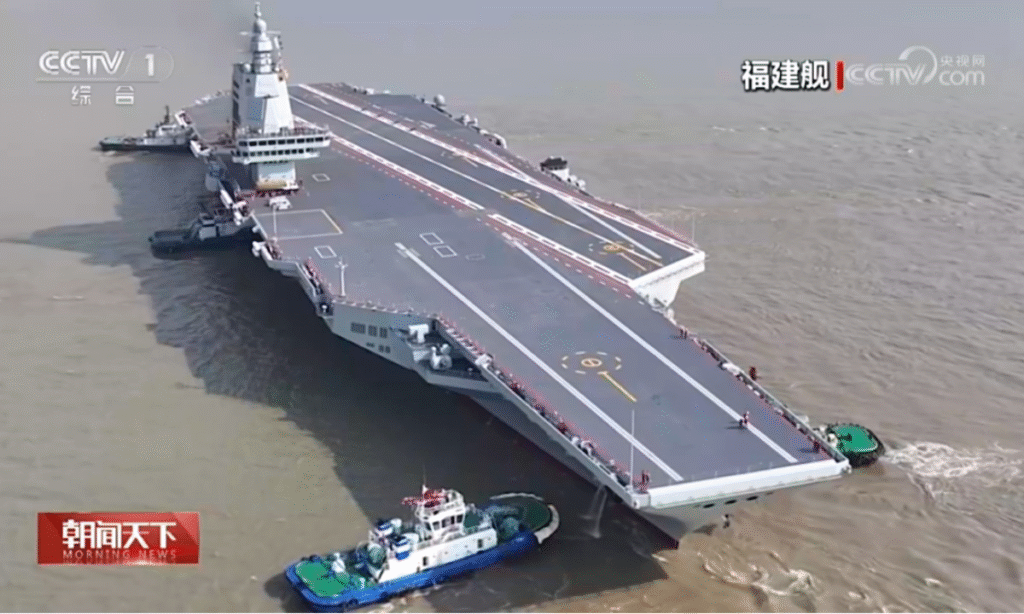
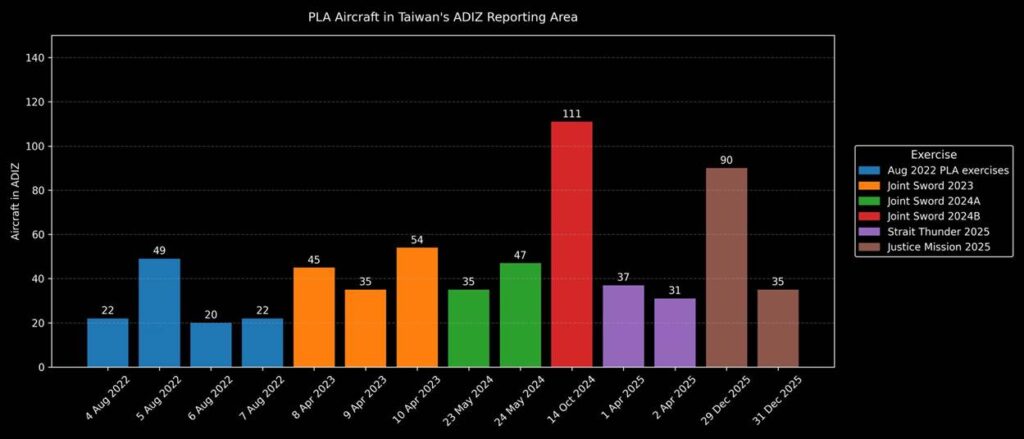
The number of aircraft and naval vessels involved during the exercise naturally grew from prior iterations, as should be expected with an increasingly large and coordinated force. December 29 saw the second-largest single-day ADIZ violation by PLA aircraft on record, with the period from December 29-30 representing the largest overall violation period. Notably, the exercise did not feature an aircraft carrier, instead opting to involve a Type 075 amphibious assault vessel for the first time.

Visualization of ADIZ violations during a major exercise, via Ben Lewis and PLATracker

The exercises featured Beijing’s increasing use of coordinated propaganda, law enforcement involvement, and symbolic imagery alongside military pressure. By linking the drills to U.S. arms sales and rationalizing them as “just” and “defensive,” the PRC aimed to shift blame for escalation to Taipei and Washington while normalizing the PLA’s presence near Taiwan. Regional reactions, which were mostly expressions of concern, underscore the gap between Beijing’s claims of legitimacy and the international community’s view of destabilization. Overall, the exercise suggests that future PLA operations around Taiwan will be frequent, multi-domain, and information-driven, focusing on eroding confidence and complicating decision-making rather than preparing for immediate invasion.


[i] Global Times. ‘Justice Mission 2025’ drills serious warning to ‘Taiwan independence’ separatist forces and foreign interference, MND on comment drills target US arms sale to Taiwan. December 29th, 2025. https://www.globaltimes.cn/page/202512/1351803.shtml

[ii] Prior joint-exercises include: 2023 ”Joint Sword”, Joint Sword 2024-A, Joint Sword 2024-B, and Strait Thunder 2025-A.

[iii] PRC Ministry of National Defense. 国防部新闻发言人张晓刚就东部战区“正义使命-2025”演习答记者问. December 29th,2025.

[iv] PRC Ministry of National Defense. 东部战区海空兵力实施环台岛战备警巡. December 29th, 2025.

[v] Guo Yuandan and Liu Xuanzun. Expert interprets PLA’s ‘Justice Mission 2025’ drill areas as media on Taiwan island describes exercises as ‘sudden’. Global Times. December 29th, 2025. https://www.globaltimes.cn/page/202512/1351721.shtml, Taiwan Military News Agency. 中共片面宣布軍演 國防部:綿密掌握確保國家安全. December 29th, 2025. https://www.mnd.gov.tw/news/mnd/85591

[vi] PRC Ministry of National Defense. 东部战区位台湾海峡中部海空域开展对陆机动目标打击演练. December 29th, 2025.

[vii] ROC Ministry of National Defense. https://x.com/MoNDefense/status/2005460859901051243. December 29th, 2025.

[viii] PRC Ministry of National Defense.  东部战区位台岛北部、西南海空域开展对海实弹射击等科目训练. December 29th, 2025.

[ix] Song’s Defense Watch. https://x.com/songs349/status/2005953998604623997. December 30th, 2025., PLA Daily. 东部战区位台岛周边开展“正义使命-2025”演习. Pg 1. December 30th, 2025.

[x] PRC Ministry of National Defense. 东部战区位台岛以东海空域开展对海突击、区域制空、搜潜反潜等科目演练. December 29th, 2025.

[xi] Jaime Ocon. https://x.com/JaimeOcon1/status/2005475439108833748.December 29th, 2025.

[xii] Taiwan Security Monitor. https://x.com/TaiwanMonitor/status/2005499477323374881.December 29th, 2025.

[xiii] Taiwan Security Monitor. https://x.com/TaiwanMonitor/status/2005569169895366874. December 29th, 2025.

[xiv] PLA Eastern Theater Command Weibo. 东部战区位台岛西南空域开展区域巡逻、空中对抗、信息支援等科目演练. December 29th, 2025.

[xv] PLA Eastern Theater Command Weibo. 东部战区组织轰炸机编队赴台岛以东开展远海战备巡航. December 29th, 2025.

[xvi] Guo Yuandan and Liu Xuanzun. Type 075 amphibious assault ship joins drills surrounding Taiwan for first time. Global Times. December 29th, 2025.

[xvii] Joseph Wen. https://x.com/JosephWen___/status/2005729323593224444. December 29th, 2025., PLA Eastern Theater Command Weibo. 东部战区发布#微视频这么近那么美随时到台北#. December 29th, 2025.

[xviii] PLA Eastern Theater Command Weibo. 东部战区位台岛南北两端开展对海突击、防空反潜等科目演练. December 30th, 2025.

[xix] Joseph Wen & Taiwan Defense Studies Initiative. https://x.com/JosephWen___/status/2005661342691398111. December 29th, 2025.

[xx] Joseph Wen & Taiwan Defense Studies Initiative. https://x.com/JosephWen___/status/2005661342691398111. December 29th, 2025.

[xxi] Joseph Wen & Taiwan Defense Studies Initiative. https://x.com/JosephWen___/status/2005661342691398111. December 29th, 2025.

[xxii] Joseph Yeh. PLA rockets land inside Taiwan’s 24 nautical mile contiguous zone: MNDFocus Taiwan/CNA. December 30th, 2025.

[xxiii] Taiwan Security Monitor. https://x.com/TaiwanMonitor/status/2006216815442116690. December 30th, 2025.

[xxiv] ROC Military News Agency. 中共機艦臺海周邊活動 國軍嚴密監控應處. January 1st, 2026.https://mna.mnd.gov.tw/news/detail/?UserKey=a7500bc9-1570-4fc9-8818-8998d9b695cf

[xxv] Taiwan Security Monitor TAO Statement Tracker https://tsm.schar.gmu.edu/taiwan-affairs-office-the-plas-military-operations-are-a-solemn-warning-to-taiwan-independence-separatist-forces-and-external-interference-forces/

[xxvi] Taiwan Security Monitor on X/Twitter:   https://tsm.schar.gmu.edu/new-arms-sales-for-taiwan-details-and-reactions/

[xxvii] Taiwan Security Monitor on X/Twitter:   https://www.fmprc.gov.cn/fyrbt_673021/jzhsl_673025/202512/t20251229_11789718.shtml

[xxviii]  Taiwan Security Monitor on X/Twitter:   https://x.com/TaiwanMonitor/status/2005869817232867426?s=20

[xxix] Taiwan Security Monitor on X/Twitter:   https://x.com/TaiwanMonitor/status/2005807062735790564?s=20; https://x.com/TaiwanMonitor/status/2005456163249192993?s=20

[xxx] Taiwan Security Monitor on X/Twitter:  https://x.com/TaiwanMonitor/status/2005521133496623314?s=20; https://x.com/TaiwanMonitor/status/2005837836851855481?s=20; https://x.com/TaiwanMonitor/status/2005569169895366874?s=20

[xxxi] Taiwan Security Monitor TAO Statement Tracker https://tsm.schar.gmu.edu/taiwan-affairs-office-the-plas-military-operations-are-a-solemn-warning-to-taiwan-independence-separatist-forces-and-external-interference-forces/

[xxxii] Taiwan Security Monitor TAO Statement Tracker https://tsm.schar.gmu.edu/taiwan-affairs-office-any-country-or-force-that-plays-with-fire-on-the-taiwan-question-will-inevitably-pay-a-price/; https://tsm.schar.gmu.edu/taiwan-affairs-office-any-taiwan-independence-separatist-actions-will-never-be-tolerated-and-will-be-met-with-severe-punishment/

[xxxiii] Taiwan Security Monitor TAO Statement Tracker https://tsm.schar.gmu.edu/taiwan-affairs-office-any-taiwan-independence-separatist-actions-will-never-be-tolerated-and-will-be-met-with-severe-punishment/

[xxxiv] Taiwan Security Monitor TAO Statement Tracker https://tsm.schar.gmu.edu/taiwan-affairs-office-any-taiwan-independence-separatist-actions-will-never-be-tolerated-and-will-be-met-with-severe-punishment/

[xxxv] Ng and Ewe, “Trump Downplays Chinese Military Drills Around Taiwan” BBC, https://www.bbc.com/news/articles/cdxwxkeg9w6o

[xxxvi]US State Department on Justice Mission 2025 from CBS News: “U.S. says China’s military activities near Taiwan “increase tensions unnecessarily” https://www.cbsnews.com/news/china-military-activities-near-taiwan-unnecessarily-raise-tensions-us-says

[xxxvii] https://www.cna.com.tw/news/aopl/202512303004.aspx

[xxxviii] Japan Times: https://www.japantimes.co.jp/news/2025/12/31/japan/china-military-exercises-taiwan-japan-europe/

[xxxix] Philippines Government Announcement: https://www.bworldonline.com/the-nation/2026/01/01/721925/philippines-concerned-over-chinas-drills-near-taiwan-says-they-undermine-regional-stability

[xl] Taiwan Ministry of Foreign Affairs Announcement: https://en.mofa.gov.tw/News_Content.aspx?n=1329&s=121415

[xli] German Government Announcement: https://www.auswaertiges-amt.de/en/newsroom/news/military-exercises-china-taiwan-2750712

[xlii] United Kingdom Government Announcement: https://www.gov.uk/government/news/statement-on-chinas-military-drills-december-2025

[xliii] French Government Announcement: https://www.diplomatie.gouv.fr/en/country-files/china/news/article/justice-mission-2025-exercises-around-taiwan-december-30-2025

[xliv]Taiwan Ministry of Foreign Affairs Announcement: https://x.com/MOFA_Taiwan/status/2006273783192297963?s=20

Taiwan, want to stop the gray-zone? Put your money where your mouth is.

Author: Jonathan Walberg


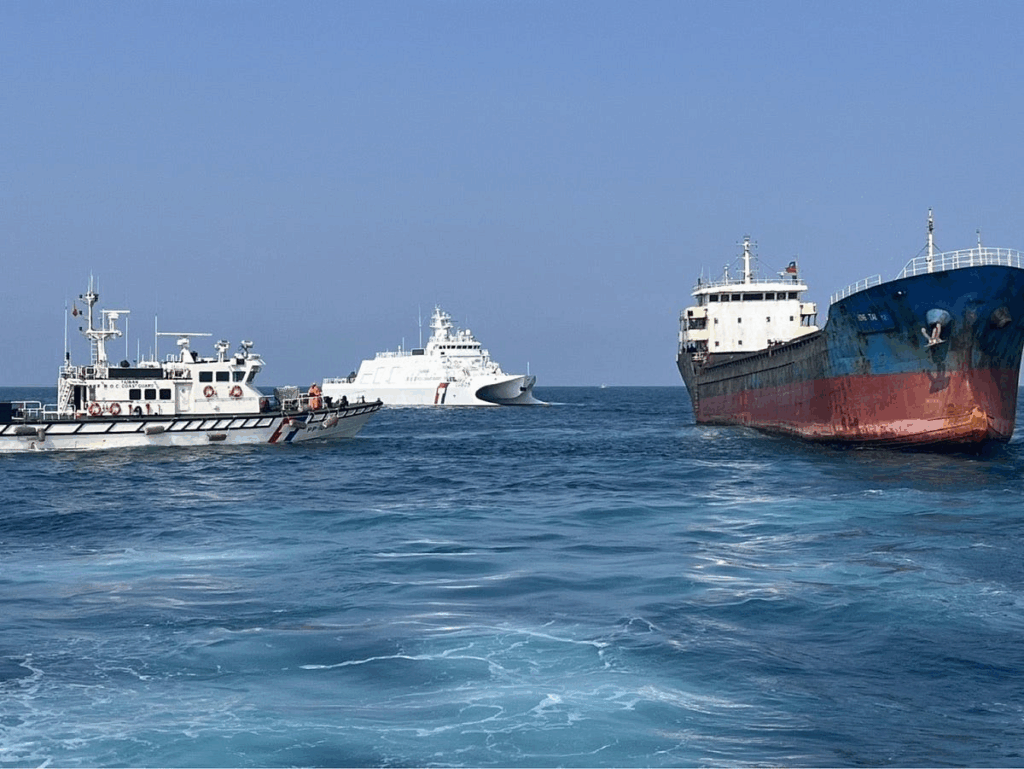
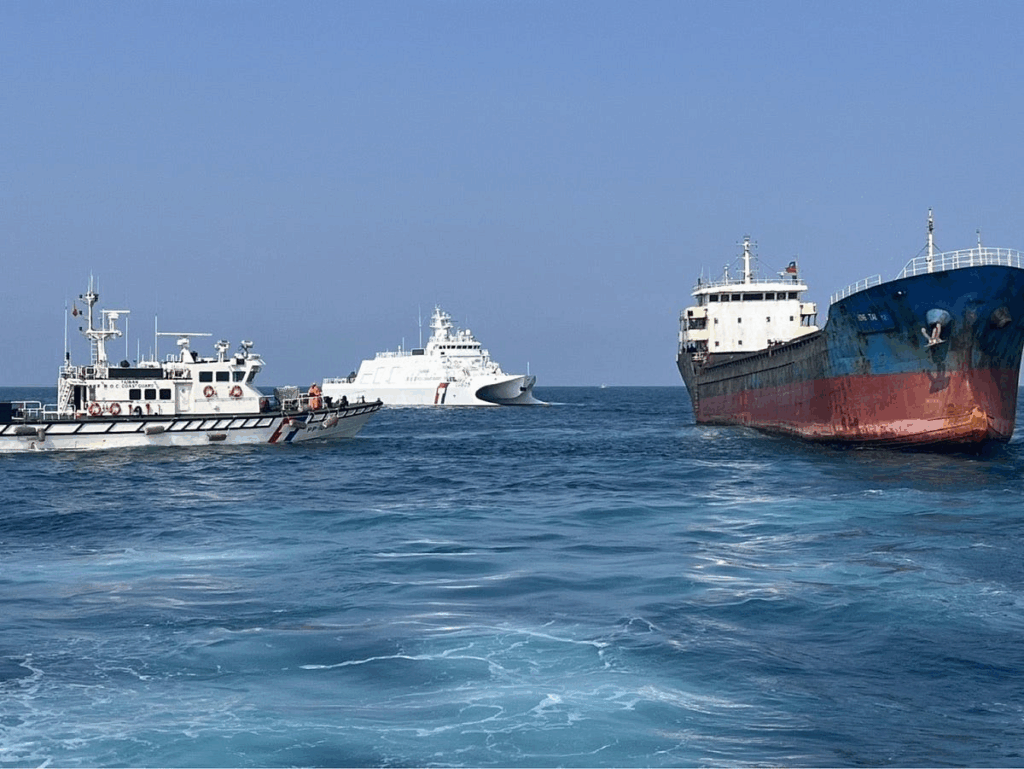
Photo of Hongtai58 released by the Taiwan Coast Guard

The conviction stemming from the severing of Taiwan’s TP3 undersea cable was not merely a local legal success but a demonstration that gray-zone coercion can be countered when ambiguity is met with evidence and enforcement. Gray-zone strategies rely on deniability, repetition, and administrative normalization—coast-guard pressure, maritime militias, cable interference, and disinformation meant to exhaust institutions and condition the public to view incursions as routine. If left unchallenged, these tactics gradually reshape realities on the ground, shift the burden of proof onto Taipei, and narrow its political and operational options.

The effective response lies less in escalating conventional military power than in sustained investment in attribution, law enforcement, and narrative control. Although most global undersea cable faults are accidental, that very background noise makes persistent surveillance, pattern analysis, and prosecutorial capacity essential. Patrol vessels, sensors, and legal authorities convert suspicion into proof and protests into penalties, raising the cost of coercion at a fraction of the price of advanced fighter aircraft or major combatants.

Partnerships and disciplined transparency further strengthen deterrence. Cooperation with allies, insurers, and port authorities can impose economic and legal consequences on China-linked “shadow fleets,” while selective, evidence-based disclosure undermines disinformation without fueling panic. The TP3 verdict signaled that Taiwan’s maritime domain is governed by rules and consequences; sustaining that message requires consistently funding the institutions that patrol, document, prosecute, and communicate. If Taipei seeks fewer gray-zone tests, it must resource the people and tools that confront them every day.

Read at Small Wars Journal.

How Japan Can Unlock US Munitions Bottlenecks for Taiwan

Author: Jonathan Walberg


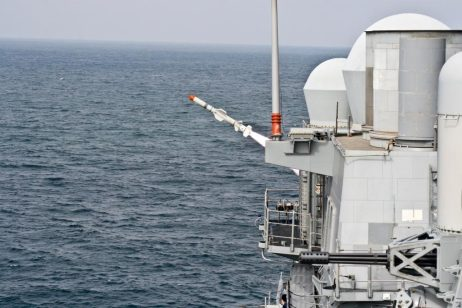
The guided missile cruiser USS Princeton (CG 59) launches an AGM-84 Harpoon Block II missile at the Naval Air Systems Command Sea Test Range off the coast of Southern California, Sept. 10, 2009. The Harpoon Block II is one of several arms systems sold but not yet delivered to Taiwan. Image Credit: U.S. Navy

U.S. arms deliveries to Taiwan are being slowed less by politics than by production and regulatory constraints. Bottlenecks in munitions and critical subcomponents (such as rocket motors, seekers, radomes, and launch hardware) are limiting output on U.S. production lines. Because those same lines support foreign military sales to multiple allies, delays to Taiwan also push deliveries for other partners further into the future.

Current export control rules, particularly the International Traffic in Arms Regulations (ITAR), restrict the ability of close allies to help relieve these industrial chokepoints, even when they have available capacity. The 2024 AUKUS ITAR framework with the United Kingdom and Australia shows that it is possible to reduce regulatory friction while maintaining strong security safeguards. A similarly narrow, mission-driven arrangement with Japan could allow co-production of low-sensitivity munitions subassemblies that are currently constraining U.S. output, without transferring sensitive technologies or design authority.

Read the full article here.

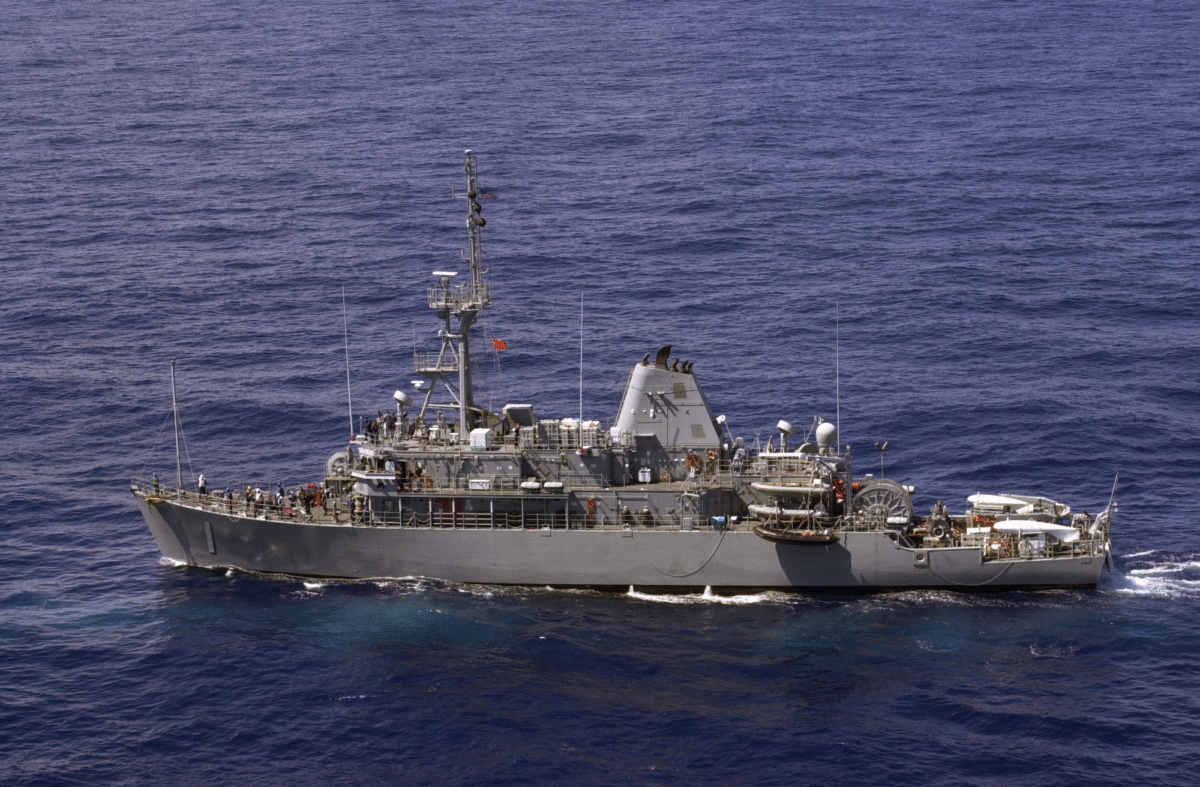
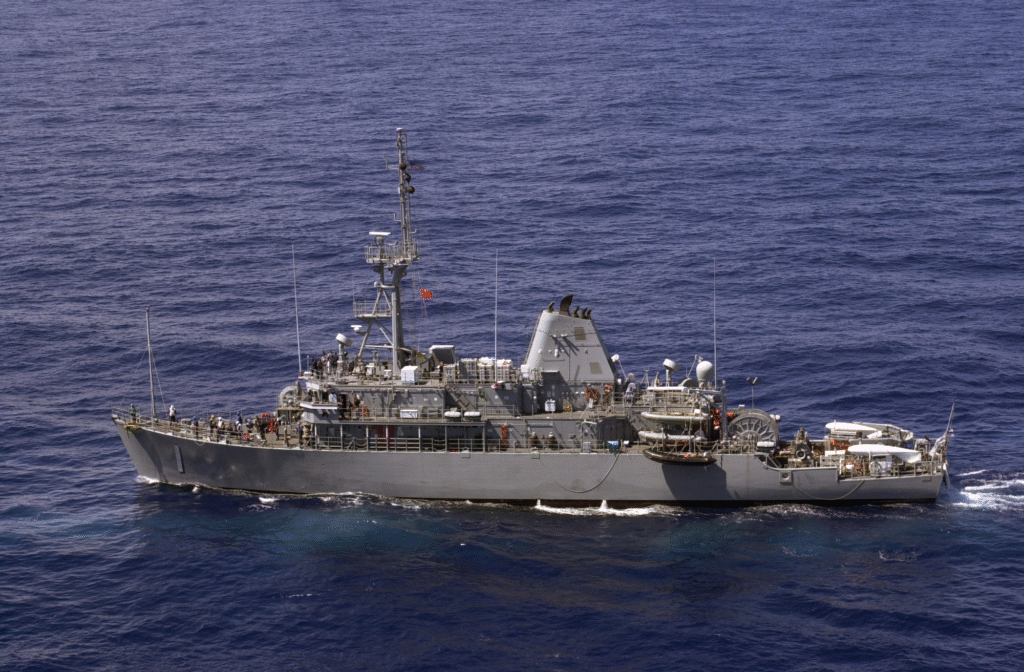
Don’t Sweep Minesweepers Under the Rug: America’s Critical Naval Vulnerability

Authors: Ethan Connell & Jonathan Walberg


TSM Research Team Lead Ethan Connell and Associate Director Jonathan Walberg write about the urgent threat facing the United States Navy. In it, they talk about the looming mine threat and the role of minesweeping capabilities in modern conflict. They note the exigency of this problem, and illustrate a path forward to addressing this issue. The Center for Maritime Strategy’s Maritime Operations Center. May 20th, 2025.

Read the full piece here.

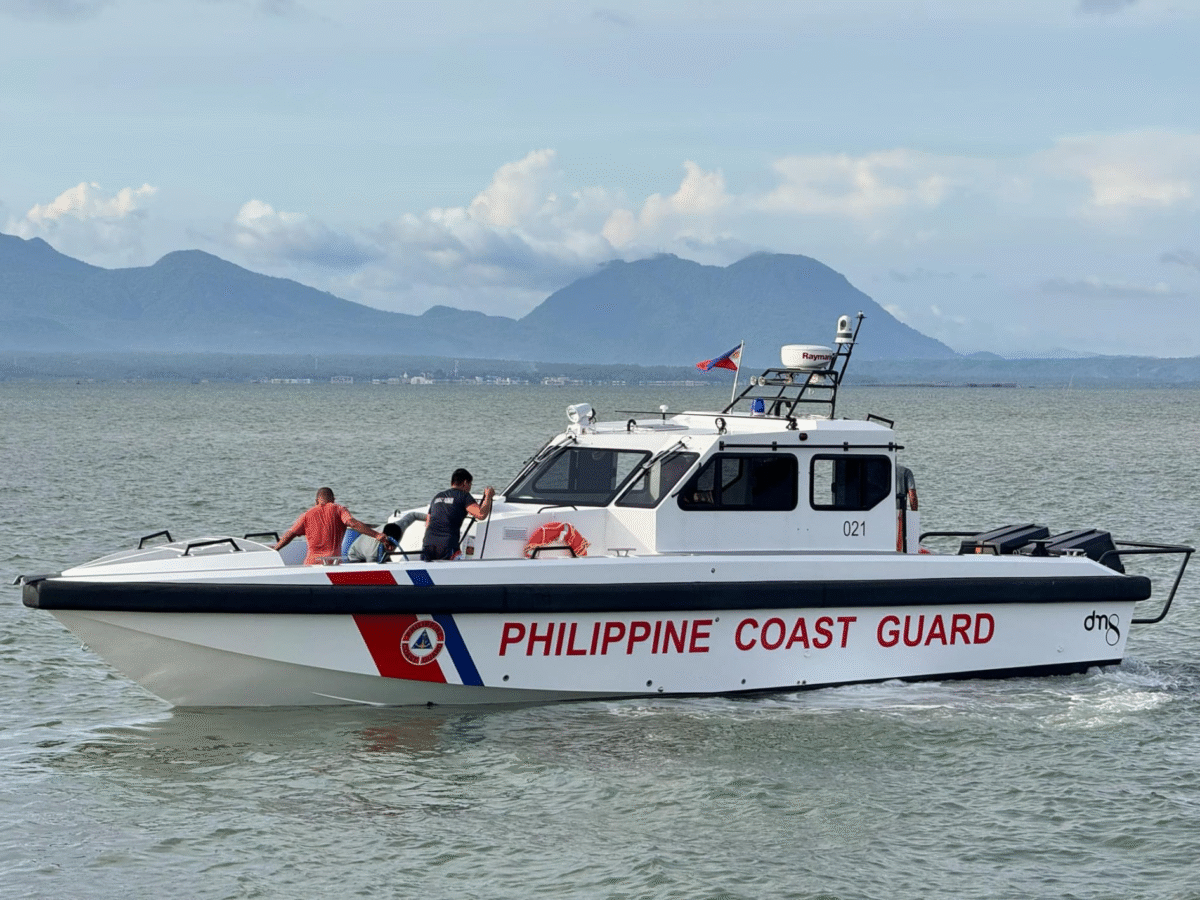
How the Philippines Can Counter China’s South China Sea Aggression

Authors: Jonathan Walberg & Ethan Connell


TSM Associate Director Jonathan Walberg and Research Team Lead Ethan Connell write about how the Philippines’ fragmented maritime response to China’s aggression in the South China Sea undermines its sovereignty while allowing Beijing to control the narrative and test U.S. resolve.

Read the full piece here.

Left on Read: America’s Taiwan Warning Crisis

Authors: Noah Reed & Jonathan Walberg


TSM Research Director Noah Reed and Associate Director Jonathan Walberg assess the risk of miscommunication between Taipei and Washington.

Overinflated: China’s Balloon Threats to Taiwan

Authors: Jonathan Walberg & Noah Reed


TSM Associate Director Jonathan Walberg and Research Director Noah Reed discuss the 2023-2024 balloon overflights of Taiwan.

Read the full piece here.