Special Budget Complications Continue
Authors: Joseph O’Connor, Eric Gomez, & Shikhar Chaturvedi
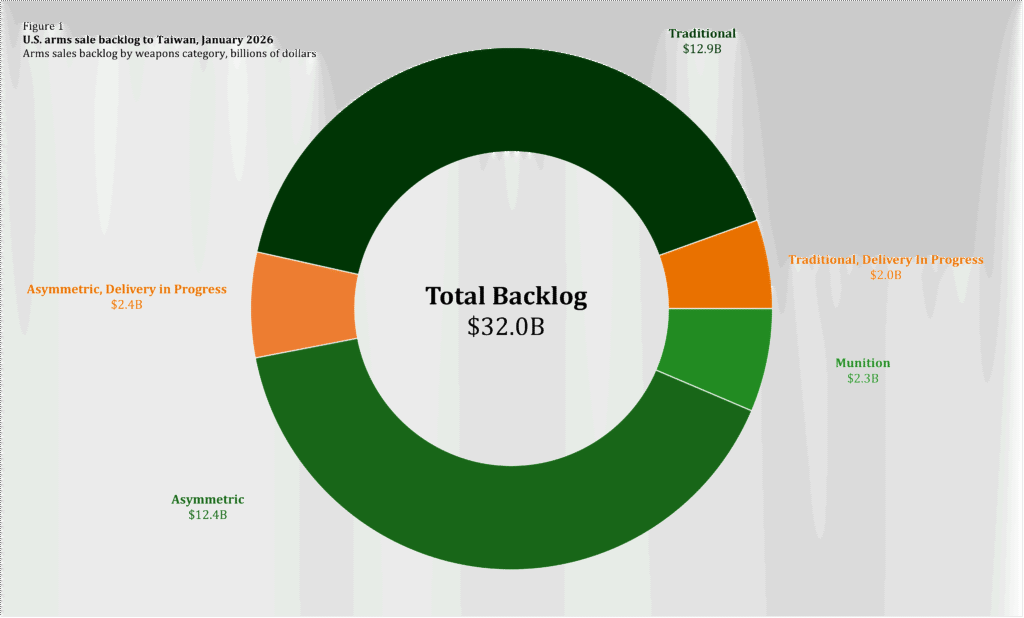
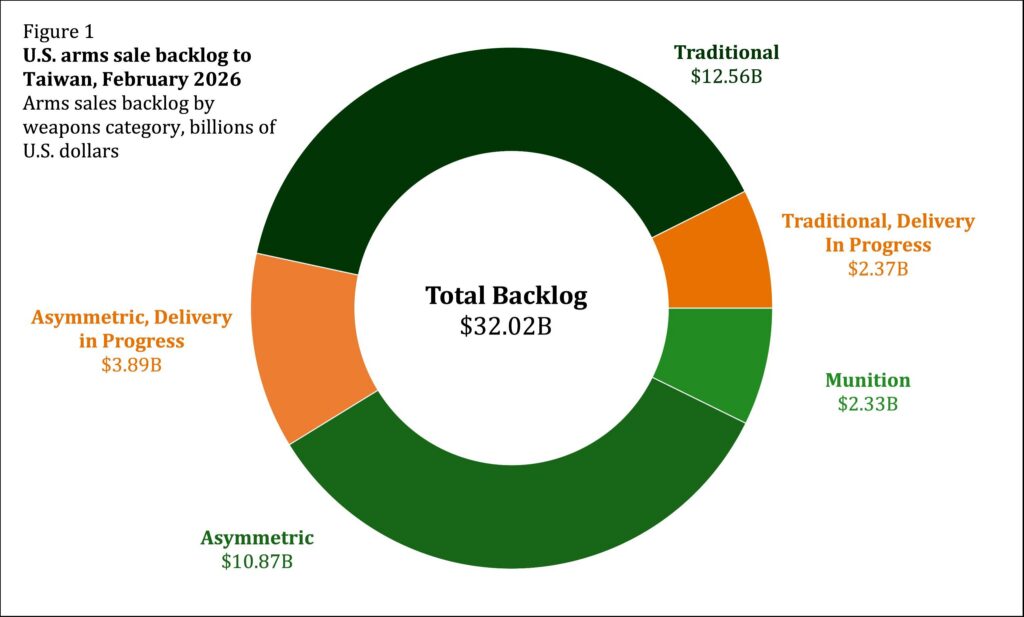
Political gridlock over the Lai administration’s special procurement budget continued in February 2026, leading to concerns about recently announced U.S. arms sales to Taiwan. No new Foreign Military Sales (FMS) cases were notified to Congress, and no existing sales were delivered in February. The total value of FMS cases notified to Congress but not delivered to Taiwan remains $32 billion.
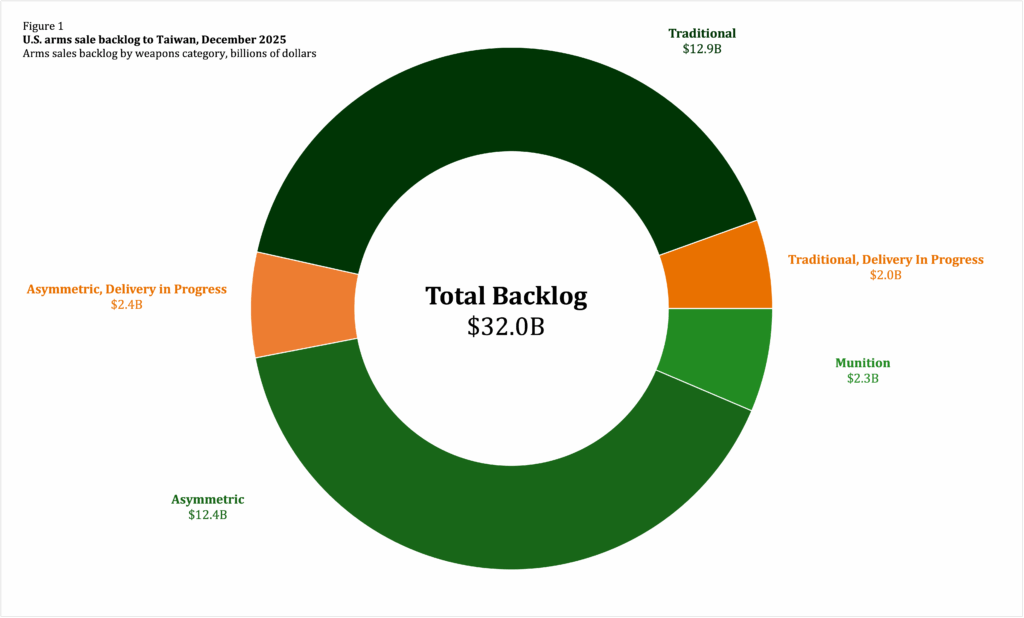
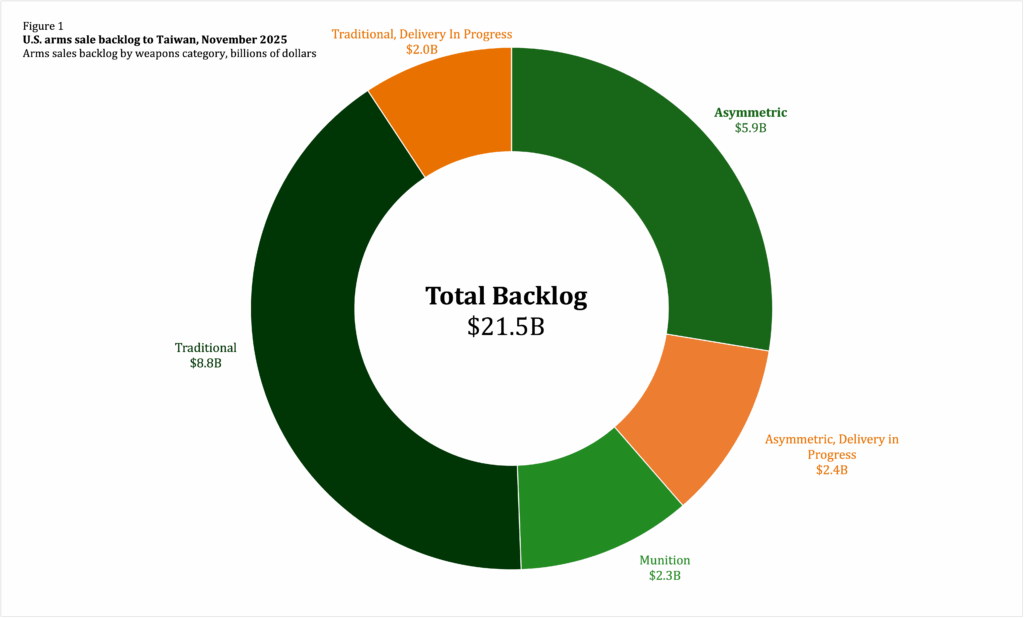
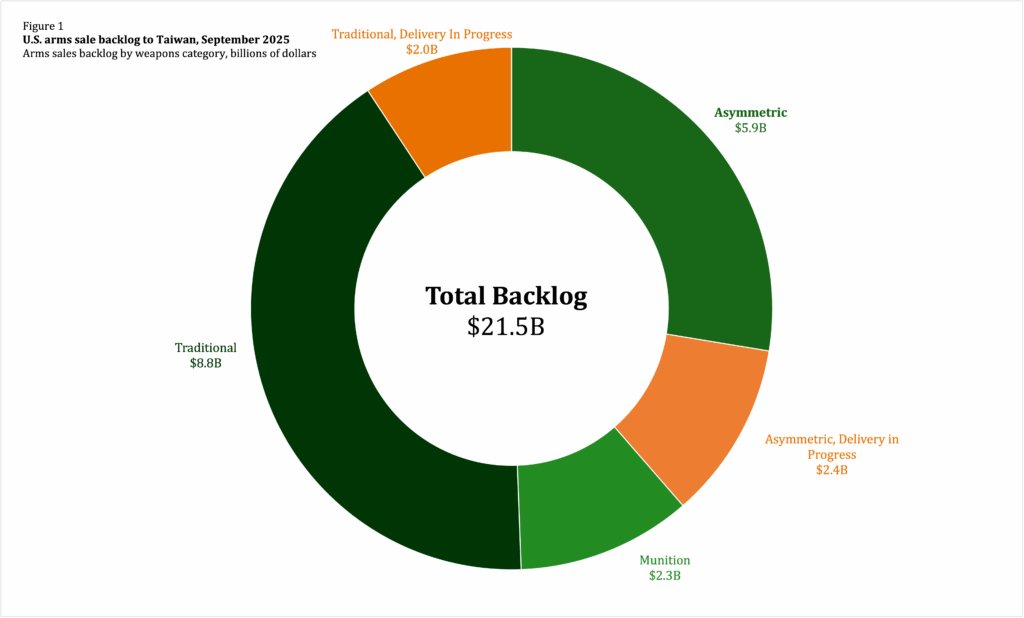
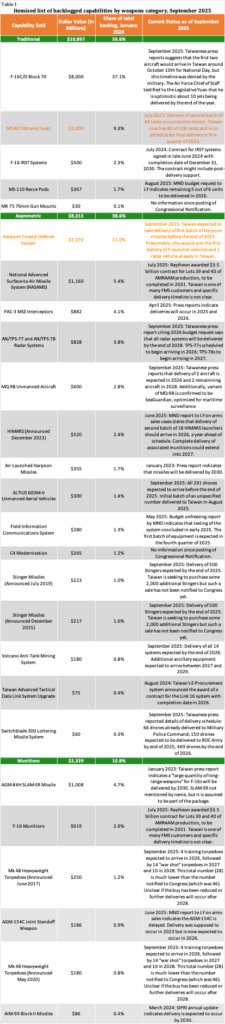
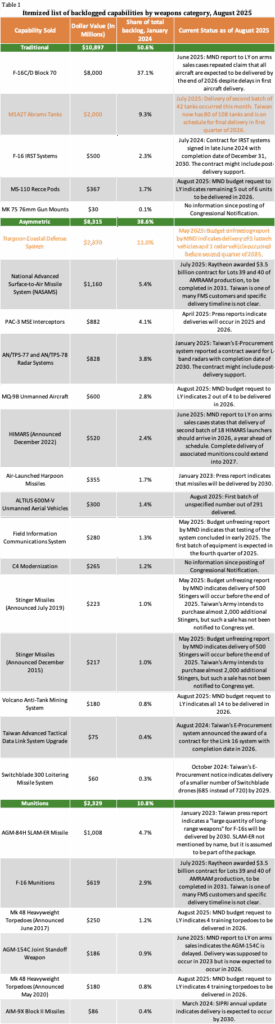
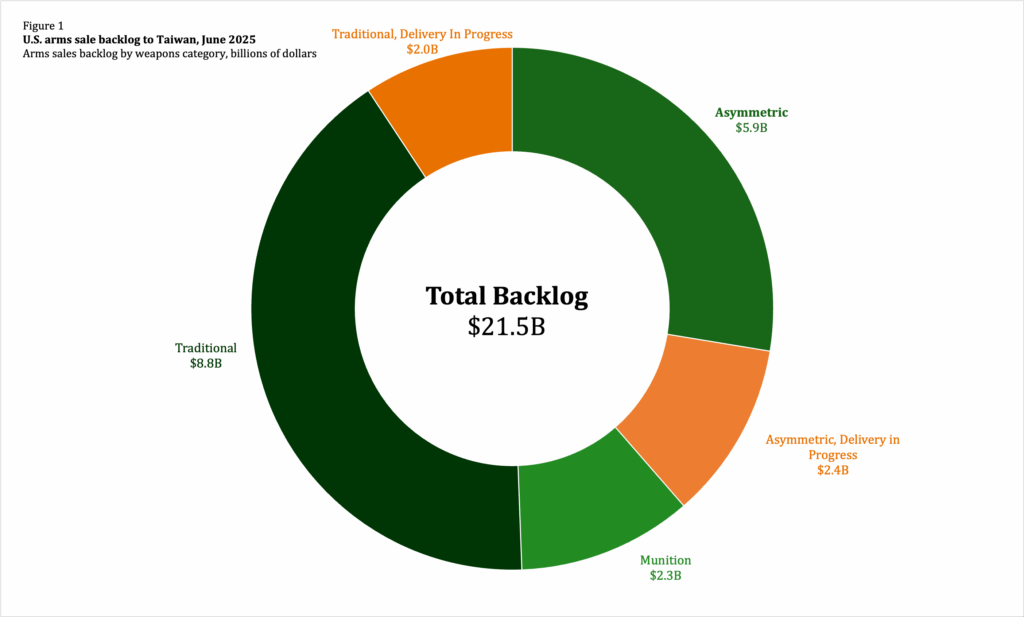
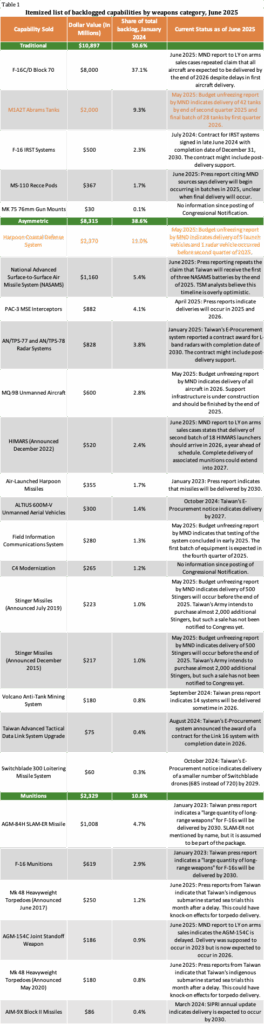
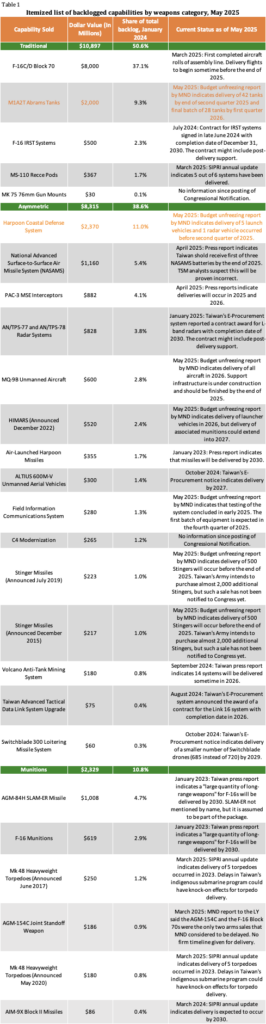
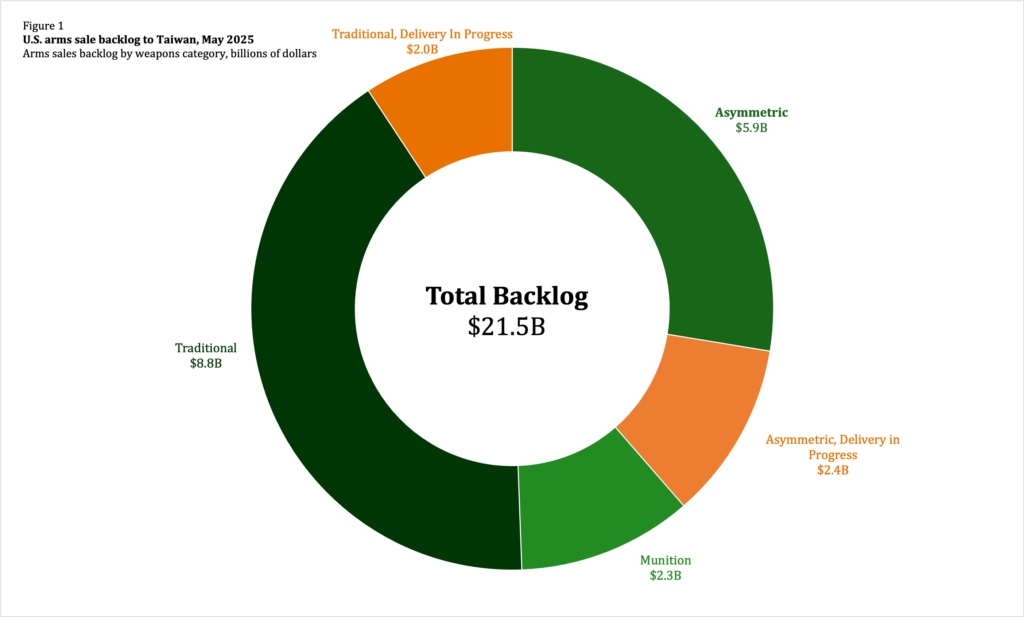
Eagle-eyed readers will notice that there is a change in Figure 1. Arms sales cases are fully removed from our dataset once final delivery occurs, but we do not reduce the dollar value of the backlog for partial deliveries. We have explained our thinking in other articles.
We indicate partially delivered arms sales through color coding in our data visualizations, with the yellow-orange color representing cases that are partially delivered to the best of our knowledge. Previously, we have only done this for arms sales valued at $1 billion or more because these were the most militarily significant sales and because, given the quantities and types of capabilities involved, they tended to be the easiest to track.
However, we realize that a $1 billion threshold has its own problems. We have therefore decided to adjust our methodology for data visualizations, and from now on, any arms sale that we can verify as partially delivered will be visually indicated with the yellow-orange color. The dollar value of the backlog will only be reduced when a sale is fully delivered, but we think this new approach represents a reasonable way to show in-progress deliveries.
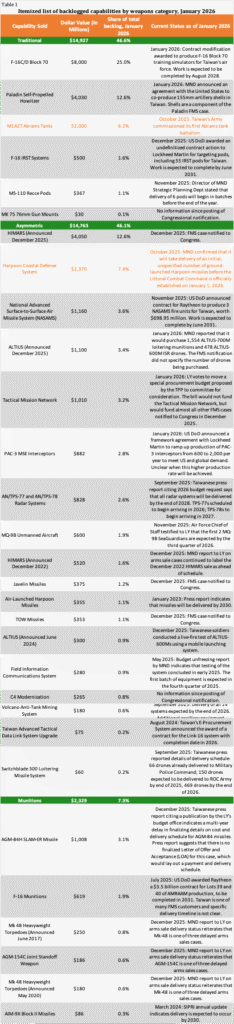
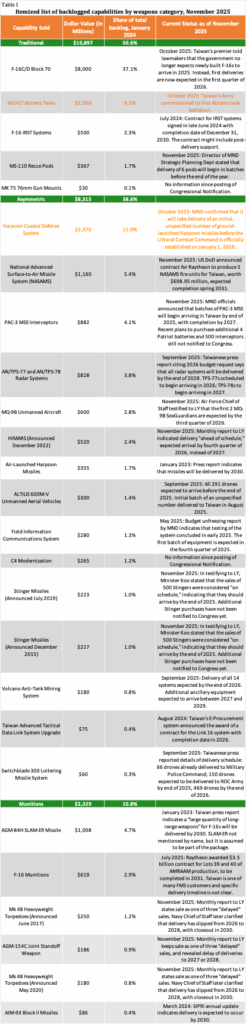
This methodology change moves five arms sales cases worth $1.89 billion into the partially delivered category. Combined with the two cases above, the $1 billion threshold that we were already tracking as partially delivered—M1A2T Abrams tanks and Harpoon Coastal Defense Cruise Missile systems—there are seven arms sales cases worth $6.26 billion that are partially delivered, just shy of 20 percent of the backlog’s total dollar value.
Special Budget Updates in February
Ongoing deliberations in the Legislative Yuan (LY) relating to a special defense budget slowed down in February, as the LY recessed for the Lunar New Year holiday. Prior to recess, the legislature voted to advance a proposal made by the opposition Taiwan People’s Party (TPP) to committee review, leaving the Lai administration’s NT$1.25 trillion (US$40 billion) proposal in limbo. During the recess, 37 U.S. senators and representatives, including senior members of the House and Senate foreign affairs committees and from both parties in Congress, sent a letter to LY Speaker Han Kuo-yu and party caucus leaders, expressing concern about “ongoing deliberations in the Legislative Yuan to only partially fund a supplemental budget request.” Han, responding on February 16, stated that the budget would be one of the “very first” items to be debated, and upon re-convening on February 24, the LY voted to advance the government’s proposal, ending the month with both proposals under review by the Foreign Affairs and National Defense Committee.
The differences between the competing proposals largely center on flexibility and holistic spending, as opposed to narrower and targeted procurements of established systems, as discussed in detail in our recent article comparing the two proposals. On the sidelines, the Kuomintang (KMT), the third and largest major party in the LY, announced in late February that they would be releasing their own special budget proposal, which they did in early March. As of the end of February, the proposal had ranged from NT$350 billion (US$11.19 billion) to NT$750 billion (US$23.97 billion) but turned out to be only NT$380 billion (US$12 billion) when announced on March 6.
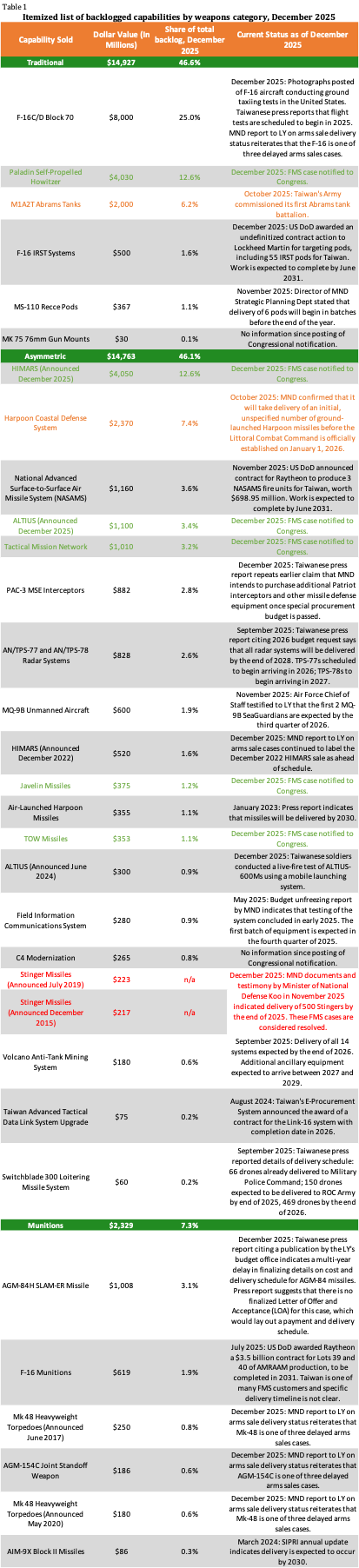
Taiwan’s MND, on February 6, sounded the alarm about three Letters of Offer and Acceptance (LOAs) that are set to expire on March 15. The LOAs, which are for the December sales of Paladin self-propelled howitzers, TOW-2B anti-armor missiles, and Javelin anti-armor missiles, were not signed because of ongoing battles in the LY. MND officials stated they were seeking extensions to the LOAs if a deal was not reached soon. Signing a LOA quickly is an important milestone in the FMS process. A LOA has a payment schedule, whereby Taiwan would pay the U.S. government in installments for the capabilities it is purchasing. The U.S. government negotiates a contract with the defense industry and pays for the capabilities using the funds that Taiwan transfers per the LOA. Importantly, until a LOA is signed and a first payment is made, the Department of Defense cannot enter a contract to produce the weapons. If a LOA is not signed before it expires, then certain steps in the FMS process must be repeated or renegotiated due to potential changes in pricing.

Updates to Abrams, PAC-3 Sales
On February 2, MND officials reported that the final batch of 28 M1A2T Abrams tanks will arrive in Taiwan by the end of March. Delivery of the total 108 tanks has been ongoing since December 2024, when the first batch of 38 arrived in Taiwan.
On February 11, MND officials confirmed to the press that they would be procuring 102 PAC-3 Missile Segment Enhancement (MSE) missiles for Patriot air defense systems, which would be paid via surplus funds from a prior Patriot procurement program. This is a positive development for the backlog, as the 102 PAC-3 MSEs are a 2022 modification to a 2010 Patriot case and can be funded through surplus from the earlier program. They are separate from and (additive to) the planned but not yet notified Patriot follow-on package (additional batteries and PAC-3 MSEs) expected to be financed through the Lai administration’s special defense budget.
Amidst these updates, reporting from the Financial Times, New York Times, and Taipei Times has revealed a future arms sale package to Taiwan, including PAC-3 MSE missiles, additional Patriot batteries, Integrated Battle Command Systems, and Lower Tier Air and Missile Defense Sensors radars, all designed to integrate into the Lai administration’s planned “T-Dome” air defense system. The timeline of this sale, however, is in flux owing to Trump’s summit with Xi in April.
Trump Administration Announces Arms Sale Reforms
On February 6, the Trump administration launched a new round of arms-transfer reforms through Executive Order 14383 and its accompanying White House fact sheet, establishing an “America First Arms Transfer Strategy.” The order reframes arms transfers as a mechanism for expanding U.S. production capacity, strengthening supply chains, and prioritizing partners that invest in their own defense. The point was reinforced on February 10, when the Pentagon announced the realignment of the Defense Security Cooperation Agency (DSCA) and the Defense Technology Security Administration (DTSA) under the Under Secretary for Acquisition and Sustainment, explicitly tying security cooperation and export administration more closely to defense-industrial management and execution.
At the same time, Taiwan’s arms sales became more visibly entangled with summit diplomacy. Following the February 4 Trump–Xi call, Beijing publicly urged Washington to handle Taiwan arms sales with “prudence” and again described Taiwan as the“most important issue” in U.S.–China relations. Trump then said he was “talking” with Xi about future arms sales to Taiwan and would decide “pretty soon,” before the White House promptly clarified that there had been no change in longstanding U.S. policy. Further reporting that a major new package could move only after a Trump trip to China further underscores that dynamic.
Conclusion
Taiwan’s arms sales backlog remained steady at $32.0 billion through the end of February 2026. However, recent developments highlight the role of political factors in the backlog rather than defense industrial capacity.
The Legislative Yuan has only just begun substantive review of competing special budget proposals, while the March 15 LOA expiration deadline is approaching for several cases notified in December. Meanwhile, Washington’s efforts to streamline arms transfers are occurring alongside high-level diplomacy, which may influence the timing of major new Taiwan FMS notifications to Congress.
March will be a critical month to determine whether Taipei can turn budget discussions into signed agreements and funding, and whether U.S. process improvements will result in faster execution or be offset by political considerations on both sides.