
Surge Before the Summit
Authors: Ethan Connell & TSM Staff
_____________________________________________________________________________________
KEY FINDINGS
- Taiwan’s Ministry of National Defense documented 255 PLA aerial sorties around the island in September 2026, with 181 entering the Air Defense Identification Zone. The total rose 47 percent from August’s 173, the largest month-on-month gain of the year, but sat 43 percent below September 2025’s 444. The nine-month sequence: 270, 190, 173, 229, 274, 208, 260, 173, 255.
- The PLA conducted four joint combat readiness patrols on September 5 (21 aircraft, 13 ADIZ entries), September 9 (18 aircraft, 13 ADIZ entries), September 17 (28 aircraft, 24 ADIZ entries, with H-6K bombers), and September 30 (23 aircraft, 16 ADIZ entries), the eve of PRC National Day. The September 15–18 run produced 82 sorties, nearly a third of the month. Activity then fell to 15 sorties over September 24–28, the days around Xi Jinping’s state visit to Washington, before the fourth patrol closed the month.
- PLAN vessel detections averaged 7.1 per day and peaked at 13 on September 6, the day after the first patrol. Official and government-ship detections fell to 114 from August’s 160 but stayed well above the January–May range. New Zealand’s HMNZS Te Mana and HMNZS Aotearoa transited the Taiwan Strait on September 18, the first allied warship transit since June 5.
- The Coast Guard Administration documented seven PRC government-vessel incursions in September: four into Kinmen restricted waters in four days (two on September 8, then September 10 and 11) by the same four-ship formation, one at Dongsha (September 7), and two east-of-Taiwan position reports (September 3 and 29). The Zhujiajian formation replaced the Putuoshan formation east of Taiwan, the fourth rotation since June. Cumulative 2026 incursions reached 54.
Air Activity: The Rebound
Taiwan’s MND detected 255 PLA sorties in September, up 82 from August’s 173. That was the largest single-month gain of 2026 and lifted September to the fourth-busiest month of the year, behind May (274), January (270), and July (260). The year-on-year gap held: September 2025 recorded 444 sorties and September 2024 recorded 447, putting this September 43 percent below both.
The first two weeks of the month carried two patrols, 21 aircraft on September 5 and 18 on September 9, around otherwise light days. The second phase of the month contained a sustained push: 82 sorties over September 15–18, peaking at 28 on September 17, when MND reported J-11, J-16, JH-7, H-6K, KJ-500, and Y-8EW aircraft operating with PLAN vessels under the patrol label. Median-line crossings were recorded on ten consecutive days, September 14 through 23. The third phase was relatively quiet: from September 24 through 28, the daily count never exceeded five, for 15 sorties in total. September 30 then produced 23 aircraft, 16 of them across the median line, in a fourth patrol that MND announced at 14:10 and dated from 09:12, when J-10, J-11, J-16, JH-7, Su-30, KJ-500, and Y-8 aircraft and drones went out to sea with PLAN vessels.
Seventy-one percent of sorties entered the ADIZ (181 of 255), in line with August’s 72 percent. Median-line crossings totaled 145, 57 percent of sorties, on 16 of the month’s 30 days. Only two days, September 2 and 3, registered no aircraft, against seven in August.
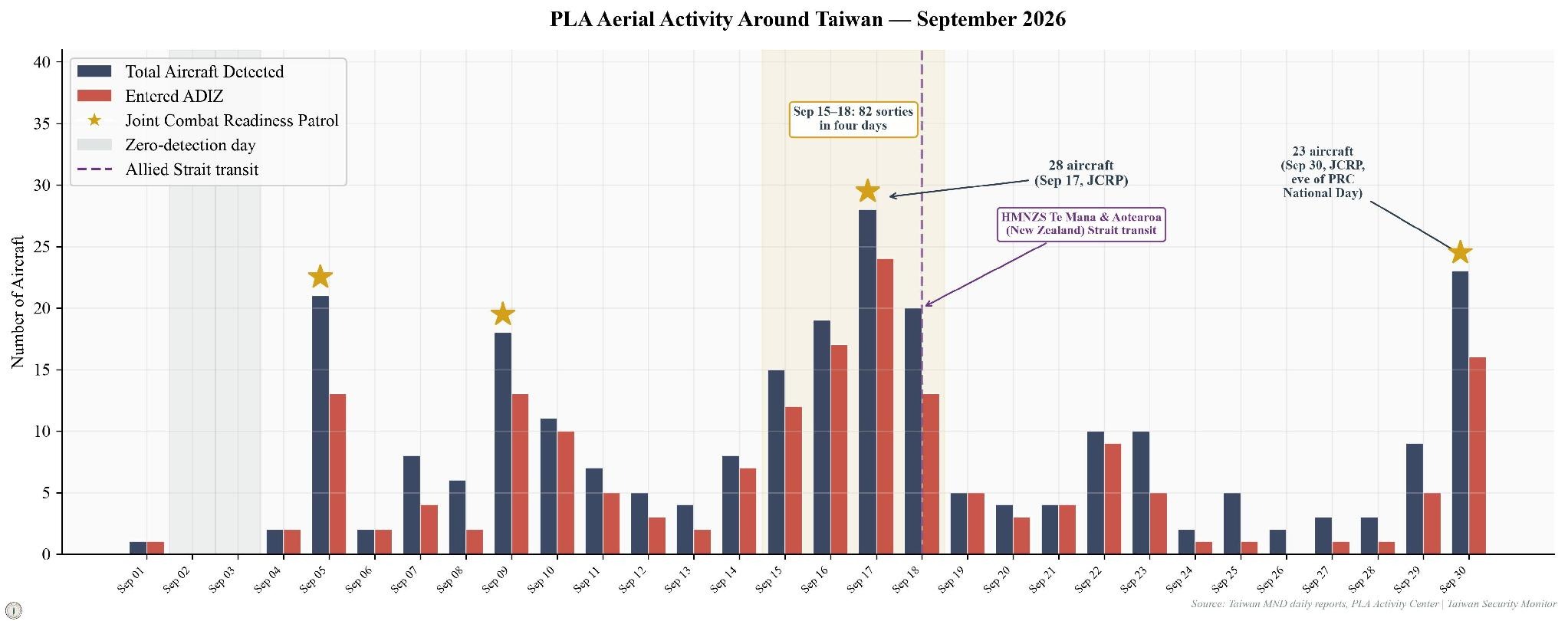
Figure 1. Daily PLA aerial activity around Taiwan, September 2026. Gold stars mark joint combat readiness patrols on September 5, 9, 17, and 30; the shaded band marks the September 15–18 surge; the dashed purple line marks the September 18 New Zealand Strait transit; gray columns denote zero-detection days.
Surge, Then Summit
The surge and the lull bracketed a dense political calendar. Taiwan held joint live-fire precision-strike exercises from September 16 to 18, and President Lai Ching-te inspected the tri-service missile firing in Pingtung on September 18. New Zealand’s two-ship transit came on September 18, the last day of the surge. Beijing formally announced Xi’s state visit on September 21, and Xi was in Washington from September 23 to 25. In the September 24 talks, he urged the United States to handle the Taiwan question with prudence. No new U.S. arms sales to Taiwan were notified during the month.
The air picture tracked that sequence closely. The heaviest four days of the month came in the week before the visit was announced. The five days from September 24 to 28, during and just after it, produced 15 sorties. The pattern fits a PLA that applies pressure ahead of high-level diplomacy and stands down while it is underway. Neither the PRC Ministry of National Defense, the Eastern Theater Command, nor the Taiwan Affairs Office commented on the September patrols, so the timing is the only evidence for intent. The fourth patrol, on September 30, the eve of National Day, showed the lull was a pause, not a new floor.
Monthly Trajectory: The Sawtooth Returns
August looked like a break in the 2026 pattern: the count fell to 173 with no rebound in sight. September restored the sawtooth. The sequence now reads 270, 190, 173, 229, 274, 208, 260, 173, 255, and each trough this year (March, June, August) has been followed by a rebound the next month. The four September patrols averaged 22 aircraft, up from 17 in August but below the 26-to-32 range of the first seven months.
The comparison with prior years has not moved. September 2024 (447) and September 2025 (444) were nearly identical. September 2026 recovered to 255 and remains more than 40 percent below both. Median-line crossings show the same gap: 145 this September against 307 in 2025 and 320 in 2024.
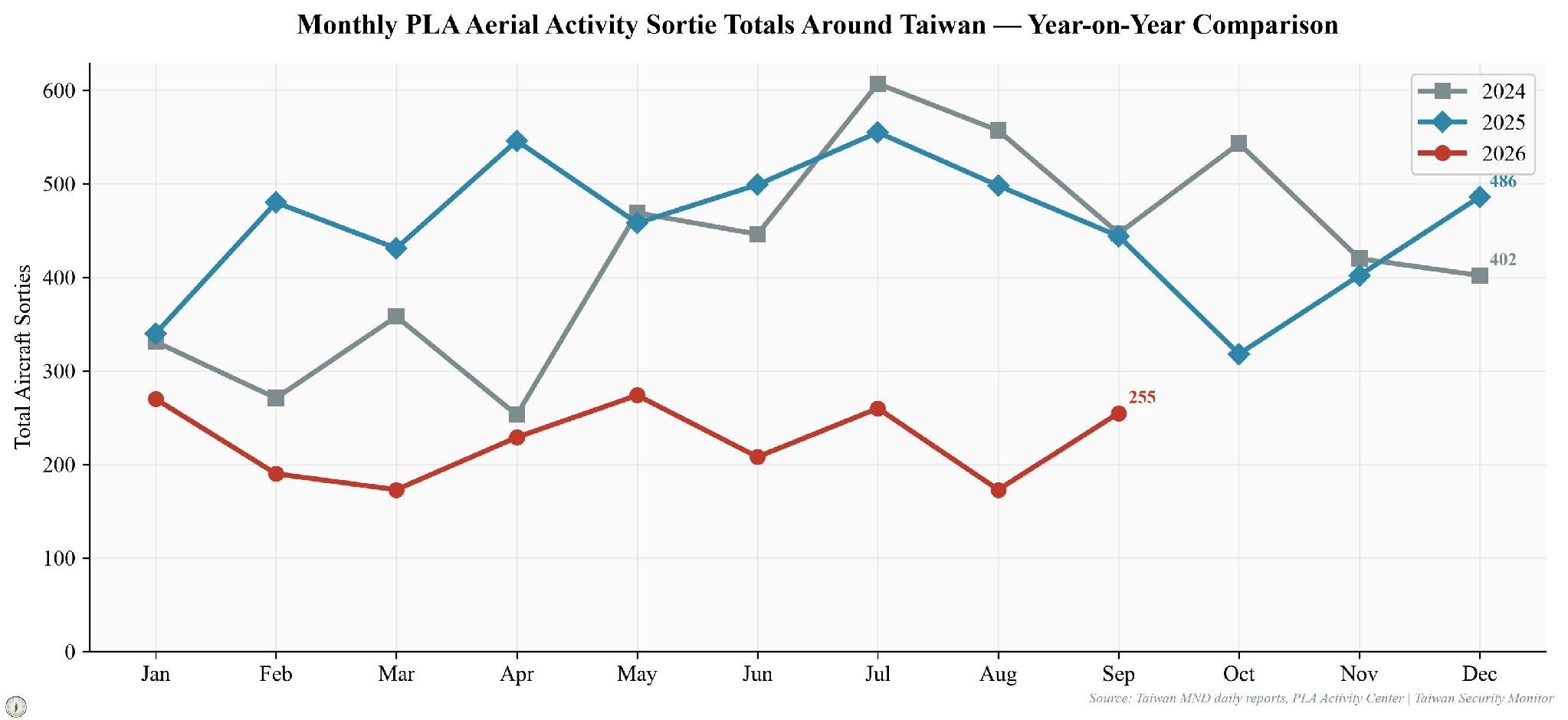
Figure 2. Monthly PLA aerial activity sortie totals, 2024–2026. September 2026 rebounds from August’s low and restores the year’s sawtooth pattern, while remaining well below 2024 and 2025.
At Sea: Baseline Steady, Allied Hulls Return
PLAN detections averaged 7.1 vessels per day, inside the five-to-nine band that has defined the 2025–2026 baseline. The two peaks followed air activity: 13 vessels on September 6, the day after the first patrol, and 11 on September 18 and 19, at the end of the surge. The naval presence again moved less than the air, rising briefly around patrols and settling back to five or six vessels within days.
Official and government-ship detections totaled 114, down from August’s 160 and in line with June (110) and July (116). The monthly totals for January through May never exceeded 46. Daily counts sat at two from September 10 to 17, then ran between three and seven over the last ten days of the month.
On September 18, the New Zealand frigate HMNZS Te Mana and replenishment oiler HMNZS Aotearoa transited the Taiwan Strait during a three-month Indo-Pacific deployment, en route to an exercise with the Philippines. It was the sixth allied warship transit of 2026 and the first since the Netherlands frigate HNLMS De Ruyter on June 5. The PLA’s Eastern Theater Command issued no statement; PRC defense ministry spokesperson Jiang Bin said on September 24 that naval and air forces had tracked and monitored the ships.
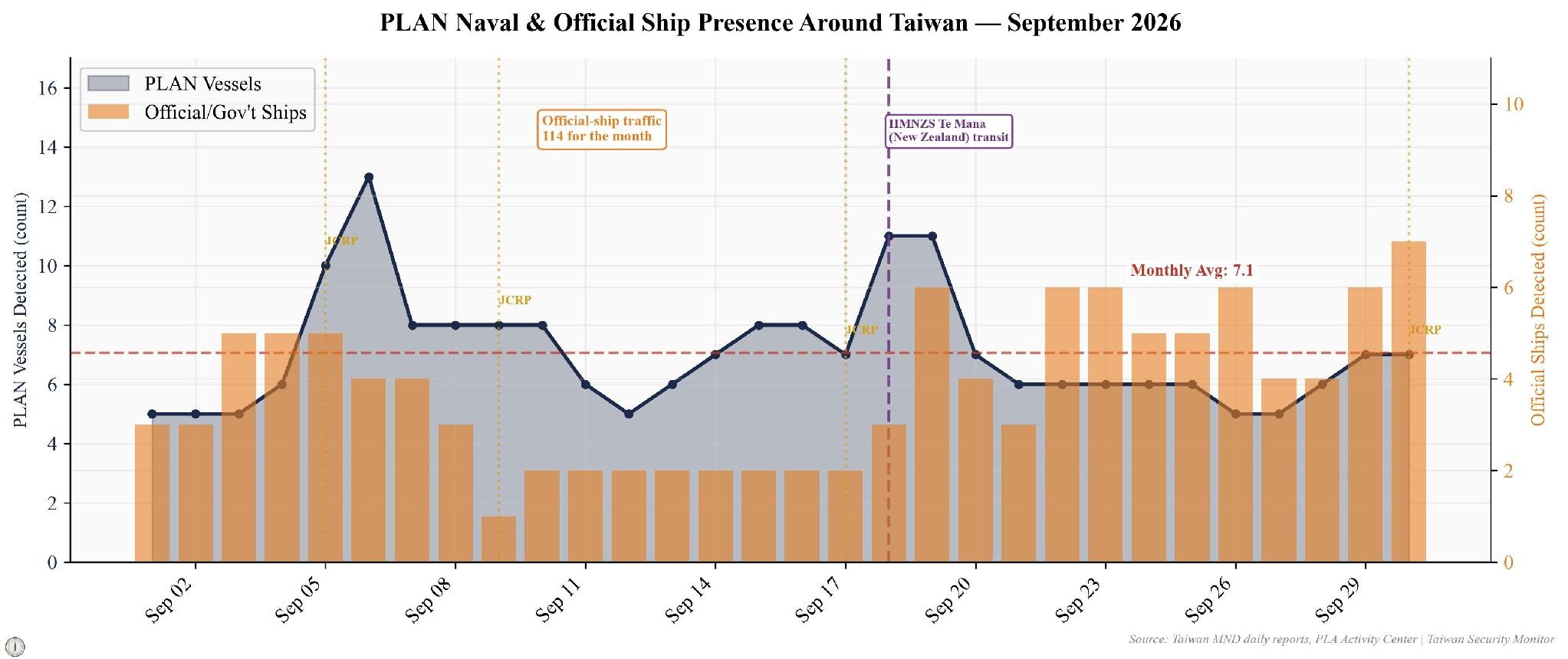
Figure 3. PLAN vessel and official-ship detections around Taiwan, September 2026. Dotted gold lines mark joint combat readiness patrols; the dashed purple line marks the September 18 New Zealand transit.
Coast Guard Gray Zone Operations
The Coast Guard Administration documented seven PRC government-vessel incursions in September, concentrated in one week. The same four-ship formation, hulls 14527, 14531, 14604, and 14608, entered Kinmen restricted waters four times between September 8 and 11: southwest of Damaoshan on the morning of September 8 (09:00 to 11:09), again that afternoon in a split east-west approach (about 15:00 to 17:03), and south of Kinmen on September 10 and 11, each time massing from 09:00 and gone by 11:13. The September 10 incursion included Mid-Autumn Festival broadcasts. Two incursions in one day, and four in four days, is the densest set of Kinmen activity in the tracker this year.
At Dongsha, CCG 3501 entered restricted waters southwest of the island at 08:00 on September 7, radioed that the area was “China’s Taiwan,” and was shadowed by the CGA cutter Yunlin. The CGA counted it as the twelfth CCG incursion at Dongsha in 2026.
East of Taiwan, the patrol line rotated again. On September 3, the CGA located CCG 1306 Putuoshan and 2502 Daishan about 105 and 74 nautical miles east of Green Island. By September 29, the station was held by 2503 Zhujiajian and 1401 Chongming, which the CCG said had been there since September. That is the fourth formation on the line since June (Daishan, Xiushan, Putuoshan, Zhujiajian). The same da,y the CCG’s East China Sea branch described its Kinmen operations as routine law-enforcement patrols; the CGA replied that it had recorded 35 CCG transits of Kinmen restricted waters so far in 2026. Cumulative incursions in the tracker reached 54.
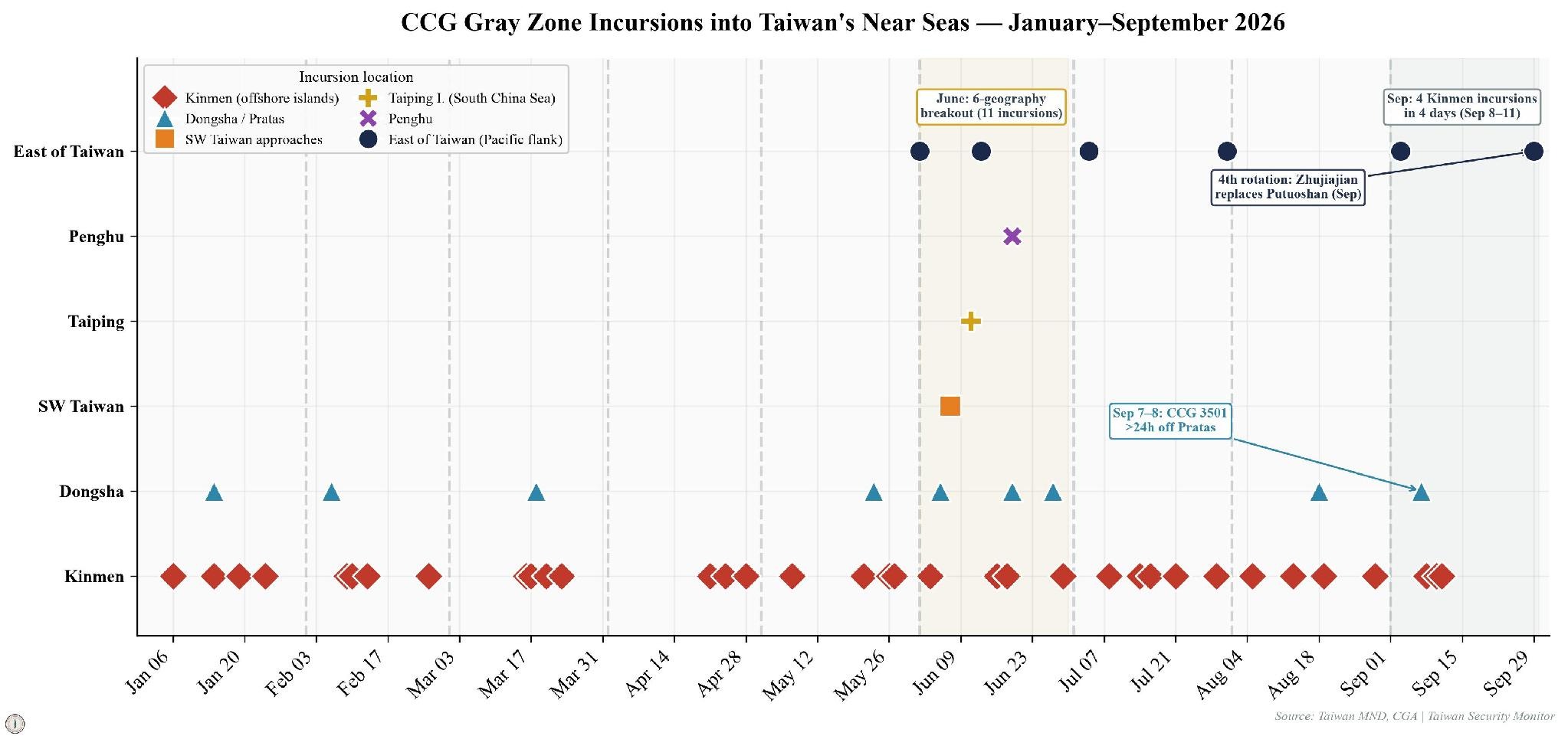
Figure 4. CCG incursions into Taiwan’s near seas, January–September 2026, by location. September brings four Kinmen incursions in four days and a fourth rotation of the east-of-Taiwan patrol.
The Full Picture: Multi-Domain Overview
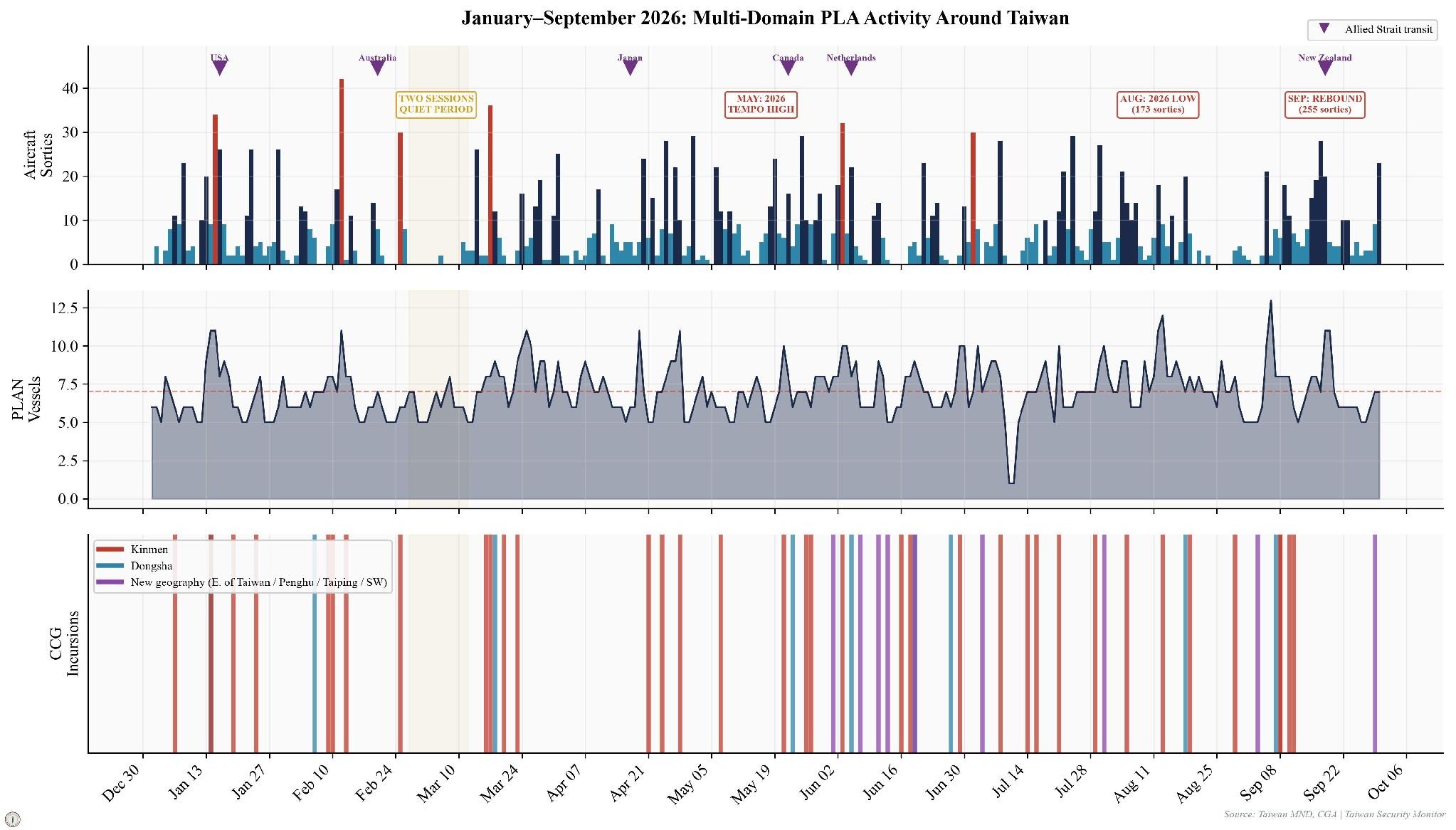
Figure 5. January–September 2026 multi-domain PLA activity: air sorties, naval presence, and CCG incursions. Inverted triangles atop the air panel mark allied warship transits of the Taiwan Strait (United States, January 16; Australia, February 20; Japan, April 17; Canada, May 22; Netherlands, June 5; New Zealand, September 18).
September reversed August’s split between the different activity domains. In August, air activity sank to the year’s floor while the maritime and constabulary presence held. In September, air activity rebounded, the CCG ran its most compressed Kinmen sequence of the year, and the east-of-Taiwan station rotated without a gap. Only official-ship traffic eased, and it still stayed far above the spring’s numbers.
The month’s shape matters more than its total. Pressure built through mid-September, eased during the Washington visit, and returned on the eve of National Day. Read that way, the PLA’s air tempo appears to be timed around diplomacy rather than reduced by it. Every month of 2026 has run below the same month of 2025, which marks this as a lower-volume year in the air, but not a quieter one at sea.
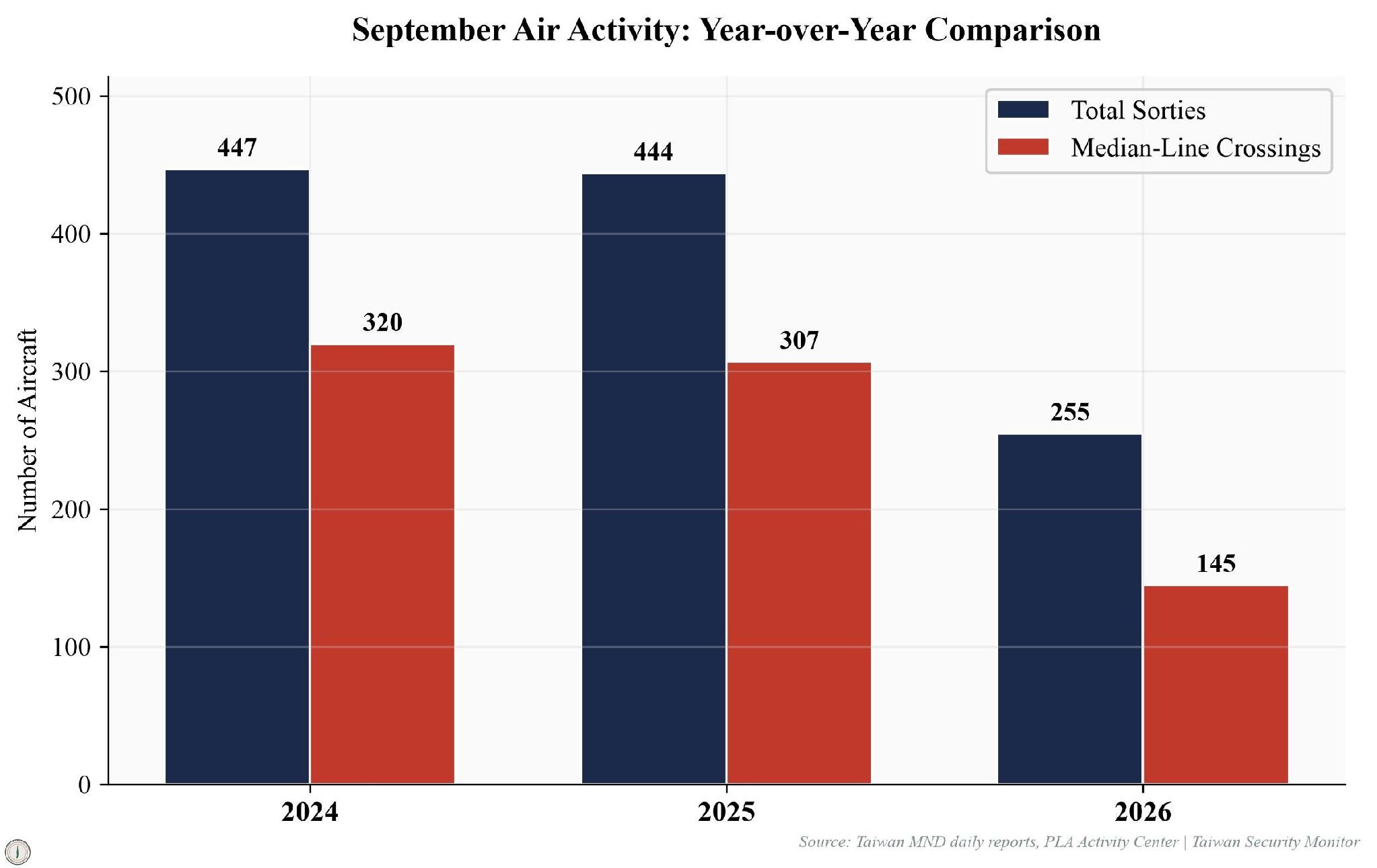
Figure 6. September air activity year-over-year: total sorties and median-line crossings, 2024–2026.
Methodology & Sources
Air and naval detection data are drawn from daily reports issued by Taiwan’s Ministry of National Defense. Each day in this report covers the MND reporting window from 06:00 that day to 06:00 the next (Taiwan time), so September figures come from reports posted September 2 through October 1. January–August figures are taken from the PLA Activity Center database maintained by the Taiwan Security Monitor; September figures are compiled directly from the MND reports. ADIZ entries are the aircraft MND reports as entering Taiwan’s ADIZ; median-line crossings are the subset MND reports as crossing the median line. Joint combat readiness patrols are those announced in MND press releases; patrol-day counts use the full daily window, so they can exceed the figure in the press release. Comparisons with 2024 and 2025 use the Taiwan Security Monitor’s comprehensive PLA activity tracker, with days missing from it filled from the historical PLAAF activity series; the September 2024 and 2025 figures cited in the text were re-derived day by day from MND’s archived reports. Coast Guard incident data are compiled from Coast Guard Administration press releases (cga.gov.tw) and verified against contemporaneous media reporting. Allied Taiwan Strait transit records are drawn from the Taiwan Strait Transit Tracker maintained by the Taiwan Security Monitor and contemporaneous reporting. “ADIZ” denotes Taiwan’s Air Defense Identification Zone; “median line” refers to the informal centerline of the Taiwan Strait historically observed by both sides; “JCRP” denotes Joint Combat Readiness Patrols as designated by Taiwan’s MND. All analysis and commentary are by the Taiwan Security Monitor.
© 2026 Taiwan Security Monitor. All rights reserved.